
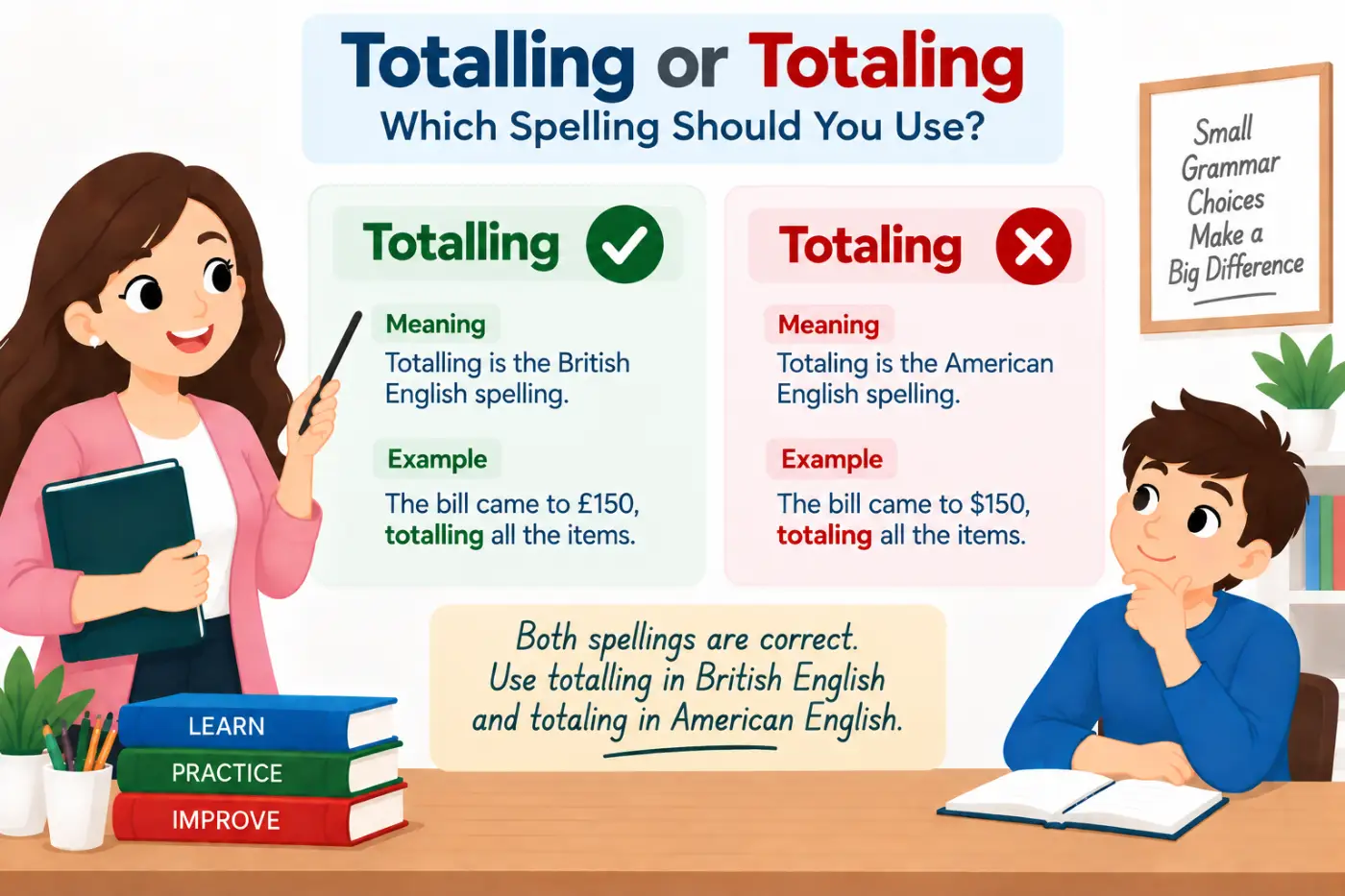
If you’ve written the word for adding amounts together and stopped to wonder about the spelling you’re not dealing with a simple right or wrong answer. Both totalling or totaling are accepted spellings. The main difference is regional. Totaling is the standard spelling in American English while totalling is the usual spelling in British English and several other varieties of English.
The confusion comes from a familiar spelling pattern. When a word ends in a single consonant and takes an ending that begins with a vowel the consonant may be doubled in some forms of English. American and British spelling conventions handle this pattern differently in words such as canceled and cancelled, traveled and travelled, and modeled and modelled. The same regional pattern explains the difference here.
This guide focuses on the choice that actually matters. You’ll learn what the word means, how it functions as a verb, why the spellings differ, which form works best for American readers, how other English varieties handle it, and how to use the word naturally in sentences. You’ll also see related forms and practical editing advice.
You may also want to read Distress Vs Duress Which Word Fits Your Sentence 2026.
Quick Definition
Both spellings are correct. Totaling is the preferred American English spelling, while totalling is preferred in British English and is also common in Australian and other varieties. Both forms mean adding amounts together to reach a total. The difference is mainly a matter of regional spelling convention rather than meaning or grammar.
Quick Answer
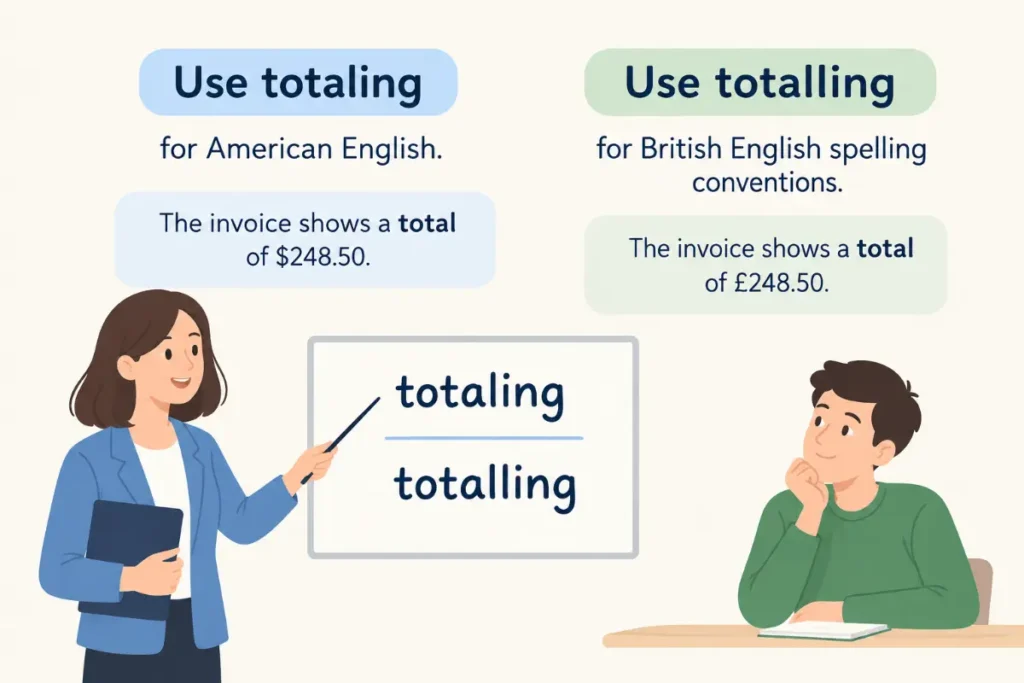
Use totaling for American English. Use totalling when following British English spelling conventions.
Neither spelling is inherently wrong. The two forms have the same meaning and grammatical function. Your choice should match the variety of English you’re writing for and the style used by your publication school workplace or audience.
Comparison Table
| Form | Meaning | Part of Speech | Origin | Usage Frequency | Formality | Common Contexts | Example |
|---|---|---|---|---|---|---|---|
| Totaling | Adding amounts to reach a total | Verb form | From total plus the ending ing | Very common in American English | Neutral | US business writing accounting reports everyday writing | The expenses are totaling $500. |
| Totalling | Adding amounts to reach a total | Verb form | From total plus the ending ing | Very common in British English | Neutral | UK business writing accounting reports everyday writing | The expenses are totalling £500. |
Meaning and Definition
Meaning of Totaling
Totaling means adding separate amounts or quantities together to produce a final total.
For example:
The three invoices are totaling $1,250.
The verb comes from total, which can function as both a noun and a verb. As a verb, total means to add amounts together or to reach a particular combined amount.
The form totaling is the American English spelling of the present participle and gerund.
You might see it in financial records, invoices, business reports, shopping calculations, school mathematics, budgets, and everyday conversation.
The word can also describe the combined amount itself in a sentence where the subject is the collection of items being added.
The donations are totaling more than $10,000.
Here totaling describes the process or current result of the amounts being combined.
Meaning of Totalling
Totalling has exactly the same basic meaning.
It means adding several amounts or quantities together to find their combined total.
For example:
The expenses are totalling £2,000.
The spelling with two l letters follows a common British English convention for words ending in a single consonant.
Totalling is standard in British English and can also be found in Australian English and other varieties that generally follow British spelling patterns.
So there is no difference in meaning between the two forms. If you change totaling to totalling the action remains the same. What changes is the spelling convention.
Why Both Forms Exist
The important point is that this is a regional spelling difference.
English has several pairs of words that follow the same pattern. American English often uses one consonant while British English frequently doubles the consonant before certain endings.
Consider these examples.
- Canceled and cancelled.
- Traveled and travelled.
- Labeled and labelled.
- Modeled and modelled.
- Signaled and signalled.
The same broad spelling difference appears with total.
American English generally writes totaling.
British English generally writes totalling.
This means you shouldn’t treat one form as a careless version of the other. Both belong to established English spelling systems.
Key Differences Explained
- Spelling. Totaling has one l after the a. Totalling has two l letters.
- Meaning. Both forms mean adding amounts or quantities together to produce a total.
- Grammar. Both are forms of the verb total. They can function as present participles or gerunds depending on the sentence.
- Pronunciation. The two spellings are pronounced the same in normal English.
- American usage. Totaling is the preferred form in American English.
- British usage. Totalling is the usual form in British English.
- Australian usage. Australian English commonly follows the doubled consonant pattern and uses totalling.
- Formality. Neither form is more formal. The choice depends mainly on regional spelling conventions.
- Context. Both forms work in financial writing, business communication, mathematics, journalism, everyday speech, and general writing.
- Standard usage. Both are standard forms. The best choice depends on the English variety you’re using.
The difference is therefore much smaller than it may first appear. Think of it as two roads leading to the same destination.
Which Form Is Correct?
Both forms are correct.
If you’re writing for a primarily American audience, choose totaling. If you’re writing in British English, choose totalling.
This distinction follows a broader difference in how American and British English handle consonant doubling when certain endings are added.
The base word is total. The final consonant is l. American English generally keeps one l when adding ing in this word. British English commonly doubles the l and produces totalling.
The same spelling principle appears in other common words. That makes the difference predictable rather than random.
A dictionary can tell you that both forms exist, but regional dictionaries and style guides help you decide which one fits your audience. For an American article, business document, school assignment, or website, totaling is normally the better choice.
For British writing, totalling is normally the natural choice.
The best editing rule is simple: match the spelling to your audience and stay consistent.
Sentence Examples
Here are natural examples using the American spelling.
- The five invoices are totaling nearly $8,000.
- The repair costs are totaling more than we expected.
- The company is totaling all expenses before preparing the report.
- The donations are totaling $12,500 so far.
- We spent the afternoon totaling the receipts.
- The accountant is totaling the figures for the monthly statement.
- The points from each round are totaling 250.
- The expenses were carefully reviewed before totaling the final amount.
- She spent several minutes totaling the numbers on the calculator.
- The project costs are totaling far more than the original estimate.
Now look at the same idea using British spelling.
- The five invoices are totalling nearly £8,000.
- The repair costs are totalling more than expected.
- The company is totalling all expenses before preparing the report.
- The donations are totalling £12,500 so far.
- We spent the afternoon totalling the receipts.
The meaning does not change. Only the spelling convention changes.
Common Mistakes and Spelling Confusion
Treating One Form as Incorrect
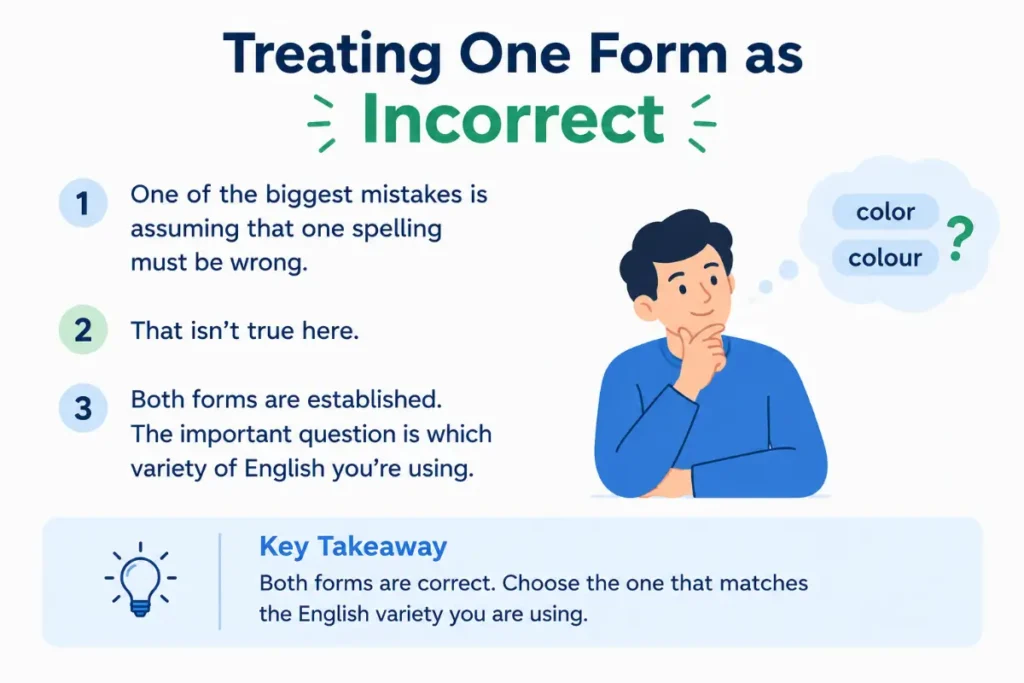
One of the biggest mistakes is assuming that one spelling must be wrong.
That isn’t true here.
Both forms are established. The important question is which variety of English you’re using.
If your document follows American English, totaling is the natural choice. If it follows British English, totalling is generally expected.
Mixing Regional Styles
A writer may use totaling in one paragraph and totalling in another.
That creates an inconsistent style.
The reader probably won’t misunderstand the meaning, but the inconsistency can make a document look poorly edited. Pick one regional convention and keep it throughout the document.
Confusing the Word With Total
Some writers hesitate because total can be used as both a noun and a verb.
As a noun:
The total is $400.
As a verb:
Please total the numbers.
The present participle then becomes totaling in American English or totalling in British English.
Assuming Every American Word Drops the Double Letter
American spelling often avoids consonant doubling in these forms, but the pattern isn’t a universal rule that applies mechanically to every English word.
English spelling has exceptions and historical patterns.
That’s why it’s better to learn common word families and established spellings instead of applying one rule to every word you encounter.
Relying Only on Spellcheck
Spellcheck can help but it may not know your intended regional style.
A program might accept both spellings because both are valid English forms. It can’t always determine from a single word that your entire document should follow American spelling.
Professional editing goes one step further. It considers the audience and checks consistency across the complete document.
Pronunciation Guide
The two forms are pronounced essentially the same.
A common pronunciation can be represented as:
/ˈtoʊtəlɪŋ/
A simple pronunciation guide is:
TOH tuh ling.
The strongest stress falls on the first syllable.
You can hear the word as three main sound parts.
TOH
tuh
ling
The extra l in the British spelling does not create an extra syllable or a separate sound.
This is a useful reminder that spelling and pronunciation don’t always match perfectly. Two words can have different written forms while sounding the same.
The most common pronunciation mistake comes from trying to make the spelling differences audible. You don’t need to pronounce the British form differently simply because it has two l letters.
The difference belongs to writing rather than ordinary speech.
Etymology and Word Origin
The word total has a long history connected with the idea of completeness and the whole amount.
It entered English through French from Latin totus, meaning whole or entire. The Latin root also appears in related words connected with completeness.
Over time total developed into an English word used as both a noun and an adjective. It later became established as a verb meaning to add amounts together or bring them to a complete sum.
The ending ing creates forms that can describe an ongoing action or can function as a gerund.
The spelling difference between totaling and totalling developed within the broader regional spelling traditions of English.
American English has generally favored a single consonant in this pattern. British English has more often retained consonant doubling in comparable forms.
The history is useful because it shows why the two spellings aren’t random mistakes. They reflect different conventions that developed within the same language.
You may also want to read Eccentric vs Eclectic Meaning and Usage (2026).
Regional Usage
American English
American English normally uses totaling with one l.
You’ll find this spelling in US newspapers, business documents, school materials, financial writing, government communication, websites, and everyday writing.
For example:
The expenses are totaling $7,500.
If your target audience is in the United States, totaling is the safest standard choice.
The same American pattern appears in several related words such as canceled, traveled, labeled, and modeled. This doesn’t mean every verb follows the exact same pattern, but it gives you a useful spelling family to recognize.
British English
British English generally uses totalling with two l letters.
For example:
The expenses are totalling £7,500.
The doubled consonant fits a wider British spelling pattern found in words such as cancelled, travelled, labelled, and modelled.
British publications, schools, workplaces, and formal documents generally favor this spelling.
Australian English
Australian English commonly follows British spelling conventions in this area. As a result, totalling is the expected form in standard Australian writing.
You may see the word in financial documents, workplace communication, journalism, education, and everyday writing.
The meaning remains identical to the American form.
Canadian English
Canadian English can show influence from both American and British spelling traditions. Usage may therefore vary depending on the publication, institution, or style being followed.
If you’re writing for a Canadian audience, consistency matters more than trying to force a single universal rule. Check the style guide used by your organization or publication when formal consistency is required.
Grammar Rules and Part of Speech
Totaling and totalling come from the verb total.
The base verb is simple:
Please total the amounts.
When you add the ing ending, you get the present participle or gerund form.
The exact grammatical role depends on how the word appears in the sentence.
Present Participle
A present participle can form part of a progressive verb construction.
The accountant is totaling the expenses.
Here totaling works with is to describe an action in progress.
In British English:
The accountant is totalling the expenses.
Gerund
The same form can act as a noun.
Totaling the receipts took an hour.
Here the phrase totaling the receipts functions as the subject of the sentence.
Again the British version would use totalling.
As Part of a Longer Verb Phrase
The form can also appear after verbs that naturally take an ing form.
We spent the afternoon totaling the receipts.
The action describes what the speakers spent their time doing.
Punctuation
There is no special punctuation rule attached to this word.
Use normal sentence punctuation.
For example:
After totaling the receipts, Maria prepared the report.
The comma belongs to the introductory phrase rather than to the spelling of the word itself.
Formal and Informal Usage
Both forms work in formal and informal writing.
You can use them in:
- Business reports.
- Financial documents.
- Academic writing.
- Emails.
- News articles.
- Everyday conversation.
- Personal notes.
The regional spelling choice stays the same regardless of formality.
How The Spelling Pattern Works
The difference becomes easier to understand when you look at the word family.
Start with:
Total
Then add:
ing
American English gives:
Totaling
British English gives:
Totalling
This pattern is part of a larger difference between major English varieties.
Consider the following pair:
American English uses canceled.
British English uses cancelled.
American English uses traveled.
British English uses travelled.
American English uses labeled.
British English uses labelled.
The same idea helps explain the spelling found here.
Still, don’t turn this into a rigid formula. English has many spelling patterns and exceptions. A reliable dictionary or the style guide for your audience remains the best final check.
Why American English Uses Totaling
American spelling has developed several conventions that favor a single consonant in words of this type.
The goal isn’t to make the word shorter for its own sake. The spelling reflects an established American convention.
This is why American readers are accustomed to forms such as canceled and traveled.
When they see totalling in an American document they’ll probably understand it immediately. It won’t usually cause confusion. It may simply look like British or Commonwealth spelling.
That distinction matters for polished writing.
If you’re creating content specifically for the United States, consistent American spelling makes the writing feel more natural to the intended audience.
Why British English Uses Totalling
British English commonly doubles the final consonant in comparable words before certain endings.
This produces forms such as totalling.
The doubled l is not a sign that the word has a different meaning. It reflects the spelling convention used by that variety of English.
British readers generally recognize the pattern immediately because they encounter it across many familiar verbs.
This is also why a British editor may change totaling to totalling during proofreading. The editor isn’t correcting the meaning. The editor is making the spelling consistent with the chosen English variety.
Real Life Usage Examples
Daily Conversation
In ordinary conversation people rarely hear the spelling difference because both forms are pronounced the same.
- I’m totaling everything before we leave.
- The bills are totaling more than I expected.
The spoken language doesn’t force you to choose between the two spellings. The choice appears when you write the word.
Email and Workplace Communication
Business writing often uses the word when discussing costs or figures.
- I’m totaling the receipts now and will send the final figure this afternoon.
- The current expenses are totaling about $6,000.
These examples fit naturally into professional communication.
Academic Writing
Academic work can use the verb when describing calculations or collected figures.
- The researcher began totaling the responses from each group.
- The combined scores were totaled before the final analysis.
In academic writing, clarity matters more than using a complicated synonym. Totaling is a direct and familiar choice for American readers.
News and Journalism
News reports may use the word when describing money, losses, damages, or collected amounts.
- The donations are totaling millions of dollars.
- The costs are totaling more than the original estimate.
Journalistic writing usually favors direct language. There’s no need to replace a familiar word with something unnecessarily elaborate.
Literature and Storytelling
Storytelling can use the word in scenes involving money, counting, or records.
- She sat at the kitchen table totaling the receipts from the trip.
- He spent the evening totaling the family expenses.
The word works naturally here because the action is concrete and easy to understand.
Related and Confused Terms
Total
Total can be a noun, adjective, or verb.
As a noun:
The total was $900.
As a verb:
Please total the figures.
The spelling under discussion is formed from this verb.
Sum
Sum refers to the result of adding numbers.
The sum of the two amounts is $100.
It can also refer more generally to an amount of money.
Add
It is the basic verb for combining numbers or quantities.
Add the three figures together.
It’s more general than total.
Calculate
It means to work out an answer using mathematical operations or reasoning.
Calculate the final cost.
You might calculate a total before recording it.
Count
It usually means determining how many items there are, although it can also refer to keeping track of something.
Count the receipts before filing them.
It doesn’t always involve adding monetary amounts.
Amount
Amount refers to a quantity, especially a quantity of something measured.
The total amount was higher than expected.
Amount and total often appear together in financial contexts.
Totaled
Totaled is the past form and past participle of total in both major spelling systems.
The American spelling is totaled.
The British spelling is totalled.
This is another useful example of the same regional pattern.
Totaling and Totalled
These forms belong to the same spelling family but represent different grammatical forms.
American English:
The company is totaling the costs.
The company totaled the costs.
British English:
The company is totalling the costs.
The company totalled the costs.
Once you see the pattern across the word family the difference becomes much easier to manage.
Expert Editor Insight
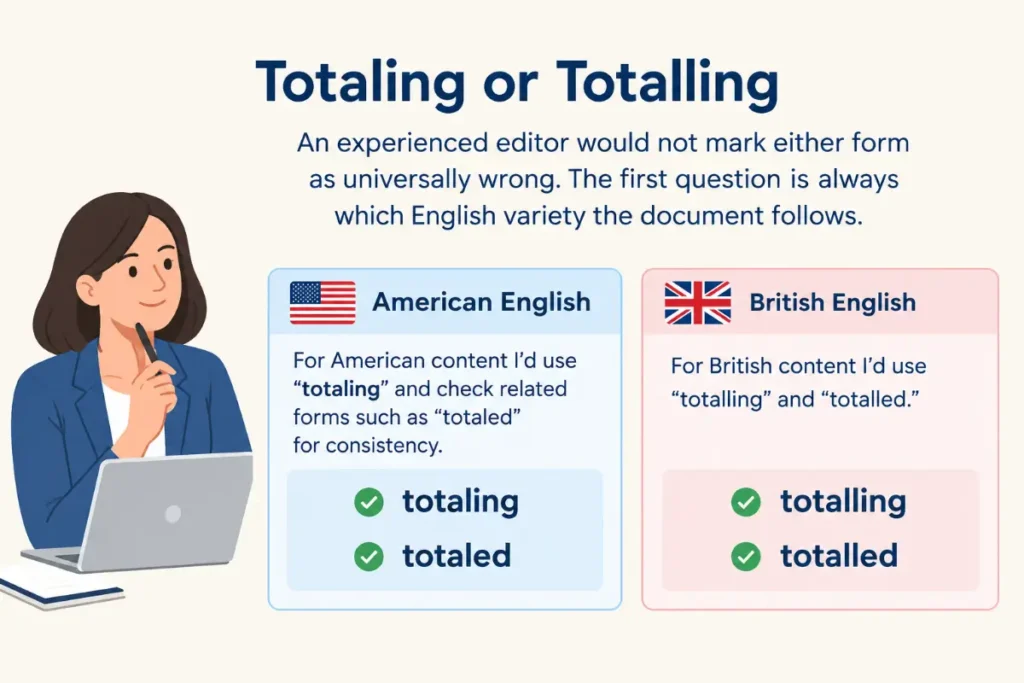
An experienced editor would not mark either form as universally wrong. The first question is always which English variety the document follows. For American content I’d use totaling and check related forms such as totaled for consistency. For British content I’d use totalling and totalled. Spelling software may accept both because both are legitimate forms, so a dictionary check alone may not settle the style question. The stronger editing habit is to establish the regional style before proofreading and then apply it consistently across the entire document.
Final Practical Rule
When you need to choose between these forms, start with your audience rather than the word itself.
For American English, write:
Totaling
For British English, write:
Totalling
For Australian English, totalling is commonly preferred.
For Canadian English, usage can reflect both British and American influences, so follow the style guide used by your organization or publication.
The safest professional habit is consistency. Don’t switch between the two forms simply because both appear in dictionaries or online. Choose the spelling that matches your chosen English variety and keep the same convention throughout your document.
Many readers also check convertor vs converter Which Form Is Correct.
Conclusion
Totalling or totaling are both correct spellings, but the preferred choice depends on regional English. American English generally uses totaling, while British English and commonly Australian English use totalling. Neither form changes the meaning, pronunciation, or grammatical function of the word.
The word means adding amounts or quantities together to reach a total. You can use it naturally in business writing, financial documents, academic work, journalism, emails, and everyday communication. The main difference is the number of l letters in the spelling.
A simple editing tip can save you from second guessing yourself. Decide which English variety your audience expects before proofreading. Once you choose American or British spelling, apply that choice consistently throughout the document. That approach keeps your writing polished and natural.
FAQs
Is totaling or totalling correct?
Both spellings are correct. Totaling is the standard American English form while totalling is the usual British English form and is also common in Australian English. The two words have the same meaning and grammatical function. Your choice should depend on the English variety used by your audience, publication, school, company, or style guide.
Is totaling American English?
Yes. Totaling is the standard spelling commonly used in American English. It follows the American preference for a single l in this type of word formation. If you’re writing for readers in the United States, totaling is the natural choice. The British form totalling is still understandable to American readers but may look distinctly British or Commonwealth.
Is totalling British English?
Yes. Totalling is the usual British English spelling. British English commonly doubles the final consonant in comparable forms before certain endings. You’ll see the same broader pattern in words such as travelled, cancelled, labelled, and modelled. The meaning remains exactly the same as the American spelling with one l.
Do totaling and totalling mean the same thing?
Yes. There is no difference in basic meaning. Both forms mean adding separate amounts or quantities together to reach a total. The distinction is spelling rather than vocabulary or grammar. For example, an American writer may say the costs are totaling $5,000 while a British writer may say the costs are totalling £5,000.
How do you pronounce totaling and totalling?
The two spellings are normally pronounced the same. A common pronunciation is represented as /ˈtoʊtəlɪŋ/. You can think of it as TOH tuh ling. The extra l in the British spelling does not add another syllable or create a different pronunciation. The distinction exists in written English rather than normal spoken English.
Should I use totaling in American writing?
Yes. If your document follows American English, totaling is the preferred spelling. This applies to general writing as well as professional emails, reports, articles, academic work, and business documents. The British spelling is understandable in the United States, but using the American form keeps your spelling consistent with other US conventions.
Why does British English use two l letters?
British English commonly doubles the final consonant in certain words when adding endings such as ing. This produces forms such as totalling, travelling, and cancelling. American English often uses a single consonant in these forms. The difference developed as part of the separate spelling traditions of American and British English.
Is totaling appropriate in formal writing?
Yes. Totaling is completely suitable for formal American writing. You can use it in financial reports, business documents, academic papers, professional emails, and other serious contexts. It isn’t an informal word. The main consideration is regional style. If the document follows British English, use totalling instead to maintain a consistent spelling system