
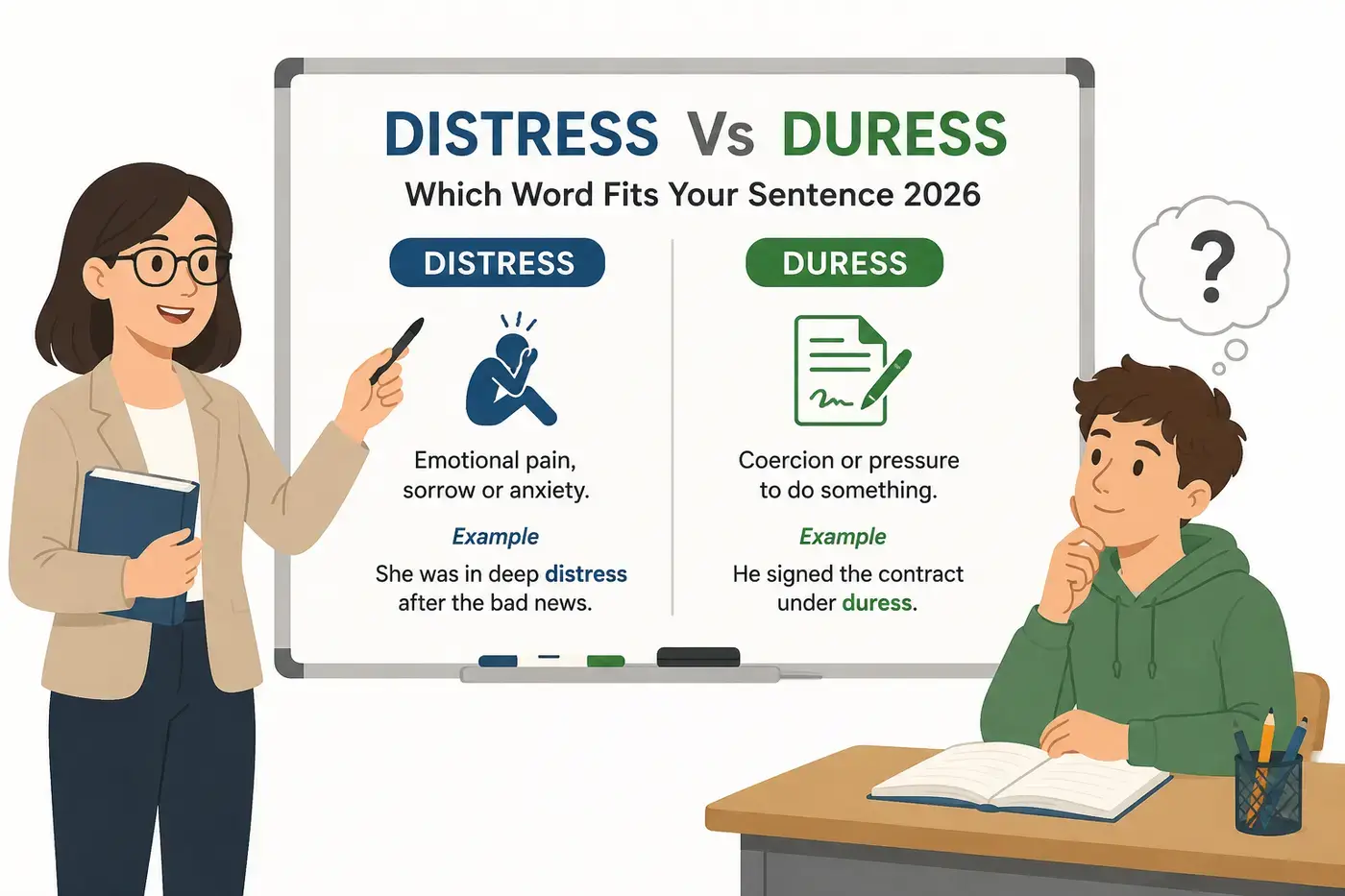
If you see distress vs duress and think they look similar enough to mean the same thing you’re not alone. These two words share a similar ending and both describe difficult situations. Still they belong in different parts of the English language and carry very different meanings.
People often confuse them in legal writing everyday conversations business communication and even academic papers. The mistake usually happens because both words involve hardship or pressure. The real difference comes from the type of pressure each word describes. Distress refers to suffering pain anxiety or extreme hardship. Duress refers to force threats or pressure that makes someone act against their own free will. One describes a condition. The other describes coercion.
By the end of this guide you’ll know what each word means how to pronounce it when to use it and how to avoid one of the most common vocabulary mix ups in English. You’ll also find practical examples grammar tips regional usage expert editing advice and answers to common questions people search for online.
Many readers also check onsite vs on-site: Correct Usage Explained.
Quick Definition
Distress means emotional physical or financial suffering. Duress means someone is forced or threatened into doing something against their will. The words aren’t interchangeable because they describe different situations. Use distress for hardship and duress for coercion.
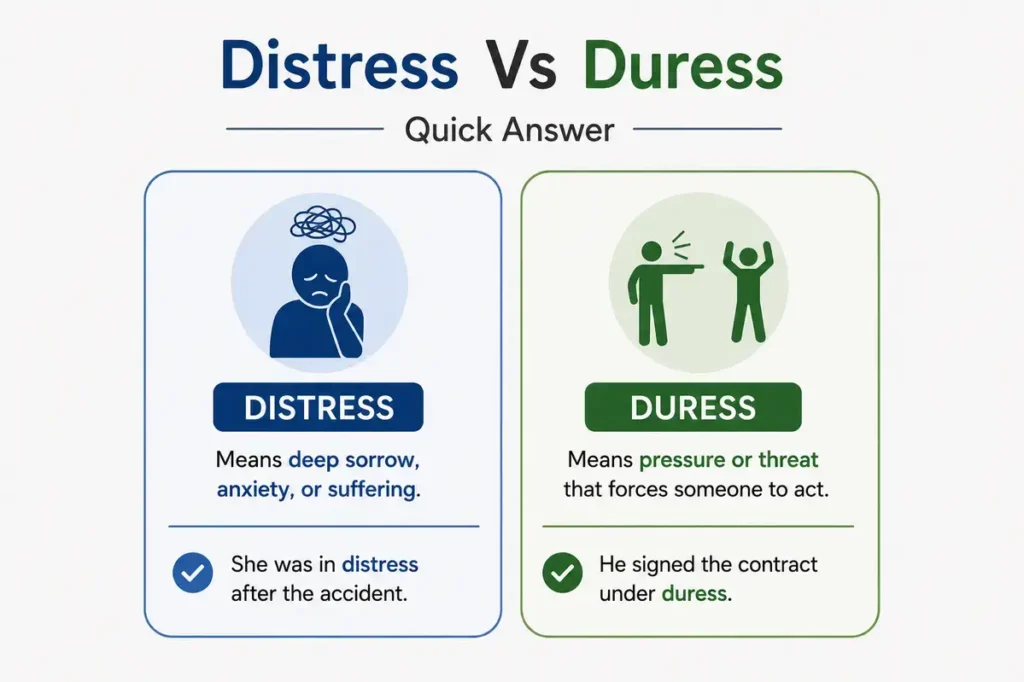
Distress Vs Duress Quick Answer
People often search for these words because the words sound related. They aren’t synonyms.
- Use distress when talking about pain anxiety hardship or suffering.
- Use duress when talking about threats force or unlawful pressure.
- Both words are correct English words but they belong in different contexts.
- In legal writing duress has a specific meaning that can affect the validity of contracts confessions and agreements.
- In everyday English distress appears far more often than duress.
Distress or Duress Comparison Table
| Feature | Distress | Duress |
|---|---|---|
| Correct form | Distress | Duress |
| Meaning | Physical emotional or financial suffering | Force or threats used to make someone act |
| Part of speech | Noun and verb | Noun |
| Origin | Latin through Old French | Latin through Old French |
| Usage frequency | Very common | Less common |
| Formality level | Works in everyday and formal writing | Mostly legal and formal writing |
| Common contexts | Mental health emergencies finance disasters emotions | Law contracts police investigations legal disputes |
| Example | She showed signs of distress after the accident. | He signed the agreement under duress. |
Meaning Of Distress
Distress is a word that describes serious suffering or discomfort. The hardship can be emotional physical financial or even environmental. The exact meaning depends on the situation but the central idea stays the same. Someone or something is experiencing severe difficulty.
As a noun distress refers to a painful condition. Examples include emotional distress financial distress and respiratory distress. As a verb distress means to cause suffering worry or pain. Editors often see this word in health reports news articles legal documents and everyday conversations because it covers many kinds of hardship.
The word comes from Latin through Old French and has been part of English for centuries. Over time its meaning expanded from physical hardship to include emotional and financial struggles.
Common contexts include.
- Emotional distress after losing a loved one.
- Financial distress caused by heavy debt.
- A distress signal sent from a ship in danger.
- Psychological distress after a traumatic event.
- A company facing economic distress.
Even though these situations differ they all share the same idea of suffering or serious trouble.
Meaning Of Duress
Duress has a much narrower meaning.
It describes pressure force or threats that leave someone feeling they have no real choice. The word appears most often in legal settings where someone claims they acted because another person threatened them.Unlike distress duress doesn’t describe emotional suffering by itself. Instead it focuses on the outside force that caused the action.
Someone acting under duress isn’t acting freely. Courts may decide that a contract confession or agreement isn’t legally valid if it was made under duress. The word also comes from Latin through Old French. Its original meaning centered on harsh treatment force and restraint. That legal meaning remains strong today.
Common situations include.
- Signing a contract after receiving threats.
- Giving false information because of intimidation.
- Handing over money after being threatened.
- Confessing during unlawful coercion.
- Agreeing to terms because someone used force.
Outside legal writing people sometimes use duress more loosely. Someone might say they finished a project under duress to suggest intense pressure. Even then the idea of outside pressure still remains.
Distress and Duress Meaning Differences
Although the words seem related their meanings move in different directions.
Distress Describes A Condition
Distress focuses on the person’s state.
Someone feels pain fear anxiety grief hardship or suffering.
Examples include.
- Emotional distress after a breakup.
- Financial distress during a recession.
- Physical distress after an injury.
The suffering may come from illness accidents loss natural disasters or many other causes.
Duress Describes A Cause
Duress focuses on outside pressure.Someone forces another person to act against their own wishes.
Examples include.
- Threats.
- Intimidation.
- Blackmail.
- Coercion.
- Unlawful pressure.
The person’s emotional state isn’t the main point. The lack of free choice is.
In Everyday English
Most native speakers use distress far more often than duress.
You might hear distress in conversations about.
- Health.
- Mental wellness.
- Family problems.
- Money troubles.
- Emergency situations.
Duress usually appears during discussions about.
- Legal matters.
- Police investigations.
- Contracts.
- Court cases.
- Criminal law.
Outside legal settings people still understand duress but they don’t use it nearly as often.That’s one reason writers sometimes replace it with distress by mistake.
Which One Is Correct
The answer depends on your sentence.Both words are correct English words.
Choose distress if you’re describing suffering hardship anxiety pain or emotional strain.Choose duress if someone was forced threatened or pressured into doing something against their will.Think of it this way.Distress tells you how someone feels.Duress tells you why someone acted.That simple distinction prevents most mistakes.
Expert Language Insight
After editing thousands of academic papers business reports legal documents and online articles one pattern appears again and again. Writers often notice the emotional weight of both words and assume they overlap. They don’t.Professional editors look at the source of the problem.
If the sentence describes someone’s suffering distress is almost always the right choice.If the sentence explains that someone acted because another person used threats force or intimidation duress is almost always correct.Native speakers rarely stop and think about this distinction because they’ve seen both words used in their natural settings for years. Learners and occasional writers benefit from remembering one simple idea.Distress is about suffering.Duress is about forced action.That single rule solves most cases in seconds.
Key Differences At A Glance
- Distress describes suffering.
- Duress describes coercion.
- Distress works as both a noun and a verb.
- Duress functions only as a noun in modern English.
- Distress appears in everyday conversation much more often.
- Duress appears mainly in legal and formal writing.
- Distress covers emotional physical financial and medical hardship.
- Duress focuses on threats force and loss of free choice.
Need another quick comparison? Read Sleave or Sleeve Which Spelling Is Correct? 2026.
Distress Vs Duress Examples In Sentences
The fastest way to understand these words is to see both words in real sentences. Once you notice the pattern the difference becomes much easier to remember.
Distress Sentence Examples
- The family experienced great distress after the house fire.
- She showed signs of emotional distress during the interview.
- The company entered financial distress after losing several major clients.
- His voice revealed genuine distress as he described the accident.
- The doctor checked the patient for signs of respiratory distress.
- The rescue team responded immediately after receiving a distress signal.
- Watching the injured animal caused everyone distress.
- Parents should pay attention if a child shows emotional distress.
- The unexpected news left him in obvious distress.
- The charity provides support for people facing severe financial distress.
Duress Sentence Examples
- He signed the contract under duress.
- The witness claimed she made the statement under duress.
- The court examined the evidence to decide if the confession resulted from duress.
- She argued that the agreement should not stand because of duress.
- No one should make important decisions under duress.
- The employee said threats forced him to resign under duress.
- The judge dismissed the document after finding clear evidence of duress.
- They admitted they acted under duress after receiving repeated threats.
- A contract signed under duress may become legally invalid.
- The lawyer explained that duress removes genuine consent in many legal situations.
Distress Vs Duress Common Mistakes
These words confuse many writers because they sound alike and both involve difficult situations. Still the mistakes usually fall into a few familiar patterns.
Using Distress Instead Of Duress
This is the most common error.
Incorrect.
He signed the contract under distress.
Correct.
He signed the contract under duress.The sentence describes coercion instead of emotional suffering.
Using Duress Instead Of Distress
This mistake happens less often but still appears in blogs student papers and online discussions.
Incorrect.
She felt great duress after hearing the bad news.
Correct.
She felt great distress after hearing the bad news.The sentence describes an emotional reaction instead of outside pressure.
Assuming Both Words Mean Stress
Many people think both words simply mean stress.
They don’t.
Stress is a broad everyday word.Distress means severe suffering.Duress means coercion or unlawful pressure.
Ignoring Legal Meaning
Some writers treat duress as another word for pressure.In everyday conversation people sometimes stretch the meaning. Legal writing does not.Courts use duress in a very specific way. It refers to force threats or unlawful pressure that removes genuine free choice.
Distress Vs Duress Pronunciation Guide
The spelling looks similar but the pronunciation also deserves attention.
Distress
IPA.
/ dɪˈstrɛs /
Syllables.
Dis tress.
The second syllable receives the stress.
Duress
IPA.
/ duˈrɛs / or / djuˈrɛs /
Syllables.
Du ress.
Again the second syllable carries the stress.
Common Pronunciation Mistakes
- Adding an extra syllable to duress.
- Stressing the first syllable instead of the second.
- Confusing the beginning sounds because the spellings look alike.
- Mixing the words while speaking quickly.
Listening to native speakers and repeating each word in complete sentences helps build confidence.
Etymology And Word Origin
Knowing where words come from often explains why they mean different things today.
Origin Of Distress
Distress traces back to the Latin word distringere which meant to pull apart or tighten. The idea later passed through Old French before entering Middle English. As English developed the meaning expanded. It came to describe hardship suffering anxiety pain and serious difficulty. Today the word appears across medicine psychology finance emergency services and everyday conversation.
Origin Of Duress
Duress comes from the Old French word duresse which referred to harshness severity and constraint. Its deeper roots also connect to Latin. Unlike distress its meaning stayed much narrower. English speakers continued using it mainly in legal settings where force threats and coercion became the central idea. That legal connection remains strong after hundreds of years.
Regional Usage
English speakers across the world understand both words. Still their frequency changes from one region to another.
American English
American English uses distress very often.You’ll hear it in healthcare education psychology business news emergency services and daily conversation.Duress appears mainly in legal documents court decisions and formal reporting.
British English
British English follows almost the same pattern.Distress appears in everyday speech while duress remains largely connected with legal matters.British legal writing uses the phrase under duress just as American English does.
Canadian English
Canadian English mirrors both American and British usage.Distress appears across many situations.Duress stays closely tied to law contracts and legal rights.
Australian English
Australian English also keeps the same distinction.People regularly talk about emotional distress financial distress or distress signals.Duress remains a formal legal term.Across all four major English varieties there is very little difference in meaning.The biggest difference is frequency.Distress appears much more often.
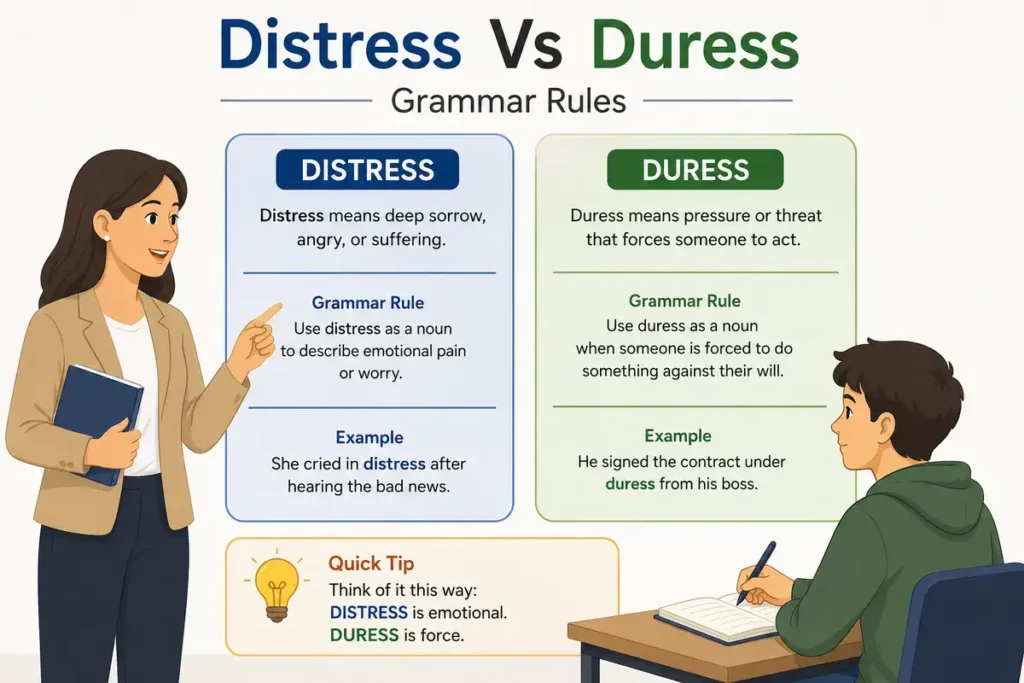
Distress Vs Duress Grammar Rules
Grammar also separates these words.
Distress Can Function As A Noun
Examples.
- The patient showed signs of distress.
- Financial distress affected thousands of families.
Distress Can Function As A Verb
Examples.
- The news distressed everyone.
- The images distressed many viewers.
Notice that the verb changes form naturally.
- Distress.
- Distresses.
- Distressed.
- Distressing.
Duress Functions Only As A Noun
Modern English treats duress as a noun.
Examples.
- The agreement was signed under duress.
- She claimed duress during the trial.
There is no commonly accepted verb form such as duressing.
Common Sentence Patterns
Distress often appears with words like.
- Emotional.
- Financial.
- Physical.
- Mental.
- Psychological.
- Severe.
- Obvious.
Duress commonly appears with phrases like.
- Under duress.
- Claim duress.
- Act under duress.
- Sign under duress.
- Evidence of duress.
These natural combinations make writing sound more fluent.
Distress Vs Duress In Real Life
Real situations make the difference easy to remember.
Daily Conversation
I could tell she was in distress after hearing the news.He wasn’t acting under duress. He made the decision on his own.
Academic Writing
Researchers measured levels of emotional distress among participants.The study examined legal decisions involving claims of duress.
Professional Communication
The business entered financial distress after losing major investors.The attorney argued that the employee accepted the agreement under duress.
Literature
Novelists often describe characters experiencing emotional distress after personal loss.Courtroom stories frequently include characters claiming they acted under duress.
News Reporting
Journalists report distress during natural disasters humanitarian crises and emergencies.Legal reporters discuss duress during criminal trials contract disputes and investigations.
Memory Tip
One simple trick helps many writers remember the difference.Think about the source.If the problem comes from inside the person’s experience use distress.If the problem comes from outside pressure forcing someone to act use duress.Another easy reminder works just as well.
Distress equals suffering.
Duress equals force.
That small distinction can save you from making the wrong word choice every time.
Distress Vs Duress Related Words And Confused Terms
People searching for distress vs duress often end up comparing other similar words. Some are closely related in meaning while others simply sound alike. Knowing the difference makes your writing more accurate and more natural.
Words Related To Distress
- Stress.
- Anxiety.
- Suffering.
- Hardship.
- Anguish.
- Misery.
- Pain.
- Trauma.
- Grief.
- Agony.
These words describe emotional physical or financial difficulty. They don’t suggest that another person forced someone to act.
Words Related To Duress
- Coercion.
- Intimidation.
- Pressure.
- Threat.
- Compulsion.
- Force.
- Constraint.
- Extortion.
- Blackmail.
- Undue influence.
These terms focus on outside pressure instead of personal suffering. Several also carry legal meaning.
Commonly Confused Words
- Distress and stress.
- Duress and pressure.
- Distress and depression.
- Duress and coercion.
- Distress and disaster.
Some of these pairs overlap in everyday conversation. They still aren’t perfect substitutes. The surrounding sentence always determines the best choice.
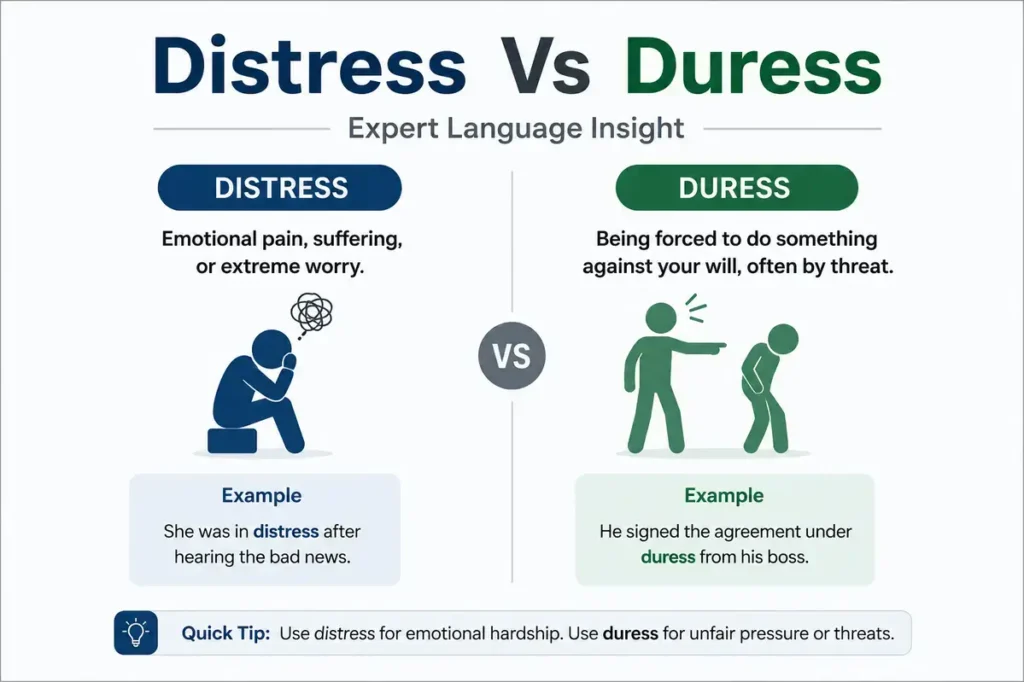
Distress Vs Duress Expert Language Insight
After reviewing years of academic papers legal documents business reports website content and student assignments one editing pattern appears again and again.Most writers don’t misunderstand the definitions. They misunderstand the relationship between the words.The shared ending makes them look like close relatives. Their meanings create the opposite impression because both involve unpleasant situations. That’s enough to cause hesitation.
Professional editors rarely choose between them based on emotion alone.Instead they ask one simple question.What is the sentence actually describing.If the sentence focuses on someone’s emotional physical medical or financial condition the answer is almost always distress.If the sentence explains that someone acted because another person used threats force intimidation or unlawful pressure the answer is almost always duress.
Native speakers don’t usually stop to analyze this difference. Years of reading hearing and speaking English make the distinction feel automatic. For learners writers and professionals a quick mental check works just as well. Ask yourself if the sentence describes suffering or forced action. That single question solves nearly every case.
Many readers also check Cubical vs Cubicle Meaning Difference and Correct Usage.
Conclusion Distress Vs Duress
The comparison between distress vs duress becomes simple once you understand the core idea behind each word. Distress describes emotional physical medical or financial suffering. It tells readers that someone is facing serious hardship. Duress describes threats force or unlawful pressure that leaves someone with little or no real choice. It explains why a person acted instead of how they felt.
Although the words look similar they serve different purposes. Mixing them can change the meaning of a sentence and make your writing less precise. That’s especially important in legal documents academic papers business communication and professional writing where word choice matters.
If you remember only one rule let it be this.
Use distress for suffering.
Use duress for forced action.
That distinction matches the way native speakers use these words and will keep your writing clear accurate and confident.
Distress Vs Duress Frequently Asked Questions
Is Distress The Same As Duress?
No. Distress describes suffering hardship anxiety or pain. Duress describes threats force or coercion that remove someone’s freedom to choose. The words aren’t interchangeable because they refer to different situations.
Can I Use Distress Instead Of Duress?
No. Replacing duress with distress changes the meaning of the sentence. If someone signed a contract because of threats the correct word is duress not distress.
Is Duress Only A Legal Word?
Mostly yes. Lawyers judges and legal writers use duress regularly because it has a precise legal definition. People also use it in everyday conversation from time to time but the legal meaning remains its primary use.
Why Do People Confuse Distress And Duress?
The words share a similar spelling and both involve unpleasant experiences. Many people also assume they describe different levels of stress. In reality one describes suffering while the other describes coercion.
Which Word Is More Common?
Distress appears far more often.You’ll find it in healthcare education psychology news finance and everyday conversation. Duress appears less often and usually shows up in legal contexts.
Can Someone Feel Duress?
Not exactly. People experience distress. They act under duress. The first describes a condition. The second describes pressure that affects someone’s decisions.
Is Stress The Same As Distress?
No. Stress can be positive neutral or negative depending on the situation. Distress always carries a negative meaning and refers to serious suffering or hardship.
How Can I Remember The Difference Quickly?
Think about the source of the problem. If the sentence describes suffering use distress. If someone uses threats or force to make another person act use duress.That simple rule works in almost every situation.