
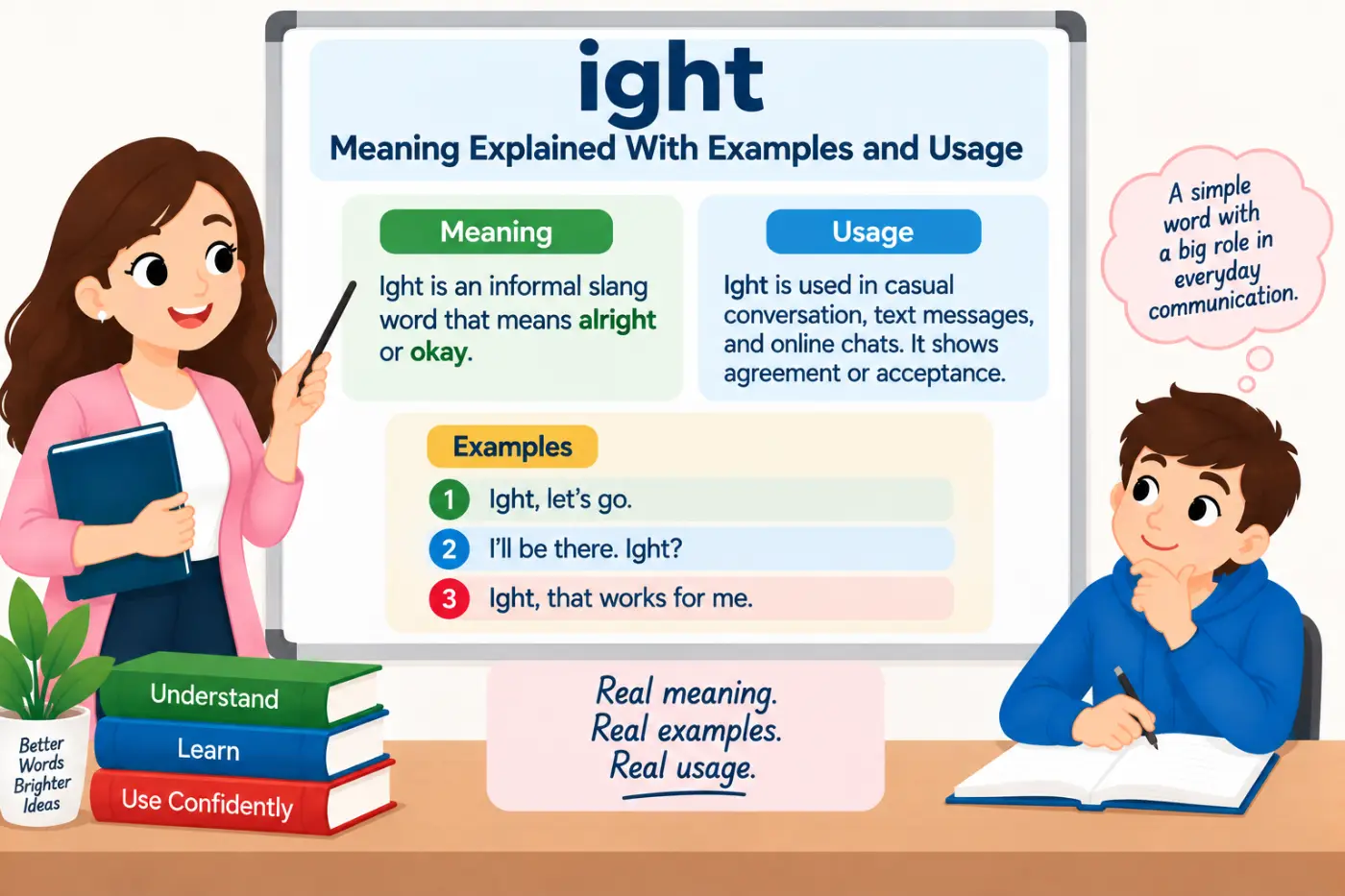
If someone texts you ight and you’re not sure how to read it, the confusion is understandable. The ight meaning is usually a casual form of alright or all right, and it commonly means okay, fine, or sounds good. The exact feeling can change with the situation and the way someone writes it.
You’ll mostly see this expression in text messages, social media comments, online chats, gaming conversations, and casual speech. It isn’t normally the choice for a school essay, formal email, business report, or other polished writing. Depending on context, it can show agreement, acceptance, reassurance, or simple acknowledgment. Sometimes it can also sound a little blunt, especially when someone sends only one short word.
This guide explains what the expression means, where it comes from, how people pronounce it, and how native speakers use it naturally. You’ll also see examples from texting and everyday conversation, a comparison with related expressions, common mistakes, regional usage, and practical advice for knowing when this casual form fits.
You may also want to read employer name meaning And How To Enter It Correctly.
Quick Definition
Ight is an informal slang expression commonly used in texting and online conversation as a shortened form of alright or all right. It usually means okay, fine, agreed, or understood. Its tone depends heavily on context. It’s common in casual communication but generally isn’t suitable for formal or academic writing.
Quick Answer
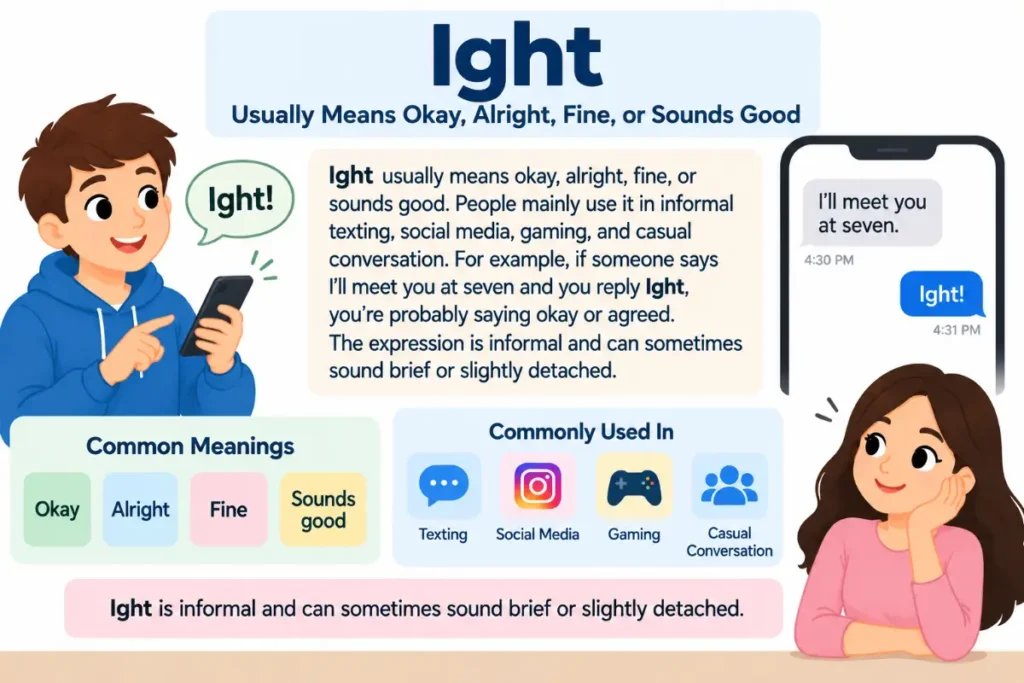
Ight usually means okay, alright, fine, or sounds good. People mainly use it in informal texting, social media, gaming, and casual conversation. For example, if someone says I’ll meet you at seven and you reply Ight, you’re probably saying okay or agreed. The expression is informal and can sometimes sound brief or slightly detached.
Comparison Table
| Form | Meaning | Part of Speech | Origin | Usage Frequency | Formality | Common Contexts | Example |
|---|---|---|---|---|---|---|---|
| Ight | Okay, fine, agreed, or understood | Informal interjection or discourse expression | Informal shortened spelling associated with alright and all right | Common in casual digital communication | Very informal | Texting, chats, social media, gaming | Ight, I’ll see you later. |
| Alright | Okay, fine, satisfactory, or agreed | Adjective, adverb, interjection, or discourse marker depending on use | English development from all right | Very common | Informal to neutral | Conversation and general writing | Alright, let’s go. |
| All right | Okay, satisfactory, or agreed | Adjective, adverb, interjection, or discourse marker depending on use | English phrase | Very common | Neutral and widely accepted | Conversation and formal writing | All right, we can begin. |
| Okay | Agreement, acceptance, or satisfactory condition | Adjective, adverb, noun, verb, or interjection depending on use | English form influenced by earlier spelling and abbreviation traditions | Extremely common | Informal to neutral | Almost every kind of communication | Okay, I understand. |
Meaning and Definition
What Ight Usually Means
The most common use is simple agreement.
If a friend asks, Can you pick me up at eight? you might answer Ight.
In that situation the expression means yes, okay, or sure.
It can also show acceptance.
Ight, I’ll do it.
Here the speaker accepts a request or decision.
Another common use is acknowledgment.
Ight.
That short response can mean I understand or okay. The meaning depends heavily on the conversation around it.
This is one reason slang can be tricky. A dictionary style definition gives you the basic meaning, but real conversation adds tone. A short response can sound friendly between close friends and slightly cold between people who don’t know each other well.
Is Ight a Real Word?
Ight is best understood as an informal slang spelling rather than a standard formal English word.
You may find it in online dictionaries or slang references because people genuinely use it. That doesn’t mean it belongs in every kind of writing. Language has different registers, and informal digital communication has created many spellings and shortcuts that don’t belong in formal prose.
Think about the difference between writing to your best friend and writing to your professor. The same person may naturally use casual slang in a text but choose standard English in an academic assignment.
That difference is normal.
Ight has a recognizable meaning among many English speakers, especially in casual digital communication. Its status is informal rather than standard formal English.
What Does It Mean in Texting?
In texting, the expression usually means okay, alright, sure, or understood.
For example:
Friend: We’re leaving at six.
You: Ight.
The response shows acknowledgment.
It can also carry a stronger sense of agreement.
Friend: You want pizza tonight?
You: Ight, I’m down.
Here it works like sure or sounds good.
The meaning can also shift slightly based on punctuation.
Ight.
This may sound short and final.
Ight!
This can sound more upbeat or enthusiastic.
Ight 😂
This may feel playful.
Ight bet.
This can express agreement with a stronger casual tone.
Texting removes many clues that exist in face to face conversation. You can’t hear someone’s voice or see their facial expression. As a result, punctuation, emojis, surrounding words, and the relationship between the speakers can affect interpretation.
Key Differences Explained
Spelling
Ight uses an intentionally shortened informal spelling. It doesn’t follow the standard spelling of alright or all right.
Meaning
The basic meaning is usually okay, fine, agreed, or understood. The expression can also communicate acceptance of a suggestion or plan.
Grammar
It commonly functions as an informal interjection or conversational response. It doesn’t behave like a normal noun or verb in most everyday uses.
Pronunciation
People generally pronounce it similarly to a casual shortened form of alright. The exact pronunciation can vary depending on the speaker and context.
Formality
The expression is strongly informal. Standard forms such as okay, all right, and alright are safer in formal communication.
Context
It appears most often in texting, online chats, social media, gaming, casual speech, and conversations among friends.
Regional usage
Its use is not limited to one single English speaking region. Digital communication allows slang to spread quickly across communities and countries.
Standard versus nonstandard usage
Ight is recognizable informal language. It shouldn’t be treated as a standard spelling for formal English.
The biggest point is simple. It’s a casual expression for casual situations.
How People Use It in Conversation
Although you’ll often see the expression written, its conversational meaning is easy to understand from ordinary exchanges.
Imagine a friend says:
We should grab dinner after work.
A response like Ight can mean:
Sure.
Sounds good.
Okay.
I’m in.
The expression can also appear at the beginning of a longer statement.
Ight, let’s go.
Ight, give me five minutes.
In these examples it acts almost like okay at the start of a sentence.
Tone matters here. A relaxed speaker may use it naturally without intending any attitude. Another speaker may use the same expression to sound brief or dismissive.
For example:
Ight.
Could mean I understand.
But in a tense conversation it might be interpreted as Fine or whatever.
That’s why context matters more with short slang expressions than with many standard words.
Sentence Examples
Here are natural examples showing how people may use the expression in informal communication.
- Ight, I’ll meet you outside.
- Ight, that works for me.
- You want to play later? Ight.
- Ight, give me a few minutes.
- Ight, I understand what you mean.
- Ight, let’s get some food.
- Ight, I’ll send it tonight.
- Ight, see you tomorrow.
- You can borrow my charger. Ight?
- Ight, we’re good.
The expression can also appear in slightly longer responses.
Ight, I’ll text you when I get there.
Ight, no problem. Take your time.
Ight, I didn’t know that.
Ight, that makes sense now.
These examples show why translating the expression into one fixed English word doesn’t always work. Depending on the sentence, it can correspond to okay, sure, agreed, understood, fine, or sounds good.
Common Mistakes and Confusion
Treating It as Formal English
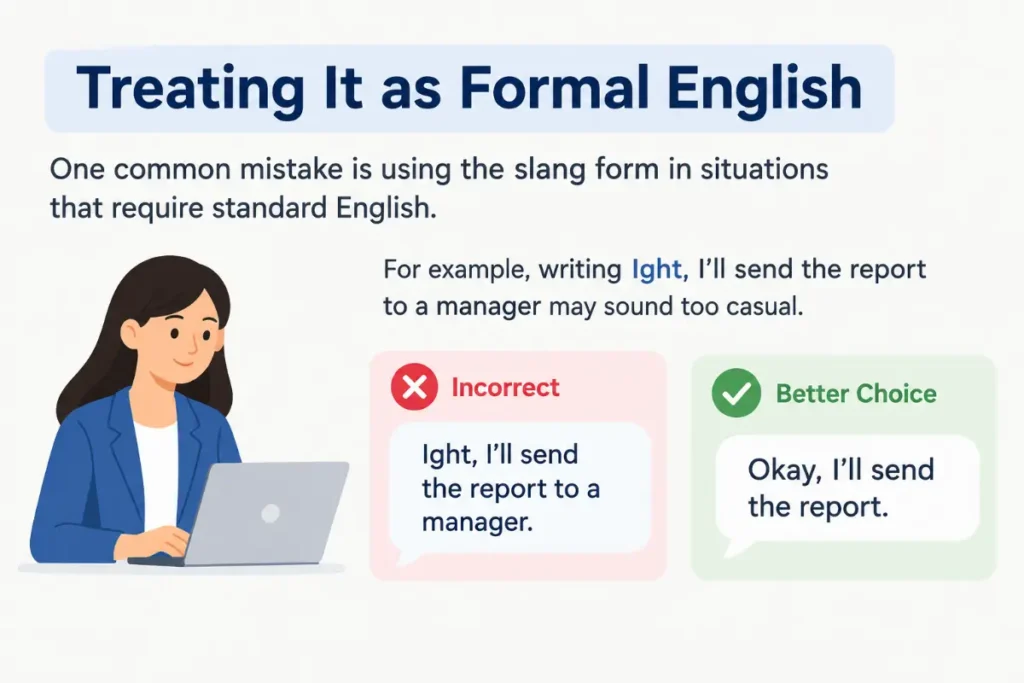
One common mistake is using the slang form in situations that require standard English.
For example, writing Ight, I’ll send the report to a manager may sound too casual.
A better choice is:
Okay, I’ll send the report.
Or:
All right, I’ll send the report.
The problem isn’t that the slang has no meaning. The problem is register. Good writing matches language to the situation.
Assuming It Always Sounds Friendly
A short Ight can sometimes sound cold.
Compare these:
Ight!.
Ight, sounds good.
The first may sound energetic. The second can feel abrupt. The third gives the reader more context and usually feels warmer.
Tone comes from more than vocabulary. Punctuation, sentence length, emojis, and the relationship between speakers all matter.
Confusing It With Alright
These forms are related in casual usage but they aren’t spelled the same way.
Alright is a standard informal form widely used in ordinary English.
Ight is much more casual and associated strongly with slang and digital communication.
If you’re unsure which one to use, alright or all right is usually the safer choice.
Assuming Every Short Response Means the Same Thing
Okay, sure, fine, got it, sounds good, and Ight can all show agreement but they aren’t identical in tone.
For example, got it focuses on understanding.
Sounds good focuses on approval.
Fine can sometimes sound annoyed.
Ight usually sounds casual and relaxed but can become blunt in certain contexts.
Overusing Internet Slang
Slang can make a conversation feel natural when everyone involved understands it. Using too much slang can make your writing harder to read or less appropriate for the audience.
A good editor doesn’t remove informal language simply because it’s informal. The editor asks if it fits the speaker, audience, purpose, and situation.
Pronunciation Guide
There isn’t one universally fixed pronunciation because slang spellings can vary across speakers and communities.
Most people pronounce Ight as a very short casual form associated with alright. It commonly sounds close to aight, with the initial vowel sound reduced or omitted in rapid speech.
A simple pronunciation guide is:
ayt
You may also hear something closer to:
aight
The exact sound depends on the speaker.
The spelling itself can mislead learners. The letters don’t behave like a normal standard English word with a stable dictionary pronunciation. Slang often develops through speech first and then gets represented in creative spellings online.
If you hear someone say something that sounds like a shortened alright, context can help you identify the intended expression.
It’s also worth remembering that slang pronunciation can change from one social group to another. Online communities often create their own spelling habits. That flexibility is part of what makes slang lively but also difficult to define with the same precision as formal vocabulary.
Etymology and Word Origin
The expression is generally understood as an informal shortened form related to alright and all right.
The phrase all right has a long history in English and expresses ideas such as being satisfactory, correct, safe, or acceptable. Alright developed as a combined spelling and became common in informal English.
Ight belongs to a later style of informal shortening. It represents the way speakers can reduce familiar expressions in fast casual communication. Similar processes appear throughout language. Speakers shorten phrases, reduce sounds, and create spellings that capture the way words feel in conversation.
Digital communication has helped these forms spread widely. Texting encourages short responses, and online communities often develop distinctive vocabulary and spellings.
The important point is that there isn’t a need to treat the expression as a mysterious word with an unrelated origin. Its meaning makes sense when you see it as part of the broader family of casual forms associated with alright and all right.
The history of slang is often messy. Unlike carefully standardized vocabulary, informal expressions can spread through music, local communities, social groups, online platforms, and ordinary conversation. Different spellings may appear at different times.
Need another quick comparison? Read Busing or Bussing Grammar Rules and Usage Guide 2026.
Regional Usage
American English
In American English, the expression is strongly associated with informal communication. You’re most likely to encounter it in texts, social media, online chats, gaming, and casual conversations.
It can sound perfectly natural among friends.
Ight, I’ll see you later.
In a formal American setting, however, okay or all right would usually be more appropriate.
British English
British speakers may understand the expression because internet slang travels easily across English speaking communities. Still, its use can vary by age, social group, and personal style.
It shouldn’t be treated as a uniquely British expression. Its digital presence crosses national boundaries.
Australian English
Australian English speakers may also recognize the slang through online communication and popular culture. Its presence doesn’t mean it has become a standard Australian English spelling.
As with other regions, context and social group have a strong effect on how natural the expression feels.
Canadian English
Canadian speakers are also likely to understand the expression in casual online communication. There is no special Canadian spelling rule that makes it a standard formal alternative to all right or alright.
Across these varieties the important distinction is register rather than regional spelling. The expression belongs to casual language rather than formal standard prose.
Grammar Rules and Part of Speech
Calling Ight a traditional part of speech can be tricky because it’s primarily used as a conversational response.
In many examples it functions like an interjection.
Ight!
The speaker is expressing agreement or acknowledgment.
It can also work as a discourse marker at the beginning of a longer informal statement.
Ight, let’s head home.
Here it helps signal that the speaker is ready to move forward.
It doesn’t usually function like a conventional adjective in the way alright can.
For example, standard English allows:
Everything is all right.
You can also hear:
Everything is alright.
Replacing that phrase with Ight would not produce natural standard grammar.
You generally wouldn’t write:
Everything is ight.
That would change the expression completely and may confuse the reader.
The slang form works best as a conversational response rather than as a direct replacement for every grammatical use of alright.
Punctuation
Texting doesn’t follow one strict punctuation system, but punctuation can affect tone.
Ight.
This can sound final or neutral.
Ight!
This can sound more enthusiastic.
Ight, let’s go.
This clearly introduces the next thought.
Ight?
This can sound like a casual check for agreement.
The punctuation isn’t changing the basic dictionary style meaning. It changes how the reader may interpret the speaker’s attitude.
Formal Writing
Avoid the slang form in academic papers, formal reports, job applications, professional documents, and official correspondence.
Use standard alternatives such as:
Okay.
All right.
Agreed.
Understood.
That works for me.
Those choices communicate the same general ideas while fitting a wider range of situations.
When Should You Use It?
The best place for this expression is a relaxed conversation with people who understand the slang.
It can work well when:
- You’re texting a friend.
- You’re chatting with someone casually online.
- You’re participating in a gaming conversation.
- You’re responding to a casual social media message.
- You’re writing dialogue for a character who naturally uses slang.
- You’re communicating with a group where the expression is already normal.
It’s less suitable when:
- You’re writing an academic assignment.
- You’re sending a formal workplace email.
- You’re writing a business proposal.
- You’re preparing a professional application.
- You’re communicating with an unfamiliar professional audience.
- You’re writing content that needs standard edited English.
The rule is simple. Match the language to the relationship and purpose.
Real Life Usage Examples
Daily Conversation
A friend might say:
Are you coming with us?
You could answer:
Ight, give me two minutes.
The expression shows agreement while keeping the tone relaxed.
Another example is:
Ight, I’ll see you after work.
Here it simply means okay or sure.
Text Messages
Texting is probably the most familiar environment for this slang.
Friend: Meet me at the coffee shop.
Reply: Ight, I’m on my way.
Or:
Friend: I’ll send you the address.
Reply: Ight, thanks.
The short form works because the relationship and setting are informal.
Workplace Communication
It’s generally better to avoid slang in professional messages.
Instead of:
Ight, I’ll send the file.
Use:
Okay, I’ll send the file.
Or:
All right, I’ll send the file.
This doesn’t mean workplace communication must sound stiff. You can still write naturally while choosing standard language.
Academic Writing
Academic writing requires a more controlled register.
A student shouldn’t normally write:
Ight, the results support the theory.
A suitable version would be:
The results support the theory.
The informal expression adds nothing useful to the academic sentence.
News Writing
News writing also favors standard vocabulary.
A journalist would normally write:
Officials agreed to continue the talks.
An informal expression would rarely be appropriate in the reporter’s own narration. It might appear inside a direct quotation when preserving the speaker’s original language is relevant.
Literature and Storytelling
Fiction is different because writers often use slang to create believable dialogue.
A character might say:
Ight, I’ll come with you.
That can help establish personality, age, social setting, or conversational style.
The same expression in the narrator’s formal description could feel out of place. Writers choose slang based on character and voice.
Related and Confused Terms
Okay
Okay is the broadest and safest everyday alternative. It can express agreement, understanding, acceptance, or a satisfactory condition.
All Right
All right is a standard phrase that can mean okay, satisfactory, safe, or acceptable. It works in formal writing much more comfortably than slang.
Alright
Alright is widely used in modern English, especially in informal and general writing. Style preferences can vary, but it’s far more standard than the slang form.
Aight
Aight is another informal spelling associated with the same general pronunciation and meaning. It can appear in slang and online communication.
Bet
Bet is modern informal slang that can express agreement or confident acceptance.
For example:
I’ll see you at eight.
Bet.
It doesn’t always mean exactly the same thing as Ight, but the two can overlap in casual conversation.
Sure
Sure expresses agreement or willingness.
It usually sounds clearer and more neutral than slang.
Got It
Got it focuses on understanding or acknowledgment.
I’ll send the details tonight.
Got it.
That meaning is close to one common use of the slang expression.
Sounds Good
Sounds good shows positive agreement with a plan or suggestion.
We’ll meet at seven.
Sounds good.
It usually sounds warmer and more explicit than a very short slang response.
Tone and Context Matter
A major part of understanding slang is learning that meaning and tone aren’t always the same thing.
Suppose someone says:
Can you help me move on Saturday?
You answer:
Ight.
That probably sounds like agreement.
Now imagine an argument.
Are you seriously going to leave right now?
Ight.
The same expression might sound dismissive or annoyed.
This happens because listeners interpret words together with context. In face to face speech, tone of voice provides additional information. In texting, readers rely on punctuation, timing, emojis, previous messages, and shared social knowledge.
A response can therefore be technically agreeable while emotionally distant.
Compare:
Ight, no worries.
Ight! I’m down.
All four communicate some form of acceptance, but they don’t create exactly the same impression.
That’s a useful lesson beyond slang. Short messages often carry more social meaning than their dictionary definitions suggest.
Why Slang Spellings Change
Informal language often follows speech rather than formal spelling rules.
When people speak quickly, familiar phrases get reduced. The shortened pronunciation can eventually appear in writing, especially in places where people write the way they talk.
Texting strengthens this process because users value speed and informality. A short expression can feel more natural than a complete sentence.
Social groups also shape language. Teenagers, gamers, musicians, online communities, and regional groups can develop distinctive expressions that spread beyond their original circles.
That doesn’t mean every new spelling becomes standard English.
Standard language changes slowly through broad repeated use, dictionaries, published writing, education, and general acceptance. Slang can change much faster.
An expression can be popular for years and still remain informal.
That distinction helps explain why a word can feel completely normal in a text message but look inappropriate in a formal essay.
How to Tell What Someone Means
If you receive this expression and aren’t sure about the tone, look at the surrounding conversation.
Ask yourself:
- Was the person agreeing to a plan?
- Did they respond to a request?
- Were you asking for confirmation?
- Was the conversation playful?
- Was there an argument happening?
- Did they add punctuation or an emoji?
- Is this how the person normally texts?
These clues usually make the intended meaning clear.
If someone writes:
Ight, see you at eight.
They almost certainly mean okay or agreed.
If someone writes only:
Ight.
The meaning is still likely to be okay or understood, but the emotional tone may be less obvious.
When a message seems cold, don’t assume the word itself is hostile. Short digital replies often sound more abrupt than the writer intended.
Expert Editor Insight
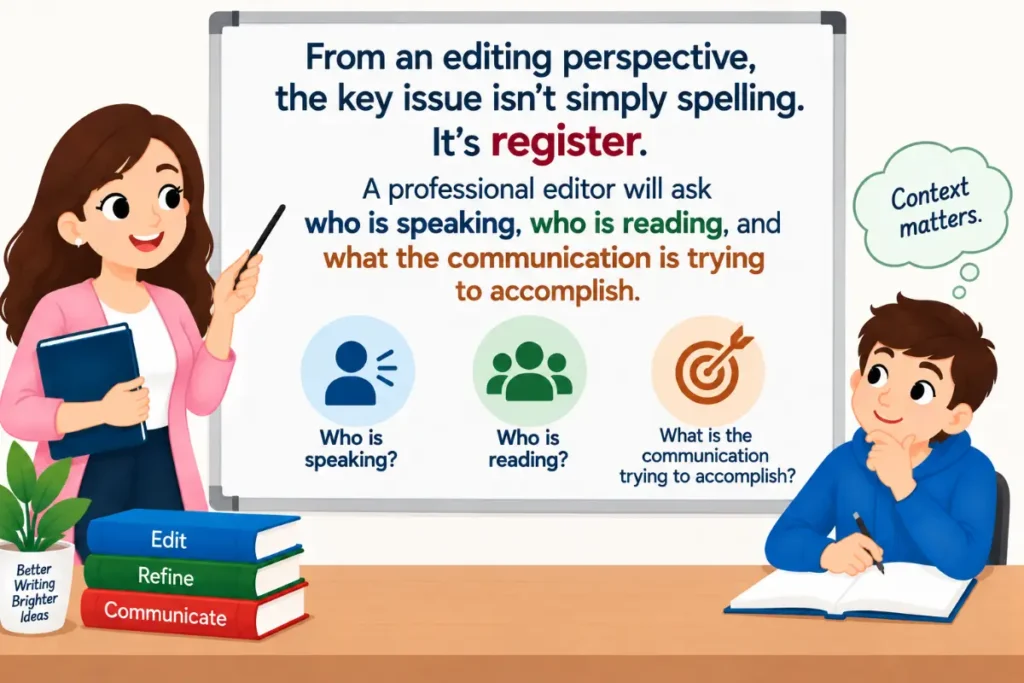
From an editing perspective, the key issue isn’t simply spelling. It’s register. A professional editor will ask who is speaking, who is reading, and what the communication is trying to accomplish. In dialogue or casual messages, the slang can sound natural and authentic. In academic or professional prose, standard forms such as okay or all right are usually stronger choices. Grammar and spelling tools may flag the slang because it doesn’t fit standard vocabulary databases. That doesn’t automatically mean the expression has no meaning. It means the software is distinguishing informal language from standard edited English.
You may also want to read pmg meaning Explained Clearly With Common Uses.
Final Takeaway
The ight meaning is usually okay, alright, sure, or understood. It’s an informal slang expression most often found in texts, online chats, social media, gaming, and relaxed conversations. It’s related in meaning to alright and all right but has a much more casual tone.
The expression can communicate agreement without needing a full sentence. Still, context matters. A short reply can sound friendly, neutral, or slightly blunt depending on the conversation and punctuation.
For formal writing, choose standard alternatives such as okay, all right, understood, or agreed. For casual conversations with people who use the slang naturally, the expression can fit perfectly well. A simple rule will keep you on safe ground: match your language to your audience and situation.
FAQs
What does ight mean in texting?
In texting, Ight usually means okay, alright, sure, or understood. It’s a very informal expression commonly used as a quick response to a suggestion, request, or plan. The exact tone depends on context. A message such as Ight, see you later usually sounds friendly and casual, while a single Ight can sometimes feel brief or slightly dismissive.
Is ight a real word?
Ight is a recognizable slang expression, but it isn’t normally considered a standard formal English word. People use it in texts, online chats, social media, gaming, and casual conversations. It’s best understood as an informal shortened spelling associated with alright or all right. Its widespread use doesn’t make it appropriate for every type of writing.
Is ight the same as alright?
Ight and alright can communicate a similar basic idea, especially when someone is expressing agreement or acknowledgment. However, they differ strongly in register. Alright is widely used in ordinary English writing and conversation, while Ight is much more informal slang. In professional or academic writing, alright or all right is generally a safer choice.
How do you pronounce ight?
Ight is commonly pronounced like a shortened form of alright and may sound similar to aight or ayt. There isn’t one formal pronunciation rule because the expression belongs to informal slang. Speakers can pronounce it slightly differently depending on their accent and speech style. Context usually makes the intended meaning clear even when the pronunciation varies.
Can you use ight in formal writing?
You generally shouldn’t use Ight in formal writing. It’s strongly associated with casual speech, texting, social media, and online communication. In a formal email, academic assignment, report, application, or professional document, use standard alternatives such as okay, all right, understood, or agreed. The issue is mainly register and audience rather than basic comprehension.
What is another word for ight?
Common alternatives include okay, alright, all right, sure, got it, sounds good, and agreed. The best choice depends on what you want to communicate. Okay is the most flexible option. Got it emphasizes understanding. Sounds good expresses approval of a plan. Agreed clearly communicates acceptance. Ight is more casual than all of these choices.
Why do people say ight instead of alright?
People use the shortened form because casual speech often reduces familiar expressions. Texting and online communication also encourage quick informal responses. Slang spellings can capture the relaxed way people actually speak. Social groups and internet communities help these forms spread. The result is an expression that can feel perfectly natural among friends even though it doesn’t belong to formal standard writing.
Is ight rude?
Ight isn’t automatically rude. Its tone depends on context, relationship, and delivery. Among friends it can simply mean okay or sounds good. In a tense conversation, a very short response may sound dismissive because it provides little emotional information. Adding context can make the intention clearer. For example, Ight, no worries usually sounds warmer than a bare Ight.