
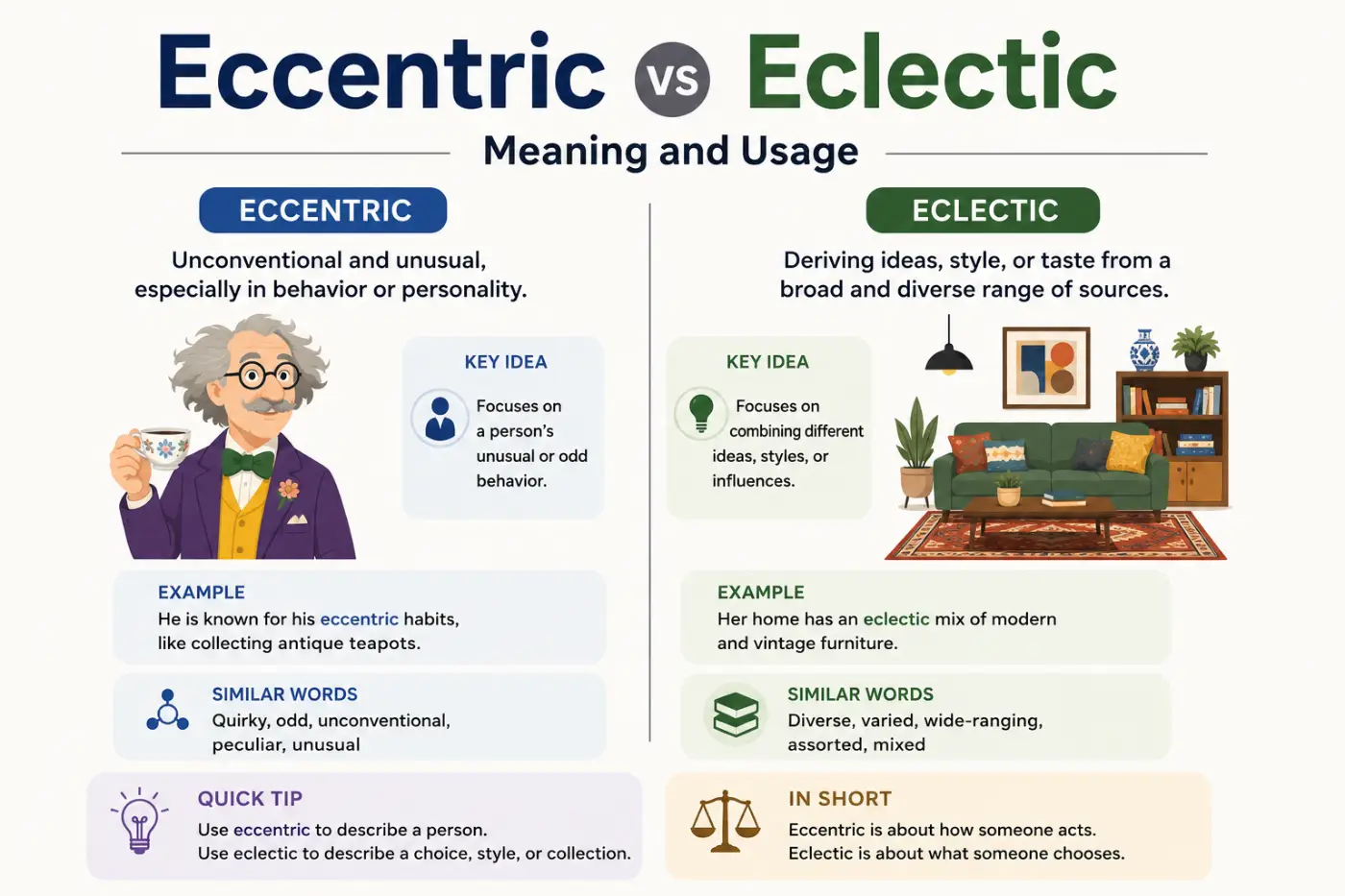
If you’ve ever seen eccentric vs eclectic and wondered if the words are interchangeable you’re not alone. They look and sound somewhat similar but their meanings are quite different. Eccentric usually describes a person or behavior that is unusual or unconventional. Eclectic describes a person or thing that draws ideas styles or choices from many different sources.
The confusion often comes from their similar appearance. Both words begin with the same three letters and both can describe people with distinctive tastes or personalities. That small overlap can make them easy to mix up in writing. The meaning behind each word gives you the clearest way to separate them.
Once you understand the difference you’ll see that these words serve different purposes. You can call someone eccentric because they behave in an unusual way. You can call someone’s taste eclectic because they enjoy a wide range of styles. The first word focuses on unusual behavior or character. The second focuses on variety and the selection of different influences.
A related grammar guide is begun or began The Simple Grammar Rule 2026.
Quick Answer
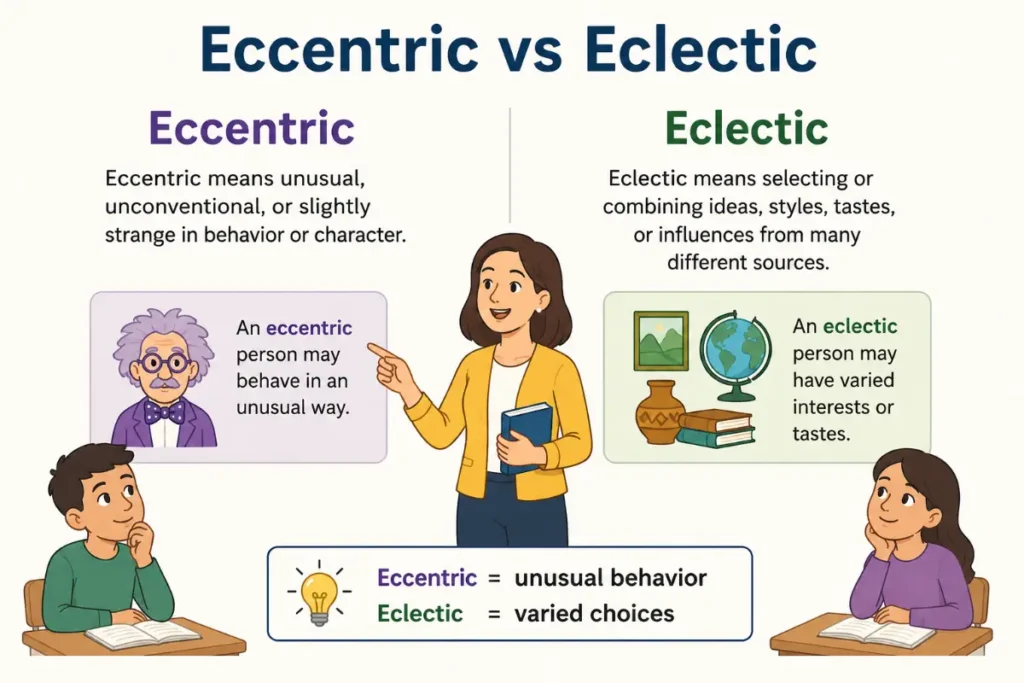
Eccentric means unusual unconventional or slightly strange in behavior or character. Eclectic means selecting or combining ideas styles tastes or influences from many different sources. An eccentric person may behave in an unusual way. An eclectic person may have varied interests or tastes.
Quick Answer In Simple Terms
Think of eccentric as unusual.
Think of eclectic as varied.
If your neighbor wears a different costume every Friday and talks to garden statues you might describe the behavior as eccentric. If your friend listens to jazz country rock classical music and hip hop you could describe their musical taste as eclectic.
The difference becomes much easier when you focus on the central idea behind each word. Eccentric points toward something that stands apart from what people normally expect. Eclectic points toward a mixture created from different sources.
Both words are standard English. Neither one is a misspelling of the other. They simply express different ideas.
Comparison Table
| Form | Meaning | Part of Speech | Origin | Usage Frequency | Formality | Common Contexts | Example |
|---|---|---|---|---|---|---|---|
| Eccentric | Unusual unconventional or outside the usual pattern | Adjective and noun | Greek through Latin and French | Common | Neutral to formal | Personality behavior habits style | She has an eccentric sense of humor. |
| Eclectic | Choosing or combining ideas styles or things from different sources | Adjective | Greek through French | Common | Neutral to formal | Taste art design music reading interests | His music collection is eclectic. |
Meaning Of Eccentric
Eccentric is mainly used to describe someone or something that does not follow ordinary patterns.
When you describe a person as eccentric you usually mean that the person behaves in an unusual or unconventional way. The word does not automatically mean bad or foolish. An eccentric person may simply have habits ideas clothing choices or interests that seem unusual to other people.
For example you might say that a professor is eccentric because he wears brightly colored suits every day and gives lectures while walking around the room with a toy dinosaur. The behavior is unusual but it does not necessarily harm anyone.
The word can also describe things that are not centered or positioned in the usual way. In technical contexts eccentric can refer to something that is not located at the center of a circle or another object. That technical meaning appears in fields such as engineering and mechanics.
In everyday English though the personality meaning is especially common.
Eccentric As An Adjective
As an adjective eccentric describes a person thing idea style or behavior.
Consider these examples.
- Her uncle has an eccentric sense of humor.
- The artist lives in an eccentric old house.
- His eccentric habits make him memorable.
- The designer created an eccentric piece of furniture.
The adjective often carries a sense of individuality. Depending on the context it can sound affectionate neutral or mildly critical.
Eccentric As A Noun
Eccentric can also function as a noun.
An eccentric is a person who behaves in an unconventional way.
For example you could write:
The town’s eccentric became famous for collecting antique clocks.
The noun does not necessarily insult the person. Context determines the tone. A writer may use it to describe someone whose unusual personality has become part of their identity.
Meaning Of Eclectic
Eclectic describes variety that comes from different sources. When someone has eclectic taste they don’t limit themselves to one style category or tradition. They choose things because they like them even if those things come from very different backgrounds.
Imagine someone whose living room contains a modern sofa a Victorian lamp a handmade rug and an abstract painting. You could describe the decor as eclectic because it combines different styles.
The same idea works for music. Someone might listen to opera in the morning hip hop in the afternoon and classical rock at night. Their musical taste is eclectic. The important idea is selection from variety. Eclectic doesn’t mean random. It often suggests that someone has deliberately chosen different influences and brought them together.
Eclectic As An Adjective
Eclectic is normally used as an adjective.
You might say:
Her reading list is eclectic.
The restaurant has an eclectic menu.
He has an eclectic taste in music.
The museum displays an eclectic collection of artwork.
The word often works well in discussions about art design culture education literature music food and personal interests.
The Core Difference
The simplest distinction is this.
Eccentric describes unusualness.
Eclectic describes variety.
An eccentric person stands out because their behavior or personality differs from the norm. An eclectic person stands out because their choices include influences from many different sources.
That difference matters because the words don’t describe the same quality.
Imagine two people named Sarah and Maya.
Sarah wears unusual clothes and invents strange games for her friends. Her behavior might be eccentric.
Maya wears simple clothes but listens to twenty different kinds of music and decorates her home with pieces from many cultures. Her taste might be eclectic.
Now imagine that Maya also behaves in strange ways. She could be both eccentric and eclectic. One word would describe her unusual personality while the other would describe the variety in her interests.
This is why the words can sometimes appear in discussions about the same person. They still have different meanings.
Eccentric And Eclectic In Everyday English
Native English speakers often use eccentric when talking about personalities.
You may hear phrases such as eccentric artist eccentric neighbor eccentric millionaire or eccentric professor.
These phrases suggest that the person has unusual habits or characteristics.
Eclectic appears more often with words connected to taste choice and variety.
Common combinations include eclectic taste eclectic style eclectic collection eclectic music eclectic design and eclectic influences.
This pattern can help you choose the right word quickly.
If you are describing someone’s behavior ask yourself if it is unusual.
If yes eccentric may fit.
And If you are describing someone’s collection taste or influences ask yourself if they come from many different sources.
If yes eclectic may fit.
Spelling And Word Formation
The spelling difference becomes easier to remember when you connect each word with its meaning.
Eccentric contains the sound and spelling pattern associated with center. Its deeper historical sense relates to something outside the center.
Eclectic comes from a Greek word connected with choosing. Its history reflects the idea of selecting from different possibilities.
The two words therefore developed along different semantic paths.
Eccentric moved toward the idea of being outside the ordinary center or norm.
Eclectic developed around the idea of selecting from different sources.
That historical distinction supports the modern meanings and gives you a useful memory tool.
Pronunciation Guide
Eccentric is commonly pronounced:
ik SEN trik.
Its IPA pronunciation is /ɪkˈsɛntrɪk/.
The main stress falls on the second syllable.
Eclectic is commonly pronounced:
ih KLEK tik.
Its IPA pronunciation is /ɪˈklɛktɪk/.
The main stress also falls on the second syllable.
The similar rhythm can contribute to confusion. Both words contain three syllables and both have stress near the middle. Their meanings are the better guide than their sound.
A useful pronunciation trick is to listen for the beginning.
Eccentric begins with a sound like ek.
Eclectic begins with a sound like ih KLEK.
Say them slowly a few times and the difference becomes easier to hear.
Etymology And Word Origin
Eccentric comes from a Greek term meaning outside the center. It entered English through Latin and French before developing its modern uses.
The original spatial idea is useful because it connects with the modern figurative meaning. Something eccentric stands outside the normal center or pattern. A person with eccentric behavior similarly stands outside ordinary expectations.
Eclectic also has Greek roots. Its history is connected with a verb meaning to choose or select. The word later passed through French before becoming established in English.
That history explains why eclectic is associated with choosing from different sources.
These origins aren’t just historical trivia. They give you a practical memory shortcut.
Eccentric relates to being outside the usual center.
Eclectic relates to selecting from a range of choices.
Grammar And Part Of Speech
Eccentric can work as both an adjective and a noun.
As an adjective:
He has an eccentric personality.
As a noun:
The old man was known as an eccentric.
Eclectic is normally an adjective.
Her taste is eclectic.
The gallery has an eclectic collection.
Because eclectic normally functions as an adjective you should not treat it as a direct noun replacement for eccentric.
You would say:
He is eccentric.
You would say:
He has eclectic taste.
You would not normally use eclectic to mean a strange person.
The grammatical role can therefore help you spot an incorrect choice.
Common Grammar Patterns
Eccentric often appears before a noun.
Examples include:
Eccentric character.
Eccentric artist.
It can also appear after linking verbs.
She is eccentric.
His behavior seems eccentric.
The professor became eccentric in his later years.
Eclectic also commonly appears before a noun.
Examples include:
Eclectic taste.
Eclectic approach.
It can also appear after linking verbs.
Her taste is eclectic.
The menu is eclectic.
His interests are eclectic.
Notice the semantic difference even when the grammar looks similar.
His personality is eccentric.
His interests are eclectic.
Those two sentences communicate different information.
Which Form Is Correct
Both forms are correct.
The choice depends on the meaning you want.
Use eccentric when you mean unusual unconventional or outside ordinary expectations.
Use eclectic when you mean varied or drawn from different sources.
Calling an unusual person eclectic can change the meaning. It suggests that the person’s choices or interests come from many different sources rather than simply being strange.
Likewise calling a varied collection eccentric changes the meaning. It suggests that the collection itself is unusual or unconventional rather than simply diverse in its influences.
The safest approach is to identify the main idea before choosing the word.
Ask yourself one question.
Am I describing unusualness or variety?
Unusualness points toward eccentric.
Variety points toward eclectic.
Sentence Examples
Here are natural examples that show how the two words work in real English.
- The eccentric artist painted portraits using unusual materials.
- My grandfather had an eccentric habit of naming every plant in his garden.
- The professor was known for his eccentric teaching methods.
- She has an eclectic taste in music and enjoys everything from jazz to punk.
- The apartment has an eclectic mix of modern and vintage furniture.
- His bookshelf reflects his eclectic interests in history science fiction poetry and travel.
- The designer created an eccentric costume for the theater production.
- Our new restaurant has an eclectic menu inspired by several culinary traditions.
- The little bookstore attracts an eclectic group of readers.
- His eccentric personality made him one of the most memorable people at the school.
These examples show why replacing one word with the other can create a different message.
Common Mistakes
Several mistakes can make these words confusing.
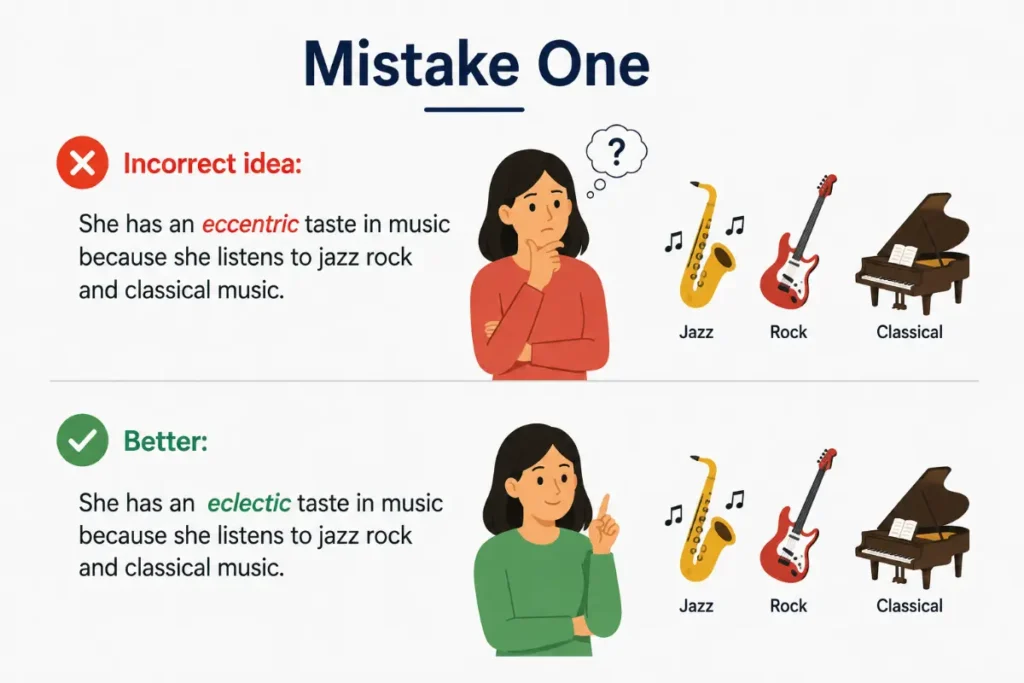
Mistake One
Incorrect idea:
She has an eccentric taste in music because she listens to jazz rock and classical music.
Better:
She has an eclectic taste in music because she listens to jazz rock and classical music.
The issue is that the sentence describes variety rather than unusual behavior.
Mistake Two
Incorrect idea:
The professor is eclectic because he wears strange clothes and talks to himself.
Better:
The professor is eccentric because he wears unusual clothes and behaves in unconventional ways.
The description focuses on unusual behavior.
Mistake Three
Incorrect idea:
The museum has an eccentric collection of paintings from different artistic traditions.
Better:
The museum has an eclectic collection of paintings from different artistic traditions.
The collection draws from several sources and styles.
Mistake Four
Incorrect idea:
He is an eclectic person who behaves strangely at every meeting.
Better:
He is an eccentric person who behaves strangely at every meeting.
The word describes his unusual behavior.
Mistake Five
Incorrect idea:
Her eclectic personality includes wearing unusual costumes every day.
Better:
Her eccentric personality includes wearing unusual costumes every day.
If the focus is on unusual personal behavior then eccentric is the stronger choice.
For another common grammar confusion, see Miss vs Missed Meaning Grammar and Usage 2026.
Regional Usage
American English
Both words are standard in American English.
Eccentric is commonly used to describe unusual personalities habits behavior ideas and styles.
Eclectic is commonly used to describe varied tastes collections designs interests and influences.
There is no major American spelling difference that separates the two words.
British English
Both words are also standard in British English.
Their meanings remain essentially the same. British speakers use eccentric for unusual behavior and eclectic for varied selections or influences.
The distinction is semantic rather than regional.
Australian English
Australian English also uses both words with the same basic meanings.
You may encounter eccentric in descriptions of unusual people or behavior. Eclectic commonly appears in discussions of art music design culture and personal taste.
Canadian English
Canadian English follows the same general distinction.
There is no major regional rule that makes one word correct and the other incorrect.
The important point is that the difference isn’t an American versus British spelling issue. It is a meaning issue.
Real Life Usage
Daily Conversation
People often use eccentric in casual conversations about unusual personalities.
My uncle is a little eccentric.
That neighbor has some eccentric habits.
Eclectic is common when discussing personal interests.
Her taste in movies is pretty eclectic.
He has an eclectic collection of records.
Workplace Communication
Both words can appear in professional writing when the context calls for them.
An editor might describe an author’s style as eclectic if the work combines influences from several traditions.
A profile writer might call a creative director eccentric because of unusual habits or unconventional ideas.
In professional writing it helps to choose the word carefully because each one carries a different message.
Academic Writing
Eclectic often appears in academic discussions of approaches theories and influences.
For example:
The researcher used an eclectic approach that combined ideas from several fields.
Eccentric can appear in academic writing when discussing personality culture art history or technical subjects.
For example:
The novel presents an eccentric character whose behavior challenges social expectations.
News And Journalism
Journalists often use eccentric to make a person sound distinctive or unusual.
The eccentric inventor became a local celebrity.
Eclectic is useful when describing culture art entertainment or consumer taste.
The festival offered an eclectic mix of music and food.
Literature And Storytelling
Writers can use eccentric to create memorable characters.
An eccentric character may have unusual habits strange beliefs or unexpected ways of speaking.
Eclectic can help describe a character’s tastes.
A character might have eclectic musical interests or an eclectic collection of books.
The two words can add detail without requiring a long explanation.
Related Terms
Understanding nearby words can sharpen the distinction.
Unconventional
Unconventional means different from the usual way of doing things.
It is close to eccentric but doesn’t always suggest unusual personality traits.
Unusual
Unusual simply means not common or expected.
It is broader than eccentric.
Quirky
Quirky describes something unusual in an interesting or slightly amusing way.
It can overlap with eccentric in descriptions of personality.
Individualistic
Individualistic describes someone who strongly follows their own ideas or style.
It can describe a person without suggesting that the person is strange.
Diverse
Diverse means showing a range of different types or qualities.
It can overlap with eclectic when discussing collections or influences.
Varied
Varied means containing different kinds or forms.
It is often close to eclectic when describing interests tastes or collections.
Unorthodox
Unorthodox means not following traditional or accepted methods.
It can be close to eccentric when describing unusual ideas or behavior.
Assorted
Assorted means made up of different kinds or types.
It is useful for collections but usually lacks the personal and stylistic meaning of eclectic.
How To Remember The Difference
A simple memory trick can save you from mixing them up.
Think of eccentric as standing outside the center.
An eccentric person stands outside the usual social pattern. Their behavior catches your attention because it doesn’t follow the norm.
Now think of eclectic as selecting.
An eclectic person selects from many different sources. Their taste may include things that don’t normally appear together.
You can remember it with two short phrases.
Eccentric means unusual.
Eclectic means many influences.
Another useful trick is to picture two rooms.
Room A contains one strange chair shaped like a giant shoe. The chair is eccentric.
Room B contains a modern sofa a Persian rug a wooden cabinet and colorful modern art. The room is eclectic.
That mental picture makes the distinction much easier to recall.
Can Someone Be Both
Yes.
A person can be eccentric and eclectic at the same time.
Imagine a musician who dresses in unusual clothes speaks in unconventional ways and collects music from dozens of cultures and genres.
Their behavior may be eccentric.
Their musical taste may be eclectic.
The two words describe different sides of the same person.
This is an important point because some readers assume that using both words together is contradictory. It isn’t. The words can complement each other when they describe separate qualities.
For example:
The eccentric musician had an eclectic taste in music.
The sentence works because eccentric describes the musician’s personality while eclectic describes the range of musical preferences.
Eccentric In Formal Writing
Eccentric is acceptable in formal writing when the meaning is appropriate.
You might use it in an essay about a fictional character an artist a historical figure or a social movement.
The word can sound slightly judgmental in some contexts. If you want a more neutral description you might choose unconventional distinctive or individualistic.
For example:
The artist had an eccentric approach to color.
This sentence suggests something unusual.
The artist had an unconventional approach to color.
This sounds somewhat more neutral and academic.
The best choice depends on the tone you want.
Eclectic In Formal Writing
Eclectic works comfortably in formal and academic contexts.
It is especially useful when describing an approach that combines ideas from different sources.
For example:
The course takes an eclectic approach to language instruction.
That means the course draws on several methods rather than following one single system.
The word is also common in writing about architecture art literature music and culture.
An eclectic architectural style may combine features from several historical periods. An eclectic literary style may draw on different traditions and techniques.
Expert Editor Insight
An experienced editor looks at the idea behind the sentence before looking at the spelling. If the writer is describing someone who behaves in an unusual way eccentric is likely the right choice. If the writer is describing a mixture of influences or a wide range of tastes eclectic is usually better. A useful editing test is to replace the word with unusual or varied. If unusual fits naturally choose eccentric. If varied fits better choose eclectic.
Why People Confuse These Words
The confusion is understandable because the words share several surface features.
Both begin with similar letters.
Both often appear in writing about artists designers writers musicians and other creative people.
That overlap creates a mental shortcut. A reader may recognize the general idea of something being distinctive but fail to notice the specific meaning.
Pronunciation can also contribute to the problem. The words have similar rhythm and both contain the strong sound in the middle.
The best solution isn’t to memorize the spelling alone. Learn the meaning pair.
Eccentric points to unusual behavior.
Eclectic points to varied sources.
Once that distinction becomes familiar the words are much easier to use.
A Simple Decision Test
When you’re writing and you hesitate between the two words use this quick test.
- Are you describing unusual behavior or personality?
Choose eccentric.
- Are you describing a wide range of tastes or influences?
Choose eclectic.
- Are you describing a collection made from different sources?
Use eclectic.
- Are you describing something strange or unconventional?
Choose eccentric.
- Are you describing a person whose habits seem unusual?
Choose eccentric.
- Are you describing an approach that combines several methods?
Use eclectic.
This test works because it focuses on meaning instead of appearance.
Examples That Show The Contrast
Compare these pairs carefully.
She has an eccentric personality.
She has eclectic interests.
The first sentence describes her character.
The second describes the range of things she enjoys.
The artist is eccentric.
The artist’s work is eclectic.
The first sentence describes the person.
The second describes the variety of influences in the work.
He chose an eccentric outfit.
He has an eclectic wardrobe.
The first sentence suggests that the outfit itself is unusual.
The second suggests that his wardrobe contains many different styles.
The professor has eccentric habits.
The professor uses an eclectic teaching approach.
Again the first describes unusual behavior. The second describes a method built from different sources.
Frequently Confused Contexts
Some contexts make the distinction especially important.
Art
An eccentric artist behaves or presents themselves in an unusual way.
An eclectic artist may combine different artistic traditions or techniques.
Music
An eccentric musician may have an unusual personality or stage presence.
An eclectic musician may enjoy or create music influenced by many genres.
Interior Design
An eccentric room may contain unusual or unexpected design choices.
An eclectic room combines different styles in one space.
Literature
An eccentric character behaves in an unconventional way.
An eclectic writing style draws from different literary traditions.
Education
An eccentric teacher may use unusual teaching habits.
An eclectic teaching approach combines methods from different educational traditions.
These examples show how context helps determine the correct word.
Is Eclectic A Synonym For Eccentric
No.
The words can overlap when talking about distinctive people but they are not synonyms.
Eccentric means unusual or unconventional.
Eclectic means selecting from a broad range of sources.
A person’s eclectic taste may be unusual but the word itself doesn’t mean strange.
Likewise an eccentric person may have very narrow interests. Their personality can be eccentric even if their tastes aren’t varied.
This distinction is small in spelling but large in meaning.
Is Eccentric Always Negative
No.
Eccentric can be negative neutral or even positive depending on the context.
Calling someone eccentric may suggest that they are strange. It can also suggest that they are creative independent memorable or delightfully unconventional.
For example:
The eccentric inventor never followed traditional methods.
That sentence can sound admiring.
In another context:
His eccentric behavior made the staff uncomfortable.
Here the tone is more critical.
Context and surrounding language determine the emotional effect.
Is Eclectic Always Positive
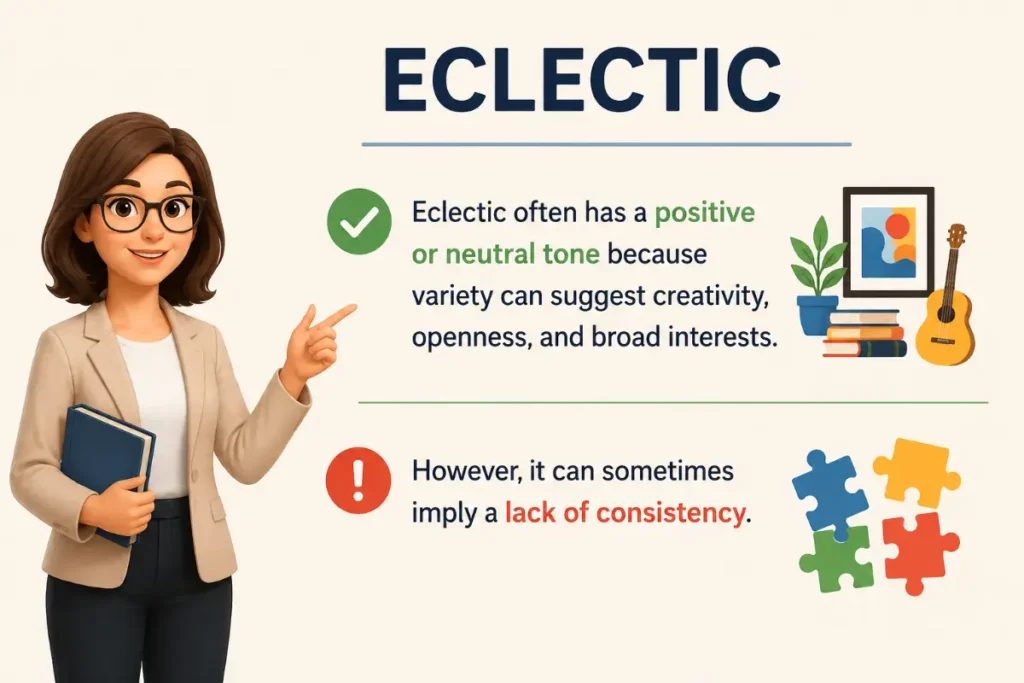
Not necessarily. Eclectic often has a positive or neutral tone because variety can suggest creativity openness and broad interests. However it can sometimes imply a lack of consistency. For example: The collection is eclectic. This is usually neutral or positive. The design is so eclectic that the room feels disconnected. Here the variety may be presented as a weakness. Again context controls the tone.
For another common grammar confusion, see Courtesy Vs Curtesy Which Word Should You Use in 2026.
Final Takeaway
Eccentric vs eclectic becomes simple once you focus on the central meaning of each word. Eccentric describes someone or something unusual unconventional or outside the ordinary pattern. Eclectic describes tastes styles collections or approaches that draw from many different sources.
Use eccentric when the main idea is unusualness. Use eclectic when the main idea is variety. An eccentric person may behave in an unexpected way while an eclectic person may enjoy a wide range of music art books or ideas. The two words can describe the same person but they highlight different qualities. The easiest editing trick is to replace the word mentally with unusual or varied. If unusual fits choose eccentric. If varied fits choose eclectic.
FAQs
Is eccentric a real word?
Yes. Eccentric is a standard English word. It can function as an adjective meaning unusual or unconventional. It can also function as a noun for a person whose behavior is notably unconventional. The word appears in everyday English as well as formal writing and specialized technical contexts.
Is eclectic a real word?
Yes. Eclectic is also a standard English word. It is mainly an adjective used for things that combine ideas styles tastes or influences from different sources. Common phrases include eclectic taste eclectic style eclectic collection and eclectic approach.
Which is correct eccentric or eclectic?
Both are correct. They simply have different meanings. Use eccentric for something unusual or unconventional. Use eclectic for something that draws from a variety of sources. The correct choice depends on the idea you want to communicate rather than on spelling preference.
How do you pronounce eccentric?
Eccentric is commonly pronounced ik SEN trik. Its IPA pronunciation is /ɪkˈsɛntrɪk/. The strongest stress falls on the second syllable. Say the word slowly as three parts and place the strongest emphasis on sen.
How do you pronounce eclectic?
Eclectic is commonly pronounced ih KLEK tik. Its IPA pronunciation is /ɪˈklɛktɪk/. The main stress falls on the second syllable. The middle sound is especially noticeable and helps distinguish it from eccentric when spoken clearly.
Can eclectic describe a person?
Yes but usually it describes a person’s tastes interests or choices rather than their personality. You can say someone has eclectic interests or eclectic taste. If you mean that the person behaves in a strange or unconventional way eccentric is the better word.
Why do people confuse eccentric and eclectic?
People confuse them because the words look and sound similar. Both have three syllables and both can appear in discussions about creative people and distinctive styles. Their meanings differ though. Eccentric focuses on unusualness while eclectic focuses on variety and different sources.
Is eccentric appropriate in formal writing?
Yes. Eccentric can appear in formal writing when it accurately describes unusual behavior character ideas or style. In some contexts it may sound slightly judgmental. If you need a more neutral tone you can use words such as unconventional or distinctive when they express the intended meaning.