
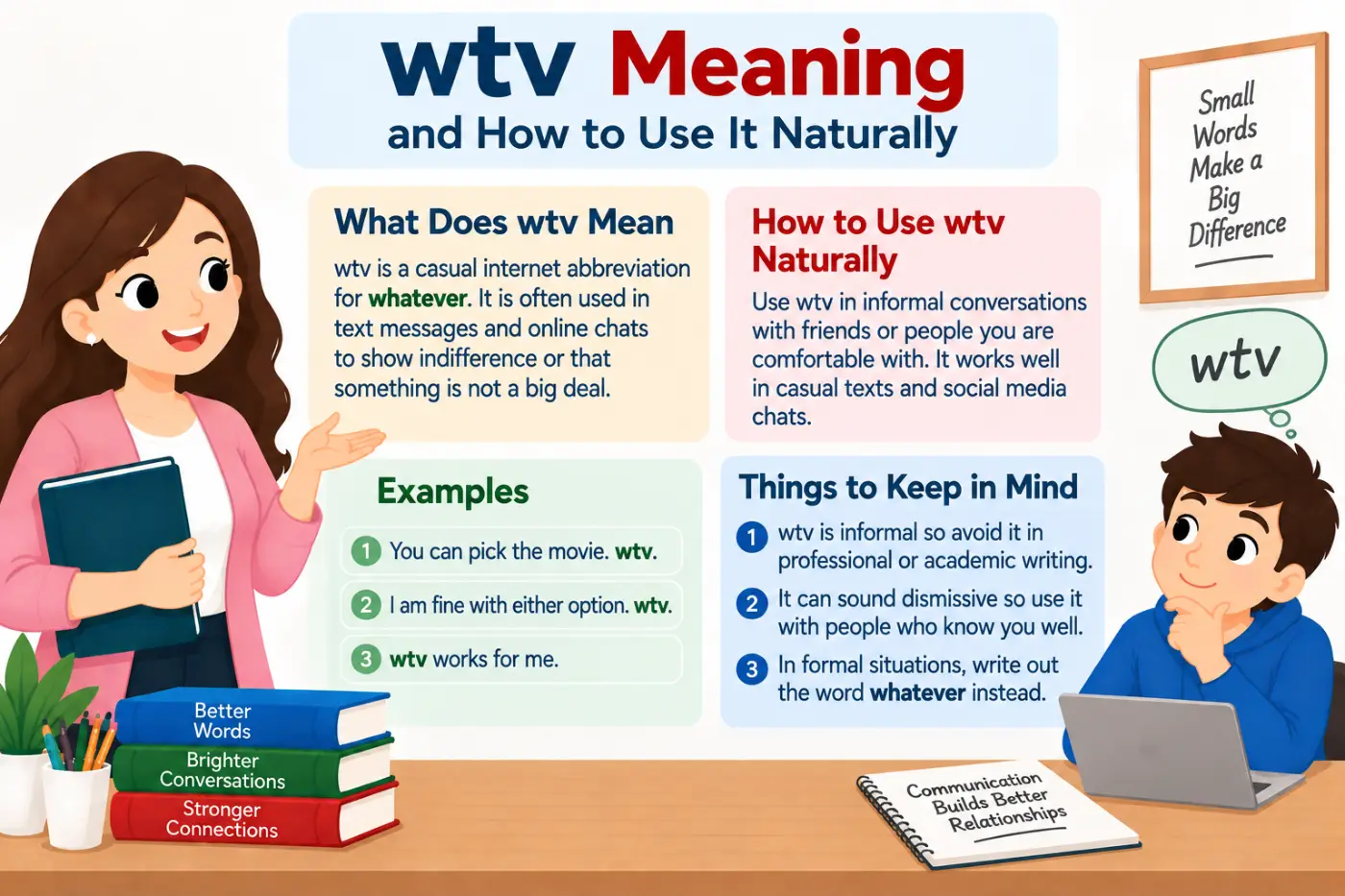
wtv meaning is usually simple once you know the context. Wtv is an informal abbreviation of whatever, and people mainly use it in texts chats comments and social media messages. Depending on the situation it can mean anything whatever you want or I don’t really care.
The tricky part isn’t the definition. It’s the tone. A short message such as wtv can sound relaxed and harmless between close friends but it can also sound dismissive annoyed or sarcastic in a serious conversation. The meaning often depends on what came before it and how the people involved normally communicate.
You’ll most often see this abbreviation in fast digital conversations where people shorten familiar words to type less. This guide explains what the abbreviation means how people use it what tone it can carry and how it compares with similar expressions. You’ll also find realistic examples grammar guidance pronunciation tips regional usage and advice for knowing when the short form works and when writing the full word is a better choice.
For another common grammar confusion, see employer name meaning And How To Enter It Correctly.
Quick Definition
Wtv is a casual abbreviation of whatever. It is commonly used in texting online chats social media and informal messages to express indifference agreement with any choice or a lack of concern. Its tone can range from relaxed to dismissive depending on the conversation and relationship between the speakers.
Quick Answer
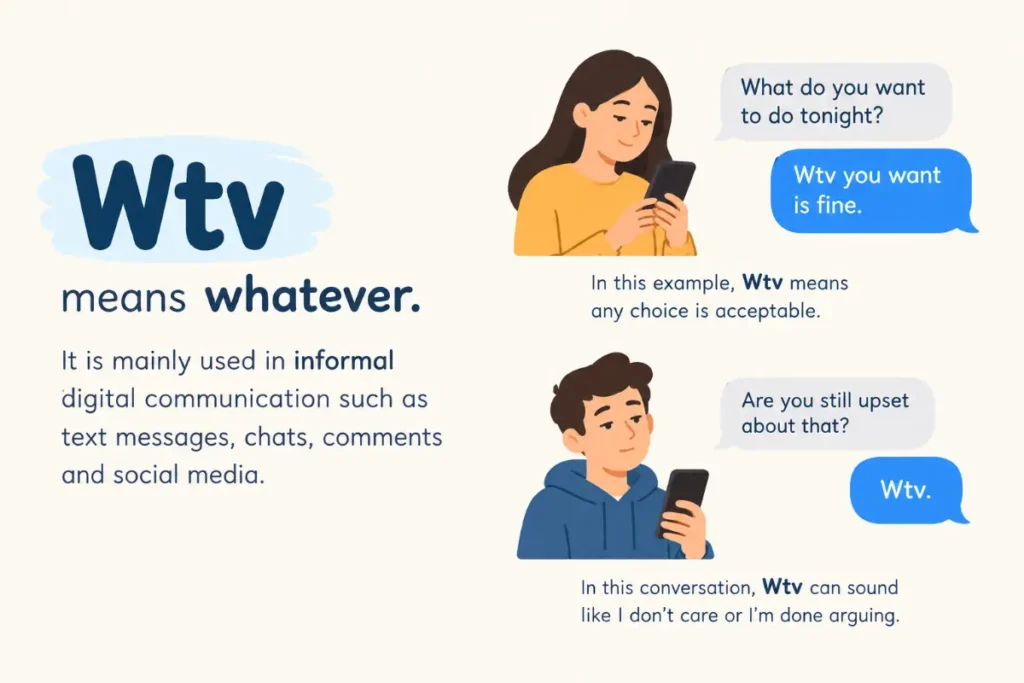
Wtv means whatever. It is mainly used in informal digital communication such as text messages chats comments and social media. For example someone might text Wtv you want is fine to mean that any choice is acceptable. In another conversation Wtv can sound like I don’t care or I’m done arguing.
Comparison Table
| Form | Meaning | Part of Speech | Origin | Usage Frequency | Formality | Common Contexts | Example |
|---|---|---|---|---|---|---|---|
| Wtv | Whatever | Informal abbreviation | Shortened digital form of whatever | Common in informal online communication | Very informal | Texts chats comments social media | Wtv you decide is fine. |
| Whatever | Any thing or choice or an expression of indifference | Pronoun adjective determiner or conjunction depending on use | Established English word | Very common | Neutral to informal | Conversation writing speech and digital communication | Whatever you choose is fine. |
| Whatever | An expression meaning I do not care | Interjection in informal use | Developed from the ordinary word whatever | Common in speech and informal writing | Informal | Arguments casual conversation online messages | Whatever. I’m not arguing anymore. |
Meaning and Definition
What the abbreviation means
Wtv is simply a shortened written form of whatever. It belongs to the large group of internet and texting abbreviations created to make communication faster and more compact.
Unlike a formal abbreviation used in academic or professional writing wtv is strongly associated with casual communication. You may see it in a message from a friend or in a social media comment. You generally would not use it in a formal letter a school essay a business report or an official request.
The word whatever has several meanings in standard English. The abbreviation can reflect several of them too.
It can mean any option.
Wtv works for me.
Here the writer is saying that any option is acceptable.
It can also express indifference.
Wtv. Do what you want.
In this case the writer sounds less interested. Depending on context the message may feel irritated or dismissive.
It can also appear as part of a longer sentence.
Wtv happens next we’ll deal with it.
Here the shortened form carries the general idea of whatever happens.
The surrounding words matter greatly. A two or three letter abbreviation gives the reader very little emotional information. That means the same expression can feel friendly in one conversation and rude in another.
The standard word behind it
Whatever is a much more flexible word than its short digital form.
It can function as a pronoun.
Whatever you choose is fine.
It can work as a determiner.
Choose whatever book you want.
It can also introduce a clause.
Whatever happens we’ll be ready.
In informal speech it can act almost like an interjection.
Whatever.
That final use is where tone becomes especially important. Spoken with a light voice it can sound playful. Spoken sharply it can communicate annoyance or dismissal.
The abbreviation inherits that flexibility but is much less formal.
Is it slang or an abbreviation
Wtv is best described as an informal abbreviation used in digital communication. It can also be called texting slang because it belongs to the informal language style common in online messaging.
It isn’t a new English word with an independent dictionary meaning. Its meaning comes from whatever.
That distinction matters. If someone asks what wtv means they are usually asking about a digital abbreviation rather than a separate vocabulary item.
Key Differences Explained
- Length. Whatever is the full word. Wtv is a shortened digital form.
- Formality. Whatever works in almost any setting. Wtv is mainly suitable for informal communication.
- Meaning. Both can express ideas connected with any choice or indifference depending on context.
- Tone. The short form can feel more casual and sometimes more dismissive than the full word.
- Pronunciation. Whatever is pronounced as a normal English word. Wtv is usually understood as written letters or interpreted as whatever rather than spoken as a conventional word.
- Context. Wtv is most natural in texting social media chats and casual online exchanges.
- Grammar. Whatever has several grammatical functions. Wtv usually replaces it in an informal written sentence.
- Regional usage. The abbreviation is not limited to one major English speaking region. Its use is tied more strongly to digital communication than geography.
- Standard English. Whatever is standard English. Wtv is an informal shortened form and shouldn’t be treated as a normal substitute in formal writing.
The biggest difference is register. Register simply means the style of language suited to a particular situation. Wtv belongs to a very casual register.
How People Use It in Texting
Texting has its own rhythm. People often leave out words punctuation and extra letters because the goal is quick communication.
Wtv fits that environment perfectly.
A friend might ask:
Do you want pizza or burgers?
You might reply:
Wtv is fine.
The intended meaning is that either choice works.
Another person might write:
Wtv. I’m tired of talking about it.
That message has a very different tone. Here the writer probably means I don’t care anymore or I’m finished with this discussion.
The abbreviation can also soften a choice in some situations.
Wtv you want is okay with me.
This can mean you’re free to choose.
Still the short form doesn’t always make a message friendlier. Text has no facial expression or vocal tone so readers often interpret short replies based on context.
Compare these messages.
Wtv you want.
Wtv you want.
The words are nearly identical but the emotional effect can change because punctuation and surrounding signals influence how people interpret the message.
That’s one reason experienced texters use emojis extra words or the full word when they want to avoid sounding cold.
When Wtv Sounds Friendly
The abbreviation can be perfectly harmless between people who know each other well.
Imagine two friends planning a movie.
Which one should we watch?
Wtv you want.
That answer can simply mean I’m happy with your choice.
Another example might be:
Wtv works for me.
This sounds casual and flexible. The writer isn’t showing frustration. They’re saying that the proposed option is acceptable.
Context provides the missing emotional information.
Friends often use short forms without worrying about formal grammar. In a familiar conversation the reader already understands the writer’s personality and intent.
That shared understanding makes informal abbreviations easier to interpret.
When Wtv Sounds Rude
The same abbreviation can sound dismissive when used during conflict.
Consider this exchange.
I thought you said you were going to help me.
Wtv.
That response can easily sound like I don’t care what you think.
The problem isn’t the abbreviation alone. The surrounding situation creates the tone.
A short response after an argument can feel like a door closing. The writer may intend to end the conversation rather than continue explaining.
For that reason it’s wise to use the full word or a longer sentence when discussing something serious.
Instead of:
Wtv.
You might write:
I don’t want to argue about this anymore.
That message is much clearer. It tells the other person exactly what you mean without making them guess your emotional state.
Sentence Examples
Here are natural examples that show different uses.
- Wtv you choose is fine with me.
- Wtv happens we’ll figure it out.
- I’m okay with wtv you decide.
- Wtv works best for you.
- Wtv. I’m too tired to argue.
- We can eat wtv you want tonight.
- Wtv happens at the meeting I’ll let you know.
- Pick wtv movie you like.
- Wtv you need just send me a message.
- Wtv. Let’s talk about something else.
Notice how the meaning changes from flexible and cooperative to dismissive. The surrounding sentence is what tells you how to interpret the abbreviation.
Common Mistakes and Misunderstandings
Treating it as formal English
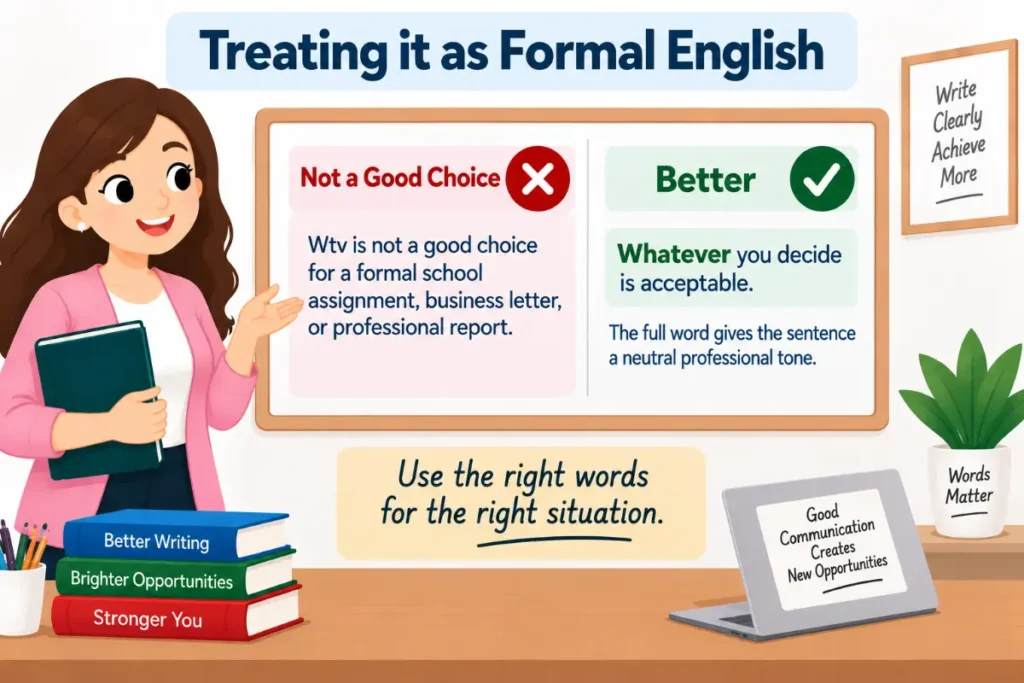
Wtv is not a good choice for a formal school assignment business letter or professional report.
Better: Whatever you decide is acceptable.
The full word gives the sentence a neutral professional tone.
Assuming it always means I don’t care
That interpretation is common but incomplete.
Wtv can mean any option is fine.
For example:
Wtv restaurant you choose works for me.
The writer isn’t necessarily annoyed. They may simply be giving the other person freedom to choose.
Using it during a serious disagreement
A short response can easily sound cold during an emotional conversation.
If you need to communicate clearly it’s better to explain the thought.
Instead of:
Wtv.
Try:
I understand your point but I don’t want to continue this argument.
Reading too much emotion into it
Not every use is rude. Some people use abbreviations constantly and may not intend any negative attitude.
You should consider the entire conversation before deciding what the writer means.
Assuming every short form works everywhere
Texting language has its own rules. An abbreviation that feels normal in a group chat can look careless in a job application.
Good communication means matching your language to your audience.
Pronunciation Guide
Wtv doesn’t have one universally established spoken pronunciation in everyday English.
When people encounter it in writing they normally interpret it as whatever. In some conversations people may refer to the letters individually but that depends on personal speaking habits.
The full word whatever is commonly pronounced in American English as /wʌtˈɛvər/.
A simple pronunciation guide is:
wut EV er.
The strongest stress generally falls on the middle syllable.
The word has three main syllables in ordinary American pronunciation.
what ever is a useful way to begin practicing it though natural speech often reduces the sounds.
The short form itself is mainly a visual abbreviation. That’s why you’ll see it far more often in writing than you’ll hear someone actually say it aloud.
If you’re reading a message containing wtv out loud the most natural approach is usually to say whatever.
Many readers also check grisly vs grizzly: Correct Spelling, Meaning and Usage.
Etymology and Word Origin
The abbreviation comes from the English word whatever.
Whatever developed from the combination of what and ever. The word has been part of English for centuries and has served several grammatical functions over time.
The modern digital abbreviation is much newer. Like many texting forms it emerged from informal written communication where speed and brevity matter.
There isn’t a single moment when wtv can be said to have entered everyday language. Digital abbreviations develop gradually as users shorten familiar expressions.
The same basic process appears in many texting forms. Writers remove vowels or shorten familiar words while keeping enough letters for readers to recognize the intended expression.
Wtv works because whatever is highly familiar. Most readers can reconstruct the full word from the three letters without difficulty.
This is an example of how context allows people to communicate efficiently even when the written form is heavily shortened.
Regional Usage
American English
Wtv is used in American digital communication, especially among people who are comfortable with texting and online slang. It can appear in private messages group chats comments and social platforms.
American users generally understand it as a shortened form of whatever. The exact emotional tone depends heavily on context.
The full word remains the better choice in formal American English.
British English
British English speakers can also understand and use wtv in informal digital communication. Its use is linked more to texting culture than to a distinct British grammatical pattern.
There is no major British meaning that differs from the common informal meaning.
Australian English
Australian users may encounter the abbreviation in casual online conversations as well. The basic meaning remains whatever.
As with other English varieties the short form is informal rather than a standard formal replacement for the full word.
Canadian English
Canadian English users also understand the abbreviation in casual digital settings. The meaning normally matches its use in American British and Australian online communication.
There is no important Canadian spelling distinction attached to this abbreviation.
Overall its use is better understood as a feature of informal digital communication than as a regional variety of English.
Grammar Rules and Part of Speech
The full word whatever has several grammatical roles.
It can act as a pronoun.
Whatever you choose is fine.
Here whatever refers to an unspecified thing or choice.
It can also act as a determiner.
Take whatever seat you want.
In this sentence it comes before the noun seat and identifies an unrestricted choice.
Whatever can introduce a clause.
Whatever happens next we’ll handle it.
It can also function informally as an expression of dismissal.
Whatever.
That last use is especially important for understanding messages. The grammar becomes less important than the conversational function.
Wtv usually mirrors these uses in informal writing.
For example:
Wtv you want is fine.
Wtv can stand in for whatever within the sentence.
Still there’s an important difference between grammatical possibility and appropriate writing. Just because people understand a shortened form doesn’t mean it belongs in every setting.
In formal English the full word is the clear choice.
Punctuation
Punctuation depends on the sentence.
Wtv can appear without punctuation in quick messages.
Wtv is fine.
It can also appear as a standalone response.
Wtv.
That period can make the message feel firmer or colder than the same letters without punctuation.
Compare:
Wtv
Wtv.
The second version may sound more final because the punctuation reinforces the feeling of ending the conversation.
In informal messaging people may use emojis or additional words to clarify intent.
Wtv you want 😊
That extra signal can make the message feel warmer.
Formal and Informal Usage
The most useful rule is simple.
Use the full word in formal writing.
Use the abbreviation only when the communication is clearly casual.
A school essay should normally use whatever.
A job application should use whatever.
A business email should use whatever.
A text to a close friend may naturally use wtv.
A casual group chat may also use it.
The choice is less about correctness and more about register. Formal writing expects established words and clear sentences. Informal texting allows shortened forms because readers already understand the communication style.
Think of it like clothing. A text to your best friend is a relaxed setting. A formal application is not. The language should fit the occasion.
Real Life Usage Examples
Daily Conversation
Wtv you want to eat sounds natural in a casual message between friends.
Wtv happens tonight we’ll deal with it tomorrow also fits relaxed communication.
These examples show the flexible side of the abbreviation.
Workplace Communication
A casual message to a close coworker might contain the abbreviation if the workplace culture allows it.
Wtv time works for me.
Still a professional email would usually sound better as:
Whatever time works for you is fine with me.
The second version is clearer and more polished.
Academic Writing
Academic writing should normally use the full word rather than the abbreviation.
Whatever explanation best fits the evidence should be considered.
Using wtv in an academic paper would make the writing look informal and out of place.
News Writing
News writing also favors standard forms.
Whatever decision officials make will affect the next stage of the process.
A shortened texting form would not normally fit a conventional news article.
Literature and Storytelling
A fictional character can use wtv in dialogue when the writer wants to reflect casual digital speech.
She texted back wtv and put her phone down.
Another character might write:
Wtv you decide I’ll go along with it.
Here the abbreviation helps show the character’s informal communication style.
This is a good reminder that informal language isn’t necessarily bad language. Writers use it deliberately to make dialogue sound believable.
Related and Confused Terms
Whatever
Whatever is the full standard word behind the abbreviation. It can express unrestricted choice or indifference depending on context.
IDK
IDK means I don’t know. It communicates uncertainty rather than indifference.
For example:
IDK what movie to watch.
That means the person doesn’t know what to choose.
IDC
IDC means I don’t care. This is much closer to the dismissive sense of whatever.
Because of that overlap the two can sometimes appear in similar conversations.
TBH
TBH means to be honest. It usually introduces a candid opinion.
TBH I don’t like that idea.
It doesn’t have the same meaning as whatever.
NVM
NVM means never mind. People use it when they want to withdraw a question or say that something is no longer relevant.
For example:
NVM I found it.
IMO
IMO means in my opinion. It signals that the writer is sharing a personal view.
IMO this is the better option.
It has a completely different function from whatever.
FYI
FYI means for your information. It introduces information the reader may need to know.
FYI the meeting starts at three.
Again this is informational rather than dismissive.
Whatever you want
This full phrase is a useful alternative when you want to express flexibility without relying on slang.
Whatever you want works for me.
It sounds clearer and less abrupt than a very short digital reply.
Why Tone Matters So Much
Digital communication removes many clues that people rely on during face to face conversation.
When someone says whatever aloud you can hear their voice. You can notice a smile a sigh a pause or an irritated tone.
A text message gives you only words on a screen.
That changes how short expressions are interpreted.
For example:
Wtv is fine.
Could mean I’m happy with anything.
It could also mean I’m annoyed and don’t want to discuss this.
The reader has to infer the emotion from the surrounding conversation.
This is why punctuation word choice emojis and extra context matter in texting.
Compare:
Wtv you want is fine with me 😊
with:
Wtv.
The first message clearly suggests flexibility. The second can feel like a conversation has hit a wall.
If you’re unsure how your message will sound consider adding a few words. Clear communication often beats extreme brevity.
Is It Appropriate for Social Media
Yes. Wtv can fit naturally on social media because platforms often encourage short informal communication.
Someone might comment:
Wtv makes you happy.
Another person might reply:
Wtv 😂
The meaning depends on the interaction.
Still context matters. A public comment can be interpreted by people who don’t know your usual tone. A message that feels funny among friends might seem rude to strangers.
If you want to sound neutral and respectful use the full word.
Is Wtv Rude
Not automatically.
Wtv can be neutral when it means any choice is acceptable.
For example:
Wtv restaurant you pick is fine.
But it can sound rude when it stands alone after a disagreement.
Wtv.
In that context the reader may hear I don’t care or stop talking about it.
Tone depends on context relationship punctuation and the rest of the message. There is no single emotional meaning that applies every time.
A useful communication rule is to avoid very short dismissive replies when the topic is important. A few extra words can prevent unnecessary tension.
Expert Editor Insight
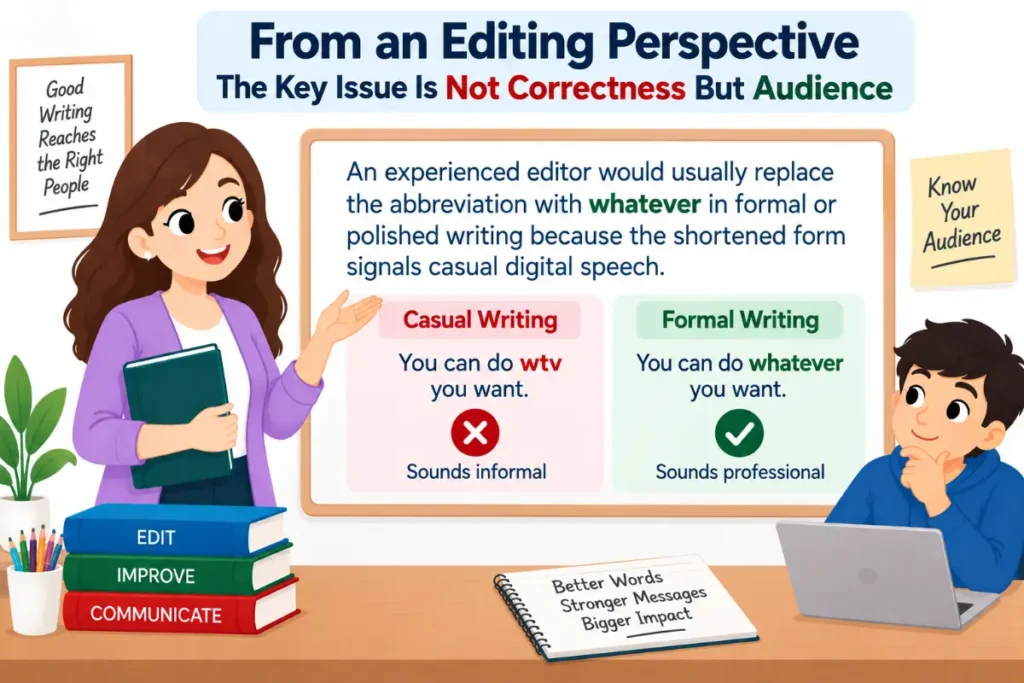
From an editing perspective the key issue is not correctness but audience. An experienced editor would usually replace the abbreviation with whatever in formal or polished writing because the shortened form signals casual digital speech. Spellcheck tools may recognize the full word more reliably than the abbreviation and some writing systems may flag the short form as informal. The best practical test is to read the sentence as if it were going into a professional email. If it would look too casual there use the full word. Save the abbreviation for conversations where that relaxed tone is expected.
For another common grammar confusion, see dsl meaning And How DSL Internet Works.
Conclusion
Wtv meaning comes down to one simple idea. Wtv is an informal abbreviation of whatever and people mainly use it in texts chats social media and other casual digital conversations. It can mean any choice is fine or express indifference depending on the situation.
The full word is much more flexible and works in formal as well as informal English. The abbreviation has a narrower role because its casual style can affect how a message feels. A friendly Wtv you want can show flexibility while a standalone Wtv can sound dismissive during an argument.
The best practical rule is to match the language to the audience. Use the short form with people who understand your casual texting style. In school work professional emails and formal writing use whatever. A few extra letters can make your meaning much clearer.
FAQs
What does wtv mean in texting?
Wtv is an informal abbreviation of whatever. In texting it can mean any option is acceptable or it can express indifference. The exact meaning depends on context. For example Wtv you want is fine usually means the person is happy with your choice. A standalone Wtv after an argument may sound dismissive and can mean I don’t care.
Is wtv considered slang?
Wtv is generally treated as an informal texting abbreviation or piece of digital slang. It comes directly from the standard English word whatever. People mainly use it in text messages chats social media comments and other casual settings. It isn’t normally appropriate for formal writing such as academic papers business reports job applications or official correspondence.
Does wtv mean whatever?
Yes. Wtv is a shortened form of whatever. The abbreviation doesn’t usually have a separate meaning of its own. Depending on context whatever can express an unrestricted choice or a feeling of indifference and the shortened form can carry those same ideas. The surrounding words and tone determine which interpretation makes the most sense.
Can wtv sound rude?
Yes. A standalone wtv can sound dismissive or annoyed especially during an argument. However the abbreviation isn’t automatically rude. In a friendly conversation Wtv you want can simply mean that the other person is free to choose. Because text messages lack vocal tone and facial expressions readers may interpret very short replies differently from what the writer intended.
What is the difference between wtv and IDC?
Wtv usually means whatever while IDC means I don’t care. They can overlap when someone wants to show indifference but they aren’t identical. Wtv can also express flexibility such as Wtv movie you want is fine. IDC is more direct and specifically states that the writer doesn’t care about something.
Can you use wtv in formal writing?
It’s best to avoid wtv in formal writing. Use whatever instead in school assignments professional emails reports applications academic papers and official documents. The full word is clear and standard across English varieties. The abbreviation belongs mainly to casual digital communication where shortened forms are expected. Choosing the full word keeps your writing polished without changing the meaning.
How do you pronounce wtv?
Wtv is mainly a written abbreviation so it doesn’t have one fixed spoken pronunciation. Most readers mentally expand it to whatever. The full word is commonly pronounced /wʌtˈɛvər/ in American English. If you’re reading a message aloud it will usually sound most natural to say whatever rather than trying to pronounce the three letters as a new word.
Why do people use wtv instead of whatever?
People use wtv because texting and online communication often favor speed and brevity. The abbreviation saves space and is easy for familiar readers to understand. It can also make a message feel casual and relaxed. The tradeoff is that the shorter form can sometimes sound colder or more dismissive than the full word so context matters.