
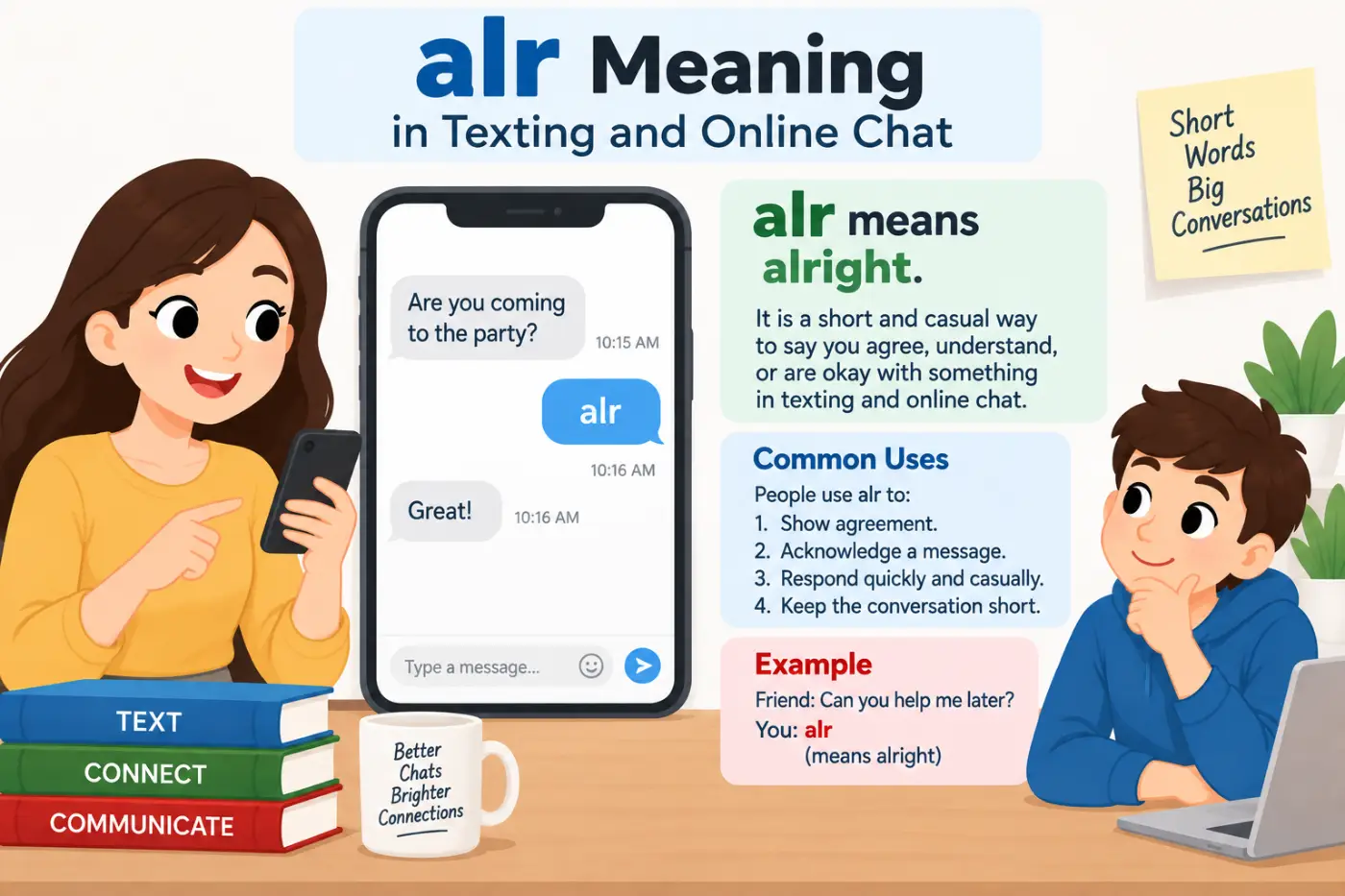
The alr meaning is usually simple once you see it in context. In texting and online chat, ALR most often means alright or all right. People use it as a quick way to say okay, agree with something, show they understand, or let someone know everything is fine.
You may have seen a message like Alr I’ll be there soon and wondered why someone suddenly used three letters instead of writing the whole word. There’s no hidden meaning in most cases. It’s simply informal internet shorthand that saves time and keeps a conversation moving. The tone can change slightly depending on the message, punctuation, and situation. A friendly alr sounds good feels different from a short alr sent after an argument.
In this guide, you’ll learn what ALR means, how people use it in real conversations, how it differs from alright and all right, and when you should avoid it. You’ll also see natural examples, pronunciation guidance, related texting terms, and practical advice for using informal abbreviations appropriately.
Learn the difference in How The Turntables Meaning Origin And Correct Usage 2026.
Quick Definition
ALR is an informal abbreviation most commonly used in texting and online communication to mean alright or all right. Depending on context it can express agreement acceptance reassurance or acknowledgment. It’s generally casual and is best suited to messages and informal conversations rather than formal school or professional writing.
Quick Answer
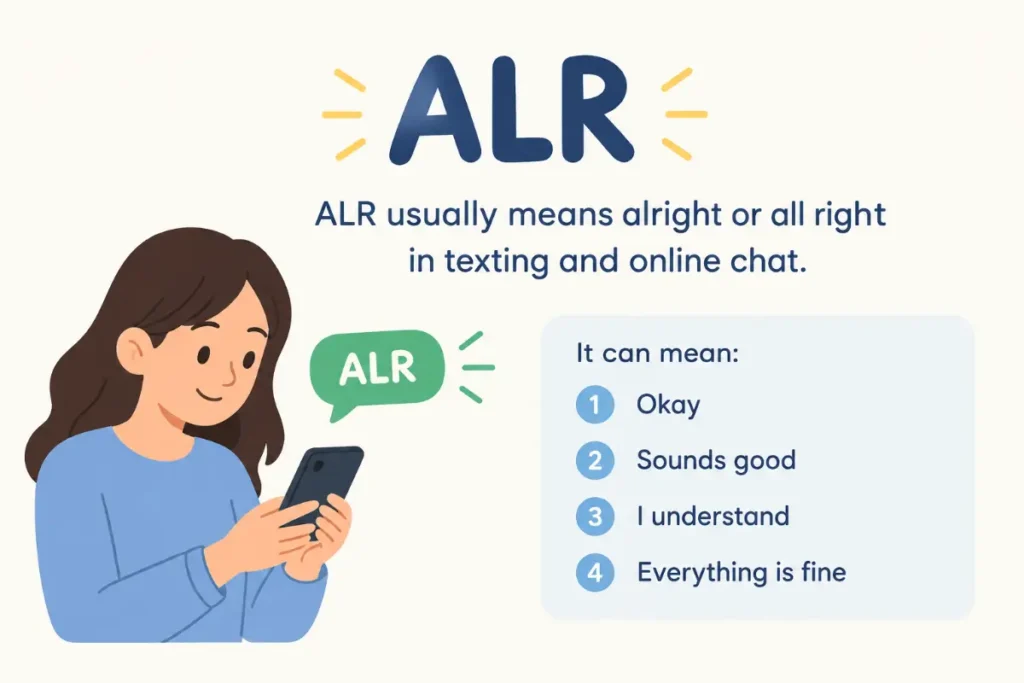
ALR usually means alright or all right in texting and online chat. It can mean okay sounds good I understand or everything is fine depending on the conversation.
For example someone might text Alr I’ll meet you at seven. Here the abbreviation simply means Alright I’ll meet you at seven.
What Does ALR Mean?
The most common expansion is alright or all right.
In everyday texting the abbreviation can perform several conversational jobs. Someone might use it to agree with a suggestion.
Alr sounds good.
They might use it to acknowledge information.
Alr I got it.
They might also use it as reassurance.
Alr don’t worry about it.
The basic idea is simple but the emotional tone can change. Text communication doesn’t give you facial expressions voice pitch or body language. As a result short messages can sometimes feel more serious than the sender intended.
For instance alr can sound perfectly friendly between close friends.
Alr see you later.
But a message such as Alr. can feel more abrupt because the short response provides little emotional information. The period may add a sense of finality even though the abbreviation itself remains neutral.
That’s why context matters more than the letters alone.
Why People Use This Abbreviation
Texting has its own rhythm. People often want to respond quickly without typing every letter of every word. Abbreviations make that possible.
ALR is especially convenient because the intended phrase is already obvious in most casual conversations. Instead of typing alright or all right a person can type three letters and move on.
Several forces encourage this kind of shorthand.
- Speed. Shorter messages take less time to type.
- Casual tone. Abbreviations can make a conversation feel relaxed and informal.
- Digital habits. People who spend a lot of time texting or chatting online become familiar with shortened forms.
- Context. Friends often understand abbreviated language without needing every word written out.
- Character limits. Some online environments have historically encouraged shorter messages.
This doesn’t mean every shortened form belongs in every situation. Language changes with context. The same person who types alr to a friend may write alright in an email to a professor or manager.
Is ALR a Word or an Abbreviation?
ALR is better understood as an informal abbreviation or piece of texting shorthand rather than a standard English word.
The distinction matters because abbreviations don’t always follow ordinary spelling rules. They often represent a longer expression through a small group of letters.
For example ASAP represents as soon as possible and IDK represents I don’t know. In the same broad world of digital communication ALR can represent alright or all right.
The abbreviation doesn’t replace the standard spelling in formal English. Instead it serves as a convenient shortcut in informal communication.
You can think of it as a compressed version of familiar language. The meaning remains connected to the original expression even though most of the letters have disappeared.
Meaning Changes With Context
Although the basic meaning stays close to alright the conversational purpose can change.
Agreement
Someone may use it to accept a plan.
Alr we can go after lunch.
Here it means something like okay or sounds good.
Acknowledgment
It can simply show that the person received your message.
Alr I understand.
In this case the speaker isn’t necessarily agreeing. They’re showing that they understood the information.
Reassurance
It can also tell someone that a situation is fine.
Alr we still have plenty of time.
The meaning is close to okay or everything is fine.
Acceptance
Sometimes it signals that someone accepts a decision even if they aren’t excited about it.
Alr I’ll do it your way.
Tone becomes especially important here. Depending on the conversation this could sound cooperative or slightly reluctant.
Ending a Conversation
A short response can also signal that the person has nothing more to add.
Alr take care.
That usage is usually friendly but concise.
Comparison Table
| Form | Meaning | Part of Speech | Origin | Usage Frequency | Formality | Common Contexts | Example |
|---|---|---|---|---|---|---|---|
| ALR | Alright or all right | Informal abbreviation | Digital and texting shorthand | Common in casual online communication | Very informal | Texting chats social media gaming | Alr I’ll be there soon. |
| Alright | Okay or satisfactory | Adjective or adverb depending on use | Modern English form related to all right | Common | Informal to neutral | Conversation messages general writing | Everything is alright. |
| All right | Okay satisfactory or acceptable | Adjective or adverbial phrase | Traditional English phrase | Very common | Neutral and formal | Conversation school work professional writing | Everything is all right. |
| Okay | Agreement acceptance or satisfactory | Interjection adjective noun or adverb depending on use | English borrowing from American usage | Extremely common | Informal to neutral | Conversation writing messages | Okay I understand. |
ALR Compared With Alright
ALR and alright usually communicate the same basic idea in casual messages but they don’t have the same level of formality.
Alright is a recognizable English form that appears in everyday writing and speech. ALR is much more closely tied to digital shorthand.
Consider these examples.
Alr I’ll call you later.
Alright I’ll call you later.
The meaning is essentially the same. The difference is presentation.
The first feels like a quick text. The second looks more like ordinary written English.
In a professional email the second option would usually be the better choice. In a conversation with a close friend the first may feel completely natural.
ALR Compared With All Right
All right is the traditional two word expression. It can mean okay satisfactory correct or safe depending on context.
Are you all right?
Here the phrase asks if someone is okay.
All right let’s start.
Here it introduces agreement or a transition.
ALR can represent either of these ideas in casual digital communication but it can’t always reproduce the full nuance of the original phrase.
That’s one reason context matters.
If someone texts alr? after you tell them about a problem they may be asking if you’re okay with the situation. If someone writes alr let’s go they’re more likely expressing agreement or readiness.
Grammar and Language Function
Because ALR is an abbreviation of alright or all right it doesn’t have one fixed grammatical role in every message. Its function depends on the phrase it represents.
When it means okay it may work like an interjection.
Alr I’ll help you.
It can also function as a quick response.
Alr.
In that situation the message works conversationally rather than behaving like a complete traditional sentence.
The expanded form has more flexible grammatical possibilities.
She is alright.
Here alright describes her condition.
All right let’s leave.
Here all right works as an expression that signals agreement or transition.
The abbreviation strips away much of this visible grammar. That’s normal for texting language.
Sentence Examples
Here are natural examples of how people might use the abbreviation in casual communication.
- Alr I’ll meet you outside.
- Alr sounds good to me.
- Alr I understand what you mean.
- Alr give me five minutes.
- Alr we can talk later.
- Alr I’ll send it tonight.
- Alr don’t stress about it.
- Alr see you tomorrow.
- Alr that works for me.
- Alr I got you.
The expanded forms would usually use alright or all right depending on the intended style.
Alright I’ll meet you outside.
All right I understand.
Alright that works for me.
The abbreviation is most natural when the surrounding conversation is already informal.
Examples in Different Situations
Texting a Friend
Alr I’m almost home.
The message is short and casual. There’s no need for formal wording between friends.
Group Chat
Alr everyone I’ll bring the snacks.
Here it functions as a quick acknowledgment of a plan.
Gaming Chat
Alr one more round.
The abbreviation keeps the message fast. In a game people often prioritize speed over complete sentences.
Social Media
Alr that was actually funny.
A user may use the abbreviation as part of a casual reaction.
Private Message
Alr I’ll check and let you know.
It can make the message feel relaxed and conversational.
Common Mistakes
Assuming ALR Has Only One Meaning
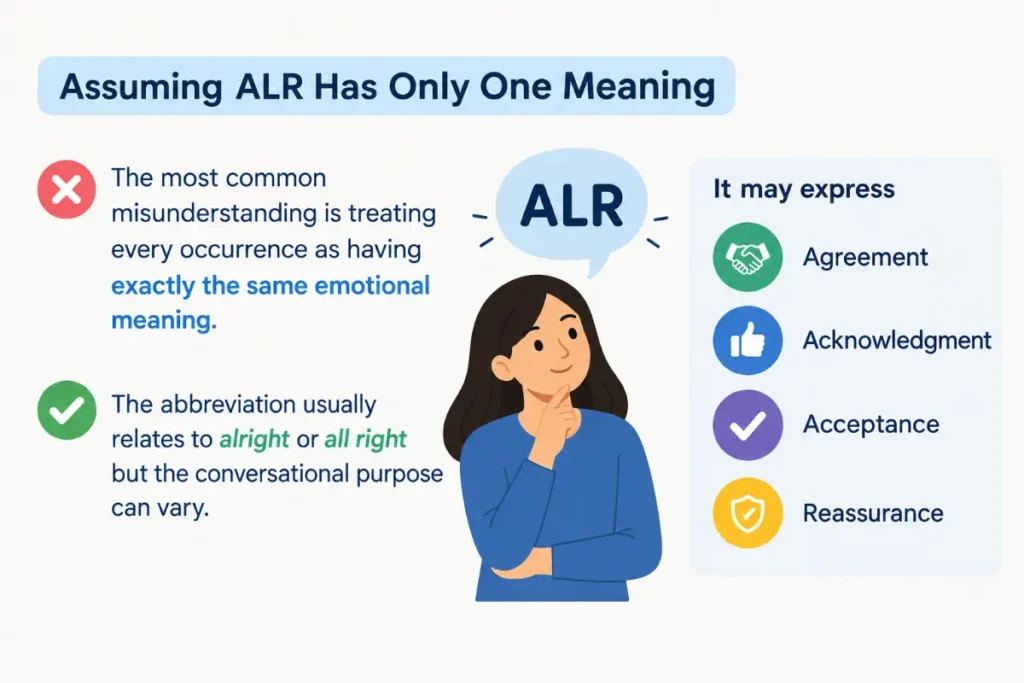
The most common misunderstanding is treating every occurrence as having exactly the same emotional meaning.
The abbreviation usually relates to alright or all right but the conversational purpose can vary. It may express agreement acknowledgment acceptance or reassurance.
Always read the surrounding sentence.
Using It in Formal Writing
ALR is casual shorthand. Using it in a school essay business report formal letter or professional application can make the writing look careless.
Use alright or all right instead when the setting calls for standard written English.
Reading a Short Reply as Anger
A message such as Alr. can seem cold. However the sender may simply be typing quickly.
Digital communication removes many social cues. Don’t automatically assume irritation from the abbreviation alone.
Look at the rest of the conversation.
Assuming All Online Abbreviations Are Universal
Not every person knows every texting abbreviation. Age social group platform and personal habits can affect familiarity.
If someone doesn’t understand a shortened form there’s nothing wrong with writing the full phrase.
Confusing It With Unrelated Initialisms
ALR can appear in specialized contexts as an abbreviation for other terms. The surrounding subject determines the intended meaning.
In ordinary texting the interpretation is usually alright or all right. In technical professional or specialized material the same letters can have another expansion.
Pronunciation Guide
ALR usually isn’t pronounced as a separate word in ordinary conversation. If someone says the letters aloud they may pronounce them individually as A L R.
When the abbreviation appears in a text message it is generally understood as the spoken phrase alright or all right.
For alright a common American pronunciation is approximately:
awl RIGHT
The stress normally falls on the second part.
For all right the pronunciation is very similar:
awl RIGHT
The abbreviation therefore represents the meaning and function of the longer phrase rather than creating a completely new spoken sound.
You generally wouldn’t read a text such as Alr I’ll call you as A L R I’ll call you in normal conversation. You’d understand it as Alright I’ll call you.
For another common grammar confusion, see legal department plan for smarter legal operations.
Is ALR Formal or Informal?
ALR is strongly informal.
That doesn’t make it bad English. It simply means the form belongs to a particular communication setting.
Informal language is useful. Friends don’t normally speak to each other like legal documents. Texting also encourages short quick responses.
The problem appears when an informal abbreviation moves into a context that expects standard written English.
Good Contexts
- Text messages.
- Private chats.
- Casual social media conversations.
- Gaming chats.
- Informal group conversations.
- Messages between friends.
Contexts to Avoid
- Academic essays.
- Job applications.
- Business reports.
- Formal letters.
- Professional proposals.
- Official documents.
- Customer service communication when a polished tone is expected.
A simple rule works well. If you’d normally proofread the message carefully before sending it then spell out the expression.
American English Usage
In the United States ALR can appear in casual texting and online communication as shorthand for alright or all right.
It belongs to informal digital language rather than standard formal prose. American users may choose it because it’s quick and because their conversation partner already understands the abbreviation.
There is no need to use it simply because someone else does. Digital language is flexible. If you prefer writing alright or all right your message remains perfectly natural.
British English Usage
British English speakers also use online abbreviations but familiarity can vary from person to person. The underlying expressions alright and all right are both familiar in British English.
The abbreviation ALR is not a special British spelling. It belongs to informal digital shorthand.
A British user may understand it immediately in a text while another reader may prefer the complete expression.
Australian English Usage
Australian English has a strong tradition of informal conversational language and digital communication uses many abbreviations. Still ALR should be understood as informal shorthand rather than a formal Australian spelling.
The standard expressions alright and all right remain the appropriate choices in conventional writing.
Canadian English Usage
Canadian English follows the same general pattern. ALR can appear in casual digital conversations while alright and all right are used in ordinary written English.
There is no major Canadian spelling rule that changes the meaning of the abbreviation.
The main difference is context rather than geography.
Etymology of the Underlying Expression
The abbreviation itself is relatively modern because it belongs to the world of digital shorthand. Its exact history as a texting form is less important than understanding the older expression behind it.
All right is an established English phrase that has been used for a long time. It combines all with right and developed meanings connected with being satisfactory correct safe or acceptable.
Alright developed as a combined written form. Its use has sometimes been debated in edited English but it is now a familiar form in general usage.
ALR is much shorter. It represents a later stage of informal abbreviation where users remove letters that aren’t needed for the reader to recover the intended meaning.
This process is common in digital communication. The goal isn’t to create a new dictionary word. The goal is to make a familiar phrase quicker to type and recognize.
When ALR Can Sound Different
One of the interesting things about short digital expressions is that punctuation and context can change the emotional impression.
Compare these messages.
Alr sounds good.
Alr I’ll do it.
The first sounds friendly and cooperative.
The second sounds like acceptance.
The third may feel abrupt because it ends the conversation without additional detail.
The fourth can sound neutral or slightly irritated depending on the previous messages.
None of these meanings is fixed. Text has fewer emotional signals than face to face conversation. Readers therefore use punctuation word choice previous messages and relationship clues to interpret tone.
This is why you shouldn’t treat an abbreviation as having one permanent emotional value.
ALR in Social Media and Online Culture
Internet language changes quickly. Users create shortenings because digital communication rewards speed and familiarity.
An abbreviation can spread within a community and become immediately understandable to people who spend time there. Another person might see the same letters and have no idea what they mean.
That doesn’t mean one reader is wrong. It simply shows that informal language depends heavily on shared context.
Social media also makes written conversation resemble speech. People write fragments reactions and shortened expressions that they might say aloud.
ALR fits that pattern. It feels less like formal writing and more like a quick conversational response.
This distinction helps explain why you may see it frequently online but rarely in carefully edited articles.
Related Texting Expressions
OK
OK is one of the closest alternatives. It can express agreement acknowledgment or acceptance.
OK I’ll be there.
Okay
It is the fully written conversational form and works in many informal and neutral situations.
Okay I understand.
Sure
It can express agreement or willingness.
Sure I can help.
Yep
It is an informal way to say yes.
Yep that works.
Got It
It signals understanding.
Got it I’ll send the file.
Sounds Good
It expresses agreement with a suggestion or plan.
Sounds good I’ll see you there.
Fine
Fine can mean acceptable or satisfactory but tone matters. In some situations it may sound less enthusiastic.
Fine we can leave now.
All Right
It is the traditional phrase behind much of the abbreviation’s meaning.
All right I’m ready.
These alternatives are not perfect substitutes in every sentence. Each has its own tone. Choosing the right one depends on what you want the message to communicate.
What ALR Means in Different Types of Messages
A Simple Agreement
Alr I’ll come with you.
Meaning: Okay I’ll come with you.
Acknowledging Information
Alr thanks for telling me.
Meaning: Okay I understand or I received the information.
Accepting a Request
Alr I’ll finish it tonight.
Meaning: Okay I’ll do it.
Showing Reassurance
Alr we have enough time.
Meaning: Everything is okay.
Closing a Conversation
Alr talk to you tomorrow.
Meaning: Okay talk to you tomorrow.
The same three letters can therefore perform several conversational functions. The common thread is acknowledgment or acceptance.
Should You Use ALR at Work?
That depends on the relationship and the communication channel.
In a casual workplace chat between coworkers who regularly use informal language it may be understood without difficulty. Even then you should consider the tone you want.
In a formal email to a manager client recruiter professor or customer it’s better to write the complete expression.
Compare these.
Alr I’ll send the report today.
Alright I’ll send the report today.
The second looks more polished and requires no interpretation.
For important professional communication clarity usually wins over speed.
Should You Use It in School Writing?
Generally no.
An essay research paper assignment application or formal school document should use standard written English. Texting abbreviations can make the writing appear overly casual.
That doesn’t mean you should avoid learning them. Understanding informal language is part of understanding how English works in real life.
You simply need to separate the language of a group chat from the language expected in an academic paper.
Expert Editor Insight
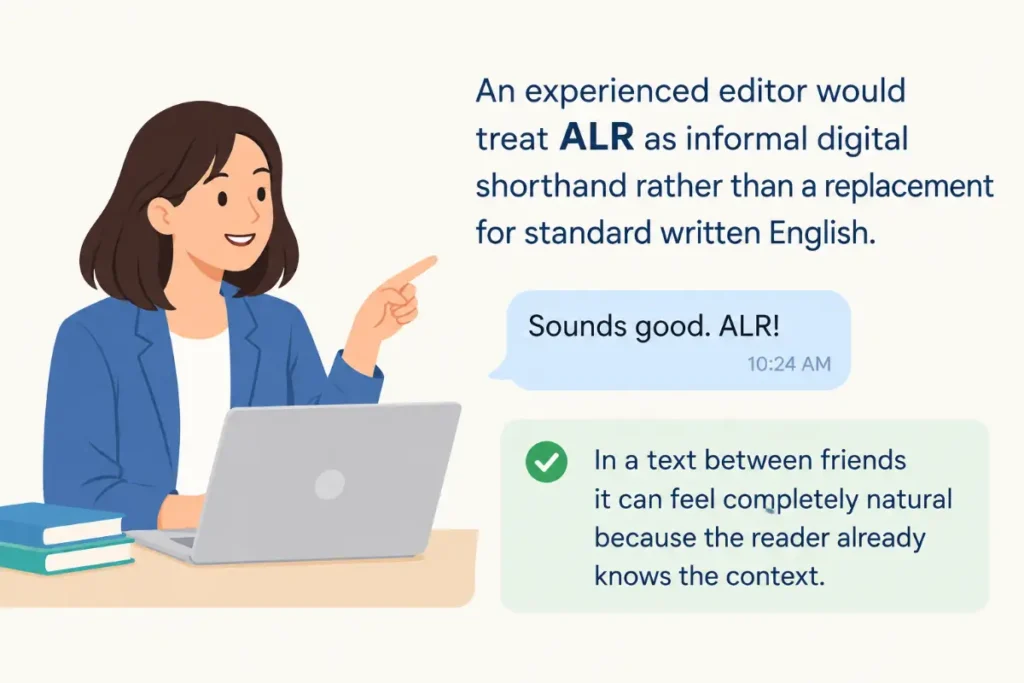
An experienced editor would treat ALR as informal digital shorthand rather than a replacement for standard written English. In a text between friends it can feel completely natural because the reader already knows the context. In polished writing the editor would usually replace it with alright or all right because the full expression is clearer and better suited to the setting. Spellcheck tools may flag the abbreviation because it isn’t part of a standard dictionary vocabulary list. The best editing tip is to think about the reader first. If the reader expects a formal document use the full phrase. If the conversation is casual and the meaning is obvious the abbreviation may fit naturally.
Learn the difference in hy meaning in text and chat.
Conclusion
The alr meaning most people want to know is simple. In texting and online chat it usually stands for alright or all right and can mean okay sounds good I understand or everything is fine. The exact meaning depends on the surrounding conversation and the tone of the message.
This abbreviation belongs to informal digital communication. It can work naturally in texts chats gaming conversations and social media but it usually doesn’t belong in academic essays formal documents or polished professional emails. In those settings writing the complete expression makes your message clearer and more appropriate.
The easiest way to understand ALR is to replace it mentally with alright or all right and then read the sentence again. If the expanded phrase makes sense you’ve probably understood the message correctly. When you’re writing instead of reading simply choose the full phrase when the situation calls for a professional tone.
FAQs
What does ALR mean in texting?
ALR usually means alright or all right in texting. Depending on context it can communicate okay agreement acknowledgment acceptance or reassurance. For example Alr I’ll be there means Alright I’ll be there. The exact emotional tone depends on the surrounding conversation. A short response may sound casual while punctuation or previous messages can make it seem more abrupt.
Is ALR slang or an abbreviation?
ALR is best described as informal texting shorthand or an abbreviation. It isn’t normally treated as a standard English word. People use it to shorten alright or all right in casual digital communication. It can appear in text messages online chats gaming conversations and social media. Its informal nature makes it less suitable for carefully edited professional or academic writing.
Does ALR mean alright or all right?
It can represent either alright or all right because the two expressions share closely related meanings. In a casual message the distinction usually doesn’t matter. A person typing Alr I understand is communicating the same basic idea as Alright I understand or All right I understand. The intended meaning comes from the surrounding sentence and conversation rather than the abbreviation itself.
Is ALR appropriate in formal writing?
ALR is generally too informal for formal writing. Avoid it in academic essays business reports job applications official documents and other writing that requires a polished tone. Use alright or all right instead. In a casual message to a friend the abbreviation is perfectly understandable. The best choice depends on your audience and the level of formality expected in the situation.
How do you pronounce ALR?
When someone encounters ALR in a message they normally interpret it as alright or all right rather than pronouncing the three letters as a new word. If the letters are read individually they can be pronounced A L R. In ordinary conversation the expanded phrase is more natural. Alright is commonly pronounced close to awl RIGHT in American English.
Can ALR mean something else?
Yes. Like many abbreviations ALR can have different meanings in specialized settings. The intended definition depends on context. In ordinary texting and casual online communication it most commonly represents alright or all right. In technical professional or organizational contexts the same letters may stand for another phrase. Look at the surrounding subject before deciding what the abbreviation means.
Why do people type ALR instead of alright?
People use ALR mainly because it is short and quick to type. Texting encourages compact language and familiar abbreviations can make conversations move faster. The reader can usually reconstruct the original phrase from just a few letters. It also gives messages a relaxed digital tone. Someone who regularly uses texting shorthand may type ALR automatically without thinking about the longer form.
Is ALR rude?
ALR is not inherently rude. Its tone depends on context punctuation and the relationship between the people communicating. Alr sounds good usually feels friendly and cooperative. A message containing only Alr. might seem abrupt or annoyed because it provides little information about the sender’s mood. Don’t judge the tone from the abbreviation alone. Consider the entire conversation before interpreting it.