
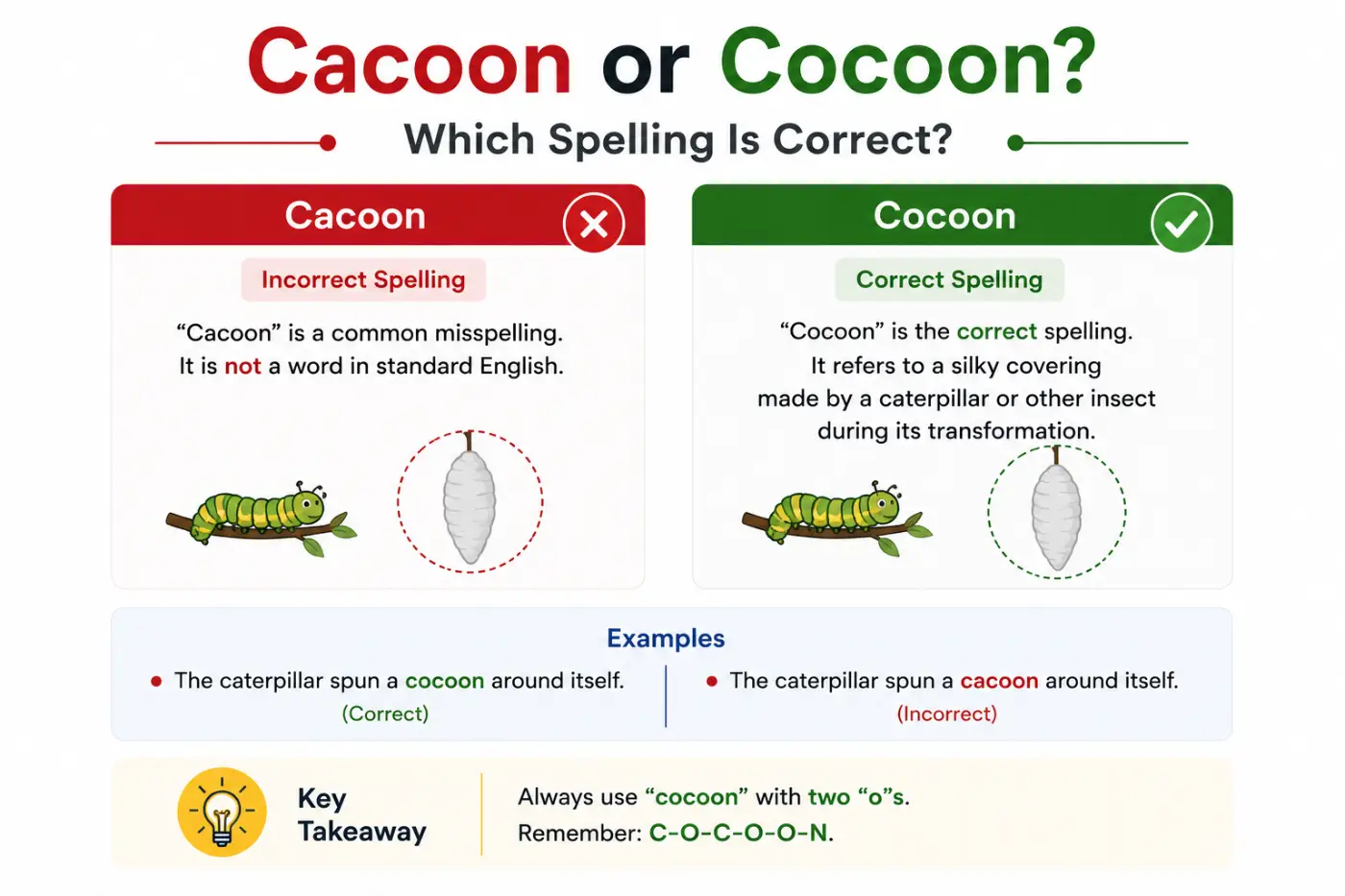
If you’re unsure about cacoon or cocoon you’re dealing with a very common spelling mixup. Cocoon is the correct standard English spelling. Cacoon is generally a misspelling of the word used for the protective covering made by certain insects and other animals.
The confusion is easy to understand because the two forms look remarkably similar. Both contain the same general consonant pattern and both can seem plausible when you spell the word from memory. The vowel in the middle is the part that usually causes trouble. English also contains many words with the letter a in similar positions so your brain may choose a familiar pattern even when it doesn’t match the standard spelling.
The correct word has several useful meanings. It can describe the silk or protective covering made by an insect before it becomes an adult. It can also describe a protected or isolated environment in a figurative sense. You’ll learn the meaning pronunciation grammar history common mistakes related expressions and natural examples so you can recognize and use the word confidently.
A related grammar guide is Blankie or Blanky (2026): Which Spelling Is Standard English?.
Quick Definition
Cocoon is the standard English spelling for a protective covering made by some insects during a stage of development. The word can also describe a person or place that provides protection or isolation. Cacoon is generally a misspelling when the intended word is cocoon.
Quick Answer
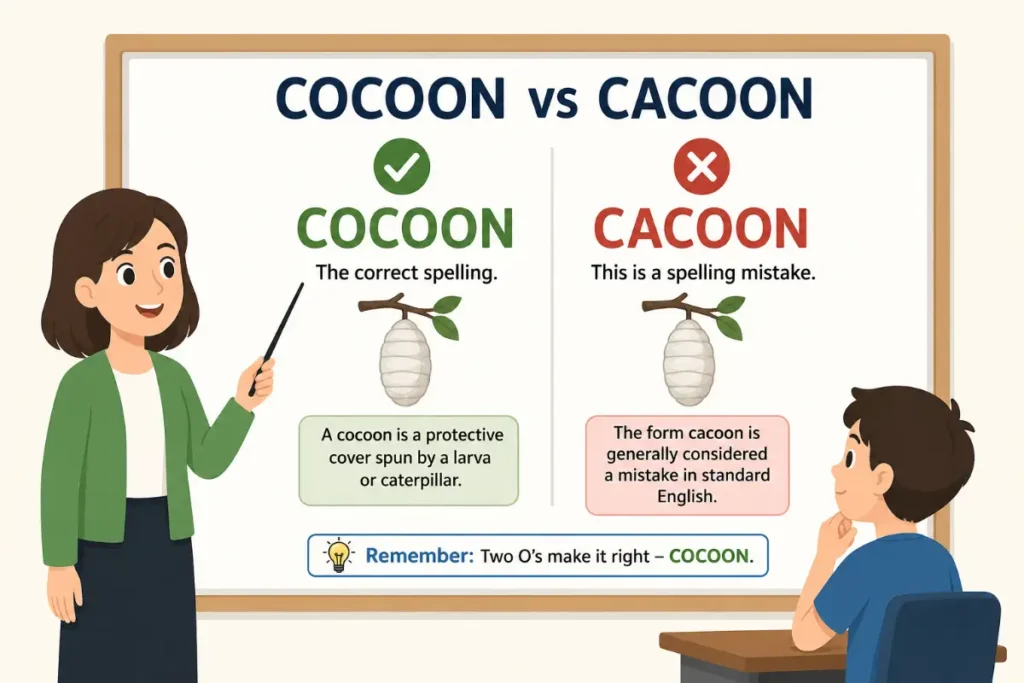
The correct spelling is cocoon. The spelling cacoon is normally incorrect when you mean the protective covering associated with insects.
Cocoon can be a noun or a verb. As a noun it describes the protective covering itself. As a verb it means to surround or protect something within a covering or sheltered environment.
Comparison Table
| Form | Meaning | Part of Speech | Origin | Usage Frequency | Formality | Common Contexts | Example |
|---|---|---|---|---|---|---|---|
| Cocoon | A protective covering made by certain insects or a protected environment | Noun and verb | French and Latin roots | Common | Neutral | Biology nature everyday speech figurative writing | The moth developed inside a cocoon. |
| Cacoon | Usually an incorrect spelling of cocoon | Nonstandard spelling | Not an established spelling of the intended word | Uncommon as a standard form | Not standard | Typing errors spelling mistakes informal writing | Cacoon should be corrected to cocoon. |
Meaning and Definition
Meaning of the Incorrect Form
Cacoon is generally not the standard spelling of the biological or figurative word that most writers intend. In ordinary English writing it is best understood as a spelling mistake rather than a separate word with its own established meaning.
You may see this form in search queries social media comments schoolwork informal messages or quickly written notes. A misspelling can become surprisingly familiar when many people make the same mistake. That familiarity doesn’t turn it into a standard spelling.
The error probably feels natural because the pronunciation of cocoon doesn’t strongly tell you which vowel belongs in the middle. If you’re spelling the word from memory you might reach for a because English has many words where similar sound patterns use different vowels.
There is another useful point here. Not every unusual spelling found online should automatically be corrected if it is functioning as a proper name username fictional term or specialized label. Context matters. If the writer means the biological structure or the figurative idea of a sheltered environment then cocoon is the standard choice.
For an essay report article email school assignment or professional document use cocoon.
Meaning of the Correct Form
Cocoon is primarily a noun. It refers to a protective covering produced by certain insects and other organisms during a stage of development.
A familiar example comes from moths. A caterpillar may spin a silk covering around itself before undergoing a major transformation. That protective structure is called a cocoon.
The word also has a broader figurative meaning. People sometimes describe themselves as being in a cocoon when they have created a safe private environment away from outside pressure.
For example:
She stayed home in a quiet cocoon of books and music.
Here the speaker isn’t talking about an actual insect structure. The word creates an image of comfort protection and separation from the outside world.
Cocoon can also function as a verb.
The fabric cocooned the sleeping baby.
In this sentence the verb describes something surrounding and protecting another thing.
The figurative verb is common too.
He cocooned himself from the noise outside.
This suggests that he created a sheltered space or withdrew from outside activity.
The central idea remains the same across these meanings. A cocoon provides some form of covering separation or protection.
Key Differences Explained
- Spelling. Cocoon is the standard spelling. Cacoon is normally a misspelling of that word.
- Meaning. Cocoon has established literal and figurative meanings. The incorrect form does not normally have a separate standard meaning in this context.
- Grammar. Cocoon can function as a noun and as a verb.
- Pronunciation. The word is commonly pronounced with stress on the second syllable. The middle vowel sounds like the vowel in book.
- Formality. Cocoon is suitable for everyday conversation as well as scientific educational professional and literary writing.
- Context. You may encounter it in biology nature writing personal essays storytelling psychology discussions and everyday speech.
- Regional usage. Major varieties of English use cocoon as the standard spelling.
- Standard usage. The established English form is cocoon. The alternative spelling is generally an error when referring to the same word.
The most important distinction is the vowel pattern. The correct form uses co at the beginning rather than ca.
Which Form Is Correct?
Cocoon is the correct standard spelling.
The word is established in English and appears in standard dictionaries as both a noun and a verb. The spelling begins with c o and continues with c o o n. The repeated o pattern is worth remembering because it’s the part that makes the word visually distinctive.
A useful spelling strategy is to separate the word into two simple sound and letter groups.
co + coon
The first part is co. The second part contains another coon sound. Seeing the structure this way can make the spelling easier to recall.
The incorrect form changes the first vowel from o to a. That single letter is enough to turn the standard word into a misspelling.
This is a good example of why spelling should not always be based entirely on pronunciation. English has many words where several vowel spellings can represent similar sounds. Visual memory and word structure often provide a better guide.
If you’re proofreading a sentence and see cacoon, check the intended meaning. If the writer means an insect covering or a protected environment then the standard spelling should be cocoon.
Sentence Examples
The following examples show how native English speakers naturally use the correct word.
- The caterpillar built a cocoon around itself before beginning its transformation.
- We found an empty cocoon attached to a branch in the backyard.
- The moth emerged from its cocoon during the night.
- The children learned how insects use a cocoon during their science lesson.
- She created a quiet cocoon of blankets and books on the rainy afternoon.
- After a stressful week he wanted to retreat into a comfortable cocoon at home.
- The soft fabric cocooned the baby while she slept.
- The small room felt like a peaceful cocoon away from the busy city.
- The insect remained inside its cocoon while its body changed.
- During the winter the cabin became a warm cocoon for the family.
These examples show an important feature of the word. Its literal meaning belongs to nature and biology while its figurative meaning often describes comfort privacy protection or isolation.
For spelling correction purposes the following examples show how the common mistake may appear.
- The moth emerged from its cacoon.
- The child drew a butterfly inside a cacoon.
- We found a cacoon hanging from the tree.
- The caterpillar formed a cacoon before changing.
- She described her bedroom as a peaceful cacoon.
In all five sentences the intended standard spelling is cocoon.
Common Mistakes and Misspellings
Writing Cacoon Instead of Cocoon
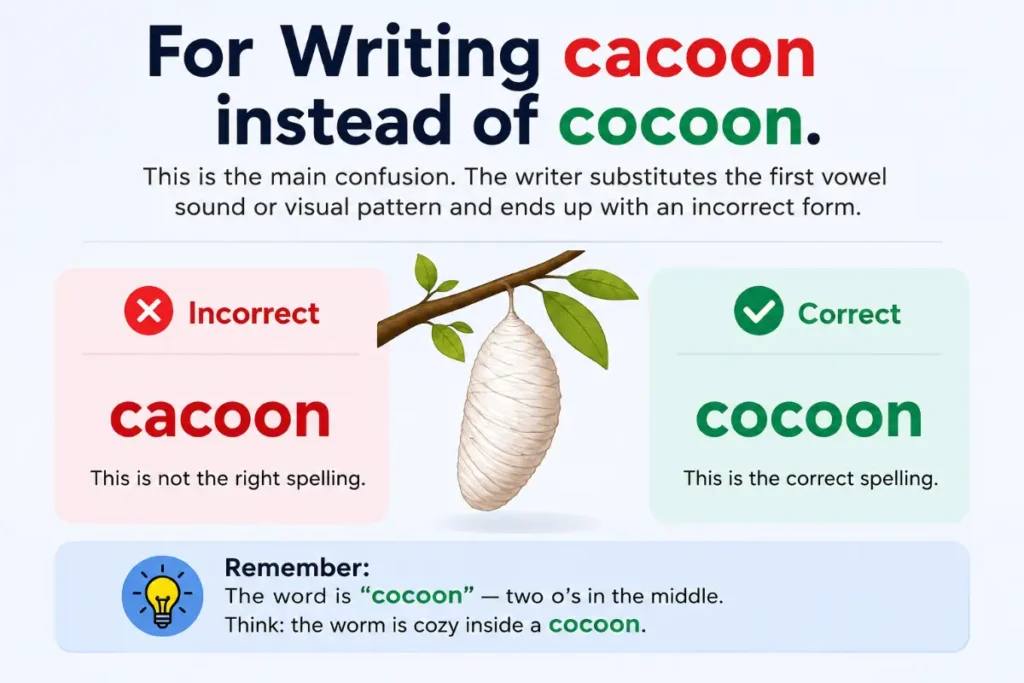
This is the central spelling error. Writers remember the general shape of the word but select a instead of o.
Incorrect: The insect built a cacoon.
Correct: The insect built a cocoon.
The error is particularly easy to make when writing quickly.
Using Cocooned as a Noun
Cocooned is the past form or participle of the verb cocoon. It should not replace the noun when you mean the protective covering itself.
Incorrect: The caterpillar was inside a cocooned.
Correct: The caterpillar was inside a cocoon.
The form cocooned describes an action or state.
Confusing Cocoon With Chrysalis
These words are related to insect development but they aren’t identical.
A chrysalis is the pupal stage of a butterfly and certain related insects. A cocoon is generally a protective covering spun by an insect such as a moth.
This distinction matters in biology. Calling every insect pupal covering a cocoon can make a sentence scientifically less precise.
Assuming Every Insect Makes a Cocoon
Not every insect creates a cocoon. Some insects have pupal stages without constructing a silk covering around themselves.
This is a useful example of why a familiar everyday word can have a more specific scientific meaning.
Treating Online Frequency as Proof of Correct Spelling
You may encounter cacoon repeatedly in online searches or user generated writing. That doesn’t establish it as a standard spelling.
Search engines often understand misspellings and infer the intended word. Human writers should still use the established form in polished text.
From an NLP perspective the issue is simple. A language system can use surrounding words to infer that a misspelled token probably refers to cocoon. Context helps recover meaning but it doesn’t change the spelling standard.
Pronunciation Guide
Cocoon is commonly pronounced /kəˈkuːn/.
You can think of it as two syllables.
kuh KOON
The main stress falls on the second syllable.
The first vowel is usually a relaxed sound similar to the beginning of words such as about. The second syllable has a long oo sound.
The pronunciation can be useful for understanding why the spelling causes confusion. The sound doesn’t clearly announce that the first vowel should be o. Someone spelling the word from memory may choose a different vowel and produce cacoon.
The second syllable sounds like koon. It rhymes closely with words that have the long oo sound such as moon.
A common mistake is placing too much stress on the first syllable. Standard pronunciation gives stronger emphasis to the second part.
Try saying the word naturally.
kuh KOON
Then connect the sound to the visual spelling.
CO COON
That small connection can make the written form easier to remember.
Etymology and Word Origin
Cocoon has an interesting history. The English word came through French and is ultimately connected with a Latin word associated with a shell or protective covering.
The French form cocon influenced the English spelling and pronunciation. English later developed the modern form cocoon.
The history fits the meaning well because the word describes a covering that surrounds and protects a developing organism.
Over time the word also gained figurative uses. Writers began using cocoon to describe people places or situations that provide shelter isolation or protection.
That figurative development is common in English. Physical objects often become metaphors for emotional or social experiences. A cocoon is an especially natural metaphor because it represents a temporary protected state before change or emergence.
The word therefore works on two levels.
In biology it describes a physical protective structure.
In everyday and literary language it can describe a sheltered state.
That connection makes the word memorable. A person who withdraws into a quiet private space can be compared to an organism inside a protective covering.
For another common grammar confusion, see Envolve vs involve: Correct Spelling and Usage.
Regional Usage
American English
Cocoon is the standard spelling in American English. It appears in biology lessons nature writing general conversation and figurative expressions.
American speakers also commonly use the verb form.
The thick blanket cocooned him on the couch.
The figurative sense can describe comfort privacy or withdrawal from outside activity.
British English
British English also uses cocoon as the standard form. There is no major spelling difference between British and American English for this word.
British writers use the noun in scientific and everyday contexts and the verb in figurative descriptions.
The spelling does not change to cacoon.
Australian English
Australian English uses cocoon as the standard spelling. The word can appear in discussions of insects wildlife gardening education and storytelling.
There is no established Australian spelling variant that replaces the first o with a.
Canadian English
Canadian English also uses cocoon. The spelling remains the same as in American and British English.
Canadian speakers and writers can use the word literally for an insect covering or figuratively for a protected personal environment.
Across these major English varieties the spelling is stable. The difference between the two forms is not a regional spelling issue.
Grammar Rules and Part of Speech
Cocoon can work as both a noun and a verb.
As a noun it names the protective covering.
The moth emerged from its cocoon.
Here cocoon is the object of the preposition from.
It can also be used with articles.
A cocoon hung from the branch.
The cocoon was small and pale.
Because it is a countable noun in this sense you can talk about a cocoon or several cocoons.
The plural form is cocoons.
We found three cocoons on the tree.
As a verb cocoon means to surround or enclose something in a protective covering. It can also describe withdrawing into a private sheltered environment.
The blanket cocooned the child.
She cocooned herself in her room for the weekend.
The verb can appear in several forms.
Cocoon.
Cocoons.
Cocooned.
Cocooning.
The context determines which form you need.
Another important point is the distinction between literal and figurative usage. Scientific writing usually uses the literal sense. Personal essays stories and lifestyle writing may use the figurative sense.
Punctuation doesn’t change the spelling. If the word begins a sentence you simply capitalize it.
Cocoon structures can protect developing insects.
If it appears in the middle of a sentence use lowercase unless another grammatical reason requires capitalization.
Real Life Usage Examples
Daily Conversation
People may use the word when talking about insects or describing a cozy private space.
I found a cocoon on the tree this morning.
After the long trip I just wanted to stay home in my little cocoon.
The first sentence uses the literal meaning. The second uses a metaphor.
Email and Workplace Communication
The word is less common in ordinary business writing but it can appear in creative professional communication.
The new office gives employees a quiet cocoon for focused work.
The product packaging creates a protective cocoon around the item.
In workplace writing the figurative sense can be effective when the comparison is clear. It’s best used when the image adds something useful rather than simply decorating the sentence.
Academic Writing
The word appears naturally in biology and environmental studies.
The insect remains inside the cocoon during an important stage of development.
Researchers observed several cocoons attached to the underside of the leaves.
In scientific writing precision matters. Writers should use cocoon only when the biological structure being described fits the term.
News and Journalism
Journalists may use the literal term in nature stories and the figurative meaning in human interest writing.
The nature center discovered several cocoons during its spring survey.
The quiet neighborhood became a cocoon of calm during the storm.
The second example uses metaphor to create a strong image for readers.
Literature and Storytelling
Writers often use cocoon as a metaphor for transformation.
She spent the winter in a quiet cocoon before returning to the outside world.
The old house became a cocoon where the family could escape the noise of the city.
The metaphor works because a cocoon suggests both protection and change. It isn’t simply a hiding place. It can suggest a temporary stage before something emerges.
Related and Confused Terms
Chrysalis
A chrysalis is the pupal stage of a butterfly and some related insects. People sometimes use cocoon and chrysalis as if they mean exactly the same thing but they can refer to different biological structures.
Pupa
Pupa refers to a developmental stage between larva and adult in insects that undergo complete metamorphosis. The pupa is the organism itself rather than simply the outer covering.
Larva
Larva describes an immature stage of an insect or another animal with a life cycle that includes a larval form. A caterpillar is the larval stage of a butterfly or moth.
Caterpillar
A caterpillar is the larval stage of a butterfly or moth. Some caterpillars later create protective coverings before reaching the adult stage.
Metamorphosis
Metamorphosis describes a major physical change during an organism’s development. Butterflies and moths are familiar examples.
Shell
A shell is a hard outer covering found in animals such as turtles mollusks and some eggs. It differs from a cocoon because it has a different biological structure and function.
Covering
Covering is a broad everyday word for something that surrounds or protects another object. Cocoon is much more specific.
Shelter
Shelter means a place or structure that provides protection. It can be literal or figurative and overlaps with the broader metaphorical meaning of cocoon.
These related words help clarify the semantic field around the term. They also show why context matters. A writer discussing insect biology needs more precision than someone using the word as a metaphor for comfort.
Why Is This Spelling So Confusing?
The spelling problem mainly comes from the middle vowel.
When you hear cocoon the first syllable is relatively weak. The vowel may not feel clear enough to tell you that the spelling begins with co rather than ca. This is a common feature of English pronunciation. Unstressed vowels can become less distinct in natural speech.
Memory also plays a role. When a word is familiar enough to recognize but not familiar enough to spell automatically your brain may reconstruct the spelling from patterns it already knows.
The incorrect form looks plausible.
That is exactly what makes it dangerous. A spelling mistake that looks obviously strange is easy to catch. A spelling mistake that looks almost right can slip through proofreading.
Typing speed adds another layer. People often write by recognizing word shapes rather than consciously checking every letter. If the overall shape seems familiar the brain may not notice a single incorrect vowel.
This is why visual proofreading matters. Reading your work slowly can expose errors that remain invisible during fast drafting.
How To Remember The Correct Spelling
A simple memory trick can make the spelling much easier.
Think of the word as two parts.
CO + COON
The first part begins with co. The second part also starts with co.
That gives you a useful visual pattern.
CO COON
You can also connect the word with related forms such as cocoons and cocooned. Seeing the same spelling pattern in several forms reinforces the correct structure.
Another technique is to associate the word with the image of a caterpillar.
Picture the insect inside a cocoon.
Then remember that both visible parts begin with the letter sequence co.
Spelling becomes easier when you attach a word to an image or concept instead of memorizing isolated letters. In this case the concept and the spelling fit together nicely.
Literal Meaning Versus Figurative Meaning
The literal meaning is biological.
A cocoon is a protective structure associated with the development of certain insects.
The figurative meaning is broader.
A cocoon can represent a protected private environment.
Consider these two sentences.
The moth remained inside its cocoon.
She created a cocoon of comfort in her bedroom.
The first sentence describes a physical structure. The second creates a metaphor.
This figurative use can suggest safety warmth privacy isolation or preparation for change. Writers often choose the word because it carries more emotional meaning than simple words such as room or shelter.
Still context should guide your interpretation. A science textbook and a personal essay may use the same word but communicate very different ideas.
Is The Word Used As A Metaphor?
Yes. Cocoon has a well established figurative use.
Someone may describe a quiet home as a cocoon because it feels separate from the outside world. A person may also cocoon themselves by withdrawing from social activity and spending time in a private environment.
For example:
After a stressful month she cocooned herself in books and music.
The sentence doesn’t suggest an actual insect covering. It uses the physical image of protection to describe emotional withdrawal.
This metaphor can also suggest transformation. An insect emerges from its protective stage changed. Because of that association writers may use cocoon when describing a period of growth preparation or personal change.
The metaphor works best when the surrounding context makes the comparison clear.
Expert Editor Insight
An experienced editor would correct cacoon to cocoon in standard English unless the unusual spelling clearly functions as a proper name or intentionally created term. The mistake is easy to make because the first vowel is unstressed and doesn’t stand out in ordinary speech. Editors also check the surrounding context because cocoon can be literal or figurative and can function as both a noun and a verb. Spellcheck tools will usually identify the incorrect form while language systems may infer the intended word from context. My practical tip is to remember the visual pattern co plus coon. It gives you two quick reminders that the first vowel should be o.
Many readers also check powerfull vs powerful Correct Spelling and Usage.
Conclusion
Cacoon or cocoon has a clear answer. Cocoon is the standard spelling and cacoon is normally a spelling mistake. The correct word refers to a protective covering made by certain insects and can also describe a sheltered environment in figurative writing.
The word works as both a noun and a verb. You can talk about a cocoon surrounding a developing insect or use cocoon as a verb to describe something that surrounds or protects. The spelling stays the same across American British Canadian and Australian English.
The easiest memory trick is to picture the word as CO plus COON. Both parts begin with co. If you connect that pattern with the image of a caterpillar inside its protective covering you’ll have a simple reminder of the correct spelling whenever the question comes up.
FAQs
Is cacoon a correct spelling?
Cacoon is generally not the standard spelling when you mean the protective covering associated with certain insects. The standard English form is cocoon. The unusual spelling may appear online because of typing mistakes or other informal uses. For school assignments professional writing scientific material and polished content use cocoon.
What does cocoon mean?
Cocoon usually means a protective covering produced by certain insects during development. The word can also have a figurative meaning. Someone can describe a comfortable private environment as a cocoon because it offers protection from outside activity. The word can also function as a verb meaning to surround or protect something or to withdraw into a sheltered space.
Which is correct cacoon or cocoon?
Cocoon is the correct standard English spelling. Cacoon is normally a misspelling created by changing the first o to a. The difference is only one letter but it matters in standard writing. A useful way to remember the correct form is to divide it visually into co and coon. Both parts begin with co.
How do you pronounce cocoon?
Cocoon is commonly pronounced /kəˈkuːn/. An easy pronunciation guide is kuh KOON. The word has two syllables and the main stress falls on the second syllable. The final syllable has a long oo sound similar to the sound in moon. The first syllable is weaker which can contribute to uncertainty about its spelling.
Is cocoon a noun or a verb?
Cocoon can be both a noun and a verb. As a noun it refers to the protective covering associated with certain insects. As a verb it means to surround or enclose something or to create a sheltered environment. For example the insect remained inside a cocoon while the blanket cocooned the sleeping child.
What is the difference between a cocoon and a chrysalis?
A cocoon is generally a protective covering produced around a developing insect. A chrysalis refers to the pupal stage of a butterfly and some related insects. The chrysalis is the insect itself during that stage rather than simply an outer covering. The terms can overlap in casual speech but they are not exact scientific equivalents.
Why do people spell cocoon incorrectly?
The mistake often happens because the first syllable is unstressed in normal pronunciation. That makes the vowel less noticeable when someone tries to spell the word from sound. The incorrect form also looks plausible because English has many familiar words containing the letter a. Fast typing and weak visual memory can make the error even easier to miss.
Is cocoon appropriate in formal writing?
Yes. Cocoon is suitable for formal writing when it accurately expresses the intended meaning. It can appear in scientific writing when discussing insect development and in formal descriptive writing when used as a metaphor. The key is context. In scientific work especially make sure the biological structure you describe actually fits the term rather than using it as a general label for every insect stage.