
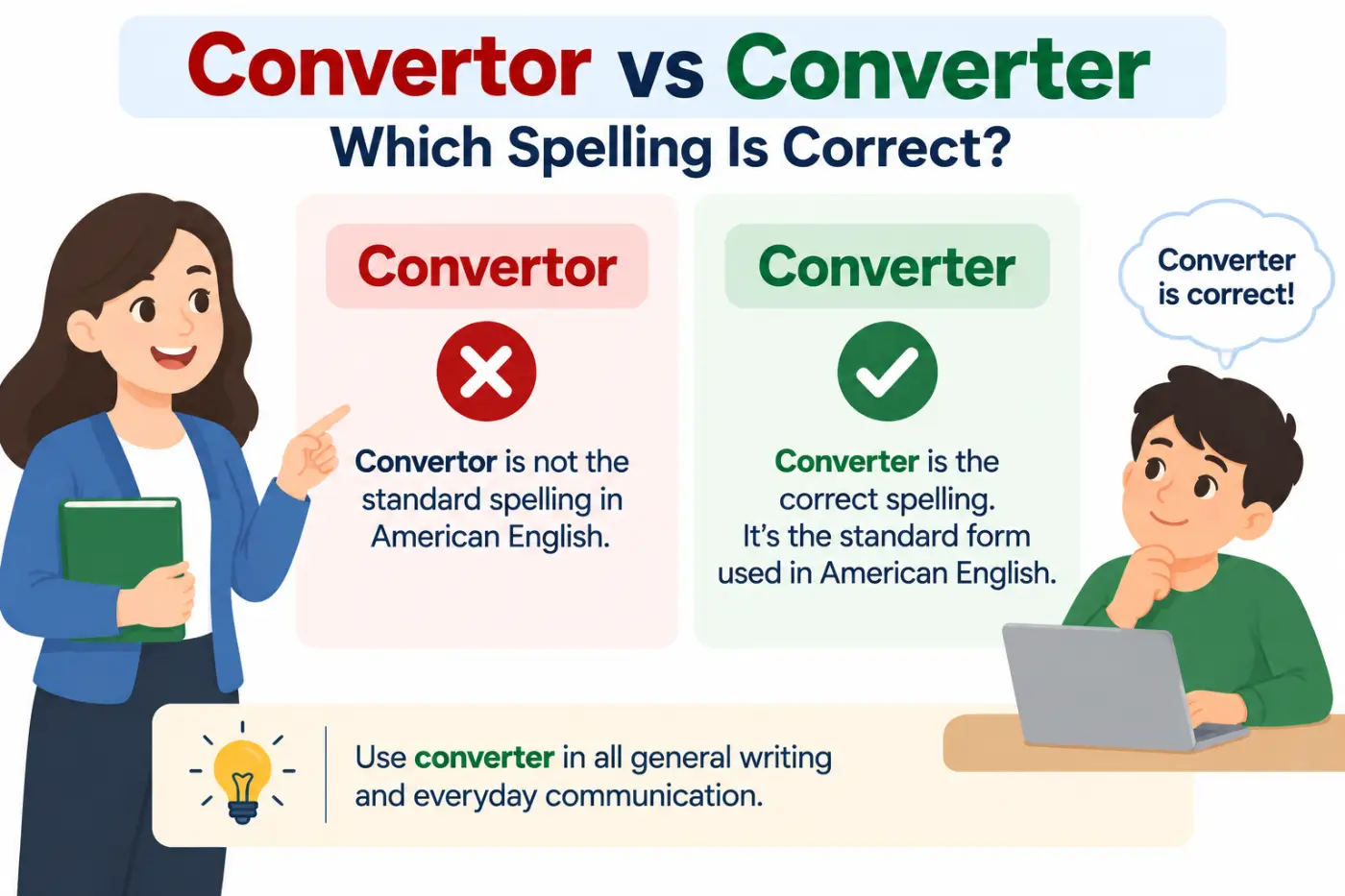
If you’ve ever paused over convertor vs converter while writing about software tools devices or technical equipment you’re not alone. The two forms look almost identical and both seem like reasonable nouns derived from convert. In standard modern English converter is the usual and preferred form. Convertor does appear in some dictionaries and specialized contexts but it’s far less common and often isn’t the form American readers expect.
The confusion makes sense because English uses several noun endings to describe something that performs an action. Words such as operator creator and generator follow familiar patterns. That can make convertor seem perfectly logical at first glance. The real distinction comes from established usage rather than a simple rule that says one suffix can never follow convert.
In this guide you’ll see how the two forms differ in meaning and frequency. You’ll also learn how American and British English treat them how to pronounce the words how they developed and which form makes the safest choice in professional writing. The goal is simple. You should finish knowing exactly which word to choose and why.
You may also want to read Instalments or Installments Which Spelling Is Correct 2026.
Quick Definition
Converter is the standard and much more common noun for something that converts one form type or system into another. Convertor is a legitimate but uncommon variant found in some dictionaries and specialized usage. For general American English especially in business technical and everyday writing converter is the better choice.
Quick Answer
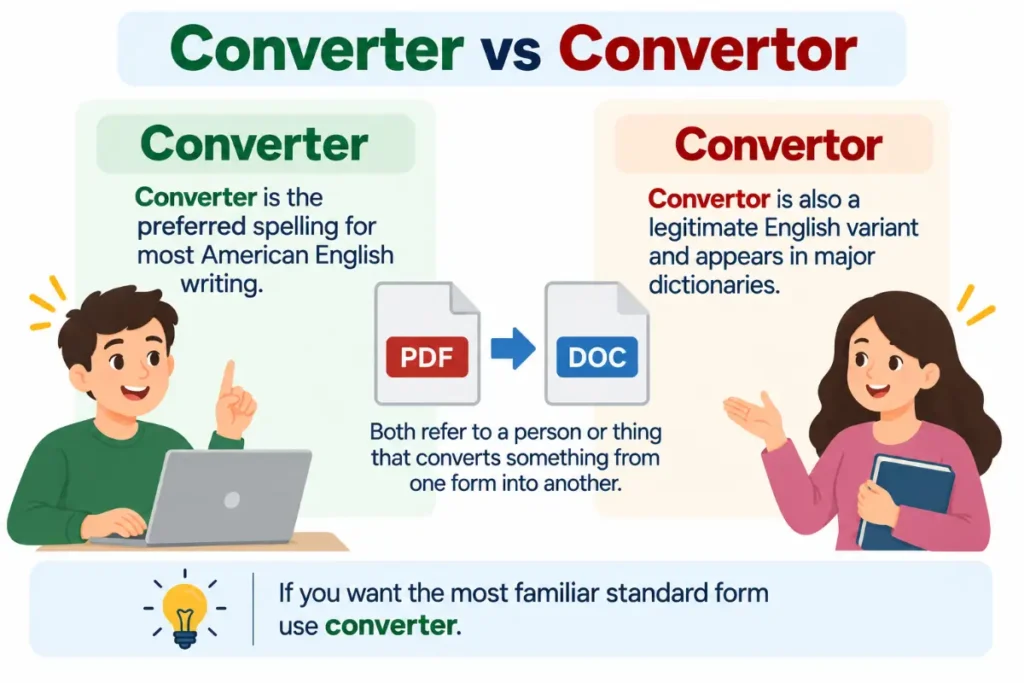
Converter is the preferred form in standard modern English. Convertor exists as a less common variant but most writers should choose converter unless a specific product name organization or technical source uses convertor.
A converter can be a device program person or system that changes something from one form into another. Examples include a currency converter a file converter and an electrical power converter.
Comparison Table
| Preferred Form | Meaning | Part of Speech | Origin | Usage Frequency | Formality | Common Contexts | Example |
|---|---|---|---|---|---|---|---|
| Converter | Something that converts one form into another | Noun | Formed from convert with the noun ending er | Very common | Neutral and formal | Technology engineering software finance electronics | This converter changes the file into another format. |
| Convertor | Something that converts | Noun | Variant formation from convert with the noun ending or | Much less common | Neutral but uncommon | Specialized technical usage and variant spelling | The manual refers to the device as a convertor. |
The table shows the most useful practical distinction. Both forms can refer to something that performs a conversion. Their difference lies mainly in established usage and frequency.
For most readers converter will look familiar immediately. It appears in everyday expressions such as unit converter currency converter file converter and analog to digital converter.
Convertor can still appear in specialized material. A particular company product manual or technical tradition may prefer it. That doesn’t make it the best general choice for new writing.
Meaning and Definition
Meaning of Convertor
Convertor is a noun meaning something that converts. In other words it describes a person device mechanism or system that changes something from one form into another.
The word is not simply nonsense or a random spelling mistake. It has genuine dictionary and historical usage as a variant. Still its presence in English is limited compared with converter.
That distinction matters because dictionary recognition and common usage aren’t always the same thing. A word can be valid while remaining uncommon. Writers often need to choose the form that readers recognize most easily.
For example you might encounter convertor in a technical document that describes a specific machine. If the manufacturer consistently calls the equipment a convertor it makes sense to preserve that terminology when discussing the product.
For general writing though converter is the safer choice.
Meaning of Converter
Converter is a noun derived from the verb convert. It refers to something that changes one thing into another.
The meaning can be broad because conversion happens in many fields.
A currency converter changes one currency value into another.
A file converter changes a file from one format into another.
An electrical converter changes electrical characteristics such as voltage or current.
A digital converter can change information from one format or signal type into another.
A person can also technically be called a converter when that person performs a conversion. However modern usage most often applies the word to a device software tool or system.
The basic idea remains the same. Something starts in one form and ends in another.
Why The Two Forms Cause Confusion
The confusion comes from English word formation.
The verb is convert. English can create nouns for people or things that perform actions by adding different endings. The ending er is extremely productive in English.
Consider several familiar words.
- A driver drives.
- A printer prints.
- A generator generates.
- A translator translates.
- A converter converts.
The pattern feels natural because er is deeply established in English.
The ending or also appears in words that describe people or things associated with an action. Actor and creator are familiar examples. That makes convertor look reasonable even though converter has become much more established.
This is a useful reminder that English spelling isn’t governed by one perfect formula. Historical usage matters. Native speakers learn patterns through exposure and repeated use.
So if convertor looks logical to you that doesn’t mean you’re making a careless mistake. You’re recognizing a real English word formation pattern. The issue is simply that converter has become the dominant form.
Key Differences Explained
- Spelling. Converter ends with er while convertor ends with or.
- Meaning. Both can describe something that converts one form into another.
- Standard usage. Converter is the normal choice in contemporary general English.
- Frequency. Converter is considerably more common in everyday technical commercial and general writing.
- Grammar. Both forms function primarily as nouns.
- Pronunciation. Both forms begin with the same basic sound and differ mainly in their final syllable.
- Formality. Converter works comfortably in casual professional academic and technical contexts.
- Regional usage. Neither form represents a simple American versus British spelling rule. Converter is broadly established across major English varieties.
- Technical context. Convertor can appear in specialized terminology or product documentation.
- Editorial choice. If you’re writing for a broad audience converter is normally the clearest choice.
The key point is easy to remember. The two words can carry the same basic idea but they don’t have equal standing in everyday usage.
Which Form Is Correct
Converter is the best general choice.
Calling convertor incorrect in every possible context would be too strong. The form has legitimate usage. However it is uncommon enough that most writers should avoid introducing it when converter communicates the idea naturally.
This is a classic case where usage frequency matters more than a rigid spelling rule. English has several noun forming patterns and speakers don’t always choose the same ending for every verb.
Dictionary treatment also supports a careful distinction. Major English dictionaries recognize converter as a standard noun. Some dictionaries also record convertor as a variant or less common form. That means the sensible editorial approach is not to label one as impossible. Instead choose the established form unless you have a reason to preserve the variant.
For general American English the practical answer is straightforward.
Use converter.
If you’re editing a product manual or technical document that consistently uses convertor as an official term you can retain that form for consistency. Consistency matters in technical communication because readers need stable terminology.
Sentence Examples
Here are natural examples showing the preferred form in different situations.
- I need a currency converter before I make the purchase.
- This file converter can change the document into a PDF.
- The technician installed a new power converter.
- You can use an online unit converter to check the measurement.
- The software includes a built in image converter.
- Our team tested the converter before connecting the equipment.
- The adapter includes a voltage converter for international use.
- The website has a simple temperature converter.
- The converter changed the audio file into a format the program could read.
- The engineer explained how the signal converter works.
These examples show why converter is so familiar. The word fits naturally into many areas of modern life.
You can also encounter convertor in real writing. These examples demonstrate the less common form rather than recommending it as the default.
- The manufacturer describes the component as a convertor.
- The technical document uses convertor throughout the specification.
- The old manual refers to the device as a convertor.
- The company retained the term convertor in its product documentation.
- The specialist explained why that particular system is called a convertor.
The important point is context. If you see convertor in a technical document it doesn’t automatically mean the writer has made a spelling error.
Common Mistakes And Confusions
Treating Convertor As The Only Correct Form
Some writers assume that because words such as actor and creator end in or the same pattern must apply to convert. English doesn’t work that mechanically. Converter is the established general form.
Treating Convertor As Completely Invalid
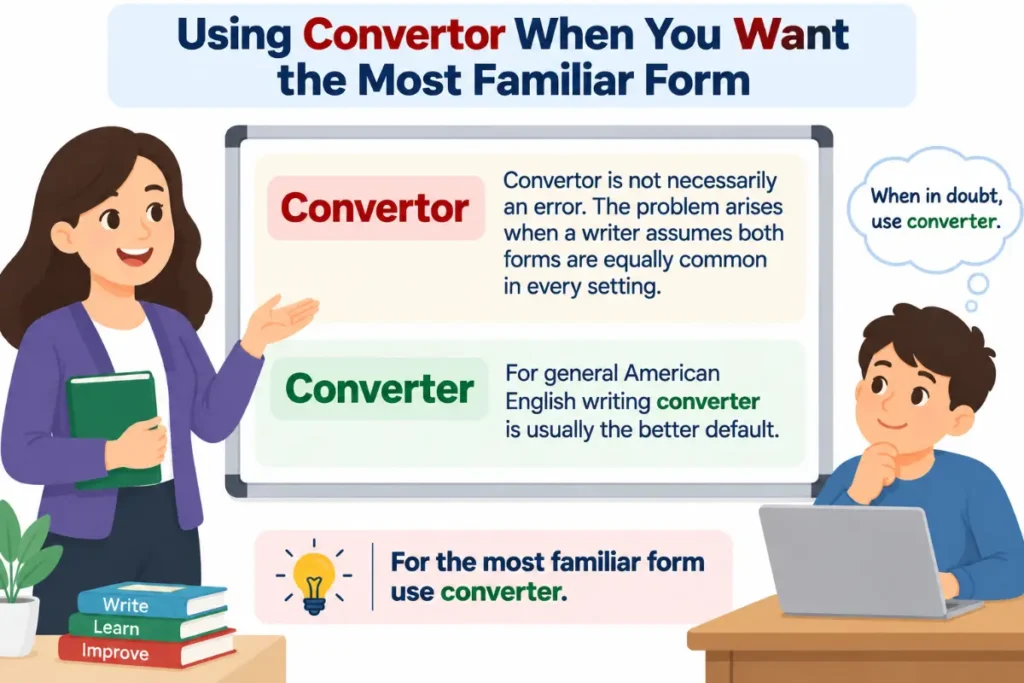
The opposite mistake is also possible. Convertor does have real usage. Calling it impossible in every context ignores established variant usage.
Assuming The Difference Is American And British English
The choice isn’t a simple US versus UK spelling difference. Converter is widely used across English varieties. Convertor can occur in British and other varieties as a less common form.
Using The Less Familiar Form In General Writing
A reader may understand convertor without trouble but converter is immediately familiar to most English speakers. In broad audience writing familiarity is valuable.
Changing An Official Technical Term
Editors should avoid changing a specialized product or system name just because another form is more common. If an organization officially calls something a convertor consistency may be more important than general preference.
Pronunciation Guide
The two forms are pronounced similarly at the beginning.
Converter is commonly pronounced something like:
kuhn VUR tur
The stress generally falls on the second syllable.
A common American English pronunciation is represented approximately as:
/kənˈvɝːtər/
The exact vowel quality can vary by accent.
Convertor has a similar first part but ends with a sound closer to or.
A practical approximation is:
kuhn VUR tor
The pronunciation difference is small enough that spoken language can make the spelling distinction easy to miss.
That helps explain why people sometimes hesitate when writing the word. If you only hear the term in conversation you may not know which noun ending the writer used.
A useful learning habit is to connect the word with a familiar phrase. Think of currency converter or file converter. Once the common form becomes a familiar chunk of language the spelling requires less conscious effort.
Learn the difference in Deep Seated Vs Deep Seeded Which One Is Correct (2026).
Etymology And Word Origin
Both forms are connected to the verb convert.
Convert ultimately traces back through French to Latin roots associated with turning or changing. The Latin verb convertere was built around the idea of turning something around or changing its direction. The same historical family gave English words connected with conversion and change.
English later developed nouns for things or people that perform actions. The ending er became especially productive in English. That helped establish forms such as converter.
The ending or also has a long history in English and entered many nouns through French and Latin influenced word formation. Words such as actor and creator show this pattern clearly.
The existence of two possible noun forming patterns explains why convertor doesn’t look strange from a linguistic point of view. Yet language users ultimately settle on forms through long term usage. Converter became the much more common form in modern general English.
This is an important lesson in English vocabulary. A word can be structurally possible without becoming the preferred form. Usage determines which form becomes familiar to most speakers.
Regional Usage
American English
American English strongly favors converter. The word appears across consumer technology engineering finance software electronics and everyday conversation. Common phrases include currency converter file converter unit converter and power converter.
Convertor may appear in specialized documents or product terminology but it isn’t the form most American readers expect in general writing.
British English
British English also uses converter widely. There is no simple British rule that replaces the er ending with or in this word. Convertor can appear as a variant but it remains much less common than converter.
A British technical document may preserve convertor if a manufacturer or specialist field uses that terminology.
Australian English
Australian English generally follows the same broad pattern. Converter is the familiar standard form across general and professional communication. Convertor can appear as a variant in specialized contexts but doesn’t function as the normal everyday spelling.
Canadian English
Canadian English also favors converter. Writers can use the word naturally in technical documents business communication educational material and everyday contexts. The less common variant may still appear in specialized sources but it doesn’t represent a standard Canadian spelling rule.
Across these varieties the safest broad conclusion is the same. Converter is the form readers are most likely to expect.
Grammar Rules And Part Of Speech
Converter is a noun.
It names a person device program or system that performs conversion.
The simplest pattern is:
converter + noun
For example:
A currency converter.
A voltage converter.
A file converter.
A signal converter.
The noun can also appear after a verb.
The converter changed the file.
We installed the converter yesterday.
The technician tested the converter.
It can take a modifier that identifies the kind of conversion involved.
A digital converter.
An audio converter.
A measurement converter.
A power converter.
A language converter.
The word can also be used in compound nouns. English frequently combines nouns with other nouns to create precise technical terms. That is why you’ll see converter used across specialized fields.
Convertor follows the same basic grammatical role when it appears. It is also a noun. The main issue isn’t grammar. It’s preference and established usage.
Punctuation doesn’t change based on the choice between the two forms. The word follows ordinary noun punctuation rules.
If it begins a sentence it should be capitalized like any other common noun.
The converter stopped working.
If it appears in the middle of a sentence it normally remains lowercase.
We replaced the converter.
Real Life Usage Examples
Daily Conversation
People often use converter in ordinary situations without thinking about its spelling.
- Do you have a converter for this outlet?
- I used a currency converter before booking the hotel.
The word feels natural because conversion tools have become common in everyday life.
Email And Workplace Communication
Professional communication often uses the term when discussing software equipment or data.
- Please test the converter before sending the equipment to the client.
- I’ve attached the converted file and included the converter settings we used.
In workplace writing clarity matters more than trying to sound technical. The familiar form usually works best.
Academic Writing
Academic and technical writers use the word when describing processes equipment or digital tools.
- The researchers used a signal converter to process the incoming data.
- The study compared the performance of two types of power converters.
In formal writing converter fits comfortably without sounding casual.
News And Journalism
News stories may use the term when discussing technology energy transportation or consumer products.
- The new device includes a converter that supports several power standards.
- The company released a free currency converter for international travelers.
Journalists generally favor familiar terms that readers can understand quickly.
Literature And Storytelling
The word is less common in traditional literary writing but can appear naturally in stories involving technology or machines.
- He reached beneath the dashboard and checked the converter.
- The old converter hummed quietly as the machine came back to life.
In storytelling the choice should fit the setting and terminology of the subject.
Related And Confused Terms
Convert
Convert is the base verb. It means to change something from one form state system or use into another.
Conversion
Conversion is the noun describing the act or process of converting.
Convertible
Convertible is an adjective meaning capable of being converted. It can also function as a noun for certain types of cars or financial instruments depending on context.
Converted
Converted is the past tense and past participle of convert. It can describe something that has already changed form.
Converter
Converter names the thing that performs the conversion. It is the most common noun in this family for a device tool or system.
Transform
Transform is a related verb meaning to change something significantly in form or appearance. It doesn’t always imply the same technical process as convert.
Adapter
Adapter is sometimes confused with converter because both can describe equipment used to make systems work together. They aren’t always the same. An adapter often allows connection or compatibility while a converter changes a form or characteristic.
Translator
Translator can describe a person or software system that changes language from one language to another. It overlaps with the broader idea of conversion but has a more specific meaning.
When Converter Is The Better Choice
For most writing the choice is easy. Use converter.
It works especially well when your audience is broad. A reader looking at phrases such as file converter currency converter or voltage converter will understand the term instantly.
It’s also the stronger choice for websites software documentation school assignments reports product descriptions and general business writing.
The word doesn’t need extra explanation. That’s a major advantage.
Good writing usually favors familiar language when a familiar word communicates the idea accurately. There’s little benefit in choosing a rare variant simply because it looks equally logical.
Think of it like choosing a well worn road. Both paths may reach the same destination but one is easier for most readers to recognize.
When Convertor May Appear
There are situations where you might encounter the less common form and leave it unchanged.
A product manufacturer may use convertor in its official terminology.
An older technical document may use the form consistently.
A specialized industry may have adopted the term as part of its vocabulary.
A quotation from an existing source may contain it.
In these cases the spelling can be part of the source’s established language.
If you’re writing a new general article though you usually don’t need to choose the uncommon form. Converter is clearer and more familiar.
This is especially useful advice for editors. Don’t confuse uncommon with automatically wrong. Language contains many variants and historical forms. The editor’s job is to understand the context and then choose the form that best serves the intended reader.
Expert Editor Insight
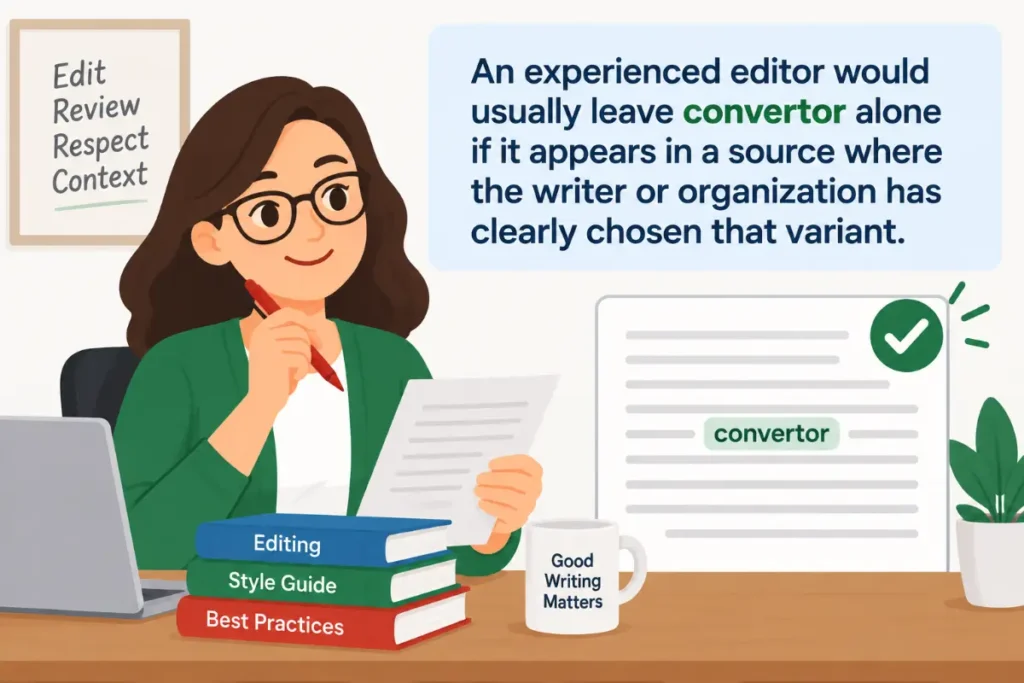
From an editing perspective the safest default is converter because it is the familiar form used across everyday technical and professional English. When I see convertor in a draft I don’t automatically mark it as a spelling error. I first check the context and surrounding terminology. If the writer is discussing a standard device or general conversion tool I’d normally change it to converter. If the word belongs to an official product name or established technical vocabulary I’d preserve it for consistency. A useful editing tip is to check the noun against the audience rather than relying only on whether the form looks grammatically possible.
Why Usage Frequency Matters
English spelling questions often seem like simple right or wrong problems. In practice some cases are more nuanced.
Two forms can exist while one clearly dominates modern usage. That happens because language develops through repeated use. Speakers choose forms naturally and communities gradually settle around familiar patterns.
Converter is a good example.
Convertor follows a recognizable noun formation pattern. Yet converter has become the form most people encounter. That makes it the practical choice for broad communication.
This distinction is especially useful for writers who want their work to sound natural. Grammar and spelling rules matter but so does idiomatic usage.
A sentence can be technically understandable and still sound unusual to a native speaker. Choosing the familiar form reduces that friction.
That’s why professional editors consider audience expectations alongside dictionary status.
A Simple Memory Trick
If you keep forgetting which ending to use think of the phrase convert plus er.
Convert becomes converter.
The ending er appears in many English words for something that performs an action. A printer prints. A scanner scans. A generator generates. A converter converts.
This isn’t a universal spelling rule. English has plenty of exceptions. It’s simply a useful memory pattern for this particular word.
Another trick is to remember common compounds.
Currency converter.
File converter.
Unit converter.
Power converter.
Once you’ve seen these phrases enough times the standard spelling starts to feel automatic.
You may also want to read Shown vs Showed Which Form Is Correct.
Final Takeaway
convertor vs converter comes down to usage more than meaning. Both forms can refer to something that converts one form into another but converter is the standard and far more familiar choice in modern general English. It works naturally in American English and across other major English varieties.
If you’re writing an article report email assignment or technical document for a broad audience choose converter. It’s clear familiar and widely accepted. Convertor can still appear in specialized terminology or established product language so don’t automatically treat every occurrence as an error.
The easiest editing tip is to connect the word with familiar phrases such as currency converter and file converter. Once that pattern becomes familiar you’ll naturally reach for the preferred form when you need it.
Frequently Asked Questions
Is convertor a real word?
Yes. Convertor exists as a less common variant noun meaning something that converts. It isn’t simply an invented spelling. However converter is much more common in modern general English. If you’re writing for a broad American audience or preparing professional content from scratch converter is normally the better choice.
What does converter mean?
Converter is a noun for something that changes one form or type into another. It can describe a device software program tool or system. A currency converter changes values between currencies while a file converter changes one file format into another. The exact meaning depends on the type of conversion being discussed.
Which is correct convertor or converter?
Converter is the preferred form for standard modern English and is the safest choice for general writing. Convertor is an established but uncommon variant. So the two forms aren’t completely unrelated or one simply a random typo. They differ mainly in established usage and frequency.
How do you pronounce converter?
Converter is commonly pronounced something like kuhn VUR tur in American English. The IPA form is approximately /kənˈvɝːtər/. The main stress falls on the second syllable. The pronunciation can vary slightly by accent. Because the two forms sound similar at the end it’s easy to miss the spelling difference when you only hear the word.
Is converter appropriate in formal writing?
Yes. Converter is completely suitable for formal writing. You can use it in academic papers technical reports workplace communication product documentation and professional articles. It is also common in everyday language. There’s no need to replace it with a more complicated term simply to make your writing sound formal.
What is a synonym for converter?
The best alternative depends on context. Terms such as conversion tool conversion device or transformation system can sometimes describe a similar idea. However they aren’t exact replacements in every sentence. Converter is usually the clearest term because it directly identifies something designed to perform a conversion.
Why do people confuse these two forms?
The confusion comes from English noun formation. Both er and or appear in nouns describing people or things associated with an action. Since convert can logically produce either looking form some writers assume both are equally common. Actual usage tells a different story. Converter became the dominant form in general modern English.
Should I use converter in technical writing?
Yes in most cases. Converter is widely understood and works naturally in technical writing. Still technical terminology can vary between manufacturers industries and older documents. If a specific system officially uses convertor you may need to retain that spelling for consistency. For a new technical document without an established terminology choice converter is normally the stronger option.