
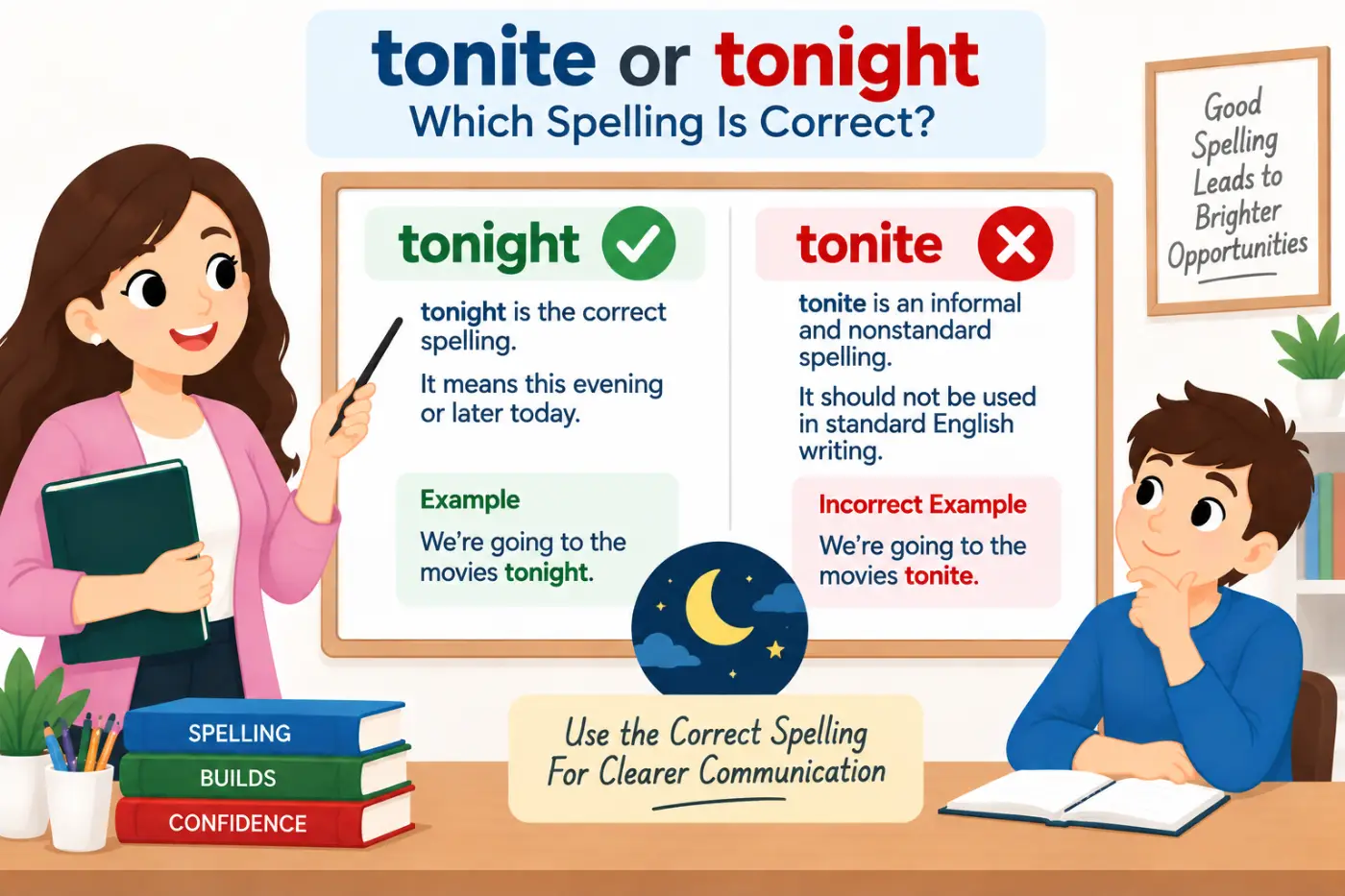
tonite or tonight can be confusing because both forms look familiar and both are easy to understand. The standard spelling is tonight. Tonite is an informal shortened spelling that appears mainly in casual messages advertising song titles brand names and other relaxed contexts.
The confusion comes from pronunciation. In normal speech the word is pronounced much closer to tonite than its traditional spelling suggests. When people write quickly they may spell a word according to its sound. Texting and social media have also made shortened spellings more visible. That can make an informal form look more standard than it really is.
If you need to write an email school assignment business message article report or other polished text use the standard form. This guide explains the meaning grammar pronunciation history and regional usage of the word. You’ll also learn when the shortened spelling can appear naturally and why it usually isn’t the best choice for formal English.
For another common grammar confusion, see totalling or totaling Which Spelling Should You Use.
Quick Definition
Tonight is the standard English spelling for the evening or night of the current day. Tonite is an informal nonstandard spelling that represents the same pronunciation and meaning. It commonly appears in casual texting advertising creative writing and names but tonight is the preferred form in standard written English.
Quick Answer
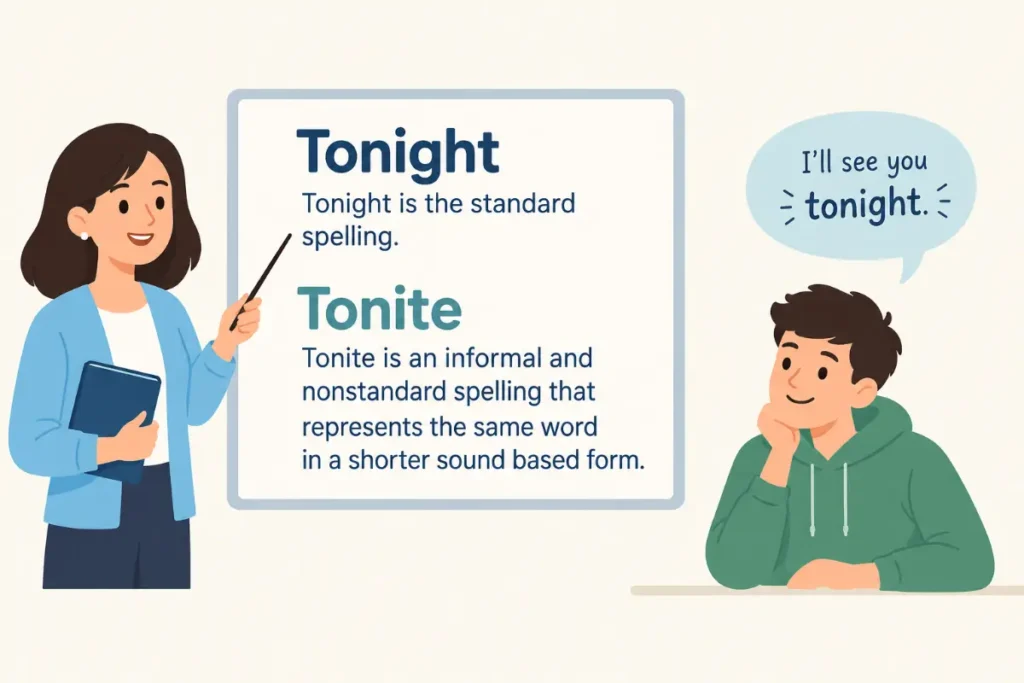
Tonight is the standard spelling. Tonite is an informal and nonstandard spelling that represents the same word in a shorter sound based form. Use tonight in normal writing. The shortened version can appear in casual communication or creative contexts where a relaxed style is intentional.
Comparison Table
| Correct Form | Meaning | Part of Speech | Origin | Usage Frequency | Formality | Common Contexts | Example |
|---|---|---|---|---|---|---|---|
| Tonight | This evening or night | Adverb or noun | Old English combination of this and night | Very common | Neutral and standard | Conversation email school news literature | We are meeting tonight. |
| Tonite | Same basic meaning as tonight | Informal spelling | Modern shortened spelling based on pronunciation | Common as an informal variant | Casual and nonstandard | Texting advertising creative contexts names | See you tonite. |
Meaning and Definition
Meaning of the Informal Form
Tonite represents the same basic word as tonight. It is not normally treated as a separate word with a different dictionary meaning. Instead it is an informal spelling created by removing letters that aren’t clearly represented in pronunciation.
The form became especially visible in informal communication because English speakers often shorten words when space speed or a casual tone matters. Text messages advertisements posters song titles and promotional language can all favor shorter spellings.
For example a business might use a phrase such as Live Music Tonite in a sign. The spelling helps create a casual promotional feel. A person might also write See you tonite in a quick text.
That doesn’t mean the spelling is appropriate everywhere. A relaxed text and a college application have very different expectations.
This distinction is useful because calling every appearance of the shortened form a simple typo would be too broad. In some contexts the writer may have chosen it deliberately. Still standard edited English generally favors the traditional spelling.
Meaning of the Standard Form
Tonight refers to the evening or night of the present day.
If someone says I’ll call you tonight they mean they’ll call later on the same day during the evening or night.
The word can function as an adverb.
We’re leaving tonight.
Here it tells us when the action will happen.
It can also function as a noun.
Tonight was unforgettable.
In that sentence the word refers to the current evening or night as a period or occasion.
The meaning is simple but context can determine the exact time intended. In everyday American English tonight usually covers the period after the daytime portion of the current day and into the night.
The word is closely connected to other time expressions such as today tomorrow yesterday and this morning. These words help speakers locate an event in time without needing to give an exact date.
Key Differences Explained
- Spelling. Tonight is the standard form. Tonite is a shortened informal spelling.
- Meaning. Both forms normally communicate the idea of the current evening or night.
- Grammar. The standard word can work as an adverb or noun depending on the sentence.
- Pronunciation. The two forms are normally pronounced alike or very similarly in ordinary English.
- Formality. Tonight works in casual and formal writing. Tonite has a strongly informal feel.
- Context. Tonight belongs comfortably in essays reports emails news stories and professional communication. The shortened spelling is better limited to contexts that intentionally use casual language.
- Regional usage. Major English varieties generally recognize tonight as the standard spelling. The informal spelling may appear across regions but doesn’t become a standard regional variant.
- Standard usage. Tonight should be your default choice unless you have a specific stylistic reason to use the shortened form.
The important point is that the two forms don’t represent two different times. The distinction is mainly about spelling style and context.
Which Form Is Correct
Tonight is the correct standard spelling.
The shortened form isn’t simply meaningless. It clearly communicates the intended word in many informal settings. However standard English distinguishes established spelling from creative or casual respelling.
This is similar to the difference between a conventional written form and a deliberate shortened form used for effect. A reader can understand both, but understanding doesn’t automatically make both equally suitable for every situation.
Dictionary based usage generally treats tonight as the established English word. The shortened spelling belongs more naturally to informal usage and stylistic contexts.
A useful editorial rule is to start with the standard form. Choose the informal version only when the tone or design of the text gives you a reason to do so.
If you’re unsure what to write in an email to a teacher manager client professor or unfamiliar reader, choose tonight. It’s clear and universally appropriate.
Sentence Examples
Here are natural examples using the standard form.
- I’m going to finish the report tonight.
- Are you free tonight?
- We’re having dinner with our friends tonight.
- The movie starts tonight at eight.
- She said she would call me tonight.
- I need to study for the exam tonight.
- The weather should improve tonight.
- They’re hosting a small party tonight.
- Tonight is the perfect time to start.
- I finally have some free time tonight.
The informal spelling can also appear in casual contexts.
- See you tonite.
- Are you coming tonite?
- We’re having pizza tonite.
- Live music tonite.
- Party tonite.
These examples demonstrate how the shortened spelling is used. They don’t mean that the informal form should replace the standard spelling in every situation.
For school work you would normally write The event is tonight.
For a casual text you might see See you tonite.
The intended meaning is the same. The social tone is different.
Common Mistakes and Misspellings
Using The Informal Spelling In Formal Writing
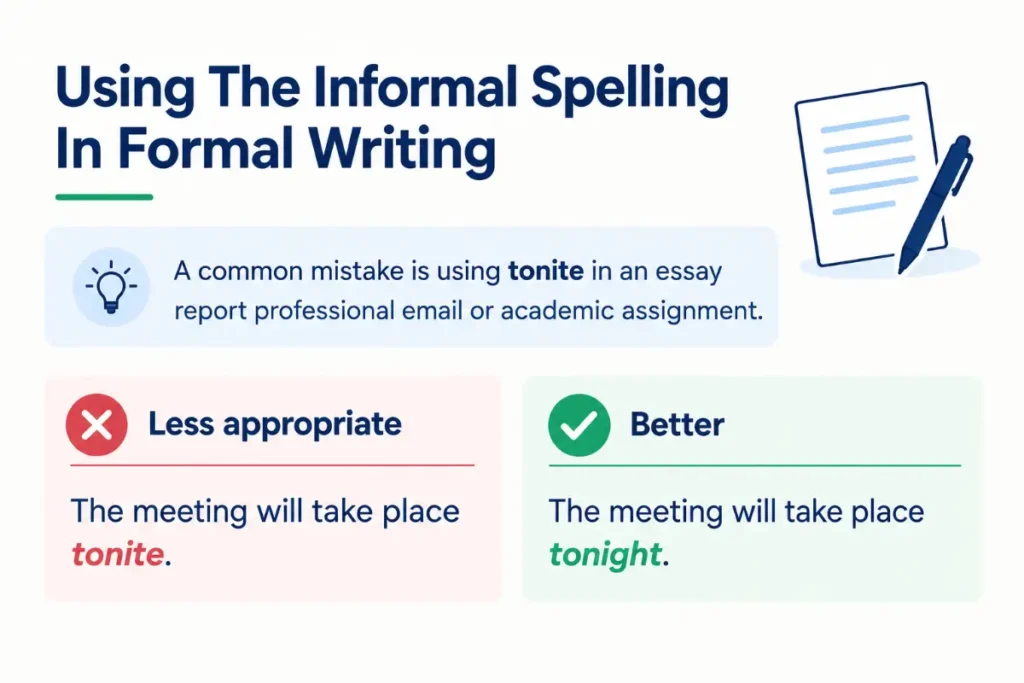
A common mistake is using tonite in an essay report professional email or academic assignment.
Less appropriate: The meeting will take place tonite.
Better: The meeting will take place tonight.
The issue isn’t comprehension. Most readers will understand the sentence immediately. The issue is standard written style.
Assuming Pronunciation Determines Spelling
People sometimes write the word based entirely on its sound. Since tonight sounds close to tonite the shorter form can feel logical.
English spelling doesn’t always follow pronunciation perfectly. Historical spelling patterns often remain even after pronunciation changes.
Treating Informal Usage As A Standard Variant
Seeing the shortened form frequently can make it seem equally correct. Online communication can blur the line between standard spelling and creative spelling.
A word can be common in informal writing without becoming the preferred form in edited English.
Confusing Tonight With Today
Tonight refers specifically to the evening or night. Today covers the whole current day.
Correct: I’ll finish it today.
Correct: I’ll finish it tonight.
The second sentence gives a narrower time frame.
Confusing Tonight With Tomorrow Night
Tonight refers to the current evening or night. Tomorrow night refers to the following day’s evening or night.
If it is Monday afternoon and you say I’ll see you tonight you mean Monday evening. If you say I’ll see you tomorrow night you mean Tuesday evening.
That distinction matters in scheduling.
Pronunciation Guide
Tonight is commonly pronounced /təˈnaɪt/.
The word has two syllables.
tə NIGHT
The main stress falls on the second syllable.
The first syllable often uses a weak vowel sound. In natural American speech it can sound like tuh rather than a strong to.
The second syllable rhymes with words such as light right night and sight.
An easy pronunciation guide is:
tuh NIGHT
The shortened spelling looks different but normally represents essentially the same spoken form.
That creates an interesting spelling issue. If you write a word based only on pronunciation you may naturally arrive at a form that seems logical but isn’t the standard written version.
English has many examples of this kind of spelling gap. The written language preserves older forms and established conventions while spoken language changes more freely.
When learning the word it helps to connect the pronunciation with the familiar spelling pattern.
Think:
to plus night equals tonight.
That gives you a simple visual and meaning based memory aid.
For another common grammar confusion, see Smoothe or Smooth Which Spelling Is Correct?.
Etymology and Word Origin
The history of tonight is fairly straightforward. The modern word developed from older English expressions that combined the ideas of this and night.
Old English used forms such as tō niht meaning at or during this night. Over centuries English spelling and pronunciation changed and the expression developed into the single modern word tonight.
This history explains why the word contains the familiar element night. The word is essentially a time expression that identifies the current night.
The development is similar to several other common English time words. Expressions that once consisted of separate parts can become fixed compounds as language changes.
The standard spelling preserves this historical connection. The informal spelling removes letters to create a form that more closely reflects modern pronunciation.
That is one reason tonite feels intuitive to many speakers. It represents how the word sounds. But spelling traditions don’t always follow the shortest route from sound to letters.
Understanding the history also helps explain why the standard form looks longer than the spoken word seems to require.
Regional Usage
American English
Tonight is the standard spelling in American English. It appears in everyday conversation writing education journalism business communication and formal documents.
The informal spelling appears in texts social media promotional signs creative material and other relaxed settings.
An American reader will usually understand the shortened form immediately but may consider it casual or deliberately stylized.
For professional communication tonight is the stronger choice.
British English
British English also uses tonight as the standard spelling. There is no major spelling difference between American and British English for this word.
The shortened form can appear in informal communication or advertising but it isn’t the normal spelling expected in edited British writing.
Australian English
Australian English follows the same standard spelling. Tonight is used naturally in everyday speech and writing.
The informal version can appear in casual contexts but there is no major Australian spelling rule that makes it a standard alternative.
Canadian English
Canadian English also uses tonight as the established spelling. Writers can use it in casual messages as well as formal and professional contexts.
The shortened spelling may appear in informal material but it doesn’t represent a separate Canadian standard.
Across these varieties the main distinction is style rather than geography. The standard spelling remains stable.
Grammar Rules and Part of Speech
Tonight can serve more than one grammatical function.
Tonight As An Adverb
The most common use is as an adverb of time.
We’re going home tonight.
Here tonight tells us when the action will happen.
It can appear at the beginning of a sentence.
Tonight we’re going to watch a movie.
It can also appear at the end.
We’re going to watch a movie tonight.
The final position is extremely common in everyday English.
Tonight As A Noun
The word can also function as a noun when it refers to the current evening or night as an event or period.
Tonight was special.
Tonight is the big night.
In these examples the word itself serves as the subject or part of the subject.
Sentence Position
There is flexibility in placement.
Tonight we’re meeting our friends.
We’re meeting our friends tonight.
Both are natural.
Putting the word first can give it extra emphasis or establish the time before the main action. Putting it at the end often sounds relaxed and conversational.
Punctuation
Tonight doesn’t require special punctuation simply because it refers to time.
If it begins a sentence as an introductory time expression, punctuation depends on the sentence structure and rhythm.
Tonight we’re staying home.
A comma isn’t normally needed in this short construction.
In a longer sentence a comma may sometimes improve readability.
The main grammar rule is simple. Treat the word according to its function in the sentence rather than assuming it always behaves as an adverb.
Formal And Informal Usage
The standard spelling is suitable for every level of writing.
The shortened spelling is different. It carries a casual tone and can make writing feel playful or informal.
That can be useful in the right setting.
It can also make otherwise professional writing look careless.
Good editing means matching the spelling to the purpose.
Real Life Usage Examples
Daily Conversation
Tonight is extremely common in everyday speech.
Are you doing anything tonight?
I’m staying home tonight because I’m tired.
These sentences sound completely natural in American conversation.
Email And Workplace Communication
Professional messages generally use the standard form.
I’ll send the revised document tonight.
We need to confirm the meeting time before tonight.
The standard spelling keeps the message polished without making it sound stiff.
Academic Writing
Academic writing can use the word when discussing events or schedules.
The participants were asked to complete the assignment tonight.
The lecture will continue tonight as part of the evening program.
The word itself isn’t too casual for academic work. The surrounding context determines the overall tone.
News And Journalism
News writing commonly uses the standard spelling to describe scheduled events.
The candidates will speak at a public event tonight.
The storm is expected to weaken tonight.
The word helps establish a clear timeline for the reader.
Literature And Storytelling
Storytellers can use the word to create anticipation.
Tonight would change everything.
He knew he had to make a decision tonight.
In storytelling the word can create urgency. A simple time expression can make an event feel close and immediate.
When The Informal Spelling Can Work
The shortened spelling has a legitimate stylistic role even though it isn’t the preferred standard form.
It can work when the writer intentionally wants a casual or playful voice. Advertising has long used shortened forms because they can fit signs and promotional designs more easily.
You might see something like:
Live Music Tonite
A poster using this style may be deliberately informal. The spelling becomes part of the visual personality of the message.
The same idea can apply to creative writing. A character’s text message might use the shortened form because the writer wants the message to sound natural for that character.
The key is intention.
If you accidentally type the informal form in a formal document that’s a spelling choice worth correcting. If a designer deliberately uses it on a casual event poster the spelling may be serving a stylistic purpose.
That distinction is common in language. Standard English provides the default while creative language sometimes bends the rules for tone identity or effect.
Why The Shortened Form Looks So Natural
There is a clear reason many people accept the shortened spelling at first glance. It closely matches the way the word sounds.
Tonight is often pronounced with a weak first syllable followed by the stressed sound night. When spoken quickly the spelling can seem unnecessarily long.
English has many words whose traditional spelling contains more information than casual pronunciation reveals.
This creates a natural tension between speech and writing.
Speech changes quickly because speakers simplify sounds connect words and reduce unstressed syllables. Written language tends to change more slowly because schools dictionaries publishers and institutions preserve established conventions.
The shortened spelling takes advantage of that difference. It writes the word closer to its sound.
That makes it easy to understand but doesn’t make it the standard form.
Related And Confused Terms
Tonight
This refers to the current evening or night. It is the standard form and the best choice for general writing.
This Evening
This expression often overlaps with tonight but can sound slightly more precise or formal depending on context.
I’ll call you this evening.
This Night
This phrase is grammatically possible but is much less natural in ordinary American conversation. Native speakers usually prefer tonight when referring to the current night.
Tomorrow Night
This refers to the evening or night of the following day.
I’ll see you tomorrow night.
It should not be confused with the current evening.
Last Night
This refers to the previous night.
I watched a movie last night.
The meaning moves backward in time rather than forward or toward the current evening.
Tonight Only
This phrase often appears in advertising to emphasize that an event or offer happens during the current night.
Live performance tonight only.
This Afternoon
This refers to the afternoon of the current day rather than the evening or night.
I’ll finish the project this afternoon.
Tomorrow Evening
This refers to the next day’s evening. It has a similar time structure to tomorrow night but can sound slightly broader.
These expressions are useful because they place an event on a simple timeline.
Yesterday → last night → today → tonight → tomorrow → tomorrow night.
Knowing the timeline makes scheduling language much easier.
Standard Spelling Versus Creative Spelling
Standard spelling exists to give readers a shared system. When everyone uses established forms readers can move through text without stopping to interpret the writer’s choices.
Creative spelling works differently. It may shorten words change letters or imitate speech to create a particular personality.
The shortened form belongs closer to the second category.
This is why you shouldn’t ask only whether readers can understand it. Ask what kind of writing you’re producing.
If you’re writing a personal text to a close friend a shortened spelling may feel perfectly natural.
If you’re writing a research paper the same spelling can look careless.
If you’re creating a humorous poster the informal form may actually fit the design.
Good writing isn’t just about knowing rules. It’s also about knowing when a deliberate variation serves the message.
Expert Editor Insight
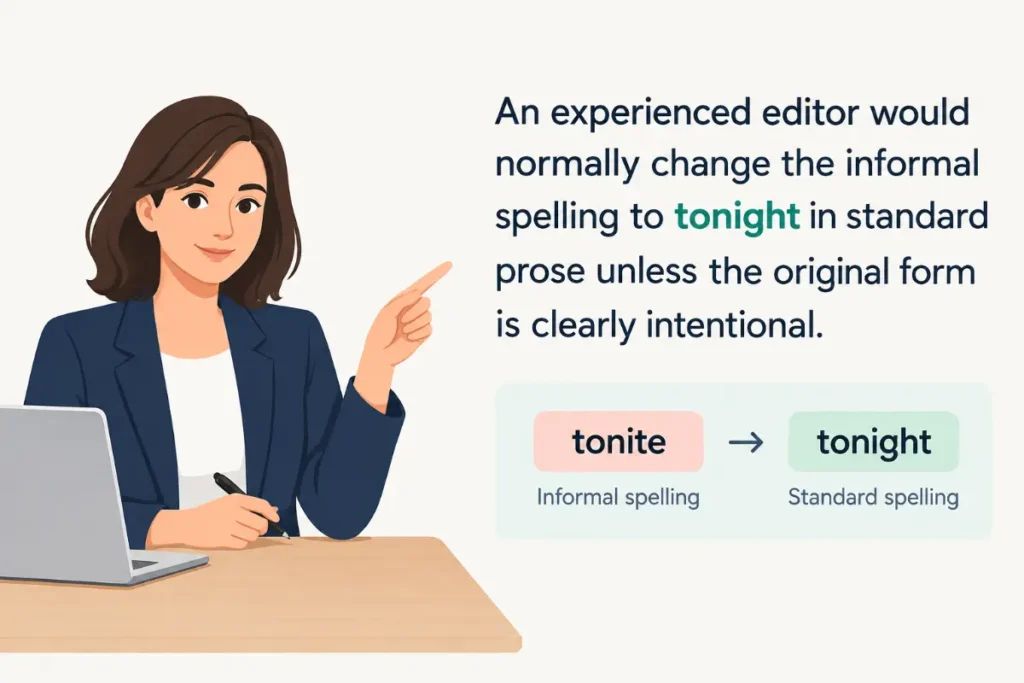
An experienced editor would normally change the informal spelling to tonight in standard prose unless the original form is clearly intentional. The confusion happens because the shortened version closely reflects pronunciation and appears often in casual digital communication. Editors look at context first. A spelling checker may flag the informal form or suggest the standard spelling while a human editor also considers voice audience and purpose. The best practical rule is simple: use the established spelling by default and choose the shortened form only when its casual tone is part of the message.
Learn the difference in Cryer vs Crier Which Spelling Is Correct 2026.
Conclusion
Tonite or tonight has a clear distinction. Tonight is the standard English spelling for the current evening or night, while tonite is an informal shortened spelling that is mainly used for casual or creative effect.
The two forms generally carry the same meaning and are pronounced alike or very similarly. The real difference is style. The standard form works across everyday conversation professional writing academic work journalism and formal communication. The shortened form can fit texts advertisements posters and creative contexts where an informal voice is intentional.
The easiest editing rule is to use tonight by default. If you see the shorter spelling in your draft, ask yourself if you deliberately chose it for tone. If not, restore the standard spelling and keep your writing clear and polished.
FAQs
Is tonite a real word?
Tonite is widely understood as an informal spelling of tonight but it isn’t the standard spelling expected in formal English. It can appear intentionally in casual messages advertising creative work and promotional material. If you’re writing an essay professional email report or other polished text, use tonight. The shortened version is best viewed as a stylistic variation rather than the normal written form.
What does tonight mean?
Tonight means the evening or night of the current day. It can function as an adverb or a noun depending on how it appears in a sentence. In I’m working tonight it tells us when the action happens. In Tonight was wonderful it refers to the evening itself. The exact hours covered depend on context and the speaker’s situation.
tonite or tonight which is correct?
Tonight is the standard spelling. Tonite is an informal shortened spelling that represents the same basic meaning and usually the same pronunciation. Most standard writing should use tonight because it works in casual professional academic and formal contexts. The shortened form can be appropriate when a writer intentionally wants a relaxed tone or a promotional style.
How do you pronounce tonight?
Tonight is commonly pronounced /təˈnaɪt/. It has two syllables with the main stress on the second syllable. An easy pronunciation guide is tuh NIGHT. The first syllable is usually weak in natural American speech while the second syllable rhymes with night. The spelling contains more letters than you may clearly hear during normal conversation.
Can tonight start a sentence?
Yes. Tonight can naturally begin a sentence when you want to establish the time before giving the main information. For example you can write Tonight we’re meeting our friends. This position can add emphasis to the time. The word can also appear at the end of a sentence which is extremely common in everyday American English.
What is a synonym for tonight?
There is no perfect single word synonym for tonight in every context. Depending on the sentence you can use this evening or this night but they don’t always sound equally natural. This evening is the closest common alternative in many situations. If you mean the current evening or night specifically, tonight is usually the clearest and most natural choice.
Why do people spell tonight informally?
The shortened spelling reflects pronunciation and casual writing habits. The spoken word can sound much shorter than its traditional spelling looks, especially because the first syllable is weak. Texting advertising and social communication also encourage shorter forms. People may choose the informal spelling intentionally to create a relaxed tone. It can also appear accidentally when someone writes quickly.
Is tonight appropriate in formal writing?
Yes. Tonight is fully appropriate in formal and professional writing when the meaning calls for it. You can use it in reports emails academic work news writing and official communication. The word itself isn’t informal. The main distinction concerns the shortened spelling. If your writing needs a polished standard style, choose tonight rather than the casual respelling.