
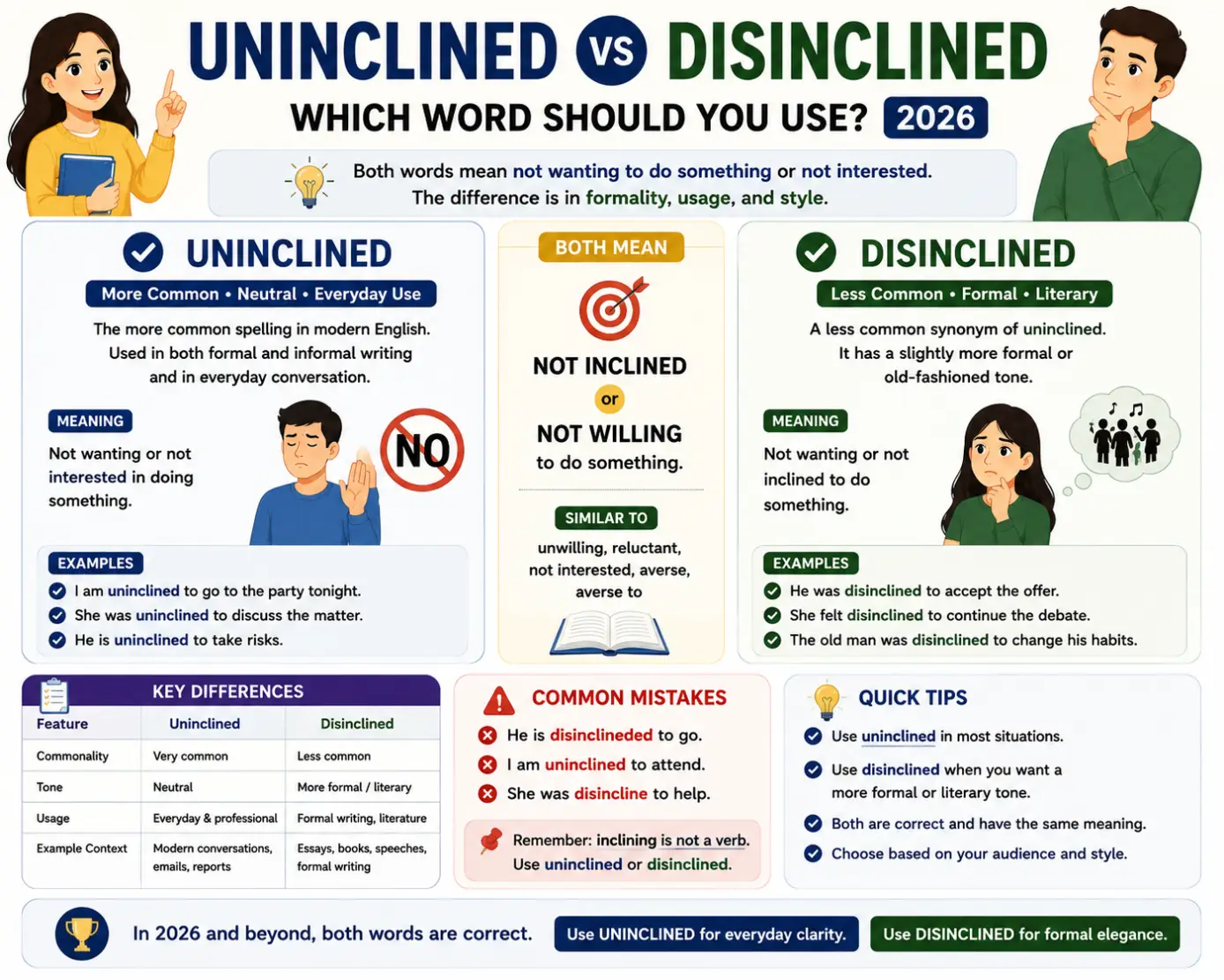
If you’ve searched for uninclined vs disinclined, you’re probably wondering if these words mean the same thing or if one is more correct than the other. They look similar, both suggest a lack of willingness, and many dictionaries list overlapping definitions. Still, they are not always interchangeable. Their tone, frequency, and typical usage differ in ways that matter, especially in professional writing, academic work, and polished communication.
The confusion comes from the shared root incline, which means to have a tendency, preference, or willingness toward something. Both words describe an absence of that willingness, but one often sounds stronger and more deliberate than the other.
This guide explains the difference between uninclined vs disinclined, when each word is appropriate, how native English speakers actually use them, and which choice works best in different situations. You’ll also find sentence examples, grammar guidance, pronunciation, etymology, regional usage, and practical editing advice so you can choose the right word with confidence.
Learn the difference in share me vs share with me Which Is Correct.
Quick Definition
Uninclined and disinclined both describe someone who lacks the desire to do something. However, disinclined usually suggests a conscious reluctance or unwillingness, while uninclined simply indicates an absence of interest or motivation. In modern English, disinclined is considerably more common and sounds more natural in most contexts.
Quick Answer
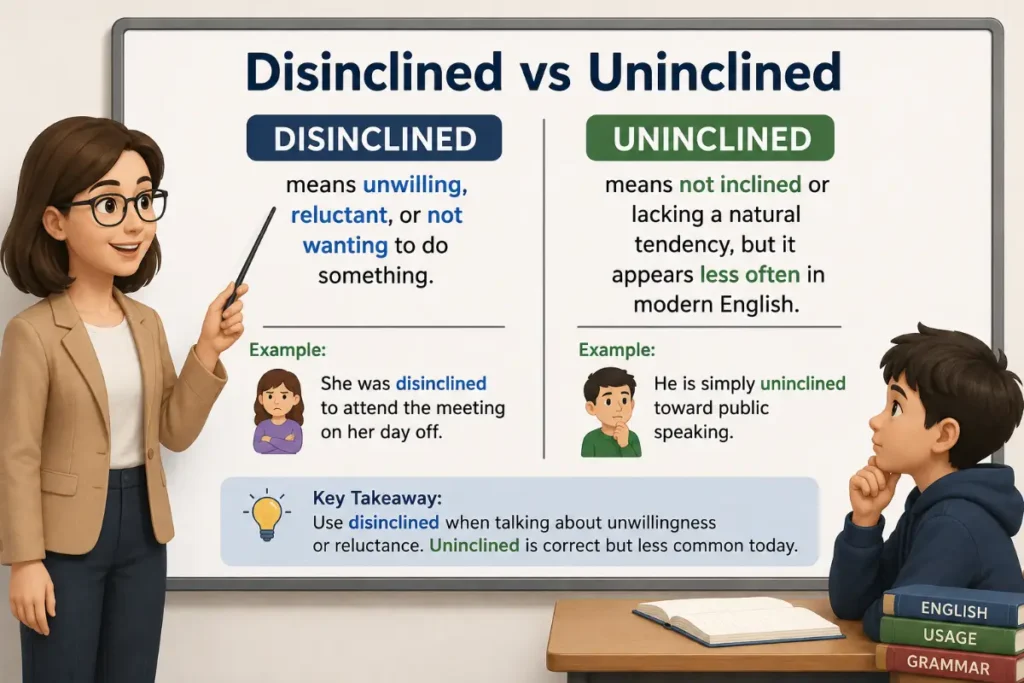
If you’re choosing between uninclined vs disinclined, disinclined is usually the better choice.
- Disinclined means unwilling, reluctant, or not wanting to do something.
- Uninclined means not inclined or lacking a natural tendency, but it appears less often in modern English.
- Neither word is incorrect.
- Most native speakers naturally prefer disinclined in everyday and professional writing.
Uninclined vs Disinclined Comparison Table
| Feature | Uninclined | Disinclined |
|---|---|---|
| Correct form | Yes | Yes |
| Part of speech | Adjective | Adjective |
| Core meaning | Not inclined | Reluctant or unwilling |
| Strength of meaning | Mild lack of interest | More deliberate reluctance |
| Origin | Prefix un + incline | Prefix dis + incline |
| Usage frequency | Less common | Much more common |
| Formality | Neutral to formal | Neutral to formal |
| Typical contexts | Personal tendencies, preferences | Decisions, refusals, hesitation |
| Naturalness | Less common in conversation | Common in speech and writing |
| Example | She was uninclined to argue. | She was disinclined to argue. |
Meaning of Both Terms
What Does Uninclined Mean?
Uninclined means not naturally disposed toward doing something. It describes someone who simply lacks interest, desire, or motivation. The word often sounds neutral rather than emotional. It suggests that a person does not feel drawn toward an action instead of actively resisting it.
Examples include:
- He was uninclined to participate in the discussion.
- They remained uninclined to change their routine.
- She felt uninclined to travel during winter.
Although perfectly correct, uninclined is relatively uncommon in present-day English. Many writers choose disinclined because it sounds more idiomatic.
Etymology of Uninclined
The word combines:
- Un meaning not.
- Inclined meaning having a tendency or willingness.
Its literal meaning is simply “not inclined.”
Typical Contexts
Writers use uninclined when describing:
- Personal preferences.
- Lack of enthusiasm.
- Passive unwillingness.
- Mild hesitation.
- Natural tendencies.
What Does Disinclined Mean?
Disinclined means reluctant, unwilling, or lacking the desire to do something. It usually implies that a person has consciously decided against an action. Compared with uninclined, this word often carries a stronger emotional or psychological element.
Examples include:
- She was disinclined to discuss politics.
- The company was disinclined to increase spending.
- He seemed disinclined to apologize.
Native speakers frequently choose disinclined because it sounds more natural in formal writing and educated conversation.
Etymology of Disinclined
The word comes from:
- Dis meaning apart, away from, or lacking.
- Inclined meaning having a tendency.
Over time, the combination developed the meaning of being unwilling or reluctant.
Typical Contexts
Disinclined commonly appears in:
- Journalism.
- Academic writing.
- Legal writing.
- Business communication.
- Literature.
- Editorial writing.
Uninclined vs Disinclined Key Differences
Although the meanings overlap, professional editors recognize several distinctions.
1. Difference in Meaning
Uninclined often indicates an absence of desire. Disinclined usually expresses active reluctance.
Compare these examples.
She was uninclined to join the game.
This simply means she did not feel interested.
She was disinclined to join the game.
This suggests she deliberately preferred not to participate.
2. Difference in Tone
Uninclined feels softer.
Disinclined sounds firmer and more intentional.
3. Difference in Common Usage
One of the biggest differences between uninclined vs disinclined is frequency. Modern English strongly favors disinclined. It appears more often in newspapers, books, academic journals, and professional communication.
4. Difference in Formal Writing
Editors usually recommend disinclined because readers recognize it more readily. Using uninclined is not wrong, but it can sound slightly unusual or dated depending on the context.
5. Difference in Emotional Force
Someone who is uninclined simply lacks motivation. Someone who is disinclined may intentionally avoid an action. That subtle distinction often determines which word sounds more natural.
Which One Is Correct?
Both uninclined and disinclined are correct English words. The better choice depends on the meaning you want to express. Choose uninclined when you want to emphasize a simple lack of interest or inclination. Choose disinclined when you want to express reluctance, unwillingness, or a conscious preference not to do something. For most everyday writing, professional communication, and academic work, disinclined is the safer and more natural option because it aligns with contemporary usage and reader expectations.
Why Do People Confuse Uninclined and Disinclined?
Several factors contribute to the confusion.
- Both words share the same root.
- Both describe a lack of willingness.
- Dictionary definitions overlap.
- Either word can fit many of the same sentences.
- The difference is based more on nuance than grammar.
- Modern speakers encounter disinclined far more often, making uninclined feel unfamiliar even though it is correct.
Professional editors pay attention to these nuances because word choice shapes tone as much as meaning.
Examples in Sentences
The best way to understand uninclined vs disinclined is to see both words used naturally. Although they often fit similar situations, the tone changes slightly depending on the writer’s choice.
10 Examples Using Uninclined
- Emma was uninclined to speak during the meeting because she preferred listening.
- The children seemed uninclined to leave the playground.
- I felt uninclined to watch television after a busy day.
- He remained uninclined to make quick decisions without enough information.
- The professor appeared uninclined to interrupt the discussion.
- She was uninclined to spend money on unnecessary items.
- They were uninclined to accept rumors without evidence.
- Many experienced investors are uninclined to follow market trends blindly.
- The author seemed uninclined to explain every detail.
- We were uninclined to change our travel plans at the last minute.
10 Examples Using Disinclined
- She was disinclined to answer personal questions.
- The manager was disinclined to approve the proposal without further review.
- They seemed disinclined to negotiate a lower price.
- He became disinclined to trust anonymous online reviews.
- Most voters appeared disinclined to support the new policy.
- The witness was disinclined to provide additional details.
- Investors remained disinclined to take unnecessary risks.
- Sarah felt disinclined to continue the conversation.
- The committee was disinclined to delay the project again.
- Many readers are disinclined to finish articles that are difficult to understand.
Side by Side Comparison
Notice how the meaning shifts slightly.
| Sentence | Impression |
|---|---|
| He was uninclined to attend. | He simply did not feel like attending. |
| He was disinclined to attend. | He consciously preferred not to attend. |
| She was uninclined to complain. | Complaining was not in her nature. |
| She was disinclined to complain. | She intentionally chose not to complain. |
| We were uninclined to argue. | We lacked interest in arguing. |
| We were disinclined to argue. | We deliberately avoided arguing. |
The difference is subtle, but experienced writers often choose the word that best matches the intended level of reluctance.
For another common grammar confusion, see Kinesthesiology vs Kinesiology Simple Rules Explained 2026.
Common Mistakes When Using Uninclined vs Disinclined
Even advanced English learners sometimes misuse these adjectives. Most errors come from assuming they are perfect synonyms.
1. Assuming One Word Is Incorrect
Some writers believe uninclined is outdated or wrong. It is not. Both words are recognized by major dictionaries and have been part of English for centuries.
2. Ignoring the Difference in Tone
This sentence sounds neutral. She was uninclined to argue. This sentence sounds more intentional. She was disinclined to argue. Choosing the wrong tone can slightly change how readers interpret the sentence.
3. Overusing Uninclined
Because disinclined appears much more often in modern English, repeatedly choosing uninclined may make writing sound unusual or old-fashioned. Professional editors generally recommend using disinclined unless you specifically want the softer meaning.
4. Confusing Them With Unable
These words do not describe someone’s ability.
Incorrect:
He was disinclined because he could not swim.
Correct:
He was disinclined to swim because the water looked unsafe.
The adjective describes willingness, not capability.
5. Using Them With the Wrong Structure
The standard pattern is:
adjective + to + verb
Correct examples:
- Disinclined to participate.
- Uninclined to cooperate.
- Disinclined to comment.
- Uninclined to travel.
Incorrect examples:
- Disinclined for participate.
- Uninclined participate.
- Disinclined in attend.
Pronunciation Guide
Although the pronunciation is straightforward, some learners stress the wrong syllable.
Uninclined
IPA
American English: /ˌʌn.ɪnˈklaɪnd/
British English: /ˌʌn.ɪnˈklaɪnd/
Syllable Breakdown
un • in • clined
The primary stress falls on clined.
Disinclined
IPA
American English: /ˌdɪs.ɪnˈklaɪnd/
British English: /ˌdɪs.ɪnˈklaɪnd/
Syllable Breakdown
dis • in • clined
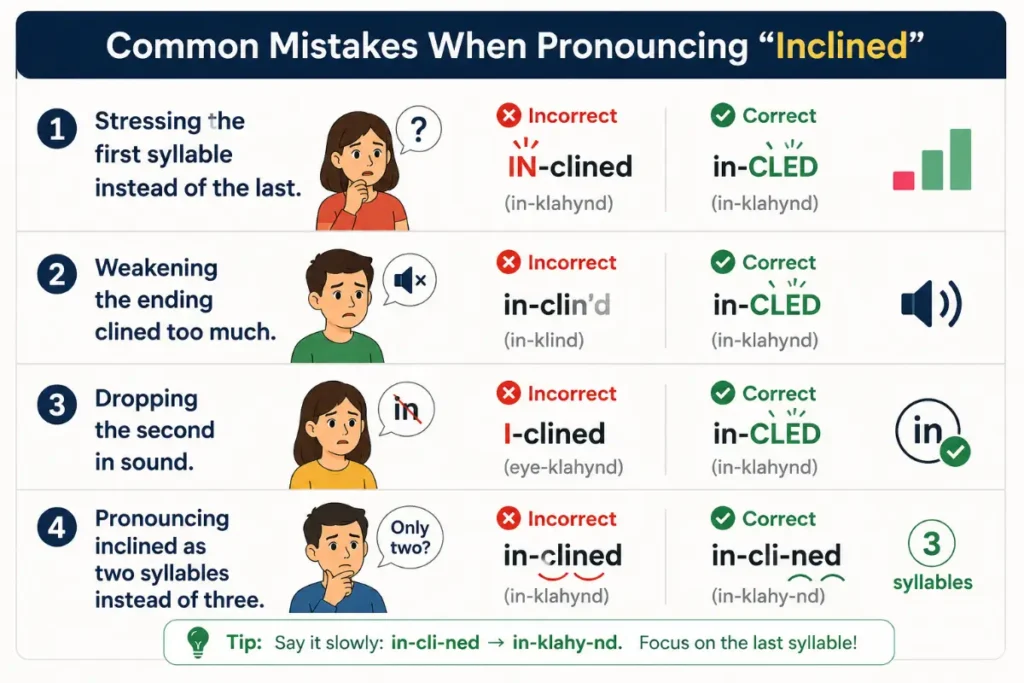
Again, the strongest stress falls on clined.
Common Pronunciation Mistakes
- Stressing the first syllable instead of the last.
- Weakening the ending clined too much.
- Dropping the second in sound.
- Pronouncing inclined as two syllables instead of three.
Reading both words aloud a few times helps make the rhythm feel natural.
Etymology and Word Origin
Learning where these words come from explains why they are so closely related.
Origin of Incline
Both adjectives come from the verb incline. The English word ultimately comes from the Latin verb inclinare, meaning “to bend,” “to lean,” or “to slope.” Over time, English expanded the meaning from physical movement to mental preference. If someone is inclined to do something, they naturally lean toward doing it.
Formation of Uninclined
The prefix un simply means “not.” So uninclined literally means “not inclined.” Historically, writers used it to describe someone who lacked interest or natural willingness.
Formation of Disinclined
The prefix dis often indicates separation, reversal, or opposition. As English evolved, disinclined came to express active reluctance rather than simple absence of inclination. This slight difference explains why modern speakers usually interpret disinclined as stronger than uninclined.
How the Meanings Changed Over Time
Early English writers often treated the two adjectives as near synonyms. During the nineteenth and twentieth centuries, usage gradually shifted. Today, professional writers tend to reserve:
- Uninclined for mild absence of interest.
- Disinclined for deliberate unwillingness.
The distinction is not an official grammar rule, but it reflects current usage patterns in edited English.
Regional Usage
One question readers often ask is whether uninclined vs disinclined differs across English-speaking countries. The answer is that both words are understood everywhere, but their frequency varies.
American English
American writers strongly favor disinclined. It appears regularly in journalism, legal writing, academic publications, and professional communication. Uninclined is recognized but relatively uncommon.
British English
British English also prefers disinclined, especially in newspapers, books, and formal writing. However, British literature sometimes uses uninclined for stylistic variation.
Canadian English
Canadian English follows the same general pattern as American English. Editors usually recommend disinclined because it sounds more idiomatic.
Australian English
Australian English also favors disinclined, particularly in professional writing. Uninclined appears occasionally but much less often.
Regional Preference Summary
| Variety | Preferred Word |
|---|---|
| American English | Disinclined |
| British English | Disinclined |
| Canadian English | Disinclined |
| Australian English | Disinclined |
The preference is remarkably consistent across major English varieties.
Grammar Rules
Understanding the grammar behind these adjectives helps you use them naturally.
Part of Speech
Both uninclined and disinclined are adjectives.
Examples:
- She is disinclined to comment.
- He seems uninclined to participate.
Predicate Adjectives
These words most often appear after linking verbs.
Examples include:
- She is disinclined.
- They were uninclined.
- He became disinclined.
- We remain uninclined.
Followed by an Infinitive
The most common grammatical pattern is:
adjective + to + base verb
Examples:
- Disinclined to help.
- Uninclined to negotiate.
- Disinclined to answer.
- Uninclined to travel.
Tense
Because they are adjectives, these words do not change with tense. Instead, the verb around them changes.
Present:
She is disinclined to cooperate.
Past:
She was disinclined to cooperate.
Future:
She will be disinclined to cooperate.
Plural Forms
Adjectives never take plural endings.
Correct:
- The students were disinclined.
- The employees remained uninclined.
Incorrect:
- Disinclineds.
- Uninclineds.
Common Sentence Structures
- Subject + be + disinclined + to + verb.
- Subject + seem + uninclined + to + verb.
- Subject + become + disinclined + to + verb.
- Subject + remain + uninclined + to + verb.
These structures account for the vast majority of real-world usage.
Real Life Usage Examples
Understanding dictionary definitions is helpful, but seeing uninclined vs disinclined in real situations makes the difference much clearer. Native speakers generally choose the word that best matches the degree of reluctance they want to express.
Daily Conversation
In everyday speech, people usually prefer disinclined because it sounds more natural.
Examples:
- I’m disinclined to go out tonight because I’m exhausted.
- She seemed disinclined to discuss the issue any further.
- My parents are disinclined to buy a new car this year.
- He was uninclined to wake up early on weekends.
- We’re disinclined to change our vacation plans.
Notice that uninclined tends to describe a simple lack of enthusiasm, while disinclined often suggests a conscious decision.
Academic Writing
Academic authors frequently use disinclined when discussing research participants, institutions, or historical figures.
Examples:
- Participants were disinclined to alter their responses after completing the survey.
- Some scholars remain disinclined to accept the proposed theory.
- Reviewers appeared disinclined to support the revised methodology.
Because academic writing values precision, disinclined usually communicates the intended meaning more effectively.
Professional Communication
Business writing often favors disinclined because it conveys polite reluctance without sounding emotional.
Examples:
- The board is disinclined to approve additional spending at this stage.
- Our clients were disinclined to extend the contract.
- Management remains disinclined to modify the existing policy.
Using uninclined in these situations would still be grammatically correct, but it may sound slightly less idiomatic.
Literature
Novelists use both words to shape characterization.
Examples:
- The old sailor was uninclined to trust strangers after years at sea.
- The queen appeared disinclined to forgive the betrayal.
- The detective seemed disinclined to believe the suspect’s story.
The choice depends on the emotional nuance the author wants to create.
News and Media
Journalists frequently choose disinclined because it is concise and formal.
Examples:
- Investors were disinclined to react before the official announcement.
- Officials remained disinclined to comment on the investigation.
- Consumers appear disinclined to spend during periods of economic uncertainty.
This is one reason disinclined feels more familiar to modern readers.
Related Words and Commonly Confused Terms
Many words share similar meanings with uninclined and disinclined, but each carries its own nuance.
| Word | Meaning | Difference |
|---|---|---|
| Reluctant | Hesitant or unwilling | More common than both words. |
| Unwilling | Not willing | Stronger and more direct. |
| Hesitant | Slow to act because of uncertainty | Focuses on doubt rather than lack of desire. |
| Resistant | Opposed to change or action | Stronger sense of opposition. |
| Indifferent | Showing little interest | Suggests emotional neutrality rather than reluctance. |
| Apathetic | Lacking interest or enthusiasm | Implies emotional disengagement. |
| Hesitant | Unsure about acting | Often temporary. |
| Inclined | Having a tendency or desire | The opposite of both words. |
| Willing | Ready to do something | Direct opposite. |
| Enthusiastic | Showing eager interest | Much stronger positive attitude. |
Words That Learners Often Confuse
English learners sometimes mix these adjectives with similar expressions.
- Reluctant and disinclined.
- Unwilling and disinclined.
- Indifferent and uninclined.
- Inclined and disinclined.
- Interested and inclined.
Although they overlap, they are not perfect substitutes.
For example:
Reluctant often implies emotional hesitation.
Disinclined usually suggests a settled preference not to do something.
Expert Language Insight
From an editor’s perspective, the distinction between uninclined vs disinclined is less about grammar and more about style. Both words are correct. Neither is obsolete. However, frequency matters. Modern English strongly favors disinclined because readers encounter it more often in books, newspapers, academic writing, and professional communication. As a result, it feels smoother and more familiar. Professional editors rarely replace disinclined with uninclined, but they sometimes do the opposite when revising manuscripts for clarity and readability.
A useful guideline is this:
- Use disinclined when someone consciously prefers not to do something.
- Use uninclined when describing a simple absence of interest or natural tendency.
If either word works equally well in your sentence, disinclined will usually sound more natural to contemporary readers.
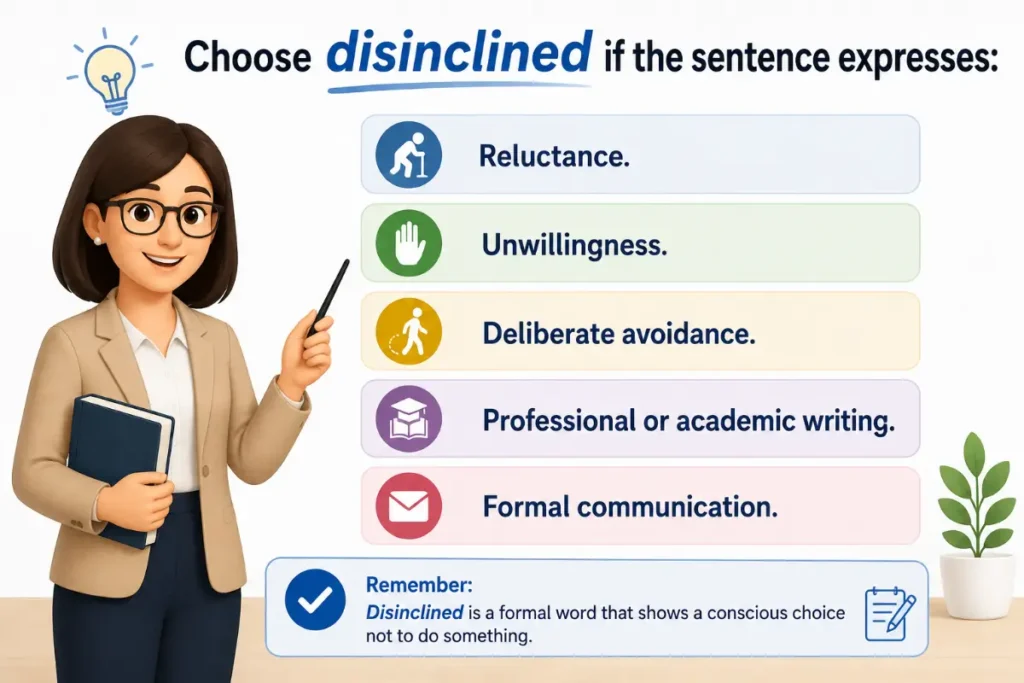
Quick Decision Guide
Choose disinclined if the sentence expresses:
- Reluctance.
- Unwillingness.
- Deliberate avoidance.
- Professional or academic writing.
- Formal communication.
Choose uninclined if the sentence expresses:
- Mild lack of interest.
- Absence of motivation.
- Natural disposition.
- Literary style.
- Softer wording.
Still confused? Compare Cubical vs Cubicle Meaning Difference and Correct Usage.
Conclusion
When comparing uninclined vs disinclined, the most important point is that both words are correct, but they are not always the best choice for the same situation.
Uninclined simply means not inclined or lacking a natural desire to do something. It usually carries a softer, more neutral tone.
Disinclined goes a step further. It often suggests deliberate reluctance, unwillingness, or a conscious preference not to act. Because this meaning aligns more closely with modern usage, it has become the preferred choice in professional writing, journalism, academic work, and everyday English.
Frequently Asked Questions
Is uninclined a real English word?
Yes. Uninclined is a legitimate English adjective recognized by major dictionaries. It means “not inclined” or “not naturally willing.” Although it appears less frequently than disinclined, it remains grammatically correct and appropriate in formal writing.
Is disinclined more common than uninclined?
Yes. Disinclined is significantly more common in modern English. It appears more often in newspapers, books, academic journals, legal documents, and professional communication, making it the more natural choice in most situations.
Can uninclined and disinclined be used interchangeably?
Often they can, but not always. Both describe a lack of willingness, yet disinclined usually implies deliberate reluctance, while uninclined often suggests a simple absence of interest or inclination. Choosing the right word helps convey the intended tone.
Which word should I use in professional writing?
In most professional contexts, disinclined is the better choice. It is more familiar to readers and better reflects contemporary usage. Uninclined is still correct but may sound slightly less idiomatic in business and academic writing.
Do American and British English prefer different words?
No. American English, British English, Canadian English, and Australian English all generally favor disinclined. While uninclined is understood in every major variety of English, it is used less frequently across all regions.
What is the opposite of disinclined?
The direct opposite is inclined, meaning willing, disposed, or naturally interested in doing something. Depending on the context, willing, eager, and enthusiastic may also serve as appropriate opposites.
Are these words formal or informal?
Both adjectives are more common in formal or carefully edited English than in casual conversation. In everyday speech, many people choose simpler alternatives such as reluctant, unwilling, or not interested.
Why do dictionaries define them similarly?
The two words share the same root, incline, and their meanings overlap considerably. Over time, actual usage has created a subtle distinction, with disinclined generally expressing stronger reluctance and uninclined suggesting a milder lack of inclination.