

The debate over kinesthesiology vs kinesiology often confuses students, healthcare professionals, and people searching for careers in movement science. At first glance, both words look almost the same. They also sound alike, which makes many people wonder if they mean different things or if one is simply a misspelling.
The good news is that both terms are real. However, they are not used in exactly the same way. One spelling is far more common in universities, research papers, and professional organizations, while the other appears in some educational programs and historical references.
This guide explains these words in clear, simple English. You will learn what each word means, why people confuse them, which spelling is more common today, and how to use the correct term with confidence.
A related grammar guide is ally vs allie Meaning Spelling and Usage.
Kinesthesiology vs Kinesiology Simple Answer in One Look
When comparing these words, kinesiology is the standard and widely accepted term. Kinesthesiology is a less common variant that appears in some schools, organizations, and historical sources but is rarely used in modern academic writing.

What Does Kinesthesiology vs Kinesiology Mean in Simple English?
Both words are connected to the study of human movement. They focus on how the body moves, how muscles work together, and how movement affects health, fitness, sports, and daily life.
Imagine someone learning how to walk after an injury. A movement specialist studies how the person’s muscles, bones, joints, and nerves work together. This area of study is called kinesiology in most colleges and universities.
People who study this subject learn about:
- How muscles move the body.
- How exercise improves health.
- How injuries affect movement.
- How athletes improve performance.
- How to help people move safely.
Some older books or educational programs may use kinesthesiology, but they usually refer to the same general field.
In everyday English, if someone says they studied kinesiology, they mean they learned about human movement and physical activity.
Why Do People Mix These Words?
Many people become confused because the two words look almost identical.
Here are the main reasons.
Both Words Sound Nearly the Same
Most speakers pronounce them so similarly that it is difficult to hear a difference during conversation.
Both Refer to Human Movement
Whether someone says kinesiology or kinesthesiology, they are usually talking about the science of movement.
Different Schools Have Used Different Names
Over the years, some colleges and training programs chose the longer spelling, while most universities adopted the shorter one.
Internet Searches Show Both Spellings
When people search online, they often find websites using both terms. This makes it seem like they are equally common, even though kinesiology is now the standard spelling.
Similar Medical Words
English includes many scientific words beginning with kine, kines, or kinesth, making it easy to confuse one with another.
For example:
- Kinesiology
- Kinesthesia
- Kinesthetic
- Kinesthesiology
Because these words are closely related, many people assume they are interchangeable.
Clear Difference Explained Simply
The easiest way to understand the difference is with a simple comparison.
| Feature | Kinesiology | Kinesthesiology |
|---|---|---|
| Modern academic term | ✅ Yes | Less common |
| Used by most universities | ✅ Yes | Occasionally |
| Common in research | ✅ Yes | Rare |
| Dictionary recognition | ✅ Standard | Limited |
| Meaning | Study of human movement | Generally the same field |
Kinesiology
- Standard modern spelling.
- Used by universities around the world.
- Found in textbooks and research papers.
- Preferred by healthcare professionals.
Kinesthesiology
- Less common spelling.
- Sometimes used by specific organizations.
- May appear in older educational materials.
- Usually refers to the same subject.
The biggest difference is how often each word is used, not what it means.
Which Form Should You Use?
If you are writing for school, work, research, or professional communication, choose kinesiology.
Examples:
✔ She earned a degree in kinesiology.
✔ Kinesiology helps us understand human movement.
Avoid using kinesthesiology unless you are referring to a school, organization, or publication that officially uses that spelling.
A simple rule to remember is:
- Modern writing: Use kinesiology.
- Historical or official names: Use kinesthesiology only if that exact spelling is part of the name.
Following this rule will help your writing match modern English standards.
Easy Real Life Sentences You Can Use
Here are simple examples you can use every day.
- My sister is studying kinesiology at college.
- Kinesiology helps athletes improve their performance.
- Our teacher explained how muscles work during exercise.
- He wants a career in sports science and kinesiology.
- Exercise is an important part of kinesiology.
- The therapist understands body movement very well.
- Good posture is one topic taught in kinesiology classes.
- Human movement is the main focus of kinesiology.
These examples show the word in natural, everyday situations.
Where This Word Comes From
The word kinesiology comes from the Greek word kinesis, which means movement.
The ending ology means the study of.
Together, the word means the study of movement.
The longer form kinesthesiology developed later because some educators connected it with kinesthesia, a word describing the body’s ability to sense movement and position. As universities standardized their course names, kinesiology became the preferred spelling in most English-speaking countries. Today, that is the version you will usually see in:
- College degree programs.
- Scientific journals.
- Research articles.
- Healthcare publications.
- Professional organizations.
Understanding this history explains why both words exist even though one is much more common today. The basic difference is now clear. In the next section, you’ll learn how these terms are used in universities, healthcare, sports science, different countries, and everyday English. You’ll also see common mistakes, practical examples, frequently asked questions, and expert guidance that will help you use the correct term with confidence.
Kinesthesiology vs Kinesiology in Culture and Everyday Life
The difference between these words is mostly about spelling, not culture. Still, the word itself is connected to movement, health, and learning. People often use it when talking about exercise, sports, physical therapy, and healthy living.
Many schools, colleges, and fitness centers use the spelling that matches their country or organization. In the United States, you will usually see kinesiology. In some other places, especially in older academic writing, you may also see kinesthesiology. No matter which spelling you see, the idea stays the same. It is the study of how the human body moves.
Children learn through movement.
Athletes improve through movement.
Patients recover through movement.
Because movement is part of everyday life, this field plays an important role in health, education, and sports.
A related grammar guide is withdraw or withdrawal Meaning Difference And Usage.
Is There a Biblical or Mythological Meaning for Kinesthesiology vs Kinesiology?
There is no direct biblical or mythological meaning for these words. Neither word appears in the Bible or in ancient myths. However, many religious and cultural traditions encourage people to care for their bodies.
Simple examples include:
- Staying healthy.
- Working with strength.
- Helping injured people heal.
- Respecting the human body.
People who study kinesiology often help others improve their physical health, recover from injuries, and enjoy better movement. Those goals match many positive values found in different cultures around the world.
Symbolism of Kinesthesiology vs Kinesiology
What Kinesiology Represents
Kinesiology often represents:
- Healthy movement.
- Physical fitness.
- Scientific research.
- Exercise and wellness.
- Human performance.
- Recovery from injuries.
- Learning how the body works.
It reminds people that movement is one of the foundations of good health.
What Kinesthesiology Represents
Kinesthesiology represents the same ideas because it refers to the same field.
It may also symbolize:
- Traditional academic spelling.
- Older educational materials.
- Historical course names.
- Different institutional preferences.
Although the spelling looks different, the meaning does not change.
Related Words to Kinesthesiology vs Kinesiology
Learning related words makes this topic easier to understand.
Kinesiology
The scientific study of human movement.
Exercise Science
The study of exercise and physical fitness.
Biomechanics
The study of how muscles, bones, and joints move.
Physical Therapy
Treatment that helps people recover after injuries or surgery.
Sports Medicine
Medical care focused on athletes and active people.
Anatomy
The study of body parts.
Physiology
The study of how the body’s systems work.
Motor Skills
Movements that help people complete everyday tasks.
Rehabilitation
The process of helping someone regain strength and movement.
Human Movement
A broad term that describes how the body moves during daily life, work, exercise, and sports.
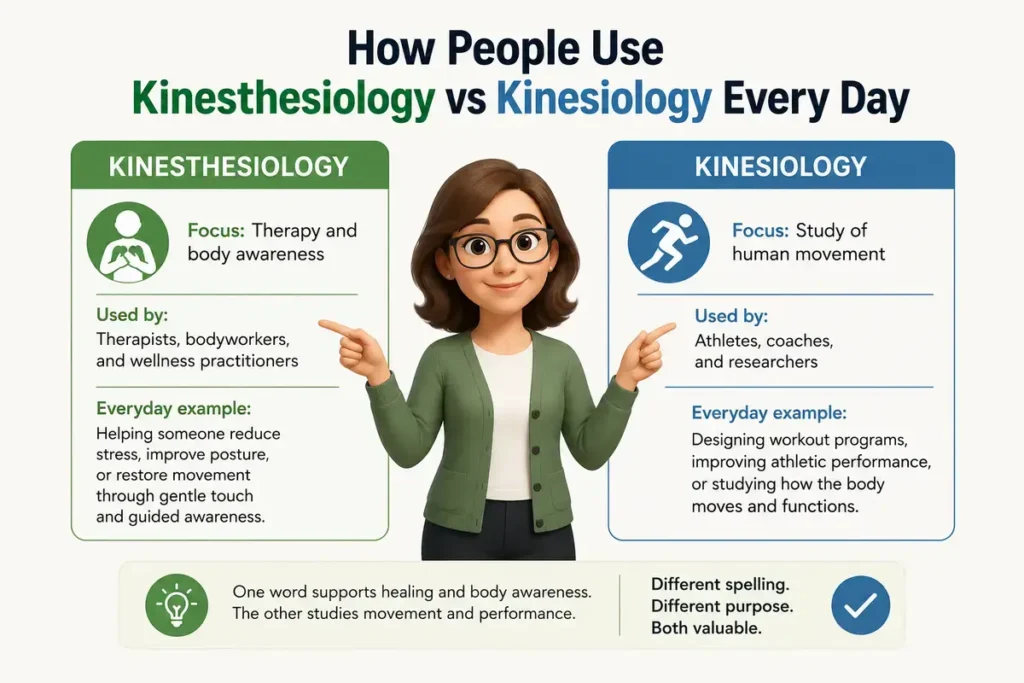
How People Use Kinesthesiology vs Kinesiology Every Day
Although many people never say these words in daily conversation, they appear often in schools, hospitals, sports centers, and universities.
Here are some natural examples.
“My sister is studying kinesiology at college.”
“He wants a degree in kinesiology.”
“Our university offers a kinesiology program.”
“The coach studied kinesiology before becoming a trainer.”
“She chose kinesiology because she enjoys sports.”
“The therapist has a background in kinesiology.”
“I found an older book that uses the spelling kinesthesiology.”
“The course title changed from kinesthesiology to kinesiology.”
“Many colleges now prefer the spelling kinesiology.”
“Both spellings describe the study of human movement.”
Common Mistakes with Kinesthesiology vs Kinesiology
People often make a few simple mistakes.
Mistake 1: Thinking One Word Has a Different Meaning
Incorrect idea:
“Kinesthesiology and kinesiology are different subjects.”
Correct idea:
They describe the same field of study.
Mistake 2: Assuming One Spelling Is Wrong
Incorrect idea:
“Kinesthesiology is always incorrect.”
Correct idea:
Both spellings exist, but kinesiology is much more common today.
Mistake 3: Mixing Regional Preferences
Some universities still use kinesthesiology because of tradition.
Others use kinesiology because it has become the modern standard.
Always use the spelling preferred by your school, employer, publisher, or organization.
Mistake 4: Confusing It with Physical Therapy
Kinesiology is a field of study.
Physical therapy is a healthcare profession.
They are connected but not identical.
Mistake 5: Thinking the Extra Letters Change the Meaning
The extra letters in kinesthesiology do not create a new subject.
They simply reflect another accepted spelling.

Final Teacher Explanation of Kinesthesiology vs Kinesiology
Imagine two schools teaching the same subject.
One writes the course name as kinesiology.
The other writes it as kinesthesiology.
Students in both classrooms learn about muscles, bones, exercise, movement, and health. The lessons are the same. The goal is the same. Only the spelling is different. If you are writing for a general audience, choosing kinesiology is usually the safest option because it is the spelling most readers expect today. If your university, textbook, or organization officially uses kinesthesiology, it is perfectly fine to follow that style. The most important thing is to stay consistent throughout your writing.
Final Answer About Kinesthesiology vs Kinesiology
When comparing kinesthesiology vs kinesiology, both spellings refer to the study of human movement.
Today, kinesiology is the more common and widely accepted spelling, especially in universities, research papers, healthcare, and professional writing. Kinesthesiology still appears in some educational institutions and older materials but carries the same meaning.
Frequently Asked Questions About Kinesthesiology vs Kinesiology
What is the difference between kinesthesiology vs kinesiology?
There is no difference in meaning. Both words refer to the study of human movement. The main difference is spelling.
Which spelling is more common today?
Kinesiology is the spelling used by most universities, healthcare organizations, and professional publications.
Is kinesthesiology incorrect?
No. Some schools and institutions still use kinesthesiology as their official spelling.
Should I use kinesthesiology or kinesiology in college papers?
Use the spelling required by your instructor or school. If there is no preference, kinesiology is the safer choice.
Why do both spellings exist?
The longer spelling developed from the word “kinesthesia,” while the shorter form became the preferred modern spelling in many academic fields.
Do both words mean the study of movement?
Yes. Both spellings describe the scientific study of human movement and physical activity.
Is kinesiology related to physical therapy?
Yes. Kinesiology provides knowledge about body movement that supports careers such as physical therapy, athletic training, exercise science, and sports medicine.
You may also want to read Appendices vs Appendixes Which Spelling Is Correct.
Conclusion
The discussion about kinesthesiology vs kinesiology is mainly a spelling question rather than a meaning question. Both words describe the study of human movement, exercise, muscles, and physical health. They help students, teachers, healthcare professionals, coaches, and researchers communicate about the same subject.
If you are writing for school, work, or online readers, kinesiology is usually the better choice because it is the spelling most universities, dictionaries, and professional organizations use today. If your institution officially prefers kinesthesiology, you should follow that style consistently.
The easiest rule to remember is simple. The meaning stays the same, but kinesiology is the modern spelling you will see most often in everyday English.