
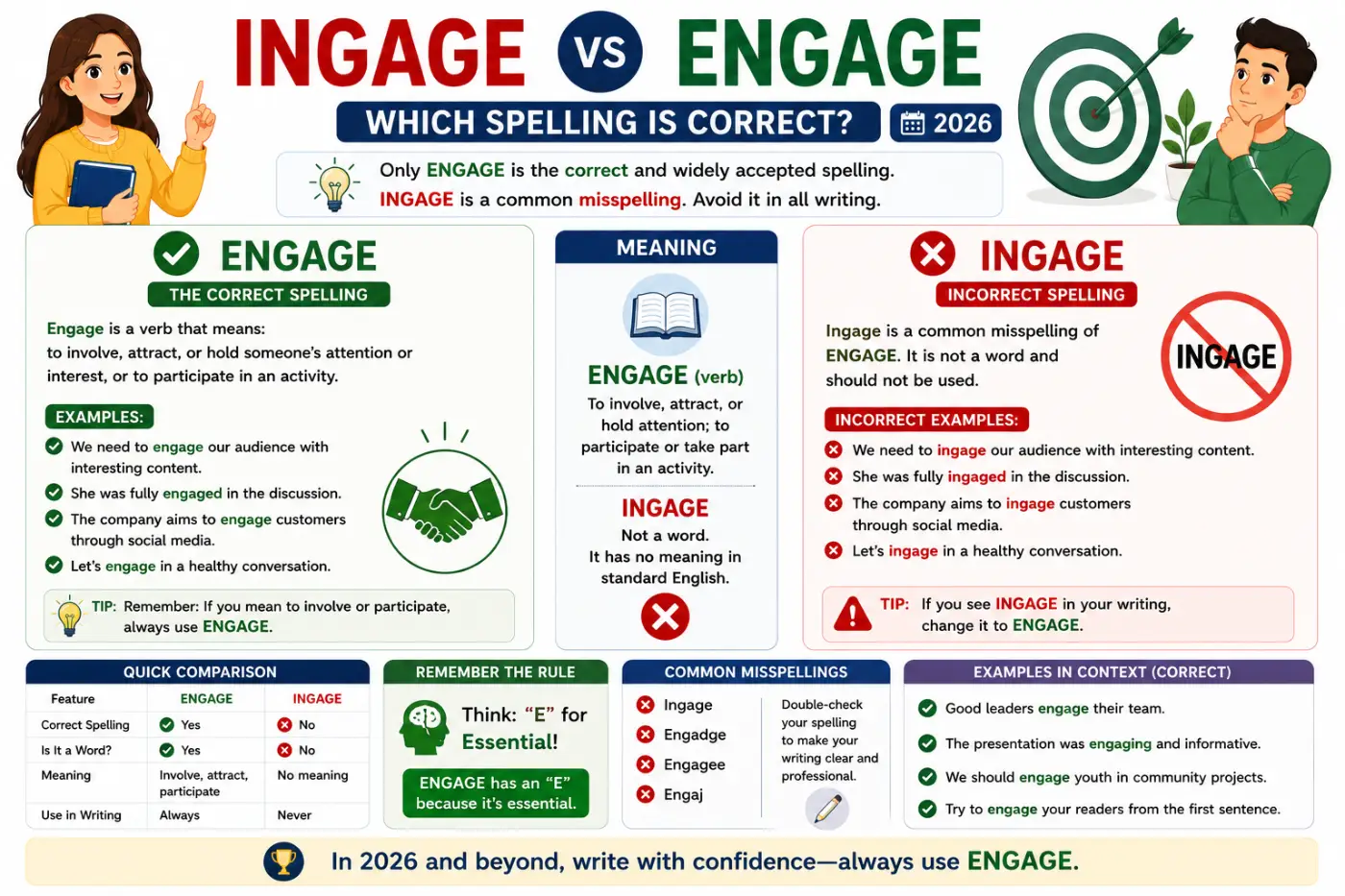
If you’ve ever typed ingage vs engage into a search engine, you’re probably trying to figure out which spelling is correct. The short answer is simple. Engage is the correct English word. Ingage is a misspelling that occasionally appears because of pronunciation, typing mistakes, or confusion about English spelling patterns.
This mix-up is surprisingly common. The first syllable in engage often sounds like “in” in everyday speech, leading many writers to assume the word begins with in instead of en. Spell checkers usually catch the mistake, but it still appears in emails, social media posts, school assignments, and even business documents.
In this guide, you’ll learn the difference between ingage vs engage, why the confusion happens, how the word developed over time, how native speakers use it, pronunciation tips, grammar rules, regional usage, and plenty of real-world examples. By the end, you’ll know exactly which spelling to use and how to avoid making this mistake again.
Need another quick comparison? Read vallies or valleys Correct Spelling Meaning and Usage Guide.
Quick Definition
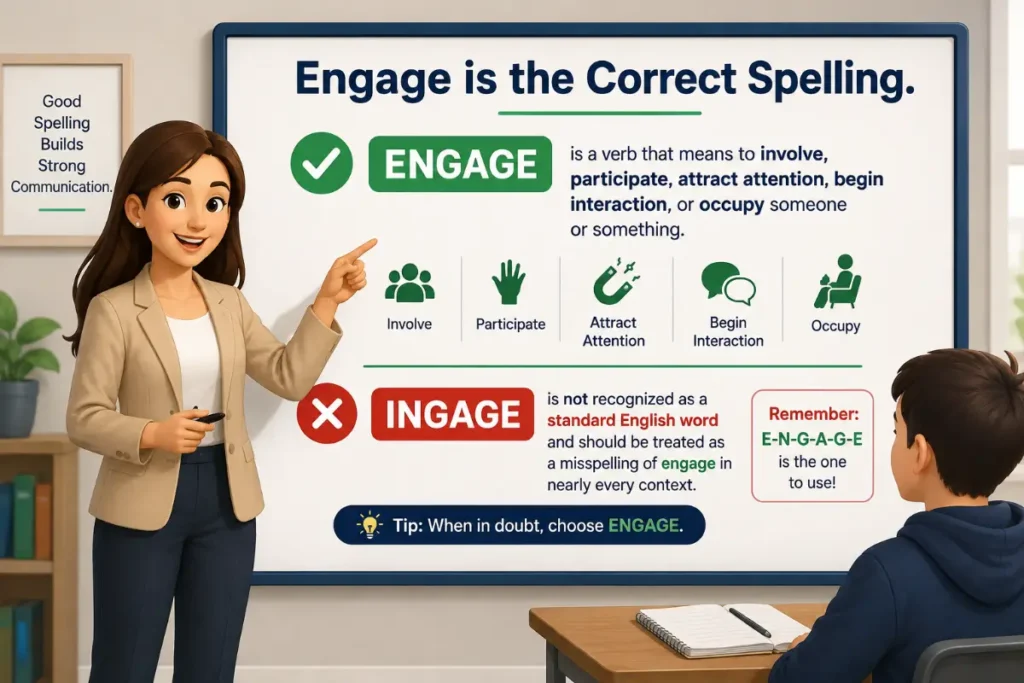
Engage is the correct spelling. It is a verb that means to involve, participate, attract attention, begin interaction, or occupy someone or something. Ingage is not recognized as a standard English word and should be treated as a misspelling of engage in nearly every context.
Quick Answer
If you’re deciding between ingage vs engage, always choose engage.
- Engage is the correct spelling in American, British, Canadian, and Australian English.
- Ingage is considered a spelling error.
- Use engage in formal writing, academic work, professional communication, and everyday conversation.
Ingage vs Engage Comparison Table
| Feature | Ingage | Engage |
|---|---|---|
| Correct spelling | No | Yes |
| Meaning | None in standard English | To involve, attract, participate, occupy, or begin interaction |
| Part of speech | Not recognized | Verb |
| Dictionary status | Misspelling | Standard English word |
| Origin | None | From Old French and Latin |
| Usage frequency | Extremely rare | Very common |
| Formality | Incorrect | Suitable for all levels of writing |
| Common contexts | Typographical error | Business, education, military, technology, marketing, conversation |
| Example | Incorrect: We should ingage customers. | Correct: We should engage customers. |
Meaning of Both Terms
What Does Ingage Mean?
Ingage has no accepted meaning in modern English dictionaries. It is almost always a misspelling of engage.
People often write ingage because:
- They spell the word based on how it sounds.
- They accidentally replace en with in.
- English prefixes can be confusing.
- They have seen the incorrect spelling online.
Although you may occasionally find ingage on websites or social media, those examples are spelling mistakes rather than legitimate usage.
What Does Engage Mean?
Engage is a versatile English verb with several meanings.
It commonly means:
- To involve someone in an activity.
- To attract someone’s attention or interest.
- To participate actively.
- To begin interaction.
- To occupy someone’s time.
- To hire someone for work.
- To enter into combat or conflict.
- To connect mechanical parts.
Examples include:
- Teachers should engage students during class.
- The movie quickly engaged the audience.
- The company engaged a new consultant.
- The gears engage automatically.
Ingage vs Engage Key Differences
Although the two spellings look similar, they are not interchangeable.
| Difference | Ingage | Engage |
|---|---|---|
| Dictionary recognition | No | Yes |
| Correct English | No | Yes |
| Used in professional writing | No | Yes |
| Appears in dictionaries | No | Yes |
| Recommended spelling | Never | Always |
The only practical difference is that one is incorrect and the other is the accepted English spelling.
Ingage vs Engage Which One Is Correct?
The correct spelling is engage. Professional editors, teachers, publishers, dictionaries, universities, and style guides all recognize engage as the standard form. You should never intentionally write ingage unless you are discussing common spelling mistakes or quoting someone’s original text.
Examples:
Correct:
- We need to engage our audience.
- The speaker engaged everyone.
- Good questions engage students.
- Social media helps businesses engage customers.
Incorrect:
- We need to ingage our audience.
- The speaker ingaged everyone.
Examples Using Ingage
The following examples demonstrate incorrect usage.
- We should ingage customers. ❌
- The book ingaged me. ❌
- Teachers ingage students daily. ❌
- Please ingage with the audience. ❌
- She wants to ingage readers. ❌
- The campaign ingaged voters. ❌
- They ingaged in conversation. ❌
- The lesson ingaged everyone. ❌
- We hope to ingage users. ❌
- The manager ingaged the team. ❌
Each sentence should use engage instead.
Examples Using Engage
- Great stories engage readers immediately.
- Teachers engage students through discussion.
- The speaker engaged the audience from the beginning.
- We need to engage customers on social media.
- The documentary engaged viewers emotionally.
- Volunteers engaged with local communities.
- Interactive lessons engage children more effectively.
- The lawyer engaged an expert witness.
- The company engaged outside consultants.
- The gears engage smoothly.
For another common grammar confusion, see Envolve vs involve: Correct Spelling and Usage.
Common Mistakes
People commonly confuse ingage vs engage for several reasons.
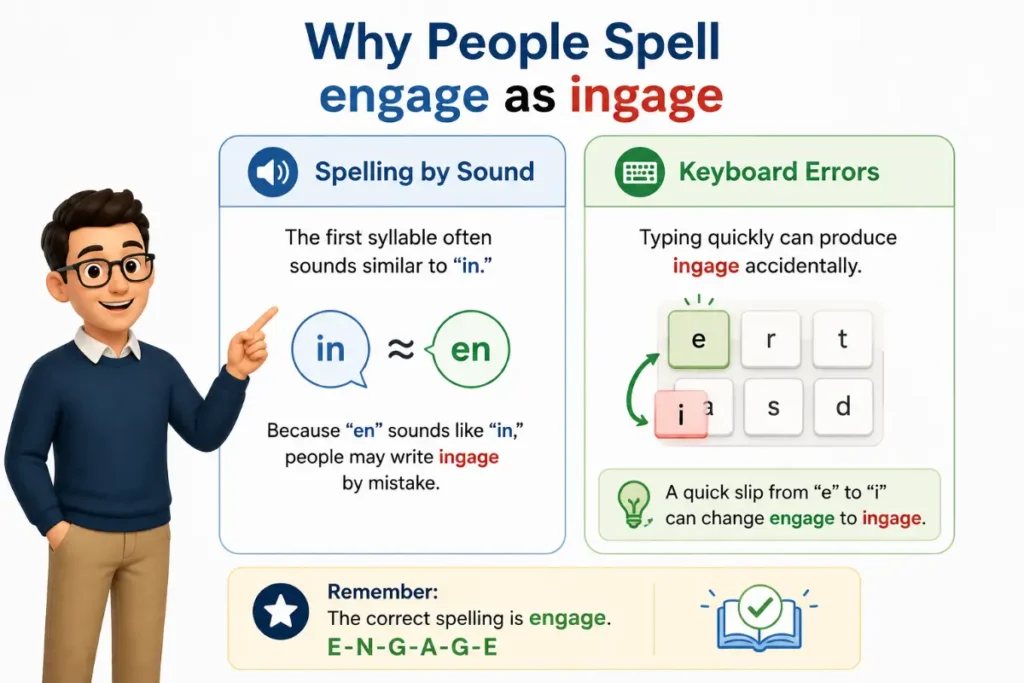
Spelling by Sound
The first syllable often sounds similar to “in.”
Keyboard Errors
Typing quickly can produce ingage accidentally.
Misunderstanding Prefixes
English contains many words beginning with in, making writers assume this word follows the same pattern.
Copying Incorrect Sources
Misspelled words spread easily through blogs, comments, and social media.
Ingage vs Engage Pronunciation Guide
Engage
IPA (American English)
/ɪnˈɡeɪdʒ/
IPA (British English)
/ɪnˈɡeɪdʒ/
Syllables
en • gage
Although the pronunciation begins with an in sound, the spelling begins with en.
Common Pronunciation Mistakes
- Assuming pronunciation determines spelling.
- Writing words exactly as they sound.
- Confusing spoken English with written English.
Etymology and Word Origin
The word engage entered English through Old French engagier, meaning to pledge or bind. Its deeper roots trace back to Frankish and Germanic languages connected with the idea of a pledge or commitment.
Over time, English expanded its meaning to include:
- Involving someone.
- Capturing attention.
- Participating actively.
- Employing someone.
- Beginning military action.
- Connecting machinery.
The spelling has consistently remained engage.
Regional Usage
American English
Americans exclusively use engage.
Example:
The presentation engaged everyone.
British English
British English also uses engage exclusively.
Example:
Students should engage fully in discussion.
Australian English
Australian English follows the same spelling.
Canadian English
Canadian English also recognizes only engage. Across all major English varieties, ingage is considered incorrect.
Grammar Rules
Part of Speech
Engage is primarily a verb.
Examples:
- They engage customers.
- We engage in conversation.
Common Verb Forms
| Base | Past | Past Participle | Present Participle |
|---|---|---|---|
| engage | engaged | engaged | engaging |
Common Expressions
- Engage the audience.
- Engage employees.
- Engage customers.
- Engage learners.
- Engage in debate.
- Engage with readers.
Real Life Usage Examples
Daily Conversation
- Try to engage everyone in the discussion.
- That game really engaged the children.
Academic Writing
- Active learning engages students more effectively.
- The article engages with previous research.
Professional Communication
- We need strategies to engage clients.
- The campaign successfully engaged customers.
Literature
Authors often describe characters who engage in conversation, engage their audience, or engage emotionally with events.
Media and Marketing
Businesses constantly discuss ways to engage audiences, engage followers, and increase customer engagement.
Related Words and Confused Terms
Words closely related to engage include:
- Involve.
- Participate.
- Interact.
- Connect.
- Occupy.
- Interest.
- Attract.
- Employ.
- Hire.
- Commit.
Commonly confused spellings include:
- Engaged.
- Engaging.
- Engagement.
- Engagements.
- Enrol and enroll.
- Gauge and gage.
- Ensure and insure.
Expert Language Insight
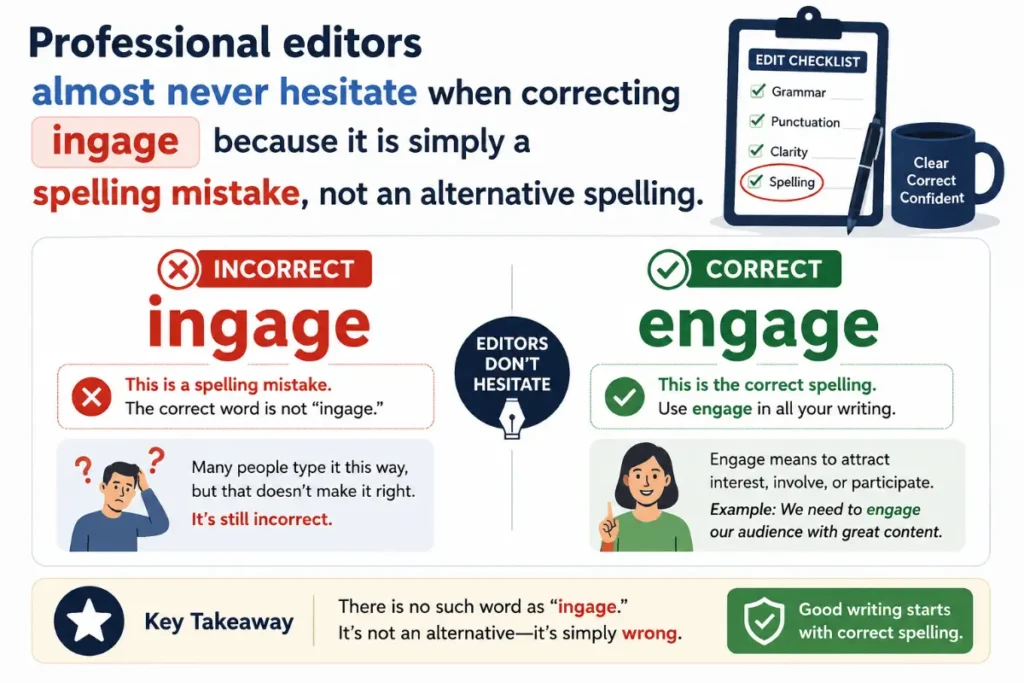
Professional editors almost never hesitate when correcting ingage because it is simply a spelling mistake, not an alternative spelling. One reason the error persists is the mismatch between English pronunciation and spelling. Native speakers pronounce the first syllable with a short i sound, making it resemble in. However, English spelling preserves the historical en prefix. Experienced writers rely on dictionaries rather than pronunciation when uncertain about spelling. That habit helps prevent errors like ingage, definately, occured, and seperate, all of which are common misspellings. When proofreading, pay extra attention to words that sound different from the way they are written. These are among the easiest mistakes to overlook.
Still confused? Compare Mentioned Vs Mentionned Which Spelling Is Correct (2026).
Conclusion
When comparing ingage vs engage, the answer is straightforward. Engage is the only correct spelling in modern English. It appears in dictionaries, style guides, academic writing, professional communication, and everyday conversation. Ingage is simply a misspelling that usually results from pronunciation or typing errors.
If you want your writing to look polished and professional, always choose engage. Remember that pronunciation does not always match spelling in English, and this word is a perfect example. Building the habit of checking uncertain spellings against reliable dictionaries will help you avoid similar mistakes and communicate with greater confidence.
Frequently Asked Question
Is ingage ever a correct spelling?
No. Standard English dictionaries recognize only engage. Ingage is a misspelling.
Why do people write ingage?
Most people spell it according to pronunciation. The beginning of engage sounds similar to “in,” which creates confusion.
Is engage a verb?
Yes. Engage is primarily a verb meaning to involve, attract attention, participate, employ, or connect.
Is engage used in business English?
Yes. It is extremely common in business communication, especially in phrases like engage customers, engage employees, and engage stakeholders.
Can engage mean participate?
Yes. One common meaning is to participate actively, especially in expressions such as engage in discussion or engage in conversation.
Is engage formal or informal?
It works in both formal and informal English. It is appropriate in academic writing, business documents, journalism, and everyday speech.
How do you remember the correct spelling?
Think of related words like engaged, engagement, and engaging. They all begin with en, making it easier to remember the correct spelling.
Do all English speaking countries use engage?
Yes. American, British, Canadian, Australian, and other major varieties of English all recognize engage as the standard spelling.