
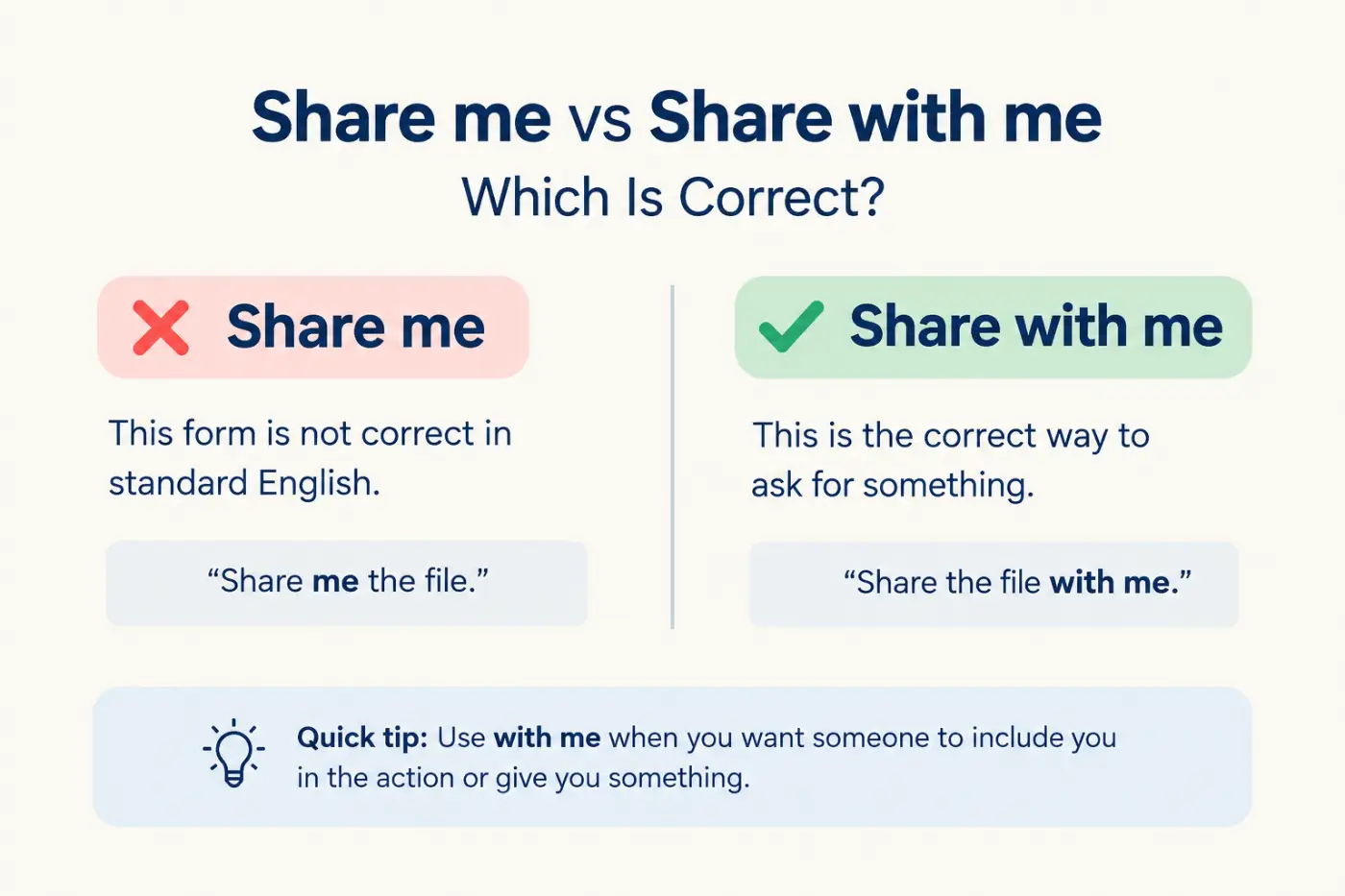
share me vs share with me can look like a small grammar choice, but the difference matters because the two expressions can perform different jobs in a sentence. If you want someone to give you a photo, file, message, idea, or piece of information, the natural American English form is usually share it with me. The phrase share with me works because me identifies the person receiving something.
The confusion comes from the verb share itself. English allows some verbs to take a person directly as an indirect object, while other structures normally use a preposition such as with. Because give me and send me are natural, learners sometimes transfer that pattern to share me. That creates a sentence that may sound incomplete or change the intended meaning.
This guide explains the grammar in plain English. You’ll see the correct patterns, realistic examples, common mistakes, differences in meaning, formal and informal usage, regional considerations, pronunciation, related expressions, and practical editing tips. The goal is simple. You should know exactly what to say when you want someone to share something with you.
For another common grammar confusion, see Sleave or Sleeve Which Spelling Is Correct? 2026.
Quick Definition
Use share with me when you mean give me access to something, show something to me, or tell me something. For example, Share the photo with me is natural standard English. Share me can be grammatical in a different structure, such as Share me with the group, but it does not normally mean share something with me.
Quick Answer
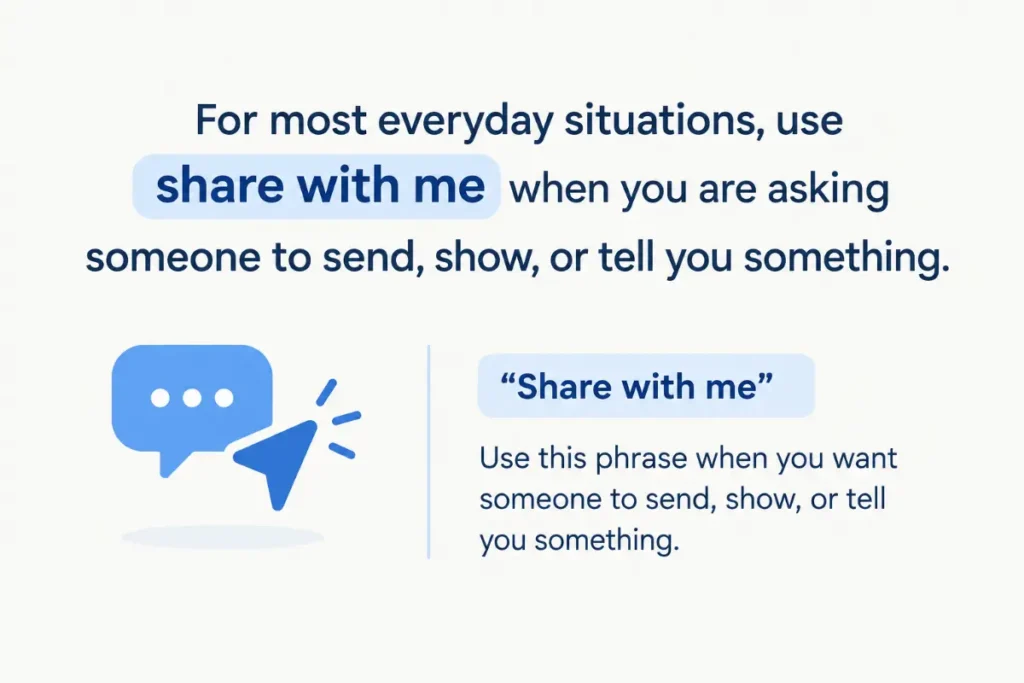
For most everyday situations, use share with me when you are asking someone to send, show, or tell you something.
Say:
Please share the file with me.
Could you share the photo with me?
The phrase share me is not normally used to mean give something to me. However, share me can be grammatical when me is the thing being divided, included, or distributed. For example, Share me with the team means include me with the team.
Comparison Table
| Form | Main Meaning | Grammar Pattern | Typical Context | Formality | Natural Example |
|---|---|---|---|---|---|
| Share with me | Give or show something to me | Share + thing + with + person | Files, photos, ideas, information, opinions | Neutral | Please share the document with me. |
| Share me | Treat me as the thing being shared or included | Share + person or object | Special contexts where the person is the object | Context dependent | Please share me with the rest of the group. |
| Share something with me | Give me access to something | Share + object + with + recipient | Everyday and professional English | Neutral | Can you share the details with me? |
| Share it with me | Give or show a known thing to me | Share + pronoun + with + recipient | Conversation and messages | Neutral | Please share it with me. |
| Share this with me | Give me this specific item or information | Share + object + with + recipient | Digital and personal communication | Neutral | Can you share this with me? |
Meaning and Definition
Meaning of Share With Me
Share with me means to give something to me so I can see it, use it, know about it, or experience it. The thing being shared can be physical or abstract.
You can share a document with me. You can share a photo with me.
The basic structure is easy to remember.
Share + something + with + someone.
For example:
Please share the notes with me.
She shared the news with me.
He shared his concerns with me.
They shared the report with me.
The person receiving the information comes after with. That is the pattern you’ll hear most often in standard American English.
The word something can also be replaced by a pronoun.
Please share it with me.
Can you share this with me?
I’ll share that with you later.
This structure works especially well in modern digital communication. People often ask others to share Google documents, photographs, videos, links, folders, screenshots, locations, posts, and messages.
Meaning of Share Me
Share me does not normally mean give something to me.
That distinction causes most of the confusion.
In a sentence such as Share me the picture, the speaker is trying to use share in the same way as give me the picture. While some speakers may use this pattern in informal or regional varieties of English, it is not the usual standard American English construction.
However, share me can be grammatically possible when the person represented by me is actually the thing being shared or included.
Consider this sentence:
Please share me with the group.
Here me is the object of share. The meaning is that I should be included with the group. The sentence has a different structure from Please share the document with me.
That difference is worth remembering because it shows why labeling every use of share me as simply wrong would be too broad.
The Basic Grammar Pattern
The most useful pattern for everyday communication is:
Share + object + with + recipient.
Examples include:
Share the picture with me.
Share your thoughts with us.
The object comes before with. The recipient comes after with.
This pattern is especially useful when the thing being shared matters more than the person receiving it.
Key Differences Explained
Spelling
There is no spelling problem in either phrase. Both share and me are correctly spelled English words.
The issue is grammar and meaning rather than spelling.
Meaning
Share with me normally means that I receive or gain access to something.
Share me can mean that I am the person or thing being included in an act of sharing. Its meaning depends heavily on the rest of the sentence.
Grammar
Share commonly takes a direct object.
You can share a photo.
You can share information.
When you identify the person who receives that thing, with is commonly used.
You can share a photo with me.
You can share information with me.
Part of Speech
Share is a verb in these expressions. Me is an object pronoun.
In Share the photo with me, photo is the direct object and me appears after the preposition with.
In Share me with the group, me is the direct object and the group identifies the people with whom the sharing takes place.
Formality
Share with me works in both casual and formal English.
You can use it in a text message.
Please share the photo with me.
You can also use it in professional communication.
Please share the revised document with me when it is ready.
Share me requires more care because its meaning can become unclear without additional context.
Context
The context often tells you which structure makes sense.
If you want a person to send you a document, use share with me.
If you mean that someone should include you with another person or group, a structure such as share me with the team can make sense.
Regional Usage
Standard American English strongly favors the pattern share something with someone when the person is the recipient.
Other varieties of English may show different informal patterns. Still, learners writing for a broad English speaking audience should use the standard construction because it is clear and widely understood.
Which Form Is Correct?
The answer depends on what you want the sentence to mean.
If you want someone to give you access to something, use share with me.
For example:
Please share the presentation with me.
If you want to say that someone should include you among other people, share me can work when the rest of the sentence provides that meaning.
For example:
Please share me with the group.
Even then, the sentence may sound unusual depending on the context. A clearer alternative could be Include me in the group or Add me to the group.
The most important point is that share does not normally follow the same pattern as give.
You can say:
Give me the book.
Send me the book.
Show me the book.
But standard American English normally says:
Share the book with me.
That difference comes from verb complementation. In simple terms, different verbs prefer different grammar patterns. English learners often make mistakes by copying the pattern of one verb and applying it to another.
Sentence Examples
Here are natural examples using the preferred structure.
- Please share the photo with me when you get a chance.
- Can you share the document with me before the meeting?
- She shared her plans with me over lunch.
- Could you share the address with me?
- He shared his concerns with me after class.
- Please share the presentation with me so I can review it.
- My friend shared the video with me yesterday.
- Can you share your notes with me?
- The teacher asked us to share our ideas with the class.
- She finally shared the news with me.
These examples cover common situations. Notice that the person receiving the information appears after with.
Now consider a few examples where share me has a different grammatical role.
- Please share me with the rest of the team.
- The coordinator asked them to share me with another department.
- The story describes a character who says that nobody should share me with strangers.
These sentences are grammatical in specific contexts, but they don’t mean give something to me. In many situations, a different verb would sound clearer.
For example:
Please include me in the rest of the team.
Please assign me to another department.
Don’t introduce me to strangers.
That is why learners should avoid using share me simply as a replacement for share something with me.
Common Mistakes and Misspellings
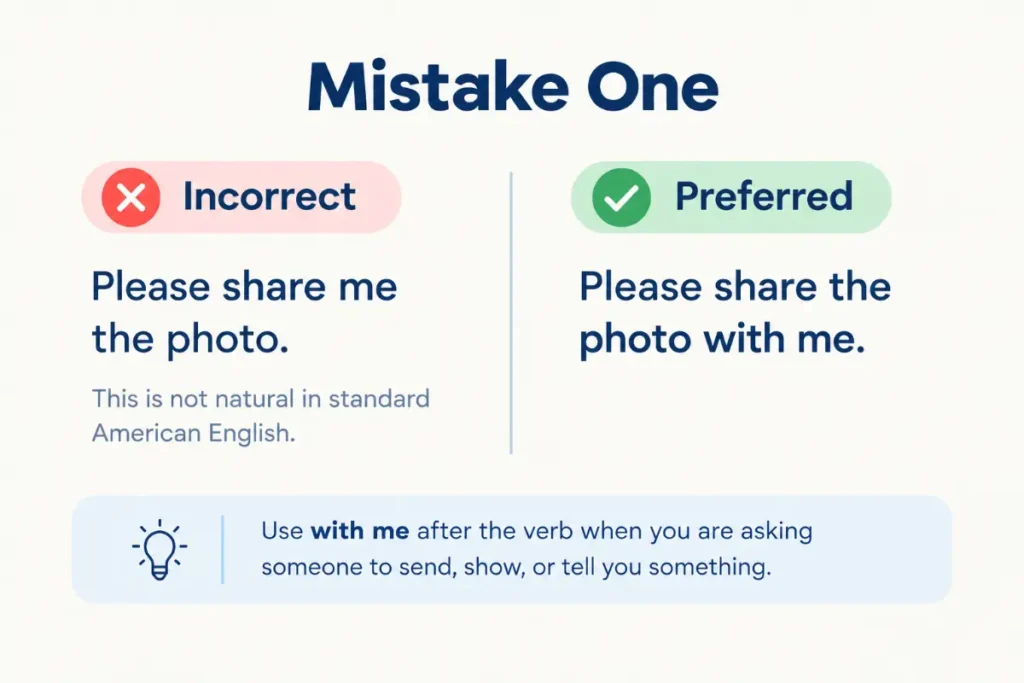
Mistake One
Incorrect or unnatural in standard American English:
Please share me the photo.
Preferred:
Please share the photo with me.
The problem is the verb pattern. The speaker wants me to receive the photo, so with introduces the recipient.
Mistake Two
Incorrect or unclear:
Can you share me your notes?
Preferred:
Can you share your notes with me?
Your notes are the thing being shared. Me is the recipient.
Mistake Three
Incorrect or unnatural:
She shared me the information.
Preferred:
She shared the information with me.
This mistake often happens because English has several verbs that allow a person to appear directly after the verb. Give and send are common examples.
Mistake Four
Potentially confusing:
Share me.
Preferred:
Share it with me.
Share me by itself usually leaves the listener wondering what the speaker means. If you want someone to send or show you something, identify the object or use it.
Mistake Five
Incorrect transfer from another grammar pattern:
Please share me this file.
Preferred:
Please share this file with me.
This is a classic language transfer problem. The speaker understands the intended meaning but applies the object pattern of another verb to share.
From an NLP perspective, this can be described as a pattern based error. A language learner has encountered structures such as give me and send me and then predicts that share me should work in the same way. Human language doesn’t always follow one universal pattern. Verb specific grammar matters.
A related grammar guide is Flies away or flys away: Correct spelling and usage.
Pronunciation Guide
The pronunciation of share is straightforward.
Share is pronounced approximately like shair.
In the International Phonetic Alphabet it is commonly represented as /ʃer/ in American English.
Me is pronounced /miː/.
The full phrase share with me can be pronounced naturally as:
shair with mee.
In connected speech, native speakers often move quickly between the words. The phrase may sound smoother than it looks in writing.
There is no special pronunciation difference between the two expressions that solves the grammar question. That is part of the reason learners can confuse them. The real distinction appears in sentence structure and meaning.
The stress usually falls naturally on the important content word rather than on me.
For example:
Can you share it with me?
The speaker may stress share if asking for the action.
Can you share it with me?
The speaker may emphasize the recipient when distinguishing them from another person.
Etymology and Word Origin
Share has a long history connected with the idea of dividing something into portions or having something in common.
The modern English verb developed from older Germanic language forms associated with a portion or part. The word became established in English with meanings connected to dividing something among people, receiving a portion, and having something in common.
Over time, its meaning expanded. Today share can describe physical objects, information, feelings, experiences, opinions, responsibilities, online content, and access to digital material.
That broader meaning explains why the verb appears so often in modern communication.
The grammar has also remained flexible across different contexts. You can share something with someone. You can share something among several people.
The central idea remains connection or common access.
Regional Usage
American English
American English commonly uses share something with someone when one person gives another person access to information or material.
For example:
Can you share the file with me?
This pattern is natural in everyday conversation, workplace communication, education, and digital communication.
The phrase share me does not normally serve as a substitute for that construction in standard American English.
British English
British English also commonly uses share something with someone for the same meaning.
For example:
Could you share the details with me?
There is no major standard British spelling difference here. The main grammar pattern remains familiar across both varieties.
Australian English
Australian English generally follows the same construction.
You might hear:
Can you share the photos with me?
The wording is natural and clear. A speaker may use more informal regional expressions in casual conversation, but standard written English favors the clear recipient pattern.
Canadian English
Canadian English also commonly uses share something with someone.
For example:
Please share the document with me.
The structure works naturally in school, workplace, government, business, and everyday communication.
Across these major varieties, the safest general rule is consistent. Use with when identifying the person who receives the thing being shared.
Grammar Rules and Part of Speech
Share is a verb. In the relevant construction, it usually takes a direct object that identifies the thing being shared.
Consider:
I shared the photo with Sarah.
The photo is the direct object.
Sarah is the recipient introduced by with.
You can replace Sarah with an object pronoun.
I shared the photo with her.
You can also replace the photo with a pronoun.
I shared it with her.
That gives you a useful grammatical template.
Subject + share + thing + with + person.
For example:
I shared the file with him.
She shared the news with us.
They shared their plans with me.
We shared the results with our teacher.
Can You Leave Out the Object?
Sometimes context allows you to say:
Please share with me.
This can work when everyone already knows what needs to be shared.
For example:
A colleague might say, Send me the document when you finish it.
You might reply:
Sure. I’ll share with you when it’s ready.
Still, adding the object often makes the sentence clearer.
I’ll share the document with you when it’s ready.
Can You Say Share It With Me?
Yes. This is one of the most common natural patterns.
Please share it with me.
The word it stands for something already understood from context.
For example:
Do you have the updated schedule?
Yes.
Great. Please share it with me.
The sentence is concise and completely natural.
Can You Say Share This With Me?
Yes.
Share this with me is also standard when this refers to a specific thing.
For example:
Can you share this with me before you leave?
The word this can refer to a file, message, photograph, idea, document, or another item that both speakers can identify.
What About Share With Us?
The same grammar applies to other pronouns.
Share it with us.
Share the information with them.
The recipient simply changes. The underlying structure stays the same.
Real Life Usage Examples
Daily Conversation
Daily speech often uses short versions because the context is already clear.
Can you share that with me?
Sure. I’ll send it now.
Another natural example is:
I found some old photos. I’ll share them with you tonight.
These sentences sound normal because the object and recipient roles are clear.
Email and Workplace Communication
Professional communication often uses this construction when requesting files or information.
Please share the updated report with me before Friday.
Could you share the meeting notes with the rest of the team?
The phrase works well because it clearly identifies the material being requested and the person who should receive it.
Academic Writing
Students and researchers may use share when discussing information, findings, opinions, or resources.
The researchers shared their findings with the academic community.
Students were encouraged to share their ideas with their classmates.
In academic writing, clarity matters more than trying to make the sentence sound complicated.
News and Journalism
News writing may describe information being released or exchanged.
The company shared the results with investors.
Officials shared additional information with reporters.
The structure is useful because it clearly identifies both the information and its recipient.
Literature and Storytelling
Narrative writing can use the same pattern for personal experiences and emotions.
She shared her secret with her closest friend.
He finally shared the truth with his family.
Here the verb can carry an emotional meaning. Sharing isn’t always about sending a file. It can also mean revealing something personal.
Related and Confused Terms
Give Me
Give me normally allows the person to appear directly after the verb.
This pattern is different from the most common structure with share.
Send Me
Send me is also natural.
Because send accepts an indirect object directly, learners sometimes transfer its structure to share.
Show Me
Show me the picture is standard.
Again, show permits the person to appear directly after the verb.
Tell Me
Tell me the truth is also natural.
Share With Me
This is the standard choice when you want access to something.
Please share the report with me.
Share Among
Share among is useful when something is distributed across several people.
The students shared the materials among themselves.
Share Between
Share between is often used when describing two people or two sides.
They shared the responsibility between them.
Share With Others
This expression emphasizes multiple recipients.
She likes to share her ideas with others.
These related patterns show why grammar cannot always be learned by translating word for word. Each verb has its own preferred structures.
Expert Editor Insight
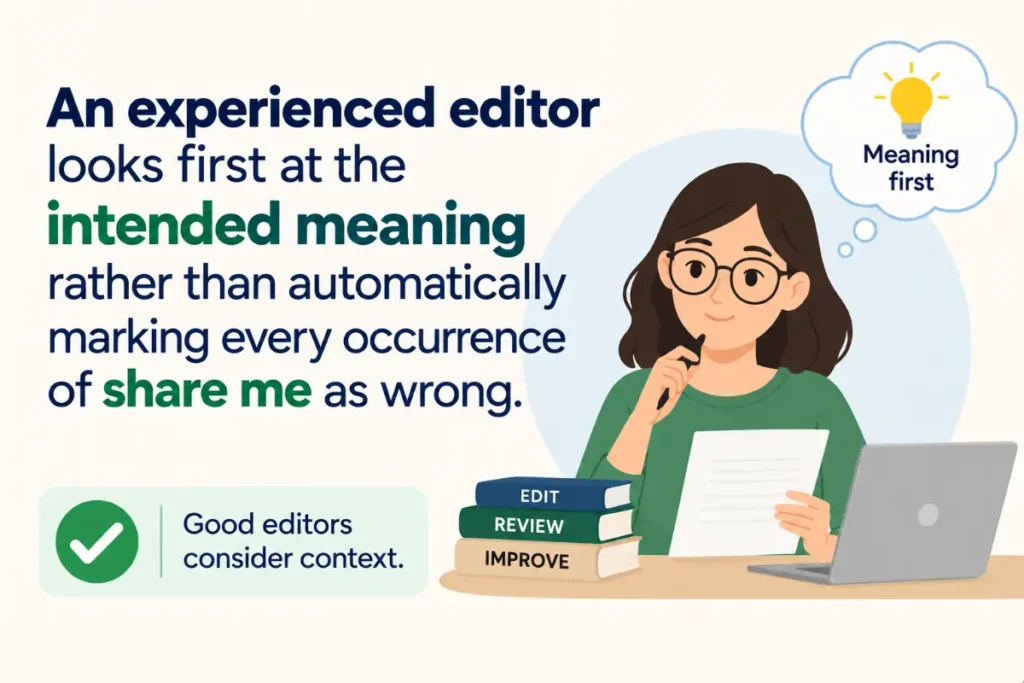
An experienced editor looks first at the intended meaning rather than automatically marking every occurrence of share me as wrong. If the writer means give me access to something, the editor will normally change the structure to share something with me because that pattern is clear and natural in standard American English. If the writer means include me as something being shared or assigned among people, the surrounding sentence may justify a different construction. The best editing tip is to identify the thing being shared first. Then identify the person receiving it. Put the thing after share and the recipient after with.
A related grammar guide is cleverer vs more clever Which Form Should You Use.
Conclusion
share me vs share with me depends on the meaning you want to express. For the common situation where you want someone to give you a photo, file, idea, message, document, or piece of information, use share with me. The standard pattern is share something with someone, so you can say Please share the file with me.
Share me can work in a different structure when you are the object being included or shared, as in Share me with the group. Still, that meaning is much less common and may sound unusual without context. Don’t treat share as if it follows the same grammar as give me or send me.
The easiest editing trick is to ask two questions. What is being shared and who is receiving it? Put the thing after share and the recipient after with. That simple habit will help you choose the natural form quickly.
FAQs
Is share me grammatically correct?
Share me can be grammatically correct in certain contexts, but it usually does not mean give something to me. For example, Share me with the group can mean include me with the group. If you want someone to give you a photo, file, idea, or piece of information, standard American English normally uses share something with me.
Is share with me correct English?
Yes. Share with me is standard and natural English when you identify yourself as the person receiving something. For example, Please share the document with me is completely natural. The thing being shared comes before with, while the recipient comes after it. You can also say Share it with me or Share this with me when the object is already clear.
Why can I say give me but not usually share me?
Different English verbs use different grammar patterns. Give commonly allows a person to appear directly after the verb, as in give me the book. Share normally uses with to identify the recipient, as in share the book with me. Learners often transfer the pattern from one verb to another, which creates this common grammar mistake.
Can I say share me the photo?
In standard American English, share me the photo is not the usual construction. Say Share the photo with me instead. The same rule applies to many similar requests. You can say Share the video with me, Share the file with me, or Share the information with me. These forms clearly show that the photo, video, file, or information is being shared with you.
What is the difference between share me and share with me?
The key difference is the grammatical role of me. In share with me, me is the recipient of something being shared. In share me with the group, me is the object being shared or included in the action. The two structures therefore have different meanings. For ordinary requests to receive something, share with me is the natural choice.
Is share with me formal enough for work emails?
Yes. Share with me is suitable for professional emails and workplace communication. You can write Please share the revised report with me or Could you share the updated schedule with me? The expression is polite, clear, and neutral. You don’t need a more complicated phrase simply to sound professional. Clear grammar usually works better than unnecessarily formal wording.
Can I use share with me in academic writing?
Yes. The phrase is grammatically appropriate in academic writing when the context involves giving information, research findings, resources, or ideas to another person or group. For example, The researchers shared their findings with the participants is natural. In academic work, the important point is to make the relationship between the information and its recipient clear.
What is an easy way to remember the correct pattern?
Think of share as answering two questions. What is being shared and who receives it? Put the thing after share and put the recipient after with. For example, share the picture with me. If you can identify the picture as the thing and me as the receiver, the structure becomes much easier to build correctly.