
Have you ever read a sentence containing implicit vs complicit and wondered if the writer chose the right word? You’re not alone. These two words look similar, share a Latin heritage, and differ by only a few letters, yet they express completely different ideas. Using the wrong one can change the meaning of an entire sentence and confuse your readers.
The confusion usually happens because both words appear in formal writing, news articles, legal documents, academic papers, and everyday conversations. Their similar spelling makes them easy to mix up, especially for English learners and even experienced writers who type quickly.
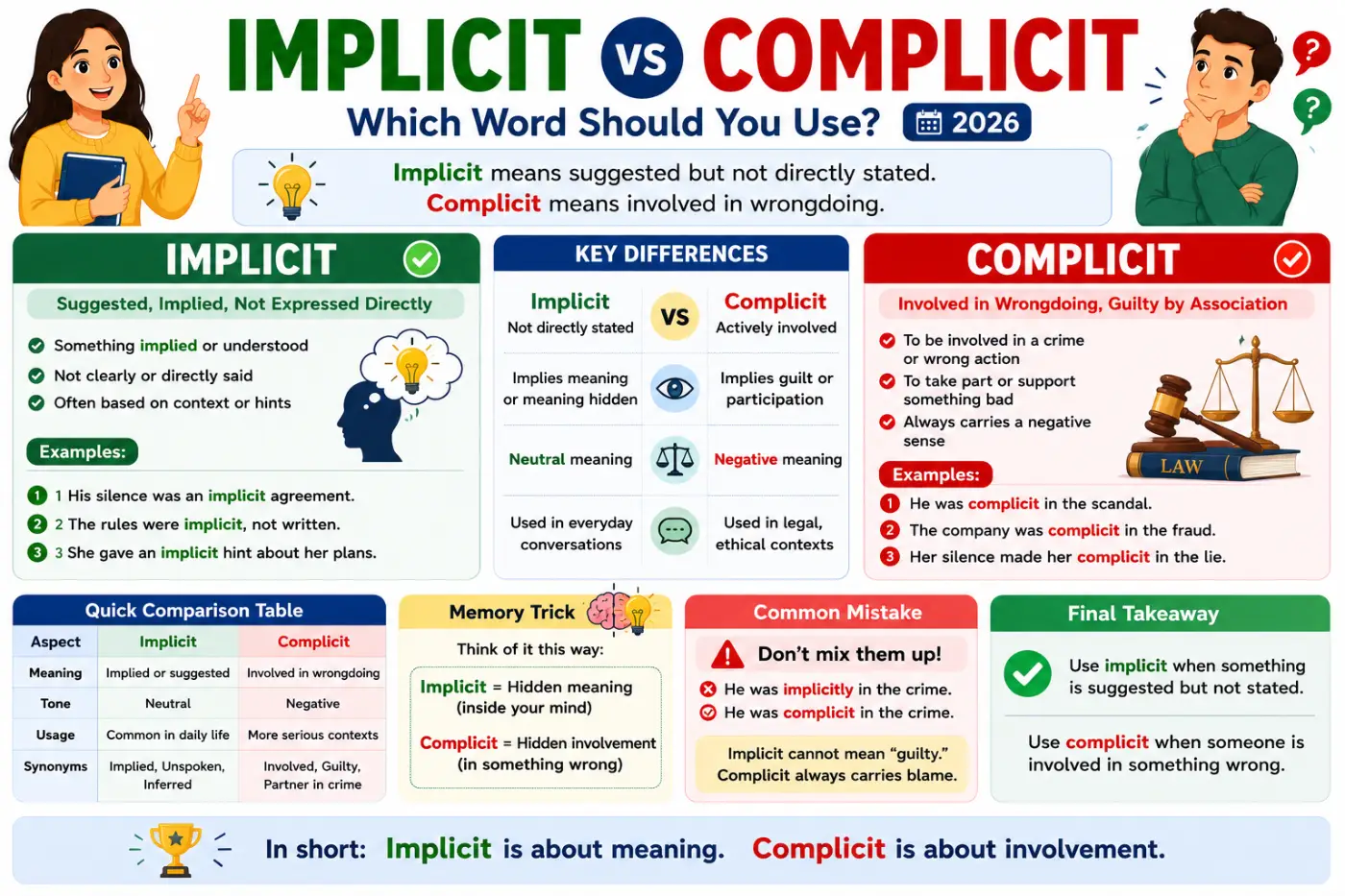
The good news is that the difference is simple once you understand what each word actually means. Implicit describes something that is suggested or understood without being stated directly. Complicit describes someone who is involved in wrongdoing or shares responsibility for it.
For another common grammar confusion, see To Small or Too Small: Which Is Correct?.
Quick Definition
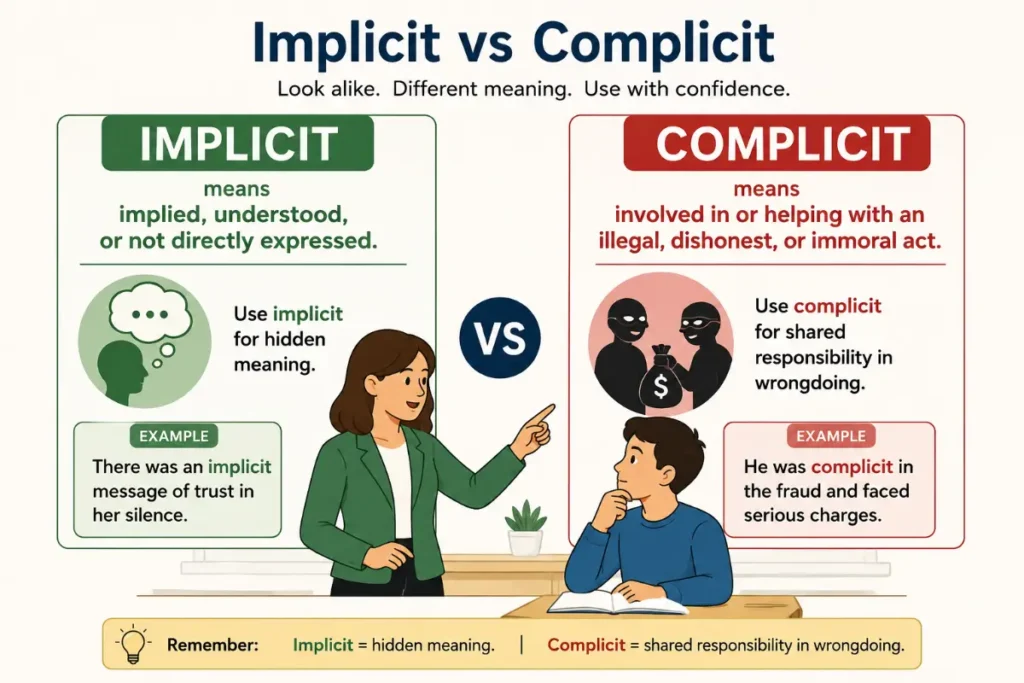
Implicit means implied, understood, or not directly expressed. Complicit means involved in or helping with an illegal, dishonest, or immoral act. Although the words look alike, they are unrelated in meaning. Use implicit for hidden meaning and complicit for shared responsibility in wrongdoing.
Quick Answer
The correct choice depends on what you want to say.
- Use implicit when something is understood without being directly stated.
- Use complicit when someone knowingly participates in or helps with wrongdoing.
- The words are never interchangeable because they describe entirely different concepts.
Implicit vs Complicit Comparison Table
| Feature | Implicit | Complicit |
|---|---|---|
| Meaning | Implied but not directly stated | Involved in wrongdoing |
| Part of Speech | Adjective | Adjective |
| Primary Idea | Hidden meaning | Shared responsibility |
| Origin | Latin implicitus | Latin complicitus |
| Tone | Neutral | Negative |
| Common Contexts | Communication, writing, instructions, agreements | Crime, ethics, law, corruption, misconduct |
| Formality | Neutral to formal | Mostly formal |
| Usage Frequency | Very common | Less common but widely recognized |
| Example | There was an implicit agreement. | He was complicit in the fraud. |
Meaning of Implicit vs Complicit
Understanding each word separately is the easiest way to avoid confusion.
What Does Implicit Mean
Implicit describes something that exists without being openly expressed. Instead of saying something directly, the meaning is implied and expected to be understood. An implicit message depends on context rather than explicit words.
Examples include:
- An implicit promise.
- An implicit understanding.
- Implicit trust.
- Implicit permission.
- Implicit criticism.
In each example, the idea exists even though nobody clearly says it aloud.
Definition
Implicit means implied, suggested, or understood without being directly expressed.
Etymology
The word comes from the Latin implicitus, meaning folded together, entwined, or involved. Over time, English speakers used it to describe ideas that remain hidden inside a statement instead of appearing openly.
Common Contexts
You will often find implicit in:
- Academic writing.
- Psychology.
- Literature.
- Contracts.
- Everyday conversations.
- Instructions.
- Workplace communication.
What Does Complicit Mean
Complicit describes someone who knowingly helps, supports, encourages, or allows wrongdoing. Unlike implicit, this word almost always carries a negative meaning because it involves responsibility for an unethical or illegal action.
Definition
Complicit means involved with another person in an illegal, dishonest, or immoral activity.
Etymology
The word comes from the Latin complicitus, meaning folded together or closely connected. English gradually narrowed the meaning to describe participation in wrongdoing.
Common Contexts
You commonly see complicit in:
- Criminal investigations.
- Court cases.
- Political reporting.
- Journalism.
- Ethics discussions.
- Corporate scandals.
- Historical analysis.
Implicit vs Complicit Key Differences
Although these words resemble each other in spelling, their meanings move in completely different directions.
Meaning Difference
The biggest difference concerns what each word describes.
Implicit refers to hidden meaning.
Complicit refers to shared guilt or involvement.
For example:
“The manager gave implicit approval.”
This means approval was understood without being spoken.
“The manager was complicit in the fraud.”
This means the manager participated in the wrongdoing.
Tone Difference
Implicit has a neutral tone. Complicit has a strongly negative tone because it suggests blame or responsibility.
Grammar Difference
Both words are adjectives. However, they modify different kinds of ideas.
Implicit usually modifies:
- Agreement.
- Meaning.
- Trust.
- Permission.
- Understanding.
- Rule.
- Expectation.
Complicit usually modifies:
- Person.
- Government.
- Organization.
- Official.
- Employee.
- Company.
- Witness.
Context Difference
Choose implicit when discussing communication, meaning, assumptions, expectations, or understanding. Choose complicit when discussing crime, ethics, dishonesty, corruption, or responsibility.
Regional Difference
There is virtually no difference between American, British, Canadian, and Australian English. Native speakers in all major English varieties use both words with the same meanings.
Which One Is Correct
Neither word is more correct than the other because they serve different purposes. Use implicit when discussing ideas that are implied instead of directly stated. Use complicit when describing someone who knowingly participates in wrongdoing. Ask yourself one question. Am I talking about hidden meaning or shared guilt? If the answer is hidden meaning, choose implicit. If the answer is shared guilt, choose complicit.
Pronunciation Guide
Correct pronunciation helps reinforce the distinction between these commonly confused words.
Implicit
IPA: /ɪmˈplɪsɪt/
Syllables:
Im.
plic.
it.
Pronunciation tip:
The stress falls on the second syllable.
Complicit
IPA: /kəmˈplɪsɪt/
Syllables:
Com.
plic.
it.
Pronunciation tip:
Notice that the beginning sounds different from implicit, even though the endings are almost identical.
Common Pronunciation Mistakes
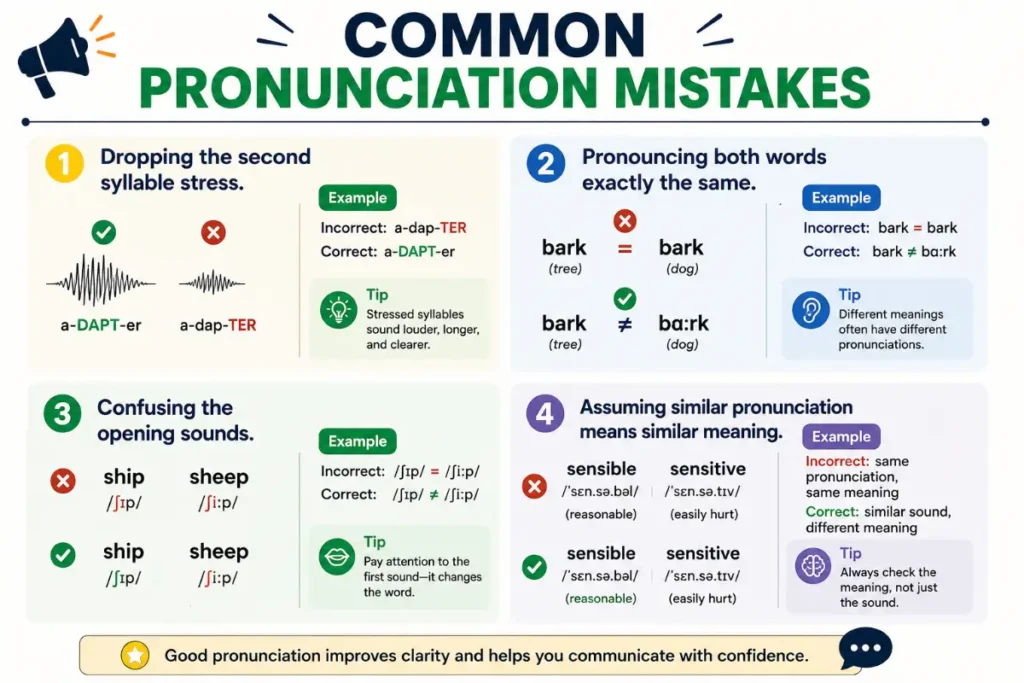
- Dropping the second syllable stress.
- Pronouncing both words exactly the same.
- Confusing the opening sounds.
- Assuming similar pronunciation means similar meaning.
Experienced speakers distinguish the opening sounds clearly, making the words easier to identify during conversation.
Etymology and Word Origin
Although implicit and complicit share Latin roots, they traveled different paths into modern English.
Origin of Implicit
The Latin word implicitus originally described something folded or entwined. English later adopted it to describe ideas that are contained within something instead of being openly expressed. Today, it refers to implied meaning, trust, assumptions, or understanding.
Origin of Complicit
The Latin word complicitus referred to being connected or involved together. English gradually specialized the meaning until it became closely associated with participation in crime, fraud, corruption, deception, or unethical behavior. Modern English almost always uses complicit in a negative sense.
Implicit vs Complicit Grammar Rules
Although implicit and complicit have different meanings, they share the same grammatical role. Both are adjectives, which means they describe nouns rather than actions.
Understanding how they function in a sentence makes it much easier to choose the correct word.
Parts of Speech
| Word | Part of Speech | Function |
|---|---|---|
| Implicit | Adjective | Describes something implied or understood. |
| Complicit | Adjective | Describes someone involved in wrongdoing. |
Examples:
- The contract contained an implicit promise.
- The witness was complicit in the cover-up.
In both sentences, the adjective modifies a noun.
Can They Be Used as Verbs?
No.
Neither implicit nor complicit is a verb.
Incorrect:
- They implicit the answer.
- He complicit the crime.
Correct:
- They implied the answer.
- He was complicit in the crime.
Common Sentence Structures
Implicit
You’ll often see implicit followed by nouns such as:
- Agreement.
- Understanding.
- Trust.
- Permission.
- Bias.
- Meaning.
- Confidence.
- Assumption.
- Rule.
- Expectation.
Examples:
- There was an implicit agreement between the partners.
- She showed implicit trust in her mentor.
- The instructions carried an implicit warning.
Complicit
You’ll usually see complicit used with in.
Pattern:
complicit in + noun
Examples:
- He was complicit in the fraud.
- Several officials became complicit in the scandal.
- The company was found complicit in environmental violations.
This pattern is extremely common in journalism and legal writing.
Comparative and Superlative Forms
Because these adjectives describe qualities, they normally take more and most instead of adding -er or -est.
Examples:
- More implicit.
- Most implicit.
- More complicit.
- Most complicit.
These forms are relatively uncommon because writers usually choose more precise wording instead.
Common Collocations
Learning common word partnerships helps your writing sound natural.
Implicit Collocations
- Implicit agreement.
- Implicit understanding.
- Implicit trust.
- Implicit assumption.
- Implicit meaning.
- Implicit message.
- Implicit permission.
- Implicit expectation.
- Implicit bias.
- Implicit confidence.
Complicit Collocations
- Complicit in corruption.
- Complicit in fraud.
- Complicit in the crime.
- Complicit in misconduct.
- Complicit in deception.
- Complicit in abuse.
- Complicit in the scheme.
- Complicit in illegal activity.
- Complicit in wrongdoing.
- Complicit in the cover-up.
These combinations appear frequently in newspapers, academic writing, and professional communication.
Examples in Sentences
Seeing both words in realistic situations is one of the fastest ways to remember the difference.
Ten Examples Using Implicit
- The manager gave implicit approval by smiling and nodding.
- Their friendship was built on implicit trust.
- The novel contains an implicit criticism of society.
- She accepted the invitation with implicit enthusiasm.
- There was an implicit expectation that everyone would arrive on time.
- His silence carried an implicit warning.
- The teacher’s comments included implicit encouragement.
- The policy created an implicit promise of fairness.
- Readers understood the author’s implicit message immediately.
- The agreement included several implicit responsibilities.
Ten Examples Using Complicit
- The accountant became complicit in the financial fraud.
- Several officials were complicit in the corruption scandal.
- Anyone who knowingly hides evidence may be complicit.
- The employee refused to become complicit in unethical behavior.
- Investigators believed the executive was complicit in the scheme.
- Remaining silent made him feel complicit.
- The organization denied being complicit in the violations.
- She refused to stay complicit by ignoring the problem.
- The report suggested multiple departments were complicit.
- Journalists uncovered evidence showing several leaders were complicit in the cover-up.
Common Mistakes With Implicit vs Complicit
Many writers confuse these words because they look alike, but the mistakes usually fall into a few predictable categories.
Mistake 1 Using One Instead of the Other
Incorrect:
- The company gave complicit permission.
Correct:
- The company gave implicit permission.
Permission can be implied, but it cannot be guilty.
Incorrect:
- The official became implicit in the fraud.
Correct:
- The official became complicit in the fraud.
Fraud involves participation, not implied meaning.
Mistake 2 Assuming Similar Spelling Means Similar Meaning
English contains many words that resemble each other but have unrelated meanings.
Examples include:
- Historic and historical.
- Eminent and imminent.
- Affect and effect.
- Complement and compliment.
- Stationary and stationery.
Implicit and complicit belong in this group.
Learn the difference in Currier vs courier Which Word Is Correct.
Mistake 3 Forgetting the Preposition
Many learners write:
- He was complicit the crime.
The correct expression is:
- He was complicit in the crime.
Remember this pattern because it appears consistently in professional English.
Mistake 4 Misreading News Articles
Readers sometimes interpret complicit as meaning simply “connected.” In reality, it suggests knowing involvement in wrongdoing. That distinction is important in journalism because accusing someone of being complicit carries serious implications.
Real Life Usage Examples
Both words appear across many forms of communication, but each has its own typical environments.
Daily Conversation
Implicit:
- We had an implicit understanding that whoever cooked would not wash the dishes.
Complicit:
- I refused to stay complicit by pretending nothing happened.
Academic Writing
Implicit:
- Researchers examined the implicit assumptions behind the theory.
Complicit:
- Historians debated which institutions were complicit in the injustice.
Professional Communication
Implicit:
- Employees understood the implicit expectations of the company culture.
Complicit:
- No manager should become complicit in unethical business practices.
Literature
Authors often rely on implicit symbolism instead of explaining every idea directly. Characters may become complicit when they knowingly support harmful actions.
Journalism and Media
Newspapers frequently use complicit in reports about:
- Political scandals.
- Corporate fraud.
- Criminal investigations.
- Human rights violations.
- Financial misconduct.
Meanwhile, implicit commonly appears in articles discussing:
- Communication.
- Education.
- Psychology.
- Literature.
- Public policy.
- Behavioral science.
Regional Usage
One advantage of learning implicit and complicit is that their meanings remain consistent across major English-speaking countries.
American English
American speakers regularly use implicit in education, psychology, technology, and workplace communication. Complicit commonly appears in legal reporting, investigative journalism, and ethics discussions.
British English
British English follows the same distinctions.
Examples include:
- Implicit trust.
- Complicit in fraud.
These expressions sound perfectly natural throughout the United Kingdom.
Canadian English
Canadian English mirrors both American and British usage. Neither spelling nor meaning changes.
Australian English
Australian writers also use both words exactly the same way. There are no regional spelling differences or alternate meanings. Unlike some confusing word pairs, implicit and complicit are remarkably stable throughout the English-speaking world.
Related Words and Commonly Confused Terms
Expanding your vocabulary makes it easier to recognize subtle differences between similar words.
Words Related to Implicit
- Implied.
- Inferred.
- Unspoken.
- Indirect.
- Suggested.
- Understood.
- Assumed.
- Tacit.
- Unexpressed.
- Hidden.
Words Related to Complicit
- Involved.
- Responsible.
- Guilty.
- Culpable.
- Accountable.
- Accomplice.
- Participant.
- Collaborator.
- Accessory.
- Co-conspirator.
Frequently Confused Word Pairs
- Affect vs Effect.
- Complement vs Compliment.
- Historic vs Historical.
- Accept vs Except.
- Eminent vs Imminent.
- Principal vs Principle.
- Moral vs Morale.
- Advice vs Advise.
- Allusion vs Illusion.
- Discreet vs Discrete.
Learning these pairs improves both writing accuracy and reading comprehension.
Expert Language Insight
After years of editing academic papers, business reports, and news copy, one pattern appears again and again. Writers rarely confuse implicit and complicit because they do not know the definitions. They confuse them because the words look and sound similar. Native English speakers usually make the distinction instinctively because each word appears in very different contexts. When native speakers hear implicit, they immediately think of ideas such as:
- Hidden meaning.
- Unspoken agreement.
- Assumption.
- Trust.
- Understanding.
When they hear complicit, they immediately associate it with:
- Crime.
- Corruption.
- Fraud.
- Dishonesty.
- Responsibility.
- Cover-ups.
The emotional tone is another useful clue. Implicit is neutral. It simply describes information that is understood without being directly expressed. Complicit carries blame. Calling someone complicit suggests they knowingly participated in or enabled something wrong. Because of that implication, professional writers use the word carefully and only when the evidence supports it. A practical editing tip is to replace the word with a synonym. If implied fits naturally, implicit is probably correct. If involved in wrongdoing fits naturally, complicit is the right choice. That simple test prevents most mistakes.
Memory Tricks
A memorable shortcut can help you choose the right word under pressure.
Remember Implicit
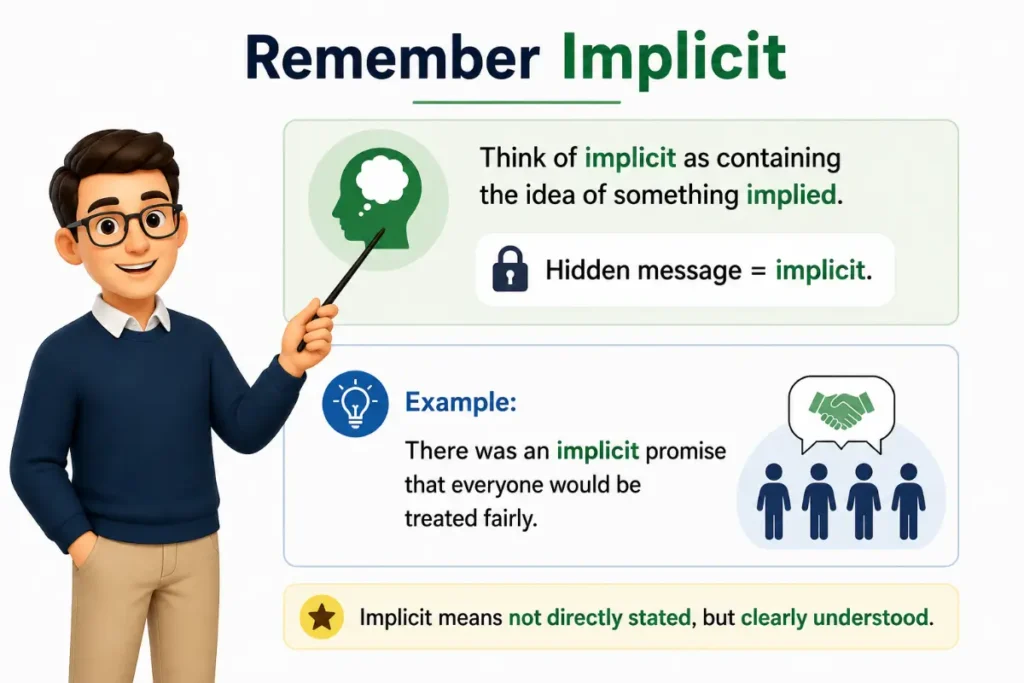
Think of implicit as containing the idea of something implied.
Hidden message = implicit.
Example:
- There was an implicit promise that everyone would be treated fairly.
Remember Complicit
Think of complicit as being connected to an accomplice. An accomplice helps commit a crime. Someone who helps is complicit.
Example:
- The employee became complicit in the fraud.
These associations are easy to remember because they connect each word with its most common real-world use.
A related grammar guide is infront or in front Correct Spelling Meaning and Usage.
Conclusion
The debate over implicit vs complicit becomes straightforward once you focus on what each word represents.
Use implicit when discussing ideas, meanings, expectations, agreements, or messages that are understood without being directly expressed. It is a neutral word commonly used in education, psychology, literature, and everyday communication.
Use complicit when describing someone who knowingly participates in or enables illegal, dishonest, or unethical behavior. It carries a negative meaning and is most often found in legal, political, historical, and journalistic contexts.
Frequently Asked Questions
Is implicit the same as complicit?
No. Implicit means implied or understood without being stated directly. Complicit means involved in or responsible for wrongdoing. Although the spellings are similar, the meanings are completely different, and the words cannot be used interchangeably.
Which word is more common in everyday English?
Implicit appears more often because people frequently discuss implicit meaning, implicit trust, implicit bias, and implicit assumptions. Complicit is less common in everyday conversation but appears regularly in journalism, legal writing, and discussions about ethics.
Can someone be implicit in a crime?
No. The correct expression is complicit in a crime. Someone cannot be implicit in a crime because implicit describes ideas or meanings, not participation in illegal or unethical actions.
What is an implicit message?
An implicit message is one that is suggested instead of directly stated. Readers or listeners understand it from context, tone, or surrounding information rather than explicit words.
Does complicit always have a negative meaning?
Yes. Complicit almost always has a negative meaning because it refers to knowing involvement in dishonest, illegal, or unethical behavior. It implies some degree of responsibility or shared blame.
Are implicit and explicit opposites?
Yes. Implicit means implied or unstated, while explicit means clear, direct, and fully expressed. These two words are recognized opposites in English.
Are there spelling differences between American and British English?
No. Both American English and British English spell implicit and complicit the same way. Their meanings, pronunciation, and usage are also consistent across other major English varieties, including Canadian and Australian English.
How can I remember the difference quickly?
Think of implicit as related to implied, since both involve hidden meaning. Think of complicit as related to accomplice, since both involve helping with wrongdoing. This simple association makes choosing the correct word much easier.