
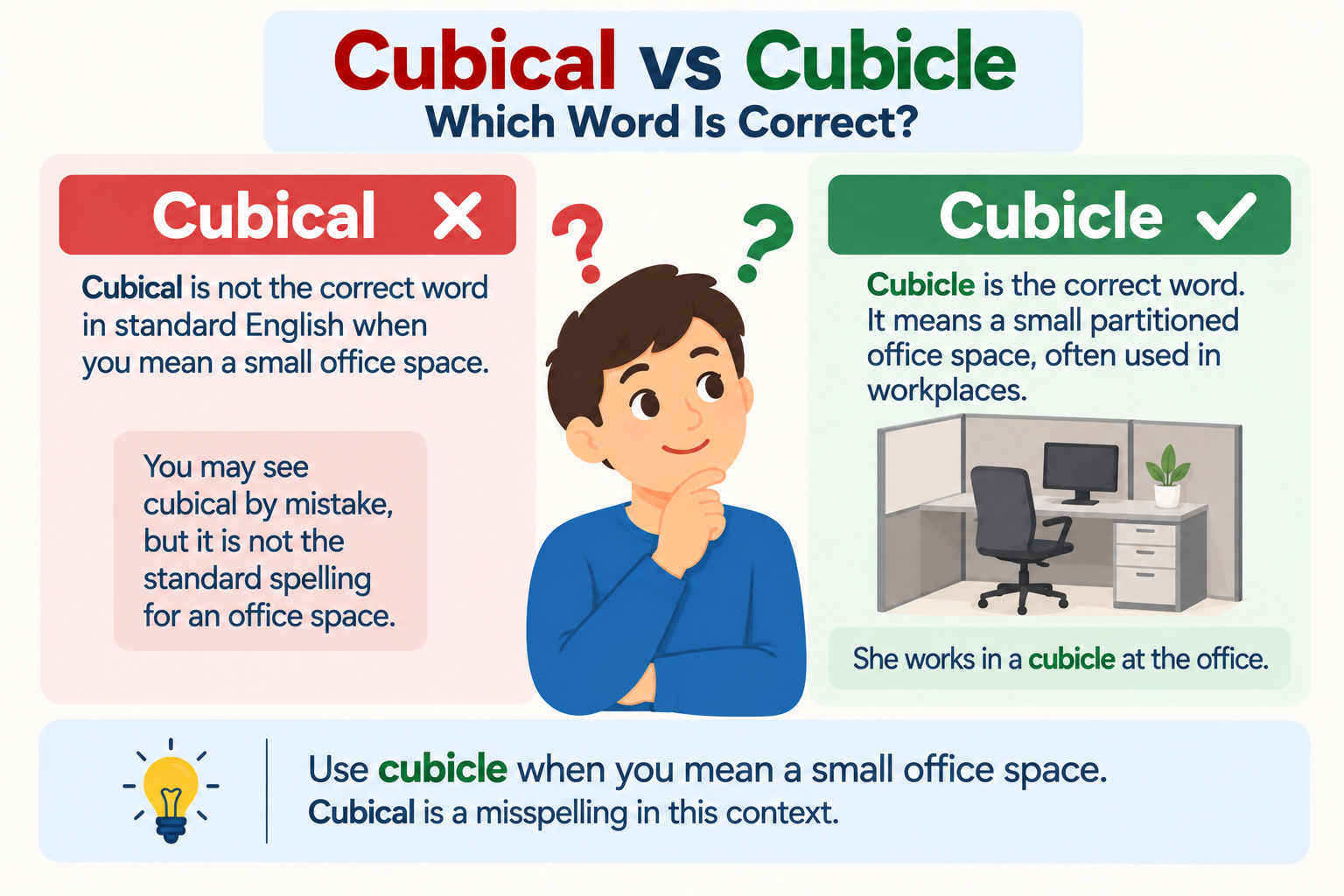
Cubical vs cubicle can be confusing because only a few letters separate the two words yet they don’t mean the same thing. Both are correct English words. Cubical usually describes something shaped like a cube while cubicle is a noun for a small enclosed or divided space such as a workstation in an office.
The confusion makes sense. Both words belong to the same broad word family and both can bring square or boxlike shapes to mind. On top of that cubicle appears far more often in everyday workplace conversations while cubical tends to appear in geometry mathematics design and technical descriptions.
Knowing the grammatical difference makes choosing the right word much easier. Cubical is mainly an adjective while cubicle is a noun. This article explains their meanings pronunciation origins grammar and real life uses with examples that show exactly where each word belongs.
Learn the difference in Investor vs Investee Which Is the Difference? 2026.
Quick Definition
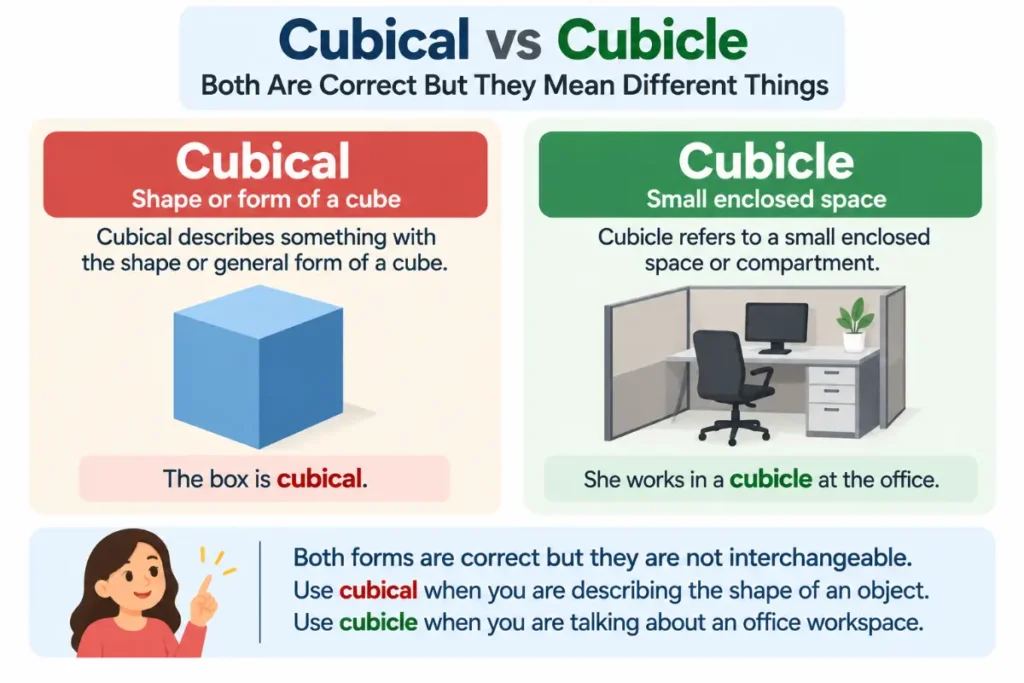
Cubical is an adjective meaning shaped like a cube or related to a cube. Cubicle is a noun meaning a small enclosed or partitioned space designed for one person or a specific purpose. A cube shaped container can be cubical while a divided office workspace is a cubicle.
Quick Answer
Both words are correct but they aren’t interchangeable. Use cubical when describing the shape or characteristics of a cube. Use cubicle when naming a small compartment room booth or partitioned workspace.
A simple test can solve most confusion. If you’re describing shape use cubical. If you’re naming a space use cubicle.
Cubical vs Cubicle Comparison Table
| Form | Meaning | Part of Speech | Origin | Usage Frequency | Formality | Common Contexts | Example |
|---|---|---|---|---|---|---|---|
| Cubical | Shaped like a cube or relating to a cube | Adjective | Derived from cube through the Latin word family connected with cubus | Less common in everyday speech | Neutral | Geometry mathematics architecture design technical descriptions | The artist created a cubical structure. |
| Cubicle | A small enclosed or partitioned space | Noun | Developed through Latin cubiculum meaning a sleeping room or chamber | Common especially in workplace contexts | Neutral | Offices changing areas study spaces booths compartments | Her cubicle is beside the conference room. |
Meaning and Definition
Meaning of Cubical
Cubical is a real English word. It isn’t a typo for cubicle.
It functions mainly as an adjective and describes an object that has the shape or general properties of a cube. A cube has six square faces with equal edges. Something described as cubical therefore has a cube shaped or approximately cube shaped form.
Consider this sentence.
The architect designed a cubical room.
Here cubical describes the shape of the room. The word room remains the noun while cubical tells us something about its physical form.
You may encounter the adjective in geometry architecture engineering product descriptions art and technical writing. It can also appear when someone simply wants a precise way to describe a boxlike three dimensional object.
Cubical isn’t restricted to perfect mathematical cubes in every everyday context. A writer may use it more loosely to describe something strongly resembling a cube. In mathematical writing however greater precision may be needed.
Meaning of Cubicle
Cubicle is also a standard English word. It is a noun rather than an adjective.
A cubicle is a small space that has been separated from a larger area. Partitions walls screens or similar dividers often create the space. The word is strongly associated with offices where employees work at desks separated by partial walls.
For example.
Mark returned to his cubicle after the meeting.
Cubicle names the place where Mark works. It doesn’t describe the geometric shape of that space.
The meaning extends beyond offices. Changing rooms public restrooms libraries medical settings and other shared buildings can contain individual cubicles. British usage in particular may use the word for small partitioned spaces such as changing or toilet cubicles.
The key idea is separation. A cubicle is a relatively small individual compartment created within a larger space or structure.
Key Differences Explained
The distinction becomes easy once you focus on what each word does in a sentence.
- Spelling. Cubical ends in ical while cubicle ends in icle. The visual similarity is one reason writers sometimes confuse them.
- Meaning. Cubical means cube shaped or relating to a cube. Cubicle means a small enclosed or partitioned space.
- Part of speech. Cubical is primarily an adjective. Cubicle is a countable noun.
- Grammar. Cubical normally modifies a noun as in cubical container. Cubicle can act as the subject or object of a sentence as in The cubicle needs a new chair.
- Pronunciation. The endings sound different. Cubical ends with a sound similar to kuh l while cubicle ends with a sound closer to kuh l but follows a different syllable pattern and spelling structure.
- Context. Cubical commonly belongs to discussions about shape geometry design and physical form. Cubicle commonly belongs to conversations about offices compartments changing areas and divided spaces.
- Formality. Neither word is inherently formal or informal. The appropriate choice depends on meaning.
- Regional usage. Both words are understood across major varieties of English. Some contexts for cubicle vary by region but the basic distinction remains stable.
The words can even appear together naturally.
The designer placed a cubical cabinet beside the office cubicle.
Cubical describes the cabinet. Cubicle names the workspace.
Which Form Is Correct
Both forms are correct standard English words. The right choice depends entirely on the meaning you need.
Use cubical for a cube shaped object or a feature associated with a cube. Standard dictionary treatment identifies it as an adjective derived from cube. This grammatical role explains expressions such as cubical box cubical structure and cubical chamber.
Use cubicle for a small compartment or partitioned space. Standard dictionaries treat it as a noun. That gives us expressions such as office cubicle changing cubicle and study cubicle.
This isn’t a case where one spelling needs to replace the other. Changing one word to the other can change the meaning of the sentence.
For example.
The workers built a cubical structure.
This tells us about its shape.
The workers built a cubicle.
This tells us what kind of enclosed or divided space they built.
Expert tip. Look at the job the word performs before checking its spelling. If it describes another noun then cubical may be what you need. If it names the compartment itself cubicle is usually the right choice.
Sentence Examples
Natural examples make the distinction much clearer.
- The sculpture has a simple cubical shape.
- Engineers tested a cubical container during the experiment.
- The child stacked several cubical blocks on the floor.
- The architect added a cubical section to the building.
- She decorated her cubicle with family photos and a small plant.
- My cubicle is close to the office kitchen.
- Each employee has a separate cubicle.
- He left his notebook on the desk inside his cubicle.
- The changing area contains six private cubicles.
- She returned to her cubicle after lunch and answered her emails.
Notice that the first four examples use cubical to describe shape. The remaining examples use cubicle to name a particular space.
Examples That Show Common Confusion
These sentences demonstrate mistakes that can occur when the words are swapped.
- Incorrect: I left my laptop in my cubical.
Correct: I left my laptop in my cubicle.
The sentence refers to a workplace rather than a shape. - Incorrect: The package has a cubicle shape.
Correct: The package has a cubical shape.
Shape requires the adjective cubical. - Incorrect: Every employee gets a private cubical.
Correct: Every employee gets a private cubicle.
The word names a workspace. - Incorrect: The designer created a cubicle object with six equal square faces.
Correct: The designer created a cubical object with six equal square faces.
The word describes the object’s form. - Incorrect: She walked back to her office cubical.
Correct: She walked back to her office cubicle.
A small office workspace is a cubicle.
Common Mistakes and Word Confusion
These words cause problems mainly because their spellings and sounds are close. Their shared association with boxlike spaces adds another layer of confusion.
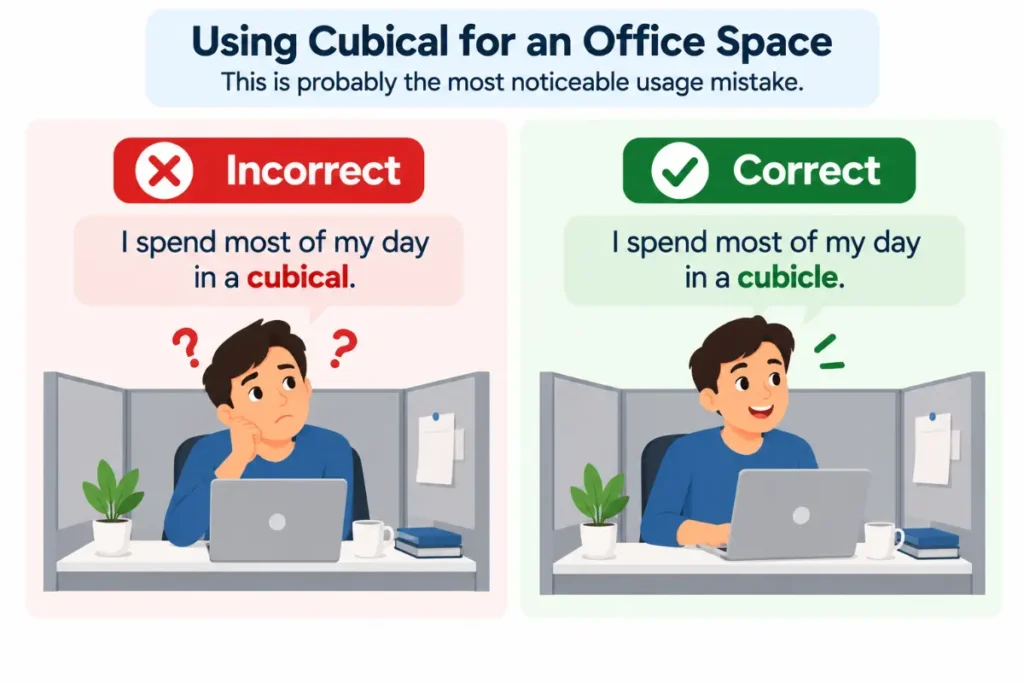
Using Cubical for an Office Workspace
Incorrect: His cubical is near the window.
Correct: His cubicle is near the window.
Cubical is normally an adjective so it doesn’t naturally name the employee’s workspace. Cubicle is the noun required here.
Using Cubicle as a Shape Adjective
Incorrect: We bought a cubicle storage box.
Correct: We bought a cubical storage box.
If the sentence specifically describes the cube shaped form of the box cubical is the appropriate adjective.
Assuming Cubical Is a Misspelling
Some writers see cubical and automatically change it to cubicle. That can introduce an error instead of fixing one.
A cubical structure is perfectly valid English if the writer means a structure shaped like a cube. Spellcheck software may recognize both forms because both exist as standard words. Context matters more than visual similarity.
Assuming Every Cubicle Is Cubical
A cubicle doesn’t need to form a perfect cube. Office partitions may create rectangular work areas with open tops and irregular layouts.
The noun describes the function and division of the space rather than demanding a particular geometric shape. Calling something a cubicle therefore tells you more about the type of space than its exact dimensions.
Choosing by Sound Alone
The two words can sound similar in quick speech. That makes pronunciation alone a poor editing method.
Instead identify the intended meaning. Shape points toward cubical. A compartment or workspace points toward cubicle.
From an NLP perspective the words are semantically related through concepts such as space shape enclosure and division but they occupy different grammatical and contextual roles. Human readers make the distinction largely through surrounding words such as office shape desk structure partition and cube.
Pronunciation Guide
How to Pronounce Cubical
Cubical is commonly pronounced:
IPA: /ˈkjuːbɪkəl/
The word has three syllables.
Cu bi cal
An easy pronunciation guide is:
KYOO bih kuhl
The main stress falls on the first syllable.
The beginning sounds like cube without the final sound being separated from the following syllable. The final syllable is light and unstressed.
How to Pronounce Cubicle
Cubicle is commonly pronounced:
IPA: /ˈkjuːbɪkəl/
It is also generally spoken with three syllables.
Cu bi cle
An easy guide is:
KYOO bih kuhl
This reveals something interesting. In common pronunciation cubical and cubicle can sound extremely similar and may be effectively identical for many speakers.
That similarity helps explain the spelling confusion. You often need sentence context rather than sound alone to know which word a speaker intends.
If someone says I went back to my KYOO bih kuhl you understand cubicle because the sentence describes a place. If someone says The object has a KYOO bih kuhl form the context points toward cubical.
You may also want to read excel vs accel Which One Should You Use in 2026.
Etymology and Word Origin
The words are related historically but they didn’t develop into identical meanings.
Origin of Cubical
Cubical belongs to the word family built around cube. The deeper history traces through Latin cubus which referred to a cube and ultimately connects with Greek kybos.
English formed cubical as an adjective for something connected with or shaped like a cube. Its structure follows a familiar English pattern in which an adjective describes a quality or relationship.
This history matches its modern geometric meaning. A cubical object resembles a cube in form.
Origin of Cubicle
Cubicle followed a different semantic path. It traces to Latin cubiculum which referred to a sleeping room or chamber. That word came from a Latin verb connected with lying down.
Over time cubicle developed the broader sense of a small room or compartment. Modern workplace culture made the office meaning especially familiar in American English.
The shared visual idea of a small boxlike area can make the two words seem closer than they actually are. Their histories help show why modern English assigns them separate jobs.
One describes form. The other names a space.
Regional Usage
American English
In American English cubicle strongly suggests a partitioned office workspace. If an American employee says I’m at my cubicle most listeners will picture a desk surrounded by partial walls or panels in an open office.
Cubical retains its geometric meaning in the United States. It is less common in casual conversation because people don’t need to describe objects as cube shaped every day. Still it is standard in technical educational architectural and descriptive contexts.
British English
British English recognizes both words with the same fundamental distinction. Cubical describes a cube shaped form while cubicle names a small partitioned space.
Cubicle can occur in a wider range of everyday physical settings. A British speaker may refer to a changing cubicle or toilet cubicle. This usage is normal and doesn’t change the core meaning of a small enclosed compartment.
Australian English
Australian English also recognizes both forms. Cubicle can refer to a small divided area in offices changing facilities restrooms and similar settings.
Cubical keeps its shape related meaning. There is no need to create a special Australian spelling for either word.
Canadian English
Canadian usage follows the same basic distinction. Cubicle commonly describes a partitioned workplace or another small separated area while cubical describes something resembling a cube.
The important difference is semantic and grammatical rather than regional. Writers across these English varieties can rely on the same core rule.
Grammar Rules and Part of Speech
Cubical as an Adjective
Cubical is primarily an adjective. Adjectives modify nouns by describing qualities characteristics or relationships.
Consider these examples.
The laboratory uses a cubical container.
They entered a cubical chamber.
In each case cubical appears before a noun and tells us about its shape.
It can also appear after a linking verb.
The container is cubical.
Here the adjective describes the subject container. This construction is grammatically different from using cubicle as a noun.
You can also use related noun phrases such as cubical shape cubical form and cubical structure.
Cubicle as a Noun
Cubicle is a countable noun. You can have one cubicle or several cubicles.
For example.
My cubicle needs better lighting.
The company installed twenty cubicles.
The word can take articles and possessive forms just like other countable nouns.
A cubicle.
The cubicle.
Her cubicle.
An office cubicle.
Cubicle can also appear in compound expressions where another word specifies its purpose. Office cubicle changing cubicle shower cubicle and study cubicle are examples.
Singular and Plural Forms
The singular form is cubicle.
The plural is cubicles.
Cubical works differently because adjectives in English generally don’t change form to match singular or plural nouns.
A cubical box.
Two cubical boxes.
The adjective remains unchanged.
Sentence Position
Cubical often comes directly before the noun it modifies.
They designed a cubical frame.
It can also follow linking verbs such as be seem and appear.
The chamber appears cubical.
Cubicle behaves as a noun and can occupy standard noun positions.
The cubicle is empty.
She cleaned the cubicle.
They walked toward the cubicle.
Punctuation
Neither word requires special punctuation. Normal sentence structure determines punctuation.
You don’t need quotation marks around either word in ordinary writing. You also don’t need a comma simply because one of these terms appears in a sentence.
The main grammar challenge is word class rather than punctuation.
Real Life Usage Examples
Daily Conversation
Example 1: My cubicle is right across from Sarah’s desk.
Example 2: That new table looks almost cubical from this angle.
The first sentence names a workspace. The second describes physical shape.
Email and Workplace Communication
Example 1: I left the signed documents on your cubicle desk this morning.
Example 2: The design team selected a cubical display unit for the lobby.
Workplace communication can contain either term. The surrounding nouns usually make the intended meaning obvious.
Academic Writing
Example 1: The students calculated the volume of the cubical container.
Example 2: Each participant completed the task in an individual study cubicle.
The first example belongs naturally in mathematical or scientific writing. The second describes the physical setting in which an activity occurred.
News and Journalism
Example 1: The company replaced traditional cubicles with larger shared work areas.
Example 2: The installation features a series of cubical forms arranged around a central courtyard.
Journalists may use cubicle when discussing workplace design and cubical when describing architecture art or physical structures.
Literature and Storytelling
Example 1: He sat alone in his cubicle listening to the quiet hum of the office.
Example 2: A strange cubical object rested in the middle of the empty room.
These examples show how each word can create a different image. One establishes a familiar setting. The other describes an object’s physical appearance.
Related and Confused Terms
Several words sit close to these terms in meaning or spelling. Understanding them can make your vocabulary more precise.
Cube
A cube is a three dimensional geometric solid with six equal square faces. Cubical is the adjective most directly related to this noun.
A cube is the object or form. Cubical describes something possessing that form.
Cubic
Cubic is another adjective related to cube. It can mean having the form of a cube but it also appears extensively in mathematics and measurement.
For example cubic feet describes volume. In many technical contexts cubic is more common than cubical because it can describe third degree mathematical relationships and units of volume.
Cube Shaped
Cube shaped is a plain English alternative to cubical. It can be easier for general audiences because its meaning is immediately visible.
For technical or concise descriptive writing cubical may sound more precise.
Compartment
A compartment is a separate section within a larger structure. A cubicle can be considered a type of compartment in some contexts but the terms aren’t identical.
Compartments appear in vehicles furniture containers and buildings. Cubicle more strongly suggests a small space intended for a person or a particular activity.
Booth
A booth is a small enclosed or partly enclosed space designed for a specific activity. Voting booths ticket booths and restaurant booths are familiar examples.
Some booths resemble cubicles but function determines which noun sounds more natural.
Workspace
Workspace refers broadly to an area where someone works. A cubicle is one specific type of workspace.
An office a desk a studio or a workshop can also serve as a workspace without being a cubicle.
Partition
A partition is a wall screen or divider that separates areas. Office cubicles are commonly created using partitions.
The partition is the dividing structure. The cubicle is the resulting space.
Cell
Cell can refer to a small room or enclosed unit in several contexts. It also has important meanings in biology technology and other fields.
Although a cell and cubicle can both describe relatively small spaces they aren’t general substitutes for each other. Context determines the natural term.
Cubic and Cubical Are Not Always Identical
Another useful distinction involves cubic and cubical. Both relate to cubes but cubic has broader mathematical uses.
You might describe an object as cubical if its physical shape resembles a cube. Cubic can also express the same general shape idea but it is essential in measurements such as cubic inches cubic meters and cubic feet.
For example.
The box has a cubical shape.
The box holds three cubic feet of material.
The first sentence describes shape. The second measures volume.
Cubic also appears in mathematics in expressions involving the third power. Cubical isn’t normally substituted in these established mathematical terms.
This distinction matters because a writer who learns that cubical relates to a cube may assume it belongs everywhere cubic appears. English usage doesn’t work that way. Established phrases determine the natural choice.
Can a Cubicle Be Cubical
Yes. A cubicle can be cubical if its physical dimensions and shape resemble a cube.
The two words can describe the same physical space from different angles. Cubicle tells us what the space is while cubical tells us what shape it has.
Consider this sentence.
The architect designed a cubical cubicle for the exhibition.
The phrase may sound repetitive because the words look and sound so similar but it can make grammatical sense. Cubical modifies the noun cubicle.
Still a normal office cubicle doesn’t have to be cubical. Many have rectangular floor plans partial walls and open tops. Calling something a cubicle tells us about its division and purpose rather than proving it has the dimensions of a cube.
How to Remember the Difference
A simple memory connection can save you from checking the spelling every time.
Think of cubical as cube plus a describing ending. It tells you what something looks like.
Think of cubicle as a little compartment. It names a place.
You can also use a sentence test.
If you can naturally place shape after the word then cubical may fit.
Cubical shape.
If you can naturally place office before the word then cubicle probably fits.
Office cubicle.
This test isn’t a complete grammar rule but it works well as a quick editing shortcut.

Expert Editor Insight
An experienced editor won’t automatically change cubical to cubicle because both are valid words. The first check is context. Words such as cube shape structure geometric and form often support cubical while office desk partition employee changing room and workspace often point to cubicle. Basic spellcheck may accept both spellings so contextual proofreading matters. A useful editing tip is to identify the part of speech first. If you need an adjective describing shape choose cubical. If you need a noun naming a compartment choose cubicle.
A related grammar guide is Implicit vs Complicit Which Word Should You Use 2026.
Conclusion
Cubical vs cubicle isn’t a choice between a correct spelling and an incorrect one. Both words belong in standard English but they perform different jobs. Cubical is mainly an adjective describing something shaped like a cube. Cubicle is a noun for a small partitioned or enclosed space.
The distinction becomes especially useful in office and technical writing. You sit in a cubicle but you might study a cubical object. One names a space while the other describes a shape.
For a quick memory trick connect cubical with cube and cubicle with compartment. Then check the word’s job in your sentence. That simple test will help you choose naturally and accurately.
FAQs
Is Cubical a Real Word?
Yes. Cubical is a standard English adjective that means shaped like a cube or related to a cube. It isn’t simply an incorrect spelling of cubicle. You may see it in geometry architecture engineering design and descriptions of physical objects. For example a cubical container is a container whose shape resembles a cube.
What Does Cubicle Mean?
A cubicle is a small enclosed or partitioned space within a larger area. It is especially common in offices where partitions separate individual employee workspaces. The term can also describe changing spaces study areas and other small compartments. Cubicle is a countable noun so its regular plural form is cubicles.
Which Is Correct Cubical or Cubicle?
Both are correct but they serve different purposes. Cubical is mainly an adjective meaning cube shaped. Cubicle is a noun referring to a small divided or enclosed space. Use cubical in a phrase such as cubical structure. Use cubicle when talking about an office workspace or another small compartment.
How Do You Pronounce Cubical and Cubicle?
Both words are commonly pronounced very similarly as /ˈkjuːbɪkəl/. A simple pronunciation guide is KYOO bih kuhl with the main stress on the first syllable. Their similar pronunciation is one reason writers confuse them. In speech the surrounding context often reveals the intended word because their meanings and grammatical functions differ.
Is an Office Space Called a Cubical or Cubicle?
A small partitioned office workspace is called a cubicle. Cubical is an adjective describing something that resembles a cube. You could technically describe an office cubicle as cubical if its shape closely resembles a cube but that is a separate description. In normal workplace conversation the noun you need is cubicle.
What Is Another Word for Cubicle?
Possible alternatives depend on context. Compartment workspace booth stall and enclosure can sometimes express related ideas but they aren’t perfect substitutes in every sentence. For an office setting workspace or workstation may fit. For a changing area stall or compartment may work in some contexts. Choose the term that accurately describes the space and its purpose.
Why Are Cubical and Cubicle Confused?
The words have similar spellings and can sound almost identical in ordinary speech. They also share a loose connection with small boxlike forms which adds to the confusion. Their grammar provides the clearest distinction. Cubical generally describes a cube shaped object while cubicle names a small partitioned space. Checking the surrounding noun or verb usually reveals the right choice.
Can I Use Cubical in Formal Writing?
Yes. Cubical is standard English and works well in formal writing when its meaning is accurate. It can be especially useful in mathematical scientific architectural and technical descriptions of cube shaped forms. Cubicle is also acceptable in formal writing when referring to a small compartment or workspace. Formality isn’t the deciding factor. Meaning and grammatical function determine the correct word.