
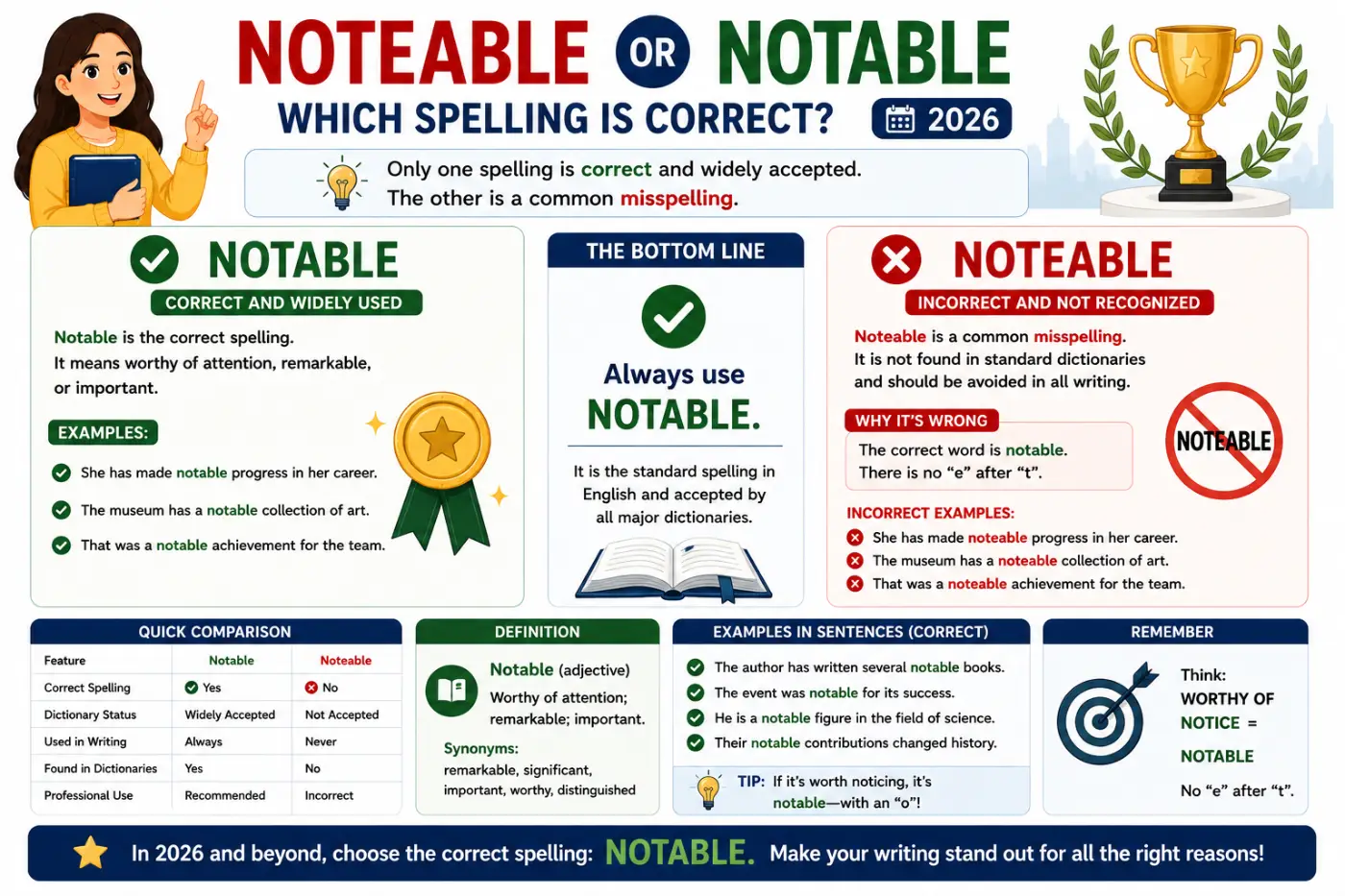
If you’ve searched for noteable or notable, you’re not alone. Many English learners and native speakers wonder if both spellings are acceptable or if one is simply a common mistake. The confusion is understandable because the word note exists, making noteable seem like a logical spelling. However, English spelling often follows historical patterns instead of simple logic.
The short answer is straightforward. Notable is the correct spelling in modern English. Noteable is considered a misspelling and should be avoided in formal, academic, professional, and everyday writing.
In this guide, you’ll learn why notable is the accepted form, where the confusion comes from, how to remember the correct spelling, how native speakers use the word, and dozens of real examples. You’ll also discover grammar rules, pronunciation, word origins, regional usage, and expert writing tips so you’ll never hesitate again.
Need another quick comparison? Read Stich Vs Stitch Which Spelling Is Correct in 2026?.
Quick Definition
Notable is the correct English adjective meaning worthy of attention, important, remarkable, or significant. Noteable is a common misspelling that is not accepted in standard American, British, Canadian, or Australian English. For clear and professional writing, always use notable.
Quick Answer
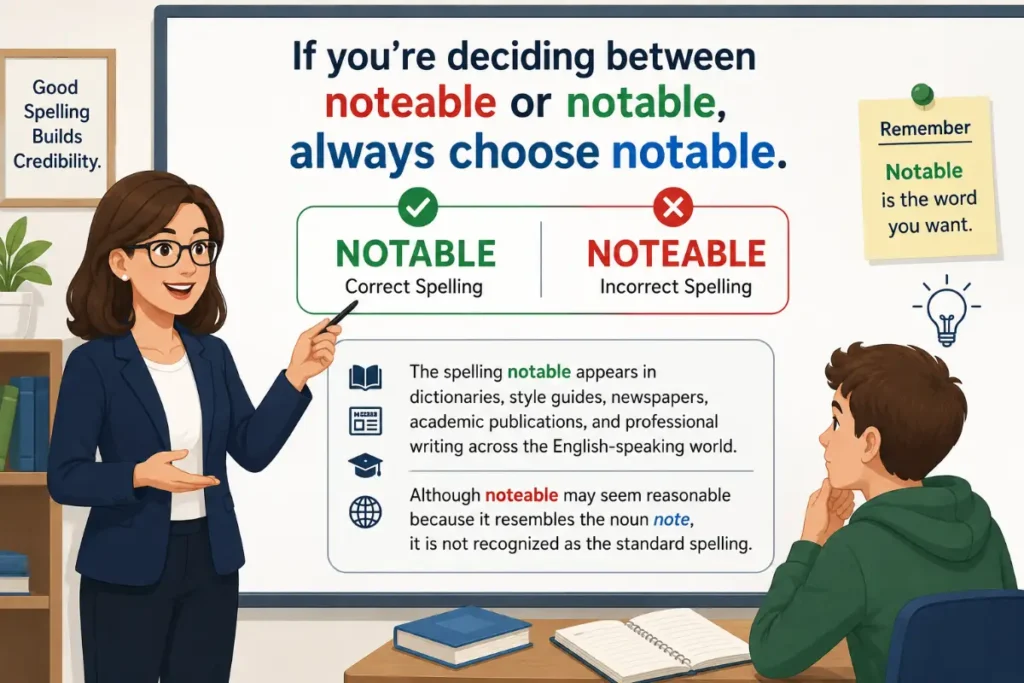
If you’re deciding between noteable or notable, always choose notable. The spelling notable appears in dictionaries, style guides, newspapers, academic publications, and professional writing across the English-speaking world. Although noteable may seem reasonable because it resembles the noun note, it is not recognized as the standard spelling.
Noteable or Notable Comparison Table
| Feature | Notable | Noteable |
|---|---|---|
| Correct spelling | Yes | No |
| Meaning | Worthy of attention or importance | Misspelling of notable |
| Part of speech | Adjective | Not recognized as a standard adjective |
| Origin | From Latin through Old French | Modern spelling error |
| Dictionary status | Listed in major dictionaries | Not accepted in standard dictionaries |
| Usage frequency | Extremely common | Very rare |
| Formal writing | Correct | Incorrect |
| Academic writing | Correct | Incorrect |
| Professional communication | Correct | Incorrect |
| Newspapers and books | Standard spelling | Avoided |
| American English | Preferred | Incorrect |
| British English | Preferred | Incorrect |
| Canadian English | Preferred | Incorrect |
| Australian English | Preferred | Incorrect |
Meaning of Notable
Notable is an adjective used to describe someone or something deserving attention because of importance, achievement, influence, quality, or significance. People often use it to highlight accomplishments, exceptional qualities, memorable events, or meaningful differences.
Examples include:
- She made a notable contribution to medical research.
- The company experienced notable growth this year.
- His speech marked a notable moment in history.
- There was a notable improvement in customer satisfaction.
- Several notable authors attended the conference.
The word can describe people, places, discoveries, historical events, artistic works, scientific achievements, businesses, organizations, and almost anything considered important enough to deserve attention.
Definition
A person or thing that is remarkable, distinguished, significant, or worthy of notice.
Part of Speech
Adjective.
Typical Contexts
- Academic writing.
- Journalism.
- Business reports.
- History.
- Science.
- Politics.
- Literature.
- Everyday conversation.
Meaning of Noteable
Unlike notable, noteable is not considered a standard English word. Most dictionaries do not list it as an accepted spelling. Instead, it usually appears because writers incorrectly assume the adjective should be formed directly from the noun note. Spell-checkers, grammar software, editors, and publishing style guides almost always flag noteable as an error and recommend replacing it with notable. If you use noteable in professional writing, readers may view it as a spelling mistake, reducing the credibility of your work.
Noteable or Notable Which Is Correct
The correct spelling is notable.
This applies to virtually every type of English writing, including:
- School assignments.
- College essays.
- Business emails.
- Books.
- Research papers.
- Websites.
- Blogs.
- Newspapers.
- Government publications.
- Professional reports.
Although noteable occasionally appears online, those examples almost always result from typing mistakes, misunderstandings, or unedited content rather than accepted English usage.
Why Do People Write Noteable
Many spelling mistakes happen because English words sometimes appear to follow predictable patterns.
People often think like this:
- Note becomes noteable.
- Debate becomes debateable.
- Value becomes valueable.
Unfortunately, English doesn’t always build adjectives this way.
The correct spellings are:
- Notable.
- Debatable.
- Valuable.
The extra e disappears before the suffix able in many words. This pattern surprises many learners because English spelling developed over centuries from several different languages rather than one consistent set of rules.
Key Differences Between Noteable and Notable
Although the two spellings look similar, they differ in several important ways.
Meaning
There is effectively no difference in intended meaning because noteable is simply a misspelling of notable.
Correctness
Notable is correct.
Noteable is incorrect.
Dictionary Recognition
Major English dictionaries recognize notable. They do not recognize noteable as a standard spelling.
Professional Acceptance
Editors, teachers, publishers, and employers expect the spelling notable. Using noteable may create an impression of carelessness.
Search Usage
Many people search for noteable because they are unsure about the spelling. Search engines usually interpret the query as notable and display results for the correct word.
Why Notable Is Spelled Without the Extra E
One of the most confusing aspects of English spelling involves words ending in able. Some words keep the final e.
For example:
- Like becomes likable.
- Sale becomes saleable in some varieties of English.
Others lose the e.
For example:
- Value becomes valuable.
- Debate becomes debatable.
- Notice becomes noticeable.
- Note does not become noteable.
- It becomes notable.
The spelling of notable did not develop by simply attaching able to the modern noun note. Instead, it entered English through historical language development, giving us the established spelling used today.
Is Noteable Ever Correct
In modern standard English, no. You should avoid noteable in:
- School writing.
- University assignments.
- Business communication.
- Professional reports.
- Journalism.
- Books.
- Academic publishing.
- Online articles.
- Marketing content.
- Government documents.
If you encounter noteable, treat it as a spelling mistake unless you are quoting an original historical source exactly as written.
How Dictionaries Treat Notable
Leading dictionaries consistently recognize notable as the standard spelling. They define it using meanings such as:
- Worthy of notice.
- Important.
- Distinguished.
- Significant.
- Remarkable.
- Famous for positive reasons.
You will not find noteable listed as an accepted alternative spelling in modern standard English dictionaries.
When to Use Notable
Use notable whenever you want to describe someone or something that deserves attention.
Common situations include:
- A notable scientist.
- A notable achievement.
- A notable increase in sales.
- A notable improvement in health.
- A notable historical figure.
- A notable discovery.
- A notable performance.
- A notable change in policy.
- A notable success.
- A notable contribution.
Because the word is flexible, it appears naturally across academic, professional, journalistic, and conversational English.
Common Collocations With Notable
Native speakers frequently pair notable with certain nouns. Some of the most common combinations include:
- Notable achievement.
- Notable author.
- Notable difference.
- Notable example.
- Notable exception.
- Notable figure.
- Notable improvement.
- Notable increase.
- Notable leader.
- Notable performance.
- Notable scientist.
- Notable success.
- Notable contribution.
- Notable feature.
- Notable event.
Using these natural combinations makes your writing sound more fluent and idiomatic.
Memory Trick
A simple way to remember the correct spelling is this: Think of notable as a complete word rather than note plus able. Remember this sentence: A notable person deserves notice, not an extra letter. That reminder helps you avoid inserting the unnecessary e.
Common Synonyms of Notable
Depending on the context, notable can be replaced with words such as:
- Remarkable.
- Significant.
- Distinguished.
- Prominent.
- Outstanding.
- Important.
- Exceptional.
- Memorable.
- Impressive.
- Influential.
- Famous.
- Eminent.
- Accomplished.
- Respected.
- Celebrated.
Each synonym carries a slightly different nuance, so choose the one that best fits your sentence.
Many readers also check Maintained vs Maintenancede Grammar and Examples 2026.
Examples of Notable in Sentences
These examples show how native speakers naturally use notable in everyday and professional writing.
- The researcher made a notable discovery that changed the field.
- There has been a notable increase in housing prices this year.
- She received a notable award for community service.
- His leadership brought notable improvements to the company.
- The museum features works by several notable artists.
- The city experienced a notable drop in crime.
- One notable feature of the software is its speed.
- The author is known for several notable novels.
- Their team achieved notable success during the tournament.
- The report highlights a notable difference between the two methods.
Examples of Noteable in Sentences
The following sentences demonstrate incorrect usage. Each should use notable instead.
- ❌ She made a noteable contribution to the project.
- ❌ The company saw a noteable rise in profits.
- ❌ He is a noteable scientist.
- ❌ There was a noteable improvement in quality.
- ❌ The article discusses several noteable events.
- ❌ They hired a noteable architect.
- ❌ This building has noteable historical value.
- ❌ The speech had a noteable impact.
- ❌ Her performance was noteable throughout the season.
- ❌ The book describes many noteable achievements.
In every sentence above, replacing noteable with notable makes the sentence correct.
Common Mistakes With Noteable or Notable
People confuse these spellings for several reasons. Understanding the mistakes makes them easier to avoid.
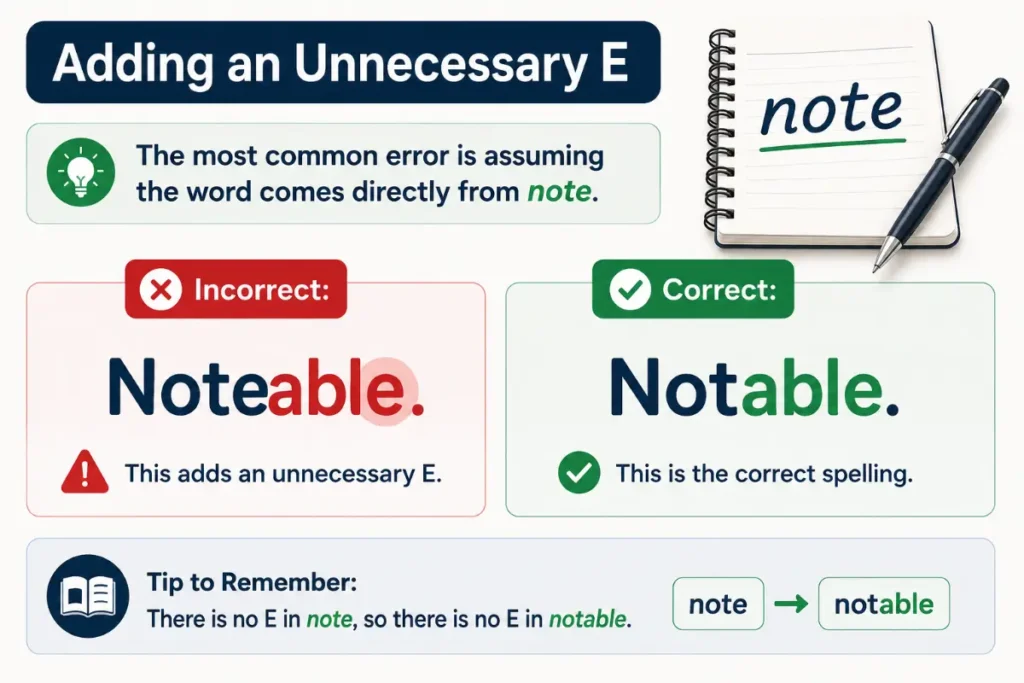
Adding an Unnecessary E
The most common error is assuming the word comes directly from note.
Incorrect:
- Noteable.
Correct:
- Notable.
Trusting Spellings Seen Online
The internet contains millions of unedited pages. Just because noteable appears somewhere does not mean it is correct. Always rely on reputable dictionaries, style guides, and edited publications.
Assuming Every Word Follows the Same Pattern
English contains many spelling patterns, but there are also numerous exceptions. Instead of inventing spellings, verify unfamiliar words before using them in important writing.
Ignoring Spell Check Warnings
Modern spelling tools usually recognize noteable as an error. If your word processor highlights it, do not ignore the suggestion unless you have verified an unusual historical quotation.
Pronunciation Guide
Since noteable is not a standard English spelling, only notable has an accepted pronunciation.
IPA
American English
/ˈnoʊ.tə.bəl/
British English
/ˈnəʊ.tə.bəl/
Syllable Breakdown
No • ta • ble
Three syllables.
Pronunciation Tips
- Stress the first syllable.
- The middle syllable sounds like tuh.
- The final syllable sounds like buhl.
Common Pronunciation Mistakes
Some learners pronounce every written vowel too strongly. Instead of saying each syllable with equal emphasis, place the stress on the beginning of the word. Listening to native speakers in news broadcasts, documentaries, and educational videos is an excellent way to develop a natural pronunciation.
Etymology and Word Origin
The history of notable explains why its spelling differs from what many people expect. The word entered English through Old French notable, which came from the Latin word notabilis, meaning worthy of being noticed or known. The Latin verb notare meant to mark, observe, or notice. Over time, English adopted the spelling notable directly from these earlier forms rather than creating a new adjective from the modern English noun note. That historical development explains why noteable never became the standard spelling. Like many English words, notable reflects centuries of influence from Latin and French rather than modern spelling logic.
Noteable or Notable in American English
American English uses notable exclusively.
You’ll find it in:
- Newspapers.
- Universities.
- Government documents.
- Business writing.
- Legal writing.
- Scientific journals.
- Professional communication.
Using noteable in American English is regarded as a spelling error.
Noteable or Notable in British English
British English follows exactly the same standard. Editors, publishers, universities, and dictionaries all use notable. The spelling noteable is not accepted.
Australian English
Australian English also recognizes notable as the standard spelling. Schools, universities, businesses, and media organizations consistently use notable.
Canadian English
Canadian English follows the same convention. Regardless of the variety of English you write, notable remains the correct spelling.
Grammar Rules
Understanding the grammar of notable helps you use it naturally.
Part of Speech
Notable functions primarily as an adjective.
Examples:
- A notable achievement.
- A notable discovery.
- A notable difference.
Comparative Form
More notable.
Example:
This year’s results are more notable than last year’s.
Superlative Form
Most notable.
Example:
She became the most notable speaker at the conference.
Predicate Adjective
Notable can appear after linking verbs.
Examples:
- Her improvement was notable.
- The difference is notable.
- His influence remains notable.
Attributive Adjective
It commonly appears before nouns.
Examples:
- A notable author.
- A notable victory.
- A notable event.
Noun Form
Notability.
Example:
Her international notability continued to grow.
Adverb Form
Notably.
Example:
The company performed notably better this quarter.
Real Life Usage Examples
Daily Conversation
“That’s a notable improvement.”
“She has become a notable member of the community.”
Academic Writing
“The experiment produced several notable findings.”
“There is a notable correlation between the variables.”
Professional Communication
“Our team achieved notable progress during the first quarter.”
“The report identifies several notable risks.”
Journalism
“The governor announced a notable policy change.”
“The athlete reached another notable career milestone.”
Literature
Authors frequently use notable to emphasize importance without sounding exaggerated. Instead of calling every achievement extraordinary, experienced writers often choose notable because it communicates significance in a measured, credible way.
Media
News organizations regularly describe:
- Notable events.
- Notable figures.
- Notable achievements.
- Notable trends.
- Notable developments.
The word sounds professional, objective, and precise, making it especially popular in journalism.
Related Words and Commonly Confused Terms
When people search for noteable or notable, they often look for similar words or make related spelling mistakes. Here are several closely connected terms.
| Word | Meaning |
|---|---|
| Notice | To observe or become aware of something. |
| Notably | Especially or particularly. |
| Notability | The quality of being important or well known. |
| Noted | Well known or recognized. |
| Noticeable | Easy to observe. |
| Remarkable | Worthy of attention. |
| Significant | Important or meaningful. |
| Prominent | Widely recognized or important. |
| Distinguished | Respected because of achievement. |
| Eminent | Famous and highly respected. |
Understanding these related words helps expand your vocabulary while reducing spelling confusion.
Expert Language Insight
Professional editors rarely choose words by habit alone. They think about precision, clarity, and the expectations of their readers. Notable is valuable because it signals importance without sounding exaggerated. It suggests that something deserves attention based on evidence rather than opinion.
Compare these examples.
“The scientist made a notable discovery.”
For that reason, editors consistently recommend learning the standard spelling and using it confidently in every form of writing.

Usage Tips for Better Writing
If you want your English to sound more natural, keep these tips in mind.
- Use notable only when something genuinely deserves attention.
- Avoid overusing it in every paragraph.
- Pair it with nouns such as achievement, change, figure, event, contribution, difference, and success.
- Replace it with a synonym when another word expresses your meaning more precisely.
- Proofread carefully so noteable does not slip into your final draft.
Following these simple practices will make your writing stronger, clearer, and more professional.
Many readers also check powerfull vs powerful Correct Spelling and Usage.
Final Verdict on Noteable or Notable
If you’re choosing between noteable or notable, the answer is simple. Notable is the only correct spelling in standard English.
The confusion is understandable because note is a common English word, making noteable appear logical at first glance. However, English spelling is shaped by centuries of linguistic history, and notable comes from Latin and Old French rather than being formed by simply adding able to note.
Whenever you write about someone or something important, remarkable, distinguished, or worthy of attention, use notable with confidence. It is the spelling recognized by dictionaries, publishers, educators, style guides, and professional editors across the English-speaking world.
Frequently Asked Questions
Is noteable ever a correct spelling?
No. In modern English, noteable is considered a misspelling. The correct spelling is notable in American, British, Canadian, and Australian English. If you use noteable in formal writing, editors and spell-checkers will almost always flag it as an error.
Why do people spell notable as noteable?
Many people assume the adjective comes directly from the noun note, so adding able seems logical. However, notable comes from the Latin notabilis through Old French, which is why the accepted spelling does not include the extra e.
What does notable mean?
Notable means worthy of attention, importance, or recognition. It can describe people, achievements, events, discoveries, changes, or anything considered significant enough to be noticed.
Is notable a positive word?
Usually, yes. Notable often highlights something impressive, important, or remarkable. However, it can also describe significant negative events if they are worthy of attention, such as a notable decline in sales or a notable increase in pollution.
What is the difference between notable and noticeable?
Although the words are related, they have different meanings. Notable means important or worthy of attention. Noticeable means easy to see, hear, or observe. Something can be noticeable without being notable, and something can be notable without being immediately noticeable.
Can notable describe a person?
Yes. Native speakers commonly use notable for people who are respected, influential, or widely recognized for their achievements.
Examples include:
- A notable scientist.
- A notable author.
- A notable business leader.
- A notable historical figure.
Is notable formal or informal?
Notable works well in both formal and informal English. It appears frequently in academic papers, news articles, business reports, and everyday conversation because it communicates importance in a clear, professional way.
How can I remember the correct spelling?
A simple memory trick is: A notable person deserves notice but never an extra e. Remember that the standard English spelling has always been notable, not noteable.