
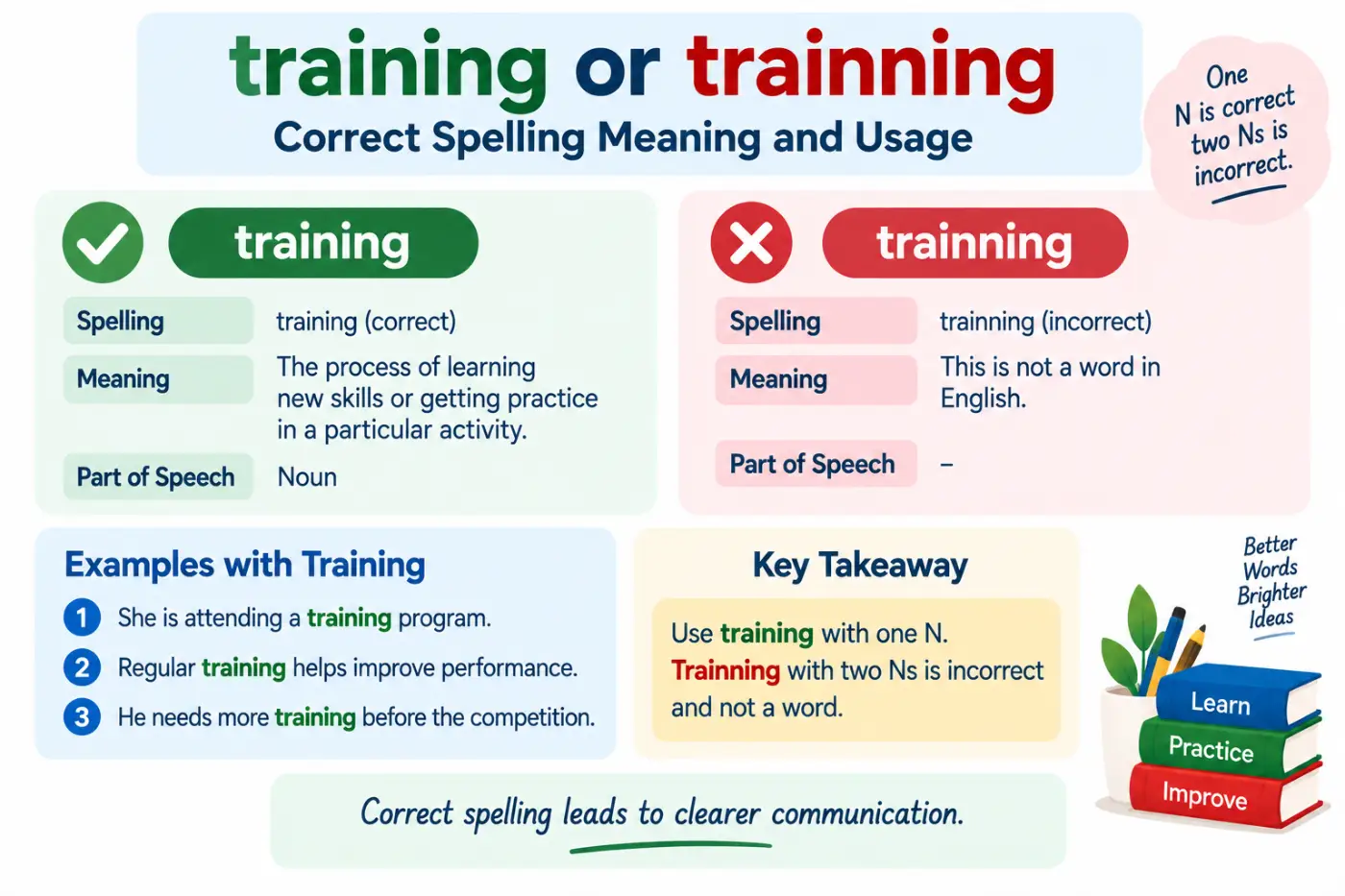
training or trainning is a common spelling question because the two forms look almost identical. The correct spelling is training. The form trainning is a misspelling in standard English because the word keeps one n before the ending ing.
The confusion usually comes from the spelling pattern people expect when adding an ending to a word. English sometimes doubles a final consonant before certain endings. However the rule does not apply to every word. Since train already ends with a vowel sound followed by n and does not meet the usual doubling pattern in this form, you write training with one n. The pronunciation also makes the spelling easy to overlook because you hear the same basic word rather than a clear difference between one n and two.
In this guide you’ll learn the meaning of training, the reason trainning is incorrect, the spelling rule behind the difference, pronunciation, grammar, examples, common mistakes, regional usage, related terms, and practical editing tips. The goal is simple. You should be able to recognize the correct form instantly and use it naturally in your own writing.
A related grammar guide is recieve or receive: Correct Spelling and Usage Guide.
Quick Definition
Training is the correct spelling. It is a noun that commonly means the process of learning or developing a skill through instruction and practice. It can also describe preparation for physical performance or a particular task. Trainning is a common spelling error and is not the standard English form.
Quick Answer
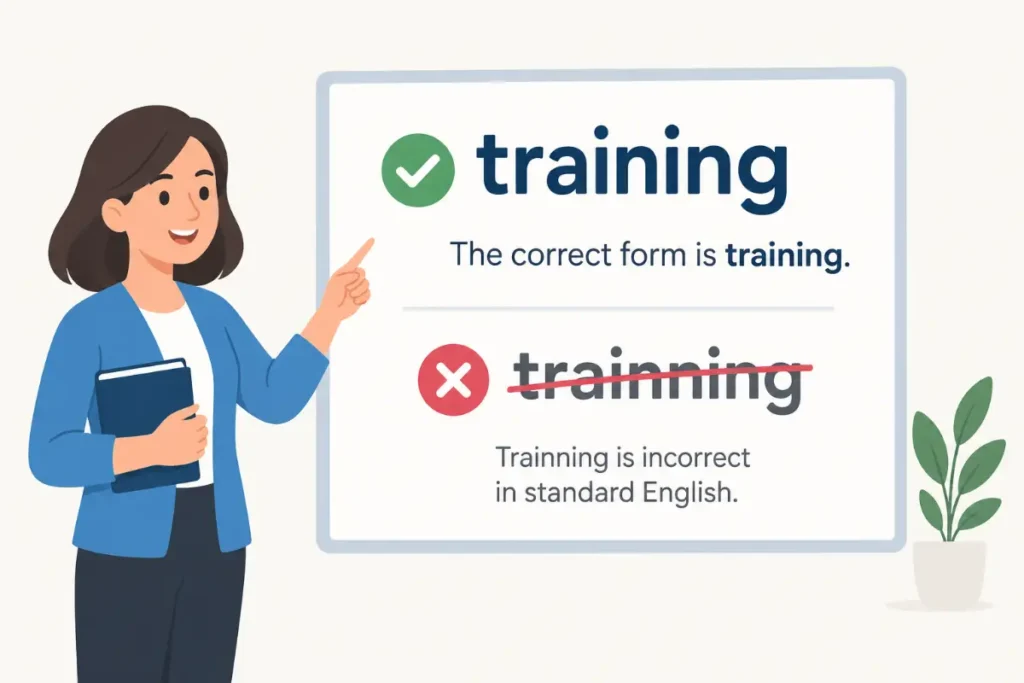
The correct form is training. Trainning is incorrect in standard English.
Training comes from the verb train plus the ending ing. The final n is not doubled in this word. For example you can write The company provides training for new employees.
Comparison Table for training or trainning
| Correct Form | Meaning | Part of Speech | Origin | Usage Frequency | Formality | Common Contexts | Example |
|---|---|---|---|---|---|---|---|
| Training | Learning practice or preparation that develops skills or ability | Noun and present participle form | Derived from train | Very common | Neutral and formal | Education work sports professional development daily communication | The staff received safety training. |
| Trainning | No standard English meaning as a spelling variant | Nonstandard spelling | Misspelling of training | Uncommon as a correct form | Not standard | Typing mistakes spelling errors drafts | Trainning should be corrected to training. |
Meaning and Definition
Meaning of the Incorrect Form
Trainning is normally a spelling mistake rather than a separate English word. Writers may produce it because they assume that the final n in train needs to be doubled before ing.
That assumption comes from a real English spelling rule. English does double some final consonants before certain endings. For example stop becomes stopping and run becomes running. The problem is that learners can apply this rule too broadly.
Train does not follow that pattern when it becomes training. The standard spelling keeps one n.
You might see trainning in online comments, notes, drafts, school assignments, workplace documents, or quickly typed messages. Its appearance in real writing does not make it an accepted spelling. A repeated typo can become familiar without becoming correct.
There is also an important difference between a spelling error and a legitimate variant. American English, British English, Canadian English, and Australian English all use training as the standard form. The extra n does not represent a regional spelling difference.
Meaning of the Correct Form
Training has several connected meanings.
The most common meaning is the process of learning or developing a skill. A person may receive training to learn how to use software, operate equipment, serve customers, teach students, or perform a professional task.
For example:
The company provides training for new employees.
Training can also refer to physical preparation. Athletes follow training programs to improve strength, speed, endurance, technique, or performance.
For example:
She increased her training before the marathon.
The word can also describe preparation for a specific situation.
The firefighters completed emergency training.
Training may refer to formal instruction, informal practice, repeated exercises, or a structured program. The exact meaning depends on the context.
The word can also function as the present participle of train.
For example:
They are training for the competition.
In that sentence training is part of the verb phrase are training. In other sentences it acts as a noun.
For example:
The training was useful.
Here training names the activity or process itself.
Key Differences Explained
- Spelling. Training contains one n before ing. Trainning contains two n letters and is not the standard spelling.
- Meaning. Training has established meanings related to learning, practice, instruction, and preparation. Trainning has no separate standard meaning.
- Grammar. Training can function as a noun or as the present participle form of train.
- Pronunciation. The two spellings do not represent two standard pronunciation choices. Standard English uses the pronunciation associated with training.
- Formality. Training is appropriate in casual conversation, school writing, business communication, academic work, journalism, and formal documents.
- Regional usage. Major English varieties use training. The spelling does not change to trainning in American English or British English.
- Spelling pattern. The main difficulty comes from applying consonant doubling rules too broadly. Not every word ending in a consonant doubles that consonant before ing.
Which Form Is Correct?
Training is the correct form.
The spelling comes from the base verb train with the ending ing. Standard English does not double the final n in this word.
A useful way to understand the spelling is to compare train with words that really do double their final consonant. Words such as run, sit, and stop follow a different pattern when the ending is added. Their spelling changes because they meet the conditions for consonant doubling.
Train does not meet those conditions in the same way. The word ends with the vowel sequence ai followed by n. The standard form therefore remains training.
This distinction matters because English spelling rules often depend on the structure of the base word. A simple rule such as double the final consonant before ing is too broad.
Established dictionary usage supports training as the standard form. Major English dictionaries list training as the noun and verb form derived from train. The spelling trainning is not treated as a standard alternative form.
For professional writing the practical choice is straightforward. Use training.
Why Training Does Not Need Two Ns
This is the part that causes the most confusion.
When English adds ing to some short verbs, the final consonant may be doubled. The pattern can be seen in examples such as:
- Run becomes running.
- Sit becomes sitting.
- Stop becomes stopping.
- Plan becomes planning.
Those examples can make train look as if it should become trainning. It does not.
The vowel pattern matters. Train contains the vowel combination ai before the final n. The standard spelling therefore adds ing without doubling the consonant.
The result is:
train + ing = training.
Not:
train + ning = trainning.
You can use this same idea when checking related words.
Train.
Trained.
Training.
Trainer.
Trainee.
Retraining.
The spelling family consistently points back to train.
Sentence Examples
Here are natural examples showing how the correct form works in different situations.
- The company provides training for all new employees.
- I have training after work this afternoon.
- She completed her safety training last week.
- The coach changed the team’s training schedule.
- Good training can help employees feel more confident.
- He is training for his first marathon.
- Our teacher gave us extra training on the new software.
- The hospital requires regular training for its staff.
- The athlete returned to training after a short break.
- The new training program focuses on practical skills.
The incorrect form may appear in writing like this:
- The company provides trainning for new employees.
- I need more trainning before I start the job.
- She completed her trainning yesterday.
- The coach changed the trainning schedule.
- We received trainning on workplace safety.
Each example should use training instead.
Common Mistakes and Misspellings
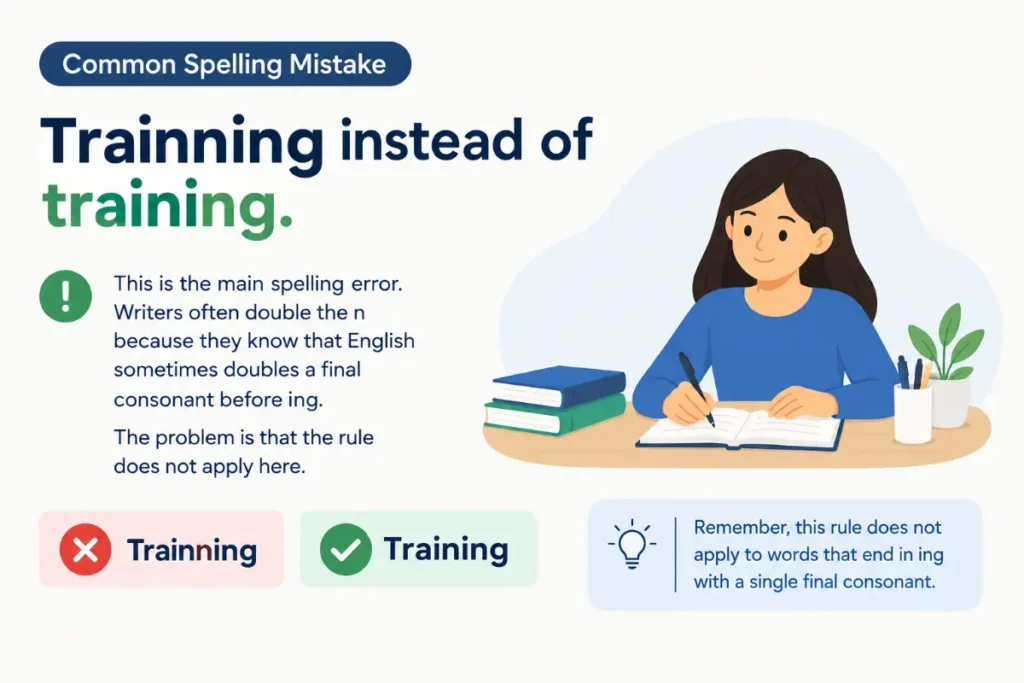
- Trainning instead of training.
This is the main spelling error. Writers often double the n because they know that English sometimes doubles a final consonant before ing. The problem is that the rule does not apply here.
Correct: The company offers training.
- Training confused with trainer.
Training names the process or activity. A trainer is a person who provides instruction or prepares someone for a task.
Correct: The trainer organized the training.
- Training confused with trainee.
A trainee is the person receiving instruction. Training is the process itself.
Correct: The trainee completed the training.
- Using train instead of training.
Train is the base verb or noun. Training can be the noun or the ing form of the verb.
Correct: I need more training.
Different meaning: I train every morning.
- Adding unnecessary consonants.
Some learners write trainning because they hear a stronger n sound when speaking quickly. This is a sound to spelling problem rather than a pronunciation difference.
From an NLP perspective the error is easy for language tools to recognize because the surrounding context often strongly predicts training. Spellcheckers may flag the unusual form and suggest the standard word. Still a human editor should understand the underlying spelling rule instead of relying only on software.
A related grammar guide is Bearable vs Bareable Which Is Correct? 2026.
Pronunciation Guide
Training is commonly pronounced /ˈtreɪnɪŋ/.
You can think of the word as two main sound groups:
TRAIN ing
The first part sounds like train. The second part sounds like ing.
The primary stress falls on the first syllable.
A simple pronunciation guide for American English is:
TRAY ning
The spelling does not mean that you should pronounce two separate n sounds. The pronunciation is one natural sequence.
The incorrect spelling trainning does not create a standard alternative pronunciation. Adding another written n does not mean the word should contain an extra spoken n.
A useful pronunciation tip is to say train and then add ing naturally.
Train.
Training.
This makes the spelling relationship easier to remember.
Etymology and Word Origin
Training has a long history connected to the verb train. Historical evidence traces training back to Middle English and records it as a verbal noun formed from train. Early meanings were connected with ideas such as drawing out or dragging along. Over time the word developed meanings connected with discipline, instruction, and developing skills.
The meaning associated with instruction became established centuries ago. Historical records show training used for discipline and instruction from the sixteenth century. Its athletic sense developed later and came to describe physical preparation for improved strength, endurance, and performance.
This history helps explain why training now works in many settings. A person can receive job training, athletic training, military training, technical training, or educational training. The central idea remains development through instruction or practice.
The related verb train has also developed several meanings over time. Today it can mean to teach a person or animal, prepare for an activity, practice for a performance, or develop a particular skill.
Regional Usage
American English
American English uses training as the standard spelling. The word is common in workplaces, schools, sports, healthcare, technology, public services, and everyday conversation.
You might hear phrases such as employee training, job training, safety training, athletic training, professional training, and training program. The spelling remains the same across these contexts.
British English
British English also uses training. There is no standard British spelling that changes the word to trainning.
The meaning can vary based on context just as it does in American English. Training may refer to education, workplace instruction, sports preparation, or practical skill development.
Australian English
Australian English uses training as the standard form. The extra n in trainning is not a regional Australian spelling.
The word appears naturally in education, employment, sports, government, and everyday communication.
Canadian English
Canadian English also uses training. There is no meaningful spelling distinction between Canadian English and American English for this word.
Canadian writers use the same standard spelling in formal documents, workplace communication, academic writing, and everyday conversation.
Grammar Rules and Part of Speech
Training has two main grammatical roles.
First it can function as a noun.
In this use it refers to the process or activity of learning and preparation.
The training was helpful.
Her training prepared her for the job.
The company provides safety training.
In each sentence training names an activity or process.
Second training can function as the present participle of the verb train.
For example:
She is training for the race.
They are training new employees.
The dog is training with its handler.
In these sentences training forms part of the verb phrase.
The word can also appear before another noun as a modifier.
For example:
Training program.
Training session.
These combinations are common because English frequently uses nouns to describe another noun.
Common Sentence Patterns
Several patterns appear regularly.
Training for something.
He is training for the competition.
Training in something.
She received training in computer programming.
Training on something.
Employees received training on the new system.
Training to do something.
The staff completed training to operate the equipment safely.
The preposition depends on the intended relationship. For example training for a race describes preparation toward a goal. Training in a subject identifies an area of knowledge or skill. Training on a system often refers to instruction about a tool or process.
Countable and Uncountable Use
Training is often used as an uncountable noun when it refers to instruction as a general process.
She needs more training.
The company provides training.
However specific programs or sessions can be described with countable nouns such as training sessions, training courses, or training programs.
She attended three training sessions.
This distinction helps your writing sound more natural.
Real Life Usage Examples
Daily Conversation
Training appears naturally when people talk about work, exercise, school, hobbies, or personal goals.
- I have training at six tonight.
- My brother started training for a cycling event.
These sentences sound normal because the word can describe both professional instruction and physical preparation.
Email and Workplace Communication
Professional writing often uses the word to describe employee development.
- New employees must complete safety training before using the equipment.
- Please finish the required training before Friday.
These examples are direct and practical. They fit ordinary workplace communication without sounding overly formal.
Academic Writing
In academic contexts the word can describe professional preparation, skill development, or research related instruction.
- Teacher training can influence classroom practice.
- The program provides specialized training in laboratory methods.
Academic writing often combines training with words such as program, course, skills, methods, professional, technical, and practical.
News and Journalism
News writing may use training when reporting on emergency services, sports, public safety, education, or professional development.
- Local firefighters completed advanced emergency training.
- The athletes returned to training ahead of the tournament.
The meaning is usually clear from the surrounding context.
Literature and Storytelling
In storytelling the word can describe a character’s preparation or development.
- Years of training had prepared her for the difficult journey.
- His early training shaped the way he approached every challenge.
Here training can carry more emotional weight because it connects past effort with later action.
Related and Confused Terms
- Train.
Train is the base verb from which training is formed. It can mean to teach, practice, prepare, or develop a skill.
- Trainer.
A trainer is usually a person who teaches or prepares another person. In sports it can refer to someone who helps an athlete prepare.
- Trainee.
A trainee is someone who receives instruction or is learning a skill.
- Training program.
This refers to an organized plan for developing knowledge or skills.
- Training course.
A training course is a structured period of instruction focused on a particular subject or skill.
- Practice.
Practice usually refers to repeated activity designed to improve performance. It can be part of training but does not always mean the full instructional process.
- Education.
Education is broader than training. It can involve general knowledge, academic learning, intellectual development, and formal schooling.
- Instruction.
Instruction focuses on teaching information, methods, procedures, or skills. Training often combines instruction with repeated practice.
These words overlap, but they are not identical. Choosing the right term depends on what you want to emphasize.
Training in Formal Writing
Training is completely appropriate in formal writing. You can use it in academic essays, workplace documents, reports, applications, policies, research papers, manuals, and professional correspondence.
For example:
The organization provides training to improve workplace safety.
That sentence sounds natural and professional.
In formal writing the bigger issue is usually precision rather than the word itself. Instead of repeating training several times in the same paragraph, you can sometimes use terms such as instruction, preparation, professional development, or skill development when they accurately express the intended idea.
However you should not replace a precise word simply to avoid repetition. If training is the most accurate term, use it.
Why the Double N Mistake Happens
The extra n is not random. It comes from a real spelling pattern that learners encounter in English.
Consider these words:
- Run becomes running.
- Swim becomes swimming.
- Begin becomes beginning.
- Stop becomes stopping.
These examples can lead writers to assume that every verb ending in n doubles the n before ing.
That assumption is too broad.
The spelling of English verbs depends on factors such as the final sound, vowel pattern, syllable structure, and stress. Train has the vowel combination ai before the final n, so it does not follow the same doubling pattern as run or stop.
This is why memorizing isolated rules can sometimes create new errors. It is better to learn the pattern with examples.
A useful comparison is:
Train becomes training.
Run becomes running.
Plan becomes planning.
The spelling difference becomes much easier to see when the words are placed side by side.
Expert Editor Insight
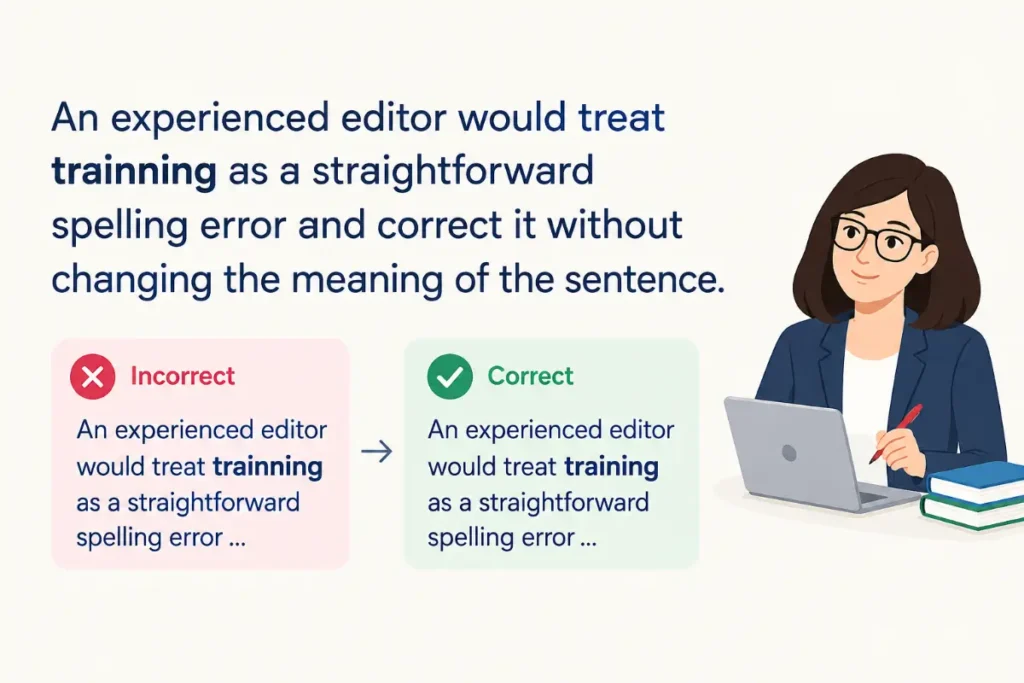
An experienced editor would treat trainning as a straightforward spelling error and correct it without changing the meaning of the sentence. The confusion is understandable because English has genuine consonant doubling patterns before ing. Professional editing focuses on the structure of the base word rather than simply counting letters. Spellcheck tools can catch the common error but understanding why training is correct gives you a stronger long term solution. A simple editing habit is to remove the ending ing mentally and check the base word first. If the base is train the standard result is training.
For another common grammar confusion, see Placque vs Plaque Which Spelling Is Correct in 2026?.
Conclusion
training or trainning has a clear answer. Training is the correct standard spelling, while trainning is a common spelling mistake. The correct form uses one n before the ing ending and works as both a noun and a present participle. It can describe learning, instruction, practice, preparation, or skill development in many settings.
The confusion usually comes from applying the consonant doubling rule too broadly. English does double final consonants in words such as running and stopping, but train follows a different spelling pattern because of its vowel structure.
For an easy memory trick, start with train and add ing. You get training. If you see trainning in your draft, remove the extra n before you submit or publish the text.
FAQs
Is trainning a real English word?
Trainning is not the standard spelling of the English word used for instruction, preparation, or skill development. It is normally a misspelling of training. The extra n comes from incorrectly applying a consonant doubling pattern. If you are writing an essay, email, report, application, or professional document, use training.
What does training mean?
Training means the process of learning, practicing, or developing a skill or ability. It can refer to workplace instruction, academic preparation, athletic preparation, technical learning, or other forms of organized practice. The word can also function as the present participle of train, as in She is training for the competition.
Which is correct training or trainning?
Training is correct. Trainning is a spelling error in standard English. The base word is train and the standard form adds ing without doubling the final n. You can remember the pattern by writing train first and then adding ing. The result is training.
How do you pronounce training?
Training is commonly pronounced /ˈtreɪnɪŋ/. A simple pronunciation guide is TRAY ning. The main stress falls on the first syllable. The word does not require an extra spoken n because the standard spelling contains only one n before the ing ending.
Why do people spell training with two Ns?
People often write trainning because English has many verbs that double a final consonant before ing. Examples include run becoming running and stop becoming stopping. Writers may apply that pattern too broadly to train. The spelling rule depends on the structure of the base word, so train becomes training rather than trainning.
Is training appropriate in formal writing?
Yes. Training is fully acceptable in formal writing. It appears naturally in academic work, workplace documents, reports, policies, professional emails, and educational materials. The word itself is not informal. Your choice of surrounding vocabulary and the clarity of the sentence matter more for formality.
What is the difference between training and practice?
Training is usually broader and can include instruction, preparation, coaching, and repeated practice. Practice focuses more directly on repeating an activity to improve performance. For example an athlete may follow a training program that includes strength work, coaching, recovery, and practice sessions.
What is the easiest way to remember the spelling?
Start with the base word train and add ing directly. Train plus ing gives training. Do not double the final n. Comparing it with words such as run and running can also help because it shows that consonant doubling applies in some cases but not every case.