
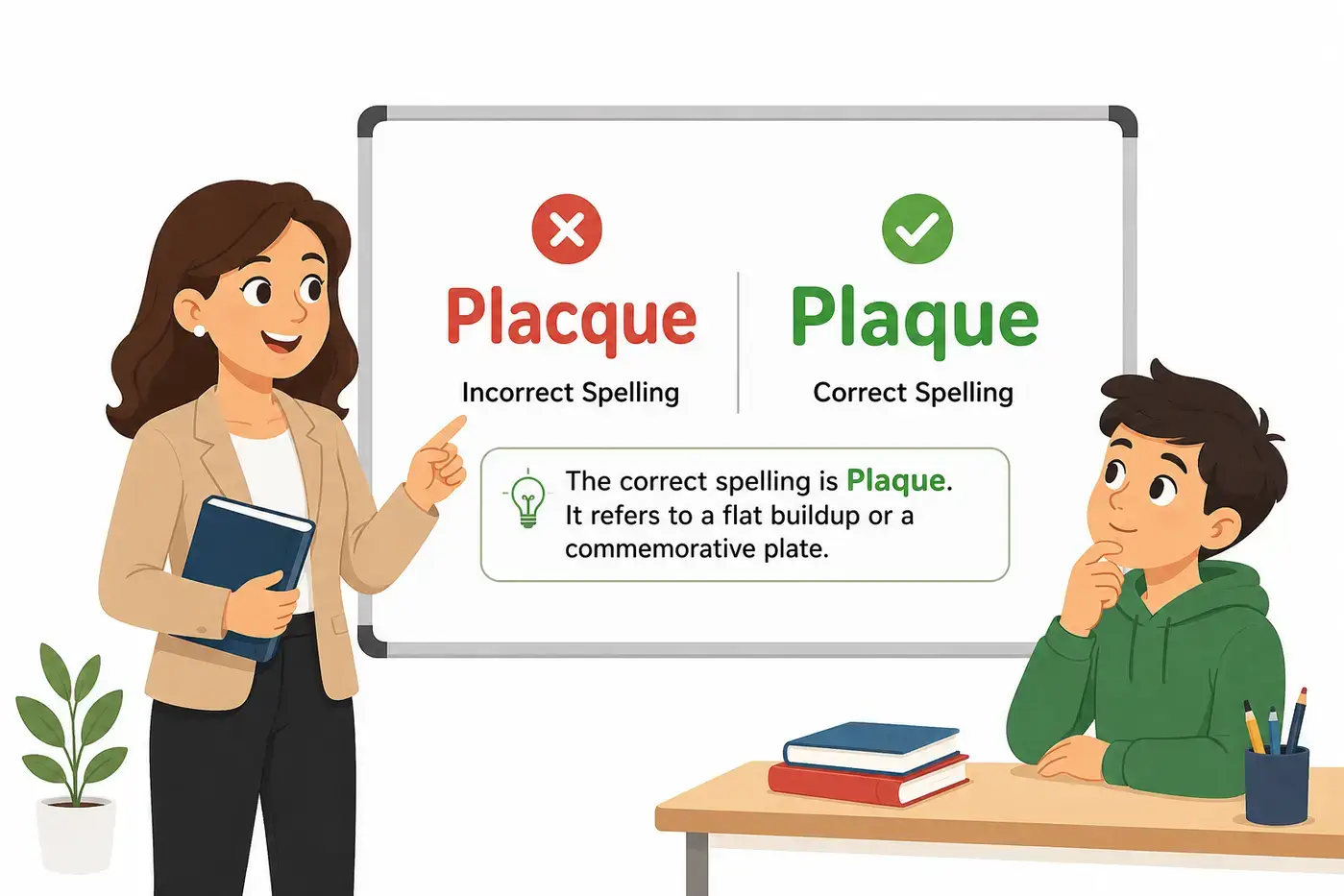
Placque vs Plaque is a common spelling confusion that catches many writers off guard. If you’ve typed placque and your spell checker flagged it, you’re not alone. This mistake appears more often than many people realize. The two spellings look similar at a glance, and the silent letters make the correct form easy to second guess. Still, only one belongs in standard English. This guide explains these words, showing you which spelling is correct, why the confusion happens, and how to remember the right form every time.
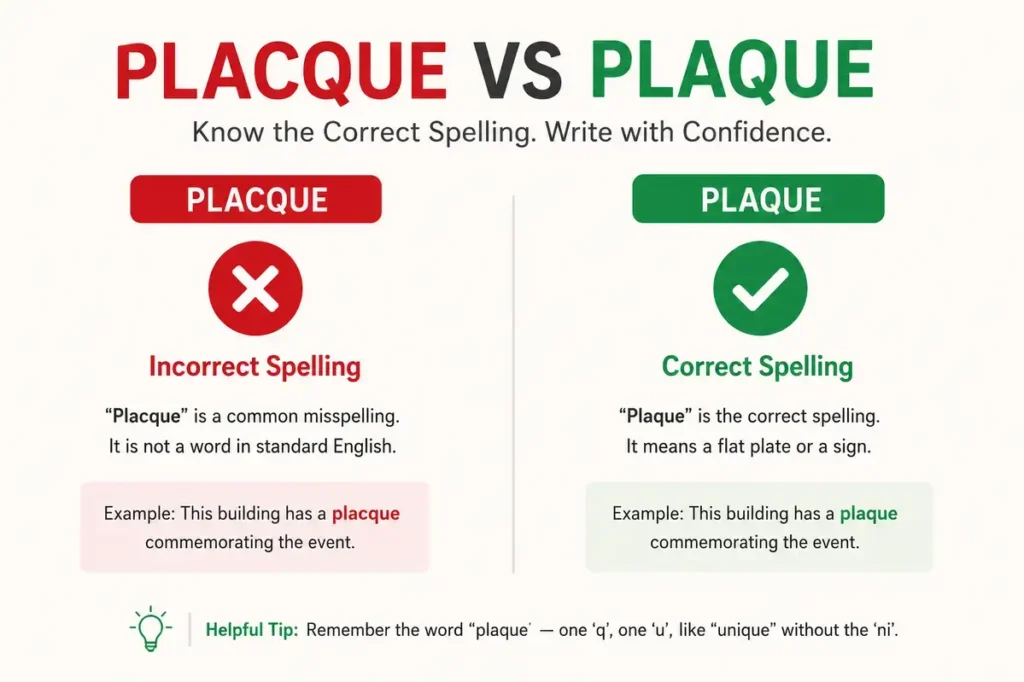
The short answer is simple. Plaque is the correct spelling. Placque is a misspelling and doesn’t appear in modern English dictionaries. The confusion usually comes from the unusual letter pattern in plaque. Since English contains many words borrowed from French, people sometimes add extra letters based on how they think the word should look instead of how it’s actually spelled.
This guide clears up the confusion from every angle. You’ll learn the meaning of plaque, why placque isn’t a real English word, how to pronounce the correct spelling, where the word came from, common grammar rules, real world examples, and practical editing tips that help you avoid this mistake for good. By the end, you’ll know exactly which spelling belongs in your writing and why professional editors never treat the two forms as interchangeable.
A related grammar guide is Encode Vs Incode Which Word Should You Use 2026.
Quick Definition
When comparing placque vs plaque, the correct spelling is plaque. It refers to a flat sign attached to a wall or object, a harmful buildup on teeth, or deposits inside arteries in medical contexts. Placque is simply a spelling mistake and isn’t recognized as an English word.
Quick Answer
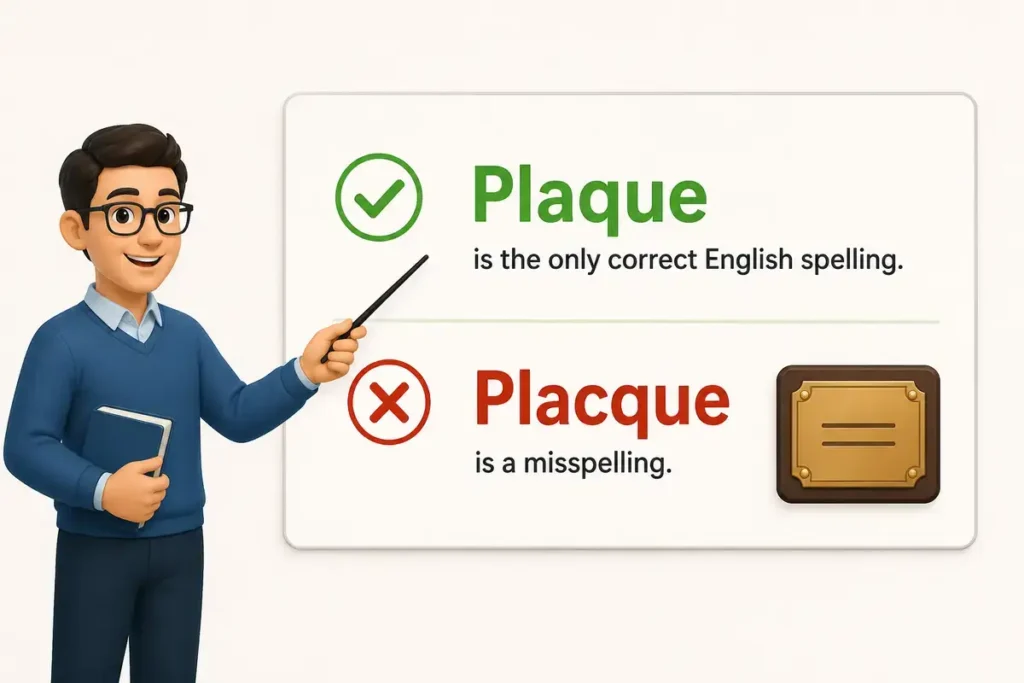
- Plaque is the only correct English spelling.
- Placque is a misspelling.
- Use plaque in medical, dental, historical, architectural, and commemorative writing.
- Native English speakers, publishers, dictionaries, and style guides all recognize only plaque.
- If you write placque, editors and spell checkers will mark it as an error.
Placque vs Plaque Comparison
| Feature | Placque | Plaque |
|---|---|---|
| Correct form | No | Yes |
| Meaning | None in standard English | A flat sign, dental buildup, or arterial deposit |
| Part of speech | Not recognized | Noun |
| Origin | None | Borrowed from French |
| Dictionary status | Misspelling | Standard English word |
| Usage frequency | Extremely rare and almost always an error | Very common |
| Formality | Not accepted | Accepted in all writing styles |
| Common contexts | Typing mistake | Dentistry, medicine, history, architecture, awards |
| Example | Incorrect spelling | The museum installed a bronze plaque beside the entrance. |
Meaning Of Plaque
Plaque is a noun with several related meanings. Although the contexts differ, the central idea stays remarkably consistent. In every case, plaque refers to something flat that sits on or inside another surface. The best known meaning is a flat piece of metal, stone, wood, or another material placed on a wall, building, monument, or object. These plaques usually display names, achievements, dates, or historical information.
Examples include memorial plaques in parks, dedication plaques on public buildings, and award plaques presented during ceremonies. The word also has important medical meanings. Dentists use plaque to describe the sticky layer of bacteria that forms on teeth every day. If it isn’t removed through brushing and flossing, it can lead to cavities and gum disease.
Doctors use the same word to describe fatty deposits that build up inside arteries. These deposits reduce blood flow and may increase the risk of heart disease or stroke. Although these meanings belong to different fields, they all describe a layer or flat deposit attached to another surface.
Meaning Of Placque
Placque has no accepted meaning in modern English. Major dictionaries don’t recognize it as a separate word, and professional editors treat it as a spelling mistake. Most appearances of placque come from typing errors, autocorrect failures, or uncertainty about the unusual spelling of plaque.
Many writers accidentally insert an extra c because English contains words with similar looking letter combinations. Others assume the spelling should match its French appearance more closely. In reality, standard English has used plaque for centuries, and no accepted alternative spelling exists.
If you see placque in an article, email, report, academic paper, or website, it’s almost certainly an error that should be corrected.
Placque vs Plaque Meaning Differences
The biggest difference is surprisingly simple. Plaque has several accepted meanings in English. Placque has none. That means this isn’t a case of two words with different definitions. It isn’t like affect and effect or complement and compliment. Instead, one spelling is correct, while the other is simply incorrect. Professional editors don’t choose between the two based on context. They automatically replace placque with plaque because standard English recognizes only one spelling.
Placque vs Plaque Grammar Differences
The grammar is equally straightforward. Plaque functions as a countable noun. You can use it with articles.
Examples include.
- A plaque was placed outside the library.
- The plaque honored local veterans.
It also has a regular plural form.
- One plaque.
- Two plaques.
- Several bronze plaques decorated the memorial garden.
Since placque isn’t a recognized English word, it has no grammatical role. It has no accepted plural form, verb form, adjective, or grammatical function.
Placque vs Plaque Context Differences
Context often helps readers understand which meaning of plaque is intended. In dentistry, plaque is the sticky layer of bacteria that forms on teeth. In medicine, the same term can describe fatty deposits inside arteries or certain raised skin lesions, depending on the context. It also refers to a commemorative sign mounted on a building or monument in architecture and history. Awards and recognition ceremonies often use plaques as decorative items to honor achievements and contributions. Across every one of these situations, the spelling remains exactly the same. Changing it to placque never changes the meaning. It simply creates a spelling mistake.
Placque vs Plaque Tone Differences
Tone doesn’t affect the spelling. Plaque works in formal writing, academic papers, medical research, professional reports, newspapers, business communication, educational material, and casual conversation.
The same spelling appears everywhere because English has only one accepted form. That’s one reason experienced writers rarely hesitate when using the word. Once you recognize plaque as the standard spelling, every context follows the same rule.
Which One Is Correct
Plaque is the correct spelling in every form of modern English. You’ll find it in dictionaries, school textbooks, medical journals, dental guides, newspapers, government publications, and professional style manuals. It has remained the accepted spelling for generations and continues to be the only standard form today.
Placque isn’t an accepted English word. It appears almost entirely because of typing mistakes or spelling confusion. If your writing includes placque, replace it with plaque before publishing or submitting your work.
Experienced editors often notice this error immediately because it follows a common pattern. Writers sometimes add extra letters to words borrowed from French, assuming the spelling should look more complex than it actually is. In this case, the extra c has never been part of the standard English spelling. A simple habit can prevent this mistake. Remember that plaque contains one c and ends with que. Once that pattern becomes familiar, the incorrect spelling looks out of place almost instantly.
Learn the difference in bosses or bosss Correct Spelling And Usage.
Examples Of Placque In Sentences
The following examples show how people mistakenly use placque. Each sentence contains a spelling error. In every case, plaque is the correct replacement.
- The museum installed a bronze placque near the entrance.
- My dentist said I need to remove placque from my teeth.
- A memorial placque honored the firefighters.
- The doctor explained that placque had formed inside the artery.
- Every classroom displayed a wooden placque with the teacher’s name.
- She received a beautiful placque after winning the competition.
- The historical placque described the building’s past.
- The guide stopped beside the placque to tell its story.
- Daily brushing helps remove placque before it hardens.
- The city unveiled a new placque during the ceremony.
Each sentence above contains the same spelling mistake. Replace placque with plaque to make the sentence correct.
Examples Of Plaque In Sentences
These examples use the correct spelling in different situations.
- The school installed a bronze plaque outside the main entrance.
- The dentist removed plaque during my cleaning appointment.
- A marble plaque marks the birthplace of the famous author.
- The doctor found plaque inside one of the patient’s arteries.
- Every winner receives a personalized plaque.
- The memorial plaque includes the names of local heroes.
- Good brushing habits reduce plaque on your teeth.
- Visitors gathered around the historical plaque to read its inscription.
- The award plaque hangs proudly in her office.
- Workers carefully cleaned the plaque before the ceremony.
These examples show how one spelling works across historical, medical, dental, educational, and professional writing.
Common Mistakes
Editors see this spelling mistake more often than people expect. It usually comes from memory rather than a lack of knowledge.
Adding An Extra Letter
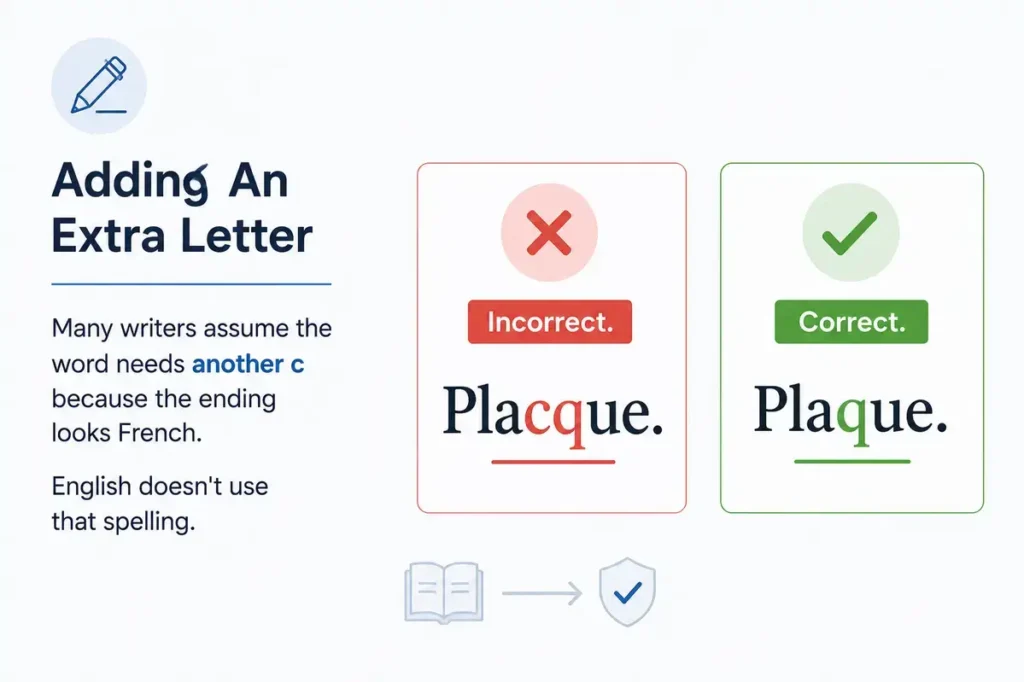
Many writers assume the word needs another c because the ending looks French. English doesn’t use that spelling.
Incorrect.
Placque.
Correct.
Plaque.
Confusing The Pronunciation
Some people think the spelling should match the sound more closely. English doesn’t always work that way. The silent letters stay even though they aren’t pronounced.
Mixing Medical And Historical Meanings
Another common misunderstanding involves the meaning instead of the spelling. Some writers think dental plaque and memorial plaque are different words. They aren’t. The spelling stays the same even though the meanings change with the context.
Trusting Typing Instead Of Proofreading
Fast typing creates many spelling mistakes. Since placque looks believable, writers sometimes overlook it during proofreading. Professional editors don’t rely only on spell checkers. They also read carefully because unusual spelling errors can slip through unnoticed.
Pronunciation Guide
Knowing the pronunciation often makes the spelling easier to remember.
IPA Pronunciation
American English.
/plæk/
British English.
/plɑːk/
Syllable Breakdown
Plaque has one syllable.
Plaque.
Although the spelling ends with que, the word is pronounced exactly like plack.
Common Pronunciation Mistakes
Some learners try to pronounce the final letters separately. Others add an extra syllable because of the unusual spelling. Neither pronunciation is correct. Think of plaque as sounding exactly like plack. The final letters remain silent.
Etymology And Word Origin
The history of plaque explains why its spelling seems unusual. The word entered English from French during the nineteenth century. The French word plaque referred to a flat plate, sheet, or slab. French itself inherited the idea from Dutch, where related words described flat surfaces and plates.
English kept the original spelling almost unchanged. That’s why the ending looks different from many native English words. Over time, English expanded the meaning. Originally, the word mainly described flat plates or signs.
Later, medicine adopted it for flat deposits inside the body. Dentistry then applied it to bacterial buildup on teeth because the thin layer resembled a flat coating. Although the meanings expanded, the spelling remained unchanged.
Regional Usage
English speaking countries all use the same spelling.
That consistency makes this word easier than many other spelling questions.
American English
American English uses plaque in every context.
You’ll see it in schools, hospitals, dental offices, newspapers, museums, and government publications.
British English
British English also recognizes only plaque.
No accepted British alternative exists.
Australian English
Australian English follows the same spelling.
Medical organizations, schools, publishers, and news outlets all use plaque.
Canadian English
Canadian English keeps the same spelling as well.
This is one of those English words that remains consistent across major regional varieties.
If your audience lives in the United States, Canada, Australia, or the United Kingdom, the correct spelling never changes.
Grammar Rules
Understanding the grammar helps you use the word naturally.
Part Of Speech
Plaque is a noun.
It names a person, place, thing, or idea.
Examples.
- The plaque was polished.
- The plaque looked brand new.
Singular And Plural Forms
The singular form is plaque.
The plural form is plaques.
Examples.
- The building has one plaque.
- The museum displays several plaques.
The plural follows the regular English pattern by adding s.
Articles
Plaque commonly appears with articles.
Examples.
- A plaque.
- The plaque.
Adjectives Before Plaque
Many descriptive adjectives naturally modify the noun.
Examples include.
- Bronze plaque.
- Marble plaque.
- Historical plaque.
- Memorial plaque.
- Dental plaque.
- Decorative plaque.
- Wooden plaque.
- Engraved plaque.
Common Sentence Structures
Plaque fits naturally into many sentence patterns.
- Subject.
The plaque hangs above the doorway.
- Object.
She admired the plaque.
- Object Of A Preposition.
Visitors stopped beside the plaque.
Its grammar stays simple because it functions like most common English nouns.
Real Life Usage Examples
Professional editors pay close attention to context because the same word appears across many industries.
Daily Conversation
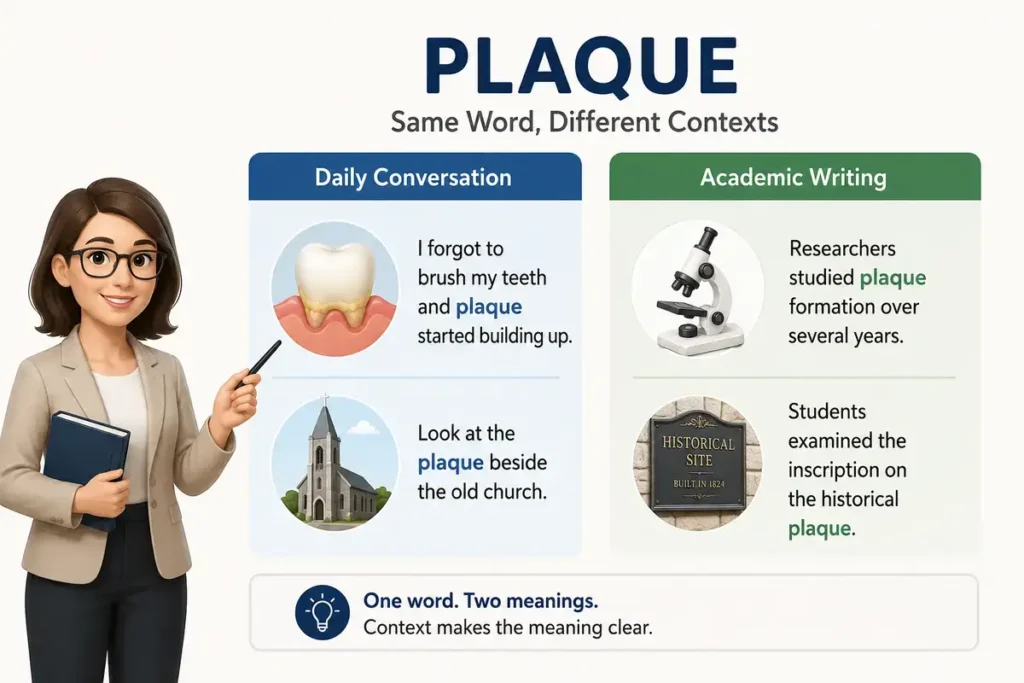
I forgot to brush my teeth and plaque started building up.
Look at the plaque beside the old church.
Academic Writing
Researchers studied plaque formation over several years.
Students examined the inscription on the historical plaque.
Professional Communication
Please verify the wording before ordering the award plaque.
The contractor installed the memorial plaque this morning.
Literature
The weathered plaque carried memories of another generation.
Its faded letters still welcomed every visitor.
Media
News reports often mention plaque during stories about dental health. Historical documentaries regularly show plaques placed on famous buildings. These examples show how naturally the word moves between everyday conversation and professional writing without changing its spelling.
Related Words And Confused Terms
Many spelling mistakes happen because English contains words that look or sound alike. Learning the related terms makes it much easier to remember the correct spelling.
Related Words
- Plate.
- Tablet.
- Sign.
- Marker.
- Memorial.
- Inscription.
- Engraving.
- Award.
- Recognition.
- Monument.
Dental Terms
- Tartar.
- Calculus.
- Cavities.
- Enamel.
- Gingivitis.
- Flossing.
- Tooth decay.
- Oral hygiene.
Medical Terms
- Artery.
- Cholesterol.
- Blood vessel.
- Atherosclerosis.
- Cardiovascular disease.
- Fatty deposits.
- Circulation.
- Inflammation.
Commonly Confused Spelling Pairs
- Principal and Principle.
- Affect and Effect.
- Stationary and Stationery.
- Complement and Compliment.
- Discreet and Discrete.
- Advice and Advise.
- Lose and Loose.
- Then and Than.
A careful proofread catches most of these mistakes before they reach your readers.
Expert Language Insight
After editing thousands of articles, reports, academic papers, and website pages, one pattern appears again and again. Most spelling mistakes don’t happen because people don’t know the correct word. They happen because the eye expects a familiar pattern instead of the actual spelling. Plaque is a perfect example.
Its ending looks unusual, so many writers instinctively add another c. The mistake feels logical, but English has never accepted that spelling. Native speakers almost never stop to think about the word because they’ve seen it countless times in books, newspapers, dental offices, museums, and medical articles. Familiarity builds confidence.
Professional editors rely on trusted dictionaries instead of guessing. If a word isn’t recognized in standard references, they correct it before publication. One simple habit makes a big difference. Read unfamiliar words slowly during proofreading. Your brain often catches mistakes that your fingers created while typing quickly.
For another common grammar confusion, see Fare Better Or Fair Better Correct Usage Guide.
Conclusion
The answer is clear.
Plaque is the only correct spelling in modern English. It appears in dictionaries, textbooks, newspapers, medical journals, dental literature, historical writing, and professional communication around the world. Placque has no accepted meaning and isn’t recognized as a standard English word. It survives only as a common typing or spelling mistake.
The easiest way to remember the correct form is to connect it with the places where you see it every day. Dentists remove plaque from teeth. Museums display historical plaques. Communities install memorial plaques to honor important people and events. Once you’ve seen that pattern a few times, the incorrect spelling starts to look unfamiliar.
Good writing depends on accuracy as much as clarity. Using the correct spelling strengthens your credibility and helps readers focus on your message instead of your mistakes.
Frequently Asked Questions
Is placque a real English word?
No. Standard English dictionaries don’t recognize placque as a word. It is considered a spelling mistake. The correct spelling is plaque, which has several accepted meanings in medical, dental, historical, and everyday writing.
Why do people spell plaque as placque?
The mistake usually comes from the unusual letter pattern. Many people assume another c belongs in the word because it looks similar to other words influenced by French spelling. The accepted English spelling has always been plaque.
How do you pronounce plaque?
Plaque is pronounced as one syllable.
American English IPA is /plæk/.
British English IPA is /plɑːk/.
In everyday speech, it sounds like plack.
Can plaque refer to more than one thing?
Yes. The same word describes a commemorative sign, bacterial buildup on teeth, and fatty deposits inside arteries. The meaning changes with the context, but the spelling stays exactly the same.
Is plaque used differently in American and British English?
No. American English, British English, Canadian English, and Australian English all use the same spelling. There are no regional spelling differences for this word.
What is the plural form of plaque?
The singular form is plaque.
The plural form is plaques.
It follows the regular English rule by adding s to the end of the noun.
Is plaque a noun or a verb?
Plaque is a noun. It names an object or a substance. English doesn’t use it as a standard verb in ordinary writing.
How can I remember the correct spelling?
Think of the ending que as one complete letter pattern. Avoid adding another c. Reading books, articles, and signs regularly helps the correct spelling become familiar until it looks natural.