
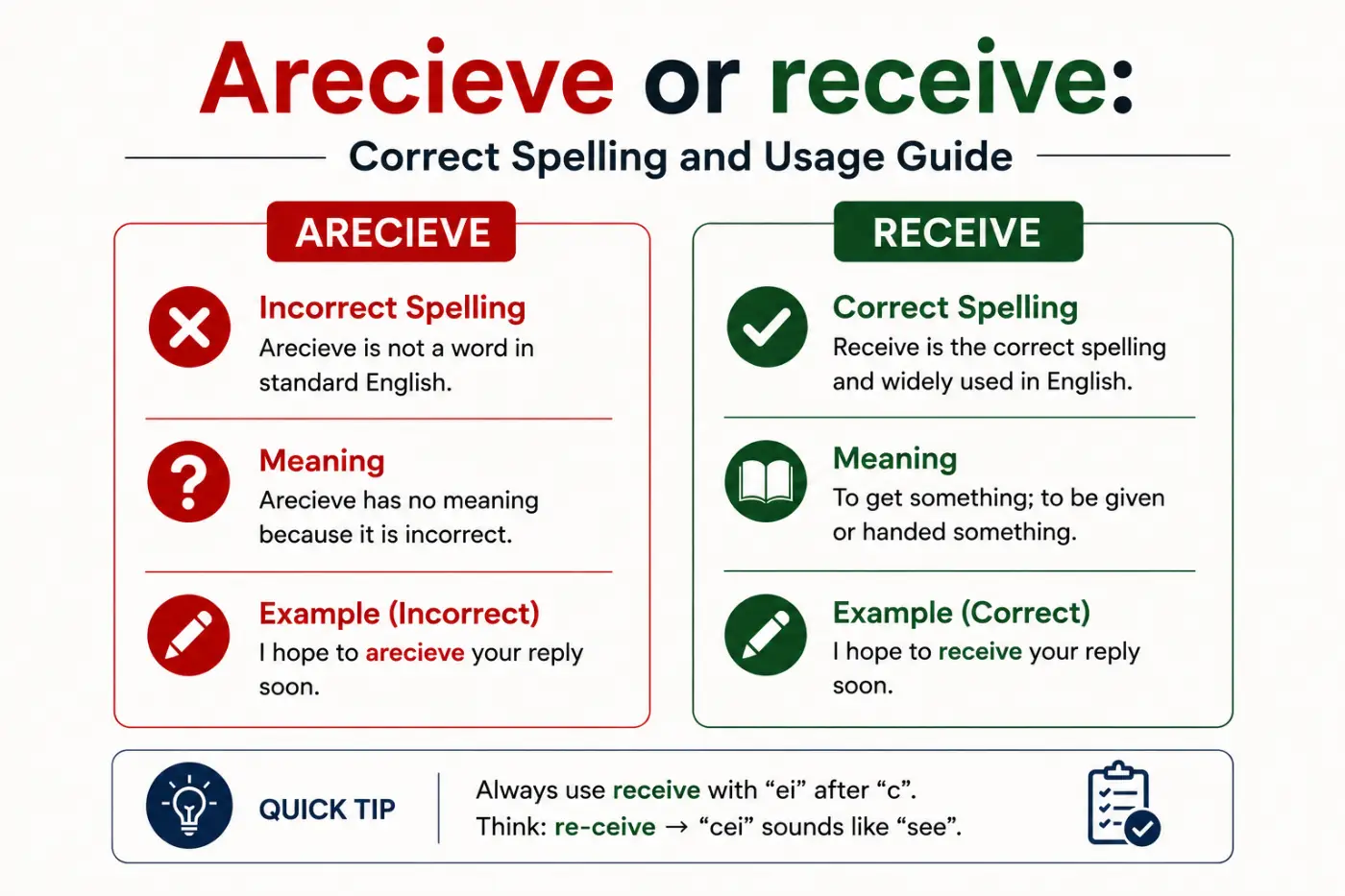
If you’ve ever typed recieve and paused because something looked slightly off, you’re not alone. Recieve or receive causes confusion because both forms look believable when you type them quickly. The correct spelling is receive. The spelling recieve is incorrect in standard English.
The reason comes from a familiar English spelling pattern. After the letter c, the word uses ei rather than ie. That gives us r e c e i v e. A simple way to remember it is the familiar rule that says i comes before e except after c. This rule has exceptions in English, but receive follows the pattern.
In this guide, you’ll learn why receive is correct, why recieve is wrong, how to pronounce the word, how to use it naturally, and how to avoid making the same mistake again. You’ll also see examples from everyday conversation, professional writing, academic work, news writing, and literature. By the end, the spelling should feel much easier to remember.
A related grammar guide is Passtime or Pastime Which Is Correct? 2026.
Quick Definition
Receive is the correct spelling of the English verb meaning to get, accept, be given something, or take something that is offered. Recieve is a common spelling mistake. The error happens because English has several words with ie and ei patterns that sound similar but follow different spelling conventions.
Quick Answer
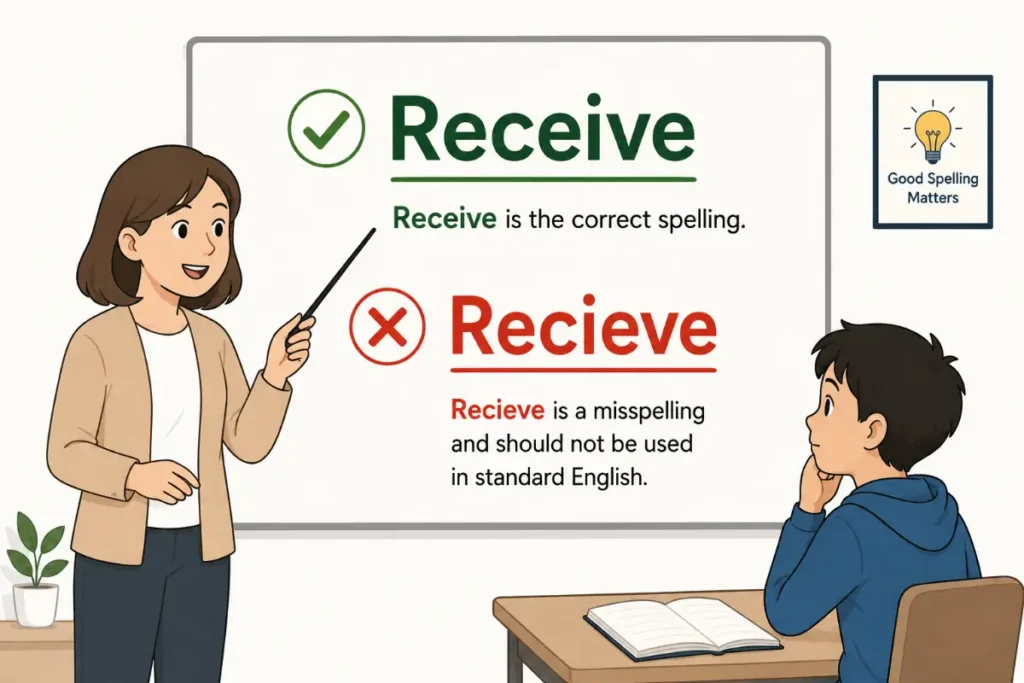
Receive is the correct spelling. Recieve is a misspelling and should not be used in standard English. You can use receive when you mean to get or accept something. For example, you might receive an email, receive a package, receive payment, or receive an invitation.
Comparison Table: recieve or receive
| Correct Form | Meaning | Part of Speech | Origin | Usage Frequency | Formality | Common Contexts | Example |
|---|---|---|---|---|---|---|---|
| Receive | To get or accept something | Verb | Latin through Old French and Middle English | Very common | Standard | Emails, packages, payments, messages, awards | I received your message this morning. |
| Recieve | No standard English meaning | Misspelling | Incorrect spelling of receive | Common as an error | Nonstandard | Typing errors, spelling mistakes, drafts | Please change recieve to receive. |
Meaning and Definition
Meaning of recieve
Recieve does not function as a standard English word. It is simply a common misspelling of receive. You may see it in informal messages, social media posts, school assignments, online comments, handwritten notes, or drafts. Spell checkers often flag it because standard English dictionaries do not recognize recieve as the accepted spelling of the verb.
The mistake is understandable. English spelling contains many competing patterns. Words such as believe, field, friend, and piece use ie. Words such as receive, ceiling, deceive, and perceive use ei after c. When you remember only part of the pattern, it’s easy to put the vowels in the wrong order.
If you type recieve, your reader will usually understand what you mean. Still, the spelling is incorrect. In professional, academic, business, and published writing, change it to receive.
Meaning of receive
Receive is a verb that generally means to get, accept, or be given something.
You can receive something physical.
I received the package yesterday.
You can receive information.
She received the news by email.
You can receive money.
The company received payment on Friday.
You can also receive something less tangible such as praise, criticism, support, attention, permission, or an award.
He received a lot of praise for his work.
The word can also describe the act of welcoming or accepting someone.
The host received the guests at the door.
In communication, receive can describe taking in a message or signal.
The radio received a weak signal.
So the basic idea is simple. Something comes to you and you get it or accept it.
The word has a long history. English received it through French from Latin roots associated with taking or accepting something. Over centuries, its spelling and pronunciation developed into the modern English form receive.
Key Differences Explained
- Spelling. Receive uses ei after c. Recieve reverses those two vowels and is incorrect.
- Grammar role. Receive is a verb. Recieve has no accepted grammatical role in standard English because it is a misspelling.
- Meaning. Receive has several related meanings connected to getting, accepting, or taking something. Recieve has no separate meaning.
- Tone. Receive works in casual conversation as well as formal writing. Recieve can make writing look careless because readers recognize it as a spelling error.
- Context. You can use receive when talking about messages, packages, money, information, awards, visitors, signals, or many other things.
Which Spelling Is Correct?
The correct form is receive.
The spelling follows the common English pattern in which ei appears after c. You can see the same pattern in words such as deceive, perceive, ceiling, and receipt.
Major English dictionaries list receive as the standard verb. They define it with meanings related to getting, accepting, or being given something.
A useful memory aid is the traditional spelling rule about i and e. The familiar version says i comes before e except after c. Receive follows the after c part of that pattern.
Still, don’t treat this as an absolute law. English spelling has plenty of exceptions. A better approach is to use the rule as a memory aid and reinforce it with familiar word families.
For example, if you know receipt, deceive, and perceive, you can connect their spelling patterns with receive.
There’s another useful trick. Think of the middle of the word as cei.
Receive.
Deceive.
Perceive.
Receipt.
That small visual pattern can help your brain recognize the correct order without having to reconstruct the spelling every time.
Sentence Examples
Here are natural examples showing how receive works in everyday English.
- I hope you receive my message before the meeting.
- Did you receive the package I sent last week?
- She received an invitation to the conference.
- We received your application yesterday.
- The team received a warm welcome from the crowd.
- You’ll receive a confirmation email after you register.
- He received excellent feedback from his manager.
- The school received several donations from local families.
- They received the award during a ceremony on Friday.
- I was happy to receive your letter.
Now compare those correct examples with the common misspelling.
- Incorrect: I hope you recieve my message soon.
- Incorrect: Did you recieve the package?
- Incorrect: She will recieve an invitation.
- Incorrect: We recieved your application yesterday.
- Incorrect: You should recieve a confirmation email.
The problem in each example is the same. The vowels are reversed. The correct spelling uses receive and received.
Notice something useful here. The spelling pattern stays consistent when the verb changes form.
Receive becomes received.
Receive becomes receiver.
The spelling can change slightly when grammar changes the word ending, but the core sequence remains recognizable.
Common Mistakes and Misspellings
English learners and native speakers alike can make spelling errors with receive. The mistake often comes from memory rather than pronunciation.
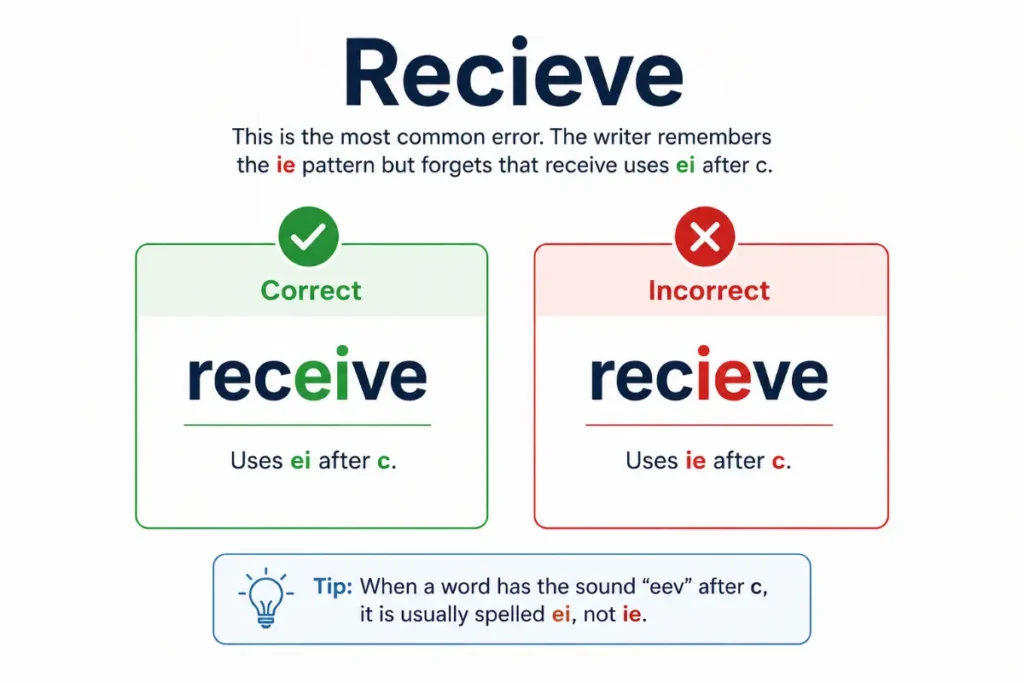
- Recieve. This is the most common error. The writer remembers the ie pattern but forgets that receive uses ei after c.
- Recieved. This adds a past tense ending to the incorrect spelling. The correct form is received.
- Recieving. This combines the wrong vowel order with the ing ending. The correct form is receiving.
- Receve. This version drops the second i. It can happen when someone writes quickly or relies too heavily on sound.
- Receeve. This version tries to represent the long vowel sound directly. English spelling doesn’t work that way in this word.
From an NLP perspective, spelling errors often involve orthographic confusion. That means the writer knows the word and its meaning but retrieves the letters in the wrong sequence.
This distinction matters. Someone who types recieve usually understands the word perfectly. The problem lies in spelling retrieval.
The word also creates a useful example of pattern based language processing. Your brain stores familiar letter sequences and word shapes. If you’ve seen many words ending in ie, your brain may produce that pattern automatically.
That’s why simply knowing the correct spelling once may not stop the mistake. Repeated exposure helps build a stronger visual memory.
Pronunciation Guide
Receive is pronounced /rɪˈsiːv/.
You can think of the pronunciation as two main parts.
rih SEEV
The first syllable is weak and short. The second syllable carries the main stress.
The word sounds similar to other English words ending in the long ee sound.
Receive.
Believe.
Achieve.
Relieve.
The pronunciation itself doesn’t clearly tell you to write ei. That’s one reason spelling can cause trouble. English pronunciation often gives you less information than you’d like about the letters inside a word.
The final sound is the voiced v sound. The word ends with a clear v rather than an f sound.
A useful pronunciation habit is to say the word slowly while remembering the written form.
Rih.
Seev.
Receive.
Then look at the spelling.
R E C E I V E.
This connects the sound with the visual pattern.
Etymology and Word Origin
Receive has deep roots in Latin.
The modern English word developed through Old French and Middle English from Latin roots associated with taking or accepting something.
The Latin verb recipere carried meanings connected with taking back, taking in, accepting, or receiving. English later adopted the word through French influence.
Over time, pronunciation and spelling changed as the word moved through different stages of English. Modern receive keeps a spelling pattern that reflects its historical development and its connection to related words.
This history explains why the spelling may not feel completely intuitive to a modern English speaker. English vocabulary has absorbed words from many languages. Their spelling often preserves traces of those earlier forms.
The same historical story appears across many common English words. Spelling is not always a direct picture of pronunciation. Sometimes it reflects older forms that have remained visible long after pronunciation changed.
That’s why memorizing receive as a complete word can be more effective than trying to spell it entirely from sound.
Regional Usage in the US
American English uses receive as the standard spelling.
You’ll see it in school writing, business communication, newspapers, websites, legal documents, emails, and everyday messages.
American dictionaries do not treat recieve as an alternative spelling. It remains a spelling error.
The meaning also stays consistent across ordinary American usage. You can receive a package, receive a call, receive payment, receive information, or receive an award.
There is no standard American variant that changes the spelling to recieve.
A related grammar guide is Different or Diffrent Which Spelling Is Correct 2026.
Regional Usage in the UK
British English also uses receive as the standard spelling.
The word appears frequently in British writing and has the same basic meanings found in American English.
British spelling has several well known differences from American spelling. For example, British English often uses colour while American English uses color. Those differences sometimes make writers wonder if receive and recieve might represent regional alternatives.
They don’t.
Receive is standard in both varieties. Recieve is a spelling error in British English as well.
Regional Usage in Australia
Australian English follows the standard spelling receive.
Australian writing uses many British influenced spelling conventions, but those conventions do not change this word.
Students, professionals, editors, and publishers should use receive.
If you see recieve in Australian writing, it’s normally a simple spelling mistake rather than an Australian variant.
Regional Usage in Canada
Canadian English also uses receive.
Canadian spelling combines influences from British and American English in different areas, but receive remains consistent.
You can therefore use receive confidently in Canadian academic writing, business writing, journalism, and everyday communication.
The important point across all four varieties is consistency. There is no standard regional English where recieve becomes the accepted spelling.
Grammar Rules and Part of Speech
Receive is a verb.
A verb describes an action, state, or occurrence. In this case, receive describes the act of getting, accepting, or being given something.
The basic structure is often:
Subject + receive + object.
For example:
She received the letter.
The company received payment.
They received new information.
You can also use receive in the passive voice.
The package was received yesterday.
The application was received by the office.
The word can appear in several verb forms.
Present: receive.
Third person present: receives.
Past: received.
Past participle: received.
Present participle: receiving.
Examples make the pattern easier to see.
I receive emails every morning.
She receives dozens of messages each day.
We received your request yesterday.
They have received the documents.
He is receiving treatment at the clinic.
Punctuation does not change because of the word itself. You simply punctuate the complete sentence according to its structure.
Receive can also appear at different positions in a sentence.
I finally received the package.
After several weeks, we received a response.
The customer received the refund yesterday.
When finally modifies receive, it often shows that something happened after a delay or period of waiting.
Real Life Usage Examples
Daily Talk
People use receive in ordinary conversation all the time.
- Did you receive my text?
- I received the package this morning.
The word sounds perfectly natural in these situations. You don’t need a formal setting to use it.
Receive appears constantly in professional and personal email.
- We received your request and will respond soon.
- Please let me know if you receive the attached document.
These sentences are clear and professional without sounding stiff.
Academic Writing
Academic writing often uses receive when discussing research, responses, data, or information.
- The researchers received responses from more than five hundred participants.
- Students who received additional instruction showed stronger results.
The verb works naturally in formal academic prose because it states a clear action.
News Writing
News writers frequently use receive when reporting awards, funding, information, or official decisions.
- The organization received additional funding from the government.
- The athlete received medical attention after the incident.
The word is useful because it communicates the event directly.
Literature
Writers also use receive in narrative and descriptive passages.
- She received the news in silence.
- He received the stranger with unexpected kindness.
Literary writing can give the verb emotional meaning. The act of receiving may involve more than physically getting something. It can describe acceptance, welcome, or reaction.
Expert Editor Insight
As a senior editor, I’d treat recieve as a straightforward spelling error rather than a vocabulary problem. Native speakers recognize the intended word immediately, but the error can still weaken polished writing. Spell checkers and grammar tools commonly flag it because receive is the established dictionary form. My practical advice is simple: don’t rely only on pronunciation. Memorize the visual sequence cei after the c. Once that pattern becomes familiar, the correct spelling starts to feel automatic.
A Simple Way to Remember the Spelling
If you regularly confuse the two forms, don’t try to memorize a complicated rule. Use one small visual pattern.
Think of:
cei
That sequence appears in receive.
Re + cei + ve.
You can also connect receive with a few familiar words.
Deceive.
Perceive.
Receipt.
These words reinforce the same vowel order after c.
Another useful technique is to connect the spelling with a phrase you already know.
I receive what I believe.
The two words share the ie and ei pattern in a way that can make the spelling easier to recall.
You can also write receive several times when learning it. That may sound old fashioned, but repeated correct exposure works. Your brain becomes familiar with the word shape.
The goal isn’t to stop and recite a spelling rule every time you write. The goal is to make the correct form feel familiar enough that you choose it automatically.
Why The Error Looks So Natural
There’s a reason this mistake survives despite being easy to correct.
English readers encounter many words that contain ie.
Believe.
Relief.
Chief.
Piece.
Field.
Because these words are common, the letter sequence can become a strong mental pattern.
Then you encounter receive.
The sound doesn’t strongly distinguish the spelling. Your brain reaches for a familiar pattern and may produce recieve.
This is a classic example of orthographic interference. A familiar spelling pattern influences the spelling of another word.
The mistake becomes even easier to make when typing quickly. You may know the correct spelling perfectly well but still produce the letters in the wrong order.
That’s why proofreading matters. A quick second look can catch errors that knowledge alone doesn’t prevent.
Receive In Different Contexts
The flexibility of receive explains why the word appears so often.
You can receive a physical object.
I received the books yesterday.
You can receive communication.
She received a phone call from the office.
You can receive money.
The business received payment.
You can receive information.
We received new instructions.
You can receive an experience or response.
The proposal received strong support.
You can receive a person.
The host received the visitors warmly.
You can receive a signal.
The device received a weak transmission.
In each case, the central concept stays connected to getting, accepting, taking in, or welcoming something.
Final Practical Tip
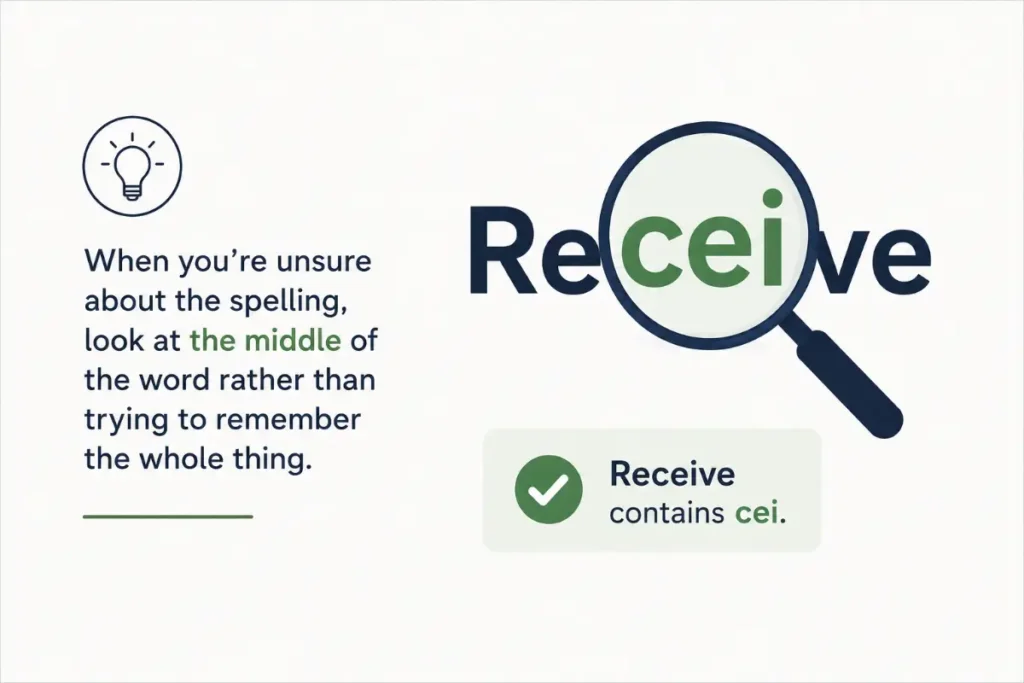
When you’re unsure about the spelling, look at the middle of the word rather than trying to remember the whole thing.
Receive contains cei.
That three letter sequence is the part most likely to cause trouble.
If you remember c followed by ei, you’ll avoid the common mistake.
Also remember that the same core spelling appears in related forms.
Receive.
Received.
Receiver.
Receiving.
The spelling changes slightly when endings are added, but the original pattern remains easy to recognize.
Need another quick comparison? Read Faves or Favs Which Spelling Is Correct 2026.
Conclusion
Recieve or receive has a simple answer: receive is the correct spelling. Recieve is a common misspelling that reverses the i and e after c. The correct form works in everyday conversation, professional emails, academic writing, journalism, and formal documents. It means to get, accept, or be given something.
The confusion comes from English spelling patterns. Many familiar words use ie, while receive follows the ei pattern after c. Pronunciation doesn’t make the vowel order obvious, so visual memory helps. Words such as deceive, perceive, and receipt can reinforce the same pattern.
If you often make this mistake, remember the small sequence cei. Write receive with that pattern in mind. Once you recognize the word shape, the correct spelling becomes much easier to recall.
Frequently Asked Questions
Is recieve accepted in standard English?
No. Recieve is not the standard spelling of an English word. It is a common misspelling of receive. The correct form appears in dictionaries and standard written English. You may encounter the incorrect form in casual online writing or drafts, but it should be corrected in schoolwork, professional communication, published content, and formal documents.
What is the basic meaning of receive?
Receive is a verb that usually means to get, accept, or be given something. You can receive a package, message, payment, invitation, award, or piece of information. The word can also describe welcoming someone or taking in a signal. The exact meaning depends on the context, but the central idea involves something coming to you.
Which spelling should you use?
Receive is correct. Recieve is incorrect. The correct spelling uses ei after c. This pattern appears in several related English words such as deceive, perceive, and receipt. If you’re writing an email, assignment, article, report, or message, use receive. The spelling is the same in American English, British English, Australian English, and Canadian English.
How should you say receive?
Receive is pronounced /rɪˈsiːv/. A simple way to approximate it in everyday English is rih SEEV. The second syllable receives the main stress. The pronunciation doesn’t clearly reveal the vowel order, so it helps to connect the sound with the written form. Remember the visual pattern cei after c to reinforce the spelling.
Can you begin a sentence with receive?
Yes. Receive can begin a sentence when the sentence structure calls for it. For example, Receive your confirmation email before closing the page. It can also appear in instructions such as Receive the package at the front desk. Starting with the verb is perfectly grammatical when you’re using an imperative structure or another appropriate construction.
What words can replace receive?
Possible synonyms include get, obtain, accept, collect, gain, acquire, and take. The best choice depends on context. Get is common and conversational. Obtain sounds more formal. Accept emphasizes willingness to take something. Acquire often suggests gaining something over time. None of these words replaces receive perfectly in every sentence, so context matters.
Why does the spelling cause confusion?
People often misspell receive because English contains many competing ie and ei patterns. Words such as believe and piece use ie, while receive and deceive use ei after c. Pronunciation also doesn’t provide enough information to determine the spelling. When someone remembers the general ie pattern but forgets the after c rule, recieve becomes an easy mistake.
Can you use receive in professional writing?
Yes. Receive is completely appropriate in formal writing. It works naturally in academic papers, business emails, reports, applications, official notices, journalism, and professional correspondence. In fact, it’s one of the most common verbs in formal communication. Just make sure you use the correct spelling. The form recieve should be corrected before you submit or publish your work.