
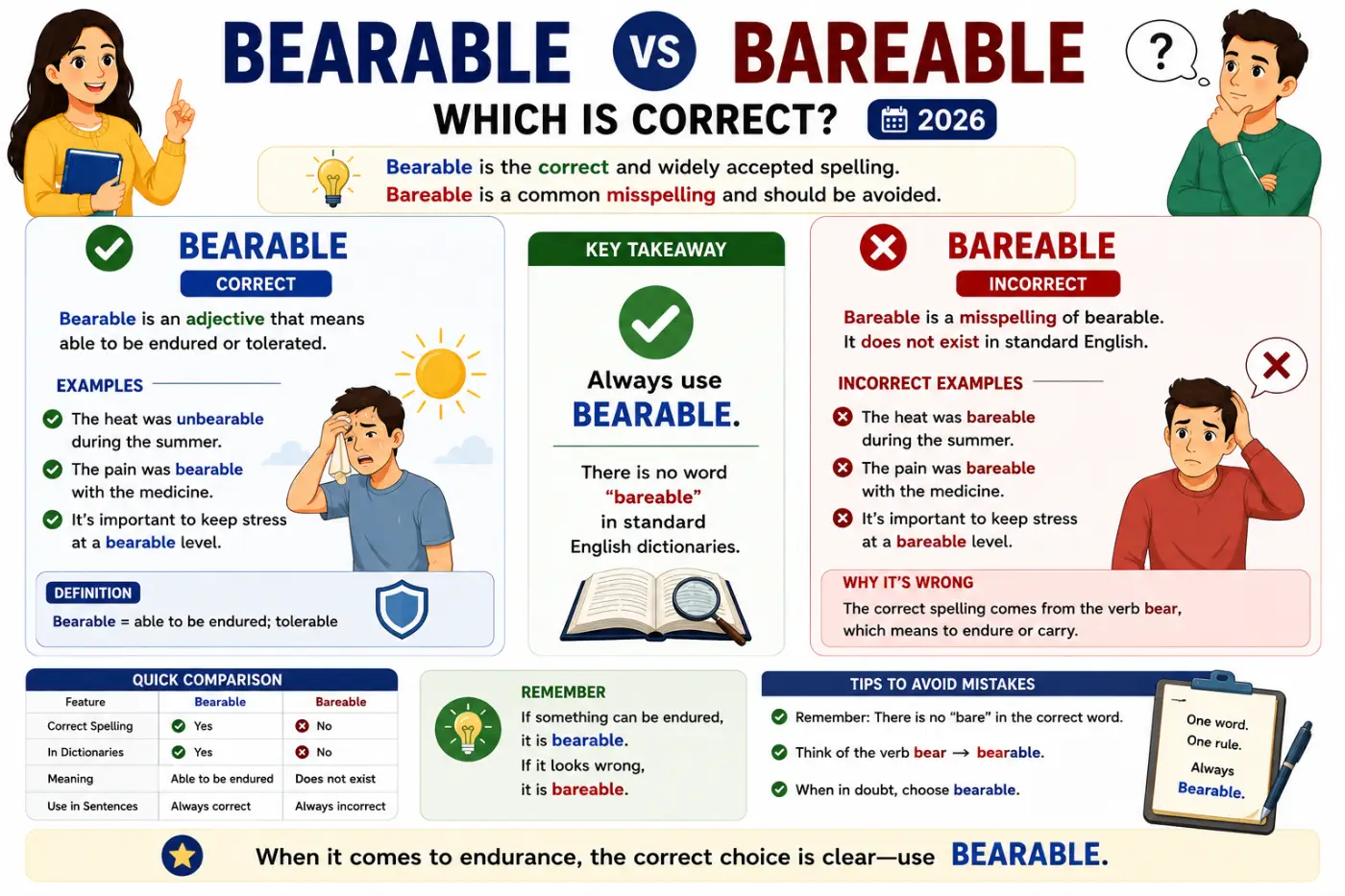
If you’ve ever typed bearable vs bareable and wondered which spelling is correct, you’re not alone. Many English learners, students, writers, and even native speakers pause when they reach this word. The confusion comes from the fact that bear and bare are both real English words with very different meanings, yet they sound exactly alike. That makes them perfect examples of commonly confused homophones.
The short answer is simple. Bearable is the correct spelling when you mean something that can be tolerated, endured, or accepted. Bareable is almost always a misspelling and is not recognized as a standard English word.
In this guide, you’ll learn the meaning of both forms, why people confuse them, how to remember the correct spelling, pronunciation, grammar rules, real-world examples, regional usage, word origins, and practical editing advice. By the end, you’ll know exactly when to use bearable and why bareable should almost always be avoided.
Still confused? Compare bosses or bosss Correct Spelling And Usage.
Quick Definition
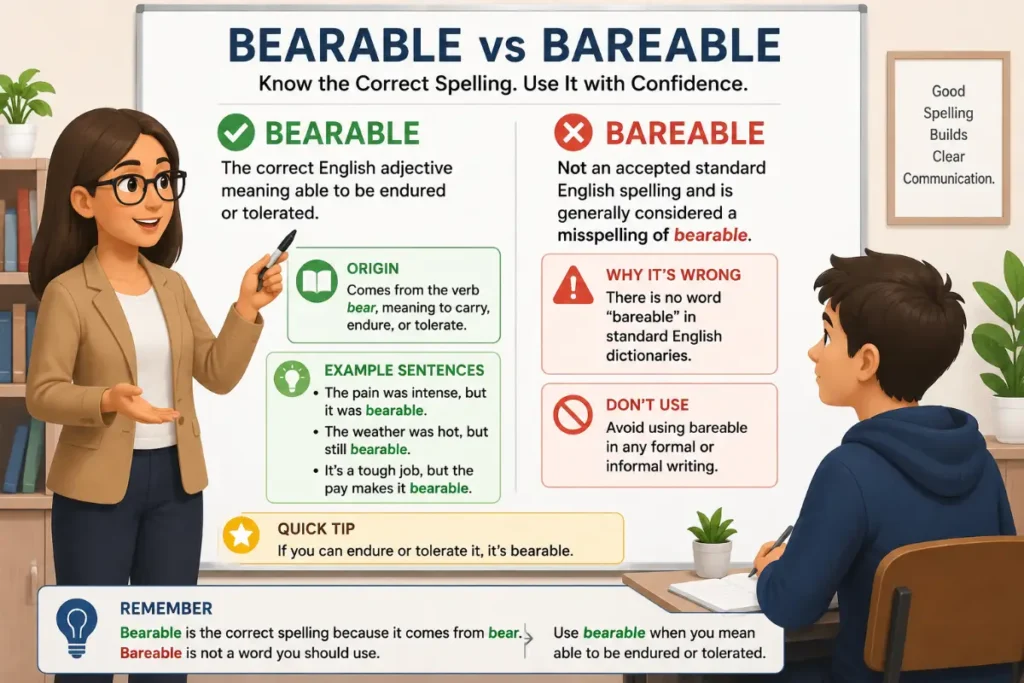
Bearable is the correct English adjective meaning able to be endured or tolerated. It comes from the verb bear, meaning to carry, endure, or tolerate. Bareable is not an accepted standard English spelling and is generally considered a misspelling of bearable.
Quick Answer
If you’re choosing between bearable vs bareable, always choose bearable when describing something that can be endured.
Examples:
- The heat became bearable after sunset.
- Her headache was unpleasant but still bearable.
- The long wait became more bearable with good company.
Avoid writing bareable, because dictionaries and style guides do not recognize it as a standard English word.
Bearable vs Bareable Comparison Table
| Feature | Bearable | Bareable |
|---|---|---|
| Correct spelling | Yes | No in standard English |
| Meaning | Able to be endured or tolerated | Generally considered a misspelling |
| Part of speech | Adjective | Not a standard adjective |
| Root word | Bear | Bare |
| Origin | Old English beran meaning to carry or endure | No established etymology as a standard word |
| Dictionary status | Recognized by major dictionaries | Not recognized by major dictionaries |
| Formal writing | Correct | Incorrect |
| Everyday writing | Common | Should be avoided |
| Academic writing | Accepted | Considered an error |
| Professional communication | Recommended | Not recommended |
| Example | The weather became bearable. | Incorrect: The weather became bareable. |
Meaning of Bearable vs Bareable
What Does Bearable Mean?
Bearable is an adjective that describes something difficult, uncomfortable, painful, or unpleasant that can still be endured. It usually suggests that something is not enjoyable but remains within a person’s ability to tolerate.
Examples include:
- Bearable pain.
- Bearable weather.
- Bearable workload.
- Bearable noise.
- Bearable inconvenience.
The word often appears with situations involving discomfort, stress, emotions, temperature, illness, waiting, or hardship.
Examples:
- The traffic was bearable because we left early.
- His criticism was harsh but bearable.
- The apartment became bearable once the air conditioner was fixed.
What Does Bareable Mean?
Unlike bearable, bareable is not considered a standard English word. People usually create this spelling because they mistakenly connect it with bare, meaning uncovered or exposed.
Examples of bare:
- Bare feet.
- Bare walls.
- Bare branches.
- Bare hands.
- Bare minimum.
Although bare is a perfectly correct English word, adding -able does not create the accepted adjective for “able to be endured.” English already has the established form bearable.
Bearable vs Bareable Key Differences
Although these words look similar, they differ in every important way.
| Category | Bearable | Bareable |
|---|---|---|
| Standard English | Yes | No |
| Dictionary entry | Yes | No |
| Meaning | Can be tolerated | No accepted meaning |
| Professional writing | Appropriate | Incorrect |
| Academic writing | Correct | Error |
| Editing recommendation | Use confidently | Replace with bearable |
The confusion exists because:
- Bear and bare sound identical.
- Both are real English words.
- English contains many similar homophones.
- Spellcheck may not always explain why the spelling is wrong.
- Writers often rely on pronunciation instead of word origin.
Bearable vs Bareable Which One Is Correct?
The correct word is bearable. The adjective comes directly from the verb bear, which has several meanings in English.
These include:
- To carry.
- To support.
- To endure.
- To tolerate.
- To withstand.
When you say something is bearable, you literally mean it can be borne or endured.
Examples:
- The cold became bearable after we lit a fire.
- His workload remained bearable throughout the semester.
- The delay was bearable because everyone stayed informed.
Bareable has no accepted place in standard English dictionaries or professional writing.
Editors, teachers, publishers, and style guides consistently replace it with bearable.
Why People Confuse Bearable vs Bareable
This spelling mistake is extremely common for several reasons.
They Sound Exactly the Same
Bear and bare are homophones. That means they share the same pronunciation while having different spellings and meanings. Many English spelling mistakes happen because writers choose words based on sound rather than meaning.
Both Root Words Already Exist
The confusion becomes stronger because both words are legitimate English vocabulary.
Bear means:
- Carry.
- Endure.
- Support.
- Tolerate.
- Produce.
Bare means:
- Uncovered.
- Naked.
- Empty.
- Plain.
- Exposed.
Since both spellings already exist, writers sometimes substitute one for the other without noticing.
The Suffix Able Creates Uncertainty
English contains thousands of adjectives ending in -able.
Examples include:
- Comfortable.
- Washable.
- Portable.
- Acceptable.
- Understandable.
Some writers incorrectly assume they can simply attach -able to bare, producing bareable. English, however, follows historical word development rather than simple construction rules. The established adjective is bearable.
Meaning Behind the Verb Bear
Understanding the original verb makes the correct spelling much easier to remember. The verb bear has existed for centuries.
Its meanings include:
- Carry a burden.
- Endure hardship.
- Accept responsibility.
- Support weight.
- Tolerate pain.
Notice how all these meanings involve carrying or enduring something difficult. That is exactly where bearable comes from.
Examples:
- She could barely bear the pain.
- We cannot bear the constant noise.
- He bore the responsibility with patience.
- They have borne many hardships together.
- The bridge bears thousands of vehicles every day.
Every one of these meanings connects naturally to bearable.
Examples in Sentences for Bearable vs Bareable
The best way to remember bearable vs bareable is to see the words used in context. Since bearable is the accepted spelling, all correct examples use that form. The bareable examples below illustrate common spelling mistakes that editors routinely correct.
10 Correct Examples Using Bearable
- The summer heat became bearable after the rain.
- Her back pain was uncomfortable but still bearable.
- The meeting was long, yet it remained bearable thanks to regular breaks.
- The noise outside was annoying but bearable.
- The hike was difficult, though the cool weather made it bearable.
- Waiting in line became more bearable after we started talking.
- His criticism was honest and surprisingly bearable.
- The financial loss was bearable because they had emergency savings.
- The spicy food was hot but bearable.
- Even under pressure, the workload stayed bearable.
10 Common Misspellings Using Bareable
These examples show the mistake many writers make. Each sentence should use bearable instead.
| Incorrect | Correct |
|---|---|
| The weather was bareable today. | The weather was bearable today. |
| The pain became bareable overnight. | The pain became bearable overnight. |
| The noise was finally bareable. | The noise was finally bearable. |
| His attitude was bareable after he apologized. | His attitude was bearable after he apologized. |
| The long drive was bareable with music. | The long drive was bearable with music. |
| The workload became bareable. | The workload became bearable. |
| Her headache was bareable today. | Her headache was bearable today. |
| The cold became bareable after sunrise. | The cold became bearable after sunrise. |
| Their delay was bareable. | Their delay was bearable. |
| The smell became bareable after opening the windows. | The smell became bearable after opening the windows. |
Common Mistakes With Bearable vs Bareable
Many spelling errors happen because English pronunciation is not always a reliable guide. Here are the mistakes editors encounter most often.
1. Choosing the Word That Sounds Right
Since bear and bare are pronounced the same way, writers sometimes pick the wrong spelling without realizing it.
Incorrect:
- The traffic was bareable.
Correct:
- The traffic was bearable.
2. Associating the Word With Bare
Some people think bearable has something to do with being uncovered because of the similarity to bare. In reality, the adjective comes from bear, meaning to endure.
3. Trusting Autocorrect Too Much
Most spell checkers catch bareable, but not every writing platform offers detailed explanations. A missed correction can easily slip into emails, assignments, or blog posts.
4. Confusing Homophones
English includes many words that sound alike but have unrelated meanings.
Examples include:
- Their and there.
- Brake and break.
- Principal and principle.
- Stationary and stationery.
- Bear and bare.
Understanding each word’s meaning is more reliable than relying on pronunciation alone.
Pronunciation Guide
One reason the confusion around bearable vs bareable continues is that bear and bare are pronounced exactly the same.
Bearable
IPA
/ˈber.ə.bəl/
Syllable Breakdown
bear • a • ble
Three syllables.
Pronunciation Tips
- Begin with bear, which rhymes with care, fair, and share.
- Add a soft uh sound.
- Finish with bəl, similar to the ending in comfortable or portable.
Say it slowly:
BEAR uh bul
Common Pronunciation Mistakes
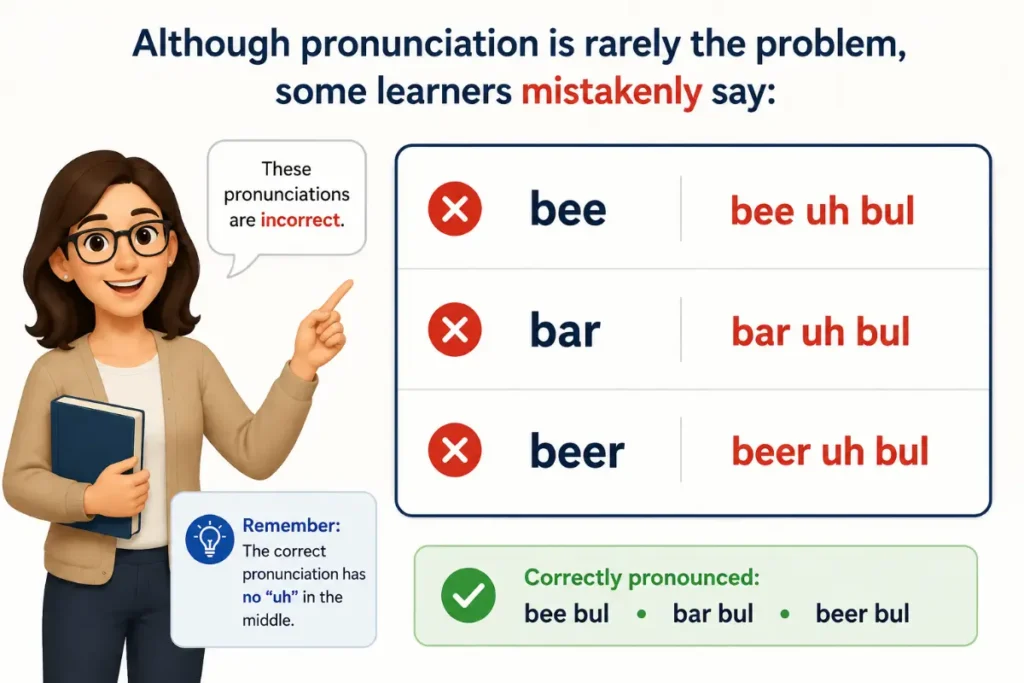
Although pronunciation is rarely the problem, some learners mistakenly say:
- bee uh bul
- bar uh bul
- beer uh bul
The standard pronunciation begins with the same sound as air, chair, and care.
Learn the difference in Definately or Definitely Which Spelling Is Correct (2026).
Etymology and Word Origin
Knowing where a word comes from often makes its spelling easier to remember.
Origin of Bear
The verb bear comes from the Old English word beran, meaning:
- To carry.
- To support.
- To endure.
- To bring.
- To transport.
Over centuries, English preserved these meanings.
Today we still say:
- Bear responsibility.
- Bear a burden.
- Bear pain.
- Bear witness.
- Bear the cost.
The adjective bearable naturally developed from this sense of enduring hardship.
Why Bareable Never Became Standard
The adjective bare has a completely different history. It comes from Old English bær, meaning:
- Naked.
- Uncovered.
- Empty.
- Exposed.
Although bare is an important English adjective, native speakers never adopted bareable to express the idea of enduring something. Instead, English standardized bearable, and that remains the accepted spelling today.
Regional Usage of Bearable vs Bareable
One question many learners ask is if one spelling is American and the other is British. The answer is no.
American English
American English uses bearable.
Examples:
- The weather is finally bearable.
- The traffic wasn’t bearable this morning.
British English
British English also uses bearable.
Examples:
- The cold became bearable after lunch.
- The workload seems bearable now.
Canadian English
Canadian English follows the same standard spelling. Editors, teachers, publishers, and dictionaries all use bearable.
Australian English
Australian English likewise recognizes bearable as the only standard form. Across major English-speaking countries, there is remarkable consistency.
| Variety of English | Preferred Form |
|---|---|
| American English | Bearable |
| British English | Bearable |
| Canadian English | Bearable |
| Australian English | Bearable |
There is no regional variety of standard English in which bareable is considered correct.
Grammar Rules for Bearable vs Bareable
Understanding the grammar behind bearable helps you use it naturally in speech and writing.
Part of Speech
Bearable is an adjective. It describes a noun.
Examples:
- A bearable temperature.
- A bearable delay.
- A bearable workload.
- A bearable level of stress.
- A bearable amount of noise.
Comparative and Superlative Forms
Because bearable is a longer adjective, English usually forms comparisons with more and most.
Examples:
- Today is more bearable than yesterday.
- This option is the most bearable.
- The afternoon became much more bearable.
Less common forms such as bearabler are generally avoided.
Common Sentence Patterns
You will often see bearable used after linking verbs.
Examples:
- The pain became bearable.
- The weather feels bearable.
- The situation seems bearable.
- Everything remained bearable.
- The wait was bearable.
It also appears before nouns.
Examples:
- Bearable conditions.
- Bearable temperatures.
- Bearable discomfort.
- Bearable risk.
- Bearable pressure.
Real Life Usage Examples
Professional editors notice that bearable appears across many types of writing because it expresses a common human experience.
Daily Conversation
- The traffic wasn’t too bad today. It was actually bearable.
- This coffee is hot, but it’s still bearable.
- The humidity is finally bearable.
Academic Writing
Researchers may write:
- Participants reported that the discomfort remained bearable throughout the experiment.
- Most volunteers described the treatment as bearable.
Professional Communication
Examples include:
- The revised schedule creates a more bearable workload.
- These changes should make the transition more bearable for employees.
Literature
Novelists often use bearable to describe emotional struggles, physical hardship, weather, grief, or difficult living conditions because the word immediately conveys endurance without suggesting comfort.
News and Media
Journalists commonly write sentences such as:
- Cooler temperatures made conditions more bearable.
- Aid supplies helped make life slightly more bearable for residents.
Notice that every professional context consistently uses bearable, never bareable.
Related Words and Confused Terms
When learning bearable vs bareable, it helps to understand other words that share similar meanings or are commonly confused with bearable. Expanding your vocabulary also makes your writing more precise.
Synonyms for Bearable
Depending on the context, these words may work as alternatives:
- Tolerable.
- Endurable.
- Manageable.
- Acceptable.
- Livable.
- Sustainable.
- Enduring.
- Moderate.
- Reasonable.
- Survivable.
Each synonym carries a slightly different nuance.
For example:
- Tolerable often suggests something is just acceptable.
- Manageable emphasizes that a situation can be handled.
- Endurable focuses on enduring hardship.
- Livable is commonly used for homes, salaries, or environments.
- Acceptable refers to meeting a minimum standard.
Antonyms of Bearable
These words express the opposite idea:
- Unbearable.
- Intolerable.
- Insufferable.
- Impossible.
- Extreme.
- Agonizing.
- Excruciating.
- Overwhelming.
- Unmanageable.
- Inexcusable.
Example:
- The summer heat became unbearable by late afternoon.
Other Commonly Confused Word Pairs
If you confused bearable with bareable, you may also find these homophone pairs challenging:
| Correct Pair | Difference |
|---|---|
| Bear / Bare | Endure or carry vs uncovered. |
| Brake / Break | Stop a vehicle vs separate into pieces. |
| Principal / Principle | School leader or primary vs rule or belief. |
| Compliment / Complement | Praise vs complete or enhance. |
| Stationary / Stationery | Not moving vs writing paper. |
| Affect / Effect | Usually a verb vs usually a noun. |
| Their / There / They’re | Possession vs place vs they are. |
| Lose / Loose | Misplace vs not tight. |
| Peak / Peek / Pique | Highest point vs glance vs stimulate interest. |
| Advice / Advise | Noun vs verb. |
Learning these pairs improves both spelling accuracy and editing skills.
Expert Language Insight
Professional editors rarely think about pronunciation when checking spelling. Instead, they ask one simple question: What does the word actually mean? If the intended meaning is able to be endured, the correct spelling is always bearable because it comes from the verb bear, meaning to endure or to carry. A useful editing habit is to replace bearable with tolerable while proofreading.
For example:
- The delay was bearable.
- The delay was tolerable.
If the sentence still makes sense, you’ve almost certainly chosen the correct spelling. Another technique is to think of familiar expressions using the verb bear:
- Bear the burden.
- Bear responsibility.
- Bear the cost.
- Bear the pain.
- Bear with me.
Every one of these expressions involves enduring or carrying something. That same idea leads directly to bearable. Professional copy editors also pay attention to context. They know that bare relates to exposure or the absence of covering.
Examples include:
- Bare feet.
- Bare walls.
- Bare branches.
- Bare hands.
- Bare minimum.
None of those meanings connect to endurance. That makes bareable an easy spelling to eliminate during editing.
Memory Tricks for Bearable vs Bareable
Simple memory devices can prevent this mistake for good.
Trick 1
If you can bear something, it is bearable.
Trick 2
Think of the phrase: Bear the pain. Then remember: Bearable pain. The root word stays the same.
Trick 3
Associate bare only with things that are uncovered.
Examples:
- Bare skin.
- Bare trees.
- Bare room.
- Bare floor.
None of these ideas relate to tolerating discomfort.
Trick 4
Remember this sentence: If you can bear it, it is bearable. This simple rule works in nearly every situation.
Quick Recap
Here are the essential points to remember.
- Bearable is the correct spelling.
- It means able to be endured or tolerated.
- It comes from the verb bear, meaning to carry or to endure.
- Bareable is not recognized as a standard English word.
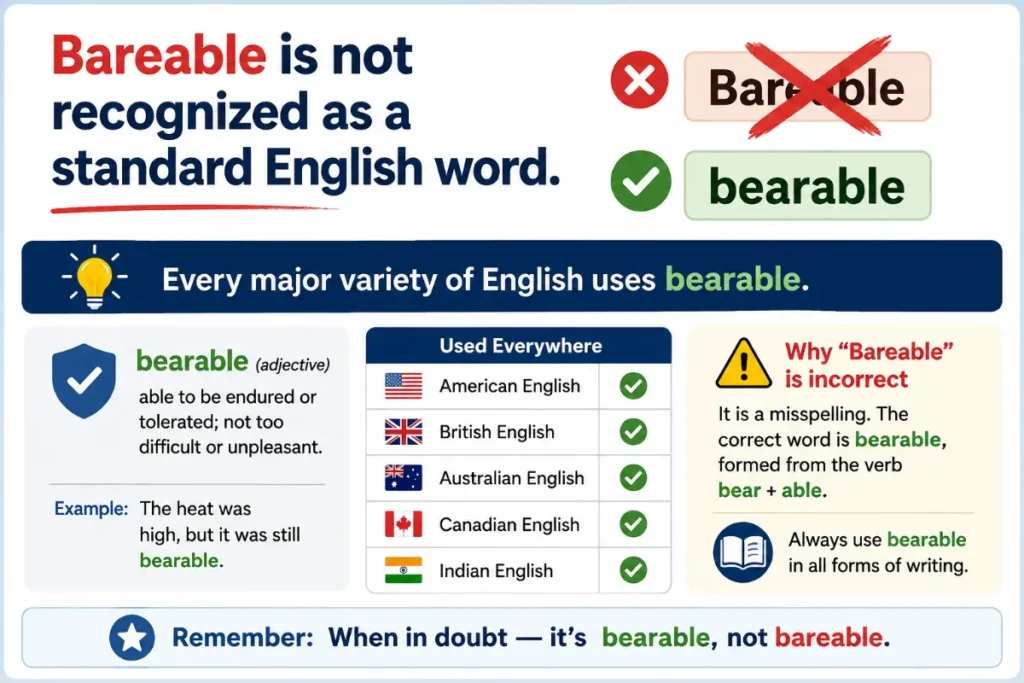
- Every major variety of English uses bearable.
- Professional writers, editors, teachers, and dictionaries all recommend bearable.
- Thinking about the meaning rather than the pronunciation helps you choose the correct spelling.
For another common grammar confusion, see Until or Untill Which Spelling Is Correct in 2026.
Conclusion
When comparing bearable vs bareable, the answer is straightforward. Bearable is the only correct standard English spelling when you mean something that can be endured, tolerated, or managed. It comes from the verb bear, which means to carry or to endure, making its meaning both logical and consistent.
Bareable, despite looking plausible, is simply a common misspelling created by confusion with the word bare, meaning uncovered or without covering. It is not recognized by major dictionaries and should be avoided in academic, professional, and everyday writing.
Whenever you’re unsure, focus on the meaning rather than the pronunciation. If the idea is about enduring discomfort, hardship, or inconvenience, choose bearable. That simple habit will help you write with greater confidence and accuracy.
Frequently Asked Questions
Is bearable or bareable correct?
Bearable is the correct spelling. It means something can be endured, tolerated, or accepted. Bareable is considered a misspelling in standard English and should not be used in formal or informal writing.
Is bareable in the dictionary?
Major English dictionaries do not recognize bareable as a standard word. If you intend to describe something that can be tolerated, the accepted spelling is bearable.
Why do people write bareable?
People often write bareable because bear and bare are homophones. They sound identical, making it easy to confuse their spellings even though they have different meanings.
What does bearable mean?
Bearable describes something unpleasant that can still be endured. It commonly refers to pain, weather, stress, noise, delays, or other uncomfortable situations that remain within a person’s ability to tolerate.
Is bearable an adjective?
Yes. Bearable is an adjective that describes a noun. It tells readers that something can be tolerated or endured.
Is bearable used in American and British English?
Yes. American English, British English, Canadian English, and Australian English all use bearable as the standard spelling. There is no regional preference for bareable.
What is the opposite of bearable?
The most common opposite is unbearable, which describes something so unpleasant or painful that it cannot reasonably be endured.
How can I remember the correct spelling?
Remember the phrase bear the burden. Since bear means to endure, bearable naturally means able to be endured. If you can bear it, it is bearable.