
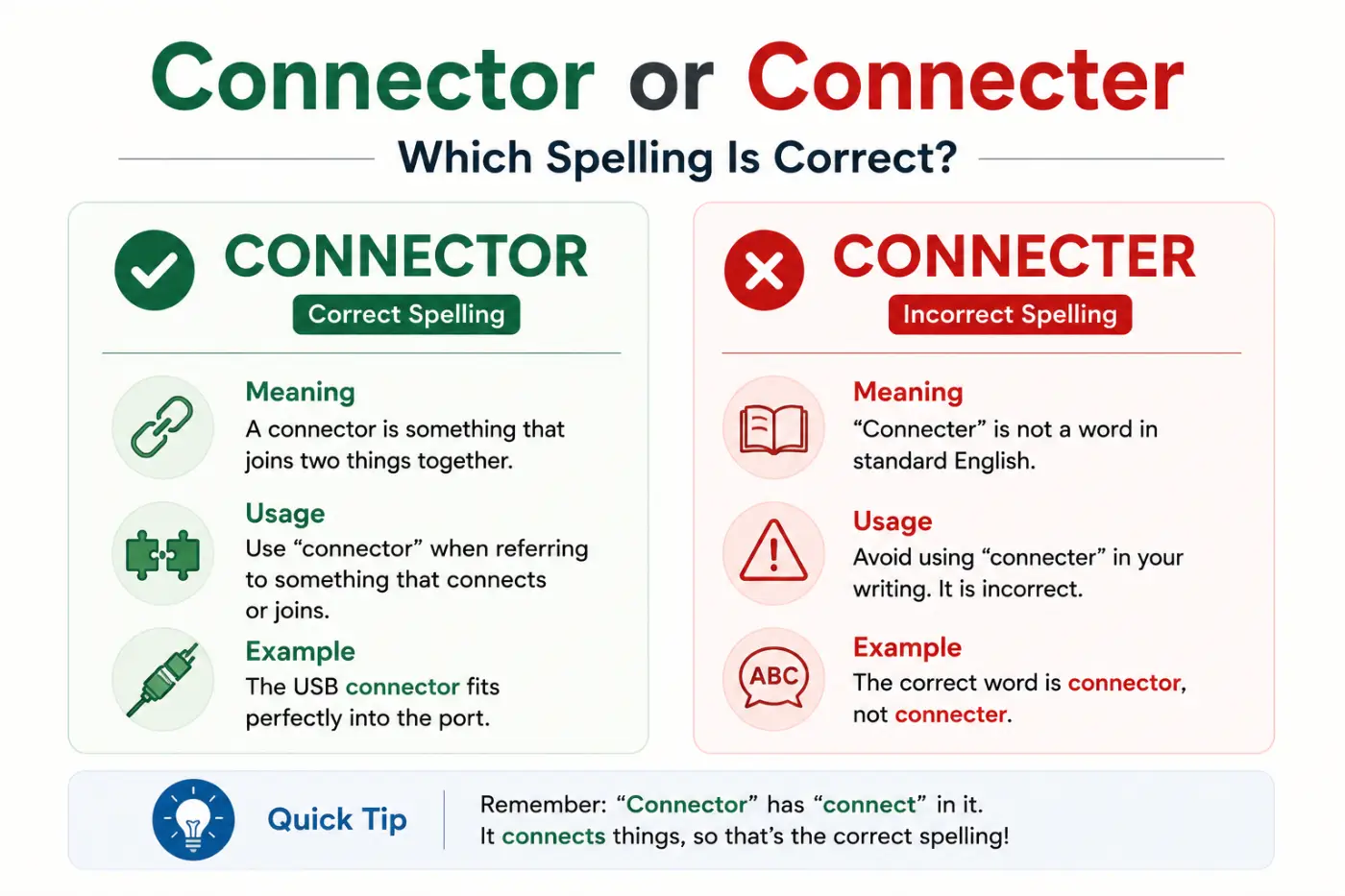
If connector or connecter has you checking the spelling twice the safest choice in most situations is connector. It is the standard and much more familiar word for a person object device or part that connects one thing to another. Connecter can also exist as an agent noun but it is far less common in everyday modern English.
The confusion makes sense because the verb connect can form an agent noun with either or or er patterns in English. Many verbs create nouns with er such as teach and teacher or write and writer. Other nouns use or such as act and actor. English developed through several languages and historical patterns so these endings don’t always follow one simple rule.
For most writing you can make the decision quickly. Use connector for cables plugs electrical parts software links mechanical components and most general references to something that connects. This article explains the narrower place of connecter and shows how pronunciation grammar context and word formation help you choose naturally.
Quick Definition
Connector is the standard modern English noun for a person device component or other thing that connects. Connecter is also possible as an agent noun meaning someone or something that connects but it is much less common. For cables electrical parts hardware and most ordinary uses choose connector.
Quick Answer
Use connector in almost every normal context. It is the established spelling for plugs cable ends electrical components linking devices and people or things that create connections.
Connecter isn’t automatically a spelling error. It can mean a person or thing that connects but modern English strongly favors connector in most contexts.
Comparison Table connector or connecter
| Preferred Form | Meaning | Part of Speech | Word Formation | Usage Frequency | Formality | Common Contexts | Example |
|---|---|---|---|---|---|---|---|
| Connector | A person object or component that connects things | Noun | Connect plus the agent noun ending or | Very common | Neutral | Electronics cables computing mechanics networking and general writing | This connector fits the charging cable. |
| Connecter | A person or thing that connects | Noun | Connect plus the agent noun ending er | Much less common | Neutral but uncommon | Occasional general agent noun use | She is a skilled connecter of people and ideas. |
Meaning and Definition
Meaning of Connecter
Connecter can function as a legitimate noun. In its most straightforward sense it refers to someone or something that connects.
The spelling follows a familiar English word formation pattern. A verb can sometimes take er to create an agent noun that names the person or thing performing the action. A teacher teaches. A builder builds. In the same structural sense a connecter connects.
That grammatical logic explains why the spelling can appear in edited English rather than only in typing mistakes. Still grammatical possibility doesn’t guarantee equal popularity. Modern usage overwhelmingly prefers connector for physical parts devices plugs fittings and similar objects.
Connecter may occasionally feel more natural when a writer deliberately wants to emphasize a person who brings other people together. Even there connector is also common and usually more immediately recognizable.
So treating connecter as universally incorrect oversimplifies the language. A better distinction is common standard form versus uncommon alternative agent noun.
Meaning of Connector
Connector is a noun meaning a person thing or component that connects two or more things.
In everyday technical language it often names a physical component. A cable may have a connector on one end. An electrical system can use connectors to join wires. Computer equipment may rely on connectors to carry power data audio or video signals.
The meaning can also extend beyond hardware. A person who introduces people builds relationships or brings groups together may be described as a connector.
Consider these examples.
The cable connector is damaged.
The pipe needs a new connector.
Maya is a natural connector who introduces people with shared interests.
The core idea stays stable in every example. Something creates or maintains a connection.
Connector is a countable noun. You can therefore write a connector for one item and connectors for more than one.
Key Differences Explained
The two forms share the same root and basic concept but their usage isn’t equally common.
- Spelling. Connector ends in or. Connecter ends in er. That final vowel is the visible difference.
- Meaning. Both forms can refer to a person or thing that connects. Connector has a much broader established presence in modern usage.
- Grammar. Both can function as nouns. Neither form is normally used as a verb. The related verb is connect.
- Technical usage. Connector is the normal choice for electrical electronic mechanical and computing components. Terms such as cable connector electrical connector and power connector sound natural and established.
- Human roles. Connector can describe a person who creates relationships or brings people together. Connecter may also appear in this sense but readers are more likely to expect connector.
- Pronunciation. The two spellings generally lead to the same or nearly identical pronunciation in ordinary speech. You usually can’t determine the intended spelling by listening alone.
- Formality. Connector works in casual professional academic and technical writing. Connecter isn’t inherently informal but its rarity can make it look unusual.
- Reader expectation. Connector is instantly familiar to most readers. Connecter may cause a reader to stop and wonder if it is a typo even in a context where the form is defensible.
That final point matters in practical editing. Correct writing isn’t only about finding a form that can exist. Good writing also chooses the form readers recognize without unnecessary friction.
Which Form Is Correct?
Both forms can be legitimate but connector is the preferred spelling in mainstream modern English.
This preference is especially strong when the noun refers to a physical component. If you are describing a plug socket cable fitting electrical terminal adapter mechanical part or similar object there is little reason to choose connecter.
The linguistic explanation lies in English agent noun formation. English uses several endings to create nouns from verbs. The endings er and or can both identify an agent or something that performs an action. Historical development and established usage determine which form becomes dominant for a particular word.
You can see why guessing from a general rule isn’t always reliable. We have teacher and writer but also actor and operator. The ending attached to a word depends partly on its history and partly on conventions that English speakers have settled on over time.
Established dictionaries recognize connector as the ordinary noun. Some dictionary traditions also record connecter as a variant or agent noun. That makes preferred versus uncommon more accurate than correct versus impossible.
Expert Tip
If both forms seem grammatically possible choose the one your audience already expects unless a specialized context gives you a reason not to. For this word that choice is almost always connector.
Sentence Examples
The following sentences show the preferred form in natural settings.
- I need a new connector for this charging cable.
- Check the connector before replacing the entire wire.
- The technician found corrosion inside the electrical connector.
- This adapter has a different connector from my old laptop.
- Please make sure each connector is firmly attached before turning on the equipment.
- The engineering team tested the connector under several operating conditions.
- Our teacher explained how the connector joins the two parts of the circuit.
- The manual identifies each connector by its location on the board.
- She is a talented connector who enjoys introducing people with similar goals.
- A loose connector caused the monitor to lose its signal.
Connecter can appear in sentences where the intended meaning is an agent that connects.
- She sees herself as a connecter of people from different professional circles.
- His greatest strength is being a connecter of ideas.
- The writer used connecter to emphasize the person performing the action.
- A community connecter can help people discover useful local resources.
- The unusual spelling of connecter may distract readers who expect the more common form.
These examples don’t mean you should replace connector with connecter freely. They show why the second spelling shouldn’t automatically be labeled meaningless.
Common Mistakes and Spelling Confusion
Most confusion comes from the endings er and or. English uses both to form nouns associated with actions so a writer can easily apply the wrong pattern by analogy.
Assuming Every Agent Noun Ends in Er
A common reasoning pattern goes like this.
Teach becomes teacher.
Drive becomes driver.
Build becomes builder.
Therefore connect should become connecter.
The logic looks reasonable but English vocabulary isn’t built from one universal formula. Historical usage has established connector as the dominant noun.
Treating Connecter as Always Meaningless
The opposite mistake is declaring that connecter can never be a word.
That claim is too broad. The form can operate as an agent noun. The practical issue is frequency and convention. Connector is so much more familiar that it should normally be your first choice.
Using Connecter for Electrical Parts
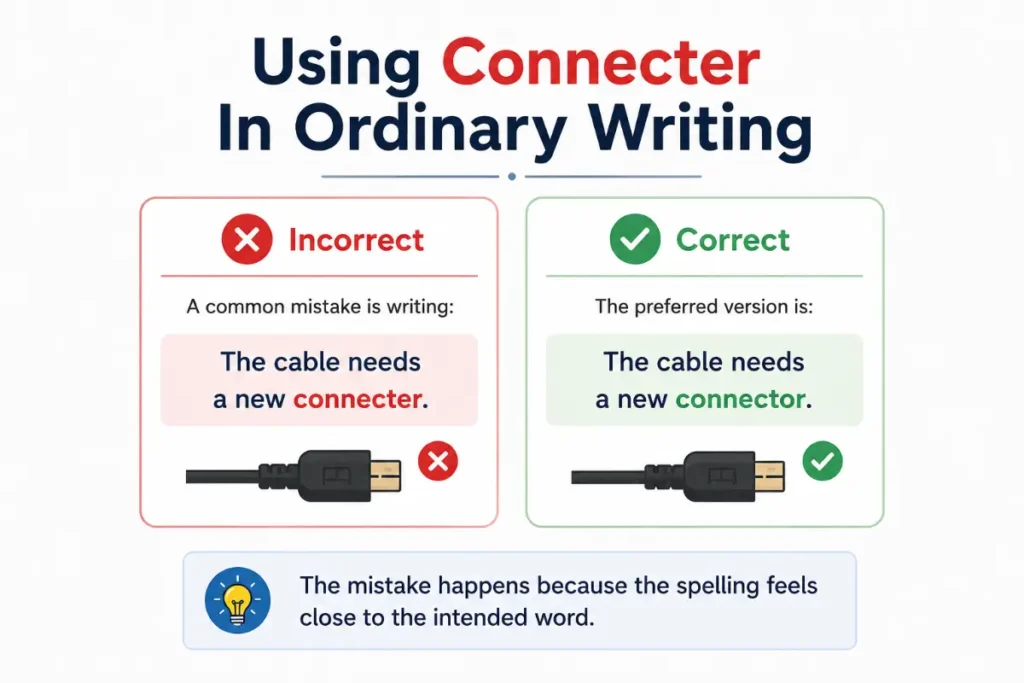
Writing electrical connecter will look odd to many readers. Technical terminology strongly favors electrical connector.
The same principle applies to phrases such as cable connector wire connector power connector and data connector.
Confusing Connector With Connective
Connector names something that connects. Connective can function differently and often describes something that links or joins.
For example a connector may be a physical part while a connective word may link ideas in language. Similar meaning doesn’t make the terms interchangeable.
Confusing Connector With Connection
A connector is the person or thing doing the connecting. A connection is the relationship link or state created.
The cable uses a connector.
The connection is unstable.
That distinction is simple but useful. One names the connecting component. The other names the link or relationship.
Pronunciation Guide
Connector is commonly pronounced /kəˈnɛktər/ in American English.
You can divide it into three syllables.
con nec tor
An easy pronunciation guide is:
kuh NEK ter
The stress falls on the middle syllable. The first syllable is weak while NEK receives the strongest emphasis.
Connecter generally has the same basic pronunciation. That similarity helps explain the spelling confusion. In ordinary speech you usually don’t hear a clear distinction between the final or and er spellings because unstressed vowels often reduce to a similar sound.
Avoid placing heavy stress on the first syllable. CON nek tor sounds less natural than kuh NEK ter in standard American pronunciation.
The best memory tool is visual rather than phonetic. Hearing the word won’t reliably tell you which ending to write.
Etymology and Word Origin
The history begins with the verb connect. English inherited the word through a Latin source associated with joining or binding things together. The underlying idea is physical or figurative joining.
The Latin elements behind the word carry the sense of joining together. That core meaning survives clearly in modern words such as connect connection connected connectivity and connector.
As English developed the noun connector became established for something that performs the action of connecting. This agent noun pattern explains its relationship to the verb.
The competing spelling with er is easy to understand because English commonly creates agent nouns by adding er to verbs. Language history however doesn’t always produce perfectly regular spelling families. Actual usage eventually determines which form becomes conventional.
That is why modern spelling decisions should consider established usage rather than analogy alone.
Regional Usage
American English
Connector is the normal spelling in American English. You will encounter it in consumer electronics engineering computing electrical work networking mechanics and ordinary conversation.
The word can also describe a socially skilled person who brings others together. That figurative meaning sounds natural in American business and social contexts.
Connecter may appear but it is far less familiar. For US readers connector is usually the clearest editorial choice.
British English
British English also strongly favors connector. There is no major British spelling rule that requires changing the word to connecter.
Technical and general British usage follows the familiar connector form. This is not comparable to pairs where British and American English have established competing national spellings.
Australian English
Australian English normally uses connector as well. Technical documentation everyday writing and professional communication follow the same basic convention.
Connecter doesn’t serve as a standard Australian replacement. If you are writing for an Australian audience connector remains the natural choice.
Canadian English
Canadian English also uses connector as the mainstream form. Canadian spelling sometimes combines British and American conventions but that doesn’t create a meaningful distinction here.
For hardware electronics cables people and general references to something that connects use connector unless a specific editorial context deliberately calls for the rarer agent noun.
Grammar Rules and Part of Speech
Connector is primarily a countable noun.
That means it can take singular and plural forms.
Singular: The connector is loose.
Plural: The connectors are loose.
It can also appear after articles and determiners.
I bought a connector.
I need the connector near the monitor.
We replaced three connectors.
The word frequently appears as part of a noun phrase. Another noun or adjective may specify the kind of component being discussed.
Examples include cable connector electrical connector power connector wire connector and mechanical connector.
In those phrases the surrounding word narrows the meaning. A cable connector connects a cable to something else while an electrical connector joins parts of an electrical system.
Connector as a Person
The noun doesn’t have to refer to an object.
You can say:
Sam is a natural connector.
Here connector describes a person who creates relationships introduces people or links groups and ideas. The grammatical structure remains the same even though the meaning becomes figurative.
Connector and Connect
Don’t confuse the noun with its verb.
Connect is the action.
Please connect the cable.
Connector names the person or thing associated with that action.
The connector is beside the cable.
This distinction is useful for learners because the forms look similar but perform different jobs in a sentence.
Possessive Forms
Standard possessive rules apply.
Singular possessive: The connector’s surface was damaged.
Plural possessive: The connectors’ positions were marked.
In most everyday situations you can rewrite a technical sentence to avoid an awkward possessive construction if a clearer noun phrase works better.
Real Life Usage Examples
A word becomes easier to understand once you see how its meaning shifts naturally with context.
Daily Conversation
I think the connector on my charger is bent.
Can you check the connector before we buy another cable?
These sentences sound ordinary because physical devices are among the most familiar uses of the noun.
Email and Workplace Communication
Please inspect the connector before sending the unit back to the customer.
We found that one connector wasn’t seated properly during the final test.
In workplace communication precision matters. The preferred spelling helps readers recognize the component immediately without stopping to question the word.
Academic Writing
The connector provides a physical interface between the two components.
Each connector was examined before the experimental equipment was assembled.
Academic and technical writing often uses the noun in a precise physical sense. Writers should define specialized connector types when readers may not know the equipment involved.
News and Journalism
Investigators examined a damaged connector found near the equipment.
Engineers traced the failure to a loose connector inside the system.
Journalistic writing usually favors familiar standard vocabulary. Connector works well because readers can understand the basic role even without deep technical knowledge.
Literature and Storytelling
He turned the cable in his hand and stared at the broken connector.
Everyone knew Lena as a connector who could bring strangers into the same conversation within minutes.
The second example shows the figurative human meaning. Context makes it clear that Lena isn’t a mechanical component. She connects people socially.
Related and Confused Terms
Several words belong to the same semantic family but each carries a different meaning.
Connect
Connect is the verb. It describes the action of joining linking or establishing communication between things.
Example: Connect the printer to the computer.
Connection
Connection is a noun referring to a link relationship association or state of being connected.
Example: The internet connection dropped again.
A connector can help create a connection.
Connected
Connected is commonly the past form or past participle of connect and can also work as an adjective.
Example: Both devices are connected.
Connectivity
Connectivity refers to the ability or capacity to connect especially in computing telecommunications and networks.
Example: The building has poor wireless connectivity.
It describes the broader ability to establish connections rather than a single physical component.
Adapter
An adapter allows components or systems with different interfaces to work together. It may contain connectors but adapter and connector don’t automatically mean the same thing.
Example: I need an adapter to use this cable with my laptop.
Plug
A plug is a component designed to fit into a matching socket or receptacle. It can be a type of connector but the words aren’t interchangeable in every technical setting.
Example: Insert the plug carefully into the socket.
Coupler
A coupler joins two similar or compatible parts. The term is common in mechanical plumbing telecommunications and other technical contexts.
Its exact meaning depends on the field so use the terminology established for the equipment you are describing.
Link
Link has a broader meaning. It can describe a physical relationship a digital connection or an abstract association between people ideas or events.
Example: Researchers found a link between the two patterns.
Connector usually names the thing creating or supporting that connection while link often names the relationship itself.
Choosing the Right Word in Technical Writing
Technical writing rewards consistency. If a manufacturer industry standard or engineering document calls a component a connector keep that terminology throughout your document. Switching casually between connector and connecter can make readers wonder if you are describing two different parts.
Precision becomes especially important when several related components appear in the same instructions. A plug receptacle terminal adapter coupler and connector may perform related jobs without being technically identical. Use the most specific established term available rather than treating every joining part as interchangeable.
Context also matters more than clever variation. In ordinary creative writing repeating a noun can sometimes sound dull. In technical writing repeating the correct term is often better than introducing a synonym that changes the meaning.
How to Remember the Preferred Spelling
A useful memory trick is to associate the or ending with familiar technical words that also name people or things performing a function.
Think of operator generator and conductor. Then place connector in the same mental group.
You don’t need to turn this into a rigid grammar rule because English has many exceptions. The goal is simply to create a quick memory cue.
Another approach is visual. Picture the word printed on a cable package:
CONNECTOR
Once that spelling becomes familiar you are less likely to replace the final or with er while typing.
For professional documents use your spellchecker as a second line of defense rather than your only authority. A spelling tool can flag unusual forms but context still determines the best word.
Standard Usage and Reader Expectations
Language allows more than one grammatically imaginable form but communication depends heavily on convention. Readers build expectations from the forms they encounter most often. Connector has a major advantage because it already looks natural across technical general and figurative contexts.
That matters even if you can defend connecter linguistically. An uncommon form may force readers to stop and inspect the spelling. That tiny interruption adds no value if both words communicate essentially the same idea.
Editors often resolve choices like this by asking a practical question. Which form communicates the intended meaning most clearly to the intended audience?
For this pair the answer is usually connector.
There can still be stylistic reasons to choose the rarer form. A writer describing someone specifically as a person who connects others may prefer connecter because the er ending makes the agent relationship feel transparent. That is a stylistic choice rather than the normal default.
Expert Editor Insight
In professional editing I would normally change connecter to connector unless context clearly showed that the writer chose the rarer agent noun deliberately. Native readers recognize connector immediately in technical and general writing while connecter can resemble an accidental spelling even where it is defensible. Grammar and spelling tools may react differently depending on their dictionaries so don’t treat a software flag as the final authority. Check meaning context audience and established usage together.
Conclusion
For connector or connecter the practical answer is straightforward. Connector is the standard and preferred choice for most modern English writing. Connecter can exist as an agent noun so calling it universally incorrect would miss an important linguistic detail. Still its uncommon status means many readers may interpret it as a spelling mistake.
Use connector for cables plugs electrical parts mechanical components devices and general references to something that connects. It also works naturally for a person who builds relationships between people or groups.
For an easy editing rule remember the familiar or ending in connector. If both spellings seem possible choose the form your reader will recognize instantly. In almost every ordinary context that form is connector.
FAQs
Is Connecter a Real Word?
Yes. Connecter can function as an English agent noun meaning a person or thing that connects. Still it is much less common than connector and may look like a misspelling to many readers. For physical components such as plugs cables fittings and electrical parts use connector. The rarer form is most defensible when a writer deliberately emphasizes a person or agent that connects.
What Does Connector Mean?
Connector is a noun for a person object or component that connects two or more things. In technical contexts it commonly refers to a physical part that joins cables wires devices or mechanical components. It can also describe a person who brings people ideas or groups together. The exact meaning becomes clear from the surrounding context.
Which Is Correct connector or connecter?
For connector or connecter both forms can exist but connector is the preferred spelling in mainstream modern English. It is especially standard for electrical electronic mechanical and computing components. Connecter is a much less common agent noun. If you need one spelling that will sound natural to the widest audience choose connector.
How Do You Pronounce Connector?
Connector is commonly pronounced /kəˈnɛktər/ in American English. Think of it as kuh NEK ter with the strongest stress on the middle syllable. The first vowel is weak and relaxed. Connecter generally sounds the same or very similar in ordinary speech which means pronunciation alone offers little help when you are deciding how to spell the word.
Can Connector Describe a Person?
Yes. Connector can describe someone who brings people together creates relationships or links individuals with useful ideas opportunities or resources. For example you might call a socially skilled colleague a natural connector. This figurative use follows the same basic meaning as the physical one. The person creates a connection rather than physically joining two pieces of equipment.
What Is Another Word for Connector?
The best alternative depends on context. For physical equipment possible related terms include adapter coupler plug fitting and link but these words don’t always name the same component. For a person you might use intermediary facilitator or networker depending on the intended meaning. In technical writing avoid replacing connector with a near synonym unless the alternative accurately identifies the specific part.
Why Are Connector and Connecter Confused?
The confusion comes mainly from English agent noun endings. Many verbs form nouns with er so connecter looks perfectly logical beside words such as teacher and builder. English also has many established nouns ending in or. Historical convention and common usage made connector dominant. Since both forms sound nearly identical speakers receive little pronunciation help when choosing the spelling.
Is Connector Appropriate in Formal Writing?
Yes. Connector is fully appropriate in formal professional academic and technical writing. It is the natural choice when discussing electrical components cables computing hardware mechanical systems or other parts that create connections. It can also describe a person in formal prose if the figurative meaning is clear. In specialized documents follow the terminology established for the particular device system or industry.