
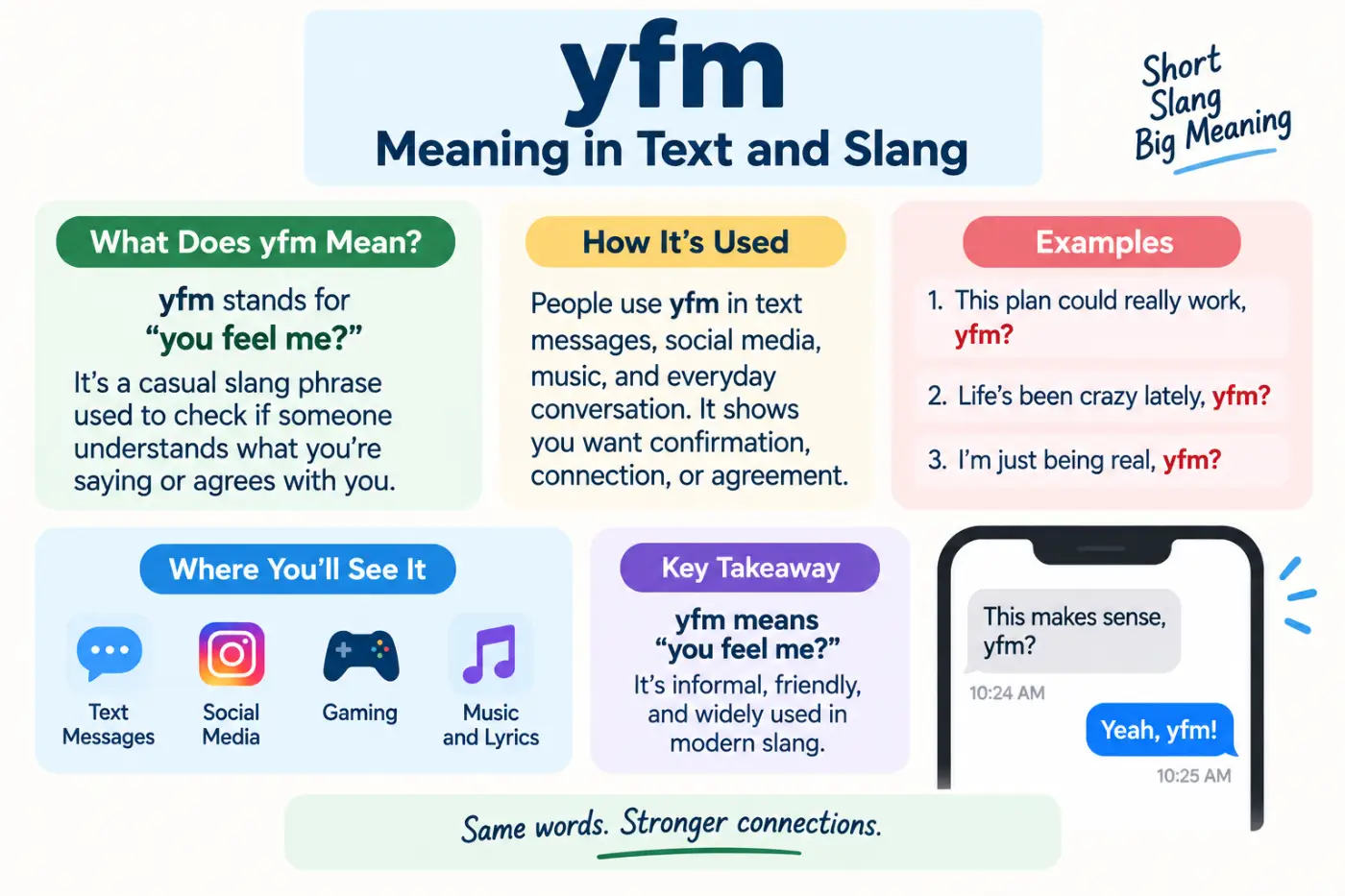
If you’ve seen YFM at the end of a text and wondered what it means, the yfm meaning is usually You Feel Me? It’s an informal expression people use to ask if you understand what they mean, agree with their point, or can relate to what they’re saying. In most casual conversations, it’s simply a quick way to check if you’re on the same page.
The meaning can shift slightly based on the conversation. One person might use YFM to ask for emotional understanding, while another might use it like Do you get what I mean? or Do you see my point? The expression isn’t usually about physically feeling someone. Instead, feel carries the conversational sense of understanding, relating, or connecting with another person’s thoughts or experience.
You’ll commonly see YFM in text messages, social media posts, group chats, gaming conversations, and private messages. Since it’s casual slang, it fits relaxed conversations much better than formal emails, academic papers, or professional documents. Understanding the context will help you figure out exactly what the sender means and choose a natural response.
A related grammar guide is Shiny Vs Shiney Meaning Usage And Examples2026.
Quick Definition
YFM usually means You Feel Me? in texting and online slang. It’s a casual way to ask if another person understands agrees with or relates to what the sender just said. It usually appears in informal conversations and often works like Do you get me? or You know what I mean?
Quick Answer
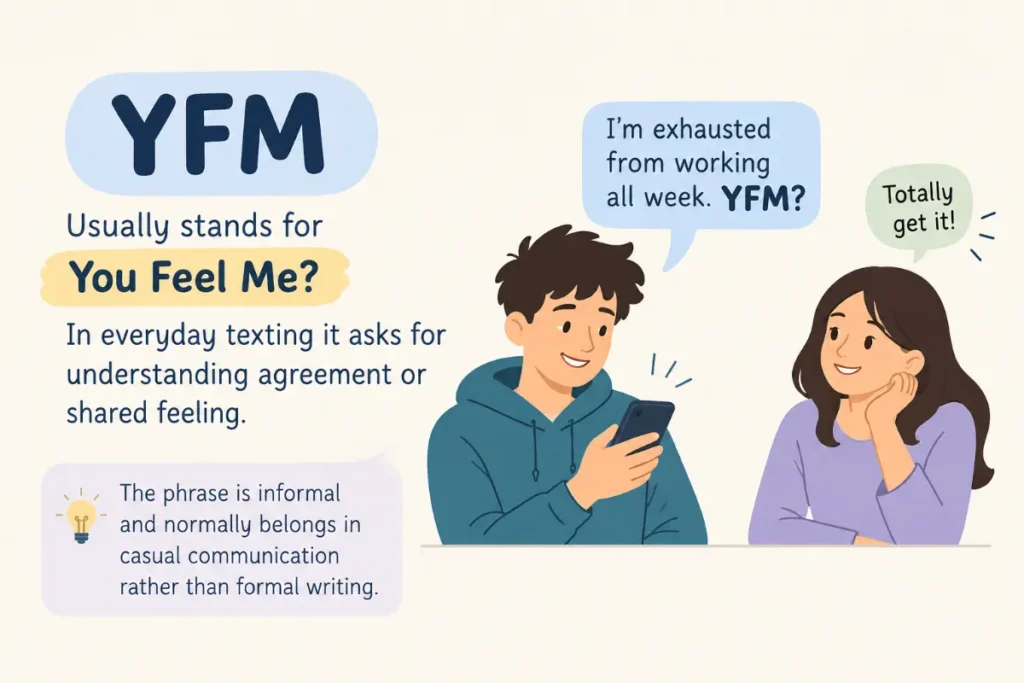
YFM usually stands for You Feel Me? In everyday texting it asks for understanding agreement or shared feeling.
For example if someone writes I’m exhausted from working all week YFM? they’re basically asking if you understand or can relate. The phrase is informal and normally belongs in casual communication rather than formal writing.
What Does YFM Mean
The most common expansion is You Feel Me? The expression is not normally asking about physical touch. Instead it uses feel in a conversational sense connected to understanding empathy agreement or shared experience.
Think of it as a short way to say:
- Do you understand me?
- Do you get what I mean?
- Can you relate?
- Are you with me?
- Do you see my point?
- Do you agree with me?
The exact shade depends on the sentence around it.
Suppose a friend says:
I’ve been studying for hours and my brain is completely done YFM?
The person probably isn’t asking for a detailed answer. They’re looking for a quick sign that you understand the feeling.
You could reply:
Yeah I feel you.
Or:
For real. I’ve been there.
Now imagine someone says:
People should stop judging others without knowing the full story YFM?
Here the expression is closer to Do you agree with my point? The sender wants confirmation that you understand their argument.
That flexibility is one reason short texting expressions can feel confusing. The dictionary style definition gives you the basic meaning but the surrounding conversation gives you the real tone.
YFM Meaning in Different Contexts
The phrase usually keeps the same basic idea but its emotional force can change.
In Text Messages
Texting is probably the most familiar setting. Someone may place YFM at the end of a message to make the conversation sound relaxed.
For example:
I just want a quiet weekend with no drama YFM?
This means something close to Do you understand what I mean?
The abbreviation saves typing time while keeping the message conversational.
On Social Media
On platforms such as TikTok Instagram and other social networks people may use YFM in comments captions or direct messages. The expression can invite agreement from other people who share the same experience.
For example:
That feeling when you study all night and still forget everything YFM?
The writer expects readers who have experienced the same thing to connect with the statement.
In Group Chats
In a group chat YFM can work like a quick call for agreement.
Someone might write:
We should leave early because traffic is going to be inexplicable YFM?
A friend may answer:
Exactly.
Another person might simply respond with:
Facts.
The abbreviation makes the original statement sound more like spoken conversation.
In Gaming Chats
Online gaming communities often use short expressions because players communicate quickly. YFM can appear after someone makes a comment about the game or a shared experience.
For example:
That final level was way harder than I expected YFM?
The phrase asks other players if they had the same experience.
In Personal Conversations
Between friends YFM can carry more emotional weight. Someone may use it after talking about stress family problems relationships school work or other personal situations.
In that setting the phrase may mean more than simple agreement. It can mean I hope you understand where I’m coming from.
That difference matters. A literal translation can miss the social meaning.
Is YFM an Acronym or Abbreviation
YFM is commonly described as an acronym or initialism for You Feel Me? Different reference sources use slightly different terminology for short forms like this. In practical everyday use the distinction doesn’t matter much because people understand YFM as a shortened version of the phrase.
Technically an initialism is usually pronounced letter by letter. YFM is generally read as the individual letters rather than as one spoken word. That makes initialism a useful linguistic description.
The important point is how the abbreviation functions. It compresses a familiar spoken phrase into three letters.
This follows a common pattern in digital communication. People shorten familiar expressions because typing a few characters is faster than writing the complete phrase.
The same basic process appears in many other common forms such as:
- IDK for I don’t know.
- BTW for by the way.
- IMO for in my opinion.
- FYI for for your information.
- YFM for You Feel Me?
Unlike some abbreviations YFM carries a strong conversational tone. It sounds more like speech than formal written English.
Comparison Table for YFM
| Form | Meaning | Part of Speech | Origin or Formation | Usage Frequency | Formality | Common Contexts | Example |
|---|---|---|---|---|---|---|---|
| YFM | You Feel Me? | Initialism or texting shorthand | Initial letters of You Feel Me | Common in informal online communication | Very informal | Texts DMs social media chats | I’m tired of explaining myself YFM? |
| yfm | You Feel Me? | Initialism or texting shorthand | Lowercase digital form of YFM | Common in casual typing | Very informal | Texts comments group chats | That test was rough yfm? |
| You feel me? | Do you understand or relate to me? | Informal phrase | Spoken conversational English | Common in speech and informal writing | Informal | Conversation music culture casual writing | This is what I mean. You feel me? |
| Do you get me? | Do you understand my point? | Informal question | Standard English phrase | Very common | Informal | Conversation and messaging | You get me? |
| You know what I mean? | Do you understand my point? | Conversational phrase | Standard English | Very common | Neutral to informal | Speech texting casual writing | It was awkward you know what I mean? |
The Meaning Behind Feel
The word feel makes this expression more interesting than a simple request for information.
In ordinary English feel can describe physical sensation. But it can also describe emotional awareness understanding and connection.
For example:
I feel your frustration.
That sentence doesn’t mean the speaker physically experiences the other person’s frustration. It means the speaker understands or empathizes with it.
You Feel Me? uses the same broader sense of feel. It asks for a connection between the speaker’s idea or experience and the listener’s understanding.
That’s why translating the phrase word for word can be misleading.
The intended message is usually closer to:
Do you understand where I’m coming from?
Can you relate to what I’m saying?
Are you with me?
Do you see my point?
This figurative use of feel is a normal part of conversational English.
How YFM Is Used in a Sentence
YFM usually appears after a statement rather than at the beginning of a message. The speaker makes a point and then adds the abbreviation as a quick request for confirmation.
For example:
I’ve had three exams this week YFM?
The structure is simple.
Statement + YFM?
The question mark often fits because the full phrase is You Feel Me? The sender is asking for a response.
Still people may type YFM without a question mark. Digital communication is flexible with punctuation.
For example:
That movie was actually pretty good yfm
The meaning can still be understood from context.
Capitalization is flexible too. YFM and yfm generally carry the same meaning in casual messaging. Lowercase writing is especially common because people often type quickly and don’t bother with capitalization.
Key Differences in Meaning and Tone
Several features help you interpret the expression correctly.
- Understanding. The sender may simply want to know if you understand their point.
- Agreement. Sometimes the sender wants you to agree with them.
- Relatability. The person may be asking if you’ve experienced something similar.
- Empathy. In an emotional conversation the phrase can ask for emotional understanding.
- Connection. It can create a sense of being on the same page.
- Informality. The expression belongs to relaxed conversation rather than professional writing.
- Context. The surrounding sentence determines the exact shade of meaning.
- Tone. Depending on the conversation it can sound friendly confident emotional persuasive or slightly challenging.
This is why you shouldn’t translate every use into one fixed English sentence. The core meaning remains stable but the social purpose can shift.
Is YFM Always Used for You Feel Me
No. Acronyms can have multiple meanings across different communities.
Reference databases list several expansions for YFM in specialized contexts. These include organizational names business terms music related names and other uses.
For ordinary texting however You Feel Me? is the meaning you should consider first. Context should confirm it.
For example if you receive:
That homework was impossible YFM?
The intended meaning is almost certainly You Feel Me?
But if YFM appears in the name of an organization on a website or in a business document it may stand for something completely different.
The same three letters can represent different things because abbreviations are highly context dependent.
That’s a useful rule for understanding internet slang in general. Don’t interpret an abbreviation in isolation. Read the words around it and consider who sent the message.
Less Common Meanings of YFM
Several sources and abbreviation databases record other expansions. These are not normally what someone means in a casual text.
One documented example is Your Favorite Martian which refers to a music and animation project. Other abbreviation databases also list organizational or professional expansions.
This doesn’t create a problem for everyday texting because context usually makes the intended meaning obvious.
If your friend writes:
I can’t believe that happened YFM?
You don’t need to search through dozens of acronym databases. The conversational setting strongly points toward You Feel Me?
If you see YFM as part of a company name event title organization name or specialized document then investigate the local context instead.
How to Reply When Someone Says YFM
Your response depends on what the sender is asking.
If you agree you can answer naturally:
Yeah I feel you.
Exactly.
For real.
I know what you mean.
Same here.
If you understand but don’t necessarily agree you can say:
I get what you mean.
I see your point.
I understand where you’re coming from.
If you don’t understand you can simply ask:
What do you mean?
Can you explain?
I’m not sure I follow.
If the person is sharing something emotional a warmer reply may fit better.
For example:
I understand. That sounds exhausting.
Yeah I can see why you feel that way.
I get you.
The best response usually mirrors the tone of the original message. A serious message deserves more than a one word response.
10 Natural Examples
- I’ve been working all week and I just want to sleep this weekend YFM?
- That test was way harder than I expected YFM?
- I don’t like arguing with people over things that don’t matter YFM?
- Sometimes you just need a quiet day to yourself YFM?
- I’ve been trying to save money but everything keeps getting more expensive YFM?
- We should leave early because traffic is going to be terrible YFM?
- I hate when people judge you without knowing the full story YFM?
- I finally understand why you were upset yesterday YFM?
- Some days you just need your friends around you YFM?
- I’m ready for the weekend because this week has been exhausting YFM?
Notice that the abbreviation usually comes after a complete thought. In every example the speaker wants some kind of acknowledgment from the reader.
Learn the difference in Shakey or Shaky Which Spelling Is Correct in 2026?.
Common Mistakes When Interpreting YFM
Taking It Literally
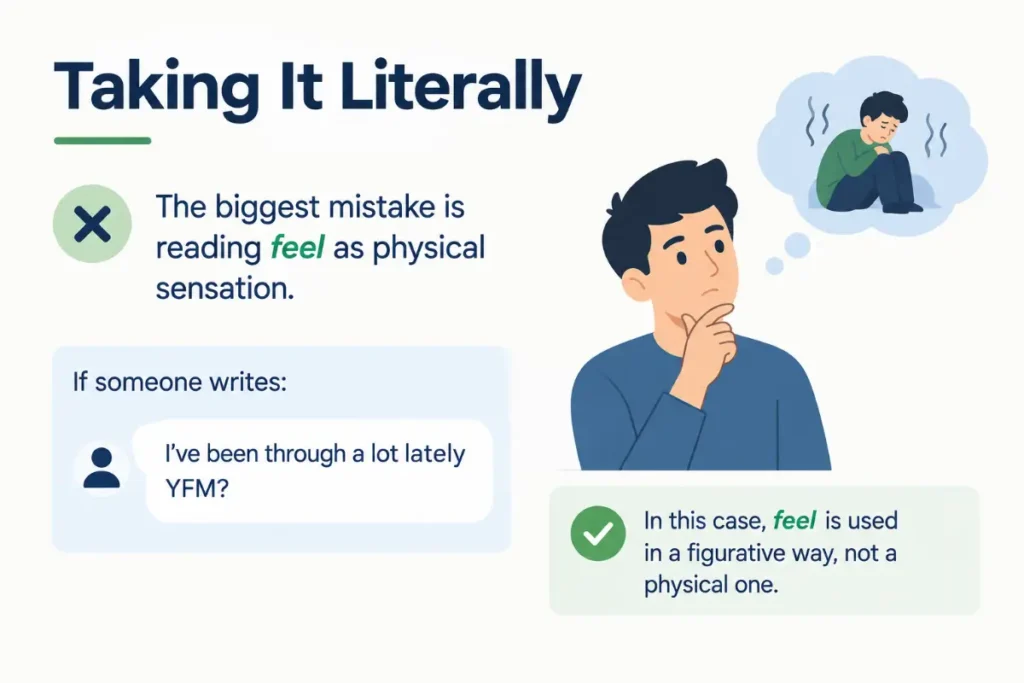
The biggest mistake is reading feel as physical sensation.
If someone writes:
I’ve been through a lot lately YFM?
They probably aren’t asking if you physically feel them. They’re asking if you understand or relate to their experience.
Assuming It Always Means Agreement
YFM can invite agreement but it doesn’t always demand it.
Someone might say:
I think this movie was overrated YFM?
They could be asking if you understand their opinion rather than demanding that you agree.
Treating It as Formal English
YFM belongs to informal communication. It may work perfectly in a text between friends but look out of place in a school essay business report formal application or professional email.
Ignoring Context
An abbreviation can have several meanings. If YFM appears in a specialized setting don’t automatically assume it means You Feel Me?
Look at the surrounding words first.
Assuming Capitalization Changes the Meaning
YFM and yfm normally communicate the same phrase in casual digital writing. Capital letters often depend on personal typing style.
Pronunciation Guide
The full phrase You Feel Me? is normally pronounced as three words.
A simple pronunciation guide is:
You feel me?
The stress depends on the speaker’s intention. A person may emphasize feel when asking for emotional understanding or me when seeking a personal connection.
YFM itself is generally read as the individual letters rather than pronounced as one word. You would say the letters Y F M.
That matters because YFM is a written shorthand. The spoken version remains You Feel Me?
When reading a text aloud you would normally expand the abbreviation rather than pronounce it as a single word.
Etymology and Language Background
The written abbreviation is a modern form of shortening. Its exact point of origin is difficult to assign to one person or one date because informal expressions develop through communities rather than appearing with an official launch.
The phrase You feel me? belongs to a broader tradition of using feel to mean understand or connect with someone. The expression has strong associations with African American English and has also been widely circulated through hip hop and popular culture. The shortened digital form developed naturally from a phrase people were already using in speech.
That background matters because slang rarely develops in a vacuum. Spoken expressions often move into music popular culture online communities and then texting. Once a phrase becomes familiar people can shorten it without losing much meaning.
The digital form YFM follows the same basic process as many texting abbreviations. Writers take the first letters of a familiar phrase and use them as shorthand.
It’s better to describe this as language change and abbreviation than as a random internet invention. The underlying phrase existed before the three letter form became common online.
Regional Usage
American English
In the United States You Feel Me? is recognized as casual conversational language. YFM appears mainly in informal digital communication. Its use is influenced by broader American slang and speech communities and by its circulation through popular culture.
The expression can signal understanding agreement or emotional connection. It is not appropriate for most formal professional documents.
British English
British speakers can understand YFM when they encounter it online but it is not a formal British English expression. Its meaning remains strongly dependent on the context in which it appears.
A British reader may interpret it as a piece of American influenced internet slang rather than ordinary formal English.
Australian English
Australian users may also encounter YFM through international social media and online communication. There is no established Australian spelling variant that changes the basic meaning of the texting shorthand.
Canadian English
Canadian users may see and understand YFM in informal online conversations. The expression generally carries the same basic meaning as in American digital communication.
Across these varieties the key point is the same. YFM is an informal shorthand rather than a standard regional grammar form.
Grammar and Part of Speech
YFM is not a normal English word with a conventional grammatical category. It represents a shortened conversational phrase.
The full expression You Feel Me? contains:
- You. A pronoun serving as the subject.
- Feel. A verb.
- Me. An object pronoun.
In the full phrase the structure is conversational rather than a formal textbook question. It asks the listener to confirm understanding or connection.
The abbreviation removes the grammatical structure from the written surface while preserving the intended conversational function.
That’s common in texting. People frequently remove words and punctuation because both participants understand the missing material.
For example:
Going home soon?
This is not a complete formal sentence but everyone understands the intended question.
YFM works in a similar way. The abbreviation represents a familiar phrase that the reader mentally expands.
Is YFM Appropriate for Formal Writing
Generally no.
You should avoid it in academic essays formal reports business proposals professional applications and official communication unless you are discussing the term itself.
Instead use a standard phrase such as:
Do you understand my point?
Does that make sense?
I hope you understand what I mean.
Do you see what I mean?
Can you relate to this experience?
Formal writing values clarity and consistency. Standard phrases make your meaning accessible to readers who may not know current internet slang.
There’s also a tone issue. YFM carries an informal conversational voice. That can be useful when writing dialogue or reproducing a casual message but it can feel out of place in a formal document.
YFM in Professional Communication
A workplace chat can be more relaxed than a report but context still matters.
If you know your coworkers well and the team regularly uses casual slang then you may see expressions like YFM in informal internal messages. Still you should consider your audience.
For example:
This deadline is brutal YFM?
That might work in a casual conversation between coworkers.
But in an email to a client you would probably write:
This deadline is particularly tight. I hope you understand the challenge.
The second version communicates the idea without relying on slang.
The safest approach is simple. Use YFM when the conversation is clearly casual. Use standard English when the audience or setting calls for professionalism.
Real Life Usage Examples
Daily Conversation
In everyday conversation the full phrase sounds natural when someone wants to check understanding.
I’m not trying to complain. I just need a break. You feel me?
That sentence carries more emotion than a simple Do you understand?
Another example is:
Sometimes you need to walk away and clear your head. You feel me?
Here the speaker wants emotional agreement or connection.
Email and Workplace Communication
YFM rarely belongs in formal email. A professional version might be:
I know the schedule has been demanding and I hope you understand my concern.
In a casual workplace chat between friends a person might instead type:
This week has been inexplicable YFM?
The difference comes from audience and setting rather than grammar alone.
Academic Writing
Academic writing normally avoids this abbreviation.
Instead of:
The results were surprising YFM?
A student should write:
The results were surprising and may require further analysis.
Academic language should communicate the idea directly.
News and Journalism
News writing generally uses standard language rather than texting abbreviations. A journalist may quote a person who used the expression but would normally keep the surrounding reporting language formal.
For example:
The speaker said the community had been overlooked and asked the audience if they understood his point.
The expression may appear inside a direct quotation but it would not normally serve as the writer’s own shorthand.
Literature and Storytelling
Fiction can use You feel me? when a character speaks casually.
He looked at his friend and said, You feel me? This is about more than money.
The full expression helps establish voice and character. A writer may also use YFM in a modern text message scene when the abbreviation fits the character.
Related Terms and Expressions
Several phrases overlap with the meaning of YFM but each has a slightly different feel.
- Do you get me? This is one of the closest alternatives. It asks directly if the listener understands.
- You know what I mean? This is common in everyday American speech and often appears when someone wants confirmation.
- Do you understand? This is clearer and more neutral but can sound more direct.
- I feel you. This usually means I understand or relate to what you’re saying. It can work as a response to YFM.
- I get you. This means I understand your point or feelings.
- I hear you. This often shows that someone understands or acknowledges another person’s concern.
- Can you relate? This focuses more directly on shared experience.
- Are you with me? This asks for agreement understanding or support depending on the context.
These expressions overlap but they aren’t interchangeable in every situation. Tone matters.
YFM vs I Feel You
YFM and I feel you are closely connected but they serve different roles.
YFM is normally a question. It asks the other person to confirm understanding.
I feel you is normally a response. It tells the other person that you understand or relate.
For example:
Person A: I’m tired of explaining myself YFM?
Person B: Yeah I feel you.
That exchange makes the relationship between the two phrases easy to see.
The first asks for connection. The second provides it.
YFM vs WYD and Other Texting Slang
YFM can be confusing if you aren’t familiar with digital shorthand. It helps to recognize that different abbreviations perform different functions.
WYD usually means What are you doing?
WYA usually means Where are you?
IDK usually means I don’t know.
IMO usually means In my opinion.
TBH usually means To be honest.
FR usually means For real.
YFM is different because it checks understanding or connection rather than simply asking for information.
Knowing the function of an abbreviation is often more useful than memorizing its letters alone. If you know what the phrase is doing in the conversation the meaning becomes easier to infer.
How Context Changes the Tone
The same expression can sound different depending on the message before it.
Consider these examples:
That was a rough day YFM?
This sounds sympathetic.
Nobody should have to deal with that kind of behavior YFM?
This may seek agreement.
I’m saying we need to leave now YFM?
This can sound more forceful.
You’re the only person who understands me YFM?
This sounds more personal and emotional.
The three letters stay the same. The surrounding message changes the tone.
That is a useful lesson for understanding online slang. Meaning is not just stored inside the abbreviation. It emerges from the words around it the relationship between the speakers and the situation.
Expert Editor Insight
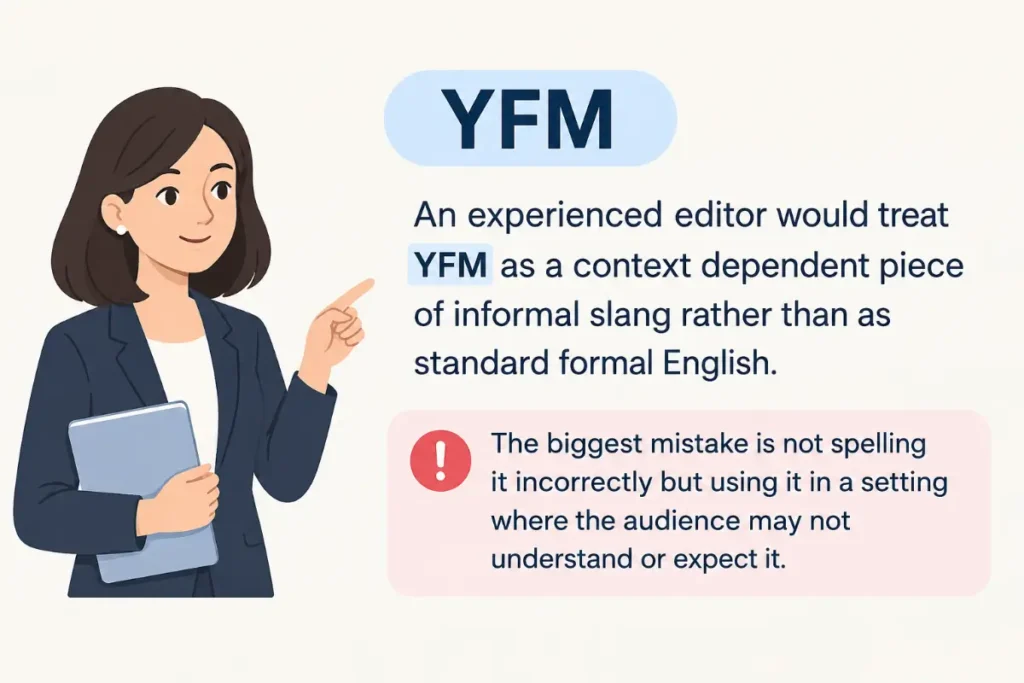
An experienced editor would treat YFM as a context dependent piece of informal slang rather than as standard formal English. The biggest mistake is not spelling it incorrectly but using it in a setting where the audience may not understand or expect it. Editors also look at the surrounding tone. If a casual character uses YFM in dialogue it can sound natural. If the same expression appears in a formal report it usually needs to be replaced with a clear standard phrase. Spellcheckers may not reliably flag every slang abbreviation because many short forms depend on context rather than conventional spelling.
Many readers also check grisly vs grizzly: Correct Spelling, Meaning and Usage.
Conclusion
The most common yfm meaning is You Feel Me? It is an informal texting expression used to ask if someone understands relates to or agrees with what the speaker is saying. The phrase uses feel in a figurative sense connected to understanding and emotional connection rather than physical sensation.
The abbreviation works best in texts social media group chats direct messages gaming conversations and other relaxed settings. It can sound friendly emotional persuasive or slightly challenging depending on the message around it. YFM can have other meanings in specialized contexts but the surrounding conversation usually makes the intended meaning clear.
A useful memory tip is to expand the three letters before deciding what the sender means. Read Y as You F as Feel and M as Me. Then look at the sentence before it. That simple habit will usually tell you exactly how the expression is being used.
FAQs
What does YFM mean in a text?
YFM usually means You Feel Me? in a text message. The sender is normally asking if you understand what they mean agree with their point or relate to their experience. It is similar to saying Do you get me? or You know what I mean? The exact tone depends on the sentence and the relationship between the people chatting.
Is YFM slang?
Yes. YFM is informal texting slang or digital shorthand. It represents You Feel Me? and is mainly used in casual conversations such as texts social media comments group chats and direct messages. It isn’t standard formal English. You can understand it easily in casual communication but you should normally avoid it in academic or professional writing.
Does YFM mean You Feel Me?
In ordinary texting YFM most commonly means You Feel Me? Reference sources identify this as the main internet slang use. The phrase asks for understanding agreement or connection. It usually isn’t a literal question about physical sensation. Context can reveal a slightly different shade of meaning.
What does YFM mean on social media?
On social media YFM usually means You Feel Me? People use it after a statement to ask if others understand relate or agree. For example someone might write That feeling when you study all night and still forget everything YFM? The writer is asking readers if they recognize the same experience. The expression keeps the tone casual and conversational.
How do you respond to YFM?
You can respond based on the meaning and tone of the message. If you agree you might say Yeah I feel you or Exactly. If you understand but don’t fully agree you can say I get what you mean or I see your point. If you’re confused simply ask the person to explain. A natural response should match the conversation.
Is YFM appropriate for formal writing?
YFM is generally not appropriate for formal writing. It works best in texts social media messages casual group chats and informal dialogue. In an essay report business email or professional document use a standard phrase such as Do you understand my point? or I hope you understand what I mean. Formal writing should favor clear language that all intended readers can understand.
Can YFM have other meanings?
Yes. YFM can represent different phrases or names in specialized contexts. Acronym databases list several alternative expansions including organizational names and entertainment related references. However You Feel Me? is the main interpretation in ordinary casual texting. If the abbreviation appears in a business organization or specialized setting check the surrounding context before choosing a meaning.
Is YFM the same as I feel you?
They are related but they usually serve different purposes. YFM means You Feel Me? and normally asks another person if they understand or relate. I feel you is usually a response that means I understand or relate to what you said. For example one person might write I’m exhausted YFM? and the other might answer Yeah I feel you.