
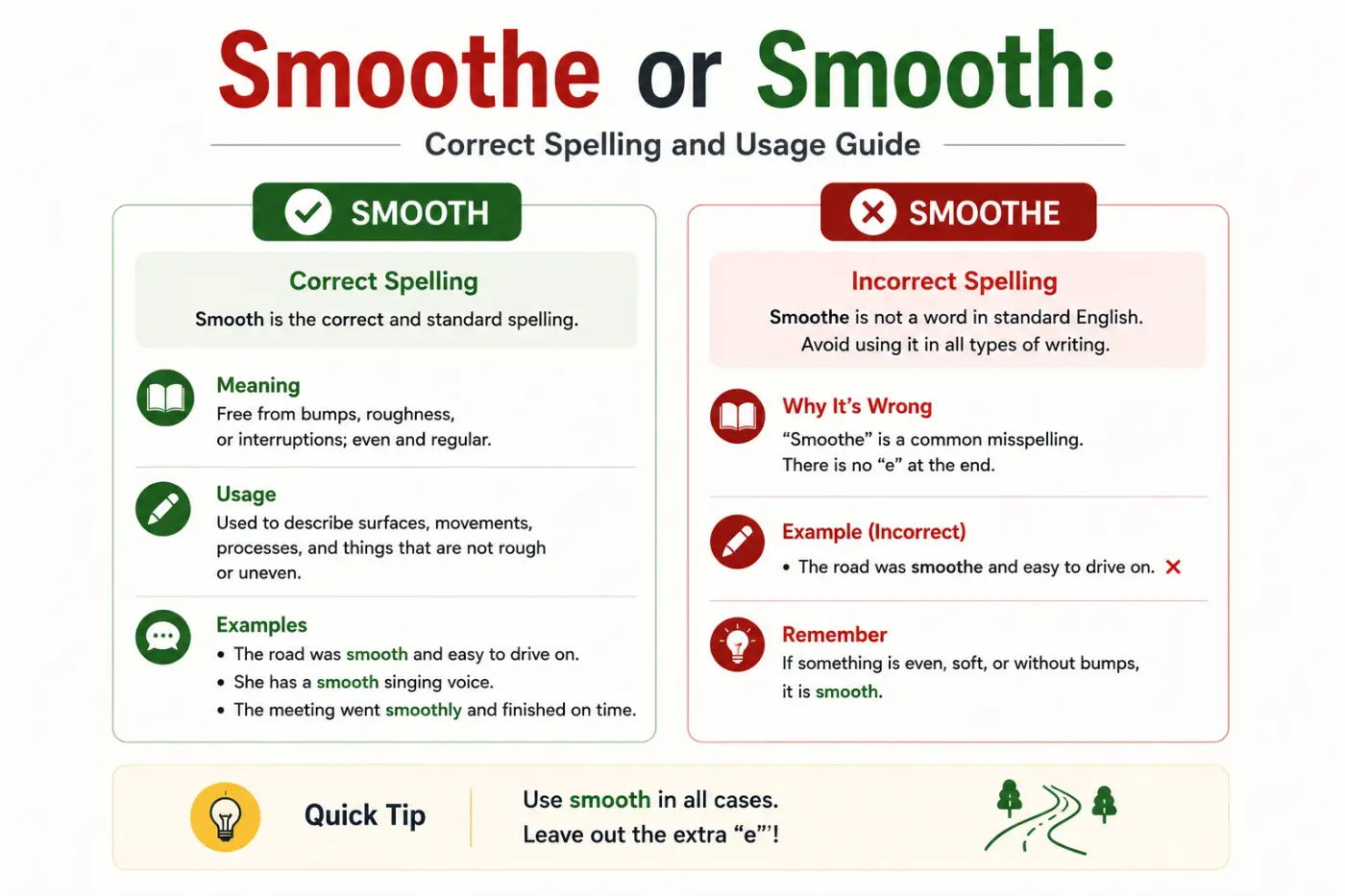
Smoothe or smooth can easily confuse even careful writers. The two forms look almost identical, but they don’t have the same place in modern English. If you’re wondering which spelling is correct, the answer is simple: smooth is the standard spelling used in modern American English. Smoothe may appear in historical or specialized sources, but it isn’t the form you should normally use in everyday writing.
The confusion makes sense because English spelling doesn’t always follow predictable patterns. Many familiar words end in a silent e, so it’s easy to assume that smooth should work the same way. The extra e can also feel natural when you’re spelling the word from its pronunciation. However, standard dictionaries and modern usage support smooth as the regular adjective and verb.
In this guide, you’ll learn the difference between smooth and smoothe, what each form means, how to pronounce smooth, and how to use it correctly in a sentence. You’ll also see natural examples, common spelling mistakes, grammar rules, word origins, regional usage, and practical advice from an editor’s perspective. By the end, you’ll know exactly which form to choose and why.
For another common grammar confusion, see Unenroll vs Disenroll Correct Usage and Meaning.
Quick Answer
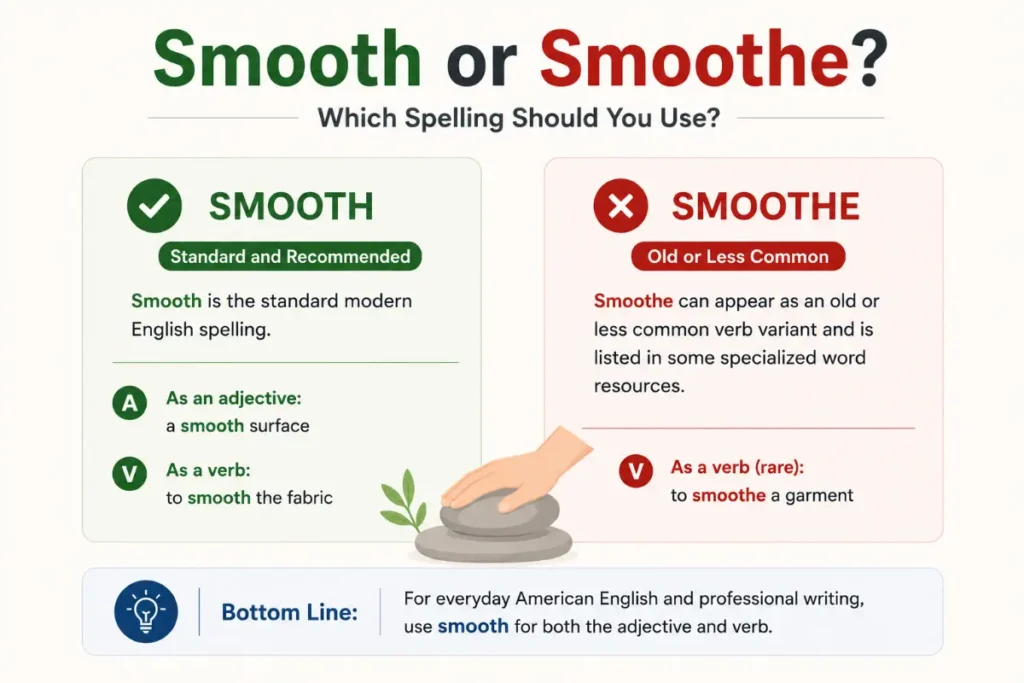
Smooth is the standard modern English spelling. Smoothe can appear as an old or less common verb variant and is also listed in some specialized word resources. However, for everyday American English and professional writing, use smooth for the adjective and verb.
Comparison Table
| Correct Form | Meaning | Part of Speech | Origin | Usage Frequency | Formality | Common Contexts | Example |
|---|---|---|---|---|---|---|---|
| Smooth | Even or free from roughness or difficulty | Adjective and verb | Old English and Middle English roots | Very common | Standard | Surfaces processes movement writing conversation | The table has a smooth surface. |
| Smoothe | Historical or uncommon form related to smooth | Verb and historical adjective form | Historical English spelling | Very rare | Archaic or nonstandard in modern use | Older texts historical references specialized word lists | The older text uses smoothe as a verb. |
Meaning and Definition
Meaning of Smoothe
Smoothe is not the spelling you should normally choose in modern American English. It has a real history in English and can be found as an archaic or less common form of the verb smooth. Some historical sources and specialized dictionaries preserve it. Merriam Webster also lists it in its Scrabble Dictionary as a playable verb meaning to smooth. That does not make it the normal choice for modern professional writing.
This distinction matters because people sometimes make a mistake by calling every appearance of smoothe an ordinary spelling error. In modern everyday writing it usually functions like a misspelling because readers expect the standard form smooth. In a brand name or creative name it may also be deliberate.
For practical writing the safest rule is simple. Use smooth. If you are editing a historical document then preserve the original spelling when the context requires it.
Meaning of Smooth
Smooth has several related meanings. At its most basic level it describes something that feels even and lacks roughness. You can have smooth skin smooth glass smooth fabric or a smooth road. Cambridge Dictionary lists smooth as an adjective for a regular surface and also uses it for things that happen without sudden changes or difficulty.
The word also works as a verb. To smooth something means to make it even or flat. You can smooth a wrinkle from a shirt. You can also smooth a difficult process by removing problems or obstacles. Cambridge Dictionary gives this broader verb sense as making something easier to do or achieve.
Smooth can also describe a person’s manner. A smooth speaker may sound confident and persuasive. Depending on the situation that quality can be positive or slightly suspicious. A smooth salesperson may know exactly how to make a pitch sound appealing.
The word has also developed several figurative meanings. A smooth conversation can flow naturally. A smooth performance can look effortless even when the person behind it has practiced for hours.
Key Differences Explained
Spelling
The main spelling difference is the final e. Modern standard English uses smooth. The extra e in smoothe is not needed in ordinary writing.
This is a useful reminder that English spelling does not always follow a neat pattern. Some words need a final e to represent a particular sound or grammatical form. Others simply do not. Smooth belongs to the second group.
Grammar Role
Smooth can function as an adjective and a verb. As an adjective it describes something even easy or polished. As a verb it describes the action of making something even or removing difficulties.
For example you can say the surface is smooth. You can also say please smooth the surface.
Smoothe has historically appeared as a verb and as an older adjective form. Modern writers normally use smooth instead.
Meaning
There is no useful modern meaning difference that requires you to choose smoothe instead of smooth. The standard word already covers the relevant meanings.
If you want to describe a surface use smooth. If you want to make something even use smooth as a verb.
Tone
Smooth sounds normal and natural in modern English. Smoothe can look old fashioned unusual or simply misspelled to a contemporary reader.
That difference in reader perception matters. Good editing is not only about dictionary definitions. It is also about choosing the form that your audience will recognize instantly.
Context
Use smooth in emails essays reports websites academic work business documents and everyday conversation. Reserve smoothe for situations where you are intentionally discussing historical language or reproducing an older source.
The extra e rarely adds anything useful in modern writing. In most cases it only creates a speed bump for the reader.
Which Spelling Is Correct?
For modern standard English the answer is smooth.
Major learner and general dictionaries treat smooth as the established modern word. Cambridge Dictionary gives smooth both adjective and verb functions and records several modern meanings related to surfaces movement difficulty taste and manner.
Historical evidence explains why smoothe sometimes appears. English spelling changed considerably over the centuries. Earlier forms of smooth included spellings such as smothe and smethe. Historical sources also record smoothe as an alternative form of the verb.
That history gives us a more accurate answer than simply saying the extra e has never existed. It has existed. It just isn’t the normal modern spelling you should use.
A professional editor would therefore change smoothe to smooth in most contemporary copy. The exception would be a historical quotation a deliberately preserved spelling or a proper name where the original form is part of the identity.
Sentence Examples
Natural Examples With Smooth
- The new road has a smooth surface that makes driving much easier.
- She has smooth skin that feels soft to the touch.
- Please smooth the paper before you place it in the folder.
- We had a smooth flight with no unexpected turbulence.
- His presentation was smooth clear and easy to follow.
- The cream gives the sauce a smooth texture.
- The team worked hard to make the transition smooth.
- She used a brush to smooth her hair before leaving.
- The conversation became smooth and relaxed after everyone arrived.
- The machine runs smoothly after the repair.
Examples Showing Smoothe As A Common Modern Error
- The surface should be smooth before you paint it.
- Please smooth the fabric before cutting it.
- She wants to smooth the rough edges.
- The company hopes to smooth the process for new customers.
- Use smooth when you mean to make something even.
These examples show why the confusion can be frustrating. The meaning is usually obvious even when the spelling is wrong. Readers can understand the sentence from context. Still the standard form makes the writing cleaner and more credible.
Common Mistakes and Misspellings
Adding An Unnecessary E
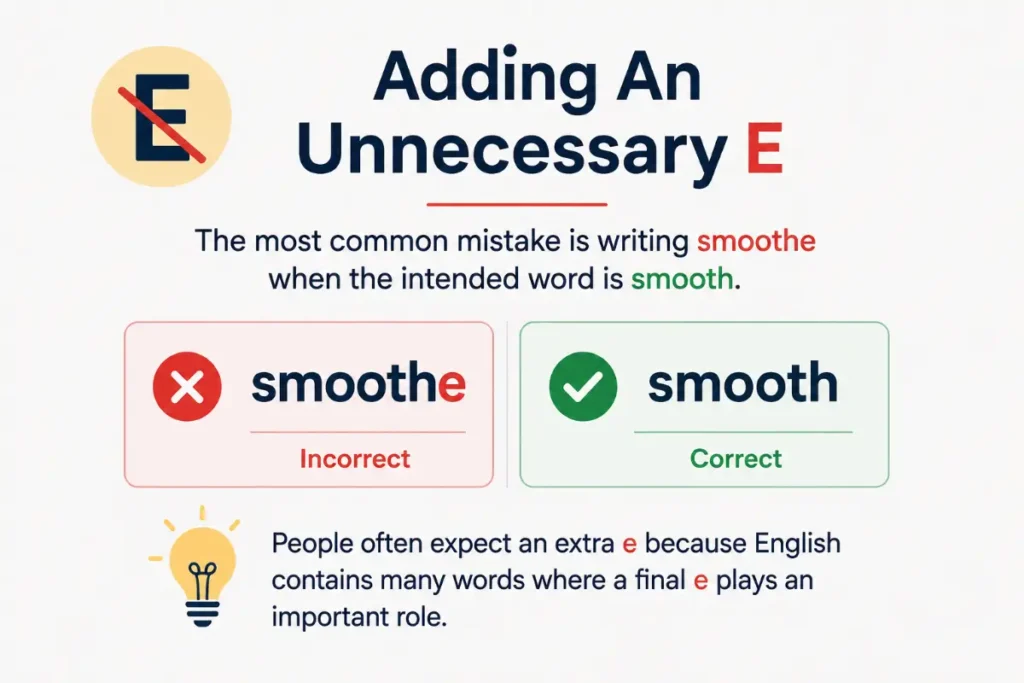
The most common mistake is writing smoothe when the intended word is smooth. People often expect an extra e because English contains many words where a final e plays an important role.
The brain also learns spelling through patterns. When a word looks like it should belong to a familiar pattern the hand may automatically add a letter. This is one reason spelling errors can happen even to strong writers.
Confusing Smooth With Soothe
Smooth and soothe look remarkably similar. They also share the same general vowel pattern in their pronunciation. Yet they are different words.
Soothe means to calm comfort or relieve. Smooth means even free from roughness or free from difficulty. A soothing voice may calm you. A smooth voice may sound pleasant and controlled.
Confusing Smooth With Smoothly
Smooth is often an adjective or verb. Smoothly is the standard adverb.
You can say the meeting was smooth. You can also say the meeting went smoothly.
This distinction helps prevent another common mistake. When you describe how an action happens you usually need smoothly rather than smooth.
Treating Historical Forms As Modern Forms
Finding smoothe in an old text does not mean modern writers should use it freely. English has many historical spellings that have fallen out of regular use.
A dictionary can preserve an old form because it has linguistic value. That does not mean the form is the best choice for a modern email or school essay.
Trusting Sound More Than Spelling
Smooth can sound as if it should end in an e. That sound based assumption can push writers toward smoothe.
English pronunciation and spelling do not always line up neatly. The safest approach is to learn the established spelling as part of the word rather than trying to build the spelling from sound alone.
Pronunciation Guide
Smooth is pronounced /smuːð/ in both major English varieties. Cambridge Dictionary gives the same basic pronunciation for US and UK English.
The word has one syllable.
A useful audio style spelling is smooth with a long oo sound followed by the voiced th sound found in words such as this and breathe.
The final sound is important. It is not the unvoiced th sound in think. Instead it uses the voiced sound you hear in this.
Say it slowly as one unit.
smooth
The sound can feel unusual for learners because English spelling does not give a simple visual clue about the final consonant. Listening practice helps more than trying to invent an extra letter.
A common pronunciation mistake is to make the final sound too hard or turn it into an s sound. Another is to pronounce the word as two syllables. Smooth has only one syllable.
Still confused? Compare Loose Or Lose Which Word Is Correct (2026).
Etymology and Word Origin
Smooth has a long history in English. Its roots reach back to Old English forms including smōð and related forms. Middle English later showed spellings such as smothe and smethe. Over time the modern spelling smooth became established.
The meaning has also expanded over time. The earliest central idea involved a surface that was free from roughness. From there the word developed broader meanings connected with movement ease speech manners and processes.
That expansion is common in language. A physical quality often becomes a metaphorical quality. Something that moves across a flat surface without bumps is smooth. A conversation that moves from one idea to another without awkward interruptions can also be smooth.
The word later developed meanings connected with polished behavior and persuasive speech. English speakers can call someone a smooth talker when that person sounds confident and convincing. The expression can carry admiration or suspicion depending on context.
Historical spellings help explain why smoothe sometimes appears. It was not invented by modern internet users. Older English used several forms that are no longer standard. Modern spelling eventually settled on smooth for ordinary use.
This history also shows why spelling questions deserve a little nuance. Calling an old form simply nonsense can erase useful information about how English developed. At the same time using an archaic form in modern writing can make your work look careless. Both facts can be true.
Regional Usage In The US
American English uses smooth as the standard spelling. It appears naturally in everyday conversation professional writing education journalism and technical language. American speakers also use smooth in a wide range of figurative expressions. A smooth process means an easy process.
A smooth transition means a transition without major problems. Smoothe is not the normal modern American spelling. If an American reader sees it in ordinary prose they will most likely treat it as an error unless the context clearly suggests an old text or a proper name.
Regional Usage In The UK
British English also uses smooth as the normal modern spelling. The word functions as both an adjective and a verb and has many of the same meanings found in American English.
Older British writing can contain historical spellings that look unfamiliar today. Smoothe belongs to that broader history of English variation. Modern British readers still generally expect smooth in contemporary prose.
The difference here is not a major US versus UK spelling issue. Unlike colour and color this pair does not represent a standard regional spelling choice.
Regional Usage In Australia
Australian English follows the modern standard and uses smooth in normal writing. Schoolwork professional communication journalism and general publishing all favor the established form.
Smoothe may appear in historical material or as an intentional name. It should not be treated as a normal Australian spelling alternative.
Regional Usage In Canada
Canadian English also uses smooth as the standard modern form. Canadian writers can use the word for physical surfaces abstract processes movement speech and personality.
As in the US UK and Australia smoothe does not represent a normal modern regional spelling difference. The extra e should not be added simply because the writer is using Canadian English.
Grammar Rules and Part of Speech
Smooth is especially useful because it can perform more than one grammatical job.
Smooth As An Adjective
As an adjective smooth describes a noun.
The glass is smooth.
She has smooth hair.
We had a smooth journey.
The adjective can describe physical texture. It can also describe an experience or process that happens without difficulty.
A smooth meeting is not necessarily physically smooth. The meaning is figurative. The meeting moves along without problems.
Smooth As A Verb
As a verb smooth means to make something even or to remove problems.
She smoothed the paper.
He smoothed the wrinkles from his shirt.
They worked to smooth the transition.
The verb can describe physical action or an abstract action. This flexibility is one reason smooth is so useful in everyday English.
Smooth As A Comparative
The comparative form is smoother.
This road is smoother than the old road.
The new process is smoother than the previous one.
The superlative is smoothest.
This is the smoothest route to the station.
The spelling remains stable as the word changes form.
Smoothly As An Adverb
When you need an adverb use smoothly.
The car moved smoothly.
The meeting went smoothly.
The system is running smoothly.
Cambridge Dictionary defines smoothly as happening easily and without interruption or difficulty.
Punctuation With Smooth
There is no special punctuation rule for smooth. Treat it like any ordinary adjective or verb.
If smooth begins a sentence then capitalize it normally. If it appears in the middle of a sentence then use lowercase unless grammar or a proper name requires capitalization.
Real Life Usage Examples
Daily Talk
People use smooth casually all the time.
- This table feels really smooth.
- The ride was surprisingly smooth.
These examples show the physical and experiential meanings people use in ordinary conversation.
Professional email often uses smooth to describe processes.
- I hope the transition goes smoothly.
- We want to make the onboarding process as smooth as possible.
The word works well because it sounds natural without being overly formal.
Academic Writing
Academic writers use smooth in technical and descriptive contexts.
- The researchers observed a smooth decline in temperature.
- The model produced a smooth curve across the measured range.
In academic work the meaning should come from the subject being discussed. Smooth can describe a physical pattern or a gradual change.
News Writing
News writers often use smooth when discussing political processes business operations transportation and public events.
- Officials said the transition had been smooth.
- The airport reported a smooth return to normal operations.
The word is short and familiar which makes it useful for clear reporting.
Literature
Literary writers often use smooth for sensory description and metaphor.
- The river moved over the smooth stones.
- His voice was smooth and quiet.
The word can create a strong image without requiring complicated language.
Expert Editor Insight
A senior editor would make the choice based on audience and context rather than on a simple rule that ignores history. In contemporary writing the natural choice is smooth. It is the form readers expect and the form supported by major modern dictionaries for adjective and verb use. Cambridge lists smooth with several modern meanings and grammatical roles while historical sources preserve smoothe as an older or less common form.
One practical editing tip is to look at the sentence rather than the isolated spelling. If the writer means make even then smooth works perfectly as the verb. If the writer means free from roughness then smooth works as the adjective. There is no need to add an e to make the grammar work.
Modern spelling tools will normally flag smoothe when it appears in ordinary prose because their dictionaries are designed around current usage. A specialized word list may treat it differently. That difference does not change the best editorial choice for normal writing.
Need another quick comparison? Read infront or in front Correct Spelling Meaning and Usage.
Conclusion
Smoothe or smooth can look like a tricky spelling choice because the extra e feels natural to many writers. For modern English the answer is clear. Smooth is the standard form to use in everyday writing professional communication academic work and polished content. Smoothe has a historical life and can still appear in specialized word resources but it is not the normal choice for contemporary prose.
The easiest practical tip is to remember that smooth already works as both an adjective and a verb. You don’t need to add an e. If you describe something as even or easy use smooth. If you describe how an action happens use smoothly.
FAQs
Is Smoothe A Real Word?
Smoothe has appeared in English as a historical and less common form related to smooth. It can also appear in specialized word resources. However modern readers generally expect smooth. For contemporary American English you should use smooth unless you are discussing an older text or deliberately preserving a historical spelling.
What Does Smooth Mean?
Smooth can describe an even surface that lacks roughness. It can also describe something that happens without difficulty or interruption. As a verb it means to make something even or to remove problems. It can also describe confident persuasive behavior. The exact meaning depends on the sentence and context.
Smoothe Or Smooth Which Is Correct?
For modern standard English use smooth. Smoothe has historical use as an alternative form but it is not the normal spelling expected in contemporary writing. If you are writing an email essay report article or professional document then smooth is the clear choice. The extra e usually makes the word look misspelled to modern readers.
How To Pronounce Smooth?
Smooth has one syllable and is pronounced /smuːð/. Start with the long oo sound and finish with the voiced th sound found in this. Do not add another syllable at the end. Cambridge Dictionary gives /smuːð/ for both US and UK pronunciation.
Can Smooth Start A Sentence?
Yes. Smooth can start a sentence when it functions as an adjective or verb. For example you can write Smooth roads make long trips easier. You can also write Smooth the surface before applying the paint. Capitalize the first letter because the word begins the sentence.
What Is The Synonym Of Smooth?
The best synonym for smooth depends on the meaning you want to express. For physical texture you can use words like even level flat or soft. For an easy process you can choose easy effortless or trouble free. When describing someone’s polished manner you might use refined polished or confident. Always choose a synonym that matches the specific context and meaning.
Why Do People Misspell Smooth?
People often add the final e because English contains many familiar words where e appears at the end. Sound can also influence spelling because smooth has a long vowel sound. The historical appearance of smoothe may add to the confusion. Still modern standard spelling uses smooth in ordinary writing.
Smooth In Formal Writing?
Smooth works very well in formal writing. It is clear familiar and grammatically versatile. You can use it in academic papers business reports professional emails journalism and technical documents. For formal writing the main concern is not avoiding the word. The key is using it precisely. Use smooth for the adjective or verb and smoothly when you need the adverb.