
If you’ve searched for cryer vs crier, you’re probably trying to figure out which spelling is correct. The confusion is understandable because both words look similar, sound almost identical, and appear in different dictionaries and online discussions. Many people assume cryer is simply an alternate spelling of crier, while others believe one is outdated or incorrect.
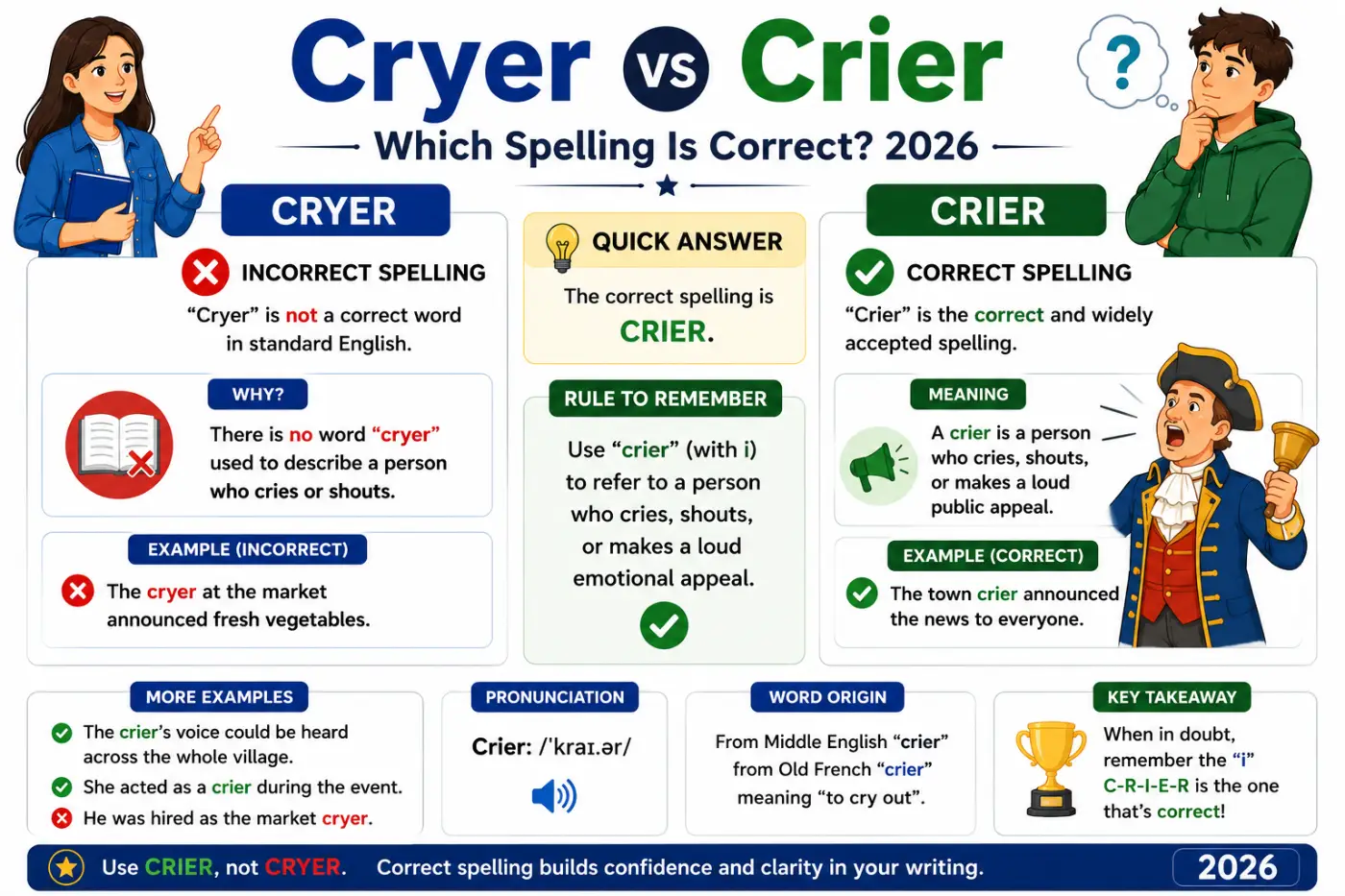
The short answer is simple. Crier is the standard and overwhelmingly preferred spelling in modern English. It refers to someone who cries, someone who publicly announces news, or an official known as a town crier. Cryer exists primarily as a surname and only appears as a rare historical spelling in older texts. In modern writing, you should almost always choose crier.
In this guide, you’ll learn the meaning of both words, why the confusion exists, pronunciation, grammar, real examples, historical background, common mistakes, regional usage, and practical advice from an editorial perspective. By the end, you’ll know exactly which spelling belongs in every situation.
Still confused? Compare cleverer vs more clever Which Form Should You Use.
Quick Definition
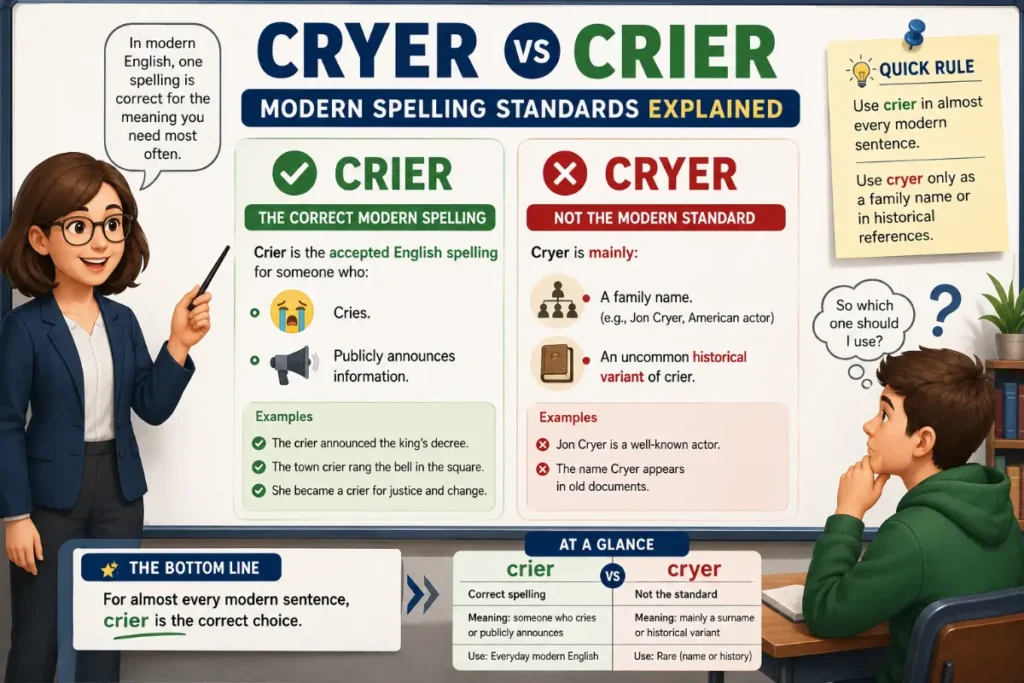
Cryer vs crier comes down to modern spelling standards. Crier is the accepted English spelling for someone who cries or publicly announces information. Cryer is mainly a family name and an uncommon historical variant. For almost every modern sentence, crier is the correct choice.
Quick Answer
If you’re writing modern English, use crier.
Use crier when referring to:
- A person who cries frequently.
- Someone who publicly announces news.
- A town crier.
- Someone known for complaining or expressing emotions openly.
Use Cryer only when it is:
- A person’s surname.
- Part of a proper name.
- Found in historical documents using older spelling conventions.
Cryer vs Crier Comparison Table
| Feature | Cryer | Crier |
|---|---|---|
| Modern correctness | Rare | Standard |
| Main meaning | Usually a surname | Person who cries or announces news |
| Part of speech | Proper noun in most cases | Common noun |
| Origin | Historical spelling and family name | From the English verb cry |
| Usage frequency | Very uncommon | Very common |
| Formality | Depends on name usage | Suitable in all writing |
| Common contexts | Personal names, genealogy | Grammar, literature, journalism, history |
| Dictionary status | Limited as common noun | Fully recognized standard spelling |
| Recommended choice | Only for names | Nearly every modern sentence |
Meaning of Crier
A crier is a person who cries, weeps, or loudly announces information. The word has several closely related meanings depending on the context.
Someone Who Cries
The most common meaning describes someone who cries easily or often.
Examples include:
- She’s always been a sensitive crier.
- He isn’t much of a crier, even during emotional movies.
- The baby became a constant crier after missing a nap.
A Public Announcer
Historically, a crier announced important information in towns before newspapers and modern communication.
Examples include:
- The town crier rang his bell before reading the king’s message.
- The village crier gathered everyone in the marketplace.
- The official crier announced the festival schedule.
Someone Who Calls Out
The word may also describe someone who loudly calls attention to something. Although this meaning is less common today, it still appears in literature and historical writing.
Meaning of Cryer
In modern English, Cryer is most often a surname rather than a vocabulary word. Examples include well known family names, business names, and historical records.
For example:
- Jon Cryer is an American actor.
- The Cryer family settled in the region during the nineteenth century.
- Professor Cryer published several research papers.
Occasionally, older English texts used cryer as an alternative spelling of crier, but this usage has almost disappeared from contemporary English.
Cryer vs Crier Meaning Differences
Although the words look nearly identical, their modern uses are very different.
Crier
- Common English noun.
- Found in dictionaries.
- Used in everyday writing.
- Refers to a person or official role.
Cryer
- Usually a proper noun.
- Most often a surname.
- Rare as an ordinary vocabulary word.
- Appears mainly in names or historical documents.
This difference explains why spell checkers usually accept crier but may flag cryer unless it is recognized as a proper name.
Cryer vs Crier Which One Is Correct
For modern English, crier is correct. Choose crier whenever you mean:
- Someone who cries.
- A town crier.
- Someone making public announcements.
- A person known for emotional expression.
Choose Cryer only when writing someone’s actual name.
For example:
Correct:
- The town crier announced the celebration.
- Emma isn’t much of a crier.
Also correct:
- Jon Cryer won several acting awards.
Incorrect:
- The town cryer announced today’s news.
Unless Cryer is someone’s surname, this spelling should normally be avoided.
Why People Confuse Cryer and Crier
Several factors contribute to the confusion.
- Both words sound almost identical.
- English spelling patterns are often inconsistent.
- Some older books contain the spelling cryer.
- Search engines display both forms.
- Family names reinforce the appearance that both spellings are equally acceptable.
- Autocorrect sometimes preserves surnames, making the difference less obvious.
The confusion is understandable, but modern editorial standards consistently favor crier as the correct common noun.
Cryer vs Crier Pronunciation Guide
Both spellings are generally pronounced the same.
Crier
IPA: /ˈkraɪ.ər/
Syllables:
cri • er
Sounds like:
CRY er
Cryer
IPA:
/ˈkraɪ.ər/
Because Cryer is primarily a surname, pronunciation occasionally varies slightly by family preference, but the standard pronunciation matches crier.
Common Pronunciation Mistakes
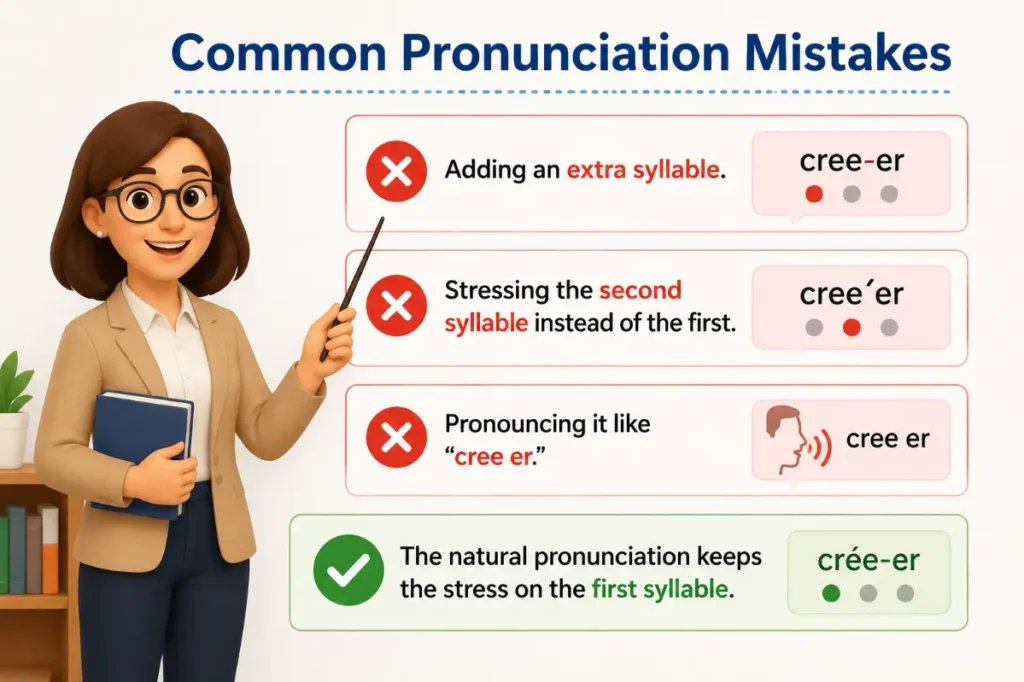
- Adding an extra syllable.
- Stressing the second syllable instead of the first.
- Pronouncing it like “cree er.”
The natural pronunciation keeps the stress on the first syllable.
A related grammar guide is Capital or Capitol Which One Is Correct 2026.
Etymology and Word Origin
The word crier comes from the Old French crier, meaning “to cry out” or “to proclaim,” which itself traces back to the Latin verb quiritare, meaning “to shout loudly.” During Middle English, spelling was much less standardized than it is today. Writers often spelled words according to local pronunciation or personal preference. Because of this, forms such as cryer occasionally appeared alongside crier. As English spelling gradually became standardized through dictionaries and printing, crier emerged as the accepted form. Today, cryer survives mainly as a surname and in historical documents rather than as a standard common noun.
Examples in Sentences
Seeing words in context is the easiest way to remember the correct spelling. The examples below show how crier functions as a common noun and how Cryer is normally used as a surname.
Ten Sentences Using Crier
- My little brother has never been much of a crier.
- The town crier announced the opening of the annual fair.
- She’s not a crier, but the speech brought tears to her eyes.
- Every crier in the audience became emotional during the memorial service.
- The royal crier delivered the king’s message to the crowd.
- Even as a child, he was not a loud crier.
- The baby became a restless crier after missing an afternoon nap.
- The newspaper described the official crier as a local landmark.
- Nobody expected the toughest player on the team to be such a crier after the championship.
- The museum hired a town crier to entertain visitors during the historical festival.
Ten Sentences Using Cryer
Because Cryer is usually a surname, it appears as part of a person’s name.
- Jon Cryer starred in several popular television shows.
- Professor Cryer presented the research findings at the conference.
- The Cryer family has lived in the village for generations.
- Ms. Cryer received an award for community service.
- Detective Cryer solved the mystery in the novel.
- Dr. Cryer specializes in emergency medicine.
- The article quoted historian James Cryer.
- Sarah Cryer published her first book this year.
- Judge Cryer delivered the final ruling.
- The Cryer Foundation supports local education programs.
These examples highlight an important distinction. Every example of Cryer refers to a proper name, while every example of crier refers to a common noun.
Common Mistakes About Cryer vs Crier
Many spelling mistakes happen because the words sound the same. Understanding the most common errors makes them much easier to avoid.
Mistake One
Using cryer instead of crier for a person who cries.
Incorrect:
- She has always been a cryer.
Correct:
- She has always been a crier.
Mistake Two
Writing town cryer.
Incorrect:
- The town cryer announced the new law.
Correct:
- The town crier announced the new law.
Mistake Three
Changing a person’s surname.
Incorrect:
- Jon Crier won the award.
Correct:
- Jon Cryer won the award.
Never change the spelling of someone’s name, even if it resembles another English word.
Mistake Four
Assuming both spellings are interchangeable. Although older documents sometimes contain cryer, modern dictionaries and style guides overwhelmingly prefer crier as the standard noun.
Mistake Five
Relying entirely on pronunciation. English contains many words that sound alike but have different spellings and meanings. Pronunciation alone cannot determine the correct form.
Cryer vs Crier Regional Usage
The distinction between these spellings remains consistent across the major varieties of English.
American English
American English strongly favors crier as the standard noun.
Examples include:
- Town crier.
- News crier.
- She’s not a crier.
Cryer appears almost exclusively as a surname.
British English
British English follows the same pattern. Historical references frequently mention the town crier, an official responsible for making public announcements before newspapers became widely available.
Canadian English
Canadian dictionaries also recognize crier as the standard spelling. Professional writing, journalism, education, and publishing consistently use crier.
Australian English
Australian English likewise uses crier in ordinary writing. Cryer remains limited to proper names and historical records.
Is There Any Regional Preference?
No.
Unlike some spelling pairs such as color and colour, there is no meaningful regional split between cryer and crier. Across modern English, crier is the accepted common noun.
Grammar Rules
Understanding the grammar behind crier helps prevent mistakes.
Part of Speech
Crier is a countable common noun.
Examples:
- One crier.
- Two criers.
- Several criers.
Singular and Plural
| Form | Example |
|---|---|
| Singular | The crier spoke loudly. |
| Plural | The criers gathered outside the courthouse. |
Possessive Forms
Singular possessive:
- The crier’s voice echoed through the square.
Plural possessive:
- The criers’ announcements attracted large crowds.
Articles
Because crier is countable, it commonly appears with articles.
Examples:
- A crier.
- The crier.
- Every crier.
Modifiers
Common adjectives include:
- Town crier.
- Official crier.
- Public crier.
- Emotional crier.
- Frequent crier.
Proper Nouns
Cryer functions differently because it is generally a proper noun.
Proper nouns:
- Are capitalized.
- Do not change spelling.
- Refer to specific people or families.
Real Life Usage Examples
Daily Conversation
- My sister isn’t much of a crier.
- The baby became a crier after bedtime.
Academic Writing
- Medieval communities relied on the town crier to communicate official announcements.
Professional Communication
- The museum hired a town crier for the heritage festival.
Literature
Historical novels frequently feature a town crier to establish the setting and reflect traditional methods of communication.
News and Media
Journalists commonly use town crier when reporting on historical reenactments, festivals, museums, and civic celebrations.
Related Words and Commonly Confused Terms
Words connected to crier include:
- Cry.
- Crying.
- Weep.
- Sob.
- Mourner.
- Herald.
- Announcer.
- Messenger.
- Proclaimer.
- Broadcaster.
- Caller.
- Orator.
Words people often confuse with crier include:
- Cryer.
- Crier.
- Crying.
- Cries.
- Cried.
- Herald.
- Caller.
- Announcer.
Although some of these words overlap in meaning, each has its own specific usage and grammatical role.
Expert Language Insight
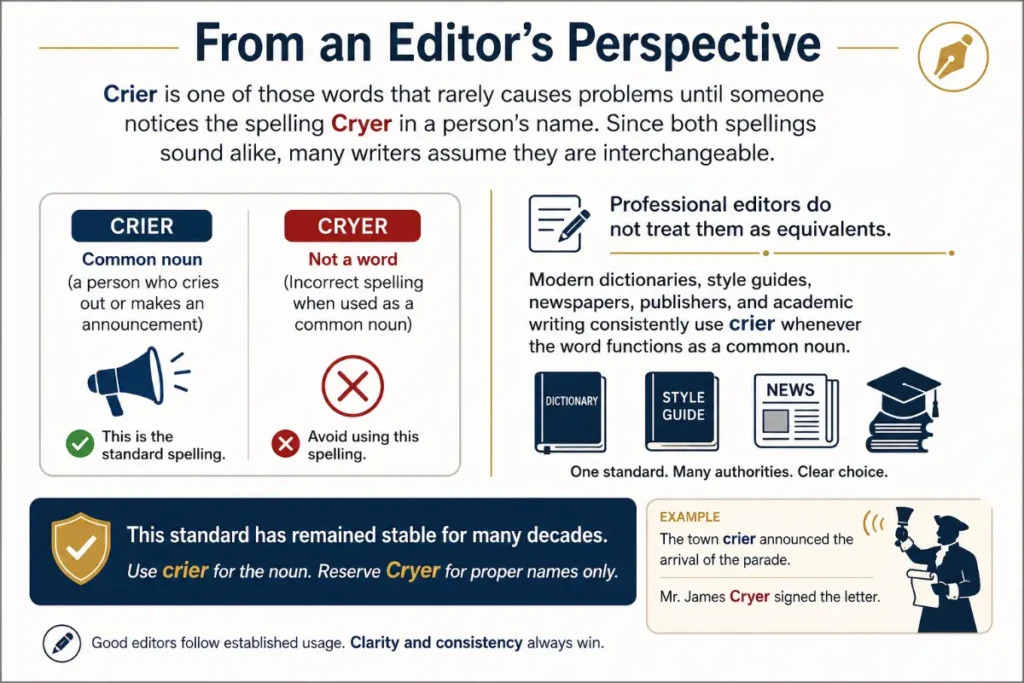
From an editor’s perspective, crier is one of those words that rarely causes problems until someone notices the spelling Cryer in a person’s name. Since both spellings sound alike, many writers assume they are interchangeable. Professional editors do not treat them as equivalents. Modern dictionaries, style guides, newspapers, publishers, and academic writing consistently use crier whenever the word functions as a common noun. This standard has remained stable for many decades.
keys Takeaway
- Crier is the standard modern English spelling.
- It refers to someone who cries or publicly announces information.
- Town crier is the historically correct expression.
- Cryer is primarily a surname.
- Older documents may contain cryer, but modern English rarely uses it as a common noun.
- American, British, Canadian, and Australian English all prefer crier.
- Both words are pronounced almost identically.
- When in doubt, use crier unless you are writing someone’s name.
Many readers also check Bearer vs Barer Explained: Meaning, Usage, and Examples 2026.
Conclusion
The answer to cryer vs crier is straightforward once you understand how each word functions. Crier is the accepted spelling in modern English for someone who cries or someone who publicly announces information, such as a town crier. It appears in dictionaries, educational materials, newspapers, and professional writing across all major English-speaking countries.
Cryer, on the other hand, is best recognized as a surname. While historical texts occasionally used it as a spelling variant, that usage has largely disappeared from modern English. Today, you should use Cryer only when it forms part of a person’s name or another proper noun.
Remember this simple rule. If you’re writing about a person who cries or an official announcer, choose crier. If you’re referring to someone’s family name, keep the spelling Cryer exactly as it appears. Following this distinction will make your writing accurate, natural, and consistent with modern English usage.
Frequently Asked Questions
Is crier the correct spelling in modern English?
Yes. Crier is the standard spelling in modern English when referring to someone who cries frequently or someone who publicly announces news, such as a town crier. It is the form recognized by major dictionaries and used in professional writing, education, journalism, and publishing.
Is cryer ever a correct word?
Yes, but only in limited situations. Cryer is most commonly a surname, as in the actor Jon Cryer. It also appears as an uncommon historical spelling in older English texts. It is not the preferred spelling for the common noun in modern English.
Why do cryer and crier sound the same?
English contains many words that share the same pronunciation but have different spellings or uses. Cryer and crier are generally pronounced /ˈkraɪ.ər/, which is why many writers accidentally choose the wrong spelling.
What is a town crier?
A town crier was an official public messenger who announced laws, news, royal proclamations, and community events before newspapers, radio, and television existed. The term is still used today during historical reenactments, festivals, and ceremonial events.
Can I use cryer instead of crier?
No. In modern English, cryer should not replace crier unless you are writing a person’s surname or quoting a historical document that uses the older spelling. For everyday writing, crier is the correct choice.
Do British and American English use different spellings?
No. British English, American English, Canadian English, and Australian English all use crier as the standard common noun. There is no regional spelling difference like there is with words such as color and colour.
What is the plural of crier?
The plural form is criers.
Examples:
- The criers gathered in the town square.
- Several criers participated in the historical parade.
The regular s ending follows standard English plural rules.
How can I remember the correct spelling?
Think of the verb cry. Someone who cries is a crier. Reserve Cryer for names only. This simple memory trick works in almost every writing situation and helps prevent one of the most common spelling mistakes.