
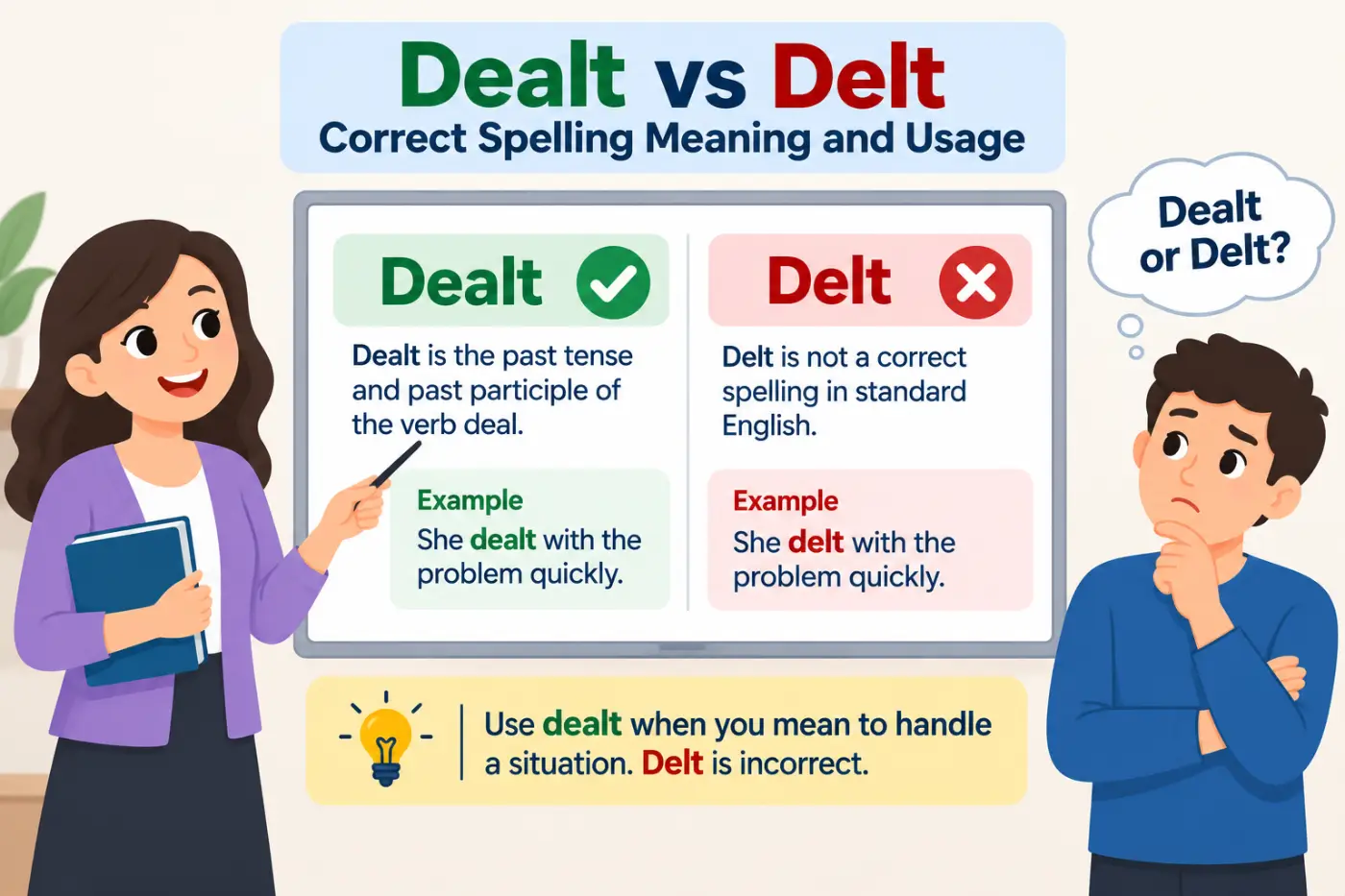
If you’ve written the past tense of deal and suddenly wondered if it should be dealt or delt you’re dealing with a very common English spelling problem. dealt vs delt has a simple answer: dealt is the correct standard English form. Delt is not the standard past tense or past participle of deal.
The confusion comes from pronunciation. In normal speech dealt is pronounced with one syllable and the vowel sound can make the spelling feel less obvious. English also has many irregular verbs whose past forms don’t follow the usual pattern of adding ed. That means you can’t always build the past tense simply by changing deal into a familiar sounding form.
The good news is that the rule is easy once you connect deal with its established past form dealt. You’ll learn what each form means, why delt appears in writing, how to pronounce the correct word, and how to use it in everyday and formal sentences. We’ll also look at grammar patterns, related expressions, regional usage, common errors, and practical examples.
Need another quick comparison? Read counselor vs councilor: Meaning and Correct Usage.
Quick Definition
Dealt is the correct standard past tense and past participle of the verb deal. It can mean handled something, distributed something, traded in something, or behaved toward someone in a particular way. Delt is generally a misspelling when it is intended as the past form of deal and should be replaced with dealt in standard English.
Quick Answer
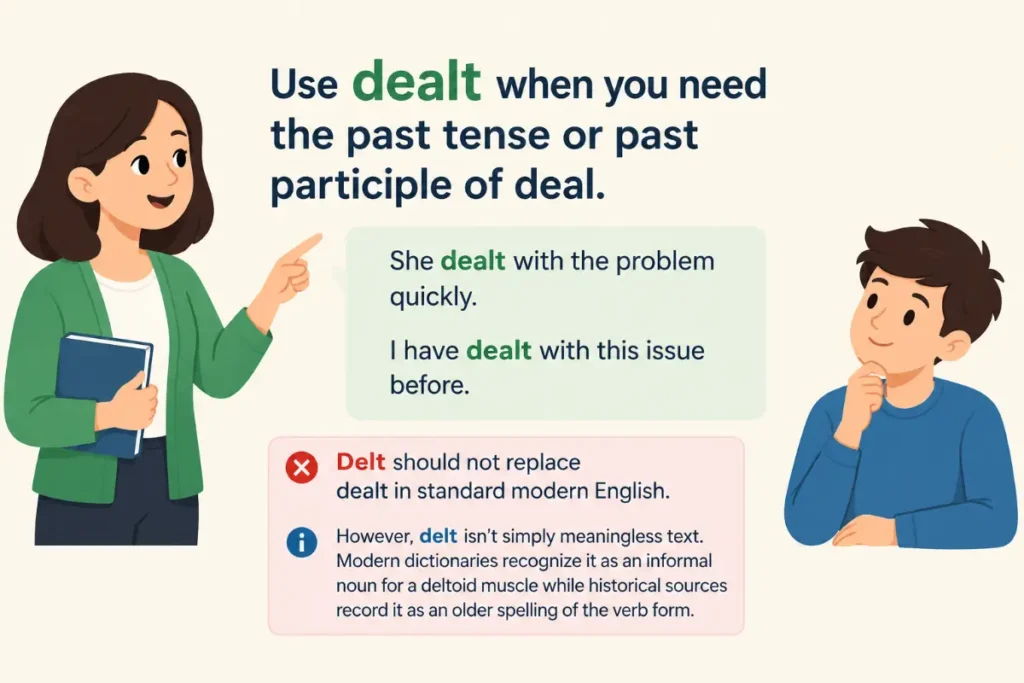
The correct form is dealt. Delt is not the standard past tense or past participle of deal.
Use dealt when talking about something that someone handled, distributed, experienced, traded, or did in the past. For example, She dealt with the problem quickly is correct.
Comparison Table
| Correct Form | Meaning | Part of Speech | Origin | Usage Frequency | Formality | Common Contexts | Example |
|---|---|---|---|---|---|---|---|
| Dealt | Past form of deal meaning handled, distributed, traded, or behaved toward | Verb | Old English and Germanic roots | Very common | Neutral and formal | Conversation, work, business, cards, problems, relationships | She dealt with the issue calmly. |
| Delt | Not the standard past form of deal | Nonstandard spelling | Usually a spelling error rather than a standard historical form | Uncommon in standard writing | Not standard | Typing mistakes and informal errors | Delt should be changed to dealt. |
Meaning and Definition
Meaning of the Incorrect Form
Delt is generally not the standard English past tense of deal.
If someone writes I delt with the problem yesterday, they almost certainly mean I dealt with the problem yesterday. The writer has tried to form the past tense by changing the spelling according to the sound or by treating deal as if it followed a simpler spelling pattern.
This error is understandable. Many English verbs form their past tense by adding ed. Others change their spelling in less predictable ways. Deal belongs to the second group.
You might see delt in quick messages, informal posts, online comments, personal notes, or unedited text. Repeated exposure can make an incorrect form look familiar. Familiarity, however, doesn’t make it a standard spelling.
There are possible situations in which Delt could appear as a name, abbreviation, fictional term, or specialized label. Those uses depend on the specific context. They don’t establish delt as the standard past tense of deal.
For normal English writing, use dealt.
Meaning of the Correct Form
Dealt is the past tense and past participle of deal.
The verb deal has several meanings, so dealt can express several related ideas depending on the sentence.
One common meaning is to handle or manage something.
She dealt with the complaint professionally.
Here dealt means that she handled the complaint.
Another meaning is to give or distribute something.
The teacher dealt the cards to the students.
In card games, dealt means distributed cards to players.
The verb can also describe business activity.
The company dealt in rare books.
In this context deal means to trade in a particular product.
Dealt can also describe treatment or behavior.
He was dealt a difficult situation.
The phrase suggests that something was given or presented to someone, often without that person choosing it.
Another familiar expression is deal with.
We dealt with the problem yesterday.
The phrase means that someone addressed or handled an issue.
The meaning therefore depends heavily on the construction around the verb. Learning dealt by itself is useful, but learning common phrases such as dealt with and dealt the cards makes the word much easier to use correctly.
Key Differences Explained
- Spelling. Dealt is the standard form. Delt is normally a spelling error when intended as the past form of deal.
- Grammar. Dealt is both the simple past form and the past participle of deal.
- Meaning. Dealt can mean handled, distributed, traded, or treated depending on the sentence.
- Pronunciation. Dealt is normally pronounced as one syllable. Its sound can make the spelling less obvious to learners.
- Verb pattern. Deal is an irregular verb. Its past forms do not follow the regular pattern of simply adding ed.
- Formality. Dealt works naturally in casual conversation, professional writing, academic writing, journalism, and formal documents.
- Context. The word appears in discussions about problems, business, card games, relationships, experiences, and decisions.
- Standard usage. English dictionaries recognize dealt as the established past and past participle form of deal. Delt is not the normal standard form.
The important point is that this isn’t a case of two English words with different meanings. In ordinary English, the comparison is mainly between the standard form and a common misspelling.
Which Form Is Correct?
Dealt is correct.
The reason is grammatical as well as lexical. Deal is an irregular verb, which means its past form doesn’t follow the regular pattern used by verbs such as walk, walked and talk, talked.
The forms are:
Present: deal
Past: dealt
Past participle: dealt
This same past form works with several meanings of the verb.
I deal with customers every day.
I have dealt with similar problems before.
Notice how the verb changes according to tense and construction while the past and past participle forms remain dealt.
A dictionary based approach gives the same result. Standard English dictionaries list deal as a verb and identify dealt as its past tense and past participle. The spelling delt is not normally presented as an alternative standard form.
A useful language learning strategy is to memorize irregular verbs as three part sets rather than learning only the present form.
Deal, dealt, dealt.
That pattern is short and easy to recall.
Sentence Examples
Here are natural examples using the correct form in different situations.
- I dealt with the problem before the meeting started.
- She dealt with the customer’s complaint calmly.
- We dealt the cards and began the game.
- He had dealt with similar situations before.
- The manager dealt with the issue immediately.
- They dealt in antiques for many years.
- I’ve dealt with enough delays for one day.
- The experience dealt a serious blow to his confidence.
- She dealt honestly with everyone on the team.
- The teacher dealt the cards to each player.
Here are examples showing the common spelling error.
- I delt with the problem yesterday.
- She delt with the complaint professionally.
- We delt the cards before starting the game.
- He has delt with this issue before.
- They delt with several difficult customers.
In each example, replace delt with dealt.
How Deal Changes Into Dealt
One reason this word causes trouble is that learners may expect a regular past tense.
For a regular verb such as call, the pattern is simple.
Call becomes called.
For deal, the pattern is different.
Deal becomes dealt.
The spelling changes rather than simply adding ed. The final t in dealt is part of the established irregular form.
You don’t need to invent the past form each time you use the verb. Treat it as a fixed verb pattern.
Deal, dealt, dealt.
This approach is especially helpful for English learners because irregular verbs often cause mistakes when writers try to apply a regular rule.
There is another useful pattern here. Deal belongs to a group of English verbs whose past forms developed through older Germanic vowel and consonant changes. Modern speakers don’t normally create these forms from scratch. They learn them as established vocabulary.
That’s why delt feels plausible but doesn’t work as the standard form.
Common Mistakes and Misspellings
Writing Delt Instead of Dealt
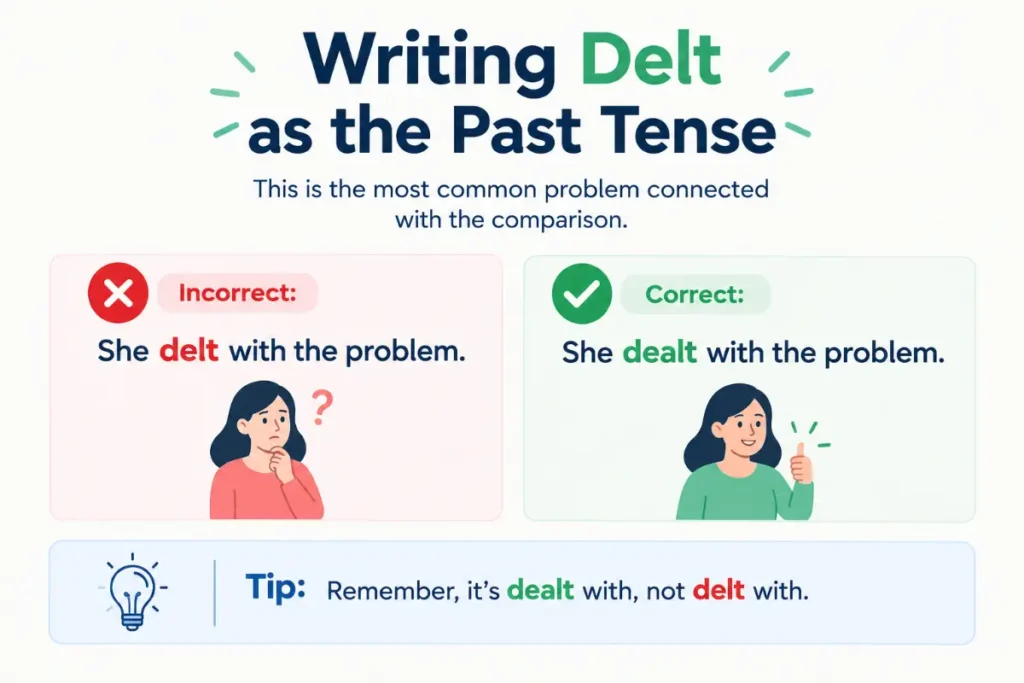
This is the main mistake.
Incorrect: She delt with the problem.
Correct: She dealt with the problem.
The writer has removed the a from the standard form. Pronunciation can contribute to this because the vowel in spoken dealt isn’t always perceived clearly.
Treating Deal Like a Regular Verb
Some learners may try to write dealed.
Incorrect: We dealed with the issue.
Correct: We dealt with the issue.
Deal is irregular, so dealed isn’t the standard past form.
Using Deal for a Past Event
Another mistake is leaving the verb in its present form when the sentence requires past tense.
Incorrect: Yesterday I deal with the complaint.
Correct: Yesterday I dealt with the complaint.
The time expression yesterday signals that the action happened in the past.
Confusing Dealt With and Dealed With
The expression is always dealt with when referring to the past.
Present: We deal with customer complaints.
Past: We dealt with customer complaints.
Present perfect: We have dealt with customer complaints.
This pattern is worth memorizing because dealt with is one of the most common uses of the word.
Confusing Dealt With and Dealt
Dealt can appear without with.
The dealer dealt the cards.
Here dealt means distributed.
But when you mean handled or addressed something, deal with is normally required.
She dealt with the complaint.
The preposition changes the construction and therefore affects the meaning.
Why Do People Write Delt?
The spelling mistake has a few understandable causes.
First, pronunciation can hide the spelling. Dealt is one syllable and the vowel sound is not always obvious to someone who is still learning English spelling.
Second, writers may rely on sound rather than the visual pattern of the word. If they hear the word and write what seems to match the sound, delt may feel reasonable.
Third, irregular verbs create uncertainty. Learners often know that English has unusual past tense forms but may not remember which form belongs to which verb.
Fourth, fast typing can remove letters. When someone is writing quickly, a vowel can disappear without the writer noticing.
Finally, autocorrect and spellcheck behavior can contribute to confusion. Some writing tools understand intended meaning from context, but no software should be treated as a substitute for knowing the standard form.
From an NLP perspective, a system can often identify delt as a likely misspelling when nearby words strongly suggest the phrase dealt with. Human writers still need to use the established form in finished text.
Pronunciation Guide
Dealt is usually pronounced /dɛlt/ in standard American English.
It is one syllable.
An easy pronunciation guide is:
DELT
The vowel sound is similar to the vowel in words such as help and left for many American speakers.
The final t is pronounced as part of the word. The word does not have two syllables.
A common mistake is trying to pronounce the a as a separate sound. You don’t say dee alt. The spelling contains the letters d e a l t but the word is pronounced as one compact syllable.
The pronunciation is one reason the spelling can be tricky. Spoken English doesn’t always reveal every written letter in an obvious way.
A good way to learn it is to connect the sound with the phrase dealt with.
Dealt with the problem.
Say the phrase naturally several times. Then write it. This links pronunciation, grammar, and spelling together.
Grammar Rules and Part of Speech
Dealt is a verb form. It serves as both the simple past and past participle of deal.
Simple Past
Use dealt for an action that happened in the past.
I dealt with the problem yesterday.
She dealt the cards.
They dealt with the complaint quickly.
The exact meaning comes from the surrounding words.
Past Participle
Dealt also works as a past participle.
It commonly appears with have, has, or had.
I have dealt with this issue before.
She has dealt with difficult customers.
They had dealt with the problem already.
The form doesn’t change.
Deal becomes dealt in the past and remains dealt after have, has, or had.
Deal With
It is one of the most important patterns to learn.
In the present:
I deal with customer complaints.
In the past:
I dealt with customer complaints.
With the present perfect:
I have dealt with customer complaints.
The phrase can mean handle, address, manage, or respond to something.
Deal the Cards
A different construction appears in card games.
The dealer dealt the cards.
Here dealt means distributed the cards.
This distinction matters because dealt with and dealt the cards have different meanings.
Dealt a Blow
Dealt can also appear in the expression dealt a blow.
The defeat dealt the team a major blow.
This means the defeat caused a serious setback.
The phrase is common in journalism, formal writing, and storytelling.
Punctuation
Dealt itself doesn’t require special punctuation. Punctuation depends on the sentence around it.
For example:
She dealt with the problem.
No special punctuation is needed.
If the sentence contains an introductory phrase, normal punctuation rules apply.
After several hours, she dealt with the problem.
The comma belongs to the introductory phrase rather than to the verb itself.
Many readers also check Maintained vs Maintenancede Grammar and Examples 2026.
Dealt With Meaning
The phrase dealt with deserves special attention because it is one of the most common places learners encounter this form.
Dealt with can mean handled or addressed.
The manager dealt with the complaint.
It can also describe someone’s experience with a particular situation.
I dealt with several problems during the move.
In both examples, the person actively handled a situation.
The phrase can also describe communication or interaction.
She dealt with the customer respectfully.
Here it describes the way she behaved toward the customer.
The meaning can shift slightly depending on the object.
Dealt with a problem means handled a problem.
Dealt with a customer means interacted with or handled the customer.
This is why context matters. The basic idea remains connected to handling, addressing, or engaging with something.
Dealt in Business and Trade
Deal has another important meaning related to trade.
Someone can deal in a particular product or type of merchandise.
The company dealt in imported furniture.
The past version is:
The company dealt in imported furniture.
Here dealt doesn’t mean handled a problem. It means engaged in trade involving a particular product.
The construction is usually deal in.
Examples include:
The family dealt in rare books.
The business dealt in fine art.
He dealt in used machinery.
This meaning is more specialized than deal with but remains common in business and historical contexts.
Don’t confuse deal in with deal with.
Deal in focuses on trade or business activity.
Deal with focuses on handling or addressing something.
That small preposition can change the meaning considerably.
Dealt in Card Games
Another familiar meaning appears in card games.
A player can deal cards to other players.
The past form is dealt.
The dealer dealt five cards to each player.
Here the meaning is distribute.
This is one of the easiest uses to understand because the action is physical and concrete.
You can also use the passive form.
Five cards were dealt to each player.
In that sentence dealt remains the past participle.
The word also appears in common phrases involving cards.
The cards were dealt.
The dealer dealt the cards.
The cards had already been dealt.
Each sentence uses the same irregular verb form.
Real Life Usage Examples
Daily Conversation
In everyday speech, the most common use often involves handling a situation.
- I dealt with it yesterday, so you don’t need to worry.
- She dealt with the problem better than I expected.
These examples sound natural in ordinary conversation. Speakers use the phrase to describe managing problems, responsibilities, or difficult situations.
Email and Workplace Communication
Professional writing frequently uses the word when discussing tasks and problems.
- We dealt with the customer complaint and provided a replacement.
- The team has dealt with similar issues in the past.
The word fits naturally into workplace communication because it clearly describes action and responsibility.
Academic Writing
Academic writing may use dealt when describing how researchers or authors addressed a topic.
- The study dealt with several factors that influence student performance.
- Previous researchers had dealt with similar questions.
In formal writing, the expression can be useful when the intended meaning is addressed or examined.
News Writing
Journalists often use dealt in descriptions of events and consequences.
- The decision dealt a major blow to the company.
- Officials dealt with the emergency throughout the night.
The first example uses the fixed expression dealt a blow. The second describes active management of a situation.
Literature and Storytelling
Storytelling can use the word to describe conflict, treatment, or difficult circumstances.
- She dealt with the loss quietly and continued her journey.
- The hand he had been dealt changed the course of his life.
The second example connects with the metaphor of cards. A person can be said to receive a hand that represents the circumstances they face.
Related and Confused Terms
Deal
Deal is the present form of the verb.
I deal with customer requests every morning.
Use it for present actions or after certain helping verbs.
Dealt
Dealt is the past and past participle form.
I dealt with the request yesterday.
It can describe something handled, distributed, traded, or experienced.
Dealing
Dealing is the present participle and gerund form.
She is dealing with the problem now.
The spelling changes from deal to dealing by adding ing.
Dealed
Dealed is not the standard past tense of deal. Writers sometimes create it by applying the regular past tense pattern. Standard English uses dealt instead.
Delt
Delt is generally a misspelling when intended as the past form of deal.
Handled
Handled is a useful synonym for one major meaning of dealt.
She handled the complaint.
She dealt with the complaint.
The two sentences can be very close in meaning.
Managed
Managed can also overlap with dealt with.
He managed the difficult situation.
He dealt with the difficult situation.
Managed can suggest control or successful organization while dealt with is broader.
Addressed
Addressed often works in formal contexts.
The committee addressed the issue.
The committee dealt with the issue.
Addressed can sound more precise when the meaning is to discuss or respond to a particular issue.
American English
Dealt is the standard form in American English. It appears in everyday conversation, professional communication, journalism, academic writing, and literature.
American speakers commonly use dealt with to describe handling a situation.
I dealt with the issue this morning.
The form also appears in card games.
She dealt five cards to each player.
Delt is not a standard American spelling of the past tense of deal.
British English
British English also uses dealt as the standard past and past participle form.
There is no major spelling difference here between American and British usage. A British writer would normally write:
I dealt with the problem yesterday.
The meanings and grammatical patterns are also essentially the same.
Delt is not an accepted regional British alternative to dealt in standard English.
Australian English
Australian English uses dealt as the standard past form of deal.
The word appears naturally in conversation, workplace writing, education, journalism, and informal communication. There is no established Australian spelling that changes dealt to delt.
The same rule applies: use dealt for the past and past participle forms of deal.
Canadian English
Canadian English also uses dealt as the standard form.
Their writers and speakers use the word in the same major constructions found in American and British English.
The spelling doesn’t change because of Canadian regional usage. Delt remains a nonstandard spelling when it is intended as the past form of deal.
Etymology and Word Origin
Deal has a long history in English and belongs to an old Germanic word family.
The modern verb developed from Old English forms connected with ideas such as dividing, distributing, and sharing. These meanings help explain several uses that remain familiar today.
The idea of distribution is especially clear in card games. When someone deals cards, they distribute them among players.
From this basic sense, the verb developed and expanded into other uses involving handling, conducting business, and treating people or situations in particular ways.
The past form dealt is an established irregular form that reflects the historical development of the verb. It wasn’t created by simply adding the regular past ending to modern English deal.
This is why deal and dealt look different from regular verb pairs such as clean and cleaned.
The irregular form has survived because it became a fixed part of the English verb system.
Understanding that history also explains why delt isn’t a natural alternative. Modern speakers inherited dealt as the established past form.
Why Dealt Looks Different From Deal
At first glance, deal and dealt seem to follow an unusual spelling pattern.
The present form is:
Deal
The past form is:
Dealt
The extra t signals the past form while the vowel pattern changes as part of the irregular verb form.
Compare this with other common irregular verbs.
Go becomes went.
Take becomes took.
Keep becomes kept.
Feel becomes felt.
Deal becomes dealt.
There isn’t always a simple rule that lets you predict an irregular verb from its present form. That’s why learners generally memorize these forms.
For practical writing, there’s no need to analyze the historical changes each time. Remember the small three word set:
Deal. Dealt. Dealt.
That is enough to prevent most tense mistakes.
Expert Editor Insight
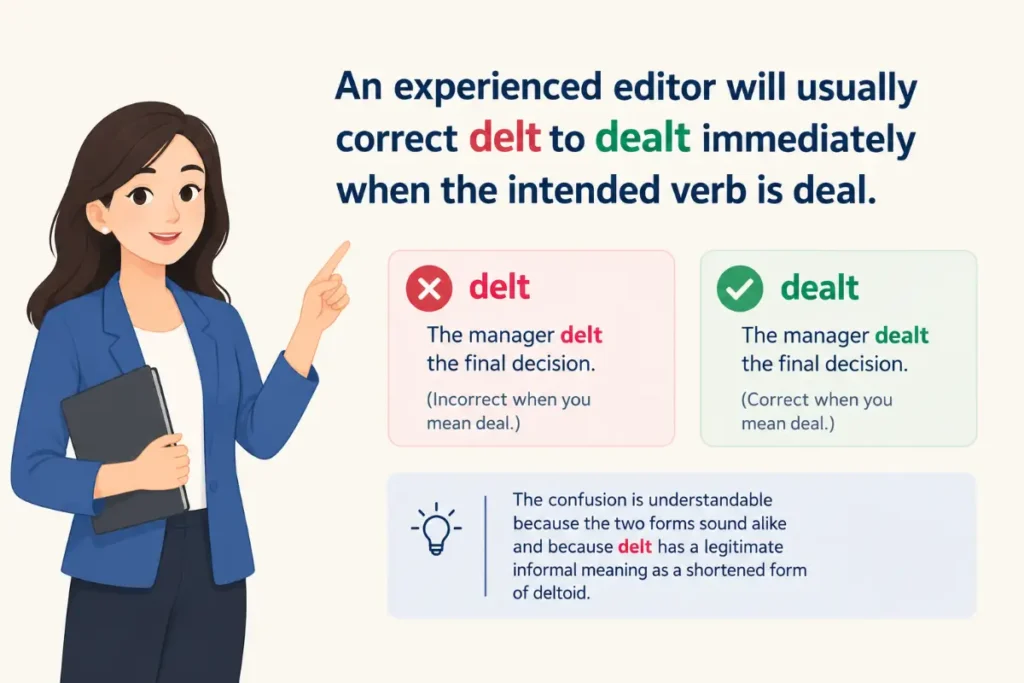
An experienced editor would correct delt immediately when it is intended as the past form of deal because the standard form is well established and widely used. The error usually comes from pronunciation, fast typing, or applying a regular verb pattern to an irregular verb. Editors also watch for related grammar problems such as dealed and incorrect uses of deal with in past tense sentences. A useful proofreading trick is to scan for time words such as yesterday, earlier, last week, and previously. When the sentence clearly describes a completed past action, check that the verb appears as dealt rather than deal or delt.
For another common grammar confusion, see Blankie or Blanky (2026): Which Spelling Is Standard English?.
Conclusion
Dealt vs delt has a clear answer. Dealt is the correct standard form, while delt is normally a misspelling when you mean the past tense or past participle of deal. The verb follows an irregular pattern: deal, dealt, dealt. This form works for meanings such as handling a problem, distributing cards, trading in goods, or describing how someone was treated.
The word appears across American, British, Australian, and Canadian English with no meaningful regional spelling difference. You’ll often see it in the common expression dealt with, which means handled or addressed something. It also appears in phrases such as dealt the cards and dealt a blow.
For an easy memory trick, learn the verb as a three part set: deal, dealt, dealt. If you’re describing something that already happened, check for dealt before you submit your writing.
FAQs
Is delt a correct spelling of the past tense of deal?
No. Delt is not the standard past tense or past participle of deal. The correct form is dealt. The mistake usually happens because the pronunciation makes the spelling less obvious or because writers apply a regular spelling pattern to an irregular verb. In standard English writing, use dealt for completed actions and for constructions that require the past participle.
What does dealt mean?
Dealt is the past tense and past participle of deal. Depending on context, it can mean handled a problem, distributed something, traded in something, or behaved toward someone. In the sentence She dealt with the complaint, it means handled. In The dealer dealt the cards, it means distributed. Context determines the exact sense.
Which is correct dealt or delt?
Dealt is correct when you need the past or past participle form of deal. Delt is normally a spelling mistake. The verb pattern is deal, dealt, dealt. Learning these three forms together is the easiest way to avoid the error. The correct form works in both casual and formal English and has no major regional spelling variation.
How do you pronounce dealt?
Dealt is commonly pronounced /dɛlt/ in American English. It is one syllable and sounds roughly like delt. The pronunciation explains part of the spelling confusion because the written a doesn’t create a separate vowel sound. Don’t pronounce it as two syllables. Say it as one compact word with a clear final t sound.
Is dealt an irregular verb?
Dealt is the irregular past and past participle form of the verb deal. The verb does not form its past tense by simply adding ed. The basic pattern is deal in the present and dealt in both the simple past and past participle. For example, I deal with problems today, I dealt with one yesterday, and I have dealt with many before.
What does dealt with mean?
Dealt with usually means handled, addressed, managed, or responded to something. For example, The manager dealt with the complaint means the manager handled the complaint. The phrase is extremely common in everyday and professional English. It can describe problems, customers, responsibilities, topics, situations, or difficult experiences depending on the object that follows it.
Why do people spell dealt as delt?
The mistake usually comes from pronunciation and the irregular nature of the verb. When people hear dealt, the vowel represented by ea may not seem obvious, so they may write the sound as delt. Fast typing can create the same error. Another cause is applying a personal spelling pattern instead of remembering the established irregular form.
Can dealt be used in formal writing?
Yes. Dealt is completely appropriate in formal writing. You can use it in academic papers, business reports, professional emails, journalism, and official documents. Examples include The report dealt with several major concerns and The committee dealt with the matter promptly. The form is standard English and doesn’t have an informal tone by itself.