
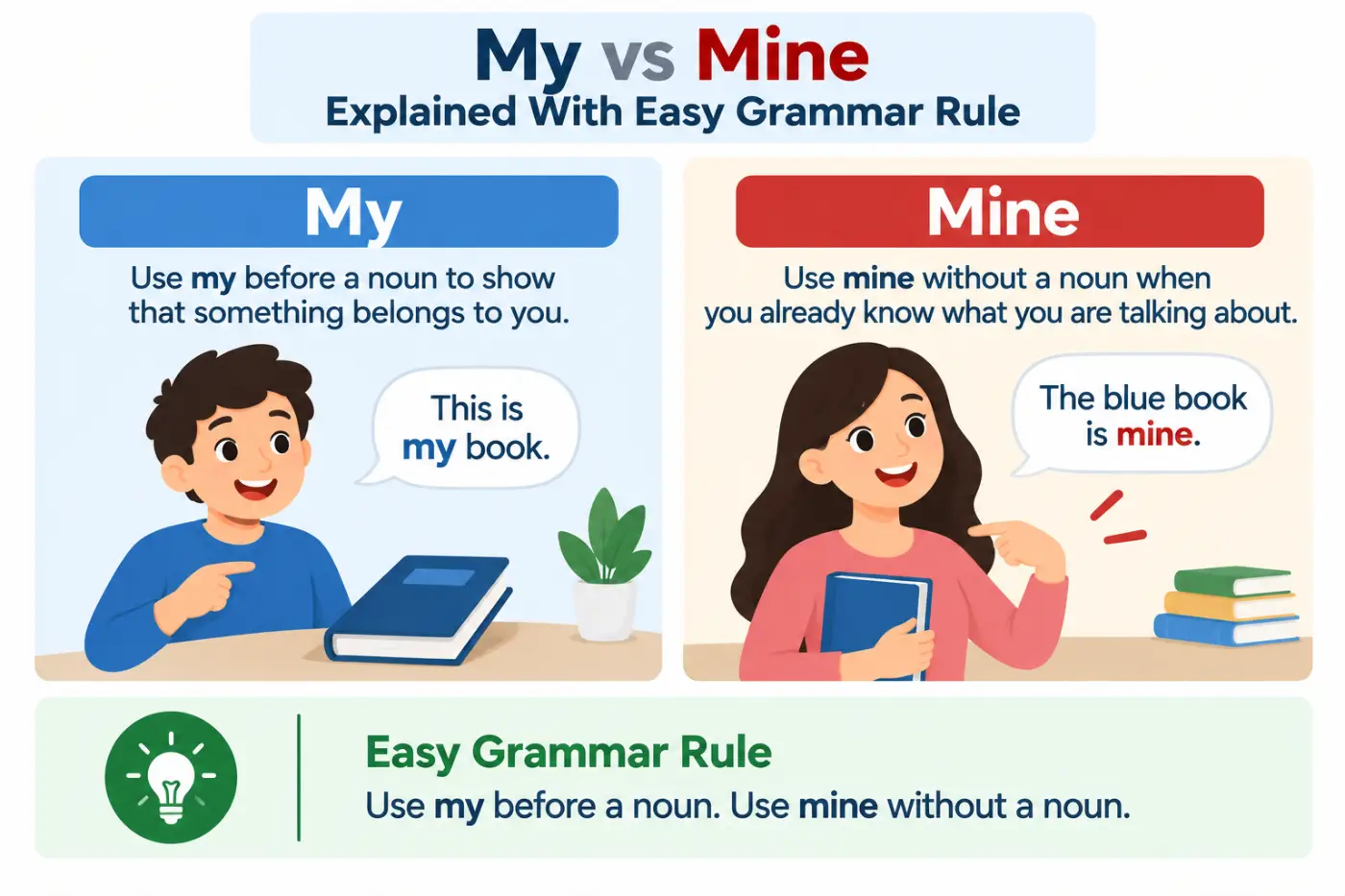
Choosing between My vs Mine can be confusing because both words show ownership, but they do not work in the same way. The main rule is simple: use my before a noun, as in my phone, and use mine when the noun does not follow, as in the phone is mine. Both forms are correct, and the right choice depends on how your sentence is built.
You might say my jacket is blue, but you would say the blue jacket is mine. You can also use mine to avoid repeating a noun that people already understand. For example, if someone asks which bag belongs to you, you can simply answer, mine. This makes your speech shorter and your writing less repetitive.
Learning the difference helps you avoid common grammar errors in everyday conversations, school assignments, emails, and formal writing. It also makes it easier to understand other possessive words, such as your and yours, her and hers, or our and ours. With a few clear rules and practical examples, you can choose the correct form confidently.
Many readers also check Among vs Between How to Choose the Right Word.
Quick Answer
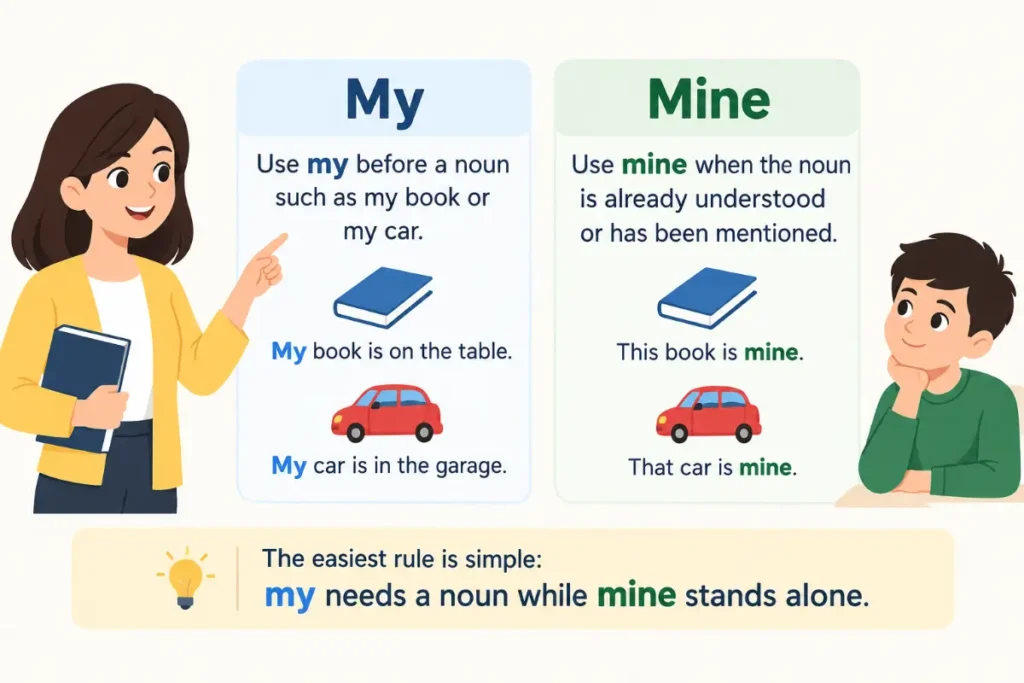
My is a possessive determiner used before a noun, as in my book or my idea. Mine is a possessive pronoun that can stand alone, as in the book is mine. Both words show ownership, but they have different grammatical roles, so you cannot freely replace one with the other.
Comparison Table
| Feature | My | Mine |
|---|---|---|
| Meaning | Belonging to me | Belonging to me |
| Part of speech | Possessive determiner | Possessive pronoun |
| Position | Usually before a noun | Usually stands without a following noun |
| Example | This is my desk. | This desk is mine. |
| Main function | Identifies a noun as belonging to the speaker | Replaces a noun phrase to show ownership |
| Common use | My house, my family, my opinion | The house is mine, the choice is mine |
| Formality | Standard in all styles | Standard in all styles |
| Common mistake | Using my without a noun in a sentence that requires a possessive pronoun | Adding a noun directly after mine |
| American English | Standard | Standard |
| British English | Standard | Standard |
Meaning and Definition
What Does My Mean?
My is a possessive determiner. It comes before a noun and tells the reader or listener that the thing, person, idea, or relationship is connected to the speaker. For example, in my car, the word my identifies the car as belonging to or being associated with the speaker.
Ownership is not always literal. You can talk about my mother, my teacher, my hometown, my opinion, or my favorite song. These phrases describe family relationships, connections, ideas, or preferences rather than simple legal ownership.
Common patterns include:
- My + noun: my phone, my room, my answer.
- My + adjective + noun: my new phone, my favorite room.
- My + noun phrase: my best friend from school.
- My + gerund phrase in certain constructions: I appreciate your helping me, although my helping you is also possible in suitable contexts.
The noun following my can be singular or plural. You can say my book, my books, my friend, or my friends. The word itself does not change to match the number of the noun.
Use my when you want to identify the person or thing you are talking about. For example, my answer was correct tells the reader which answer you mean.
What Does Mine Mean?
Mine is a possessive pronoun. It shows that something belongs to or is associated with the speaker, but it usually appears without a noun immediately after it. Instead, it stands in for a possessive phrase that the listener can understand from the context.
For example, the sentence this notebook is mine means this notebook belongs to me. The word mine takes the place of my notebook, so there is no need to repeat the noun.
Common examples include:
- This seat is mine.
- That blue backpack is mine.
- Your idea is interesting, but mine is different.
- The final decision is mine.
- The responsibility is mine.
Like my, mine can express more than physical ownership. In the sentence the mistake was mine, it identifies responsibility. In the sentence that opinion is mine, it identifies the speaker’s view.
Mine can also appear by itself as a short answer. If someone asks whose keys are on the table, you can say mine. The noun keys is understood from the question, so repeating it is unnecessary.
Are My and Mine Both Correct Words?
Yes. Both are standard English words, and neither is a misspelling or an informal substitute for the other. The difference is grammatical: my normally introduces a noun, while mine normally stands in place of a possessive noun phrase.
For example, my bicycle is new is correct because my comes before bicycle. The bicycle is mine is also correct because mine stands on its own. The bicycle is my would be incomplete in ordinary English because my usually needs a noun after it.
Key Differences Explained
1. Their Grammatical Roles
The most important difference is the role each word plays in a sentence. My is a possessive determiner, which means it helps identify a noun. Mine is a possessive pronoun, which means it can stand in place of a noun phrase.
Compare these sentences:
- My coat is hanging by the door.
- The coat hanging by the door is mine.
In the first sentence, my identifies the coat. In the second, mine tells us who owns the coat without repeating my coat. Both sentences communicate ownership, but the grammar differs.
2. Their Position in a Sentence
My normally appears directly before a noun or before an adjective that describes a noun. For example, you can say my sister, my older sister, or my older sister’s car. The word helps identify the noun phrase.
Mine usually appears after a linking verb such as is, was, or seems, or at the end of a sentence. You might say the last slice is mine or that choice seems mine to make. It can also stand alone when the missing noun is clear from the conversation.
3. Ownership and Association
Both words can show ownership, but possession in English covers more than things you legally own. My and mine can refer to relationships, responsibilities, experiences, ideas, and personal connections.
For example, my teacher identifies a relationship, while this responsibility is mine assigns responsibility to the speaker. Similarly, my opinion is clear and direct, while the opinion is mine emphasizes who holds the opinion.
4. Repetition and Clarity
Mine is useful when you want to avoid repeating a noun. Instead of saying this is my cup and that is my cup, you can say this is my cup and that one is mine. The second version is shorter and sounds more natural.
However, mine only works when the noun is clear from the context. If the listener does not know what you mean, repeating the noun may be more helpful. For example, saying mine in a conversation about several different objects could confuse the listener unless you point to the item or identify it another way.
5. Common Grammar Patterns
My normally appears as part of a noun phrase. Mine can stand alone or complete a sentence after a linking verb. This difference explains why some combinations are correct and others are not.
Correct: My answer is different.
Correct: The answer is mine.
Incorrect in standard usage: The answer is my.
Incorrect in standard usage: This is mine answer.
The first incorrect sentence needs a noun after my. The second uses mine before a noun, where my is the correct choice.
6. Pronunciation
My is pronounced /maɪ/, rhyming with sky and try. Mine is pronounced /maɪn/, with an extra /n/ sound at the end. Both have one syllable and the same main vowel sound.
The spelling difference is easy to see, but the final consonant in mine can be less noticeable in fast speech. Listening to the full sentence can help you identify the word, especially when a speaker uses a short answer such as mine.
7. Formality and Context
Both forms are appropriate in formal and informal English. You can use my in a business email, academic paper, or casual conversation. Mine works just as well in a formal statement or everyday exchange.
For example, my research focuses on language learning is suitable for academic writing. The final decision is mine is also suitable in a professional setting. Neither word is more formal than the other; the grammar determines which one you need.
8. Regional Usage
American, British, Canadian, and Australian English use my and mine in the same basic way. There is no major regional spelling difference or rule that changes their grammatical roles.
Some dialects and informal speech may use different possessive patterns, but standard written English follows the same distinction. If you are writing for a broad audience, use my before a noun and mine when the possessive form stands alone.
Which Form Is Correct?
Both forms are correct when used in the right grammatical position. The choice depends on whether a noun follows the possessive word.
Use my when the noun is stated directly after it, as in my computer, my brother, or my plan. Use mine when you do not repeat the noun, as in the computer is mine or that plan is mine.
Here are five examples that show the distinction clearly:
- Correct: My keys are on the counter.
- Correct: The keys on the counter are mine.
- Correct: My answer was accepted.
- Correct: The accepted answer was mine.
- Correct: That seat is mine, but this is my seat.
The grammar is based on the structure of the noun phrase, not on the type of ownership. My and mine can both refer to a physical object, a relationship, an idea, or responsibility.
A reliable editing tip is to look at the word immediately after the possessive form. If a noun follows, my is usually correct. If the possessive form stands alone and replaces a noun phrase, mine is usually the right choice.
Sentence Examples
Ten Natural Examples Using My and Mine
- Everyday conversation: My brother is picking me up after work.
- Text message: I left my charger at your house.
- Workplace communication: My manager approved the updated schedule.
- School: My science project is due on Friday.
- Academic writing: My research examines how children learn new words.
- Formal writing: My recommendation is to review the agreement before signing.
- Social situations: My friends invited me to dinner.
- Online communication: My account is not showing the latest update.
- Ownership comparison: Your jacket is black, but mine is gray.
- Short answer: Whose notebook is this? Mine.
These examples show that my usually appears before a noun, while mine replaces a possessive phrase or serves as a complete short answer. The correct form depends on the sentence structure, even when the meaning of ownership remains the same.
Five Examples Showing Common Errors
- Incorrect: This is mine book. Correct: This is my book.
- Incorrect: The blue backpack is my. Correct: The blue backpack is mine.
- Incorrect: Mine phone is ringing. Correct: My phone is ringing.
- Incorrect: That seat is my. Correct: That seat is mine.
- Incorrect: Is this my or yours? Correct: Is this mine or yours?
These mistakes often happen because learners know both words express ownership but have not fully learned the difference between a possessive determiner and a possessive pronoun.
Common Mistakes and Grammar Problems
Using Mine Before a Noun
Incorrect: Mine car is parked outside.
Correct: My car is parked outside.
Mine normally stands alone rather than directly modifying a noun. When you name the thing that belongs to you, use my before that noun. This rule applies to singular and plural nouns, including my car, my cars, my idea, and my ideas.
Using My Without a Noun
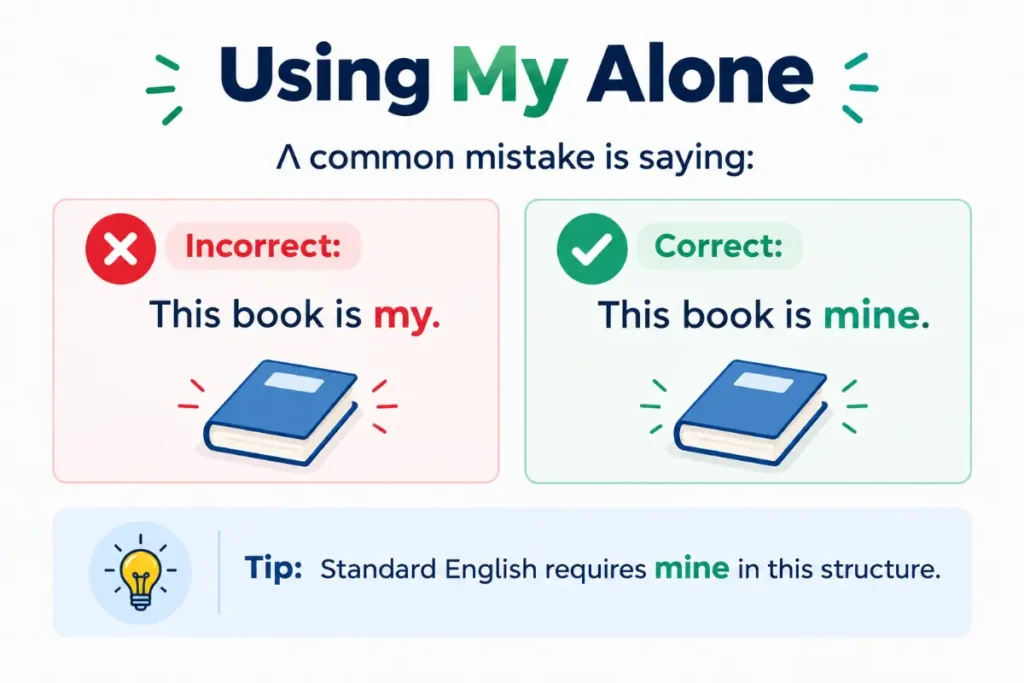
Incorrect: This notebook is my.
Correct: This notebook is mine.
My normally needs a noun after it. If the noun has already been mentioned and you do not want to repeat it, use mine. The corrected sentence is complete because mine carries the possessive meaning by itself.
Adding a Noun After Mine
Incorrect: This is mine notebook.
Correct: This is my notebook.
The noun notebook follows the possessive word, so my is required. In standard English, mine notebook is not the normal possessive structure. This is one of the clearest ways to identify the difference between the two forms.
Repeating the Noun Unnecessarily
Awkward: This is my pen, and that is my pen.
More natural: This is my pen, and that one is mine.
Repeating the noun is not always grammatically wrong, but it can make a sentence sound clumsy. Mine helps avoid repetition when the object is already clear. If the context is unclear, however, repeating the noun may help the reader or listener understand your meaning.
Confusing My With Me
Incorrect: Please give the package to my.
Correct: Please give the package to me.
My is possessive, while me is an object pronoun. Use me after a preposition such as to, with, or for when you mean the speaker as the receiver of an action. Use my before a noun when you want to show possession, as in give the package to my assistant.
Pronunciation Guide
How Do You Pronounce My?
My is pronounced /maɪ/ in standard American English. It has one syllable and rhymes with sky, try, and high. The vowel begins with an open sound and glides toward the sound at the end of the word.
Say it as my, with a clear ending rather than adding another syllable. The word sounds the same in phrases such as my house, my idea, and my friend.
How Do You Pronounce Mine?
Mine is pronounced /maɪn/. It has one syllable and rhymes with fine, line, and sign. The main vowel sound is the same as in my, but mine ends with an /n/ sound.
To say it clearly, pronounce the vowel first and finish by touching the tongue to the area behind the upper teeth for the final /n/. Avoid dropping the final consonant if you need to distinguish mine from my in speech.
Common Pronunciation Confusion
The main difference is the final /n/ in mine. In fast conversation, that sound may blend into the next word, but the distinction remains part of the standard pronunciation.
Both words have one syllable and receive ordinary sentence stress. You do not need to emphasize them unless you are making a contrast, as in your bag is here, but mine is in the car.
Need another quick comparison? Read Arised or Arose Which Is Correct.
Etymology and Word Origin
The History of My
My developed from earlier forms of English possessive language and is related to the older first person possessive forms used to identify something connected to the speaker. In Old English, forms such as mīn served possessive functions, and the language later developed the modern distinction between my before a noun and mine when used independently.
Over time, pronunciation and grammar changed, but the core meaning remained linked to the first person. Today, my identifies a noun as belonging to or being associated with the person speaking or writing.
The History of Mine
Mine comes from the same historical family as my. Earlier English used forms related to mīn for possession, and the modern form mine continues that possessive meaning in an independent role.
The difference between my and mine is now mainly grammatical rather than a difference in the kind of ownership they express. My appears before a noun, while mine can stand alone. The historical relationship helps explain their similar meaning, even though their modern sentence patterns differ.
Why the Origins Matter
You do not need to memorize the historical forms to use these words correctly. The most useful rule is the modern grammatical one: use my to introduce a noun and mine when the possessive form stands independently.
Their shared history explains why the words are closely related, but it does not mean they can be swapped freely in present day English.
Regional Usage
American English
In American English, my and mine are standard possessive forms. My appears before nouns in phrases such as my house and my friends, while mine replaces a noun phrase in sentences such as the house is mine.
Both forms work in casual conversation, school assignments, business writing, and formal documents. There is no special American rule that changes their core grammatical roles.
British English
British English follows the same basic distinction. Speakers use my before nouns and mine when the noun does not follow. For example, my coat is on the chair and the coat is mine are both standard.
Accent and pronunciation may vary, but the spelling and grammar remain the same. There is no major difference between British and American English in how these two forms function.
Australian English
Australian English uses my and mine in the same standard ways. My identifies a noun, while mine stands alone as a possessive pronoun. No major regional spelling difference affects the choice.
Canadian English
Canadian English also follows the same grammar. Writers use my book when naming the object and the book is mine when avoiding repetition. These forms are standard across formal and informal settings.
In all four varieties, the key distinction is grammatical rather than regional. The same rule works for most standard English writing and conversation.
Grammar Rules and Part of Speech
Understanding the grammatical roles of these words makes it easier to choose the right one. My is a possessive determiner, while mine is a possessive pronoun. Both connect something to the speaker, but they behave differently in a sentence.
My as a Possessive Determiner
A determiner comes before a noun and helps identify it. My works in the same general position as your, his, her, its, our, and their.
Examples include:
- My car needs gas.
- My parents are visiting.
- My favorite movie starts at seven.
- My first job taught me a lot.
- My answer was different from yours.
In each sentence, my comes before a noun or noun phrase. It does not need to change when the noun becomes plural. You say my book and my books, not a different form of my for each number.
Mine as a Possessive Pronoun
A possessive pronoun can stand in for a noun phrase that expresses ownership. Mine often appears after a linking verb or at the end of a sentence.
Examples include:
- The car is mine.
- That seat is mine.
- Your idea is similar to mine.
- The final choice was mine.
- The smaller room is mine.
In each example, mine replaces a phrase such as my car, my seat, or my idea. This allows the sentence to remain clear without repeating the noun.
My and Mine With Linking Verbs
Linking verbs connect the subject to information that describes or identifies it. Common linking verbs include is, are, was, were, and seems. Mine can follow these verbs when it identifies ownership.
For example, the red bicycle is mine is correct. The word mine identifies the bicycle as belonging to the speaker. My bicycle is red is also correct, but the structure differs because my introduces the noun bicycle.
My and Mine in Questions
Both forms appear naturally in questions. Use my when the noun follows and mine when the possessive form stands alone.
- Is this my coat?
- Is this coat mine?
- Where is my notebook?
- Which notebook is mine?
- Is your answer different from mine?
The same principle applies in statements, questions, and exclamations. The grammatical position determines the correct form.
Punctuation and Formal Writing
Neither word needs special punctuation. Apostrophes are not used in my or mine because neither form is a contraction. Avoid writing my’s or mine’s to express ordinary possession.
Formal writing follows the same grammar as everyday English. For example, my analysis suggests a different result is appropriate in an academic paper, while the responsibility is mine is suitable in a formal statement.
Real Life Usage Examples
Daily Conversation
People use these forms constantly when talking about belongings, family, preferences, and responsibility.
- My sister is coming over tonight.
- That umbrella is mine, not yours.
The first sentence identifies the sister, while the second identifies who owns the umbrella. Both forms sound natural in everyday speech.
Email and Workplace Communication
In professional messages, my often introduces a role, task, or document. Mine can clarify ownership or responsibility when the relevant noun is already understood.
- My report is attached to this email.
- The final decision is mine to make.
The first sentence names the document. The second emphasizes who has responsibility for the decision.
Academic Writing
In academic work, my can identify a research project, argument, or interpretation. Mine is less common in formal academic prose but remains grammatically correct when the writer needs to distinguish ownership or authorship.
- My research examines how children acquire new vocabulary.
- The interpretation is mine, based on the evidence presented.
Academic style guides may discourage excessive personal language in some disciplines, but they do not make either form grammatically incorrect.
News and Journalism
Journalists may use my in direct quotations or personal accounts. Mine can appear when a person emphasizes responsibility or ownership.
- My family has lived in this town for generations, the resident said.
- The choice was mine, the official explained.
The first example identifies a family relationship. The second uses mine to avoid repeating the noun choice.
Literature and Storytelling
In stories, my can build a personal voice, while mine can add emphasis or contrast.
- My brother warned me not to enter the old house.
- The secret was mine, and I intended to keep it.
The possessive forms can communicate relationships, loyalty, pride, guilt, or responsibility. Their grammar stays the same even when the emotional tone changes.
Related and Confused Terms
These eight related forms help explain how English expresses possession and how possessive words differ from object pronouns.
1. Your and Yours
Your works before a noun, as in your bag. Yours stands alone, as in the bag is yours. This pair follows the same pattern as my and mine.
2. Her and Hers
Her can function as a possessive determiner before a noun, as in her jacket. Hers stands alone, as in the jacket is hers. Her can also function as an object pronoun, so its grammatical role depends on the sentence.
3. Our and Ours
Our comes before a noun, as in our house. Ours replaces the noun phrase, as in the house is ours. Both forms show a connection to the speaker and at least one other person.
4. His
His can appear before a noun or stand alone. For example, his car uses his before a noun, while the car is his uses it independently. Unlike my and mine, the same written form serves both functions.
5. Their and Theirs
Their introduces a noun, as in their plans. Theirs stands alone, as in those plans are theirs. This pair works like my and mine but refers to people or things already mentioned.
6. Me
Me is an object pronoun, not a possessive word. Use it when the speaker receives an action, as in give me the book. Use my before a noun to show possession, as in my book.
7. Mine Own
Mine own is an old fashioned or literary expression found in some historical English styles. Modern standard English normally uses my own before a noun, as in my own room, and mine on its own, as in the room is mine.
8. Possessive Apostrophe
An apostrophe can show possession in nouns, as in Sarah’s book or the dog’s leash. My and mine do not take an apostrophe for ordinary possession. Writing my’s or mine’s to mean belonging to me is incorrect in standard English.
Expert Editor Insight
An experienced editor checks the noun phrase before changing a possessive word. Many writers know that both forms express ownership but overlook their different grammatical roles. Grammar tools may flag a phrase such as mine car, yet they can miss errors when a sentence is more complex. A useful editing habit is to identify the noun: if it follows the possessive word, use my; if the possessive form replaces the noun phrase, use mine. Also check for unnecessary repetition and avoid adding apostrophes to either form.
Key Takeaways
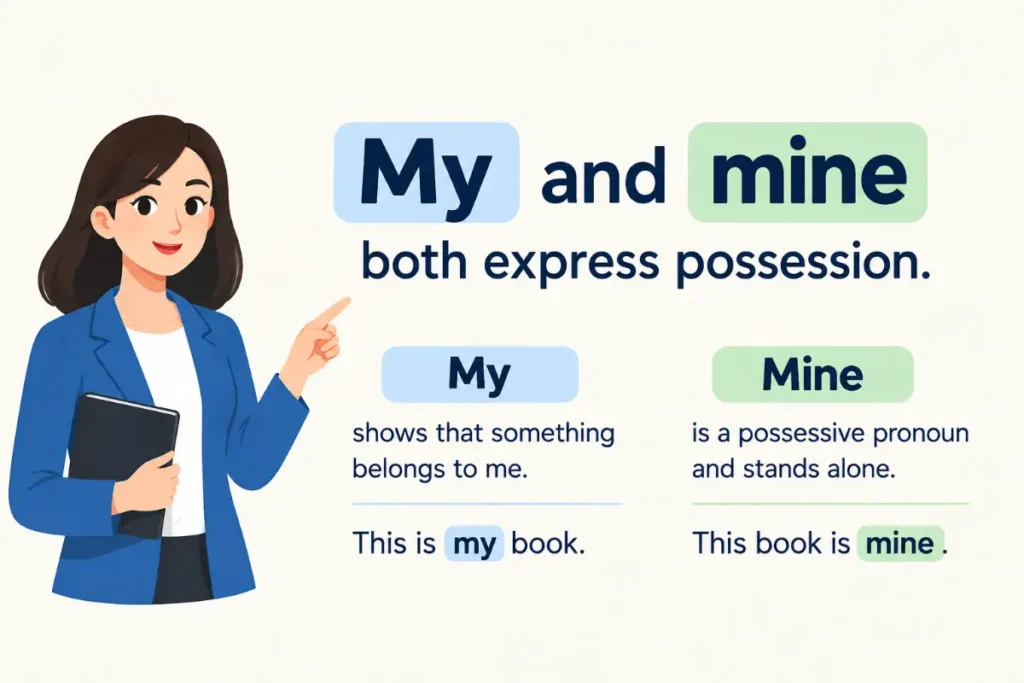
- My and mine both express possession.
- My normally comes before a noun.
- Mine replaces a noun phrase.
- My book is correct.
- The book is mine is correct.
- My cannot normally stand alone as a possessive form.
- Mine doesn’t normally come directly before a noun.
- Both forms are standard in American English.
- Both forms are also standard in British Canadian and Australian English.
- The easiest memory rule is my needs a noun while mine can stand alone.
Still confused? Compare Copy That or Roger That Which Should You Say?.
Conclusion
My vs Mine becomes easy to understand once you focus on the noun and the role of the possessive word. Use my before a noun, as in my desk, my idea, or my friends. Use mine when the noun phrase is understood and does not need to be repeated, as in the desk is mine. Both forms are correct, and neither is more formal than the other.
For a quick editing check, look at the word that follows the possessive form. If a noun comes next, choose my. If the possessive word stands alone, mine is usually correct. This simple rule helps keep your English clear and natural.
FAQs
What Is the Main Difference Between My and Mine?
My comes before a noun, as in my phone or my idea. Mine stands alone and replaces a possessive noun phrase, as in the phone is mine. Both forms show ownership or association, but their grammatical roles differ. Remember that my introduces the thing, while mine identifies it without repeating its name.
Is Mine a Real Word?
Yes, mine is a standard English possessive pronoun. It can show ownership, association, or responsibility, as in this bag is mine or the mistake was mine. The word also has other meanings as a noun and verb, including a place where minerals are extracted. In possessive grammar, it normally stands without a noun immediately after it.
Is It My Book or Mine Book?
The correct phrase is my book because my is used before a noun. Mine book is not standard English in ordinary modern usage. You can say the book is mine when the noun appears earlier in the sentence and you do not want to repeat it. The choice depends on the structure, not on the type of ownership.
Can I End a Sentence With Mine?
Yes, mine can naturally end a sentence. For example, you can say that seat is mine or the last piece of cake is mine. In both cases, mine identifies the owner without repeating the noun phrase. It can also appear as a short answer, such as mine, when someone asks whose item belongs to you.
How Do You Pronounce My and Mine?
My is pronounced /maɪ/ and rhymes with sky. Mine is pronounced /maɪn/ and rhymes with fine. Both words have one syllable, but mine has an extra /n/ sound at the end. That final consonant is the main pronunciation difference and helps listeners distinguish the two words in ordinary speech.
Can My and Mine Be Used Interchangeably?
No, not in standard English. My normally comes before a noun, while mine usually replaces a possessive noun phrase. You can write my phone is new or the phone is mine, but you cannot normally write mine phone is new or the phone is my. The meaning is related, but the grammatical structure is different.
What Is the Difference Between My and Me?
My shows possession and usually comes before a noun, as in my coat. Me is an object pronoun used when the speaker receives an action, as in give me the coat. These words have different grammatical roles. Use my coat when identifying a belonging, and give the coat to me when identifying the person receiving it.
Are My and Mine Used the Same Way in British and American English?
Yes, both varieties follow the same basic rule. American and British English use my before a noun and mine when the possessive form stands alone. The spelling is the same in both varieties, and there is no major regional grammar difference. Canadian and Australian English follow this standard pattern as well.