
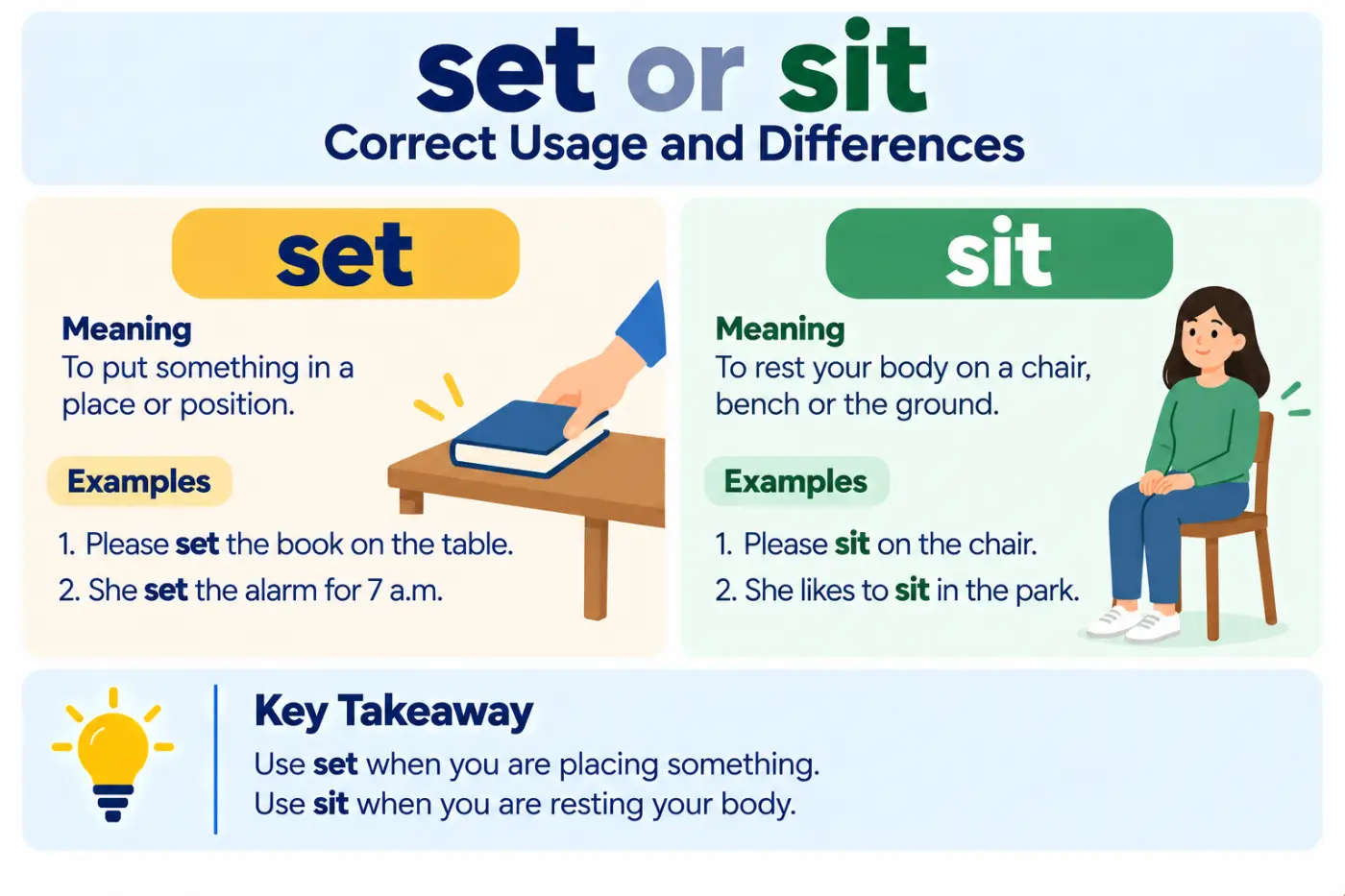
Choosing between set and sit can be confusing because the two verbs describe actions involving position, placement, or location. Both are correct English words, but they serve different purposes. Set usually means to put something somewhere, while sit usually means to rest in a seated position or be located in a particular place.
You set a book on a desk, set the table before dinner, and set an alarm for the morning. You sit on a chair, sit beside a friend, and sit down when you feel tired. The difference becomes easier to understand when you focus on who or what performs the action and what receives it.
The confusion often comes from their similar sounds and from phrases that use them in related situations. Their past tense forms also cause trouble because the past tense of sit is sat, while the past tense of set remains set. Understanding these patterns will help you choose the right verb in conversation, emails, school assignments, and professional writing.
Need another quick comparison? Read Accross vs Across Which Spelling Is Correct.
Quick Answer
Use set when you put or place something somewhere, arrange something, or establish a time or condition. Use sit when a person or animal rests in a seated position or occupies a place. For example, you set a bag on a chair, but you sit on the chair.
Comparison Table
| Feature | Set | Sit |
|---|---|---|
| Main meaning | Put, place, arrange, or establish | Rest in a seated position or occupy a place |
| Part of speech | Verb; also a noun and adjective in other uses | Verb; also a noun in other uses |
| Main grammar pattern | Often takes a direct object | Usually does not take a direct object |
| Present tense | Set or sets | Sit or sits |
| Simple past | Set | Sat |
| Past participle | Set | Sat |
| Present participle | Setting | Sitting |
| Pronunciation | /sɛt/ | /sɪt/ |
| Common phrases | Set the table, set an alarm, set a book down | Sit down, sit quietly, sit beside someone |
| Example | She set her keys on the counter. | She sat on the couch. |
Meaning and Definition
What Does Set Mean?
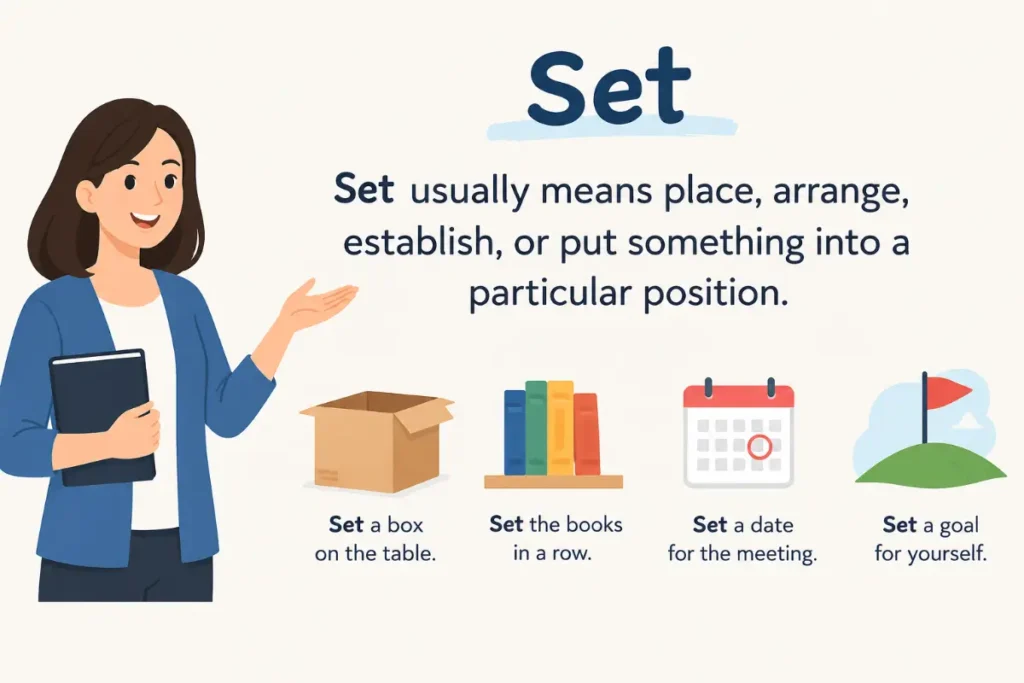
Set is a versatile English verb that often means to put something in a particular place, position, or condition. It can also mean to arrange items, establish a rule, choose a time, or prepare something for use. The meaning depends on the words around it.
For example, you set a cup on the counter, set the table for dinner, or set an alarm for 6 a.m. A teacher may set a deadline, a company may set prices, and a photographer may set up a camera. In each case, the verb describes placing, arranging, or establishing something.
Common expressions include:
- Set something on a surface.
- Set the table.
- Set an alarm.
- Set a goal.
- Set a date.
- Set something aside.
- Set a rule.
- Set something in motion.
In many of these examples, the verb has a direct object. You set an alarm, set a goal, or set a date. The object receives the action, which makes this a common transitive use of the verb.
Set has other meanings, too. The sun sets below the horizon, a substance can set as it becomes firm, and a story can be set in a particular place or period. These meanings are standard, so the verb should not be reduced to the simple idea of placing an object.
What Does Sit Mean?
Sit usually means to rest with your body supported in a seated position. It can describe a person or animal taking a seat, remaining seated, or occupying a particular location.
For example, you sit on a chair, sit beside a friend, or sit near a window. A dog may sit beside its owner, and a student may sit in the front row. The verb focuses on the position of the person or animal rather than on placing a separate object somewhere.
Common expressions include:
- Sit down.
- Sit on a chair.
- Sit beside someone.
- Sit still.
- Sit quietly.
- Sit in the front row.
- Sit at a desk.
- Sit through a meeting.
Unlike the common placement use of set, sit is usually intransitive. That means it does not normally take a direct object. You sit on a chair, but you do not usually sit the chair. You can, however, sit a child down or sit someone in a particular place. In those constructions, sit takes an object and means to place or help that person into a seated position.
The verb also has broader uses. A building may sit on a hill, a decision may sit with a manager, and a problem may sit unresolved for months. These expressions use sit to describe location, responsibility, or an unchanged state.
Why These Words Are Confused
The verbs overlap in situations involving furniture and physical placement. You might set a coat on a chair and then sit on that chair. The actions happen in the same scene, but they describe different things.
Their spelling and pronunciation also contribute to confusion. Both are short verbs beginning with the same consonant, and both appear in everyday phrases about positions and objects. Their past tense forms add another challenge because set stays the same in the past, while sit changes to sat.
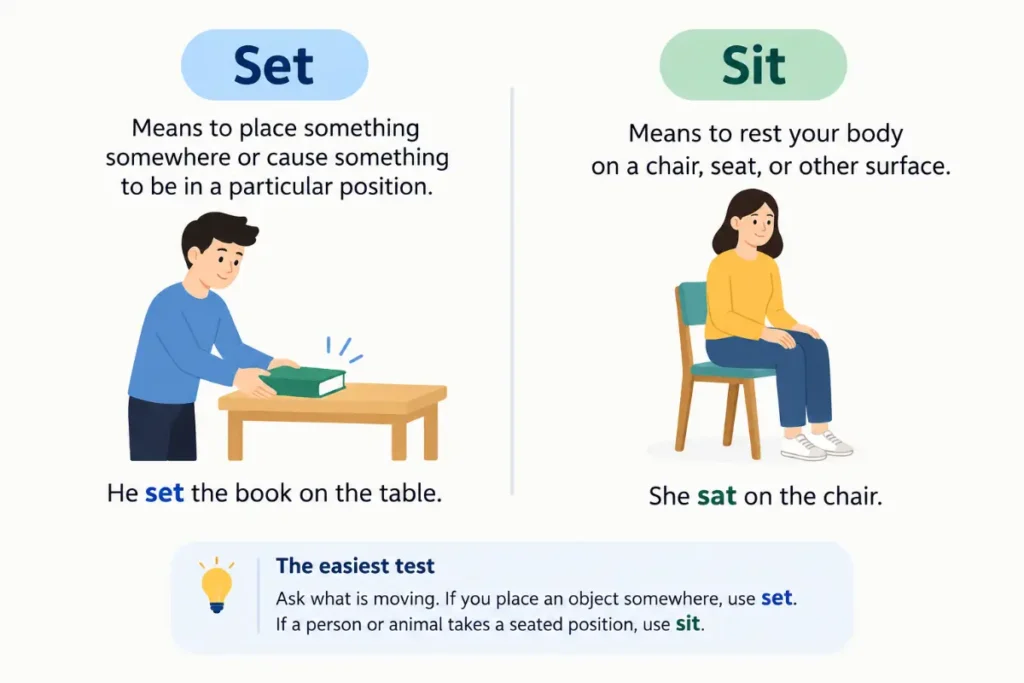
The easiest way to choose is to ask what the subject is doing. If the subject places, arranges, or establishes something, set is often right. If the subject takes a seated position or occupies a location, sit is usually right.
Key Differences Explained
1. Placement Versus Position
The clearest distinction is between placing something and occupying a position. Set usually describes an action that changes the location or arrangement of something. Sit usually describes a person or animal taking a seat or remaining in a position.
Compare these examples:
- I set the folder on the desk.
- I sit at the desk to finish my work.
In the first sentence, the speaker places a folder somewhere. In the second, the speaker occupies a seated position. The verbs cannot be swapped without changing the meaning or creating an awkward sentence.
2. Transitive and Intransitive Grammar
Set commonly takes a direct object. In a sentence such as She set the plate on the table, the plate is the object receiving the action. The sentence tells you what she placed and where she placed it.
Sit usually does not take a direct object. In She sat on the chair, the subject performs the action and the phrase on the chair describes the location. The chair is not a direct object of sat.
There are exceptions to this simple pattern. You can say Sit the child near the window, meaning place the child in a seated position. Here, sit is transitive because the child receives the action. Still, the most common everyday contrast is set something down versus sit down yourself.
3. Present and Past Tense
The two verbs differ in their past tense forms.
| Tense or form | Set | Sit |
|---|---|---|
| Simple present | I set the book down. | I sit near the window. |
| Third person present | She sets the book down. | She sits near the window. |
| Simple past | I set the book down. | I sat near the window. |
| Present participle | I am setting the book down. | I am sitting near the window. |
| Past participle | I have set the book down. | I have sat near the window. |
Set is an irregular verb whose base form, simple past, and past participle are all set. Sit changes to sat in the simple past and past participle, while its present participle is sitting.
This difference matters in both speech and writing. I set the alarm yesterday is correct, while I sat on the porch yesterday is also correct. Writing I sitted on the porch or I setted the alarm is incorrect in standard English.
4. Common Expressions
Many expressions use one verb in a fixed or familiar pattern. For example, you set the table, set a timer, and set a goal. You sit down, sit still, and sit beside someone.
These phrases become easier to remember when you learn them as complete expressions rather than isolated words. A useful contrast is set the table versus sit at the table. The first describes preparing a table for a meal, while the second describes occupying a seat at it.
5. Meaning Beyond Physical Actions
Both verbs have meanings beyond their most familiar physical uses. Set can mean establish, arrange, or determine, as in set a deadline or set a price. Sit can describe location or a state that remains unchanged, as in a house that sits on a hill or a question that sits unanswered.
These broader meanings do not remove the basic distinction. The verb set often implies an action that places or establishes something. Sit often describes a position, location, or state.
6. Pronunciation
In common American English pronunciation, set is /sɛt/ and sit is /sɪt/. Both have one syllable and begin and end with the same consonants, but the vowel sounds differ.
Set uses the vowel sound heard in bed. Sit uses the vowel sound heard in bit. If you pronounce the vowels clearly, the words are easier to distinguish in conversation.
7. Formality and Context
Both words are standard in formal and informal English. Set appears in instructions, reports, schedules, business writing, and daily conversation. Sit appears in directions, descriptions, stories, meetings, and ordinary conversation.
Neither verb is inherently more formal than the other. The right choice depends on the action and sentence structure, not on the level of formality.
8. Regional Usage
American, British, Canadian, and Australian English use both verbs with the same core meanings and standard spelling. Regional accents may change how the vowels sound, but they do not change the main grammar distinction.
Some expressions may be more common in one setting than another, but there is no major regional rule that makes set correct in one variety and sit correct in another. The same practical guidance works across these varieties.
Which Form Is Correct?
Both set and sit are correct words. The choice depends on the meaning of the sentence, not on spelling preference. Use set for placing or arranging something, establishing a value or time, or preparing something for use. Use sit for taking or maintaining a seated position, or for describing where someone or something is located.
Look at these examples:
- Correct: She set her phone on the table.
- Correct: She sat at the table.
- Correct: Please set the chairs in a circle.
- Correct: Please sit in the chair near the door.
- Correct: The manager set a deadline for Friday.
- Correct: The manager sat through the meeting.
The objects and actions explain the choices. A phone can be placed, so set works in the first sentence. A person takes a seat, so sat works in the second. Chairs can be arranged, while a person sits in one.
A helpful editing rule is to identify the subject and the object. If the subject is doing something to an object by placing, arranging, or establishing it, set may be right. If the subject itself takes a seat or occupies a location, sit is usually the correct verb.
Sentence Examples
Ten Natural Examples Using Set and Sit
- Everyday conversation: I set my keys on the kitchen counter when I got home.
- Text message: Can you set a reminder for our call at 3 p.m.?
- Workplace communication: The team set a deadline for completing the new report.
- School: The teacher asked the students to sit quietly before the lesson began.
- Academic writing: The researchers set specific criteria for selecting participants.
- Formal writing: Please set all documents on the conference table before the meeting.
- Social situations: We sat near the back of the restaurant so we could talk.
- Online communication: I set my status to unavailable while I finished the project.
- Home routine: She set the table while her brother prepared dinner.
- Travel: We sat by the window and watched the scenery pass.
These examples show that the two verbs often appear in related settings but perform different grammatical jobs. Set describes placing, arranging, or establishing something. Sit describes the position of a person or another subject.
Five Examples That Highlight Common Errors
- Incorrect: I sat the alarm for 6 a.m. Correct: I set the alarm for 6 a.m.
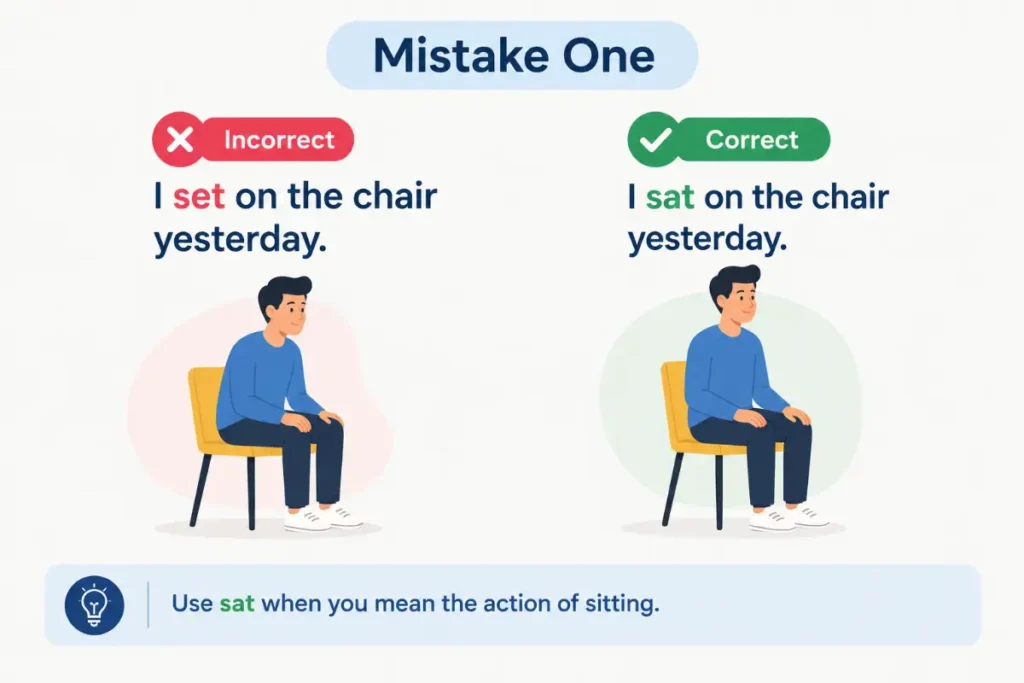
- Incorrect: She set on the couch after work. Correct: She sat on the couch after work.
- Incorrect: He sitted near the door. Correct: He sat near the door.
- Incorrect: They set down and began eating. Correct: They sat down and began eating.
- Incorrect: I have sat the plates on the table. Correct: I have set the plates on the table.
The mistakes arise from mixing up the meaning or tense of the verbs. In the first and fifth examples, the subject places objects, so set is needed. In the second, third, and fourth examples, the subject takes a seat, so sit or its correct form is needed.
Common Mistakes and Misspellings
1. Using Sit When You Mean Place
Incorrect: Please sit the book on the shelf.
Correct: Please set the book on the shelf.
The sentence describes placing a book, not taking a seated position. Use set when the object is being put somewhere.
2. Using Set When You Mean Take a Seat
Incorrect: We set on the grass to eat lunch.
Correct: We sat on the grass to eat lunch.
The people are taking seated positions, so the past tense of sit is needed. Set does not work in this sentence.
3. Writing Sitted Instead of Sat
Incorrect: She sitted beside her friend.
Correct: She sat beside her friend.
Sit is irregular. Its simple past and past participle are sat, not sitted. The ending pattern used in regular verbs does not apply here.
4. Writing Setted Instead of Set
Incorrect: He setted the timer before leaving.
Correct: He set the timer before leaving.
Set uses the same form for its base form, simple past, and past participle. The standard sentence is He set the timer before leaving.
5. Confusing Set Down With Sit Down
Incorrect: Please set down and make yourself comfortable.
Correct: Please sit down and make yourself comfortable.
Sit down tells a person to take a seat. Set down usually means to place an object on a surface, as in Set down your bag before you sit. Remember who or what is performing the action.
Pronunciation Guide
How Do You Pronounce Set?
Set is pronounced /sɛt/ in American English. It has one syllable and uses the vowel sound heard in bed, red, and met. The consonants are /s/ at the beginning and /t/ at the end.
Say it as one short sound: set. Avoid changing the vowel to the sound in sit, because that can make the two words difficult to tell apart.
How Do You Pronounce Sit?
Sit is pronounced /sɪt/ in American English. It has one syllable and uses the short vowel sound heard in bit, hit, and fit. The beginning and ending consonants match those in set, but the vowel is different.
Say it as one short syllable: sit. The difference between /ɛ/ and /ɪ/ may seem small, but it changes the word and its meaning.
Stress and Common Pronunciation Problems
Neither word has a complicated stress pattern because each has only one syllable. The main issue is the vowel sound. Some learners pronounce both words with a similar vowel, especially when their first language does not use the same sound contrast.
Practice them in pairs: set and sit, bet and bit, met and mitt. Then use each word in a short sentence. This can help you hear the difference and use the correct verb more confidently.
For another common grammar confusion, see Window Seal or Sill Which Term Is Correct?.
Etymology and Word Origin
The History of Set
Set has roots in Old English, including forms related to setting or placing something. Its history connects with older Germanic words and later developments in English. Over time, the verb gained a wide range of meanings involving placement, arrangement, establishment, and position.
Its many modern uses reflect that broad history. People set objects down, set goals, set prices, set rules, and set events in motion. The verb is also used in phrases such as the sun sets, where it describes movement below the horizon.
The History of Sit
Sit also comes from Old English, from a form related to sitting or being seated. Its roots are Germanic, and related forms appear in other Germanic languages. The modern verb retains the central meaning of occupying a seated position, along with broader uses that describe location or a state.
For example, a person can sit on a chair, a house can sit on a hill, and a question can sit unanswered. These uses show how the idea of remaining in a position developed into broader meanings.
Why the Origins Matter
You do not need to memorize the history of either verb to use it correctly. The more useful lesson is that English has preserved two different verbs with overlapping settings but distinct grammatical patterns.
Remember the modern difference: set often means place or establish, while sit usually means take a seated position or occupy a location. Their histories explain why they are separate words, but everyday sentence patterns are the best guide.
Regional Usage
American English
In American English, set and sit follow the same basic rules described above. You set a timer, set the table, or set a goal. You sit in a chair, sit beside a friend, or sit through a meeting.
The most common errors involve the past tense of sit and expressions such as sit down. American speakers may use a range of regional accents, but the standard spelling and core grammar remain the same.
British English
British English uses the same spelling and basic verb forms. A person sets the table and sits at it. The past tense of sit is sat, while set remains unchanged in the past tense.
Accent differences may affect the vowel sounds, but they do not create a different grammatical rule. Both verbs are standard in British speech and writing.
Australian English
Australian English follows the same distinction. Set is used for placing, arranging, or establishing something, while sit describes taking a seat or occupying a location. The past tense forms remain set and sat.
Canadian English
Canadian English also uses both verbs according to the same standard patterns. There is no major spelling difference between Canadian and American English for these words. Writers can follow the same guidelines in school, business, and everyday communication.
Grammar Rules and Part of Speech
Set and sit are verbs, but set also appears frequently as a noun and an adjective. As a noun, a set can mean a collection of related items, such as a set of tools. As an adjective, set can describe something fixed or decided, as in a set schedule. These uses are separate from the verb comparison.
Common Grammar Patterns With Set
The verb set often takes a direct object. Common patterns include:
- Set something somewhere. Example: She set the mug beside the sink.
- Set a time or date. Example: We set the appointment for Monday.
- Set a goal. Example: He set a goal to read every day.
- Set a rule. Example: The school set a new attendance rule.
- Set something aside. Example: I set aside some money for emergencies.
- Set something up. Example: They set up the equipment before the event.
Set changes to sets with a third person singular subject in the present tense. For example, I set the table, but she sets the table. In the simple past, the form remains set: She set the table yesterday.
Common Grammar Patterns With Sit
Sit usually describes the subject’s position or movement into a seated position. Common patterns include:
- Sit somewhere. Example: Please sit here.
- Sit on something. Example: He sat on the bench.
- Sit beside someone. Example: I sat beside my cousin.
- Sit down. Example: We sat down to eat.
- Sit still. Example: The child sat still during the story.
- Sit through something. Example: They sat through a long presentation.
The present tense changes to sits with a third person singular subject. The past tense is sat, and the present participle is sitting. For example, I sit near the door, she sits near the door, and yesterday she sat near the door.
Punctuation and Sentence Structure
Neither verb requires special punctuation. Use a period for a statement and a question mark for a direct question. The choice of verb does not change these basic punctuation rules.
For example, Set the books on the shelf is a command. Did you set the books on the shelf? is a direct question. Please sit down is also a command, while Did you sit down? asks about the action.
The Difference Between Set Down and Sit Down
These phrases are easy to confuse because both involve movement, but they describe different actions. Set down means to put an object on a surface. Sit down means to take a seated position.
Compare these examples:
- Set down your backpack before you enter the room.
- Sit down and wait for your name to be called.
In the first sentence, the backpack is the object being placed. In the second, the person is taking a seat. This distinction is one of the most useful ways to remember the difference between the verbs.
Real Life Usage Examples
Daily Conversation
In daily life, both verbs appear in common instructions and descriptions.
- Set your cup on the counter before you leave.
- Sit next to me so we can hear the speaker.
The first instruction asks someone to place an object. The second asks someone to take a particular seat. The surrounding words make the intended action clear.
Email and Workplace Communication
Workplace writing often uses set to describe goals, schedules, and arrangements. Sit appears when talking about meetings, seating, or someone’s position.
- We set the deadline for the final report for Friday afternoon.
- Please sit near the conference room screen so you can see the presentation.
Both sentences are direct and professional. The verbs describe different actions, so neither can replace the other.
Academic Writing
Academic writing uses set for criteria, limits, and conditions. Sit can describe a participant’s position or the location of an object.
- The researchers set clear rules for selecting participants.
- Students sat in assigned seats during the examination.
The first sentence describes establishing rules. The second reports where students were seated during an exam.
News and Journalism
News writing may use set for policies, goals, or records. Sit can describe location or a person remaining in a position.
- The city set a new target for reducing traffic delays.
- The damaged vehicle sat beside the road until a tow truck arrived.
The first example concerns an established target. The second uses sit to describe the vehicle’s location.
Literature and Storytelling
In storytelling, set can describe an object being placed or the setting of an event. Sit can describe a character’s position or a scene that remains unchanged.
- She set the letter on the desk and walked out without speaking.
- He sat by the window, waiting for the rain to stop.
These verbs help readers picture what is happening. One describes an action performed on an object, while the other describes a character’s position.
Related and Confused Terms
1. Put
Put means to move or place something in a particular position. It often works as a close alternative to set, as in Put the keys on the table. However, set appears in many established phrases, such as set a goal or set a deadline, where put would change the meaning or sound unnatural.
2. Place
Place means to put something somewhere, often carefully or deliberately. It can replace set in sentences such as She placed the book on the shelf. Place often sounds slightly more formal, while set is common in everyday speech.
3. Lay
Lay means to put something down, usually in a horizontal position. It takes an object, as in Lay the blanket on the bed. People sometimes confuse lay with lie, which describes reclining or resting without placing an object.
4. Lie
Lie can mean to rest or recline in a horizontal position. It usually does not take a direct object in this meaning. For example, I lie on the couch when I feel tired. Its past tense is lay, which is one reason people confuse the forms.
5. Seat
Seat means to help someone sit or arrange people in places. It usually takes an object, as in The usher seated the guests near the stage. Sit focuses on the seated person, while seat focuses on placing someone in a seat.
6. Stand
Stand means to be upright on your feet. It contrasts with sit because the two verbs describe different body positions. For example, She stood beside the chair before sitting down.
7. Arrange
Arrange means to organize or place things in a particular order. It can sometimes replace set, especially when several objects are involved. For example, Arrange the chairs in a circle describes the same general task as Set the chairs in a circle.
8. Establish
Establish means to create, set up, or make something official. It is related to set in expressions such as set a rule or set a policy. For formal writing, establish a rule may sound more precise in some contexts, while set a rule is often simpler and more direct.
Expert Editor Insight
An experienced editor checks the action before choosing the verb. If the sentence describes placing, arranging, or establishing something, set is often correct. If the subject takes a seat or occupies a location, sit is usually the right choice. The most common errors involve forms such as sitted, setted, and the phrases set down and sit down. Grammar tools may flag an incorrect verb form, but they can miss a word choice error when both words are spelled correctly. A useful editing tip is to identify the object of the action. If an object is being placed, set is a strong candidate. If the subject is taking a seat, choose sit or its correct tense form.
Key Takeaways
- Set usually means place, arrange, establish, or put something into a particular position.
- Sit means rest in a seated position.
- The past tense of sit is sat.
- The past tense of set is set.
- The past participle of sit is sat.
- The past participle of set is set.
- Set usually takes an object when it means place something.
- Sit often works without a direct object when it means take or remain in a seated position.
- You set the table but sit at the table.
- You set a book on a desk but sit at a desk.
- Set down means place something down.
- Sit down means take a seated position.
- If place works as a replacement, set is often the right choice.
- If take a seat works as a replacement, sit is often the right choice.
You may also want to read Phase vs Faze Meaning, Difference, and Correct Usage.
Conclusion
The choice between set and sit depends on the action you want to describe. Set usually means placing, arranging, or establishing something, while sit describes taking a seated position or occupying a location. Both are correct English verbs, but their grammar and tense forms differ. Remember that the past tense of set is still set, while the past tense of sit is sat.
For a quick editing check, identify who performs the action and what receives it. You set a book on a table, then sit at the table. This simple contrast will help you choose the right verb in everyday speech and formal writing.
FAQs
What Is the Main Difference Between Set and Sit?
Set usually means to put, place, arrange, or establish something. Sit usually means to rest in a seated position or occupy a location. For example, you set a book on a desk, but you sit at the desk. The key is to focus on the action rather than the similarity between the words.
Is It Set Down or Sit Down?
Both phrases are correct, but they mean different things. Set down means to place an object on a surface, as in Set down your bag. Sit down means to take a seated position, as in Sit down and relax. Remember that set down usually acts on an object, while sit down describes a person’s movement into a seat.
Is the Past Tense of Sit Sat or Set?
The simple past tense of sit is sat. For example, She sat near the window yesterday. The verb set stays the same in the present and simple past, as in I set the alarm last night. These forms are irregular, so you should memorize them rather than add the regular past tense ending.
Is It Correct to Say I Set on the Chair?
No, not if you mean that you took a seat on the chair. The correct sentence is I sat on the chair. Use set when you place an object somewhere, as in I set my bag on the chair. The subject and action help you choose the right verb.
Can Set and Sit Be Used in the Same Sentence?
Yes. You can use both verbs in one sentence when they describe different actions. For example, She set the book on the desk and sat beside the window. Set describes placing the book, while sat describes the person’s position. Using both verbs can make the contrast especially clear.
Why Do People Confuse Set and Sit?
People confuse them because the words have similar spellings, share the same beginning and ending consonants, and often appear in situations involving furniture or position. Their past forms also differ in ways that are easy to forget. Learning common expressions and practicing set, sat, and sitting in complete sentences helps reduce these mistakes.
Is Set or Sit Correct in Formal Writing?
Both are standard in formal writing. The correct choice depends on meaning and grammar, not formality. Use set for establishing a policy, placing an object, or arranging something. Use sit when describing a person taking a seat or an object occupying a location. In formal work, choose the verb that describes the action precisely.
What Is an Easy Way to Remember the Difference?
Think of set as putting something somewhere and sit as taking a seat. You set your bag on the floor, then sit on the couch. Also remember the past tense forms: set stays set, while sit changes to sat. Practicing these short contrasts is often more useful than memorizing a long grammar rule.