
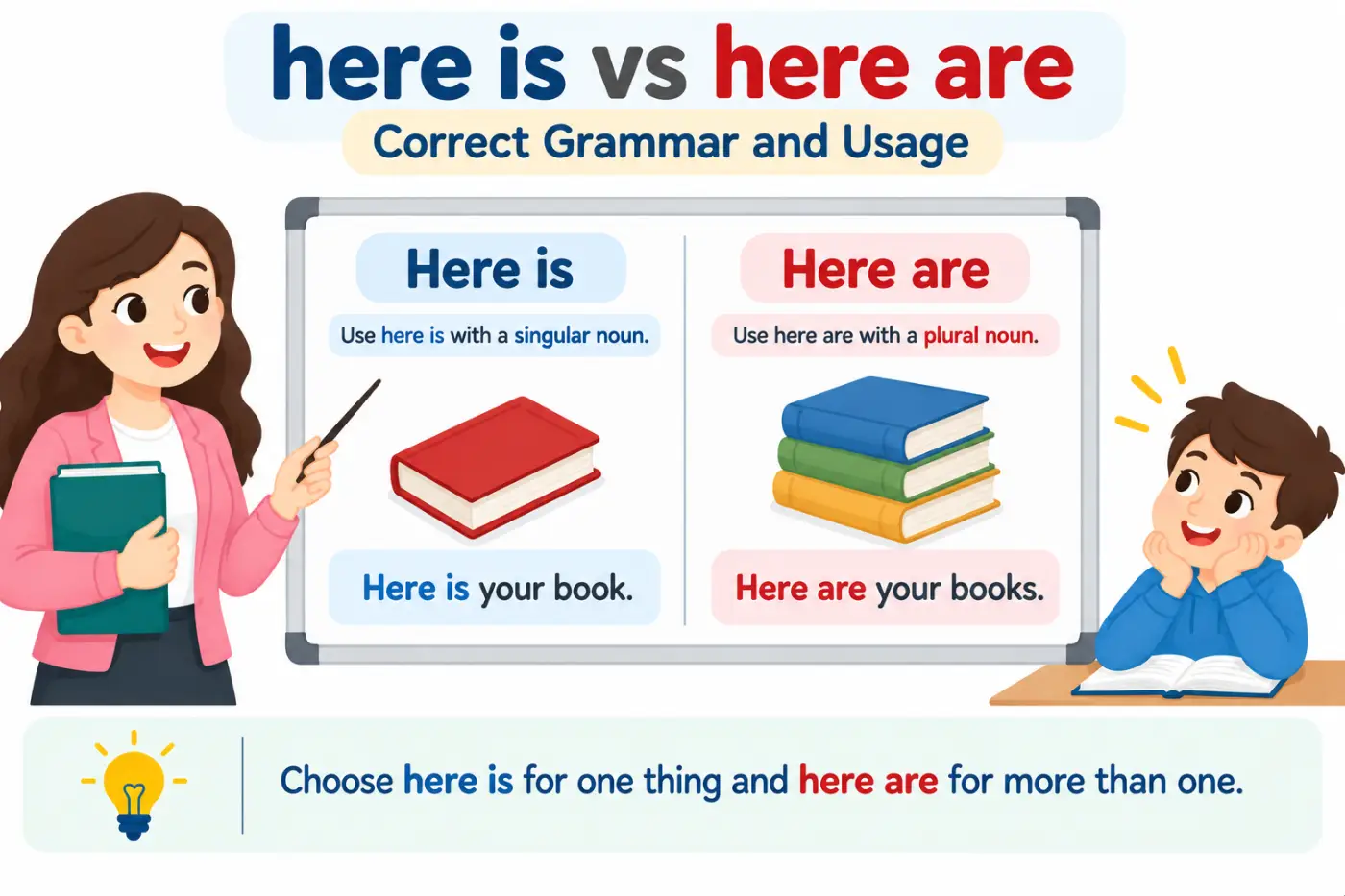
Choosing between here is or here are can be confusing, especially when a sentence contains a list, a long noun phrase, or several items. Both forms are correct, but they follow different grammar rules. Use here is when you introduce one singular item or an uncountable noun, and use here are when you introduce multiple plural items.
For example, you would say, Here is your notebook, because notebook refers to one item. You would say, Here are your notebooks, because notebooks refers to more than one. The tricky part comes when the subject appears after the verb, as in Here are the documents you requested. Writers sometimes choose the verb based on the nearest word or the word they notice first, rather than checking the actual subject.
Understanding this pattern makes your writing clearer in emails, conversations, school assignments, presentations, and professional documents. You will also learn how to handle lists, compound subjects, uncountable nouns, contractions, and formal writing. Once you understand how the verb agrees with the noun that follows, choosing the correct form becomes much easier.
You may also want to read Proud for You vs Proud of You Which Is Correct?.
Quick Answer
Use here is before a singular noun or an uncountable noun, as in Here is your key. Use here are before plural nouns, as in Here are your keys. The verb must agree with the noun or noun phrase being introduced, even though that noun usually comes after the verb.
Comparison Table
| Feature | Here Is | Here Are |
|---|---|---|
| Main use | Introduces one singular item or an uncountable noun | Introduces multiple items |
| Verb form | Singular | Plural |
| Common pattern | Here is + singular noun | Here are + plural noun |
| Example | Here is the report. | Here are the reports. |
| With uncountable nouns | Here is some water. | Usually not used directly with an uncountable noun |
| With a list | Can introduce a list treated as one combined presentation in some informal contexts | Often preferred when introducing multiple separate items |
| Formality | Standard in speech and writing | Standard in speech and writing |
| Contraction | Here’s | No common standard contraction in ordinary written English |
| Common setting | Presenting one item, giving information | Presenting several items or people |
| Main grammar rule | Singular agreement | Plural agreement |
Meaning and Definition
What Does Here Is Mean?
Here is introduces, presents, or points out a person, object, fact, or situation. The verb is singular, so it normally agrees with a singular countable noun or an uncountable noun.
Examples include Here is your ticket, Here is the answer, and Here is some useful information. In each case, the expression presents one item or something treated as a single amount or concept.
The phrase often appears when you hand something to someone, show an object, or introduce information. You might say Here is your coffee when serving a customer, or Here is the document you asked me to send when sharing a file.
The noun does not always refer to a physical object. You can also introduce an explanation, a reason, or a solution. For example, Here is why the plan failed introduces an explanation, while Here is what we need to do introduces a statement or action.
The key rule is simple: use the singular verb when the grammatical subject is singular or uncountable.
What Does Here Are Mean?
Here are introduces, presents, or points out two or more people, objects, or other plural items. The verb are is the plural form of be in the present tense.
Examples include Here are your shoes, Here are the meeting notes, and Here are three reasons to reconsider the plan. Each sentence introduces more than one item.
This construction is common when giving someone several objects, presenting a list, sharing multiple documents, or naming several people. A teacher might say Here are the assignments for next week. A coworker might write Here are the files you requested.
The expression can also introduce plural subjects that contain extra descriptive words. In Here are the books that arrived this morning, the subject is books. The added phrase that arrived this morning provides more information but does not change the plural agreement.
Use this form when the grammatical subject is plural, even if the sentence begins with the word here.
What Does Here Mean in These Expressions?
In these sentences, here points to something being presented, identified, or made available. It can refer to a physical location, but in the common expressions here is and here are, it often works as an introductory word rather than the grammatical subject that controls the verb.
Consider the sentence Here are your keys. The word here introduces the presentation, but keys is the plural subject that determines the verb form. This is why writers should look beyond the first word when checking agreement.
The same principle applies to Here is your key. The noun key is singular, so is is the correct verb.
Key Differences Explained
Singular and Plural Agreement
The main difference is number. Use is when the subject is singular and are when the subject is plural.
- Here is the package you ordered.
- Here are the packages you ordered.
- Here is an example of correct grammar.
- Here are several examples of correct grammar.
The noun that follows the verb usually makes the choice clear. Package and example are singular, while packages and examples are plural.
Countable and Uncountable Nouns
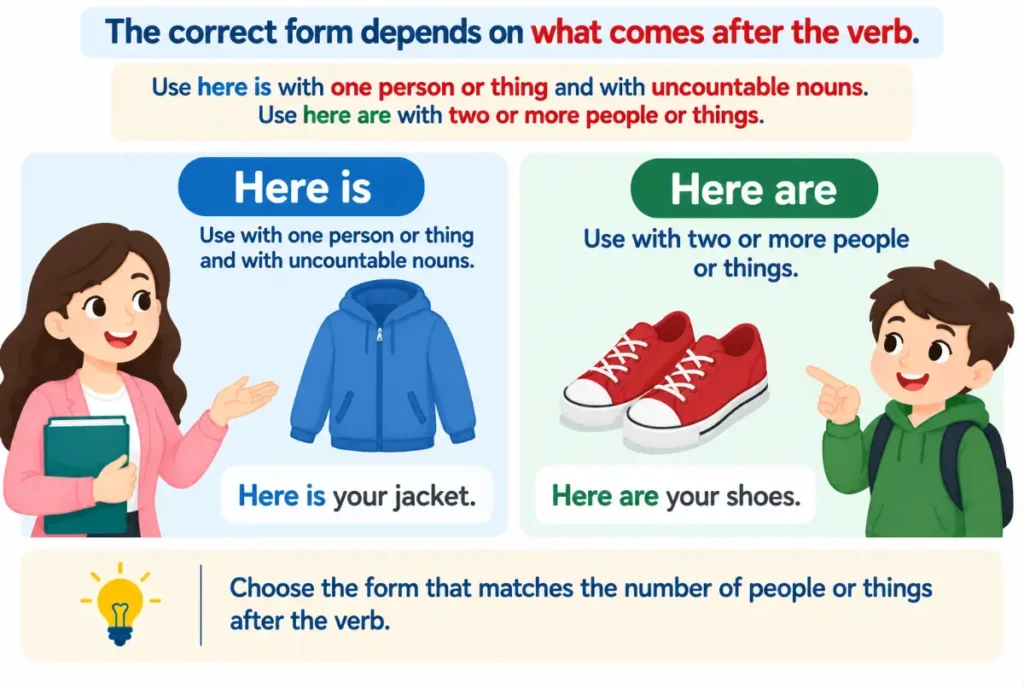
Countable nouns refer to items that can be counted individually. Examples include books, chairs, emails, and apples. Use here is with a singular countable noun and here are with a plural countable noun.
Uncountable nouns refer to things that are not usually counted as separate units in the intended meaning. Common examples include information, advice, furniture, equipment, and water. These nouns normally take a singular verb.
For example, say Here is some advice, not Here are some advice. You can say Here are some suggestions because suggestions is a plural countable noun.
The Subject Can Follow the Verb
A major source of confusion is that the subject often appears after the verb. In a regular sentence, you might say The reports are here. In the introductory construction, you say Here are the reports.
The order changes, but the agreement rule does not. The noun reports remains plural, so are is still needed. Similarly, The report is here becomes Here is the report.
This pattern is sometimes called an introductory or presentational construction because it brings something into the conversation. You do not need to memorize the label to use it correctly. Simply identify the noun being introduced.
Lists and Multiple Items
Lists can make the choice less obvious. If you introduce several separate items, here are is often the clearest form.
For example, Here are your notebook, pen, and folder sounds awkward to many readers because the phrase presents three separate objects. A clearer sentence is Here are your notebook, pen, and folder.
In casual speech, people sometimes use here is before a list when they treat the list as a single package or presentation. However, if you are editing formal writing, the plural form is usually the safer option when the sentence introduces multiple separate items.
You can also rewrite the sentence to avoid a difficult agreement choice. For example, Your notebook, pen, and folder are here is clear and natural.
Formality and Tone
Both forms are standard English. Neither is inherently more formal or more casual than the other. The choice depends on number agreement, not on the level of formality.
In a business email, Here is the updated report is correct when sharing one report. Here are the updated reports is correct when sharing several reports. The same rules apply in academic writing, text messages, classroom discussions, and presentations.
Pronunciation and Contractions
The full expressions are easy to pronounce. Here is usually sounds like heer iz, while here are sounds like heer ar in many American accents. In everyday speech, here is often contracts to here’s.
For example, Here’s your receipt is a common spoken and written form of Here is your receipt. The contraction is also used before certain clauses, as in Here’s what I found.
There is no equally common standard contraction of here are in ordinary writing. In speech, the words may blend together, but formal writing should use here are rather than inventing a nonstandard contraction.
Regional Usage
American, British, Canadian, and Australian English all use the same basic agreement rule. There is no major regional difference that changes when to use is or are in this construction.
Some speakers may use informal forms that differ from formal written English, especially in quick conversation. For standard writing, match the verb to the singular or plural subject.
Which Form Is Correct?
Neither form is universally correct on its own. The correct choice depends on the noun or noun phrase being introduced.
Use here is for a singular subject or an uncountable noun. Use here are for a plural subject. This follows the standard English rule of subject verb agreement, even when the subject appears after the verb.
Compare these examples:
- Correct: Here is your receipt.
- Correct: Here are your receipts.
- Correct: Here is the information you requested.
- Correct: Here are the details you requested.
- Correct: Here is the reason for the delay.
- Correct: Here are the reasons for the delay.
The distinction is not based on the word immediately before the noun, the length of the sentence, or how many words appear after the verb. It depends on the grammatical number of the subject.
When a sentence feels awkward, rewrite it in ordinary subject verb order. For example, change Here are the report you requested to The report you requested is here. This makes the singular subject easier to identify and exposes the agreement error.
Sentence Examples
Ten Natural Examples
- Everyday conversation: Here is your coffee, just the way you like it.
- Text message: Here are the photos from last night.
- Workplace email: Here is the updated schedule for next week’s meeting.
- School: Here are the answers to the practice questions.
- Academic writing: Here is an explanation of the method used in the experiment.
- Formal writing: Here are the documents required to complete your application.
- Social situation: Here is your seat near the window.
- Online communication: Here are three steps to reset your password.
- Customer service: Here is your refund confirmation.
- Family conversation: Here are your keys and your wallet.
These examples show how the verb changes with the number and type of subject. The first, third, fifth, seventh, and ninth examples introduce one item or concept. The remaining examples introduce several items.
Examples With Uncountable Nouns
Uncountable nouns can be confusing because they may refer to a large amount or many pieces of something. In grammar, however, they are usually treated as singular.
- Here is some information about the event.
- Here is the advice you asked for.
- Here is the furniture for the new office.
- Here is enough water for everyone.
- Here is the equipment we need for the demonstration.
Do not use are just because the amount is large. The grammar depends on how the noun works in the sentence, not on the physical quantity.
Examples With Plural Nouns
Use the plural form when you introduce several separate items.
- Here are the books for your class.
- Here are the names of the selected candidates.
- Here are the invoices from last month.
- Here are the changes we discussed.
- Here are the main points from the presentation.
The plural noun controls the verb in each sentence. Descriptive phrases such as for your class or from last month do not change the subject’s number.
Common Mistakes and Grammar Problems
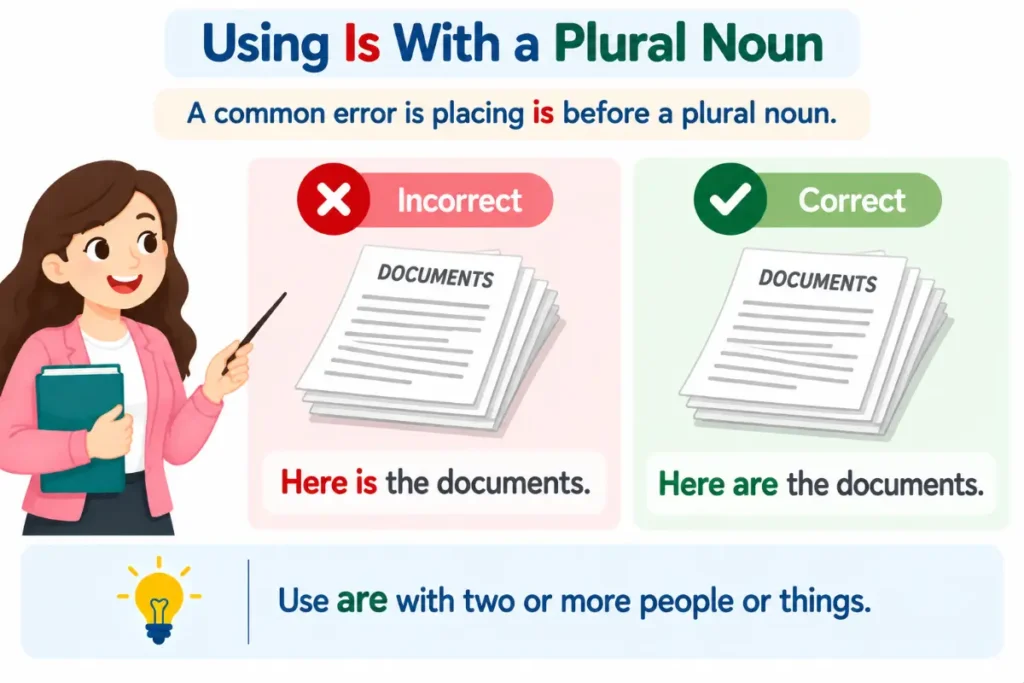
Using Is With a Plural Noun
Incorrect: Here is the documents you requested.
Correct: Here are the documents you requested.
Documents is plural, so it needs are. This mistake often happens when the writer starts the sentence before thinking about the noun that follows. Find the subject first, then choose the verb.
Using Are With a Singular Noun
Incorrect: Here are your appointment confirmation.
Correct: Here is your appointment confirmation.
The subject confirmation is singular. If you mean several confirmations, the sentence can become Here are your appointment confirmations. The noun and verb must agree in number.
Using Are With an Uncountable Noun
Incorrect: Here are the information you need.
Correct: Here is the information you need.
Information is generally uncountable in standard English, so it takes a singular verb. If you mean separate facts, use a countable noun such as details or pieces of information. For example, Here are the details you need is correct.
Letting a Nearby Noun Control the Verb
Incorrect: Here is the folder with the papers.
Correct: Here is the folder with the papers.
This example is actually correct because the main subject is folder, not papers. The plural noun papers appears inside a phrase describing the folder and does not control the verb.
The mistake occurs when writers focus on a nearby plural noun and choose are even though the main subject is singular. Always identify the head noun, which is the main noun in the subject phrase.
Treating a List as Singular Without Considering Its Meaning
Potentially awkward: Here is the pens, pencils, and notebooks.
Clearer: Here are the pens, pencils, and notebooks.
The list contains multiple separate items, so are is the natural choice. If you want to refer to the whole group as one collection, you can rewrite the sentence as This is the set of pens, pencils, and notebooks.
A Quick Editing Test
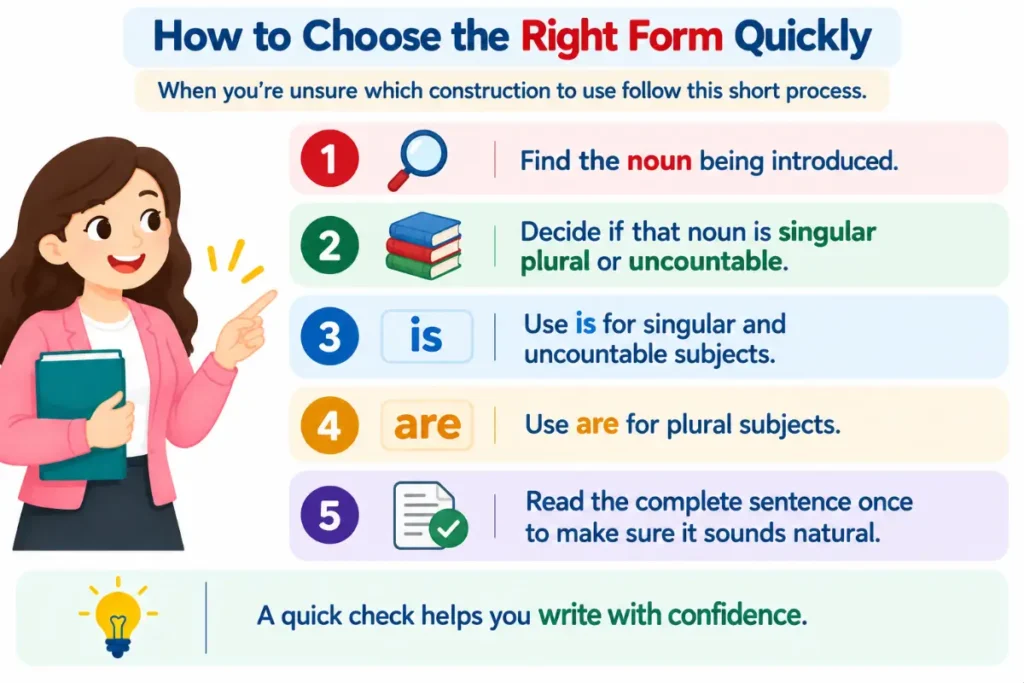
Use this three step method to check your sentence.
- Find the noun or noun phrase being introduced.
- Decide if it is singular, plural, or uncountable.
- Match the verb to that grammatical number.
If the subject is hard to spot, rewrite the sentence in ordinary order. The documents are here makes the relationship clear, so you can confidently write Here are the documents.
Many readers also check Copy That or Roger That Which Should You Say?.
Pronunciation Guide
How Do You Pronounce Here Is?
In American English, here is is commonly pronounced /hɪr ɪz/. In connected speech, the words often flow together, and here’s is pronounced /hɪrz/.
The phrase has two words but is often spoken smoothly as one short unit. The stress usually falls on here when the speaker is presenting an item, though sentence stress changes with emphasis.
How Do You Pronounce Here Are?
Here are is commonly pronounced /hɪr ɑr/ in American English. Depending on the speaker’s accent, the final sound in here and the opening vowel of are may blend together.
In careful speech, pronounce both words clearly. In ordinary conversation, connected speech may make the phrase sound faster, but the grammar remains the same.
Common Pronunciation Confusion
The phrases can sound similar when spoken quickly, especially when the next word begins with a vowel. Do not rely only on how the phrase sounds. Identify the noun being introduced and select the verb based on its grammatical number.
For example, Here are our tickets may flow together in natural speech, but the plural noun tickets still requires are. Clear writing follows grammar even when speech reduces or blends sounds.
Etymology and Word Origin
The History of Here
Here comes from Old English hēr, a word used to refer to a place or location near the speaker. Its core meaning has remained stable over the history of English, although modern usage extends beyond physical location.
In expressions such as Here is your answer, the word can introduce information rather than point to a place. This use is common in spoken English and written communication.
The History of Is and Are
Is and are are forms of the verb be, one of the oldest and most irregular verbs in English. The verb developed from several historical roots in the Germanic languages, which helps explain why its modern forms do not follow a single regular pattern.
Modern English uses is with third person singular subjects and are with plural subjects and certain other grammatical subjects. In the construction here is or here are, the verb still follows the subject agreement rule even though the subject usually comes afterward.
Why the History Matters
You do not need to study the historical roots to use these expressions correctly. The practical rule is enough: identify the noun being introduced and match the verb to its grammatical number.
Regional Usage
American English
In American English, both forms are standard. Speakers use here is for singular and uncountable subjects and here are for plural subjects. Examples include Here is the receipt and Here are the receipts.
The contraction here’s is also common in everyday American English. It works naturally in sentences such as Here’s your lunch and Here’s what I found.
British English
British English follows the same subject verb agreement rule. Writers use here is with singular and uncountable nouns and here are with plural nouns. The same distinction applies in formal documents, casual speech, and schoolwork.
Australian English
Australian English uses the same standard forms. Here is the answer introduces one answer, while here are the answers introduces multiple answers. No major regional rule changes the agreement pattern.
Canadian English
Canadian English also follows the same rule. Both expressions are common, and the verb choice depends on the subject’s grammatical number rather than a special Canadian usage.
Across these varieties, informal speech may contain reductions or local expressions, but standard written English follows the same core pattern.
Grammar Rules and Part of Speech
Identify the Subject
The most useful grammar rule is to find the subject of the sentence. In a typical sentence such as The documents are here, the subject documents comes before the verb. In Here are the documents, the order changes, but the subject remains documents.
This pattern can make agreement feel unusual because the first word is not the subject. Here introduces what follows, while is or are agrees with the item or items being presented.
Compare these pairs:
- The key is here. Here is the key.
- The keys are here. Here are the keys.
- The information is here. Here is the information.
- The results are here. Here are the results.
The verb stays the same when you change the word order because the subject’s number does not change.
Singular Countable Nouns
A singular countable noun names one person, place, object, or idea. Examples include report, chair, student, answer, and problem. Use is when introducing one of these nouns.
Examples include Here is the report for Monday and Here is a chair for the guest. If you change the noun to the plural, the verb usually changes too: Here are the reports for Monday and Here are chairs for the guests.
Plural Nouns
Plural nouns refer to more than one item. Many form their plural by adding s or es, although some have irregular forms such as children, people, and men.
Use are with plural subjects, as in Here are the children and Here are the people waiting outside. Do not let the distance between the verb and noun distract you from the agreement rule.
Uncountable Nouns
Uncountable nouns generally take singular verbs even when they describe a large amount. Common examples include information, advice, furniture, luggage, equipment, and research.
Correct examples include Here is the advice from your teacher and Here is the research we discussed. If you want to count individual units, add a suitable phrase such as pieces of advice or items of equipment.
For example, Here are three pieces of advice is correct because pieces is the plural head noun. Here is three pieces of advice is incorrect in standard English because the subject is plural.
Compound Subjects and Lists
When a sentence introduces two or more separate items, the plural form is generally the clearest choice. For example, Here are the laptop and the charger introduces two items. You can also write The laptop and the charger are here.
If the items form one named unit, the wording may change the agreement. For instance, Here is the set of keys treats set as the singular subject. The noun keys appears in a phrase describing the set, so it does not control the verb.
Punctuation and Sentence Structure
Neither expression requires special punctuation. Use a comma when the sentence structure calls for one, not simply because the phrase begins with here.
For example, Here is the answer you requested is a complete sentence without a comma. In a sentence such as Here are the options: a morning class, an afternoon class, and an evening class, a colon can introduce the list when the full sentence structure supports it.
Avoid inserting a comma between the verb and its subject. Here are, the documents is incorrect because the comma separates parts that belong together.
Contractions in Everyday English
Here’s is the standard contraction of here is. It is common in speech, messages, and many forms of writing.
Examples include Here’s your coffee, Here’s the plan, and Here’s why it matters. The contraction is singular even if the sentence introduces a longer explanation or a clause rather than a single object.
For plural subjects, use the full form here are. In standard writing, avoid nonstandard contractions such as here’re.
Real Life Usage Examples
Daily Conversation
- Here is your jacket. I found it on the sofa.
- Here are the snacks for the road trip.
The first example presents one item. The second introduces several snacks, so the plural verb is needed.
Email and Workplace Communication
- Here is the updated budget for your review.
- Here are the meeting notes and action items.
The first sentence introduces one budget. The second introduces multiple items, making the plural form appropriate.
Academic Writing
- Here is the main question explored in this paper.
- Here are the findings that support the conclusion.
The main question is singular, while findings is plural. The subject determines the verb in both cases.
News and Journalism
- Here is what we know about the new policy.
- Here are the latest details from the investigation.
The first sentence introduces a clause describing known information. The second presents multiple details.
Literature and Storytelling
- Here is the letter you have been waiting for.
- Here are the people who helped us escape.
These examples show how the expressions can introduce objects or people in a story. The same agreement rules apply even when the wording is dramatic or descriptive.
Related and Confused Terms
This Is and These Are
This is introduces one person or thing, while these are introduces multiple people or things. For example, This is my friend and These are my friends follow the same singular and plural distinction.
That Is and Those Are
That is points to one person or thing, while those are points to more than one. You might say That is the building we visited or Those are the buildings we visited.
There Is and There Are
There is and there are also follow subject verb agreement. Use there is with a singular or uncountable subject and there are with a plural subject. For example, There is a problem and There are two problems.
It Is
It is uses a singular pronoun and singular verb and It is often used to identify or describe something, as in It is a useful tool. Unlike here is, the pronoun it comes before the verb.
They Are
They are uses a plural pronoun and plural verb. For example, They are ready for the meeting. The subject is explicit, so the agreement is usually easier to recognize than in an introductory construction.
Here’s What
Here’s what introduces a statement or explanation. For example, Here’s what you need to know. The contraction remains standard because it represents here is, even though the phrase that follows may contain a longer clause.
These Are the Reasons
This expression introduces multiple reasons or explanations. It is useful when you want a more direct sentence structure than Here are the reasons. Both are grammatically correct.
The Following Is and The Following Are
The choice depends on the noun that follows. The following is the report treats report as singular, while The following are the reports treats reports as plural. In formal writing, this structure can be useful for introducing information or a list.
Expert Editor Insight
An experienced editor checks the subject rather than choosing the verb based on the first word in the sentence. The confusion happens because the introductory word here comes first, while the noun that controls agreement usually appears afterward. Grammar tools may flag clear agreement errors, but they can miss cases where the sentence is technically possible yet awkward. A practical editing tip is to reverse the sentence: Here are the files becomes The files are here. If the reversed version sounds correct, the original agreement is easier to check.
A related grammar guide is Hight or Height Which Spelling Is Correct.
Conclusion
The choice between here is and here are depends on subject verb agreement, not on personal preference or the number of words in a sentence. Use here is to introduce one item or an uncountable noun, and use here are for multiple items. Both expressions are standard in American English and other major English varieties.
The easiest editing tip is to identify the main noun and then reverse the sentence if the agreement feels unclear. The files are here confirms that Here are the files is correct. With this rule in mind, you can write natural, accurate sentences in emails, assignments, conversations, and formal documents.
FAQs
Is Here Is or Here Are Correct?
Both expressions are correct, but they are used with different subjects. Use here is with a singular noun or an uncountable noun, as in Here is the document or Here is some information. Use here are with plural nouns, as in Here are the documents. The subject’s grammatical number determines the correct verb.
Should I Say Here Is the List or Here Are the List?
The standard form is Here is the list because list is singular. The list may contain many entries, but the grammatical subject is the single list itself. If you are introducing multiple lists, use Here are the lists. Focus on the main noun, not on how many items it contains.
Is It Here Is the Documents or Here Are the Documents?
The correct form is Here are the documents because documents is plural. Here is the documents contains a subject verb agreement error. You can confirm the choice by changing the word order: The documents are here. Since documents takes are in that sentence, it also takes are in the introductory construction.
Can I Use Here’s With Plural Nouns?
In standard English, here’s is a contraction of here is, so it normally introduces a singular or uncountable subject. You might hear speakers use here’s before a plural list in casual conversation, but that usage is often treated as informal or disputed. In careful writing, use here are when introducing multiple separate items.
Is Here Is Used With Uncountable Nouns?
Yes. Uncountable nouns generally take singular verbs, so here is is correct with words such as information, advice, furniture, and equipment. For example, Here is the information you requested is standard English. If you use a plural countable expression such as pieces of information, use here are instead.
What Is the Difference Between Here Is and There Is?
Here is often presents or points out something in the speaker’s immediate context, while there is often introduces the existence or presence of something. Both use is with singular or uncountable subjects. For example, Here is your bag presents the bag, while There is a bag by the door states that a bag exists in that location.
Can Here Is Start a Sentence?
Yes. Here is commonly begins a sentence when a speaker presents an object, fact, explanation, or idea. For example, Here is the report you requested is a complete sentence. The subject appears after the verb, but the usual agreement rule still applies. Use here are at the beginning when the subject is plural.
How Can I Remember Which Form to Use?
Identify the noun that follows the verb and decide if it is singular, plural, or uncountable. Use is for a singular or uncountable subject and are for a plural subject. You can also reverse the sentence to make the agreement clearer: Here are the files becomes The files are here. This simple check catches many common errors.