
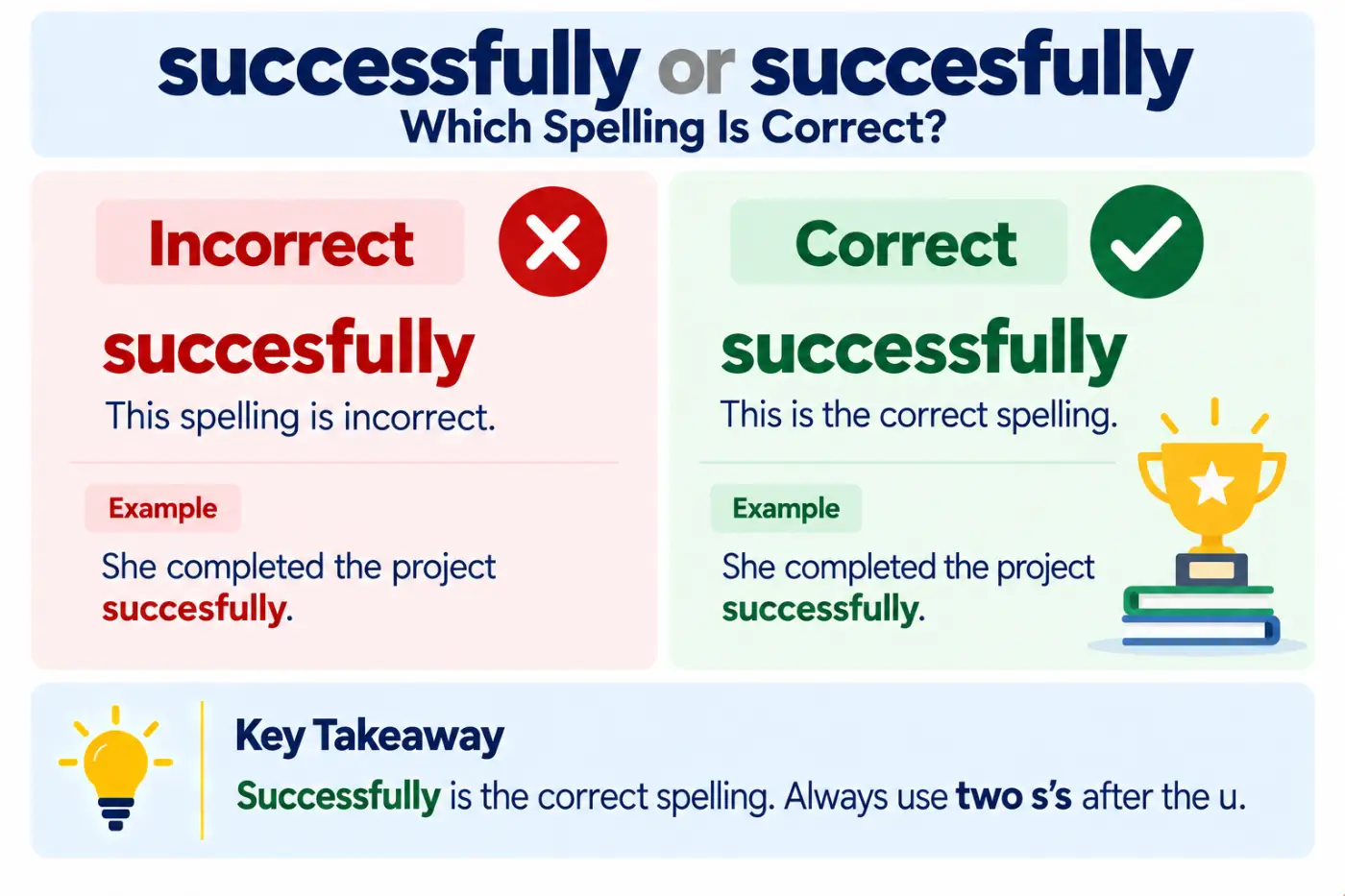
If you are unsure how to spell the word that means achieving something well or reaching a goal, the correct form is successfully. In the comparison successfully or succesfully, the first spelling is standard English, while the second is a common misspelling. The difference is one letter: successfully contains two c letters and two s letters in the middle of the word.
This mistake is easy to make because the word is long, its consonants appear close together, and its pronunciation does not clearly remind you how many letters to write. You may know the word well and still leave out a letter while typing quickly. Spellcheckers can catch many such errors, but they may not catch every mistake in every context.
Learning how the word is built makes it easier to remember. Successfully comes from successful, which comes from success, with the ending changed to form an adverb. This article explains the correct spelling, meaning, pronunciation, grammar, word history, and common errors. You will also find practical examples for school, work, everyday conversation, and formal writing.
Learn the difference in Among vs Between How to Choose the Right Word.
Quick Answer
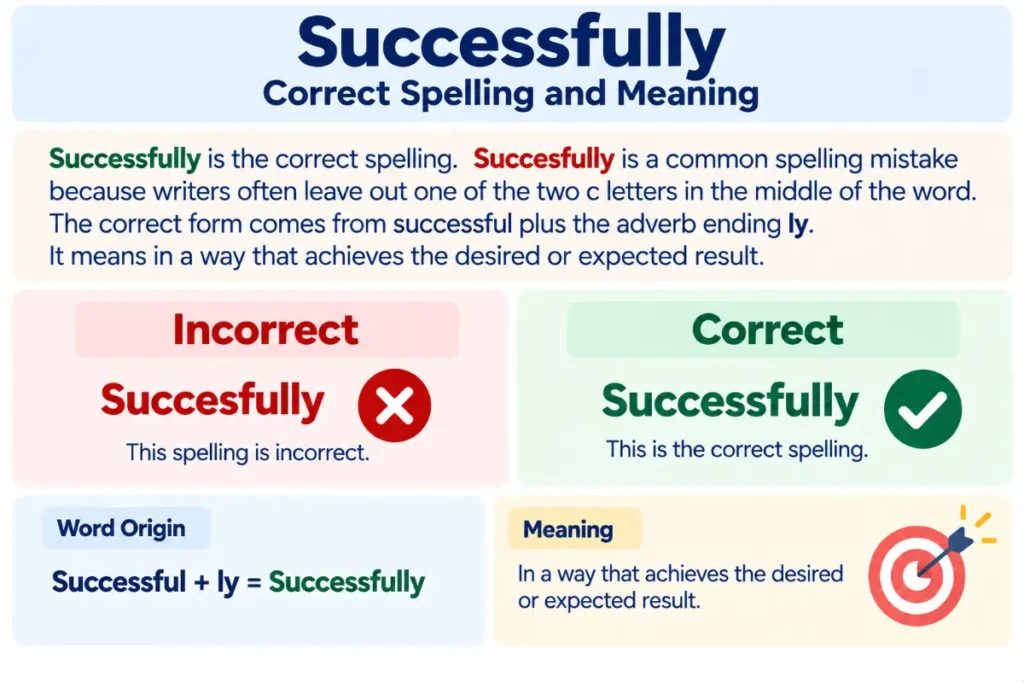
Successfully is the correct spelling. Succesfully is incorrect in standard English because it leaves out one of the two c letters found in the word. The correct form means doing something successfully, achieving a desired result, or completing an action with a good outcome.
Comparison Table
| Feature | Successfully | Succesfully |
|---|---|---|
| Spelling status | Correct standard spelling | Common misspelling |
| Meaning | In a successful way | No separate standard meaning |
| Part of speech | Adverb | Incorrect spelling of an adverb |
| Root word | Successful | Intended to be successful |
| Word formation | Success + ful + ly | Misses one c in the standard form |
| Pronunciation | /səkˈsesfəli/ | Usually intended to sound the same |
| Formality | Suitable for formal and informal writing | Should be corrected |
| Common contexts | Work, school, business, daily life | Typing and spelling errors |
| Example | She successfully completed the course. | She succesfully completed the course. |
Meaning and Definition
What Does Successfully Mean?
Successfully is an adverb that means in a successful way or with the result that was intended. It describes how an action is carried out or tells readers that an effort reached its goal.
For example, if a student successfully completes an exam, the student completes it with the desired result. If a company successfully launches a new product, the launch achieves its intended goal. The exact meaning depends on the action and the result described in the sentence.
The word often appears with verbs such as complete, finish, launch, solve, manage, pass, install, recover, and achieve. Here are a few natural examples.
- The team successfully finished the project before the deadline.
- She successfully passed her driving test.
- The technician successfully repaired the computer.
- They successfully opened a second store.
- The student successfully solved the final problem.
In each example, the adverb adds information about the outcome of the action. It tells readers that the effort worked or that the intended result was achieved.
What Does Succesfully Mean?
Succesfully is a misspelling of successfully in standard English. It does not have a separate accepted meaning in ordinary English writing. Readers can usually understand what the writer intended, but the missing letter makes the spelling incorrect.
The mistake often occurs because the writer remembers the general sound of the word but does not remember its exact letter sequence. The word contains a repeated consonant pattern that is easy to overlook when typing quickly.
For example, this sentence is incorrect:
The team succesfully completed the project.
The correct version is:
The team successfully completed the project.
The meaning does not change when you correct the spelling. Only the written form changes. In school assignments, business documents, job applications, and published content, use the standard form to maintain accuracy and credibility.
What Is the Difference Between Success and Successfully?
Success is a noun, while successfully is an adverb. They are related words, but they do different jobs in a sentence.
Success names a favorable result or achievement. Successfully describes an action that reaches a desired result.
Compare these sentences.
- Her success inspired the entire team.
- She successfully led the entire team.
In the first sentence, success is the thing being discussed. In the second, successfully describes how she led the team.
Understanding this difference helps you choose the correct form instead of treating all related words as interchangeable.
What Is the Difference Between Successful and Successfully?
Successful is an adjective, while successfully is an adverb. An adjective describes a person, thing, or situation. An adverb commonly describes an action or tells how something happens.
For example, you might say that a successful student passed an important exam. You could also say that the student successfully passed the exam.
In the first sentence, successful describes the student. In the second, successfully describes the action of passing. Both words come from the same word family, but their grammatical roles are different.
Why the Correct Spelling Has Two Cs
The easiest way to understand the spelling is to look at the word family. Successfully is built from success, then successful, and finally successfully.
The word success contains two c letters followed by two s letters. Those letters remain part of the spelling as the word changes form. Adding the endings does not remove one of the c letters.
Think of the word in three stages.
- Success is the noun.
- Successful is the adjective.
- Successfully is the adverb.
This pattern gives you a useful spelling reminder. If you can spell success correctly, you already know the key consonant sequence in successfully.
Breaking the Word Into Parts
You can understand the word through its related forms rather than trying to memorize every letter separately.
Success + ful creates successful. Adding ly to successful creates successfully.
The ending ful forms an adjective that means having or showing success. The ending ly changes that adjective into an adverb that describes an action or result.
This process is common in English. Other word families follow a similar pattern, such as careful and carefully or hopeful and hopefully. Learning the root and the endings can make longer words easier to spell.
Why People Leave Out a Letter
The incorrect form usually comes from a spelling memory error rather than a difference in meaning. Writers may remember the pronunciation but fail to reproduce the exact consonant sequence on the page.
Several factors can contribute to the mistake.
- The word is long enough that a letter can be overlooked.
- The repeated consonants are easy to confuse when typing quickly.
- Writers may remember successful but forget how it is spelled.
- Automatic typing habits can reinforce a familiar mistake.
- A quick review may miss the error if the sentence still looks familiar.
The solution is to connect the word to its base form. Remember success first, then add the endings. This gives you a clear spelling pattern to follow.
Which Spelling Is Correct?
Successfully is the correct spelling in standard American English and other major varieties of English. Succesfully is a misspelling and should be corrected in schoolwork, professional documents, formal correspondence, and published writing.
The reason is straightforward. The standard spelling preserves the spelling of success in the related forms successful and successfully. The extra c is not optional, and removing it does not create a recognized alternative spelling.
You can use the following quick check whenever you write the word.
- Write success.
- Add ful to form successful.
- Add ly to form successfully.
- Check that the two c letters remain in the word.
For an extra memory aid, notice that success, successful, and successfully all share the same opening sequence. If the word you have typed contains only one c, review it before sending your message.
A spellchecker can help, but learning the word family is more reliable than depending entirely on automatic correction. Some tools may miss a mistake, especially if their language settings or correction features are limited.
Sentence Examples
Here are ten natural examples that show how to use the correct form in different situations.
- Everyday conversation: I successfully booked our tickets for Saturday.
- Text message: We successfully found the restaurant, so we will be there in ten minutes.
- Workplace communication: The team successfully completed the new training program.
- School: Maria successfully solved every problem on the worksheet.
- Academic writing: The researchers successfully tested the proposed method under controlled conditions.
- Formal writing: The applicant successfully met all the requirements for admission.
- Social situations: He successfully organized a surprise party for his best friend.
- Online communication: I successfully updated my account settings after restarting the app.
- Business: The company successfully introduced its new service to customers.
- Personal achievement: She successfully completed her first long distance cycling event.
These examples show that the adverb can appear in many kinds of sentences. It commonly comes before the main verb phrase or after the verb and its object, depending on the sentence structure.
For example, you can say, The team successfully completed the project, or The team completed the project successfully. Both sentences are correct. The position changes slightly, but the basic meaning remains the same.
Five Examples of the Common Misspelling
The following sentences are incorrect and are included only to show what the spelling mistake looks like.
- Incorrect: She succesfully finished her assignment.
- Incorrect: The team succesfully launched the website.
- Incorrect: He succesfully repaired the damaged bicycle.
- Incorrect: We succesfully completed the application.
- Incorrect: The students succesfully passed the final exam.
In each example, replace succesfully with successfully. The correction restores the missing c and makes the sentence standard English. The grammar and intended meaning otherwise remain unchanged.
Common Spelling Mistakes
Long words with repeated consonants often create trouble, especially when a writer relies on memory rather than checking the base word. The following errors are worth watching for.
1. Leaving Out One C
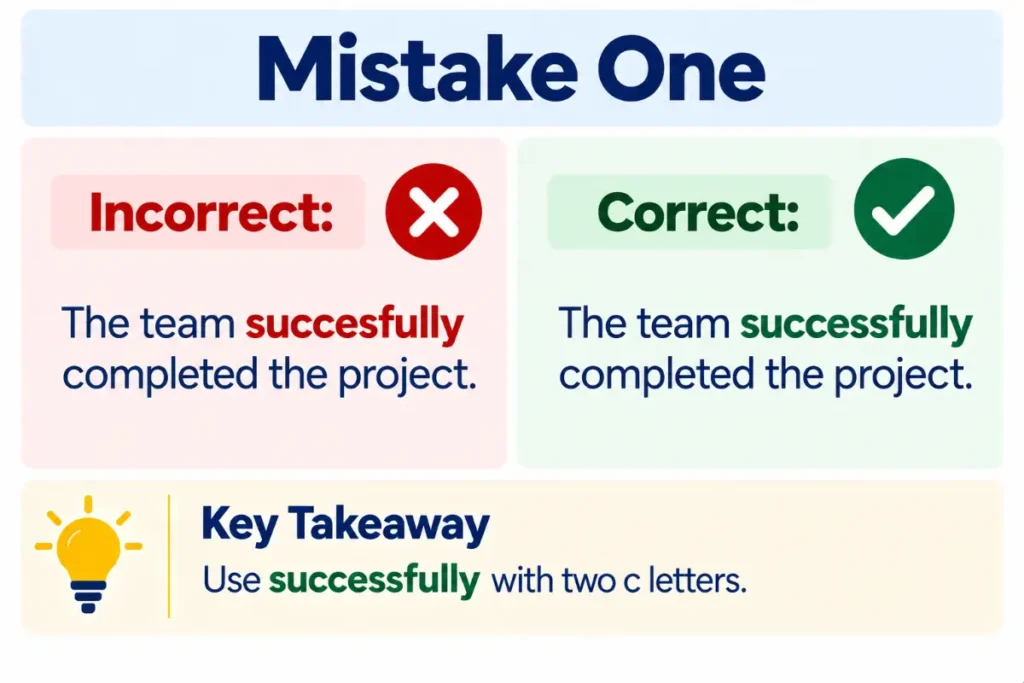
Incorrect: succesfully.
Correct: successfully.
This is the main spelling error. The writer remembers most of the word but leaves out one c from the success word family. To avoid it, write success first and then build the longer form from it.
2. Writing Only One S in the Middle
Incorrect: successfuly.
Correct: successfully.
The correct form has two s letters after the two c letters in the shared consonant sequence. The repeated letters can be hard to notice when the word is typed quickly, so check the whole middle section rather than just the beginning.
3. Confusing Successful and Successfully
Incorrect: She completed the test successful.
Correct: She completed the test successfully.
Successful is an adjective, while successfully is an adverb. The sentence needs the adverb because it describes how she completed the test. A useful check is to ask if the word describes a noun or an action.
4. Using Success Instead of Successfully
Incorrect: He success finished the project.
Correct: He successfully finished the project.
Success is a noun and cannot usually modify the verb finished in this structure. The adverb successfully describes how the project was finished. Related words may share a meaning, but their grammatical roles still matter.
5. Adding an Unnecessary Ending
Incorrect: successfullly.
Correct: successfully.
This error adds an extra letter while trying to remember the repeated consonants and the ly ending. The best solution is to build the word in stages: success, successful, successfully. Checking the word family helps prevent both missing and extra letters.
Pronunciation Guide
How Do You Pronounce Successfully?
In American English, successfully is commonly pronounced /səkˈsesfəli/. It has four syllables: suc, cess, ful, and ly. The main stress falls on the second syllable, which contains the sound associated with success.
A simple pronunciation guide is suhk SESS fuh lee. Say the word smoothly rather than stressing each part equally. The exact vowel sounds may vary slightly among speakers, but the syllable pattern and main stress remain useful guides.
Does Pronunciation Explain the Spelling?
Pronunciation helps you recognize the word, but it does not always reveal every letter. The two c letters in successfully do not represent two separate spoken sounds. That is one reason a person may pronounce the word correctly while spelling it incorrectly.
English spelling often preserves patterns from related words even when the sound does not make every letter obvious. In this case, remembering success is more useful than trying to hear each letter in the longer word.
A Simple Practice Method
Read the following word family aloud and write each form once.
- Success.
- Successful.
- Successfully.
Then use the final form in a sentence, such as, She successfully completed the task. Repeating the related forms helps connect pronunciation, spelling, and meaning. This method is especially useful if you often make the same typing error.
You may also want to read Stationary vs Stationery The Easy Way To Tell Them Apart.
Etymology and Word Origin
The word successfully belongs to the same word family as success and successful. The noun success entered English through French and is linked to Latin successus, meaning an outcome or result, from succedere, meaning to follow after or come after. Over time, success developed its modern sense of achieving a desired result.
English uses suffixes to build related words from a shared base. The suffix ful forms successful, an adjective that describes something marked by success. The suffix ly then forms successfully, an adverb that describes an action carried out with a successful result.
This word formation explains why the spelling remains consistent across the family. The c letters in success carry through into successful and successfully. Learning the base word and its related forms can make the longer spelling easier to remember than memorizing it as a string of unrelated letters.
Regional Usage
American English
Successfully is the standard spelling in the United States. It is used in school assignments, business reports, emails, news writing, and everyday messages. The misspelled version is not an accepted alternative in standard American English.
American writers can use the adverb in many sentence positions. For example, The company successfully completed the merger and The company completed the merger successfully are both correct.
British English
British English uses the same spelling. Successfully is standard, and succesfully is a spelling error. There is no British spelling variation that removes one of the c letters.
Writers in the United Kingdom follow the same word formation pattern: success, successful, successfully. The main distinction is not regional but grammatical, because the noun, adjective, and adverb serve different roles.
Australian English
Australian English also uses successfully as the standard form. There is no established regional spelling difference for this word. The correct spelling remains the same in everyday messages, academic writing, and professional documents.
Canadian English
Canadian English follows the same spelling convention. Successfully is the accepted form, and the version with one c is an error. Canadian writers do not need to apply a separate rule for this word.
Across these English varieties, the safest approach is consistent: retain the spelling of success when adding the adjective and adverb endings.
Grammar Rules and Part of Speech
Successfully is an adverb. Its main role is to describe an action or explain that an intended result was achieved. It often modifies a verb, but it can also appear within a longer verb phrase.
Where Does Successfully Go in a Sentence?
The adverb can appear before the main verb or after the verb and its object. The most natural position depends on sentence structure and emphasis.
Examples:
- The team successfully completed the project.
- The team completed the project successfully.
- She successfully applied for the scholarship.
- She applied for the scholarship successfully.
All four sentences are grammatically correct. In everyday writing, placing successfully before the main verb is common, while placing it at the end can emphasize the result.
Can Successfully Start a Sentence?
Yes, successfully can begin a sentence when the wording makes the meaning clear. For example, Successfully completing the course requires regular study and careful planning. In this sentence, successfully modifies completing, which functions as a gerund.
Another example is, Successfully managing a busy schedule takes practice. The opening adverb describes the action that follows. This structure is correct, although writers should avoid using it too often if it makes several sentences sound alike.
Can Successfully Modify an Adjective?
Usually, successfully describes an action rather than directly describing an adjective. For example, you would normally write, The team successfully completed a difficult task, not, The task was successfully difficult.
The word successful is the adjective used to describe a noun. You might say, The team completed a successful project. The choice depends on the grammatical job required by the sentence.
Tense and Verb Agreement
Successfully does not change form to match the subject or tense. The verb changes, while the adverb stays the same.
- Present: She successfully completes each assignment.
- Past: She successfully completed the assignment.
- Future: She will successfully complete the assignment.
- Present perfect: She has successfully completed the assignment.
This is a useful difference between adverbs and verbs. The adverb itself does not receive a tense ending.
Formal and Informal Usage
Successfully is appropriate in both formal and informal writing. It can describe a completed task in a text message or a result in a research report. The level of formality comes from the whole sentence and its context, not from the adverb alone.
For example, I successfully reset my password sounds natural in a message to a friend. The researchers successfully completed the trial sounds appropriate in academic writing. In both cases, the spelling and grammatical role are the same.
Real Life Usage Examples
Daily Conversation
People use the word to describe completed tasks and goals in everyday speech. It is especially useful when the result matters.
- I successfully made dinner without burning anything.
- We successfully found a parking spot near the theater.
Both examples describe an action that achieved its intended outcome. The word adds a clear sense of completion without changing the basic sentence structure.
Email and Workplace Communication
In work messages, the adverb can report a completed task or explain the outcome of an effort.
- I successfully uploaded the revised document to the shared folder.
- Our department successfully completed the safety review this morning.
These sentences are direct and professional. If the details of the process matter more than the outcome, you may choose a more specific verb instead, such as uploaded, reviewed, repaired, or approved.
Academic Writing
In academic work, successfully often describes the outcome of an experiment, test, method, or learning activity.
- The researchers successfully replicated the earlier experiment.
- Students successfully applied the formula to each problem.
The word should describe a result that the surrounding evidence supports. In research writing, avoid using it as praise without explaining what the team actually achieved.
News and Journalism
News reports may use the adverb to describe completed operations, negotiations, or rescue efforts.
- Emergency crews successfully rescued the passengers before nightfall.
- The city successfully completed repairs to the main water line.
In news writing, the word communicates the outcome quickly. Clear reporting should still identify the action, the people involved, and any relevant details needed to understand the result.
Literature and Storytelling
In stories, successfully can describe a character’s effort to reach a goal or overcome a problem.
- After several failed attempts, Lena successfully opened the locked gate.
- The travelers successfully crossed the river before the storm arrived.
These examples show how the adverb can highlight a turning point in a story. It tells readers that the action worked, allowing the narrative to move to the next event.
Related and Confused Terms
Understanding related words can help you choose the right form and avoid grammar errors.
1. Success
Success is a noun that names an achievement or favorable result. Example: The success of the project surprised the team. Use it to name the outcome, not to describe how an action was carried out.
2. Successful
Successful is an adjective that describes a person, action, event, or effort that achieves a desired result. Example: The company had a successful year. It describes the noun year rather than the way the company performed an action.
3. Successfully
Successfully is the adverb form. Example: The company successfully expanded into a new market. It describes how the company completed the expansion and confirms that the effort achieved its goal.
4. Succeed
Succeed is a verb that means to achieve a desired result or reach a goal. Example: She worked hard to succeed in her new role. It can also mean to take another person’s place, as in one leader succeeding another.
5. Successive
Successive is an adjective meaning following one after another in a series. Example: The team won three successive games. It is not a form of successful and does not mean that an action was completed well.
6. Successfully Completed
This phrase means that an activity or task was completed with the intended result. Example: The applicants successfully completed the training. It is useful in reports and updates, although a more direct verb such as finished or passed may sometimes be enough.
7. Effectively
Effectively means in a way that produces the intended effect or works well for a purpose. It overlaps with successfully, but the emphasis is different. A person may complete a task successfully, while effectively describes how well a method or action works.
8. Efficiently
Efficiently means using time, effort, or resources without waste. An action can be completed successfully but not efficiently if it takes too long or uses too many resources. Example: The team efficiently organized the files and successfully completed the audit.
Expert Editor Insight
An experienced editor checks both the spelling and the grammatical role of this word. The most common error is leaving out one c, often because the writer remembers the sound but not the full letter sequence. Spellcheckers may flag the misspelling, but proofreading remains useful because automatic tools do not catch every error. A practical editing tip is to check the base word first: success, successful, successfully. This simple sequence helps you remember the repeated consonants and choose the right form for the sentence. In professional writing, accurate spelling supports clarity and shows care without drawing attention away from the message.
Key Takeaways
- Successfully is the correct spelling.
- Succesfully is a common spelling mistake.
- The correct form contains two c letters.
- Successfully is an adverb.
- It describes an action that achieves a desired or expected result.
- The related word family is success successful successfully.
- The spelling is the same in American British Australian and Canadian English.
- The best memory trick is to remember success before adding ful and ly.
- Successful is an adjective while successfully is an adverb.
- Use the word when the successful outcome adds useful information to the sentence.
A related grammar guide is Goodbye or Good Bye hich Spelling Is Correct?.
Conclusion
Successfully or succesfully is a spelling choice with one clear answer: successfully is correct, and succesfully is a misspelling. The correct form is the adverb built from successful and success, and it describes an action that achieves its intended result. It is suitable for everyday conversation, schoolwork, business communication, and formal writing.
To remember the spelling, start with success, add ful to form successful, and then add ly to form successfully. This word family gives you a simple way to check the repeated consonants. Before sending an important message or document, review the spelling and make sure the adverb fits the sentence.
FAQs
Is Successfully or Succesfully the Correct Spelling?
Successfully is the correct spelling in standard English. Succesfully is a misspelling that leaves out one c from the word. The correct form comes from successful, which comes from success. Remembering the base word makes the longer spelling easier to reproduce in school assignments, work emails, reports, and everyday messages.
Why Does Successfully Have Two Cs?
The spelling preserves the two c letters in success. The word develops through the forms success, successful, and successfully, with the endings ful and ly added to create an adjective and then an adverb. The pronunciation does not clearly signal every letter, so remembering the base word is a reliable way to spell it correctly.
What Does Successfully Mean?
Successfully means in a way that achieves a desired result or completes an intended goal. For example, if someone successfully finishes a course, that person completes it with the intended outcome. The word is an adverb, so it commonly describes actions such as completing, solving, repairing, launching, or achieving something.
Is Succesfully Ever an Accepted Alternative Spelling?
No. Succesfully is not an accepted alternative spelling in standard English. It is generally treated as an error rather than a regional variation or a separate word. If you see it in a message, article, or document, the intended word is almost always successfully, and the spelling should be corrected.
How Do You Pronounce Successfully?
In American English, successfully is commonly pronounced /səkˈsesfəli/. It has four syllables, with the main stress on the second syllable. A simple guide is suhk SESS fuh lee. The pronunciation may vary slightly across accents, but saying the word aloud does not always reveal the two c letters in its spelling.
What Is the Difference Between Successful and Successfully?
Successful is an adjective that describes a person, thing, or effort that achieves a desired result. Successfully is an adverb that describes how an action is carried out. For example, a successful student may successfully complete an exam. The adjective describes the student, while the adverb describes the action of completing the exam.
Can Successfully Be Used at the Beginning of a Sentence?
Yes. Successfully can begin a sentence when it modifies an action or phrase that follows. For example, Successfully completing the course requires steady effort. In this sentence, the adverb describes completing. This structure is grammatically correct, but it should be used naturally rather than repeated at the start of every paragraph.
Is Successfully Suitable for Formal Writing?
Yes. Successfully is standard in formal and informal English. It works in academic papers, professional reports, business emails, applications, and everyday conversation. The main concern is accuracy: use the correct spelling and make sure the adverb describes the intended action. In research or formal reports, also explain the result clearly rather than relying on the word alone.