
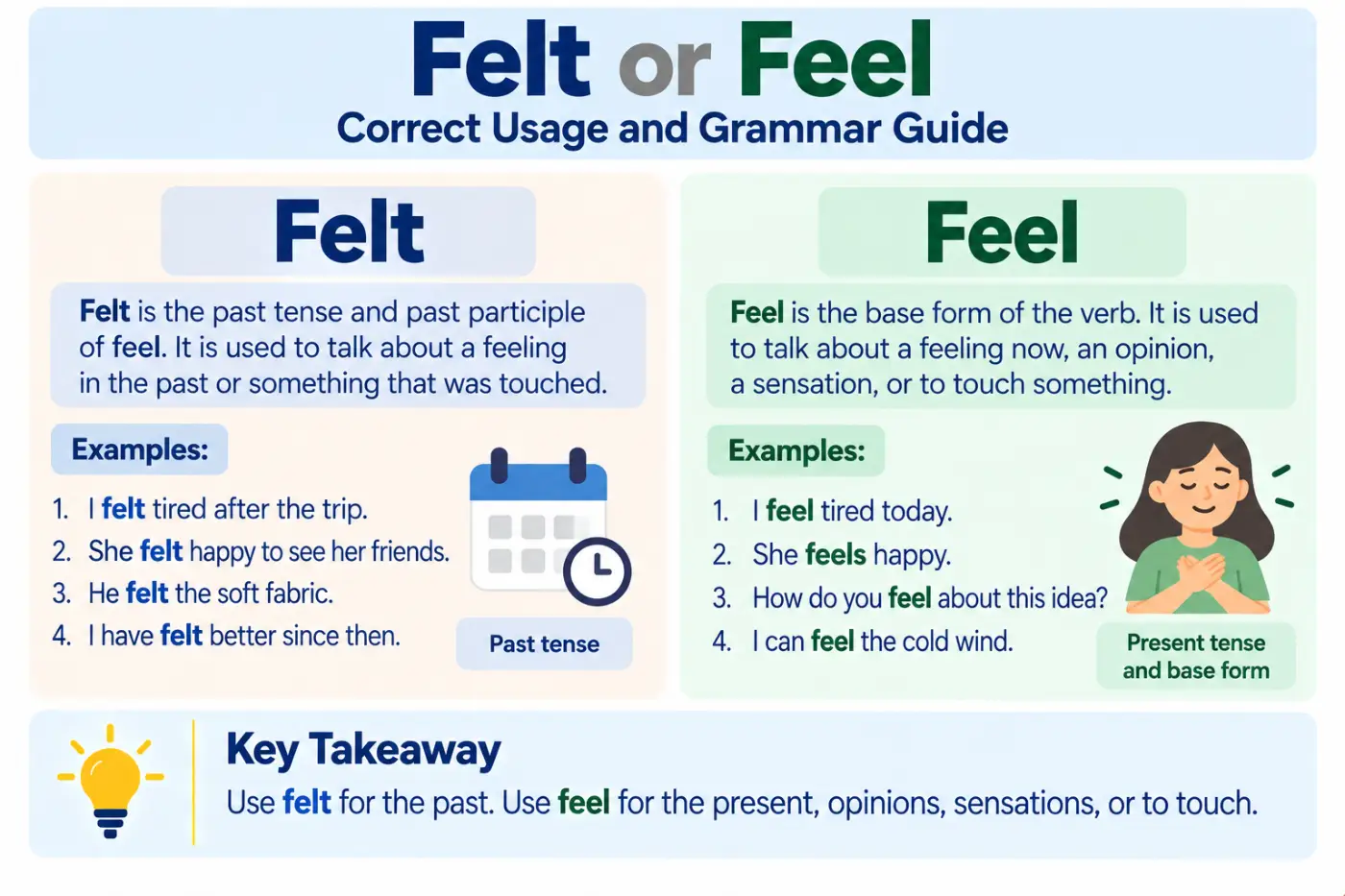
Choosing between felt or feel depends on when an action or experience happens and how the sentence is built. Both words are correct, but they serve different grammatical roles. Feel is the base form of the verb and is used for present experiences, general truths, and some future or ongoing situations. Felt is the simple past form and past participle of feel, so it usually refers to an earlier experience or condition.
For example, you might say, I feel tired today, when describing your current condition. If you are talking about yesterday, you would say, I felt tired after work. The meaning of the verb stays closely related, but the tense changes the time of the experience.
This distinction matters when you describe emotions, physical sensations, opinions, or reactions. It also affects questions, negative sentences, and phrases such as feel better, felt nervous, and have felt grateful. The following guide explains the grammar, pronunciation, common patterns, and real life examples so you can choose the right form with confidence.
A related grammar guide is Quieter vs More Quiet Which Form Is Correct.
Quick Answer
Feel is the base form of the verb and commonly describes a present sensation, emotion, or opinion. Felt is its simple past form and past participle, used for experiences in the past and in perfect tense constructions. Choose the form that matches your sentence’s tense and structure.
Comparison Table
| Feature | Feel | Felt |
|---|---|---|
| Main role | Base form and present tense form | Simple past and past participle |
| Part of speech | Verb | Verb |
| Main use | Present sensations, emotions, and opinions | Past sensations, emotions, and opinions |
| Pronunciation | /fiːl/ | /fɛlt/ |
| Common expressions | Feel happy, feel cold, feel ready | Felt happy, felt cold, felt ready |
| Present example | I feel better today. | Not normally used for a simple present statement |
| Past example | Not used alone for a simple past statement | I felt better yesterday. |
| Perfect tense | Used after helping verbs in some constructions | Have felt, had felt |
| Formality | Standard in all types of English | Standard in all types of English |
| Regional spelling | Standard across major English varieties | Standard across major English varieties |
Meaning and Definition
What Does Feel Mean?
Feel is a verb that describes a physical sensation, an emotional state, an opinion, or an impression. You can feel cold, feel happy, feel pain, feel unsure, or feel that a decision is right. The exact meaning depends on the subject and the words that follow it.
The word often refers to a person’s direct experience. For example, I feel nervous before a presentation describes an emotional state. The sentence, This fabric feels soft, describes a physical quality noticed through touch. In I feel that we should leave early, the verb introduces an opinion.
Common patterns include:
- Feel happy, sad, tired, or excited.
- Feel cold, warm, sick, or dizzy.
- Feel a pain in your shoulder.
- Feel that something is right or wrong.
- Feel like doing something.
- Feel confident about a decision.
Feel is also used in general statements, such as People feel more relaxed after a break. In this case, the present tense describes a general observation rather than one event happening at this exact moment.
What Does Felt Mean?
Felt is the simple past form and past participle of feel. It commonly describes an emotion, sensation, opinion, or impression that existed in the past. For example, I felt nervous before the interview tells the reader about an earlier emotional state.
The verb can describe physical experiences, too. You might say, I felt a sharp pain in my knee, or The wall felt cold to the touch. It can also express a past opinion, as in She felt that the plan was too risky.
Common patterns include:
- Felt happy, sad, tired, or excited.
- Felt cold, warm, sick, or dizzy.
- Felt a sudden pain.
- Felt that something was wrong.
- Have felt worried lately.
- Had felt uncertain before the meeting.
Felt is also used after helping verbs in perfect tense constructions. For example, I have felt more confident recently connects earlier experiences with the present. She had felt nervous before she entered the room places one past feeling before another past event.
Is Felt an Incorrect Form of Feel?
No. Felt is a standard English verb form, not a misspelling. It is the irregular past form of feel, so you do not add the regular past ending and write feeled. The correct forms are feel, feels, feeling, and felt.
The main issue is tense. If you describe a current state, I feel worried is usually correct. If you describe a past state, I felt worried is appropriate. If you write I have felt worried, the helping verb have requires the past participle felt.
Key Differences Explained
1. Present Time Versus Past Time
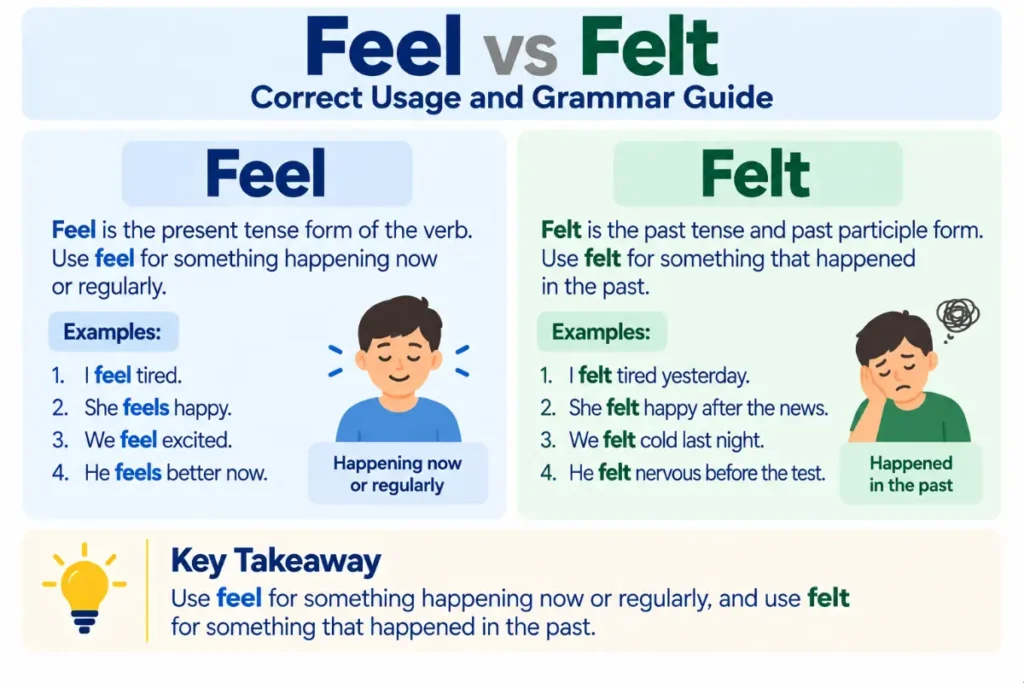
The most important difference is time. Feel commonly describes what is true now, what happens regularly, or what someone generally experiences. Felt usually places the sensation, emotion, or opinion in the past.
Compare these examples:
- I feel nervous before every exam.
- I felt nervous before yesterday’s exam.
The first sentence describes a repeated experience. The second refers to a particular event that has already happened. The verb form tells the reader how to understand the time frame.
2. Grammar and Verb Forms
Feel is the base form of the verb. It appears with I, you, we, and they in the simple present, while he, she, and it usually take feels.
Examples include I feel ready, They feel welcome, and She feels tired. Felt does not change according to the subject in the simple past, so you can say I felt, she felt, or they felt.
The basic forms are:
- Base form: feel.
- Third person singular present: feels.
- Present participle: feeling.
- Simple past: felt.
- Past participle: felt.
Learning these five forms helps prevent common errors in everyday writing.
3. Emotions and Physical Sensations
Both forms can describe emotions and physical sensations. The choice depends on when the experience occurred, not on the type of experience.
For a current emotion, write, I feel hopeful about the new job. For an earlier emotion, write, I felt hopeful after the interview. The same pattern works with physical sensations: I feel cold now, but I felt cold during the trip yesterday.
4. Opinions and Beliefs
Feel can introduce an opinion or personal judgment. For example, I feel that the team needs more time expresses a current view. Felt can report an opinion that someone held in the past, as in I felt that the team needed more time.
In this use, feel does not necessarily describe an emotion. It can mean think, believe, or have the impression that something is true. The verb often makes an opinion sound personal rather than absolute.
5. Questions and Negative Sentences
When you form questions or negative statements in the simple present, you normally use do or does with the base form feel.
Examples include Do you feel better? and She does not feel ready. Do not use felt after does in a simple present sentence, because the helping verb already carries the tense.
In the simple past, use did with feel, not felt. For example, Did you feel nervous? and I did not feel well. The correct form is feel because did marks the past tense.
6. Perfect Tenses
Felt is the past participle used in perfect tense constructions. These forms connect one experience to another time point.
- I have felt this way before.
- She has felt better since resting.
- They had felt uncertain before the announcement.
The helping verb determines the tense structure. In the first two examples, have or has creates the present perfect. In the third, had creates the past perfect.
7. Formal and Informal Usage
Both forms are standard in casual and formal English. There is no rule that makes one more formal than the other. You can use feel in a business email when describing a current opinion and felt in an academic report when discussing past responses.
For example, I feel this approach is practical works in a professional discussion. The participants felt that the instructions were unclear works in a report about a completed study.
8. Regional Usage
American, British, Canadian, and Australian English use the same standard forms: feel, feels, feeling, and felt. There is no meaningful regional spelling difference between these forms.
Accent can affect pronunciation, but the tense rules remain the same. If you are writing for an international English speaking audience, you can use the same grammar guidance.
Which Form Is Correct?
Both feel and felt are correct. The right choice depends on the sentence’s tense, meaning, and grammatical structure. Feel usually expresses a current or general state, while felt expresses a past state or serves as the past participle after a helping verb.
Use feel in a sentence such as I feel confident about the test. Use felt in I felt confident after studying all night. In I have felt confident since the first lesson, felt follows have to form the present perfect.
Here are five examples that show the distinction:
- Correct: I feel happy when I spend time with my family.
- Correct: I felt happy when I saw my family yesterday.
- Correct: She feels that the plan needs more work.
- Correct: She felt that the plan needed more work.
- Correct: We have felt welcome since arriving.
A common error is writing feeled as the past tense. Feel is an irregular verb, so its past form is felt. Another error is using felt after did, as in Did you felt tired? The correct sentence is Did you feel tired? The helping verb did already marks the past tense.
Sentence Examples
Ten Natural Examples Using Feel and Felt
- Everyday conversation: I feel much better after getting some rest.
- Text message: I feel bad that I missed your call.
- Workplace communication: I feel we should review the schedule before sending it to the client.
- School: The student feels confident about the science test.
- Academic writing: Participants feel more comfortable when instructions are clear.
- Formal writing: We feel that the proposed changes deserve further review.
- Social situations: I felt welcome when everyone introduced themselves.
- Online communication: Many readers feel that the article explains the issue clearly.
- Personal experience: She felt nervous before her first job interview.
- Family conversation: We felt relieved when Dad arrived home safely.
These examples show how the verb forms fit different situations. Feel often describes current states, general responses, or present opinions. Felt describes experiences that took place in the past, although it can also appear in perfect tense constructions when paired with a helping verb.
More Examples With Felt
- I felt a strange vibration in the steering wheel.
- He felt proud of his daughter after the school performance.
- The room felt warmer after the heater was turned on.
- They felt that the original decision was unfair.
- We have felt more connected since moving to the same neighborhood.
Notice that felt can describe touch, emotion, and judgment. In the last example, have felt connects past experiences to the present rather than describing one completed event at a specific time.
More Examples With Feel
- I feel cold whenever the air conditioner is running.
- She feels excited about starting college.
- These shoes feel comfortable after a short walk.
- We feel that the new process saves time.
- Do you feel ready to begin?
Feel can describe what is happening now, what happens repeatedly, or what someone believes. It can also appear in questions and instructions when paired with the correct sentence structure.
Common Mistakes and Usage Problems
1. Using Feeled Instead of Felt
Incorrect: I feeled nervous before the presentation.
Correct: I felt nervous before the presentation.
Feel is an irregular verb. Its simple past form is felt, not feeled. Many English verbs form the past tense by adding ed, but this pattern does not apply to every verb. Learning common irregular forms helps you avoid this mistake.
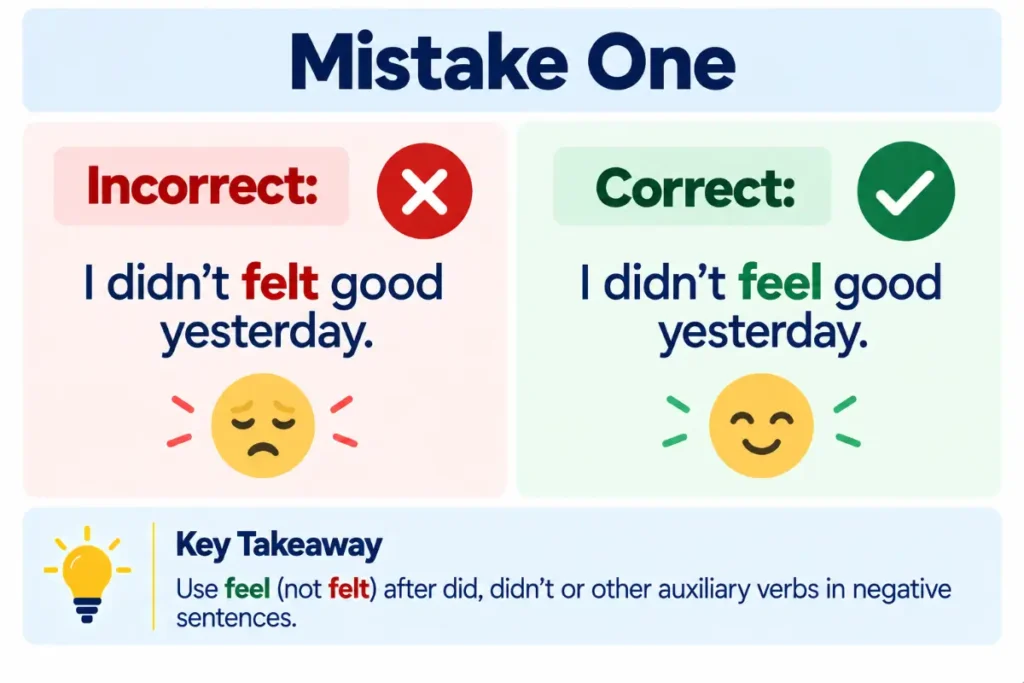
2. Using Felt After Did
Incorrect: Did you felt tired after the game?
Correct: Did you feel tired after the game?
In a simple past question, did carries the tense, so the main verb returns to its base form. The same rule applies to other verbs: Did you go, not Did you went. Remember that only one part of the verb phrase needs to show the past tense.
3. Using Feel for a Completed Past Event
Incorrect: Yesterday, I feel sick after lunch.
Correct: Yesterday, I felt sick after lunch.
The word yesterday clearly places the experience in the past, so the simple past form is normally required. Similar time markers include last night, two days ago, and earlier this morning when the event is complete.
4. Using Felt for a Current State
Incorrect: I felt tired right now.
Correct: I feel tired right now.
Right now usually points to the present. Use feel to describe the current state. If you are telling someone how you felt earlier, use a past time phrase such as this morning or before the meeting.
5. Mixing Up Felt and Have Felt
Incorrect: I have feel this way for weeks.
Correct: I have felt this way for weeks.
The present perfect uses have or has followed by the past participle. Because felt is the past participle of feel, it follows have in this structure. This form is useful when a past experience continues into the present or remains relevant now.
A Simple Editing Test
When you are unsure which form to use, look at the time frame and the helping verb.
- Use feel for a present or general statement.
- Use felt for a completed past experience.
- Use felt after have, has, or had in perfect tense constructions.
- Use feel after do, does, or did in questions and negative sentences.
This short check catches many common errors without requiring complicated grammar terms.
Pronunciation Guide
How Do You Pronounce Feel?
In standard American English, feel is pronounced /fiːl/. It has one syllable and a long ee vowel sound, similar to the vowel in see. The final l is pronounced at the end of the word.
Say it like feel, keeping the vowel steady rather than turning it into a short i sound. The word does not need an extra syllable, and the stress falls on the only syllable.
How Do You Pronounce Felt?
Felt is pronounced /fɛlt/ in standard American English. It also has one syllable, but its vowel is the short e sound heard in words such as bed and help. The final consonant group includes l and t.
The difference between feel and felt is easy to hear when you focus on the vowel and ending. Feel has a long ee sound and ends in l. Felt has a short e sound and ends in lt.
Common Pronunciation Confusion
Some learners may confuse the two forms because the spelling is similar. Saying each word slowly can help: feel, then felt. Pay attention to the shorter vowel in felt and the extra t sound at the end.
Pronunciation does not change the grammar rule. You still need to choose the verb form that matches the time frame and sentence structure.
Still confused? Compare Could or Can: What’s the Difference and When to Use Each?.
Etymology and Word Origin
The History of Feel
Feel comes from Old English forms related to the verb used for sensing, perceiving, or experiencing something. The word developed through the history of English and has retained its connection to touch and personal experience.
Over time, its meaning expanded beyond physical sensation. Modern English uses feel for emotions, opinions, impressions, and reactions, as well as the sense of touching something. For example, you can feel the texture of a table, feel nervous before a speech, or feel that a decision is fair.
The History of Felt
Felt is the irregular past form and past participle of feel. It developed as part of the verb’s historical pattern rather than through the regular addition of ed. English contains many verbs with older past tense forms, such as keep and kept, leave and left, and feel and felt.
The historical form explains why feeled is not the standard past tense. However, you do not need to study the word’s full history to use it correctly. Learning the modern forms and practicing them in sentences is usually enough.
Regional Usage
American English
In the United States, feel is used for current sensations, emotions, and opinions, while felt is used for past experiences and perfect tense constructions. The forms are standard in conversation, education, business, and formal writing.
For example, an American speaker might say, I feel ready for the meeting, or I felt nervous before the interview. Both follow standard grammar.
British English
British English uses the same verb forms and tense rules. Speakers use feel for present states and felt for past states, with no spelling difference between the varieties.
Accent may affect the exact vowel sounds, but it does not change the standard forms. The same grammar applies in British schools, newspapers, and professional communication.
Australian English
Australian English also follows the same pattern. Feel and felt are standard forms used for present and past sensations, emotions, and opinions. There is no major regional distinction that changes which form is correct.
Canadian English
Canadian English follows the same rules as American and British English. Use feel for present or general statements and felt for past experiences or as a past participle. Regional pronunciation may vary, but the spelling remains the same.
Across these varieties, the key is the sentence’s time frame and structure, not the speaker’s location.
Grammar Rules and Part of Speech
Feel and felt are forms of the same verb. Feel is the base form, while felt is both the simple past form and the past participle. The verb can describe physical sensation, emotional experience, an opinion, or an impression.
Present Tense
Use feel with I, you, we, and they in the simple present. Use feels with he, she, and it.
- I feel tired after long meetings.
- They feel welcome at the new school.
- She feels nervous before public speaking.
- The fabric feels soft.
The last example uses feels because fabric is a singular subject. The verb can describe a quality someone notices through touch, not only an emotion.
Past Tense
Use felt for all subjects in the simple past.
- I felt tired after the long drive.
- She felt proud of her work.
- They felt cold during the storm.
- The fabric felt rough.
Unlike regular verbs, felt does not change according to the subject. You do not write felts for the third person singular in the past tense.
Present Perfect and Past Perfect
Use have or has plus felt for the present perfect. Use had plus felt for the past perfect.
- I have felt this way before.
- She has felt more confident since the training.
- They had felt uncertain before the announcement.
The present perfect often connects a past experience with the present. The past perfect shows that an experience happened before another event in the past.
Questions and Negative Sentences
Use do or does plus feel for simple present questions and negatives. Use did plus feel for simple past questions and negatives.
- Do you feel better today?
- He does not feel ready.
- Did they feel welcome?
- I did not feel well yesterday.
Avoid adding a past form after did. The helper already marks the tense, so the main verb remains feel.
Feel Like and Feel That
Feel like can describe a desire or an impression. For example, I feel like going for a walk means I want to go for a walk. It can also describe a resemblance, as in This feels like a dream.
Feel that introduces an opinion or belief. For example, I feel that we should wait means the speaker thinks waiting is the better choice. In the past, use felt that: I felt that we should wait.
Real Life Usage Examples
Daily Conversation
- I feel hungry, so I am going to make a sandwich.
- I felt hungry earlier, but dinner filled me up.
The first sentence describes a current state. The second refers to a sensation that happened earlier and may have passed.
Email and Workplace Communication
- I feel that the revised deadline is realistic.
- The team felt that the instructions needed more detail.
The first sentence gives a current opinion. The second reports a view held by the team in the past. Both forms can work in professional writing without sounding too casual.
Academic Writing
- Students feel more prepared when they receive clear instructions.
- Participants felt less anxious after completing the practice session.
The first sentence describes a general pattern. The second reports an experience from a completed session. The verb tense helps readers understand the timing of the observation.
News and Journalism
- Local residents feel concerned about the proposed road changes.
- Several residents felt that the public meeting did not address their concerns.
The first sentence describes current feelings. The second reports past opinions about a specific event. News writers use the same tense distinction when describing public reactions.
Literature and Storytelling
- Mara feels uneasy as she approaches the old house.
- He felt a wave of relief when the door opened.
The present form can make a scene feel immediate, while the past form fits a story told in the past tense. Writers choose the form based on the timeline and point of view.
Related and Confused Terms
1. Feeling
Feeling is the present participle of feel and can also function as a noun. For example, I am feeling tired uses it as part of a verb phrase, while The feeling passed quickly uses it as a noun.
2. Feels
Feels is the simple present form used with he, she, or it and other singular third person subjects. Write She feels confident, not She feel confident, in a standard simple present sentence.
3. Felt Like
Felt like often describes a past desire or impression. I felt like taking a walk describes a past wish. The phrase can also express resemblance, as in The day felt like summer.
4. Have Felt
Have felt is a present perfect construction used with I, you, we, and they. It often connects past experiences to the present. For example, I have felt more relaxed since changing my routine.
5. Had Felt
Had felt is the past perfect form. It describes an experience that occurred before another past event. For example, She had felt nervous before the interview began.
6. Think
Think can express an opinion or belief, much like feel that. However, think often focuses on a judgment or idea, while feel can sound more personal or emotional. I think the plan is useful and I feel the plan is useful are both possible, but the tone may differ.
7. Sense
Sense means to notice or become aware of something, sometimes without direct evidence. You might sense tension in a room or sense that something is wrong. Feel can describe a similar impression, but sense often highlights awareness or intuition.
8. Experience
Experience means to live through or encounter an event or condition. It can be a useful alternative when you want a more neutral description. For example, I experienced discomfort is more formal and specific than I felt uncomfortable.
Expert Editor Insight
A careful editor checks tense, time markers, and helping verbs before changing either form. Words such as yesterday, last week, and earlier often point to the past, while now and today often suggest the present, though context still matters. Grammar tools may flag feeled or a form such as Did you felt, but they can miss tense errors when a sentence is otherwise well formed. A useful editing habit is to locate the main verb, identify the time frame, and check for helpers such as do, did, have, has, or had. This simple process catches many mistakes.
Key Takeaways
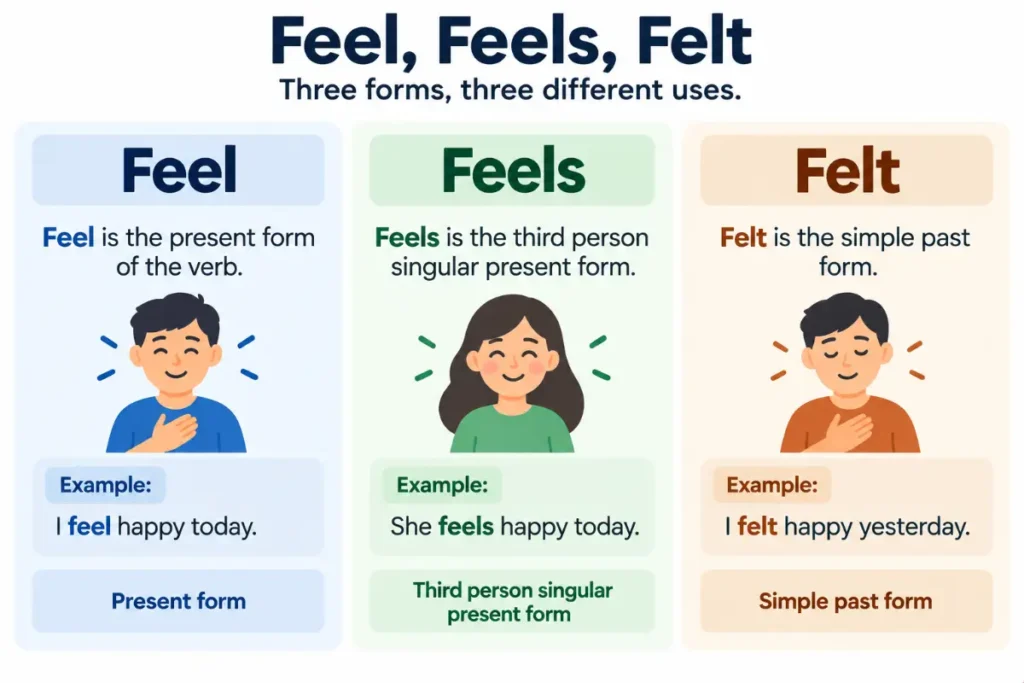
- Feel is the present form of the verb.
- Feels is the third person singular present form.
- Felt is the simple past form.
- Felt is also the past participle.
- Use feel for current or repeated experiences.
- Use felt for completed past experiences.
- After did or didn’t use feel.
- After have, has, or had use felt.
- Do not use feeled as the standard past form.
- The correct form depends on tense, subject, helping verbs, and context.
A related grammar guide is Gases or Gasses Which Spelling Is Correct.
Conclusion
The choice between felt or feel depends on the time frame and grammar of your sentence. Feel is the base form used for present experiences, general statements, and current opinions. Felt describes past experiences and also serves as the past participle after have, has, or had. Both forms are correct, but they are not interchangeable in every sentence.
To avoid mistakes, check the time marker and any helping verb before choosing a form. Remember that feel becomes felt in the past, not feeled. This simple rule will help you describe emotions, physical sensations, and opinions clearly in everyday and formal English.
FAQs
Is Feel or Felt Correct?
Both forms are correct, but they are used in different grammatical situations. Feel is the base form and is commonly used for present or general experiences. Felt is the simple past form and past participle. Write I feel tired now, but I felt tired yesterday. The sentence’s time frame and structure determine which form you need.
Is Feeled a Real Word?
Feeled is not the standard past tense of feel in modern English. The correct form is felt because feel is an irregular verb. You should write I felt nervous, not I feeled nervous. Although learners may create feeled by following the usual ed pattern, standard writing and speech use felt for both the simple past and past participle.
What Is the Past Tense of Feel?
The simple past tense of feel is felt. Use it when describing an experience that happened in the past, such as I felt happy after the game. Felt also works as the past participle in phrases such as have felt and had felt. The form does not change according to the subject, so it works with I, she, we, and they.
Should I Say I Feel or I Felt?
Say I feel when you are describing a current state, a general experience, or a present opinion. Say I felt when you are talking about a past experience. For example, I feel nervous before every presentation describes a repeated experience, while I felt nervous before yesterday’s presentation refers to one event that has already happened.
Is It Did You Feel or Did You Felt?
The correct form is Did you feel because did already marks the past tense. In simple past questions and negative statements, the main verb returns to its base form. Say Did you feel better? and I did not feel well. Do not write Did you felt better? or I did not felt well in standard English.
How Do You Use Have Felt in a Sentence?
Use have felt to connect past experiences with the present. For example, I have felt more confident since starting the course means the change began earlier and remains relevant now. Use has felt with he, she, or it, as in She has felt tired all week. The word felt is required because have and has take the past participle.
Can Feel Describe an Emotion and a Physical Sensation?
Yes. Feel can describe emotions such as happiness, worry, or excitement, as well as physical sensations such as cold, pain, or dizziness. Felt works for the same meanings in the past. For example, I feel anxious today describes a current emotion, while I felt dizzy after the ride describes an earlier physical sensation.
Is Felt Appropriate in Formal Writing?
Yes. Felt is a standard verb form and works in formal reports, academic writing, workplace communication, and everyday conversation. For example, The participants felt that the instructions were unclear is suitable in a research report. The key is to use the correct tense and provide enough context for the reader to understand when the experience or opinion occurred.