
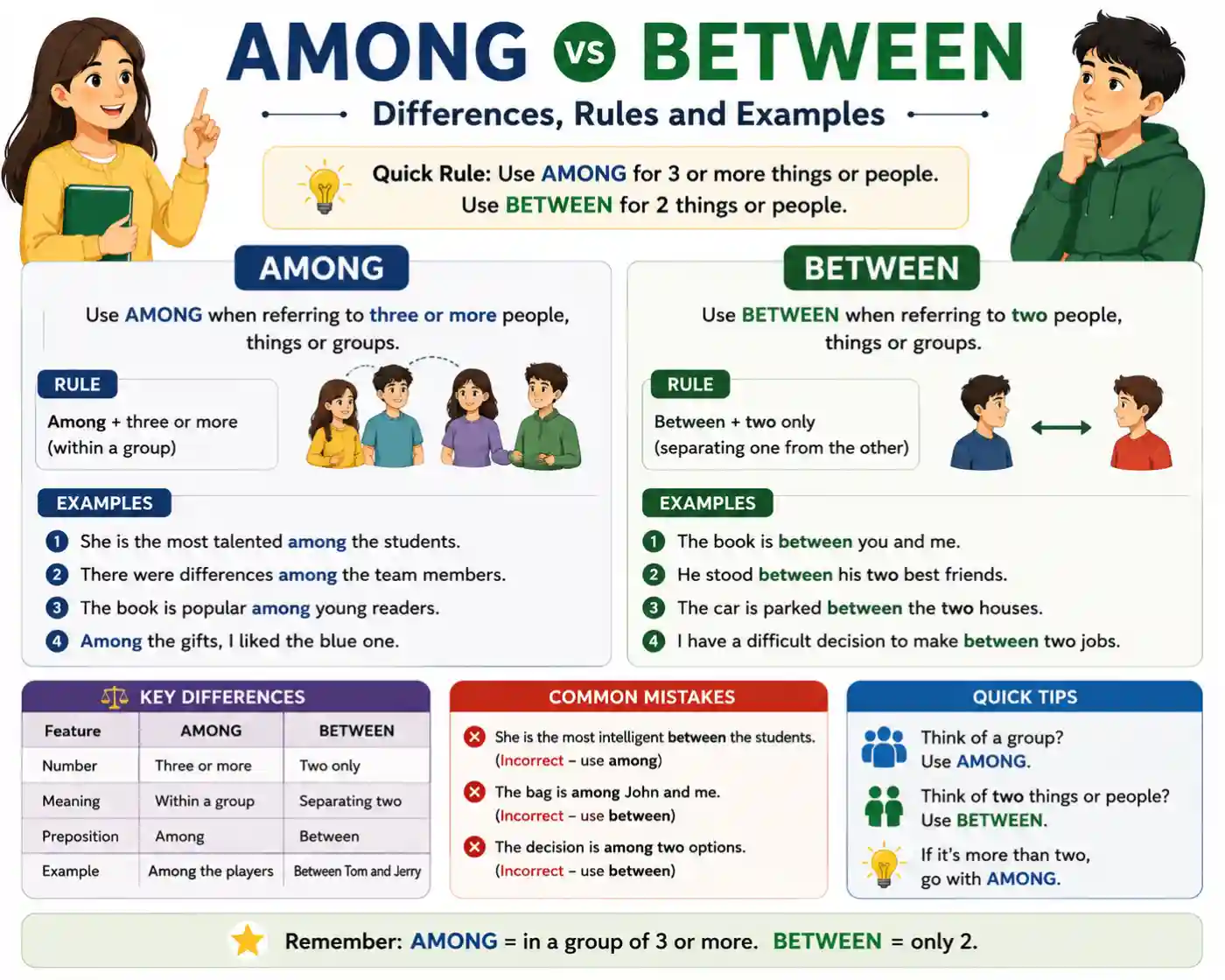
Choosing between among vs between can be confusing because both words describe relationships involving people, places, objects, or ideas. The common rule says to use “between” for two things and “among” for three or more, but that rule does not explain every situation. Both words are correct, and the best choice depends on how the items relate to one another.
Use “between” when you want to show a clear relationship involving separate people or things, even when more than two are involved. Use “among” when you mean within a group, surrounded by others, or as part of a larger collection. For example, you might divide money between three children, but search among a pile of old papers for a missing letter.
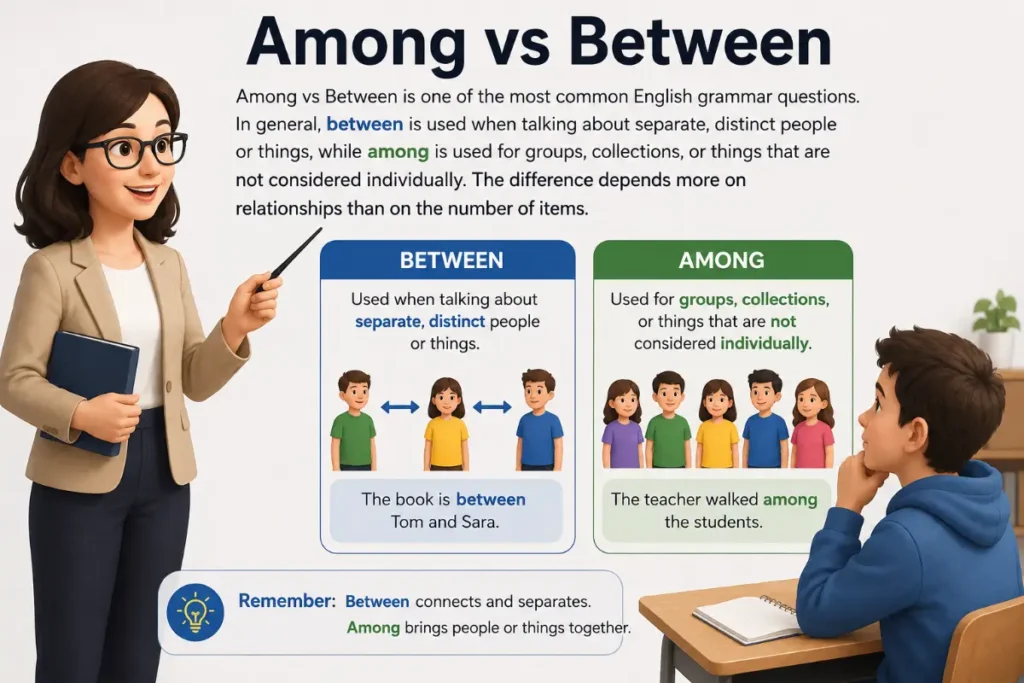
The difference becomes easier to understand when you focus on meaning instead of counting nouns. This guide explains the definitions, grammar patterns, pronunciation, regional usage, and common mistakes that often confuse English learners and native speakers alike. You will also find practical examples for everyday conversation, school, work, and formal writing.
Need another quick comparison? Read Set or Sit Which Word Is Correct.
Quick Answer
Use “between” to describe a distinct relationship or division involving separate people or things. Use “among” to describe someone or something within a group or surrounded by its members. “Between” can refer to more than two items when the relationships are distinct, so the number of items alone does not determine the correct choice.
Comparison Table
| Feature | Between | Among |
|---|---|---|
| Main meaning | In the space separating, or in a relationship involving, distinct items | In the middle of, surrounded by, or included within a group |
| Part of speech | Preposition | Preposition |
| Typical focus | Individual relationships or boundaries | A group or collective setting |
| Number of items | Two or more | Usually a group of three or more |
| Common phrases | Between friends, between two cities, choose between options | Among friends, among the crowd, among the options |
| Everyday use | Comparing, dividing, locating, or describing relationships | Describing membership, surroundings, or group settings |
| Formal writing | Common in all forms of writing | Common in all forms of writing |
| Example | The agreement was between three companies. | She felt comfortable among her coworkers. |
Meaning and Definition
What Does Between Mean?
“Between” is a preposition used to describe a position, connection, choice, division, or relationship involving distinct people or things. It can refer to physical space, time, communication, responsibility, or differences between ideas.
For example, a park might sit between two buildings. A meeting might take place between 2 p.m. and 3 p.m. Two coworkers might discuss a disagreement between their departments. In each case, the word identifies a relationship or boundary that separates or connects distinct points.
Common expressions include:
- Between two people.
- Between two places.
- Between work and family.
- Between Monday and Friday.
- An agreement between three companies.
- A choice between several options.
The last two examples show why the simple number rule can be misleading. “Between” can describe more than two items when each item is considered separately or when a distinct relationship connects the members.
For example, “The negotiations between the five countries continued” is correct if the countries are participating as separate parties in the negotiations. The word does not become incorrect just because the sentence mentions more than two countries.
What Does Among Mean?
“Among” is a preposition that usually means within a group, surrounded by members of a group, or included as part of a collection. It often presents people or objects as a group rather than emphasizing separate relationships between individual members.
For example, “She sat among her friends” means that her friends were around her or that she was in their group. “The missing key was found among the old books” means that the key was located within a collection of books.
Common expressions include:
- Among friends.
- Among the trees.
- Among the crowd.
- Among the students.
- Among the available choices.
- Popular among teenagers.
The word can also describe a shared feeling, belief, or condition within a group. For example, “There was agreement among the team members” means that agreement existed within the group. The sentence does not focus on each separate relationship between two members.
Is Among Only Used for Three or More Items?
“Among” usually refers to a group of three or more people or things, but the important feature is the group setting. It is not simply a mathematical label for any collection containing at least three items.
For example, “The child hid among the bushes” describes the child’s position within a group of bushes. “The news spread among the neighbors” describes how information moved through a community.
The word can also refer to people treated collectively, even when the exact number is unknown. In “There was concern among the audience,” the sentence focuses on the audience as a group rather than counting its members.
Is Between Only Used for Two Items?
No. “Between” can describe relationships involving three or more distinct people, places, or things. The traditional two item rule works in many basic examples, but it does not cover every correct use.
Consider the sentence, “The prize money was divided between the three winners.” This is standard English because the money is being allocated to three distinct people. Similarly, an agreement can exist between several countries, and a comparison can be made between three different products.
The useful question is not simply how many items appear in the sentence. Ask instead if the sentence emphasizes distinct relationships, separate parties, boundaries, or divisions. If it does, “between” may be the right choice.
Key Differences Explained
1. Individual Relationships Versus a Group
The most useful distinction is the way you view the people or things in the sentence. “Between” highlights separate items and the relationship connecting them. “Among” places someone or something within a group or collective setting.
Compare these examples:
- The discussion between the three managers lasted an hour.
- There was strong support among the managers.
The first sentence focuses on the managers as separate participants in a discussion. The second describes support within the group. Both are correct, but they present the relationship differently.
2. Physical Location
Use “between” when describing a position that separates two places or lies in relation to distinct points. Use “among” when someone or something is located within a surrounding group.
Examples:
- The café is between the library and the bank.
- The cabin is hidden among the trees.
The café has a position relative to two landmarks. The cabin is surrounded by trees, so the group setting matters more than any one tree.
You can also use “between” with more than two landmarks if the location is described in relation to distinct points. For example, “The village lies between the mountains, the river, and the main highway” may be correct if those features define its location.
3. Choices and Decisions
Both words can appear when discussing choices, but they often create different meanings. “Between” commonly presents alternatives as separate options. “Among” often suggests choosing or searching within a larger collection.
For example, “I had to choose between three job offers” presents three distinct offers. “She was the most experienced among the applicants” compares one person with a group.
The phrase “choose among the candidates” is also natural when you are selecting one or more people from a group. The phrase “choose between the candidates” can be equally correct when the candidates are treated as distinct alternatives. The surrounding sentence determines which wording fits best.
4. Sharing and Dividing
“Between” often appears when something is divided, allocated, or shared among distinct recipients. The recipients may number two or more.
For example, “The parents divided the cost between their four children” emphasizes how the cost was allocated to individual children. You can also say, “The cost was shared among the four children,” which presents the children as a group contributing to the expense.
Both sentences are correct. The first highlights the allocation across separate recipients, while the second emphasizes group participation. In ordinary use, the difference may be subtle, and both forms can work in the same context.
5. Time and Boundaries
“Between” is common when describing a period with a starting point and an ending point. You might work between 9 a.m. and 5 p.m. or plan a visit between Tuesday and Thursday.
“Among” does not usually describe two endpoints in this way. It is more likely to describe events or people within a broader group or setting. For example, “Among the tasks scheduled for Tuesday was a staff meeting” places the meeting within a set of tasks.
6. Abstract Relationships
The distinction also applies to ideas, feelings, responsibilities, and social connections. “Between” often connects separate concepts or parties, while “among” describes a feeling or condition shared within a group.
Examples:
- There is a clear difference between confidence and arrogance.
- Trust grew among the team members.
The first sentence compares two distinct ideas. The second describes trust within a group. You can also write “There is disagreement among the experts,” because the disagreement exists within a group of people.
7. Formality and Style
Neither word is more formal by nature. Both are standard in casual conversation, professional communication, academic writing, and formal documents.
The choice depends on meaning, not status. “Between” is appropriate in a research paper when discussing a relationship between variables. “Among” is appropriate when reporting a pattern among study participants. Using the wrong preposition can blur the meaning, even if the rest of the sentence is grammatically correct.
8. Pronunciation
In American English, “between” is pronounced /bɪˈtwiːn/. It has two syllables, with stress on the second syllable. “Among” is pronounced /əˈmʌŋ/ and also has two syllables, with stress on the second syllable.
Both words are easy to pronounce once you recognize their vowel sounds. The first syllable in “among” often sounds like the relaxed vowel in “about,” while the stressed syllable sounds similar to “strung” without the initial consonant cluster.
9. Regional Usage
American, British, Canadian, and Australian English use both words in broadly the same way. There is no major regional spelling difference or separate national rule that changes the core distinction.
Some expressions may be more common in one setting than another, but the general grammar remains stable. Writers in all four varieties can use “between” for distinct relationships and “among” for a group setting.
Which Word Is Correct?
Both words are correct, and neither is a misspelling. The right option depends on how the sentence frames the relationship between people, objects, places, or ideas.
Use “between” when the sentence highlights separate parties, boundaries, comparisons, choices, or allocations. Use “among” when it emphasizes being within a group, surrounded by a collection, or included as part of a larger whole.
Here are five correct examples:
- The agreement between the three businesses was signed yesterday.
- The children played among the trees.
- She had to choose between four colleges.
- There was excitement among the fans.
- The funds were divided between the six departments.
The first, third, and fifth sentences use “between” because they focus on distinct parties, alternatives, or recipients. The second and fourth use “among” because they describe a setting or feeling within a group.
A helpful way to check your choice is to picture the relationship. If you can identify separate points or parties that the sentence connects, “between” may fit. If you picture someone or something within a surrounding group, “among” is often the natural choice.
Sentence Examples
The following examples show how the two prepositions work in everyday and professional settings. Notice how the meaning changes depending on the relationship being described.
Ten Natural Example Sentences
- Everyday conversation: I could not decide between the blue jacket and the black one.
- Family life: The children shared the last slice of cake between themselves.
- School: The teacher walked among the desks to check everyone’s work.
- Workplace: The final decision was made between the department heads.
- Academic writing: The researchers found a connection between sleep quality and memory.
- Formal writing: The agreement between the three organizations will take effect next month.
- Social situations: She felt relaxed among people who shared her interests.
- Online communication: The discussion between the moderators continued after the live event.
- Travel: The small town sits between two major highways.
- News reporting: Concern spread among residents after the water supply warning.
Each sentence uses the preposition that best matches the relationship. Some refer to distinct people, places, or ideas, while others describe a setting or feeling within a group.
Examples Involving More Than Two Items
The most common mistake is assuming that “between” must always refer to exactly two things. These examples show why that rule is incomplete.
- The contract between the four partners outlines their responsibilities.
- The runner had to choose between three training plans.
- The prize was divided between the five finalists.
- The negotiations between the two cities and the regional council continued for weeks.
- The survey measured differences between several age groups.
These sentences are correct because the items are treated as distinct parties, options, recipients, or categories. “Among” might fit some of these contexts if the focus shifted to group membership, but the presence of more than two items does not make “between” incorrect.
Examples With Groups
Use “among” when the sentence focuses on a group or something within it.
- The teacher noticed a quiet student among the noisy children.
- A sense of relief spread among the passengers.
- The rare coin was hidden among ordinary coins.
- She was well known among local artists.
- The proposal received strong support among community members.
The group may be physical, such as children in a room, or abstract, such as artists or community members. In each case, the sentence presents the people or objects as a larger collection.
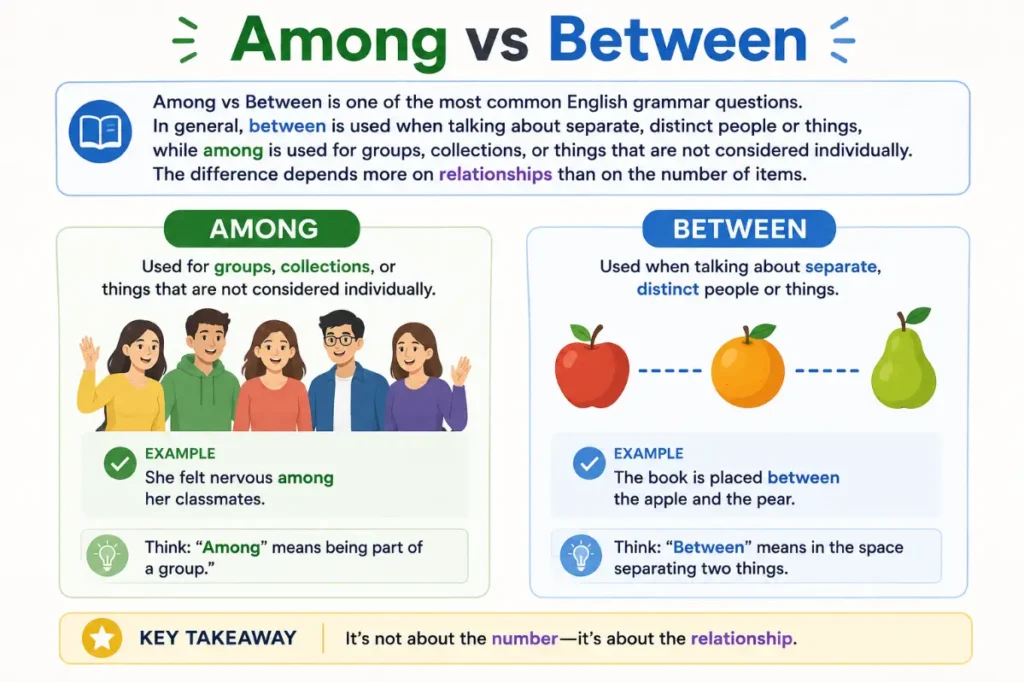
When To Use Among
Use among whenever something belongs within a larger group instead of involving separate relationships.
Within A Group
Example.
She stood among the audience.
Explanation. The audience is one collection of people.
Common Mistakes and How to Fix Them
Mistake 1: Applying the Two Item Rule Too Strictly
Incorrect: “The agreement among the three companies was finalized.”
This sentence is not always wrong, but if the writer means a formal agreement connecting three separate companies as parties, “the agreement between the three companies” is often more precise.
Correct for distinct parties: “The agreement between the three companies was finalized.”
The traditional rule can lead writers to avoid “between” whenever they see three or more items. Instead, look at the relationship being described. Distinct parties can be connected by “between” regardless of their number.
Mistake 2: Using Between for a Surrounding Group
Awkward: “He felt comfortable between his classmates.”
More natural: “He felt comfortable among his classmates.”
The first sentence could suggest that he was physically positioned between particular classmates. If the intended meaning is that he felt accepted as part of the group, “among” communicates that idea more clearly.
Mistake 3: Using Among for a Clear Division
Awkward: “The cost was divided among the two departments.”
More natural: “The cost was divided between the two departments.”
“Among” is usually associated with a group, but “between” is the conventional choice when describing a division between two distinct recipients. With larger groups, either word may work, depending on the emphasis.
Mistake 4: Ignoring the Difference Between Location and Membership
Incorrect for the intended meaning: “The cottage is among the river and the road.”
Correct: “The cottage is between the river and the road.”
The river and road act as two distinct boundaries that locate the cottage. “Among” would be more natural if the cottage were surrounded by a collection, such as trees, houses, or hills.
Mistake 5: Assuming One Word Always Sounds More Formal
Incorrect reasoning: “I should use ‘between’ because it sounds more precise in every sentence.”
There is no general rule that one word is always more formal or more precise. Both are standard prepositions. The correct choice depends on the relationship, so changing the word just to make a sentence sound more sophisticated can weaken its meaning.
A Practical Editing Tip
Try replacing the preposition with a short description of the relationship.
- If you mean connecting distinct parties or marking a boundary, test “between.”
- If you mean within a group or surrounded by its members, test “among.”
- If the sentence describes three or more items, do not reject “between” just because of the number.
- Read the whole sentence aloud to check that the intended meaning is clear.
This method is more reliable than counting nouns alone.
Need another quick comparison? Read former vs latter Explained With Clear Examples.
Pronunciation Guide
How to Pronounce Between
The American English pronunciation of “between” is /bɪˈtwiːn/. It has two syllables: be and tween. The main stress falls on the second syllable, so the word sounds like “bih TWEEN.”
The first vowel is short and relaxed, while the second syllable contains the long e sound heard in “green.” Avoid giving both syllables equal stress in careful speech. Natural regional accents may vary slightly, but the main stress remains on the second syllable.
How to Pronounce Among
The American English pronunciation of “among” is /əˈmʌŋ/. It also has two syllables: a and mong. The stress falls on the second syllable, so it sounds like “uh MUNG.”
The first syllable uses a relaxed vowel, similar to the opening sound in “about.” The second syllable has the vowel sound heard in “sun,” followed by the ng sound.
Common Pronunciation Problems
Some speakers place too much stress on the first syllable of “between” or pronounce the final sound of “among” as a separate /g/. In standard pronunciation, the ng ending is a single nasal sound, as in “song.”
You do not need to exaggerate the sounds to speak clearly. Focus on the stressed second syllable in both words and practice them in complete phrases, such as “between the houses” and “among the trees.”
Etymology and Word Origin
The History of Between
“Between” developed from Old English forms related to the idea of two things or points in relation to one another. Its historical form included “betweonum,” which was used for a position or relationship involving two sides. Over time, the word developed the broader modern uses seen in English today.
Its current meaning extends beyond physical space. People use it for relationships, choices, time periods, comparisons, and agreements. The historical connection with two sides helps explain the traditional rule, but modern usage also allows the word to connect more than two distinct parties.
The History of Among
“Among” developed from earlier English forms, including “on gemang,” an expression connected with being in a crowd or group. The word gradually became the modern preposition used to describe something within a collection or surrounded by its members.
This background fits its present use. You can be among friends, among trees, or among a group of applicants. The word commonly emphasizes the collective setting rather than separate connections between individual members.
What the Origins Tell Us
The histories help explain the basic contrast, but modern usage is the better guide for choosing the right word. “Between” has expanded to describe distinct relationships involving more than two items, while “among” continues to emphasize a group or collective setting.
You do not need to memorize the older forms. Focus on the meaning of your sentence and the relationship you want the reader to picture.
Regional Usage
American English
In the United States, both prepositions are standard. Writers commonly use “between” for distinct relationships, boundaries, comparisons, and divisions. They use “among” to describe being part of a group or surrounded by its members.
For example, “The agreement between the four companies” is natural when the companies are separate parties. “She was popular among her classmates” is natural because the sentence describes her standing within a group.
British English
British English follows the same basic distinction. “Between” can refer to more than two distinct parties, while “among” commonly refers to a group or collective setting. There is no major spelling difference between the two varieties.
Some British speakers also use “amongst,” a variant of “among.” Both are accepted, though “among” is common in American English and widely understood in British English. The choice between “among” and “amongst” does not change the central distinction from “between.”
Australian English
Australian English generally follows the same usage as American and British English. Both words are standard, and the choice depends on the meaning of the sentence rather than a special regional rule.
Canadian English
Canadian English also uses both prepositions in the same broad ways. “Between” is appropriate for distinct relationships involving two or more parties, while “among” is common for group membership, surroundings, and shared conditions.
Across these varieties, the traditional number rule may be taught as a starting point, but it should not be treated as an absolute rule. Meaning and context provide the more reliable guide.
Grammar Rules and Part of Speech
“Among” and “between” are prepositions. They connect a noun or pronoun to another part of the sentence by showing a relationship involving location, time, choice, comparison, or group membership.
Sentence Position
Both words usually appear before a noun, pronoun, or noun phrase.
- The bakery is between the school and the post office.
- The child sat among the guests.
- There is a strong bond between the sisters.
- The news spread quickly among the workers.
The noun phrase that follows the preposition is called its object. In each example, the preposition helps explain how one person, place, or idea relates to another.
Using Pronouns Correctly
Use object pronouns after these prepositions, such as me, him, her, us, and them.
Correct: “The agreement was between you and me.”
Incorrect in standard formal English: “The agreement was between you and I.”
The same principle applies to “among.” For example, “The secret stayed among us” is correct. The preposition takes an object, so use the object form of the pronoun.
Common Grammar Patterns
These patterns can help you choose the right preposition.
- Between A and B. Example: The store is between the bank and the pharmacy.
- Between two or more distinct parties. Example: The talks between the four leaders continued.
- Among a group. Example: She felt at ease among her teammates.
- Among a collection. Example: The letter was found among the old documents.
- Differences between items. Example: There is a clear difference between the two plans.
- Agreement among people. Example: There was agreement among the committee members.
These patterns are common, but context still matters. For example, “agreement between the committee members” can also be correct if the sentence focuses on the distinct people involved in reaching an agreement.
Formal and Informal Writing
Both words work in formal and informal English. You can use “between” in a casual conversation about meeting times and in a formal report about differences between research findings. You can use “among” when describing a group of friends or reporting a pattern among survey participants.
Do not choose one word simply because it sounds more academic. Choose the preposition that gives readers the clearest picture of the relationship.
Related and Confused Terms
These eight terms and expressions can help you understand the difference more clearly.
1. Amongst
“Amongst” is a variant of “among.” It is accepted in English, particularly in British usage, though “among” is common in American English. Both mean within a group or surrounded by its members. For most American readers, “among” is the straightforward choice.
2. Amid
“Amid” means in the middle of or surrounded by something, often a situation, event, or condition. For example, “The announcement came amid growing concern” describes the circumstances surrounding the announcement. “Among” more often refers to members of a group, while “amid” commonly introduces conditions or events.
3. Amidst
“Amidst” is a variant of “amid.” It has the same basic meaning and can sound more literary or formal. For example, “Amidst the confusion, she found the exit.” In everyday American writing, “amid” is often simpler, but both forms are acceptable.
4. Within
“Within” means inside a boundary, limit, group, or period. For example, “The answer is within the report” means the report contains the answer. It can overlap with “among” in some contexts, but it does not always suggest a group of separate members.
5. Across
“Across” describes movement or position from one side to another, or distribution over an area. “The message spread across the country” emphasizes its reach over a region. “Among residents” would focus instead on the people who received or discussed the message.
6. In Between
“In between” usually refers to a position or interval separating two points. For example, “The small shop sits in between the two houses.” In many sentences, “between” alone is enough. “In between” is natural in conversation, but avoid adding “in” when it serves no purpose.
7. Relationship Between
“Relationship between” is a common phrase used to describe a connection involving distinct people, variables, or ideas. For example, “The researchers examined the relationship between exercise and sleep.” The phrase can also describe connections involving more than two variables if the sentence treats them as distinct elements.
8. Shared Among
“Shared among” describes something distributed or experienced within a group. For example, “The costs were shared among the participants.” The phrase emphasizes group involvement. “Shared between” can also be correct, particularly when the focus is on dividing something among distinct recipients.
Expert Editor Insight
An experienced editor looks at the relationship described by the sentence rather than counting nouns. The old rule that “between” means two and “among” means three or more can help beginners, but it causes errors when applied too strictly. Native speakers naturally use “between” for distinct parties and “among” for group settings. Grammar tools may accept both choices because both are valid words, so automated checks cannot always catch a subtle meaning problem. A useful editing habit is to picture the situation described by the sentence. If the reader needs to see distinct connections, test “between.” If the reader needs to picture someone within a group, test “among.”
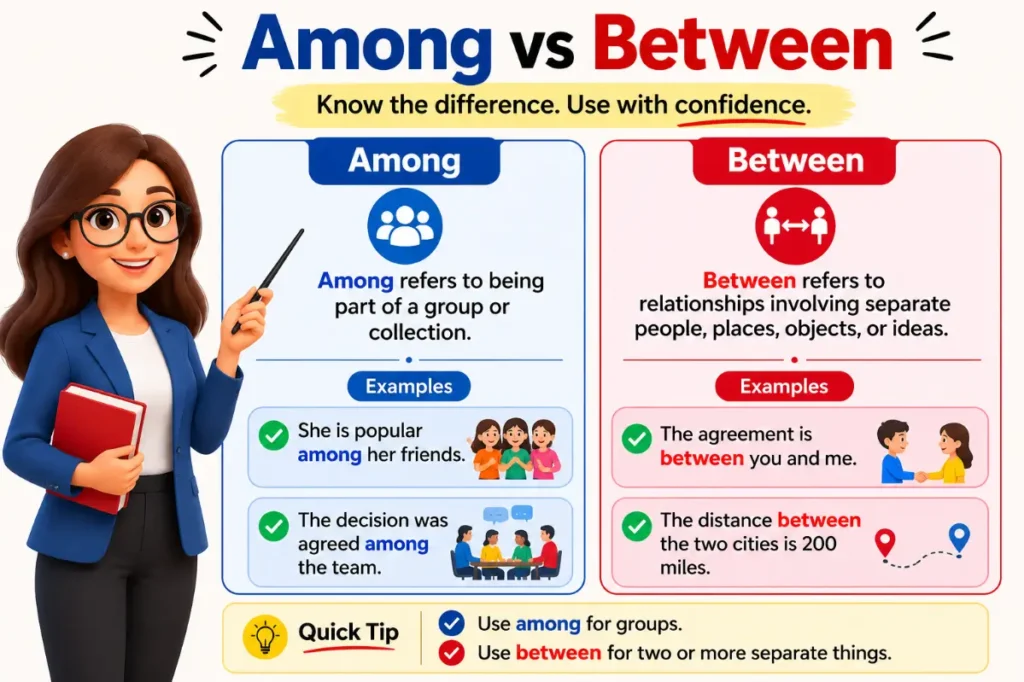
Key Takeaways
- Among refers to being part of a group or collection.
- Between refers to relationships involving separate people, places, objects, or ideas.
- Do not rely on the old rule that between is only for two and among is only for three or more.
- Focus on how the people or things relate to each other instead of counting them.
- Use among for crowds, communities, forests, collections, and categories.
- Use between for agreements, comparisons, choices, distances, and direct relationships.
- Both words are correct in American English and British English.
- Understanding the relationship in the sentence almost always leads to the correct choice.
A related grammar guide is Phase vs Faze Meaning, Difference, and Correct Usage.
Conclusion
The difference between “Among vs Between” depends on how a sentence presents a relationship. Use “between” for distinct people, places, choices, boundaries, or parties, even when more than two are involved. Use “among” when describing something within a group or surrounded by its members. Both prepositions are correct in standard English, and neither is limited to a single type of writing.
For an easy editing trick, picture the relationship before choosing the word. Separate points often suggest “between,” while a surrounding group often suggests “among.” This approach is more reliable than counting items and helps keep your writing clear and natural.
FAQs
Is Between Only Correct for Two People or Things?
No. “Between” can correctly describe relationships involving three or more distinct people or things. For example, “The agreement between the five companies” is standard English. The important factor is the relationship between separate parties, not the number of items alone. The traditional two item rule is a useful starting point, but it is not a complete grammar rule.
When Should I Use Among Instead of Between?
Use “among” when you mean within a group, surrounded by a collection, or included as part of a larger whole. For example, “She felt comfortable among her friends” describes her place within the group. Use “between” when the sentence focuses on distinct relationships, boundaries, choices, or divisions involving separate people or things.
Is Among Grammatically Correct for Two People?
“Among” usually refers to a group of three or more, so it is not normally the natural choice for exactly two distinct people. For example, “The discussion between the two friends” is more appropriate. However, English usage depends on meaning and context, so the best choice comes from the relationship being described rather than a simple count alone.
Can I Say Between Three or More Options?
Yes. You can say “choose between three options” when the options are presented as distinct alternatives. You can also say “choose among the options” when emphasizing a larger collection of choices. Both are correct. The first often highlights the decision between individual alternatives, while the second presents the options as a group from which to choose.
What Is the Difference Between Among and Amongst?
“Among” and “amongst” have essentially the same meaning. Both describe being within a group or surrounded by its members. “Among” is widely used in American English, while “amongst” is more common in some British English contexts and can sound more literary. You can generally use “among” for clear, natural writing intended for a broad audience.
Is Between More Formal Than Among?
No. Both words are standard prepositions used in formal and informal writing. “Between” is common in reports, essays, and everyday conversation when describing distinct relationships. “Among” works equally well in academic and professional contexts when describing group membership or shared conditions. The right choice depends on meaning, not formality or the length of the word.
Which Is Correct Between Friends or Among Friends?
Both expressions are correct, but they have different meanings. “Between friends” often describes a relationship, conversation, agreement, or exchange involving friends as distinct people. “Among friends” usually means within a group of friends or in their company. For example, “The secret stayed between friends” and “She felt relaxed among friends” emphasize different relationships.
How Can I Remember the Difference Easily?
Picture separate points connected by a line for “between,” and a group surrounding someone or something for “among.” This simple visual test works in many everyday sentences. Remember that “between” can involve more than two items when they are distinct parties. If the sentence focuses on being part of a group, “among” is often the better choice.