
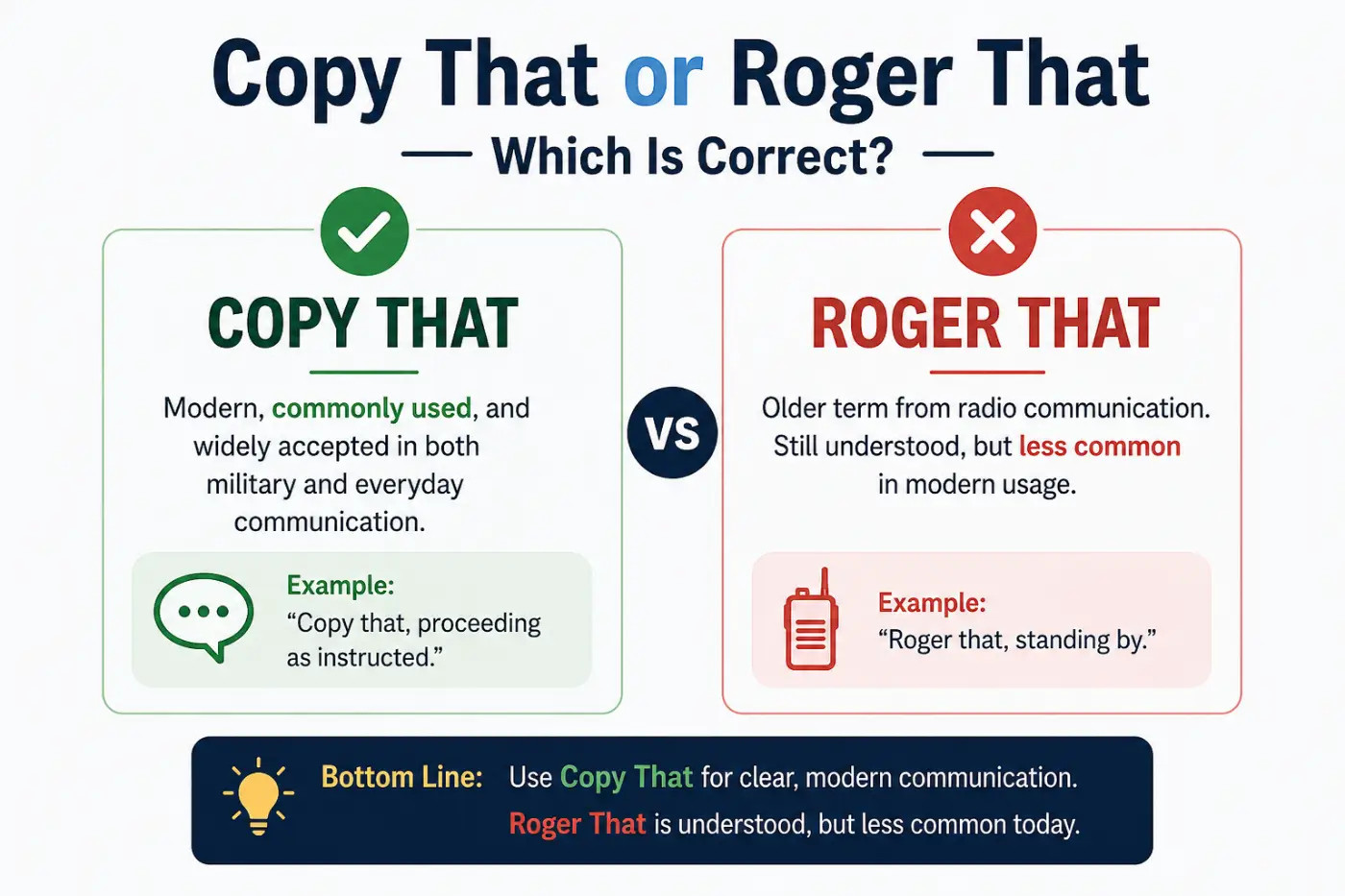
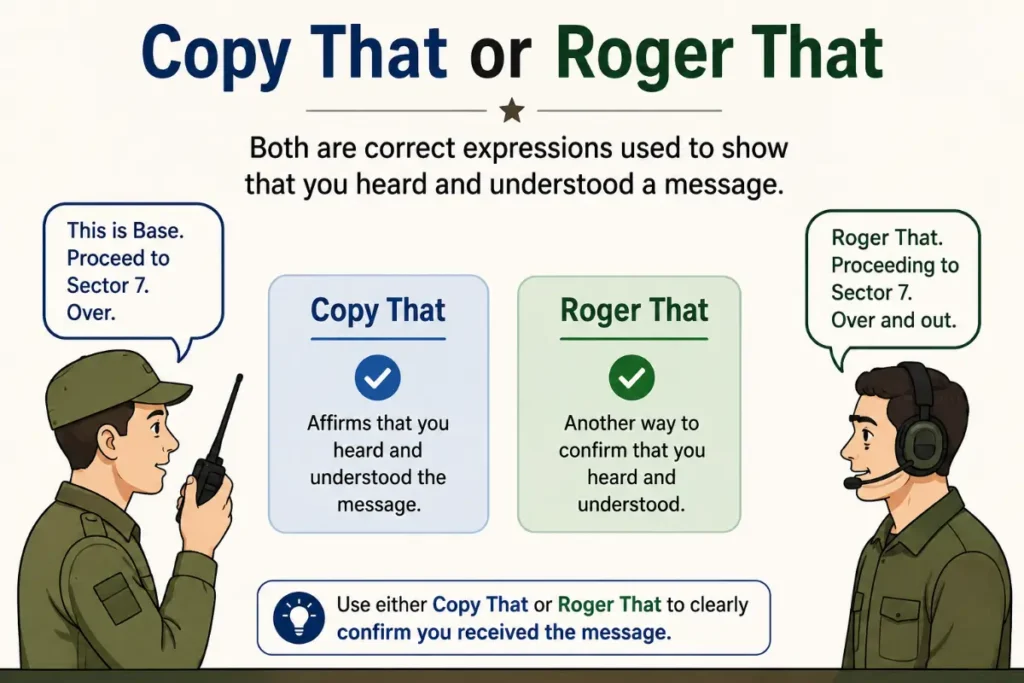
You receive a message, understand the instructions, and want to confirm that you got them. Should you reply with Copy that or Roger that? Both expressions can acknowledge a message, but they do not carry exactly the same meaning. Copy that generally confirms that you received and understood the information, while Roger that traditionally confirms that a message was received.
The expressions come from radio communication, where short and clear replies help people avoid confusion. Over time, they moved into everyday speech, workplace conversations, movies, online chats, and text messages. Today, people often use them in similar ways, especially when they want to sound casual, confident, or a little playful.
Still, there are useful differences. One focuses more on receiving and understanding information, while the other has a history tied to confirming receipt of a transmission. Knowing the distinction helps you choose a natural response in a casual conversation, professional exchange, or radio setting.
Many readers also check Cache vs Cash Which Word Should You Use.
Quick Answer
Copy that means you received and understood a message or instruction. Roger that traditionally means you successfully received a message. In everyday conversation, both can mean understood or message received, but Copy that more directly suggests understanding, while Roger that has a stronger association with radio and military communication.
Comparison Table
| Feature | Copy That | Roger That |
|---|---|---|
| Main meaning | Message received and understood | Message received |
| Main purpose | Confirm receipt and understanding | Confirm receipt of a transmission |
| Part of speech | Informal acknowledgment phrase | Informal acknowledgment phrase |
| Origin | Radio and communication language | Radio communication and phonetic alphabet history |
| Tone | Casual, direct, cooperative | Casual, confident, sometimes military sounding |
| Everyday use | Common in conversation and messages | Common in conversation, entertainment, and radio contexts |
| Workplace use | Acknowledging instructions or information | Confirming receipt of a message or direction |
| Military association | Used informally, but not a substitute for every formal radio procedure | Strong historical association with military and radio communication |
| Example | Copy that, I will send the report today. | Roger that, I received your instructions. |
Meaning and Definition
What Does Copy That Mean?
Copy that is an expression used to confirm that you have received and understood a message. It tells the other person that their information has reached you and that you understand what they communicated.
For example, your manager might say, Please send the revised file before noon. You could reply, Copy that. I will send it before the deadline.
The phrase is especially useful when someone gives instructions, shares information, or communicates something that requires acknowledgment. It can also be used in casual conversations to mean I understand or Got it.
Common situations include:
- Confirming that you received instructions.
- Acknowledging a message from a coworker.
- Responding to directions during a task.
- Confirming that you understood a request.
- Acknowledging information over a radio or communication system.
The word copy has a specific meaning in communication. It can refer to receiving or hearing a transmission. In ordinary speech, the expression has expanded to include understanding the message as well.
What Does Roger That Mean?
Roger that is an expression used to confirm that a message has been received. It comes from radio communication, where Roger was used to represent the letter R in an older phonetic spelling system. The letter R stood for received.
When someone says Roger, they traditionally mean that the message was received. The word does not automatically mean that the speaker agrees with the instruction or has completed the requested action.
For example, a team leader might say, Move the equipment to the storage area. A team member could respond, Roger that, confirming receipt of the instruction.
In everyday English, people often use the phrase more broadly. It can mean understood, acknowledged, or got it. Its familiar radio and military associations also give it a distinctive tone.
Common situations include:
- Confirming receipt of a radio message.
- Acknowledging an instruction.
- Responding to a direction.
- Using playful military style language with friends.
- Confirming that information has been received.
The expression is especially recognizable in films, television, aviation themed conversations, and online communication.
Does Roger That Mean Agreement?
No. In its traditional communication sense, Roger confirms receipt of a message, not agreement with its content. Someone can acknowledge an instruction without approving it or promising to carry it out.
For example, imagine a supervisor says, We need to work through the weekend to finish this project. An employee might reply, Roger that, meaning they heard the statement. That response does not necessarily show that they agree with the decision.
If you want to express agreement, use a phrase such as I agree, That works for me, or Absolutely. If you want to promise action, say I will take care of it or I will get it done.
This distinction matters in professional communication because acknowledgment and agreement are separate actions.
Does Copy That Mean I Understand?
Usually, yes. In modern everyday English, Copy that commonly communicates both receipt and understanding. It tells the speaker that the information was received and understood.
However, the exact meaning still depends on context. If someone sends a long message with several instructions, a reply such as Copy that may confirm that you understand the overall message. It does not always prove that you remember every detail or agree with every instruction.
For important work, it is better to repeat the key information. For example, Copy that. I will submit the report by 3 p.m. This confirms both understanding and the next action.
Key Differences Explained
1. Receipt Versus Understanding
The most useful distinction is the focus of each expression. Roger traditionally confirms receipt. Copy that often confirms receipt and understanding.
Imagine that someone gives you a set of directions over a radio. If you reply Roger, you confirm that you received the transmission. If you reply Copy that, you communicate that you received and understood it.
In everyday conversation, these meanings often overlap. Many speakers use both expressions to mean I got your message. Still, the traditional distinction helps explain why they developed and how they are commonly understood.
2. Meaning in Everyday Conversation
In casual speech, both phrases can function as short acknowledgments. You might use either one after a friend gives you a simple instruction.
For example:
- Friend: Pick me up at 6 p.m.
- Reply: Copy that.
You could also say:
- Friend: Bring the documents to the office tomorrow.
- Reply: Roger that.
Both replies sound natural in informal conversation. The choice often depends on personal style. Copy that can sound direct and practical, while Roger that may sound more playful or radio inspired.
3. Military and Radio Communication
Both expressions have connections to radio communication, but Roger has a particularly established historical role. It was used as a short acknowledgment that a transmission had been received.
In formal radio procedures, acknowledgment terms have specific meanings. Operators must use the correct terminology and follow the rules of their communication system. Casual phrases should not replace required procedure words.
Copy that is widely understood in radio themed speech, but it should not automatically be treated as a formal substitute for every prescribed acknowledgment. The correct response depends on the organization, service, and communication protocol.
4. Tone and Personality
The expressions can create slightly different impressions in ordinary conversation.
Copy that often sounds practical and straightforward. It works well when someone wants to show that they understand an instruction or have received information.
Roger that can sound more dramatic, confident, or playful. Because it is strongly associated with military and radio language, people sometimes use it humorously to make an ordinary response sound like a mission briefing.
For example, replying Roger that to a friend who asks you to bring snacks can create a lighthearted effect.
5. Professional and Workplace Use
Both expressions can be used at work, but neither is always the best choice. In a formal email, a clear response such as Received, Understood, or I will take care of it may be more appropriate.
Copy that can work in a relaxed workplace where colleagues use conversational language. Roger that may fit a team that regularly uses radio style expressions or has an informal communication culture.
Consider these examples:
- Copy that. I will update the spreadsheet before the meeting.
- Roger that. The team has received the revised instructions.
The first sounds like a direct acknowledgment with an action attached. The second sounds more like confirmation that the information has reached the team.
6. Grammar and Sentence Structure
Neither expression is a complete traditional sentence in the usual subject verb form. Both work as conversational acknowledgment phrases.
They are commonly used alone:
- Copy that.
- Roger that.
They can also be followed by a sentence that confirms the next action:
- Copy that. I will call the supplier.
- Roger that. We will wait for further instructions.
The phrases are generally written without quotation marks unless you are discussing the expressions themselves. A period or exclamation mark can follow them, depending on the tone.
7. Pronunciation
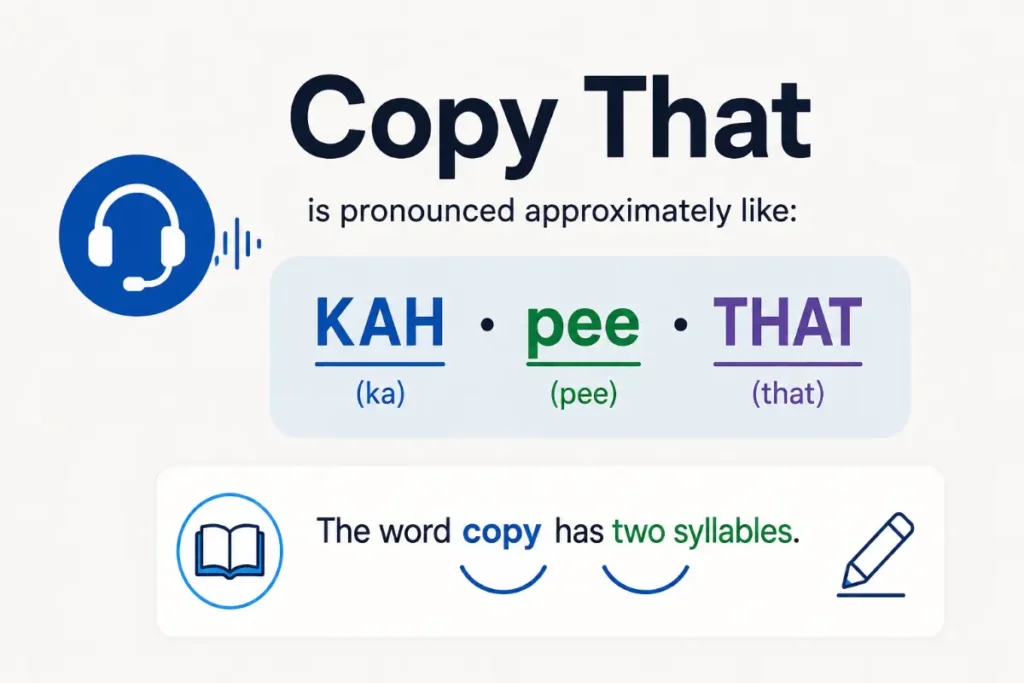
Copy that is pronounced as two words, with the main stress usually falling on Copy. In American English, copy is commonly pronounced /ˈkɑːpi/ and that is /ðæt/.
Roger that is pronounced with two syllables in Roger and one in that. In American English, Roger is commonly pronounced /ˈrɑːdʒər/. The stress falls on the first syllable.
Both expressions are easy to say and do not require a special accent. The main pronunciation challenge for some learners is the voiced th sound at the beginning of that.
8. Regional Usage
There is no major difference in the meaning of these expressions between American, British, Canadian, and Australian English. Both are widely understood because of their connection to radio communication and popular entertainment.
The frequency of use may vary by workplace, profession, age group, and personal style. In the United States, Roger that is especially familiar through military themed entertainment and everyday jokes. Copy that is also widely understood and used in informal communication.
Which Expression Is Correct?
Both expressions are correct. Neither is a misspelling, and neither should be labeled as an incorrect version of the other. They are established acknowledgment phrases with slightly different traditional meanings.
Use Copy that when you want to confirm that you received and understood information. Use Roger that when you want to acknowledge receipt of a message, especially in a radio themed or informal setting.
Here are examples of correct usage:
- Copy that. I will send the updated document today.
- Roger that. I received your message.
- Copy that. We will meet outside the main entrance.
- Roger that. The instructions are clear.
- Copy that. I understand the new schedule.
In casual conversation, either expression may work. In formal communication, choose a direct phrase such as Understood or Received if clarity matters more than style.
The important point is that acknowledgment does not always mean agreement or completion. If you need to confirm that you will perform a task, add a clear statement about the action you will take.
Sentence Examples
Ten Natural Examples Using Copy That
- Everyday conversation: Copy that, I will meet you outside the restaurant at seven.
- Text message: Copy that. I will bring the charger with me.
- Workplace communication: Copy that. I will update the presentation before the meeting.
- School: Copy that, I will submit the assignment through the online portal.
- Team communication: Copy that. Everyone should arrive at the office by 8 a.m.
- Formal instruction: Copy that. The revised procedure has been received and understood.
- Social situation: Copy that, I will save you a seat near the front.
- Online communication: Copy that. I understand how the new feature works.
- Travel planning: Copy that. We will meet at the airport entrance.
- Family conversation: Copy that, I will pick up the groceries on my way home.
These examples show how the expression can acknowledge a message and confirm understanding. In most cases, it works best when the next action is clear from the context.
Ten Natural Examples Using Roger That
- Everyday conversation: Roger that, I will be there in ten minutes.
- Text message: Roger that. I have saved the address.
- Workplace communication: Roger that. The team has received the updated schedule.
- School: Roger that. I will bring my notes to class tomorrow.
- Team instruction: Roger that. We will begin the inspection at noon.
- Radio style communication: Roger that. Moving to the next location.
- Social situation: Roger that. I will bring the snacks.
- Online gaming: Roger that. I am heading toward the marked location.
- Travel planning: Roger that. We will wait near the main entrance.
- Family conversation: Roger that. I will call Grandma this evening.
These examples use the phrase as an acknowledgment. In relaxed conversation, it can sound friendly and playful. In radio communication, the intended meaning depends on the procedure being followed.
Common Mistakes and Misunderstandings
The most common problems involve treating the expressions as exact synonyms or assuming that acknowledgment means agreement. Here are five points to remember.
1. Assuming Roger Means Agreement
Incorrect interpretation: Roger that means I agree with you.
More accurate interpretation: Roger that traditionally means I received your message.
The phrase confirms that information has been received. It does not automatically show approval. If someone gives you an instruction that you do not agree with, you can still acknowledge that you heard it. Use I agree when you want to express approval.
2. Assuming Copy That Always Confirms Action
Incorrect interpretation: Copy that means I have completed the task.
More accurate interpretation: Copy that generally confirms receipt and understanding.
If someone asks you to send a file, replying Copy that does not prove that you have sent it. It tells the person that you received the request. To confirm completion, say The file has been sent or I have submitted it.
3. Using the Expressions in Every Formal Email
Awkward: Roger that. I have received your official legal notice.
Better: Received. I will review the notice and respond by Friday.
Both expressions are understandable, but they may sound too casual in formal business or legal communication. A neutral acknowledgment is often more suitable when the message needs a professional tone.
4. Confusing Receipt With Understanding
Incomplete acknowledgment: Roger that, when the speaker has not actually understood the instructions.
Clearer response: I received your message, but could you explain the second step?
A person can receive a message without understanding it. If instructions are unclear, do not use an acknowledgment that suggests full understanding. Ask for clarification instead.
5. Treating Radio Language as a Universal Communication Rule
Incorrect assumption: Every radio operator should use Copy that and Roger that in the same way.
More accurate approach: Follow the communication rules used by the relevant organization or system.
Everyday speech is flexible, but formal radio communication can require specific words and procedures. Military, aviation, emergency services, and other radio users may follow established protocols. A casual expression should not replace a required technical acknowledgment.
A Simple Way to Remember the Difference
Think of the two expressions this way:
- Copy that: I received the message and understand it.
- Roger that: I received the message.
- Understood: I understand the information.
- Will do: I intend to carry out the instruction.
- Done: I have completed the task.
These meanings can overlap in casual conversation, but separating them helps you communicate more clearly.
Pronunciation Guide
How Do You Pronounce Copy That?
Copy that is pronounced /ˈkɑːpi ðæt/ in a common American English pronunciation. It contains three spoken syllables: COP, ee, and THAT. The strongest stress usually falls on the first syllable of Copy.
Say it naturally as KAH pee that. The th sound in that is voiced, meaning your vocal cords vibrate as your tongue touches or approaches your upper teeth.
Some American accents pronounce the first vowel in copy slightly differently. This is normal regional variation and does not change the phrase’s meaning.
How Do You Pronounce Roger That?
Roger that is commonly pronounced /ˈrɑːdʒər ðæt/ in American English. It contains three syllables: ROJ, er, and THAT. The main stress falls on the first syllable of Roger.
A simple guide is ROJ er that. The j sound in Roger is the same sound heard in words such as job and jump. The final sound in that is the voiced th sound.
Common Pronunciation Mistakes
Some speakers may pronounce Roger with too much stress on the second syllable. The usual American pronunciation stresses the first syllable.
Another common difficulty is the th sound in that. Replacing it with a simple d or t changes the sound. Practice the phrase slowly before saying it at normal speed.
Need another quick comparison? Read incite vs insight Meaning, Difference and Correct Usage.
Etymology and Word Origin
Where Does Copy That Come From?
The phrase is connected to the use of copy in radio and communication settings. In radio language, copy can mean receiving or hearing a transmission. A speaker who says Copy that confirms that the message has been received.
The exact path by which the full phrase became common in everyday speech is not always easy to pin down to one moment. However, its communication meaning is clear. It developed from the practical need to confirm that information had reached the intended listener.
As radio language entered popular culture, the phrase became familiar outside technical communication. Today, people use it in workplaces, online conversations, movies, and casual exchanges.
Where Does Roger That Come From?
Roger has a specific history in radio communication. It was used to represent the letter R in an older spelling alphabet, where R stood for received. Saying Roger therefore communicated that a transmission had been received.
The spelling alphabet used in radio communication has changed over time. Modern international radio spelling systems use Romeo for the letter R, but Roger remains familiar in ordinary speech because of its long history in radio and military communication.
The phrase became widely recognized through military communication, aviation themed entertainment, television, and movies. It now appears in everyday English, often as a playful way to acknowledge instructions.
Why Do People Associate These Phrases With the Military?
Radio communication is strongly linked with military operations, where messages must be short, clear, and easy to understand. Expressions such as Roger that became familiar through military speech and popular portrayals of radio exchanges.
However, the phrases are not limited to military use. Civilians, workers, gamers, and friends use them in informal conversations. Their history explains their style, but their modern use is much broader.
Regional Usage
American English
In the United States, both expressions are widely understood. Copy that is common in casual conversations and workplace exchanges, especially when someone wants to acknowledge an instruction. Roger that is also familiar and often carries a radio or military style tone.
People may use the phrases humorously in everyday settings. For example, a friend might say Roger that after being asked to bring coffee. The expression makes an ordinary response sound like a formal mission acknowledgment.
British English
British English speakers also understand and use both expressions. Their meanings remain broadly similar to those in American English. Roger that has a familiar radio communication association, while Copy that is used to acknowledge information.
There is no special British spelling difference. The main variation is personal style and how often speakers choose these expressions in everyday conversation.
Australian English
Australian English uses both expressions in casual speech and communication settings. The traditional radio meanings remain recognizable, but everyday speakers may use them more loosely to mean understood or received.
There is no major regional rule that changes the distinction between the phrases.
Canadian English
Canadian English follows the same general usage. Both expressions are understood in everyday conversation, radio themed communication, and popular entertainment. Their spelling and basic meanings remain the same.
Across these varieties, the phrases are informal acknowledgments. The communication setting determines how precise their meanings need to be.
Grammar Rules and Part of Speech
Are These Complete Sentences?
Copy that and Roger that are short acknowledgment expressions. They are often used as standalone replies even though they do not follow the usual subject verb object pattern of a complete sentence.
In conversation, short responses like these are natural because the missing information is clear from context. The speaker does not need to say I have received and understood your message every time.
For example:
- Manager: Please send the file before noon.
- Employee: Copy that.
The response works because both people understand what is being acknowledged.
How to Use Copy That in a Sentence
The phrase usually appears at the beginning of a response or as a complete acknowledgment. It can also be followed by a sentence that explains the next action.
Examples:
- Copy that. I will update the document.
- Copy that, we will arrive before the meeting starts.
- I received your instructions. Copy that.
The first version uses a period to separate the acknowledgment from the next sentence. The second uses a comma because the speaker continues the same conversational response. The third uses the phrase after a complete statement for emphasis.
How to Use Roger That in a Sentence
The same general pattern applies to Roger that. It can stand alone or introduce a follow up statement.
Examples:
- Roger that. We will wait for further instructions.
- Roger that, I will bring the equipment.
- The team replied, Roger that.
In formal writing, you may prefer a neutral phrase such as Received or Understood. In dialogue, stories, and informal messages, the expression can add a recognizable conversational tone.
Capitalization and Punctuation
Capitalize the first word when the phrase begins a sentence. Write Copy that or Roger that in the middle of a sentence according to the normal capitalization rules.
Use a period for a neutral acknowledgment. An exclamation mark can show excitement or enthusiasm, but it may look too informal in professional communication.
When writing dialogue, place the phrase inside quotation marks if your style requires quotation marks around spoken words. The phrase itself does not need special capitalization beyond normal sentence rules.
Formal Versus Informal Usage
Both expressions are informal acknowledgments. They can work in relaxed professional teams, group chats, and friendly conversations. However, they may sound too casual in legal notices, official reports, academic papers, or formal business correspondence.
Choose a response that matches the relationship and purpose of the communication. If you are acknowledging an important deadline, it is often better to confirm the task and timing directly rather than relying on a short phrase alone.
Real Life Usage Examples
Daily Conversation
Friends and family members often use these expressions to acknowledge simple instructions or plans.
- Friend: Meet me outside the library at five. Reply: Copy that. I will be there.
- Parent: Please lock the door before you leave. Reply: Roger that. I will check it.
The phrases can make an ordinary exchange sound relaxed and friendly. Roger that may also add a little humor because of its radio style tone.
Email and Workplace Communication
In workplaces with a relaxed communication style, these expressions can acknowledge tasks or updates.
- Copy that. I will revise the report and share the new version this afternoon.
- Roger that. The team has received the updated schedule.
For a more formal message, consider writing I have received the updated schedule or Understood. I will revise the report by this afternoon. These alternatives provide more detail and may sound more professional.
Academic and Classroom Communication
Students may use the phrases informally when responding to instructions from a teacher or group leader. However, they are usually not suitable for formal academic writing.
- Teacher: Submit your notes before the end of class. Student: Copy that.
- Group leader: Review the first section before tomorrow’s discussion. Student: Roger that.
In an academic essay, use a complete sentence instead. For example, The participants received the instructions before the experiment began.
News and Journalism
News reports may use these expressions when describing radio exchanges, military communication, or a character’s response. They are less likely to appear in formal reporting as a casual substitute for received or understood.
- The pilot acknowledged the instruction with a brief radio response.
- The documentary included an exchange in which the operator replied Roger that.
Journalists should explain the communication context if the exact wording matters to the story. The expressions are familiar, but their technical meaning may depend on the communication system.
Literature and Storytelling
Writers often use these phrases in dialogue to create a particular voice. They can make a character sound practical, confident, playful, or familiar with radio communication.
- Alex checked the map and replied, Copy that. I know the route.
- The team leader gave the signal, and Maya answered, Roger that. Moving now.
The phrases can also help establish a scene involving a mission, emergency, or coordinated task. Use them with care so they sound natural for the character and setting.
Related and Confused Terms
These eight expressions are closely related to acknowledgment and communication. Each has a slightly different purpose.
1. Understood
Understood means that you have understood the information or instruction. It is a clear and neutral response that works in both professional and everyday communication.
Example: Understood. I will complete the form today.
It is a useful choice when clarity matters more than a casual tone.
2. Received
Received confirms that a message, document, or item has reached you. It does not automatically mean that you have understood or agreed with the content.
Example: Received. I will review the attachment.
This is especially useful in professional communication when you want to confirm delivery.
3. Acknowledged
Acknowledged is a formal way to confirm that you have received or recognized information. It is common in professional, technical, and official communication.
Example: Your request has been acknowledged.
It can sound more formal than the two radio inspired expressions.
4. Got It
Got it is a casual expression meaning that you understand or have received the information. It is common in everyday speech and text messages.
Example: Got it. I will meet you at the entrance.
It is often the most natural choice in friendly conversation.
5. Affirmative
Affirmative means yes or that something is correct. It is often associated with radio and military communication.
Example: Affirmative. The vehicle is ready.
Unlike Roger, it communicates a positive answer rather than simply confirming receipt of a message.
6. Wilco
Wilco is short for will comply. It means the speaker has received an instruction and intends to follow it.
Example: Wilco. I will move the equipment now.
This is different from simply acknowledging receipt. It communicates an intention to carry out the instruction.
7. Ten Four
Ten four is a radio communication expression used to mean message received or understood. It is strongly associated with radio communication, truck drivers, and popular portrayals of radio conversations.
Example: Ten four. I will wait at the next stop.
Its meaning can overlap with Roger that and Copy that in casual speech.
8. All Clear
All clear means that a place or situation is safe or that no problem has been detected. It is not simply an acknowledgment phrase.
Example: The inspection is complete, and the building is all clear.
Use it to communicate a safety status rather than just confirm that you heard someone.
Expert Editor Insight
An experienced editor looks at the purpose of an acknowledgment before choosing the phrase. Copy that is useful when a speaker wants to show that information has been received and understood. Roger that traditionally confirms receipt and often adds a radio communication tone. Both are familiar expressions, but neither should replace a clear explanation when the message involves an important deadline, safety instruction, or formal decision. Grammar tools may accept both phrases because they are established expressions, yet they cannot always judge whether the tone suits the situation. A useful editing tip is to ask if the reply confirms receipt, understanding, agreement, or action. These are four different things.
Key Takeaways
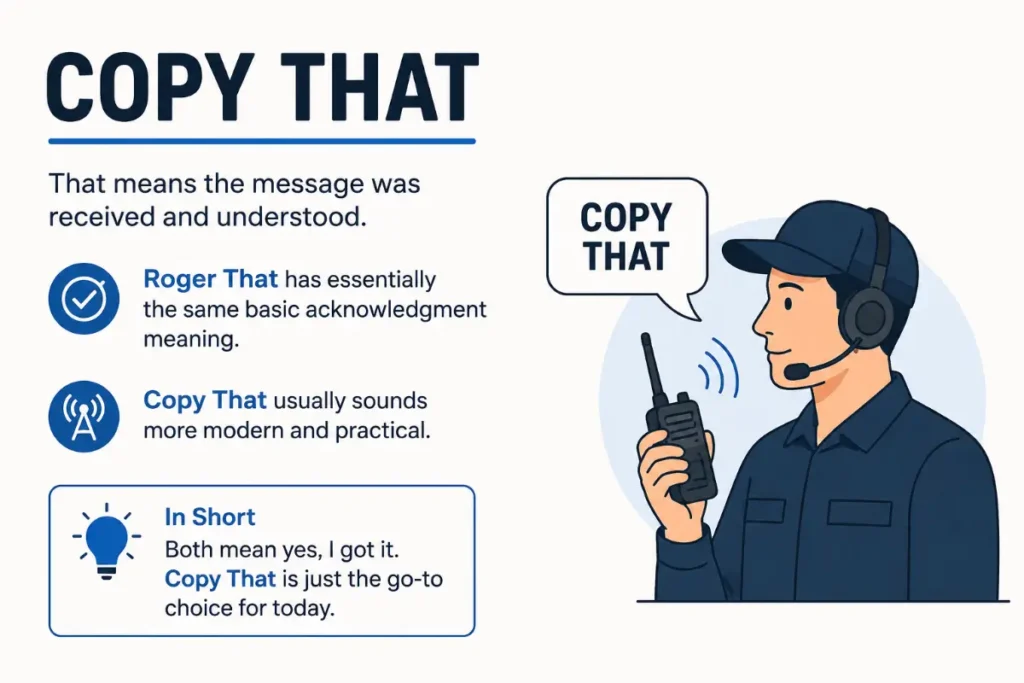
- Copy That means the message was received and understood.
- Roger That has essentially the same basic acknowledgment meaning.
- Copy That usually sounds more modern and practical.
- Roger That has a stronger radio military and aviation association.
- Neither expression automatically means agreement.
- Both phrases can stand alone as conversational responses.
- Understood and I Understand are safer choices for formal communication.
- Got It is often more natural in relaxed everyday conversation.
- The best choice depends mainly on context and tone.
- Roger comes from historical radio communication and its association with the letter R and received.
For another common grammar confusion, see Council vs Counsel Which Word Should You Use.
Conclusion
The choice between Copy That or Roger That depends on the message you want to send. Copy that usually confirms receipt and understanding, while Roger that traditionally confirms that a message has been received. In everyday conversation, both can mean got it, but their tone and history are different.
Use a simple memory tip: Copy that focuses on understanding, while Roger that focuses on receipt. If you need to show agreement or promise action, say so directly. Acknowledging a message, agreeing with it, and completing an instruction are separate things, and clear wording helps prevent confusion.
FAQs
Is Copy That the Same as Roger That?
They are similar, but their traditional meanings are slightly different. Copy that usually confirms that a message was received and understood. Roger that traditionally confirms receipt of a message. In everyday conversation, people often use both to mean got it, so the difference may not matter in casual exchanges.
What Does Copy That Mean in Texting?
In texting, Copy that means I received your message and understand what you are saying. It is a short, casual way to acknowledge instructions, plans, or information. For example, if someone asks you to meet at 6 p.m., you can reply Copy that to confirm that you understand the plan.
What Does Roger That Mean in Military Communication?
In traditional military and radio communication, Roger means that a message has been received. It does not automatically mean agreement or completion of an instruction. The phrase became widely recognized through radio communication and popular entertainment. Modern communication systems may use specific procedures and terminology, so informal wording should not replace required protocol.
Does Roger That Mean Yes?
Not exactly. Roger that usually confirms that you received a message, rather than giving a direct yes or expressing agreement. If someone asks you a question that requires a positive answer, Affirmative or Yes is clearer. In casual conversation, however, people sometimes use Roger that as a general acknowledgment.
Is Copy That More Professional Than Roger That?
Neither expression is especially formal. Copy that may sound more practical in a relaxed workplace, while Roger that can sound more playful or military inspired. For formal emails or official communication, Received, Understood, or I will take care of it may be more suitable because these phrases communicate the intended response directly.
Can I Use Copy That in a Formal Email?
You can use it in a workplace where informal communication is normal, but it may not suit every professional email. If you are acknowledging an important request, consider writing I have received your instructions and will complete the task by Friday. This gives the reader a clearer record of what you understood and intend to do.
What Is Another Way to Say Roger That?
Common alternatives include Understood, Received, Got it, Acknowledged, and Ten four. The best choice depends on your purpose. Use Received to confirm that a message arrived, Understood to confirm comprehension, and Wilco to communicate that you intend to follow an instruction. These expressions are related, but their meanings are not identical.
Is Copy That Correct English?
Yes. Copy that is an established informal acknowledgment phrase. It is widely understood in radio communication and everyday conversation. You can use it to confirm that you received and understood information. In formal writing, a complete phrase such as I understand or I have received your message may be clearer.