
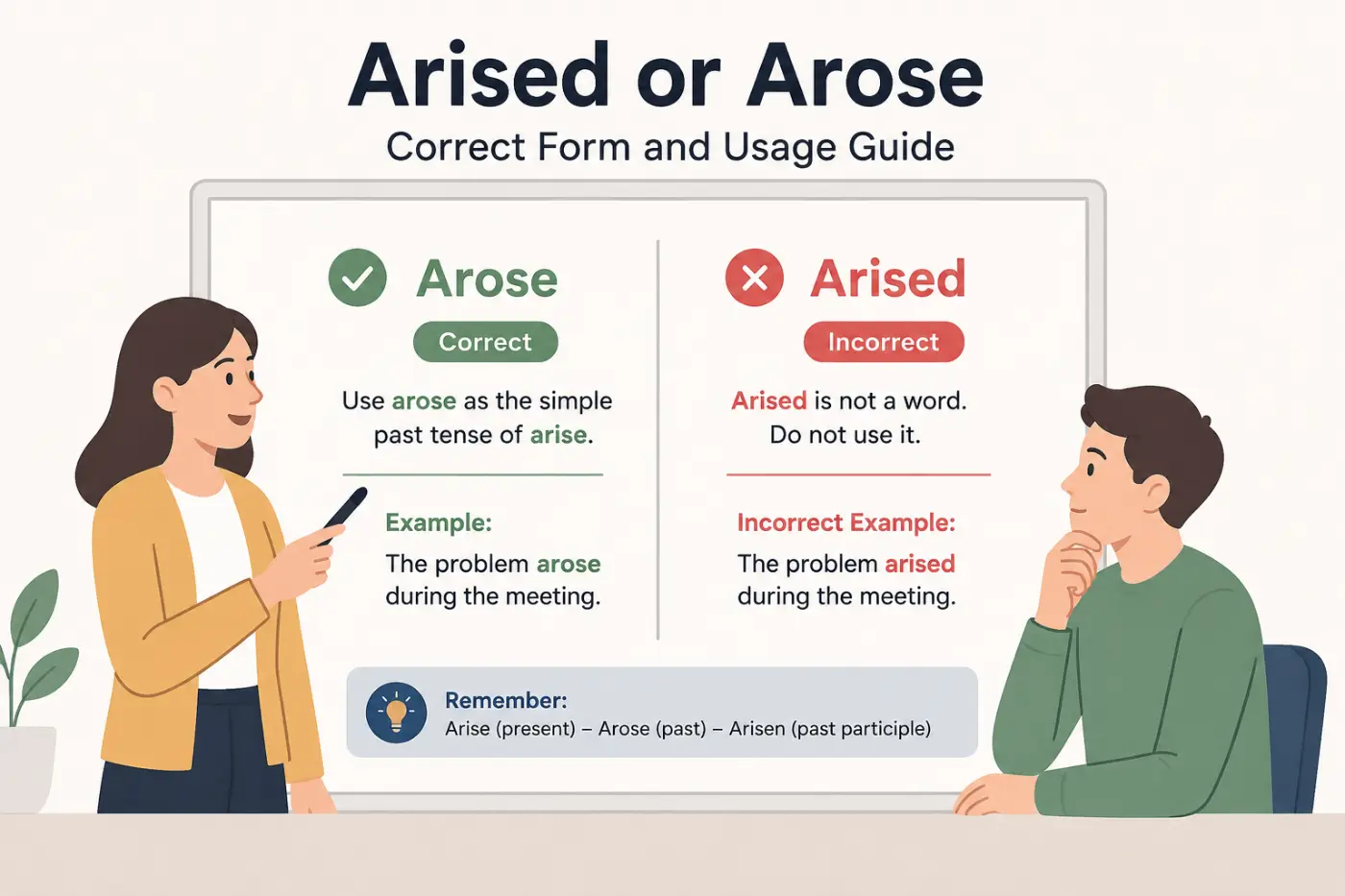
If you are confused about arised or arose, the correct choice in standard English is arose. It is the simple past tense of the verb arise, which means to appear, begin, or come into existence. Although many English verbs form their past tense by adding ed, arise is an irregular verb. For this reason, arised is considered nonstandard and should be avoided in formal writing, academic work, and everyday communication.
The word arose is used when something happened or started in the past. For example, you can write, “A problem arose during the meeting.” This sentence means that a problem appeared during the meeting. In contrast, “A problem arised during the meeting” is grammatically incorrect in standard English. Learning this difference will help you use the correct verb form in conversations, emails, school assignments, and professional documents.
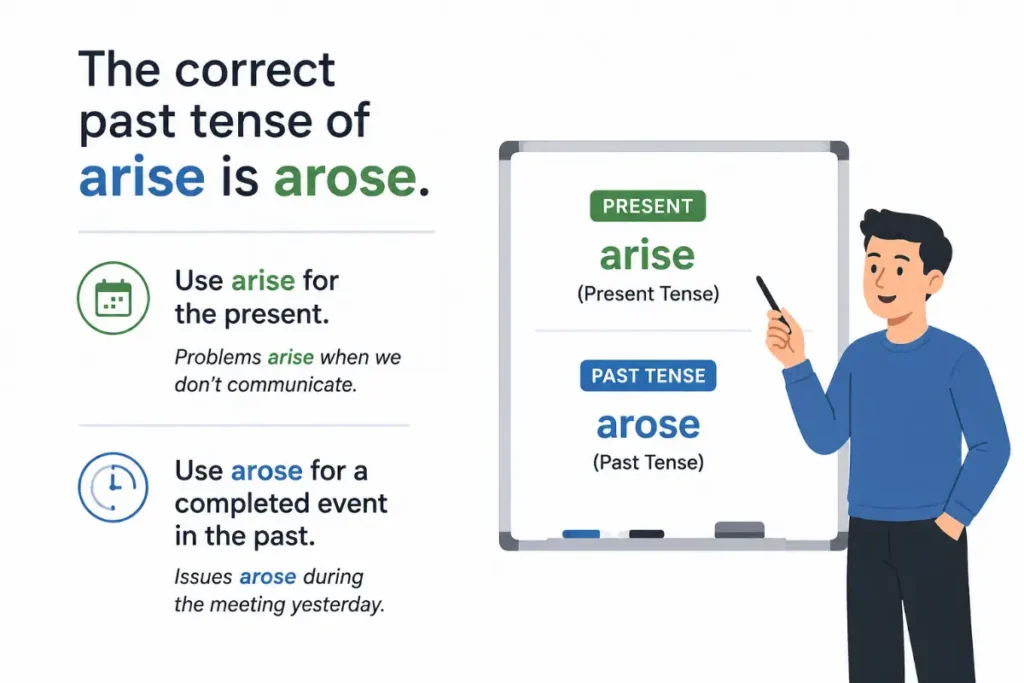
To understand the rule more clearly, remember the three main forms of this verb: arise, arose, and arisen. Use arise for the present tense, arose for the simple past tense, and arisen with helping verbs such as has, have, or had. For example, “New questions arose yesterday” is correct, while “New questions have arisen” uses the past participle correctly. Once you understand these forms, choosing the right word becomes much easier.
Many readers also check Council vs Counsel Which Word Should You Use.
Quick Answer
Arose is the correct simple past tense of arise. Arised is a nonstandard form that you should avoid in formal writing and everyday standard English. Use arose for something that happened or began in the past and arisen when forming perfect tenses with a helping verb such as has, have, or had.
Comparison Table
| Word | Meaning and Grammar | Standard Usage | Example |
|---|---|---|---|
| Arise | Base form of the verb. | Correct | Problems arise unexpectedly. |
| Arose | Simple past tense. | Correct | A problem arose yesterday. |
| Arisen | Past participle. | Correct | A problem has arisen. |
| Arised | Nonstandard past tense or participle. | Avoid in standard English. | Use arose instead. |
Introduction
If you’ve ever stopped while writing a sentence and wondered if you should use arised or arose, you’re not alone. English has many regular verbs that form the past tense by adding ed, so writing arised might seem logical at first. However, the verb arise follows a different pattern.
The correct past tense is arose. This form appears in everyday conversations, workplace reports, academic writing, and news stories. The word describes something that appeared, began, developed, or came up in the past. For example, a question arose during a lesson, a problem arose at work, or an opportunity arose unexpectedly.
The good news is that you don’t need to memorize a long list of complicated rules to get this right. You only need to learn the three main forms of the verb: arise, arose, and arisen. Once you understand how these forms work, you’ll be able to choose the right one with confidence and avoid a common grammar mistake.
Meaning and Definition
What Does Arise Mean
Arise is a verb that means to appear, begin, emerge, or come into existence. It often describes a situation, problem, question, need, or opportunity that develops without someone deliberately creating it.
For example, if a disagreement begins during a discussion, you can say that a disagreement arises. If the disagreement began yesterday, you can say that it arose yesterday. The meaning stays similar, but the verb changes to match the time.
The word can also mean to get up from a sitting or lying position. In formal or literary English, it may describe someone getting out of bed or standing up.
Examples include the following.
- New questions arise during scientific research.
- A serious concern arose after the inspection.
- She arose early to prepare for the journey.
What Does Arose Mean
Arose is the simple past tense of arise. It describes something that appeared, started, emerged, or became noticeable at an earlier time.
You can use it when reporting a past event or explaining how a situation developed. The event may have happened minutes ago, last week, or many years in the past. The important point is that the sentence presents it as a past event.
Consider these examples.
- An unexpected problem arose during the presentation.
- A new opportunity arose after he changed jobs.
- Several questions arose when the teacher explained the results.
- A dispute arose between the two companies.
In each sentence, arose shows that the situation began or emerged in the past. It doesn’t need an additional helping verb to form the simple past tense.
What Does Arisen Mean
Arisen is the past participle of arise. It usually appears with a helping verb such as has, have, or had.
For example, you can write, A new problem has arisen. You can also write, Several concerns had arisen before the meeting began.
The past participle connects an event to a time frame or another event. It doesn’t normally replace arose in a simple past sentence.
Compare these examples.
- A problem arose yesterday.
- A problem has arisen since yesterday.
- A problem had arisen before we arrived.
The first sentence reports a past event. The second connects the problem to the present. The third places the problem before another past event.
Is Arised a Real Word
Arised is not the accepted standard past tense of arise in modern English. You may encounter it in informal online writing, learner writing, or text that contains a grammatical error. Its appearance doesn’t make it the correct form for standard communication.
The confusion comes from a familiar English rule. Many verbs form their past tense by adding ed. For example, ask becomes asked, and arrive becomes arrived. A writer may apply the same pattern to arise and produce arised.
However, English contains many irregular verbs that don’t follow this pattern. Arise belongs to that group. Its accepted forms are arise, arose, and arisen.
Key Differences Explained
Spelling
The main spelling difference is the ending and the internal vowel change. The standard past tense changes arise to arose rather than adding ed.
Remember these three forms.
- Present or base form: arise.
- Simple past: arose.
- Past participle: arisen.
The form arised follows a regular spelling pattern, but that pattern doesn’t apply to this verb in standard English.
Meaning
The three accepted forms share the same core meaning. They describe something beginning, appearing, emerging, or coming up.
The difference lies mainly in grammar and time.
- Use arise for the base form and for present tense sentences such as Problems arise without warning.
- Use arose for a completed past event such as A problem arose last night.
- Use arisen with the appropriate helping verb such as A problem has arisen.
Grammar
The correct form depends on the structure of your sentence. You can’t choose a verb form based on time alone. You must also check if the sentence needs a simple past verb or a past participle.
For instance, The concern arose during the call is correct because arose carries the past tense. The concern has arisen during the call is also grammatically possible, although the surrounding context may affect the best wording.
By contrast, The concern has arose is incorrect in standard English. After has, the sentence needs the past participle arisen.
Pronunciation
The forms arise, arose, and arisen have different vowel sounds and syllable patterns.
- Arise has two syllables and sounds like uh RIZE.
- Arose has two syllables and sounds like uh ROHZ.
- Arisen has three syllables and sounds like uh RIZ uhn.
The stress falls on the second syllable in all three forms. Learning the sound pattern can help you remember the spelling, especially when you use the words in conversation.
Formality and Context
Arose works in casual conversation and formal writing. It doesn’t sound overly formal, but it often appears in reports, essays, news coverage, and professional communication because it describes the beginning of an issue clearly.
For example, A scheduling conflict arose during the planning process sounds natural in a work email. A question arose during the lecture fits an academic report. The word is useful in both settings.
Arised doesn’t offer a special informal meaning or a different level of formality. In standard writing, replace it with the correct form.
Which Form Is Correct
Use arose when you need the simple past tense of arise. This is the established form in standard modern English, including American and British usage.
The reason is grammatical rather than stylistic. Arise is an irregular verb, so it doesn’t form its simple past by adding ed. Its principal forms follow the pattern arise, arose, arisen, similar to other irregular verb patterns in English.
Think about write, wrote, written. You wouldn’t normally write writed in standard English. In the same way, the accepted past tense of arise is arose, not arised.
Use the form that matches the sentence.
- Correct: A concern arose after the announcement.
- Correct: Several concerns have arisen since the announcement.
- Incorrect: A concern arised after the announcement.
- Incorrect: Several concerns have arised since the announcement.
The first sentence uses the simple past. The second uses the present perfect. Choosing the correct verb form makes your writing clear and grammatically sound.
Sentence Examples
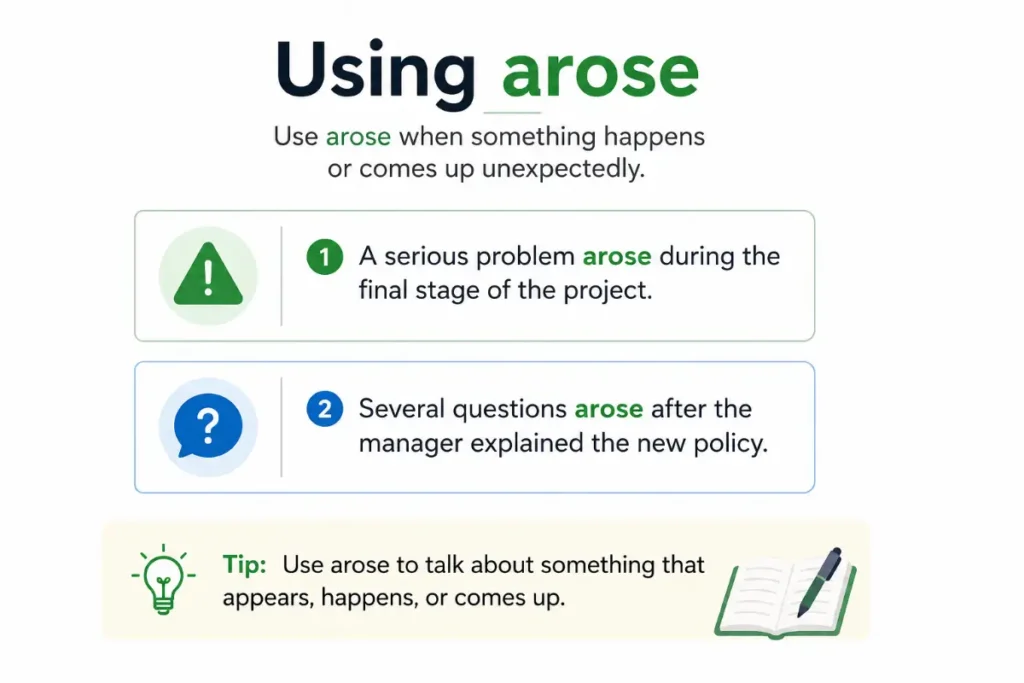
The following examples show how arose works in everyday situations and more formal settings.
- A problem arose when we tried to open the file.
- An interesting question arose during our conversation.
- A family emergency arose, so I had to leave work early.
- A new job opportunity arose after she completed her training.
- Several concerns arose during the school meeting.
- A disagreement arose over the final project deadline.
- The need for better communication arose after the team missed an important update.
- A new challenge arose as the company expanded its services.
- The issue arose from a misunderstanding between the two departments.
- An unexpected opportunity arose when the original plan changed.
Notice how the subject changes in these sentences. A problem, question, emergency, opportunity, concern, disagreement, or need can all arise. The verb doesn’t require a person as its subject.
Five Incorrect Examples and Their Corrections
These examples show common ways writers mistakenly use arised. They are included to help you spot and correct the error.
- Incorrect: A problem arised during the meeting. Correct: A problem arose during the meeting.
- Incorrect: Several questions arised after the lecture. Correct: Several questions arose after the lecture.
- Incorrect: A new opportunity arised last month. Correct: A new opportunity arose last month.
- Incorrect: The issue arised because of poor planning. Correct: The issue arose because of poor planning.
- Incorrect: A conflict arised between the neighbors. Correct: A conflict arose between the neighbors.
In each case, the correction is straightforward. Replace arised with arose when the sentence needs the simple past tense.
Common Mistakes and Misspellings
Writers often confuse irregular verbs with regular verbs. The following mistakes are worth checking when editing your work.
Using Arised Instead of Arose
This is the central mistake. Writers apply the common ed ending to a verb that changes form.
Incorrect: A serious issue arised yesterday.
Correct: A serious issue arose yesterday.
The simple fix is to remember that the past tense changes the vowel rather than adding an ending.
Using Arose With Has or Have
The past participle is required after has or have in a present perfect construction.
Incorrect: A new concern has arose.
Correct: A new concern has arisen.
The helping verb signals the grammatical pattern. Once you see has or have, check that the main verb uses the correct past participle.
Using Arisen as the Simple Past
Some writers remember that arisen is a correct word but use it in the wrong position.
Incorrect: A new question arisen during class yesterday.
Correct: A new question arose during class yesterday.
In a standard simple past sentence, arose carries the tense without a helping verb. Arisen generally needs a suitable helping verb.
Mixing Up Arise and Rise
These verbs have related meanings, but they don’t always work in the same sentence. Arise often describes an issue or situation emerging. Rise often describes something moving upward or increasing.
For example, A problem arose during the test is natural. The sun rose at six is also correct. Using arise for the sun in an ordinary description would sound unusual.
Forgetting the Past Participle Pattern
A writer may use the simple past correctly but forget the third form when writing a longer sentence.
Incorrect: By the time we arrived, several problems had arose.
Correct: By the time we arrived, several problems had arisen.
The past perfect construction uses had followed by the past participle. Knowing the three principal forms helps prevent this mistake.
Many readers also check Bailer or Baler Meaning and Correct Usage.
Pronunciation Guide
The three standard forms of arise are easy to distinguish once you listen for the vowel sound in the stressed syllable.
| Form | IPA | Syllables | Easy Pronunciation |
|---|---|---|---|
| Arise | /əˈraɪz/ | A rise | Uh RIZE |
| Arose | /əˈroʊz/ | A rose | Uh ROHZ |
| Arisen | /əˈrɪzən/ | A ris en | Uh RIZ uhn |
The IPA represents common American English pronunciation. The first syllable is unstressed, and the second syllable carries the main stress. In arisen, the final syllable is also unstressed.
How to Pronounce Arose
Start with a relaxed sound like the beginning of about. Then pronounce the second syllable with a long O sound followed by a Z sound. Keep the stress on the second syllable.
The word arose sounds similar to the phrase a rose, as in a flower. The vowel sound is the same in standard American English, so this comparison can help you remember how to say the word.
A common mistake is to pronounce the ending with an S sound. In standard pronunciation, the final consonant is voiced, so it sounds like Z.
Etymology and Word Origin
The verb arise has roots in Old English. It developed from an earlier Germanic verb meaning to get up, rise, or move upward. Over time, its meaning expanded to include the beginning or emergence of events, problems, needs, and other situations.
The past tense arose belongs to an older pattern of English verb formation. Many irregular verbs preserve changes in their vowel sounds instead of using the regular ed ending. This pattern is sometimes called a strong verb pattern in the history of English grammar.
The same broad pattern appears in familiar verbs such as rise, rose, risen and write, wrote, written. These forms developed through historical changes in the English language. Modern speakers learn them as established verb forms rather than creating the past tense by adding an ending.
This history helps explain why arised may look reasonable to a learner but isn’t the standard form. English spelling and grammar reflect several layers of historical development, so not every verb follows the same rule.
Regional Usage
American English
In the United States, arose is the standard simple past tense of arise. It’s appropriate for everyday conversation, school assignments, workplace communication, and formal documents.
For example, A concern arose after the manager shared the results is natural American English. The same applies to A question arose during the discussion.
American English doesn’t normally use arised as the accepted past tense. Writers should use arose instead.
British English
British English uses the same standard forms: arise, arose, and arisen. There is no meaningful regional difference in the basic conjugation of this verb.
A British writer might say, Several issues arose during the review. An American writer could use exactly the same sentence without changing the verb.
The word may sound more formal in some contexts because it often appears in reports and official writing. However, that impression comes from the context, not a difference in British grammar.
Australian English
Australian English also follows the standard irregular pattern. Arose is the accepted simple past form, and arisen is the past participle.
For example, A new concern arose during the inspection is grammatically correct in Australian English. There is no established Australian spelling rule that changes arose to arised.
Canadian English
Canadian English follows the same pattern as American and British English. Writers use arose for the simple past and arisen with the appropriate helping verb.
Across these major varieties of English, the standard forms remain consistent. If you’re writing for an international audience, arose is the safe and correct choice.
Grammar Rules and Part of Speech
Arise is an irregular verb. Its main job is to describe something that begins, emerges, appears, or comes into existence. It can also describe someone getting up or standing.
The correct form depends on the tense and the grammatical structure of the sentence.
Simple Present Tense
Use arise with plural subjects and with I and you in the simple present. Use arises with third person singular subjects such as he, she, it, or a singular noun.
Examples include the following.
- Questions arise during every lesson.
- A new problem arises when the system fails.
- Concerns arise when the instructions are unclear.
The present tense often describes repeated events, general facts, or situations that happen regularly.
Simple Past Tense
Use arose for a past event. It works with singular and plural subjects, so you don’t need to change the verb based on the subject.
Examples include the following.
- A problem arose during the test.
- Several questions arose after the presentation.
- An unexpected delay arose on Monday.
You don’t need a helping verb to form the simple past in these sentences. The word arose already expresses the past tense.
Present Perfect Tense
Use has arisen with a singular third person subject. Use have arisen with plural subjects and with I and you.
Examples include the following.
- A new concern has arisen.
- Several problems have arisen this week.
- Questions have arisen about the results.
The present perfect connects an earlier event to the present. It can show that a problem exists now because it developed earlier.
Past Perfect Tense
Use had arisen to describe something that began before another event in the past.
For example, Several concerns had arisen before the committee met. This sentence makes the order of events clear. The concerns appeared first, and the meeting happened later.
Can Arose Start a Sentence
Yes. Arose can start a sentence when the sentence structure allows it, especially in literary writing or inverted constructions. In everyday prose, however, writers usually place the subject before the verb.
For example, A question arose after the discussion is a natural sentence. In a more literary style, From the confusion arose a new understanding is also grammatically possible. The second sentence places the verb before its subject for emphasis.
Punctuation With Arose
The word itself doesn’t require special punctuation. Use commas, periods, and other marks according to the sentence structure.
For example, A problem arose, so we changed the schedule contains a comma before the coordinating conjunction so. In A problem arose during the meeting, the sentence needs no internal comma.
The grammar of the full sentence determines punctuation. The verb doesn’t create a separate punctuation rule.
Real Life Usage Examples
Daily Conversation
People often use arose to explain how a problem or situation started.
- A problem arose with the car, so we’ll take the bus.
- An interesting question arose while we were talking about our plans.
These sentences sound natural in conversation. The word gives a clear account of a situation that developed in the past.
Email and Workplace Communication
In professional settings, arose helps explain delays, disagreements, or changes without adding unnecessary emotion.
- A scheduling conflict arose, so we need to move the meeting to Thursday.
- A concern arose during the review of the latest proposal.
Both examples state the situation clearly. They also leave room for the writer to explain the next steps.
Academic Writing
Academic writing often uses the verb to describe questions, issues, and findings that emerge during research.
- Several questions arose during the analysis of the survey responses.
- A new research problem arose after the initial results were reviewed.
These examples suit essays, reports, and research discussions. The word communicates that an issue developed as part of a process.
News and Journalism
News writing often describes disputes, questions, and unexpected events with arose.
- Questions arose about the accuracy of the figures released on Tuesday.
- A dispute arose after residents raised concerns about the new development.
The verb helps journalists describe the start of an issue without suggesting more than the available facts support.
Literature and Storytelling
In stories, the word can describe a sudden problem, an unexpected chance, or a change in a character’s circumstances.
- A strange silence arose after the door opened.
- An opportunity arose just as the travelers began to lose hope.
In these examples, the verb creates a sense of change. Something enters the scene or develops and affects what happens next.
Related and Confused Terms
Understanding similar verbs can make your writing more precise. These eight words and expressions are especially useful to compare with arose.
1. Rise
Rise means to move upward, increase, or get up. Its past tense is rose, and its past participle is risen.
Example: The temperature rose overnight.
Use arose for an issue or situation that emerged. Use rose for an increase or upward movement in ordinary contexts.
2. Raise
Raise usually means to lift something or cause something to increase. Unlike rise, it normally takes an object.
Example: She raised an important question during the meeting.
The past tense is raised. You can say a question arose, but you can also say someone raised a question. The first focuses on the question emerging, while the second identifies the person who brought it up.
3. Emerge
Emerge means to appear or become known. Its simple past tense is emerged.
Example: New details emerged after the investigation.
It often works as a synonym for arose, especially when information or a situation becomes clear. The best choice depends on the sentence and the meaning you want to stress.
4. Occur
Occur means to happen or take place. Its past tense is occurred.
Example: An error occurred during the update.
This word often describes an event rather than the gradual development of a concern or need. In some sentences, occurred and arose are close in meaning, but they aren’t always interchangeable.
5. Develop
Develop means to grow, change, or take shape over time. Its past tense is developed.
Example: A disagreement developed between the two teams.
Use developed when the process of change matters. Use arose when the main point is that the issue began or came up.
6. Begin
Begin means to start. Its past tense is began, and its past participle is begun.
Example: The discussion began at noon.
The verb is useful for direct statements about the start of an activity or event. Arose is often more suitable for an issue or situation that comes up unexpectedly.
7. Appear
Appear means to become visible or seem to be present. Its past tense is appeared.
Example: A new option appeared on the screen.
It can replace arose when something becomes visible or noticeable. However, appeared may focus on visibility, while arose often emphasizes the beginning of a situation.
8. Arisen
Arisen is not a synonym in the usual sense. It’s the past participle of the same verb and is often confused with the simple past.
Example: Several problems have arisen since the project began.
Use arisen with a suitable helping verb in perfect tense constructions. Use arose for a simple past statement.
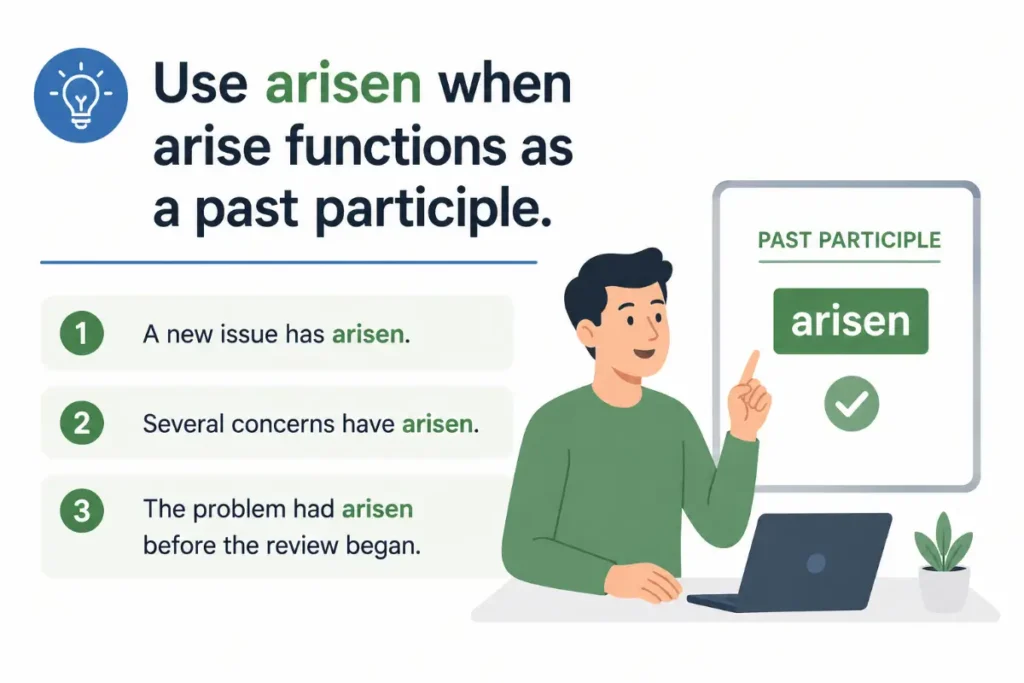
When To Use Arisen
Use arisen when arise functions as a past participle.
A new issue has arisen.
Several concerns have arisen.
The problem had arisen before the review began.
Expert Editor Insight
An experienced English editor checks the role of the verb before correcting its spelling. The main question is simple: does the sentence need the simple past or the past participle? Many writers choose arised because regular verbs often add ed, but this verb follows an irregular pattern. Grammar checkers may flag the error, though automated tools can miss problems when the surrounding sentence is unclear. My practical advice is to memorize arise, arose, arisen as one set and check the helping verb before making a correction.
Learn the difference in excelerate or accelerate Correct Spelling and Meaning.
Conclusion
When choosing arised or arose, remember that arose is the correct simple past tense of arise. The form arised is nonstandard and should be avoided in standard English. The three principal forms are arise, arose, and arisen. Use arose for a past event and arisen with a helping verb such as has, have, or had.
This rule applies across American, British, Australian, and Canadian English. For an easy memory trick, learn all three forms together rather than trying to form the past tense by adding ed. That small habit will help you write with greater accuracy and confidence.
FAQs
Is Arised a Real English Word?
Arised may appear in informal writing or as a learner’s mistake, but it isn’t the standard past tense of arise. In standard American English, use arose for a completed past event. For example, write A problem arose during the meeting. In professional documents, schoolwork, and formal communication, avoid arised.
What Does Arose Mean?
Arose is the simple past tense of arise. It means that something appeared, began, emerged, or came up in the past. For example, A new question arose during class means that the question came up during an earlier event. The word can describe problems, concerns, opportunities, disagreements, and other situations.
Which Is Correct Arised or Arose?
Arose is correct in standard modern English. Arised incorrectly applies the regular past tense ending to an irregular verb. The three principal forms are arise, arose, and arisen. Use arose in a sentence such as An unexpected problem arose yesterday. Use arisen after a helping verb such as has or have.
How Do You Pronounce Arose?
Arose is pronounced uh ROHZ in American English. Its IPA transcription is /əˈroʊz/. The word has two syllables, with the stress on the second syllable. The final sound is a voiced Z rather than an S. A useful memory aid is the phrase a rose, which has the same pronunciation.
Can Arose Be Used at the Beginning of a Sentence?
Yes. You can begin a sentence with arose when the sentence structure supports it. For example, Arose a new concern is possible in an unusual literary style, but it sounds unnatural in most everyday writing. A more natural sentence is A new concern arose during the meeting. Place the subject before the verb for clearer everyday communication.
What Is a Synonym for Arose?
Useful alternatives include emerged, appeared, occurred, and developed. The best choice depends on your intended meaning. A problem arose emphasizes that an issue came up. A problem developed suggests that it took shape over time. An event occurred simply states that something happened. Choose the word that expresses the exact relationship you want to communicate.
Why Do People Confuse Arised and Arose?
People often confuse these forms because many English verbs add ed to make the past tense. For example, arrive becomes arrived, so arised may seem logical. However, arise is irregular and changes to arose. Learning its three principal forms together helps you remember the correct pattern and avoid the mistake.
Is Arose Appropriate in Formal Writing?
Yes. Arose is standard English and works well in formal reports, academic essays, business emails, and professional documents. For example, Several concerns arose during the review is clear and grammatically correct. The word isn’t limited to formal settings, though. You can also use it in everyday conversation when explaining how a past situation began.