
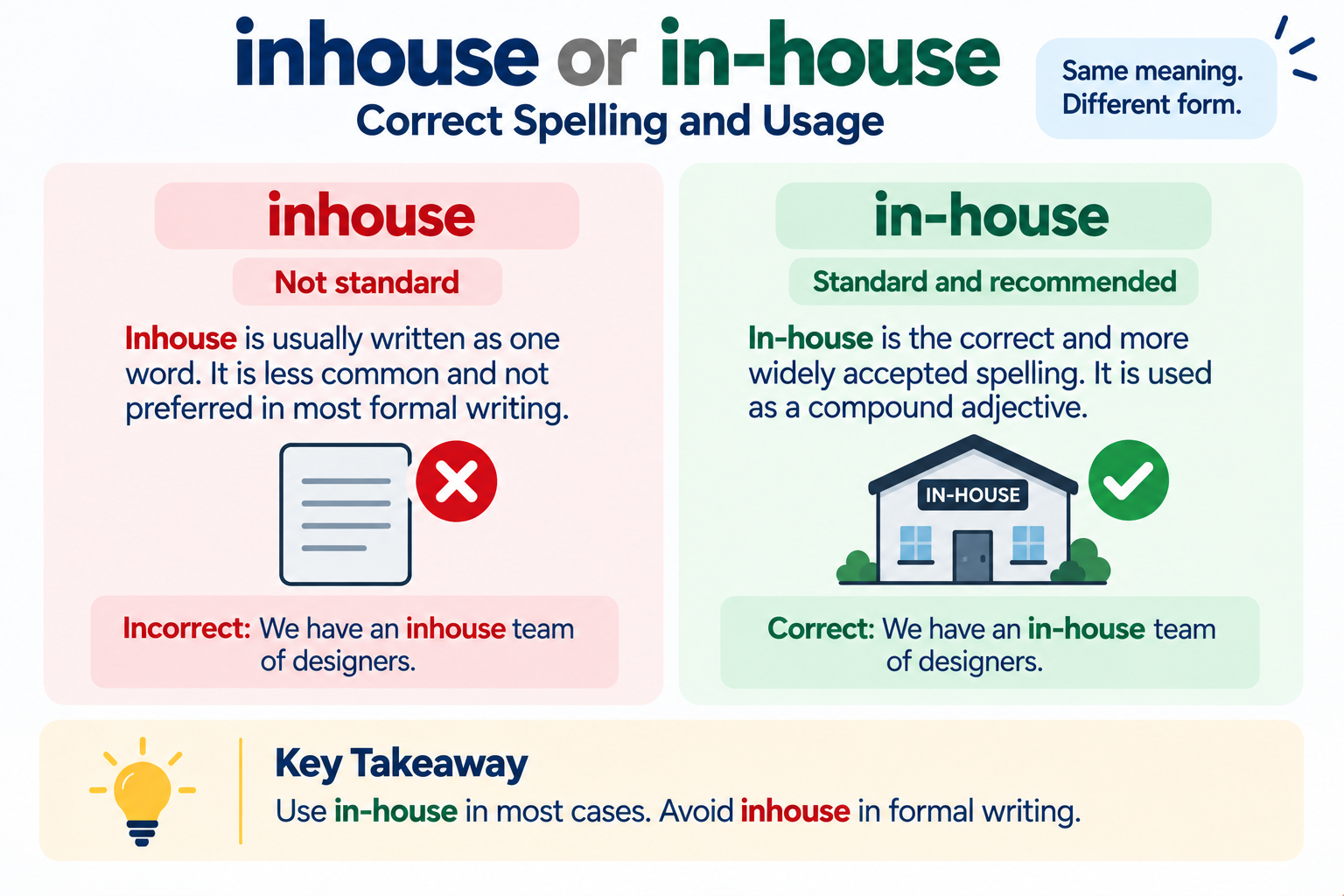
The choice between inhouse or in-house can look like a tiny spelling detail. However the form you choose can affect how polished and professional your writing appears. In standard American English in-house is the established form when the expression works as an adjective or adverb. Inhouse appears in some informal writing and in names or specialized contexts but it is not the usual standard form for general edited prose.
The confusion exists because English often combines words into new compounds over time. Some compounds become one word while others keep a space or hyphen. In-house has retained its hyphen in common standard usage. You’ll see it in phrases such as in-house team, in-house counsel, in-house training, and work done in-house.
This guide explains the meaning and grammar of the expression. You’ll also see how American and British English handle it, when the hyphen matters, common mistakes, pronunciation, related expressions, and plenty of natural examples. By the end, you’ll know exactly when to write in-house and why.
Many readers also check Momment or Moment Which Spelling Is Correct.
Quick Definition
In-house is the standard form used in edited English when the phrase means within an organization or business rather than through an outside provider. It can work as an adjective before a noun or as an adverb after a verb. For example, a company may have an in-house lawyer or handle its marketing in-house.
Quick Answer
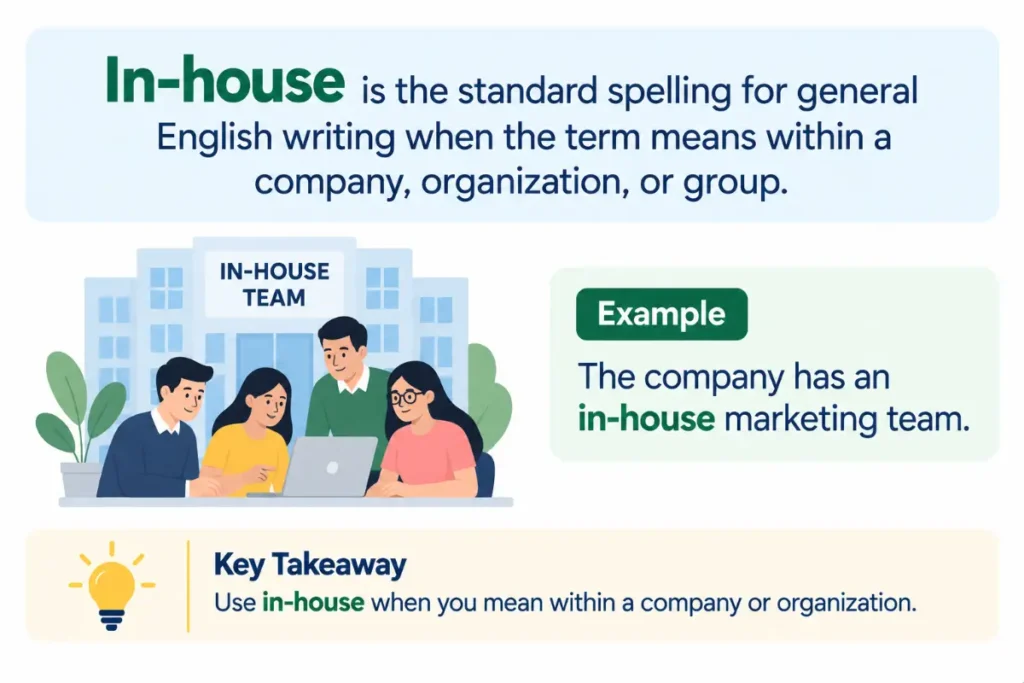
In-house is the standard spelling for general English writing when the term means within a company, organization, or group.
Inhouse is commonly seen as an informal closed spelling, a typo, or part of a name. In carefully edited American English, use the hyphenated form when the word functions as a compound adjective or adverb.
Comparison Table
| Form | Meaning | Part of Speech | Origin | Usage Frequency | Formality | Common Contexts | Example |
|---|---|---|---|---|---|---|---|
| In-house | Done within an organization or provided by its own staff | Compound adjective or adverb | Modern English compound built from in and house | Common | Neutral to professional | Business legal work marketing training technology services | We have an in-house design team. |
| Inhouse | Usually the same intended meaning but not the standard general spelling | Nonstandard closed form in ordinary prose | Modern compound variation | Less common in edited prose | Informal or specialized | Informal writing names branding and occasional organizational usage | The company handles the work in-house. |
Meaning and Definition
Meaning of Inhouse
Inhouse is usually encountered as a closed version of the standard expression. When someone writes about an inhouse team or says a company works inhouse they generally intend the same meaning as in-house.
The problem is that ordinary English spelling does not generally treat this closed form as the preferred choice in edited prose. A reader will probably understand it without difficulty but understanding and standard usage are not the same thing.
You may encounter inhouse in company names product names websites internal documents or branding. A proper name can follow its own spelling conventions. That special use should not be confused with the normal spelling used in general English.
If you are writing an essay business email report article resume or professional document the safer standard choice is in-house.
Meaning of In-House
In-house means within a particular organization or group. It often contrasts with outside external outsourced or third party services.
Consider this sentence.
The company has an in-house accountant.
The accountant works for the company rather than an outside accounting firm.
The expression can also describe work performed internally.
We handle customer support in-house.
Here in-house means the company itself provides the service.
The term appears across many fields. Businesses use it for staff departments training services marketing legal work design technology and manufacturing. Schools may discuss in-house training. Hospitals and organizations may refer to in-house services. Law firms use the phrase in-house counsel for lawyers who work directly for an organization rather than practicing as outside attorneys.
The basic idea stays the same. Something happens inside the organization instead of being sent to an outside provider.
Key Differences Explained
- Spelling. The standard general form is in-house. The hyphen connects the two words into a compound expression.
- Meaning. Both forms may be intended to express the idea of work or services being performed inside an organization. In-house is the standard written form.
- Grammar. The expression can act as an adjective before a noun or an adverb after a verb.
- Pronunciation. The two forms are normally pronounced the same way. The hyphen changes the written structure rather than creating a different spoken word.
- Formality. In-house fits professional and formal writing naturally. Inhouse can look less polished in general prose unless it is part of a proper name or established brand.
- Context. The expression is especially common in business and professional communication. It also appears in legal writing technology education marketing and many other fields.
- Regional usage. Major English varieties generally recognize in-house as the established form. There is no major American versus British spelling split that requires one country to use inhouse.
- Standard usage. When you are unsure which form to use in ordinary edited writing choose in-house.
Which Form Is Correct?
For standard English prose the preferred form is in-house. The hyphen signals that the two words work together as a compound.
This becomes especially clear when the expression appears directly before a noun.
The company hired an in-house designer.
The phrase in-house designer functions as a unit. The hyphen helps the reader see that in and house belong together in the compound modifying designer.
The same expression can also appear after a verb.
The company hired a designer in-house.
Here the phrase tells us where or through what arrangement the work is being done. It functions adverbially.
Established dictionaries and major style references generally treat in-house as the standard spelling. Exact dictionary wording can differ but the core usage is consistent. Professional editing follows the same practical principle. Use the established compound form unless a particular organization or name intentionally uses another spelling.
There is no need to overthink the rule. If you mean something is handled inside a company or organization use in-house in normal edited writing.
Sentence Examples
Here are natural examples showing the standard form in different situations.
- Our company has an in-house marketing team.
- We decided to keep the project in-house instead of hiring an outside agency.
- The hospital provides several in-house services for its staff.
- She works as an in-house attorney for a technology company.
- The school offers in-house training for new teachers.
- We have an in-house designer who handles the company website.
- The manager asked the team to develop an in-house solution.
- They produce most of their promotional materials in-house.
- The company brought its customer support operation in-house last year.
- Our engineers built the software in-house.
These examples show two major patterns. Before a noun the term commonly works as a compound adjective. After a verb it commonly works as an adverbial phrase.
Here are examples of the nonstandard closed form as mistakes.
- The company has an inhouse design team.
- We handle the project inhouse.
- She works as an inhouse lawyer.
- The school provides inhouse training.
- They developed the software inhouse.
In standard edited writing each instance would normally be changed to in-house.
Common Mistakes and Misspellings
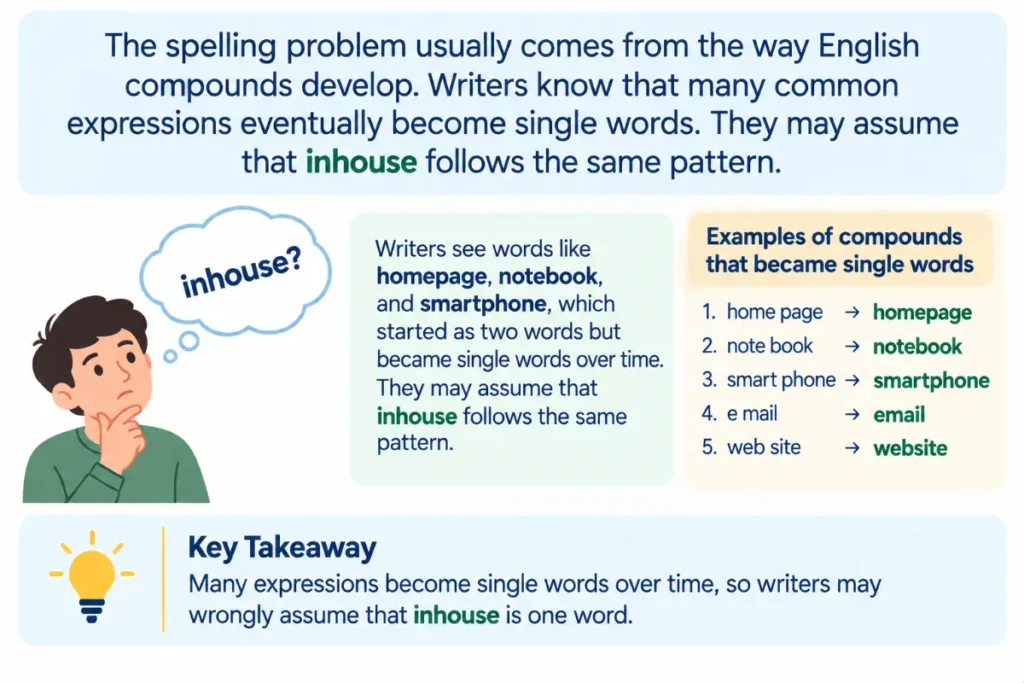
The spelling problem usually comes from the way English compounds develop. Writers know that many common expressions eventually become single words. They may assume that inhouse follows the same pattern.
Here are five common mistakes.
- Writing inhouse before a noun.
Incorrect: The company hired an inhouse consultant.
Preferred: The company hired an in-house consultant.
The hyphen makes the compound relationship clear.
- Writing inhouse after a verb.
Incorrect: We manage the service inhouse.
Preferred: We manage the service in-house.
The standard spelling remains hyphenated even when the expression functions adverbially.
- Adding unnecessary spacing.
Some writers use in house as two separate words in contexts where the compound expression is intended.
For example:
The company has an in house legal department.
In edited prose the preferred version is:
The company has an in-house legal department.
- Confusing the expression with physical location.
In house can sometimes have a literal meaning involving a physical house. In-house usually has the organizational meaning.
For example:
The guests stayed in the house.
This describes a physical building. By contrast:
The company provides in-house training.
This describes an internal service.
- Assuming every compound eventually becomes one word.
English does not follow a single timetable for compound spelling. Some expressions become closed compounds. Others remain open. Some retain hyphens for clarity. In-house belongs to the last group in standard usage.
From an NLP perspective this is a useful example of lexical variation. Search systems can recognize related forms because context supplies strong clues but a professional writer still needs to follow conventional spelling.
Pronunciation Guide
In-house is pronounced approximately /ˌɪn ˈhaʊs/.
You can break it into two spoken parts.
in house.
The main stress usually falls on house.
The word house has the same vowel sound found in words such as mouse and loud. The two parts are pronounced naturally as a single compound expression.
The hyphen does not create a special pronunciation. It mainly signals that the words function together in writing.
One common mistake is to give the expression an unusual pronunciation simply because it contains a hyphen. There is no need to do that. Say in and house naturally.
Another point matters here. English spelling and speech do not always match perfectly. The written hyphen is a visual grammar signal. It tells the reader about the relationship between the words without changing their basic sounds.
Etymology and Word Origin
The expression in-house is a relatively modern English compound built from the ordinary words in and house. Its meaning developed from the idea of keeping an activity within the organization itself rather than sending it outside.
The word house has very old Germanic roots and has existed in English for many centuries. The broader concept of something being done within a particular establishment is also natural to English. Over time business and professional language adopted the compound expression to describe internal services and staff.
The modern business sense became especially useful as organizations began distinguishing between work handled by their own employees and work given to outside specialists.
That distinction remains central today. An in-house employee belongs to the organization. An external provider works outside it.
The historical development also explains why the expression feels natural despite having a fairly literal structure. English often creates useful compounds from familiar words rather than inventing entirely new vocabulary.
Need another quick comparison? Read convertor vs converter Which Form Is Correct.
Regional Usage
American English
American English commonly uses in-house in business communication professional writing journalism and everyday workplace language. Expressions such as in-house counsel, in-house training, in-house team, and handled in-house are well established.
The form is especially common in corporate and legal settings. It also appears naturally in education healthcare technology marketing and manufacturing.
British English
British English also uses in-house as the established form. The meaning is essentially the same as in American English.
British professional writing uses the expression for internal services staff and processes. There is no major British spelling rule that changes the expression to inhouse.
Australian English
Australian English generally follows the same pattern. In-house is the normal form in edited professional writing.
The expression can describe internal teams services training and business processes. A different spelling may appear in a company name but that does not create a general regional spelling rule.
Canadian English
Canadian English also commonly uses in-house. The term works naturally in business legal education and workplace contexts.
Canadian writers do not normally need a special spelling variation. In-house is the practical standard for general edited prose.
Across these major varieties the difference is small. The standard written form remains in-house.
Grammar Rules and Part of Speech
In-house can function mainly as a compound adjective or an adverb.
In-House as an Adjective
When it comes before a noun it describes something provided or performed within an organization.
Examples include:
The company has an in-house lawyer.
We created an in-house training program.
She joined the in-house design department.
In each case the compound modifies a noun.
The hyphen is useful because it tells the reader that the two words belong together as one descriptive unit.
In-House as an Adverb
The expression can also describe how or where an activity is performed.
Examples include:
We produce the reports in-house.
The company manages its payroll in-house.
They developed the application in-house.
Here the expression modifies the action rather than directly modifying a noun.
Position in a Sentence
Before a noun the expression normally appears directly before the noun or noun phrase.
They hired an in-house consultant.
After a verb it commonly appears later in the sentence.
They hired a consultant in-house.
The exact position can change with sentence structure. The meaning remains centered on internal organizational work.
Punctuation
The hyphen is part of the conventional spelling in standard usage. You should not add spaces around it.
Correct:
in-house team.
Incorrect:
in house team.
Incorrect:
in house-team.
The form stays together.
Formal and Informal Writing
In-house works comfortably in formal writing and casual communication. It is common enough that it doesn’t sound overly technical.
You can use it in a business email just as naturally as in a formal report.
For example:
We now provide all training in-house.
That sentence sounds direct and professional without being stiff.
Real Life Usage Examples
Daily Conversation
People use the expression naturally when discussing work services or responsibilities.
- We have an in-house mechanic who handles most repairs.
- They decided to keep the work in-house.
The phrase is especially common when comparing internal work with outside services.
Email and Workplace Communication
Professional communication uses the expression frequently.
- Our in-house team will review the proposal before Friday.
- We can handle the design work in-house.
These sentences are concise and clear. They tell the reader exactly who will perform the work.
Academic Writing
Academic and educational settings also use the term when discussing institutional resources.
- The university provides in-house training for laboratory staff.
- The department developed an in-house program for student support.
The expression can describe services created and managed by the institution itself.
News and Journalism
News writing may use the expression when explaining how an organization operates.
- The company moved its advertising work in-house.
- The organization created an in-house team to manage the project.
These constructions help readers understand changes in staffing and business strategy.
Literature and Storytelling
The expression can appear in narrative writing when a story involves professional or organizational settings.
- The firm relied on its in-house experts during the crisis.
- She preferred the quiet work of the in-house research department.
The phrase works well when the writer needs to distinguish internal work from outside assistance.
Related and Confused Terms
Several expressions are closely connected to in-house. Knowing the differences can help you choose more precise wording.
- Internal. This is a broad adjective meaning inside an organization or system. An internal department can be an in-house department.
- In-house team. This specifically refers to employees or staff working directly within an organization.
- Outsourced. This describes work given to an outside company or provider. It often creates the clearest contrast with in-house.
- External. This means coming from outside the organization. An external consultant differs from an in-house employee.
- Third party. This refers to an outside person or organization involved in a service or transaction.
- On staff. This means someone is employed as part of an organization’s staff. It can overlap with the idea of an in-house employee.
- Internal team. This is a broad alternative that can replace in-house team in many contexts.
- Outsourcing. This is the practice of using an outside provider for work that could potentially be performed internally.
The choice depends on what you want to emphasize. In-house focuses on the fact that the work stays inside the organization. Outsourced focuses on the decision to use an external provider.
Why the Hyphen Matters
The hyphen in in-house is not simply a decorative mark. It helps show that the two words form a single compound idea.
Compare these examples.
The company hired an in-house lawyer.
The phrase in-house modifies lawyer as a unit.
Now consider a literal construction.
The workers were waiting in the house.
Here in describes location and house refers to a physical building. The words have their ordinary individual meanings.
This distinction is one reason compound punctuation can matter. Hyphens can reduce ambiguity and make sentence structure easier to read.
English contains many compound expressions that use hyphens for this reason. The spelling can vary over time but established usage should guide your choice in formal writing.
For in-house the conventional form remains clear and easy to follow.
In-House Versus Internal
In-house and internal are close in meaning but they aren’t always perfect substitutes.
An internal team is simply a team belonging to the organization. An in-house team often highlights the contrast with an outside service.
Consider:
We have an internal research department.
This focuses on the department’s organizational position.
Now:
We have an in-house research team.
This can suggest that the organization performs the work itself instead of hiring an outside research firm.
The difference is subtle. In everyday business writing the two can overlap.
Still in-house is often more natural when the writer is contrasting internal work with outsourcing.
In-House Versus Outsourced
These expressions describe opposite arrangements.
In-house work is performed by people within the organization. Outsourced work is performed by an external provider.
For example:
The company manages payroll in-house.
This tells us the organization handles payroll internally.
The company outsourced payroll.
This tells us an outside provider handles it.
The terms are especially common in business writing because companies regularly decide which activities should stay internal and which should go to outside specialists.
You can also use internal and external when you want a broader contrast.
In-House in Professional Writing
The expression is particularly useful in professional communication because it communicates a business arrangement quickly.
Consider a resume sentence:
Managed an in-house design team.
A reader immediately understands that the writer worked with an internal design function.
A business report might say:
The company brought customer service in-house.
Again the meaning is clear. The company moved the function from an external provider to its own organization.
Legal writing has another familiar use.
She serves as in-house counsel.
This identifies a lawyer who works directly for an organization rather than as outside counsel.
Marketing teams use the term in a similar way.
Our in-house creative team produces all campaign materials.
The expression saves words while giving the reader a precise picture of how the work is organized.
Common Questions About the Spelling
A useful way to handle compound spelling is to check the role of the expression in the sentence rather than relying only on how it sounds.
If you mean something is done within an organization use in-house.
If you are describing a physical location use ordinary words according to the intended meaning.
For example:
The company provides in-house training.
This means the company provides the training itself.
The employees met in the house.
This refers to a physical building.
The distinction becomes easy once you focus on meaning instead of appearance.
Expert Editor Insight
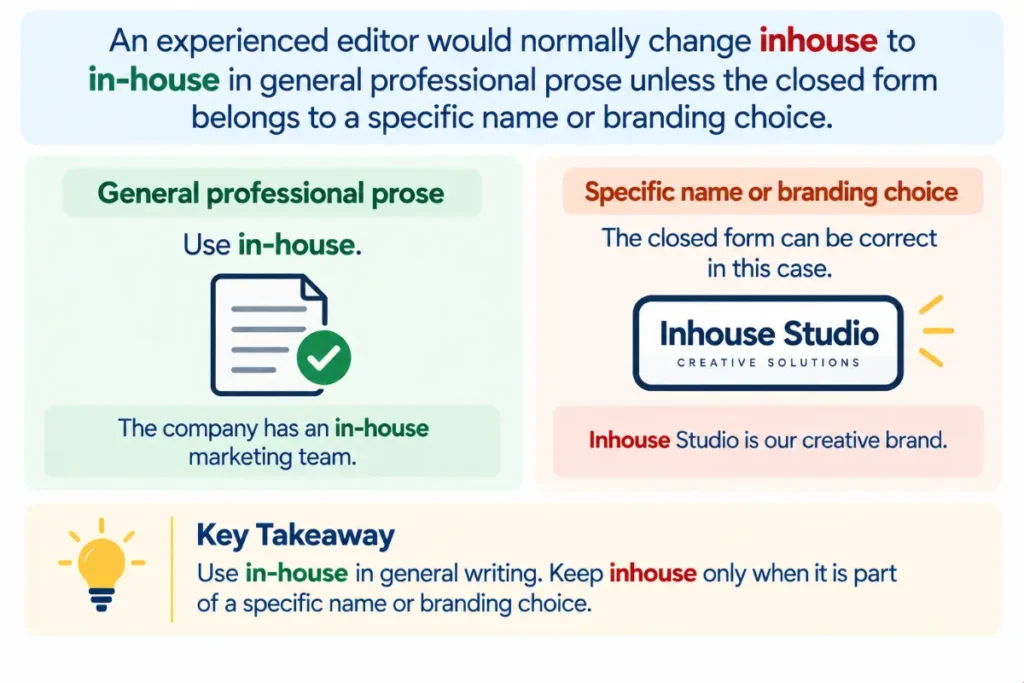
An experienced editor would normally change inhouse to in-house in general professional prose unless the closed form belongs to a specific name or branding choice. The confusion is understandable because English compounds often change spelling over time and writers cannot predict every compound from a simple rule. Professional editors look at established usage and sentence function rather than treating every familiar looking compound as one word. A useful editing tip is to ask one question: does this phrase describe something provided or performed internally? If yes then in-house is usually the form you want.
You may also want to read Busyness Vs Business Which Word Should You Use in 2026?.
Conclusion
The answer to inhouse or in-house is straightforward. In-house is the standard form for general edited English when you mean something provided or performed within a company organization or group. Inhouse may appear informally or in a proper name but it is not the usual choice for polished prose.
The expression can work as a compound adjective in phrases such as in-house team and in-house counsel. It can also work adverbially in sentences such as We handle the work in-house. The meaning stays centered on internal work rather than an outside service.
For an easy editing habit connect the expression with the idea of an internal service and keep the hyphen in place. When your sentence means that a company does something itself use in-house. That simple rule will keep your business writing clear consistent and professional.
FAQs
Is inhouse a correct spelling?
Inhouse can appear in informal writing and in proper names or branding but it is not the usual standard form for general edited English. When you mean a service or activity provided within an organization use in-house. For example write in-house team, in-house training, or handled in-house. This spelling is widely recognized across major English varieties.
Is in-house one word or two words?
In-house is written as a hyphenated compound in standard usage. It contains two words connected by a hyphen. The expression can work as an adjective before a noun or as an adverb after a verb. For example you can write in-house lawyer and manage the work in-house. The hyphen helps show that the words function together.
What does in-house mean?
In-house means within a company organization or group rather than through an outside provider. A company with an in-house design team employs its own designers. If the company handles design in-house it performs the work internally. The term is common in business legal marketing technology education and other professional settings.
Should I write in house or in-house?
Use in-house when you mean something is provided or performed internally by an organization. For example write The company offers in-house training. The open form in house can have a literal meaning involving a physical building such as The children stayed in the house. The intended meaning determines the correct construction.
Is in-house formal enough for business writing?
Yes. In-house is completely natural in professional and formal business writing. You can use it in reports emails resumes proposals policies and workplace documents. It is especially common when discussing internal employees services departments or processes. The expression is professional without sounding overly formal and it clearly contrasts internal work with outside or outsourced services.
Is in-house hyphenated in American English?
Yes. In standard American English the expression is commonly written as in-house when it functions as a compound adjective or adverb. Examples include in-house counsel, in-house team, and handled in-house. The hyphen connects the two words and makes their relationship clear. A company name may follow its own spelling but that does not change general usage.
What is another word for in-house?
Useful alternatives include internal, on staff, company based, organization based, and internally provided. The best choice depends on the sentence. Internal is often the closest general alternative. Outsourced is not a synonym because it describes the opposite arrangement. In-house is especially useful when you want to emphasize that an organization performs work itself instead of using an outside provider.
Why is in-house hyphenated?
The hyphen shows that in and house work together as one compound expression. This helps readers understand that in-house modifies a following noun as a unit or functions together as an adverb. English uses hyphens in many compounds for clarity. The hyphen also reflects established usage. You should normally retain it in edited professional writing.