
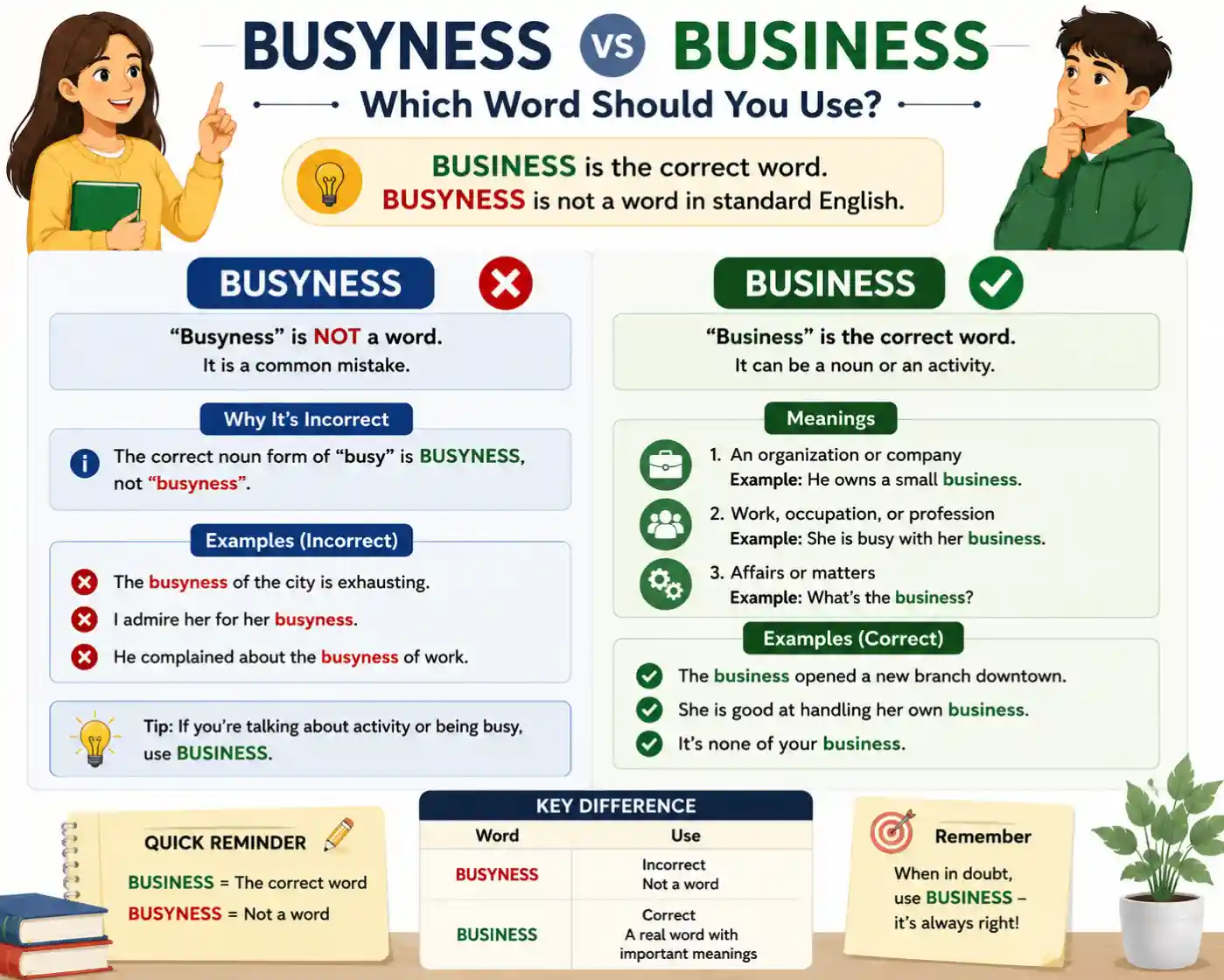
Have you ever written business when you actually meant busyness? You’re not alone. These two words differ by just one letter, yet they have completely different meanings. Because business is far more common in everyday English, many people automatically type it even when talking about someone being busy. Spell checkers may not catch the mistake because both words are correct English words.
Understanding the difference between in these words can make your writing clearer and more professional. It also helps you avoid one of the most common vocabulary mix-ups in English. While one word refers to the state of having a lot to do, the other usually relates to commerce, work, or personal affairs.
In this guide, you’ll learn what each word means, how they differ, when to use each one, how native speakers use them, and the mistakes that even experienced writers sometimes make. By the end, you’ll know exactly which word belongs in every situation.
You may also want to read Wholey Vs Wholly Which Spelling Is Correct in 2026?.
Quick Definition
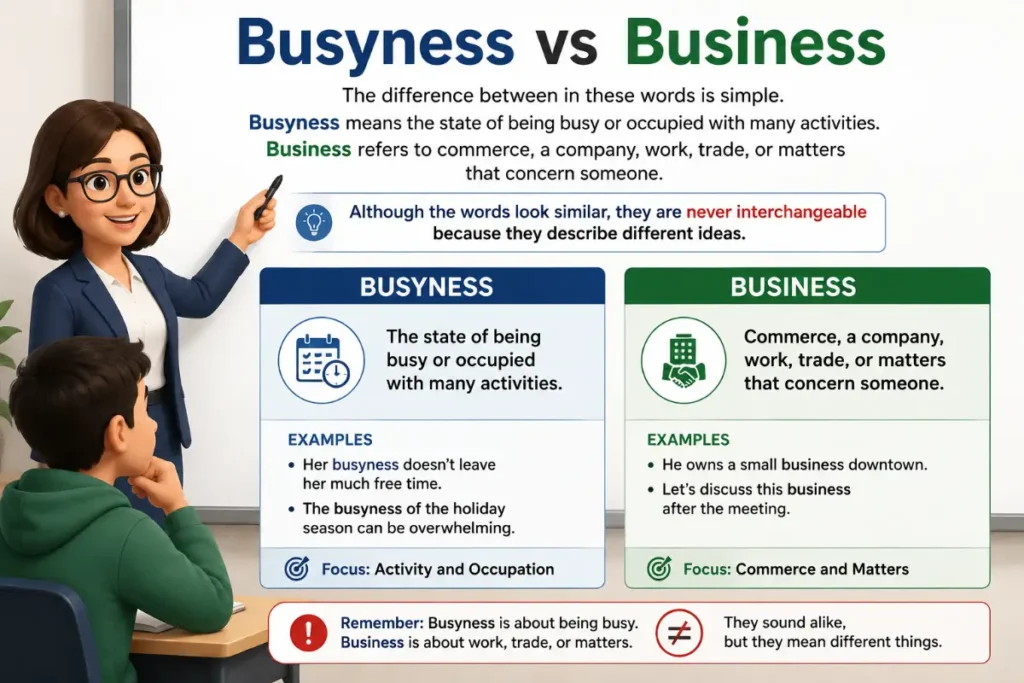
The difference between in these words is simple. Busyness means the state of being busy or occupied with many activities. Business refers to commerce, a company, work, trade, or matters that concern someone. Although the words look similar, they are never interchangeable because they describe different ideas.
Quick Answer
If you’re talking about someone having a full schedule or being occupied, use busyness.
If you’re talking about a company, trade, work, professional activities, or someone’s affairs, use business.
For example:
- Correct: Her busyness kept her from answering emails.
- Correct: Her business has expanded across the country.
Remember this simple rule: Busyness is about being busy. Business is about work, trade, or affairs.
Comparison Table
| Feature | Busyness | Business |
|---|---|---|
| Correct English word | Yes | Yes |
| Primary meaning | State of being busy | Commerce, trade, company, occupation, affairs |
| Part of speech | Noun | Noun |
| Origin | From busy + -ness | From Old English bisignis |
| Usage frequency | Much less common | Extremely common |
| Formality | Neutral | Neutral |
| Common contexts | Time management, schedules, lifestyle | Companies, careers, finance, law, daily affairs |
| Refers to activity level | Yes | Sometimes, but usually not |
| Refers to commerce | No | Yes |
| Example | His busyness prevented him from attending. | His business became profitable. |
Meaning Of Busyness
Busyness is a noun that describes the condition of being busy. It refers to having many tasks, responsibilities, appointments, or activities that occupy your time. Although the word is completely correct, it appears much less often than business in everyday writing. Many people prefer phrases like being busy, a busy schedule, or heavy workload because they sound more natural in conversation.
Definition
Busyness means the quality or condition of being occupied with work, responsibilities, or activities.
Context
You will usually see busyness in discussions about:
- Personal schedules.
- Time management.
- Productivity.
- Workload.
- Lifestyle.
- Daily routines.
Examples
- Her busyness left little time for hobbies.
- The constant busyness of city life can feel exhausting.
- His busyness increased during tax season.
- She apologized for her recent busyness.
- The office’s busyness surprised the new employee.
When Native Speakers Use Busyness
Native speakers recognize busyness, but they often replace it with smoother expressions such as:
- Being busy.
- A packed schedule.
- A heavy workload.
- A full calendar.
- A hectic routine.
For example:
Less natural:
- Her busyness prevented her from calling.
More natural:
- She was too busy to call.
That doesn’t make busyness incorrect. It simply means English often prefers shorter, more direct expressions.
Meaning Of Business
Business is one of the most frequently used nouns in English. Its meaning changes depending on the context, but it almost always relates to commerce, work, professional activity, or matters that concern a person. Unlike busyness, business has dozens of established meanings and appears in nearly every variety of English.
Definition
Business refers to commercial activity, a company, one’s occupation, or matters requiring attention.
Common Contexts
You can use business when talking about:
- Companies.
- Trade.
- Sales.
- Employment.
- Professional services.
- Personal affairs.
- Legal matters.
- Official responsibilities.
Examples
- She started a successful business last year.
- Their family business has existed for generations.
- We discussed business during lunch.
- He’s traveling on business this week.
- Mind your own business.
- Online business continues to grow rapidly.
- The business meeting lasted three hours.
- Small business owners face many challenges.
Common Meanings Of Business
Depending on the sentence, business can mean:
- A company.
- Commercial activity.
- A person’s job.
- An important matter.
- Someone’s private affairs.
- Professional dealings.
- A customer’s purchases.
- Economic activity in general.
This flexibility explains why business is so common in English.
Meaning Differences
Although these words share similar spelling, their meanings are completely different.
Busyness
- Describes activity level.
- Focuses on time and responsibilities.
- Relates to being occupied.
- Does not involve commerce.
Example:
- Her busyness made it difficult to relax.
Business
- Describes commerce or affairs.
- Focuses on work or organizations.
- Can refer to companies or occupations.
- Can also describe personal matters.
Example:
- Her business employs more than fifty people.
The easiest way to remember the difference is this: If the sentence is about being busy, choose busyness. If it is about work, companies, money, customers, or someone’s affairs, choose business.
Meaning Comparison At A Glance
| Busyness | Business |
|---|---|
| State of being busy | Company or trade |
| Occupied schedule | Commercial activity |
| Personal workload | Professional work |
| Time commitments | Financial or organizational matters |
| Lifestyle | Employment or occupation |
Which Word Is More Common?
One reason people confuse busyness or business is that business appears almost everywhere.
You see it in:
- News articles.
- Television.
- Advertisements.
- Schools.
- Government publications.
- Financial reports.
- Everyday conversations.
By contrast, busyness is relatively uncommon. Even when writers want to describe someone’s packed schedule, they often choose alternatives like:
- Being busy.
- A hectic lifestyle.
- A demanding schedule.
- A heavy workload.
- A full calendar.
As a result, many readers recognize business instantly but rarely encounter busyness, making accidental substitutions more likely.
Why People Confuse
Several factors contribute to this common mix-up.
1. Nearly Identical Spelling
The words differ by only one letter, making typing mistakes easy.
2. Similar Pronunciation
Their pronunciation is close enough that listeners may not notice the difference during casual conversation.
3. Frequency Bias
People see business thousands of times more often than busyness, so the brain tends to expect the more familiar word.
4. Autocorrect
Some typing tools automatically suggest business because it appears much more frequently in dictionaries and writing databases.
5. Fast Writing
When people type quickly, they often rely on muscle memory instead of carefully checking each word. These factors explain why even experienced writers occasionally confuse busyness and business despite understanding their meanings.
Which One Is Correct?
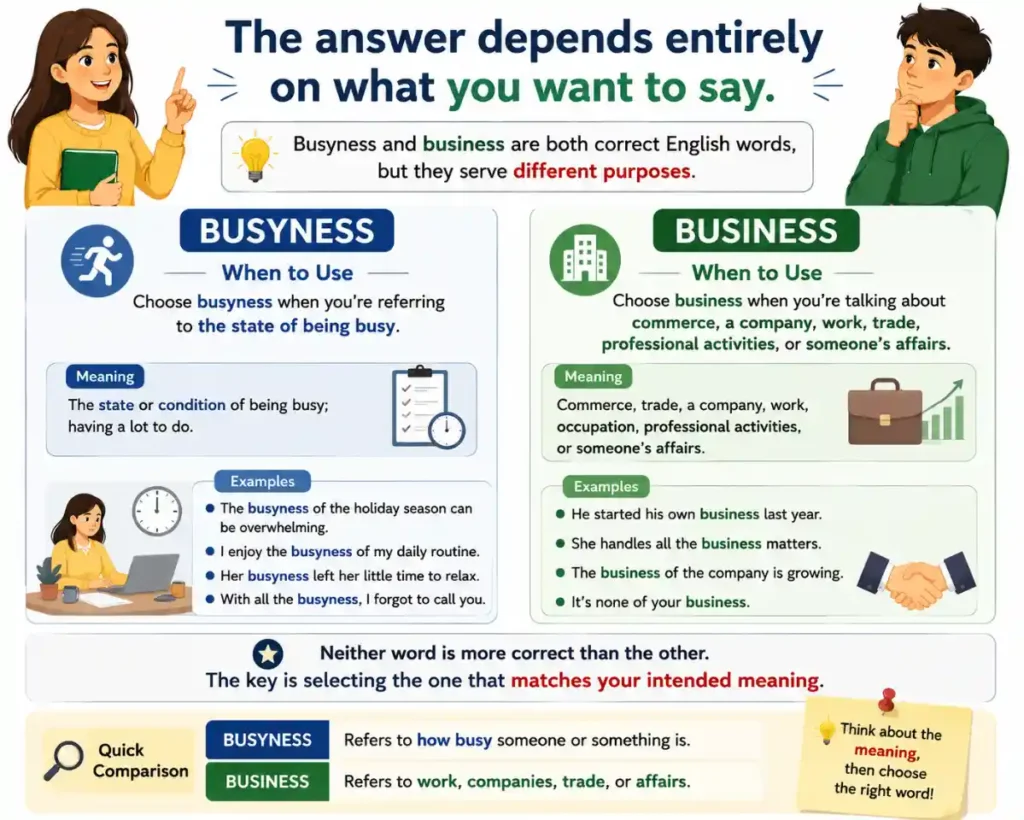
The answer depends entirely on what you want to say. Busyness and business are both correct English words, but they serve different purposes. Choose busyness when you’re referring to the state of being busy. Choose business when you’re talking about commerce, a company, work, trade, professional activities, or someone’s affairs. Neither word is more correct than the other. The key is selecting the one that matches your intended meaning.
Consider these examples:
- Correct: The busyness of the holiday season can be overwhelming.
- Incorrect: The business of the holiday season can be overwhelming. (Unless you’re referring to commercial activity.)
- Correct: The store’s business improves every December.
- Incorrect: The store’s busyness improves every December.
A simple memory trick is to ask yourself one question: Am I describing a person’s schedule or commercial activity? If the answer is a person’s schedule, use busyness. If the answer involves work, money, customers, trade, or a company, use business.
Examples Of Busyness In Sentences
Here are natural examples showing how busyness is used.
- Her busyness made it difficult to answer every message.
- The busyness of modern life leaves little room for rest.
- His busyness increased after accepting a new position.
- We underestimated the busyness of the conference week.
- The constant busyness of the office created a stressful atmosphere.
- She apologized for her recent busyness and promised to call soon.
- Their busyness kept them from attending the family reunion.
- The busyness of the city appealed to some visitors but exhausted others.
- He welcomed a quiet weekend after months of nonstop busyness.
- The teacher understood the students’ busyness during exam season.
Still confused? Compare Uncollectible Vs Uncollectable Which Is Correct in 2026.
Examples Of Business In Sentences
Now compare those with common uses of business.
- She opened a small business after graduating from college.
- His business serves customers across the country.
- We’re meeting tomorrow to discuss business plans.
- The family business has operated for more than fifty years.
- She traveled to New York on business.
- Good customer service helps every business grow.
- The local business community supported the charity event.
- Mind your own business and let them solve the problem.
- Their online business expanded faster than expected.
- Running a successful business requires patience and planning.
Side By Side Comparison
Seeing both words together makes the difference easier to remember.
| Busyness | Business |
|---|---|
| Her busyness delayed her reply. | Her business hired three new employees. |
| The busyness of the office was exhausting. | The business closed early on Friday. |
| Their busyness continued throughout the summer. | Their business serves international clients. |
| My recent busyness kept me away from social events. | My father’s business has been operating for decades. |
| Weekend busyness finally slowed down. | Weekend business was stronger than expected. |
Notice that one column always talks about activity levels, while the other focuses on commerce or affairs.
Common Mistakes
Because the words are visually similar, writers often make predictable errors.
1. Using Business To Mean Being Busy
Incorrect:
- My business prevented me from attending.
Correct:
- My busyness prevented me from attending.
Even better:
- I was too busy to attend.
This final version is the most natural choice in everyday English.
2. Using Busyness For A Company
Incorrect:
- She owns a successful busyness.
Correct:
- She owns a successful business.
A company is always a business, never busyness.
3. Assuming Busyness Is A Misspelling
Some people think busyness is incorrect because they rarely see it. It isn’t. Major dictionaries recognize busyness as the standard noun formed from busy. Its lower frequency simply makes it less familiar.
4. Trusting Autocorrect Too Much
Some writing tools strongly favor business because it’s vastly more common. Always check the sentence yourself instead of relying entirely on software suggestions.
5. Confusing Meaning With Spelling
Both words are spelled correctly. The real issue isn’t spelling. It’s choosing the correct meaning for your sentence.
Pronunciation Guide
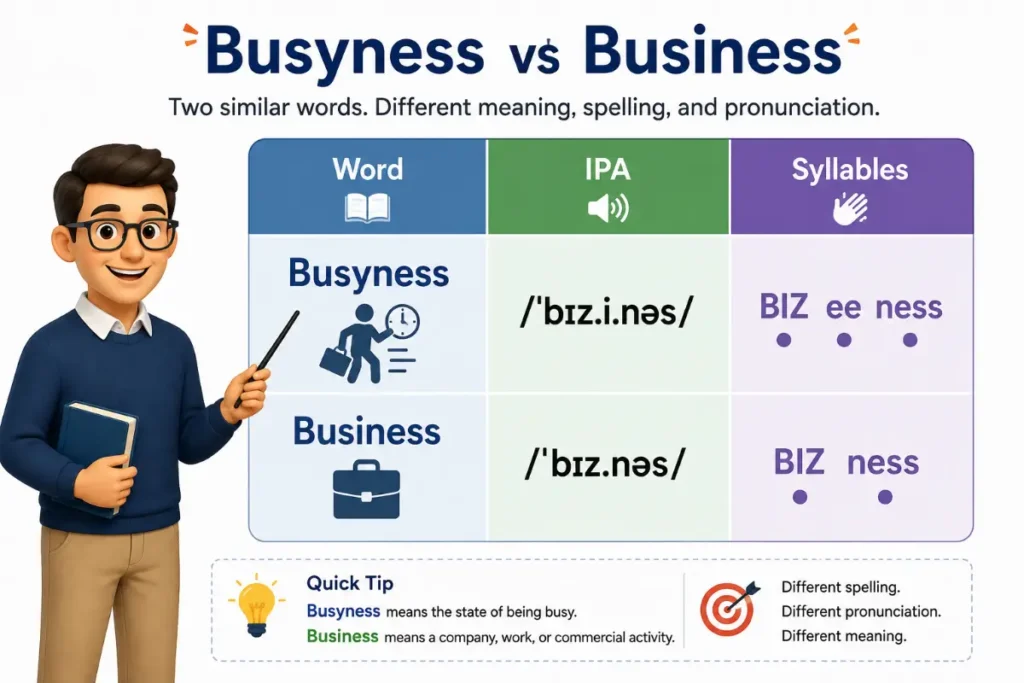
Although these words look similar, careful pronunciation helps distinguish them.
| Word | IPA | Syllables |
|---|---|---|
| Busyness | /ˈbɪz.i.nəs/ | BIZ ee ness |
| Business | /ˈbɪz.nəs/ | BIZ ness |
Notice that business is usually pronounced with two syllables, even though its spelling suggests three. Busyness, however, clearly has three syllables.
Common Pronunciation Mistakes
- Pronouncing business exactly as it is spelled.
Many learners try to say biz i ness.
Standard pronunciation is closer to:
BIZ ness
- Dropping the middle syllable in busyness.
Because business is more familiar, some speakers accidentally pronounce busyness the same way. Instead, remember that busyness includes the extra ee sound.
Pronunciation Memory Tip
Think of the base words.
- Busy becomes BUSY ness, so keep all three syllables.
- Business has evolved over centuries, resulting in its shorter modern pronunciation.
Etymology And Word Origin
Understanding where these words came from explains why they look alike but mean different things.
Origin Of Busyness
Busyness comes directly from the adjective busy combined with the suffix -ness, which forms nouns describing a quality or state. This pattern is common in English.
Examples include:
- Happy → Happiness.
- Kind → Kindness.
- Dark → Darkness.
- Busy → Busyness.
Its meaning has remained remarkably consistent throughout history: the condition of being busy.
Origin Of Business
The history of business is more complex. It developed from the Old English word bisignis, which originally referred to care, anxiety, occupation, or diligent activity.
Over time, its meaning expanded to include:
- Occupation.
- Work.
- Trade.
- Commerce.
- Financial activity.
- Professional affairs.
As economies developed, business became the standard word for commercial enterprises and trade. Today it remains one of the most frequently used nouns in English.
How The Meanings Evolved
Originally, both words shared the broader idea of activity.
As English developed:
- Busyness remained connected to personal activity and being occupied.
- Business expanded into work, commerce, organizations, and professional affairs.
This historical separation explains why the words resemble one another but are no longer interchangeable.
Grammar Rules
Understanding the grammar behind these words makes choosing the correct one much easier.
Parts Of Speech
Both busyness and business are nouns.
However, they refer to different kinds of nouns.
Busyness names a state or condition.
Example:
- Her busyness surprised everyone.
Business names an activity, organization, occupation, or matter.
Example:
- His business continues to grow.
Countable And Uncountable Usage
Busyness is usually an uncountable noun.
Correct:
- Her busyness increased this month.
Less common:
- Many busynesses.
In ordinary English, this plural form is almost never needed. Business can be both countable and uncountable.
Uncountable:
- Business is improving this year.
Countable:
- Several businesses opened downtown.
The plural businesses refers to multiple companies or commercial organizations.
Common Sentence Structures
Busyness
- Busyness + of + noun.
- Busyness + prevented + someone.
- State of busyness.
- Constant busyness.
Examples:
- The busyness of city life never stops.
- Her busyness prevented a quick response.
Business
- Business + meeting.
- Business + owner.
- Business + trip.
- Business + partner.
- Business + plan.
- Business + hours.
- Business + license.
Examples:
- We scheduled a business meeting.
- She wrote a detailed business plan.
These collocations are extremely common in both spoken and written English.
In Different English Varieties
The meanings of busyness and business remain the same across major English dialects. The differences are not about correctness but about frequency and style.
American English
In American English, business is extremely common in everyday conversation, journalism, education, and professional writing.
Examples include:
- Small business loans.
- Business owner.
- Business meeting.
- Business trip.
- Business school.
Busyness is recognized as a correct word, but Americans often replace it with more natural expressions such as being busy, a busy schedule, or a heavy workload.
British English
British English also recognizes both words. Writers may use busyness in formal or literary contexts, but phrases like being busy remain more common in everyday speech. Business appears frequently in commerce, government, education, and daily communication.
Canadian English
Canadian English follows usage patterns that are very similar to American English. Both words are correct, but business is far more common. Busyness is generally reserved for situations where the writer specifically wants to describe the state of being occupied.
Australian English
Australian English uses both words with the same meanings. As in other English varieties, speakers often choose natural alternatives such as being busy instead of busyness, while business remains the standard term for companies, work, and commercial activities.
Regional Preference Summary
| English Variety | Busyness | Business |
|---|---|---|
| American English | Correct but less common | Very common |
| British English | Correct but uncommon in speech | Very common |
| Canadian English | Correct but less frequent | Very common |
| Australian English | Correct but relatively rare | Very common |
Across all four varieties, the meanings stay consistent. The main difference is that business appears much more often in everyday communication.
Real Life Usage Examples
Looking at real-world situations helps reinforce the distinction.
Daily Conversation
- Sorry for my recent busyness. I’ll call you tonight.
- I have some business to take care of before dinner.
- The busyness of the morning finally slowed down.
- She runs a successful online business.
Academic Writing
- Researchers examined the effects of workplace busyness on employee well-being.
- Many universities offer courses in business administration.
- Constant busyness may reduce opportunities for reflection.
- International business continues to evolve with technology.
Professional Communication
- Thank you for your patience during our recent busyness.
- The business proposal will be reviewed next week.
- Seasonal busyness has increased customer demand.
- Our business strategy focuses on long-term growth.
Literature
Authors sometimes use busyness to create imagery of crowded streets, active households, or fast-paced lives.
Example:
- The cheerful busyness of the marketplace filled every corner with energy.
News And Media
News organizations overwhelmingly use business because they frequently report on:
- Companies.
- Financial markets.
- Employment.
- Investments.
- Economic trends.
- Entrepreneurship.
Examples include:
- Local business owners welcomed the new policy.
- The business sector reported steady growth.
Related Words And Commonly Confused Terms
Several English words are closely related to busyness and business. Understanding them can prevent additional mistakes.
Words Related To Busyness
- Busy.
- Occupied.
- Activity.
- Workload.
- Hustle.
- Hecticness.
- Productivity.
- Engagement.
- Schedule.
- Time pressure.
These words all relate to having many tasks or responsibilities.
Words Related To Business
- Commerce.
- Trade.
- Company.
- Enterprise.
- Corporation.
- Firm.
- Industry.
- Profession.
- Occupation.
- Organization.
These words focus on commercial or professional activity.
Commonly Confused Words
Busy And Busyness
- Busy is an adjective.
- Busyness is the noun form.
Correct:
- She is busy today.
- Her busyness surprised everyone.
Business And Businesses
- Business refers to one company or commercial activity.
- Businesses is the plural form.
Examples:
- The business is growing quickly.
- Several businesses opened last year.
Occupation And Business
These words sometimes overlap, but they are not identical.
- Occupation usually means a person’s job or profession.
- Business can refer to a company, commercial activity, or professional affairs.
Work And Business
Although both involve employment, work is much broader. You can work without owning a business. Likewise, a business may employ many people who perform different kinds of work.
Expert Language Insight
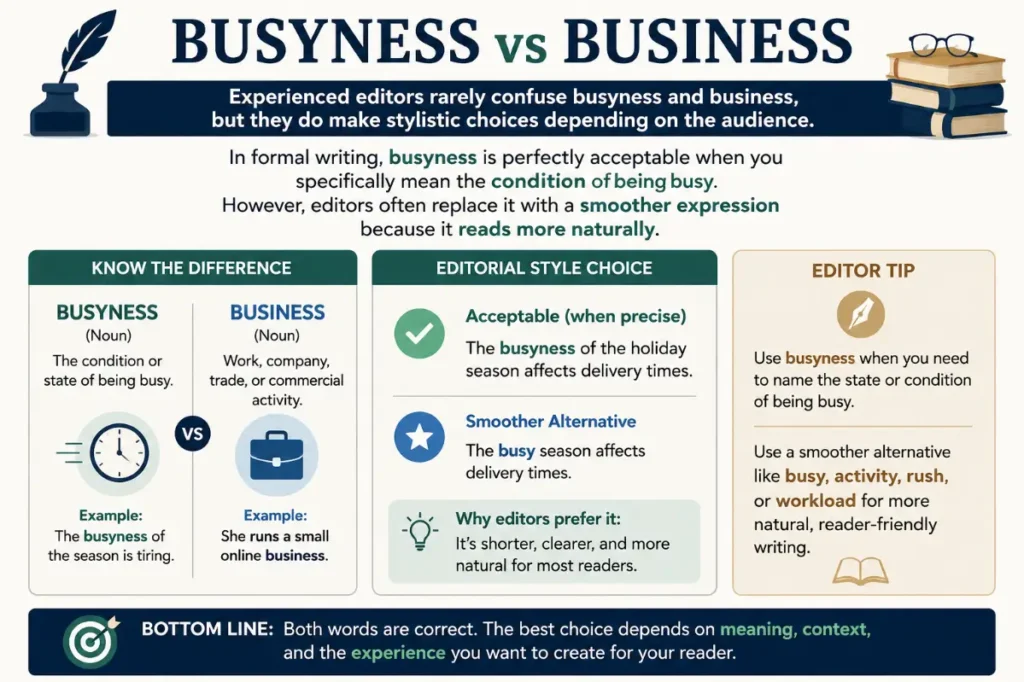
Experienced editors rarely confuse busyness and business, but they do make stylistic choices depending on the audience. In formal writing, busyness is perfectly acceptable when you specifically mean the condition of being busy. However, editors often replace it with a smoother expression because it reads more naturally.
Compare these examples.
Acceptable:
- Her busyness prevented her from responding.
Often preferred:
- She was too busy to respond.
The second sentence is shorter, more direct, and easier to read. On the other hand, business should never be replaced with busyness. It has its own well-established meanings related to commerce, work, and personal affairs. Professional writers also pay attention to context. If readers might misunderstand the sentence, they rewrite it instead of relying on similar-looking words.
For example:
Less clear:
- The business of raising children is exhausting.
Clearer:
- The work of raising children is exhausting.
Or, if the intended meaning is activity:
- The busyness of raising young children can be exhausting.
Choosing the right word is not just about correctness. It is about helping readers understand your message immediate
Learn the difference in ally vs allie Meaning Spelling and Usage.
Conclusion
The difference between busyness and business is simple once you understand what each word means. Both are correct English words, but they are used in completely different contexts.
Use busyness to describe the state of being busy or occupied with many tasks and responsibilities. While it is less common than business, it is the correct choice when referring to a person’s level of activity.
Use business when talking about a company, commerce, work, trade, or personal affairs. It is a far more common word and is used in everyday conversations, professional writing, and formal English.
When you’re unsure, think about the meaning instead of the spelling. If you’re referring to being busy, choose busyness. If you’re talking about work, companies, or commercial activities, business is always the right word.
Frequently Asked Questions
Is busyness a real word?
Yes. Busyness is a standard English noun that means the state or condition of being busy. Although it appears less often than business, it is recognized by major dictionaries and is completely correct when used in the appropriate context.
Why do people confuse busyness and business?
The words differ by only one letter, and business is far more common in everyday English. Because both are valid words, spell checkers may not identify the mistake, making it easy to substitute one for the other accidentally.
Which is more common,?
Business is much more common. It appears frequently in conversations, news reports, education, commerce, and professional writing. Busyness is used less often because many writers prefer expressions like being busy or a busy schedule.
Can I use business to mean being busy?
No. Business does not mean the state of being busy. If you’re referring to someone’s full schedule or many responsibilities, use busyness or a more natural alternative such as being busy.
Is busyness formal or informal?
Busyness works in both formal and informal writing. However, many editors prefer simpler alternatives in everyday communication because they sound more natural and are easier to read.
What part of speech are busyness and business?
Both words are nouns. Busyness names a state or condition, while business refers to commerce, a company, work, occupation, or personal affairs.
Is busyness used in American English?
Yes. American English recognizes busyness as a correct word. Even so, native speakers often choose phrases like being busy instead because they sound more conversational.
How can I remember the difference between busyness and business?
Think about the meaning of the sentence. If you’re talking about having many tasks or responsibilities, use busyness. If you’re discussing a company, trade, work, customers, or personal affairs, use business.