
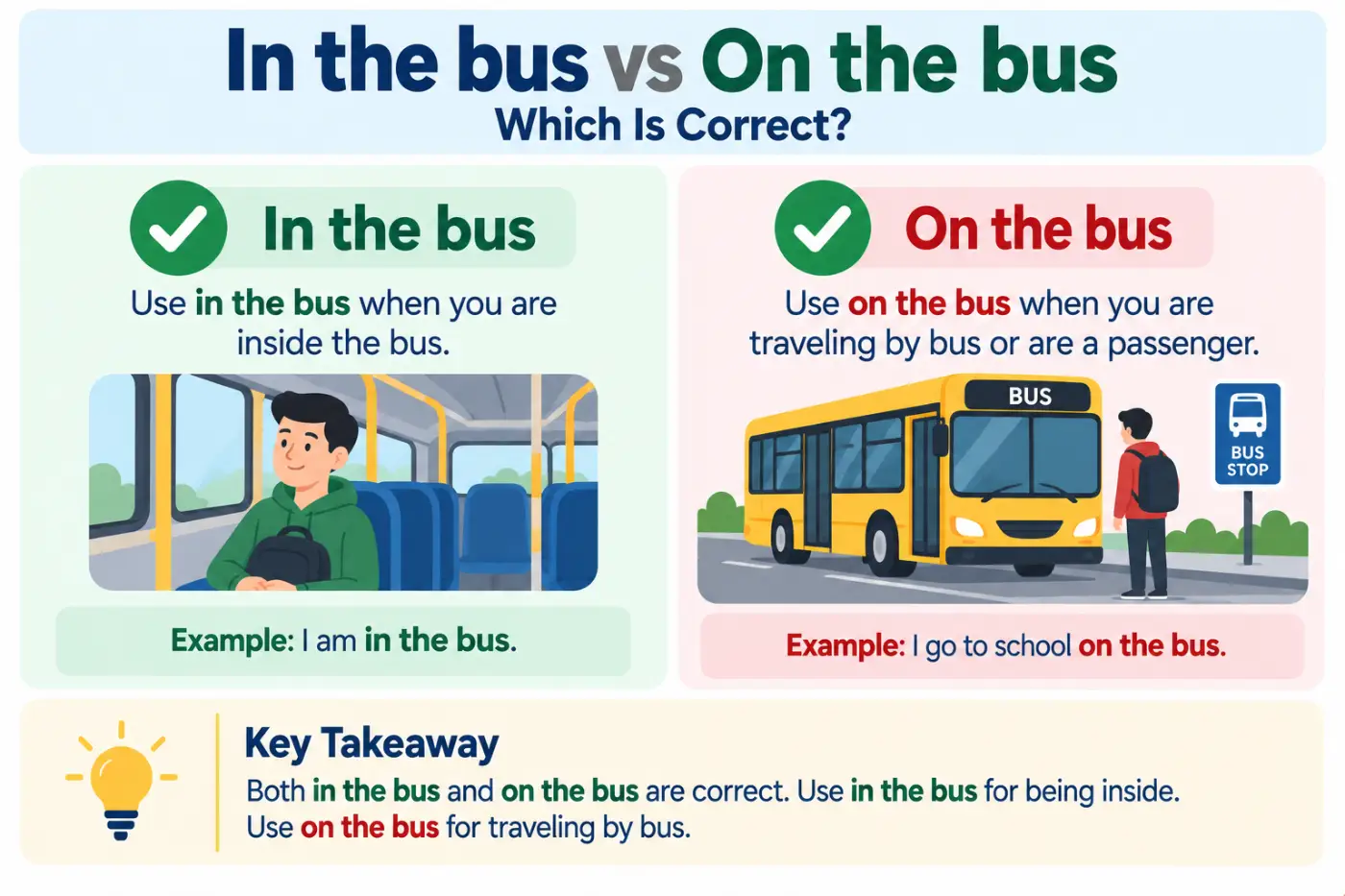
If you’ve ever stopped while writing a sentence and wondered if you should say in the bus vs on the bus, you’re not alone. The short answer is simple. On the bus is the usual and natural expression when you mean that someone is traveling by bus or riding a bus. In the bus is also grammatically possible, but it normally focuses on being physically inside the vehicle.
The confusion comes from the way English uses prepositions with transportation. We often use in for enclosed spaces such as cars and taxis, yet we commonly use on with buses, trains, planes, and ships. That pattern can feel strange at first because you are physically inside a bus. English grammar, however, follows established usage rather than physical location alone.
This guide explains the difference in plain English. You’ll learn when to use each phrase, why native speakers prefer one in everyday situations, how American and British English handle the pattern, and how context changes the meaning. You’ll also see practical examples that show exactly how these expressions work in real sentences.
For another common grammar confusion, see extent vs extant Meaning and Correct Usage.
Quick Definition
Use on the bus when you mean someone is riding or traveling by bus. Use in the bus when you specifically want to emphasize that someone or something is physically inside the bus. Both phrases can be grammatical, but they do not usually carry the same focus or sound equally natural in every situation.
Quick Answer
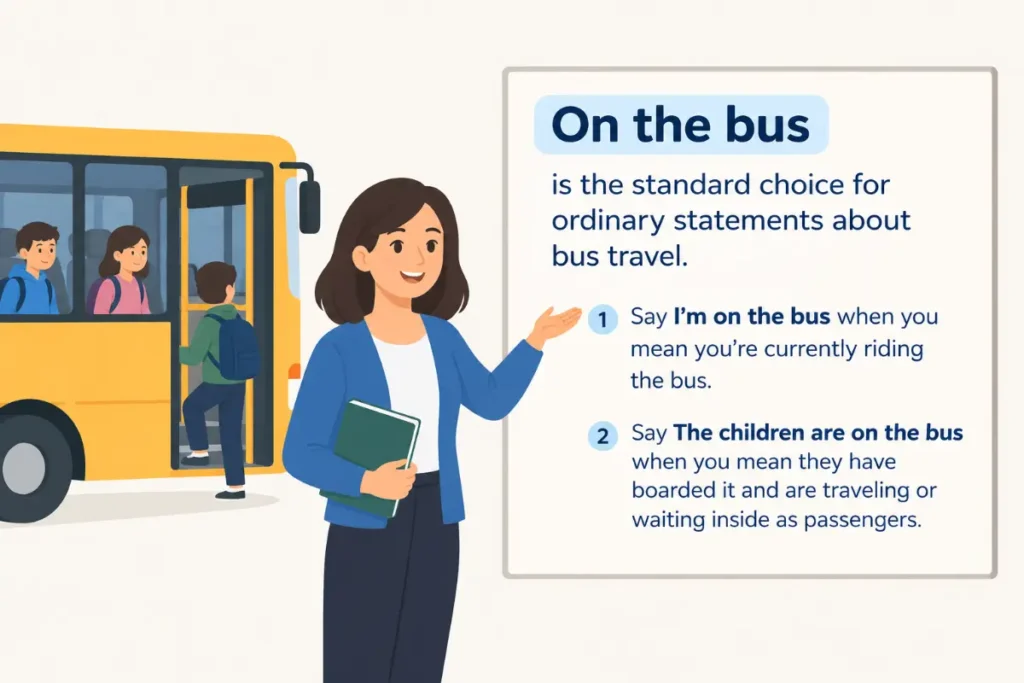
On the bus is the standard choice for ordinary statements about bus travel. For example, say I’m on the bus when you mean you’re currently riding the bus. Say The children are on the bus when you mean they have boarded it and are traveling or waiting inside as passengers.
In the bus can be correct when the physical interior matters. For example, There was a strange smell in the bus focuses on the inside environment rather than the act of traveling.
So the choice depends on meaning. If the idea is transportation or riding, use on. If the idea is location inside the vehicle, in can work.
Comparison Table
| Form | Main Meaning | Grammar Role | Typical Use | Frequency | Formality | Common Contexts | Example |
|---|---|---|---|---|---|---|---|
| On the bus | Riding or traveling by bus | Prepositional phrase | Passenger transportation | Very common | Neutral | Conversation, school, work, travel | I’m on the bus now. |
| In the bus | Inside the bus | Prepositional phrase | Physical interior or location | Less common in ordinary travel statements | Neutral | Describing the interior, objects, people, conditions | There was a bag in the bus. |
| By bus | Traveling using a bus | Prepositional phrase | Method of transportation | Very common | Neutral to formal | Travel plans, schedules, writing | We traveled by bus. |
Meaning And Usage
What On The Bus Means
On the bus usually tells the listener that someone has boarded a bus and is traveling or waiting as a passenger.
Consider this sentence.
Maria is on the bus.
The natural interpretation is that Maria is riding the bus. The sentence doesn’t simply tell us that her body is physically located inside a vehicle. It identifies her situation as a passenger on public transportation.
This is why native speakers commonly say:
I’m on the bus.
They also say:
I left my phone on the bus.
Are you still on the bus?
He fell asleep on the bus.
In each example the bus functions as a means of transportation and a shared passenger space. The expression on the bus has become an established English pattern.
The same pattern appears with several other forms of public transportation. People commonly say on the train, on the plane, on the subway, and on the ship.
That doesn’t mean the passenger is literally standing on top of the vehicle. The preposition is part of the conventional expression.
What In The Bus Means
In the bus focuses more directly on the interior of the vehicle.
For example:
There’s a strange noise in the bus.
Here the speaker is interested in something happening inside the vehicle.
Another example is:
We found a wallet in the bus.
The emphasis is on the location of the wallet. The sentence tells us where the wallet was found.
You might also say:
Several seats in the bus were damaged.
This sentence focuses on the physical interior and its condition.
In American English, however, in the bus can sound less natural than on the bus in many ordinary passenger situations. If you simply want to say that you are riding a bus, a native speaker would normally choose on the bus.
That distinction is worth remembering because it prevents a common mistake. Physical location alone doesn’t determine the preposition. English also considers the type of vehicle and the activity connected with it.
Why English Uses On For Buses
At first glance, on the bus can seem illogical. After all, passengers are normally inside the bus.
English prepositions don’t always describe physical position in the simplest possible way. They also reflect long established patterns.
With public transportation, on often identifies someone as a passenger using that transportation system.
You can be:
- On the bus.
- On the train.
- On the plane.
- On the subway.
- On the ship.
The shared idea is that you have boarded a form of transportation.
English also uses on for other shared or accessible platforms and surfaces. Think about expressions such as on a bicycle or on a motorcycle. These expressions developed through usage and are now ordinary parts of the language.
With a bus, the phrase on the bus is not a literal statement about standing on its roof. It is an established transportation expression.
That’s why trying to choose a preposition based only on physical position can lead you astray.
Why We Say In A Car
The contrast becomes clearer when you compare a bus with a car.
English normally says:
I’m in the car.
It also says:
She’s waiting in the car.
There are four people in the car.
The usual preposition for a private car is in because the car is treated as a small enclosed personal space.
Now compare that with:
I’m on the bus.
The difference reflects more than size. A bus is normally understood as public transportation where passengers board and ride as part of a shared service.
This gives English a useful pattern.
- In the car is the normal expression.
- In a taxi is also normal.
- On the bus is normal.
- On the train is normal.
- On the plane is normal.
- On the subway is normal.
These patterns are not absolute rules about every possible sentence. They are common usage patterns that help you choose the natural expression quickly.
When To Use The Bus Phrase
Use on the bus when the sentence is about riding, boarding, commuting, traveling, waiting as a passenger, or something that happened during a bus journey.
For example:
I’m on the bus right now.
The meaning is clear. The speaker is currently traveling or waiting aboard the bus.
You can also use it when talking about something that happened during the trip.
I met an old friend on the bus.
The sentence naturally suggests that the meeting happened while both people were passengers.
You can use the phrase with many verbs.
She fell asleep on the bus.
He forgot his backpack on the bus.
We talked on the bus.
They were laughing on the bus.
I read my book on the bus.
The phrase works naturally because the bus is the setting for passenger travel.
When In The Bus Makes Sense
There are situations where in the bus can communicate a specific physical meaning.
Imagine that a mechanic is inspecting a bus.
The mechanic might say:
There is water in the bus.
The focus is on the interior.
A passenger might say:
It was very hot in the bus.
This statement draws attention to the conditions inside the vehicle.
A journalist describing damage might write:
Several windows in the bus were broken.
Again, the focus is the interior rather than the transportation experience.
However, if the sentence simply says:
I’m in the bus.
Many American English speakers would expect I’m on the bus instead if the intended meaning is simply that the speaker is riding it.
That doesn’t make every use of in the bus wrong. It means that the phrase has a narrower and more physical focus in many contexts.
Key Differences Explained
- The main idea differs. On the bus normally describes riding or traveling. In the bus normally highlights an interior location.
- The frequency differs. On the bus is much more common for ordinary passenger situations. In the bus appears when the interior itself matters.
- The context differs. If you’re telling someone where you are while commuting, use on the bus. If you’re describing something located inside the vehicle, in the bus may be appropriate.
- The grammar is not simply right versus wrong. Both phrases can occur in English. The key issue is choosing the expression that matches your intended meaning.
- The pronunciation is not the source of the difference. The words in and on are pronounced normally. The challenge is selecting the appropriate preposition.
- The transportation pattern matters. English commonly uses on with buses and other public transportation.
- The regional difference is limited. American and British speakers both commonly use on the bus for bus travel.
Which Form Should You Choose
If you mean riding a bus, choose on the bus.
If you mean inside the physical space of the bus, choose in the bus when that distinction matters.
A simple test can help.
Ask yourself what you are trying to communicate.
If your answer is I am traveling by bus, use on the bus.
If your answer is something is located inside the vehicle, in the bus may be the better choice.
For example:
I’m on the bus.
This tells us about your transportation situation.
There’s a child asleep in the bus.
This can focus more strongly on the child’s physical location.
The difference is subtle, but context usually makes the intended meaning clear.
Sentence Examples
Here are natural examples using the more common transportation expression.
- I’m on the bus and I’ll be home soon.
- She called me while she was on the bus.
- We met on the bus yesterday morning.
- He usually does his homework on the bus.
- My sister left her jacket on the bus.
- They’re already on the bus, so we need to hurry.
- I saw my teacher on the bus this morning.
- The students were talking quietly on the bus.
- I listen to music on the bus every day.
- He fell asleep on the bus and missed his stop.
Now consider situations where the interior is the main focus.
- There was a lot of water in the bus after the storm.
- The air in the bus felt warm and uncomfortable.
- We found several empty bottles in the bus.
- A strange smell was coming from inside the bus.
- The seats in the bus were covered with dust.
These examples show why in the bus should not automatically be labeled incorrect. It can be meaningful when the physical interior is the focus.
For another common grammar confusion, see Channel Vs Chanel Which One Is Correct? (2026).
Common Mistakes
Saying In The Bus For Ordinary Bus Travel
A common learner sentence is:
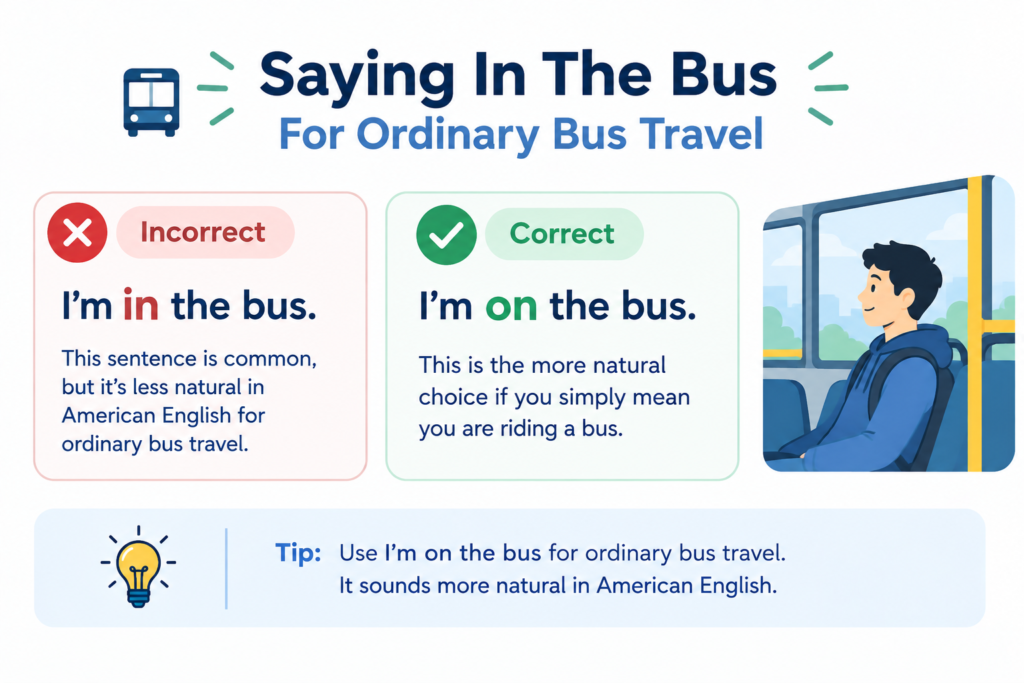
I’m in the bus.
If the speaker simply means they are riding a bus, I’m on the bus is the more natural choice in American English.
The problem comes from applying the physical rule that a person is inside the vehicle. English transportation expressions don’t always follow that simple logic.
Treating On As A Literal Surface
Some learners avoid on the bus because they imagine that on means physically above something.
That interpretation is too narrow. Prepositions have many uses that develop through established language patterns.
In this case on the bus is a conventional transportation expression.
Confusing By Bus With On The Bus
By bus and on the bus are related but they answer different questions.
We traveled by bus.
This describes the method of transportation.
We were on the bus for two hours.
This describes the passengers’ situation and location during the journey.
Both can be correct in the same conversation.
Using In And On Interchangeably
The phrases aren’t always interchangeable because they can place emphasis on different things.
There was a dog on the bus.
This sounds like an ordinary statement about a dog traveling or being present as part of the passenger setting.
There was a dog in the bus.
This gives more attention to the dog’s physical location inside the vehicle and may sound less natural in ordinary American conversation.
Copying Car Grammar
Learners often transfer in the car directly to buses.
That is understandable because both vehicles have enclosed interiors. English nevertheless uses different conventional patterns for different kinds of transportation.
Learning common phrases as complete units is more effective than trying to create every sentence from a physical rule.
Pronunciation Guide
The pronunciation difference is straightforward.
In is pronounced /ɪn/.
It sounds like the word in sit followed by an n sound.
On is pronounced /ɑːn/ in many American English pronunciation systems. In some accents the vowel quality can differ slightly.
Bus is pronounced /bʌs/ in standard American English.
The full phrases can be practiced as natural chunks.
In the bus.
On the bus.
For American English, the vowel in bus sounds similar to the vowel in cup or sun.
The main difficulty here isn’t pronunciation. It’s choosing the preposition that fits the situation.
A useful speaking exercise is to practice complete phrases rather than isolated words.
I’m on the bus.
She’s on the bus.
We’re on the bus.
There’s a bag in the bus.
This builds a stronger connection between meaning and usage.
Etymology And Language Pattern
The words in and on are both very old English prepositions. Their modern meanings developed over centuries and now cover far more than simple physical position.
In commonly expresses an enclosed location or position within boundaries. On often expresses contact with a surface or position associated with a platform. It also developed many conventional uses that don’t translate neatly into physical location.
Transportation is one of those areas.
English treats different vehicles through established patterns. A private car is commonly associated with in, while many public or larger forms of transportation use on.
This pattern is tied to how English speakers conceptualize boarding and traveling. A passenger boards a bus and becomes part of the group using that transportation service.
That is why on the bus feels natural to native speakers even though the passenger is physically inside the vehicle.
Language often works this way. A phrase can become so established that speakers stop thinking about its original physical logic. They simply recognize it as the natural expression.
Regional Usage
American English
American English strongly favors on the bus when talking about riding or traveling. You’ll hear I’m on the bus, She’s on the bus, and We met on the bus in ordinary conversation.
In the bus is possible when the speaker wants to emphasize the interior or something located inside it. Still, it isn’t the usual choice for simply describing a passenger’s travel status.
British English
British English also commonly uses on the bus for bus travel. The basic distinction is very similar to American English.
A British speaker can use in the bus when the physical interior is relevant, but ordinary statements about riding a bus generally favor on the bus.
Australian English
Australian English follows the same broad transportation pattern. On the bus is the normal expression for someone traveling by bus.
The phrase in the bus can appear when the interior is the focus, but there isn’t a major Australian spelling or grammar variation that changes the basic distinction.
Canadian English
Canadian English also commonly uses on the bus for ordinary bus travel. The phrase fits naturally into everyday Canadian speech and writing.
In the bus can still be useful for physical location. The difference is mainly about context rather than a special Canadian rule.
Grammar Rules And Part Of Speech
Neither in nor on is the main noun in these expressions. Both are prepositions. When a preposition combines with the bus, the resulting group functions as a prepositional phrase.
Consider:
I’m on the bus.
The phrase on the bus tells us where the speaker is.
Now consider:
There’s a bag in the bus.
The phrase in the bus tells us where the bag is located.
The grammar is simple, but the choice of preposition depends on meaning and conventional usage.
Using On With Travel
Use on when the sentence describes someone as a passenger or identifies an experience connected with traveling.
He is on the bus.
We talked on the bus.
She left her phone on the bus.
Using In For Physical Location
Use in when you want to focus on the inside of the vehicle.
There was smoke in the bus.
The temperature in the bus was uncomfortable.
Several seats in the bus were damaged.
Using By For Transportation Method
There is another useful structure to remember.
We went by bus.
Here by bus tells us the method of transportation. It doesn’t describe the passenger’s physical location.
Compare these three sentences.
I’m on the bus.
There’s a bag in the bus.
I came by bus.
Each one uses a different preposition because each one expresses a different relationship.
Real Life Usage Examples
Daily Conversation
I’m on the bus right now. I’ll call you when I get home.
Are you on the bus yet? We’re waiting at the next stop.
These are natural everyday sentences. The speaker is talking about bus travel rather than analyzing the vehicle’s interior.
Email And Workplace Communication
I’ll join the meeting as soon as I get off the bus.
I reviewed the document on the bus this morning.
These examples show that the expression works perfectly well in professional communication when the situation is relevant.
Academic Writing
The researchers interviewed passengers on the bus during their daily commute.
Noise levels inside the bus were recorded at several points during the journey.
Academic writing often makes the distinction more visible because researchers may discuss both passengers and physical conditions inside a vehicle.
News Writing
Several passengers were on the bus when the incident occurred.
Emergency workers found smoke inside the bus after the vehicle stopped.
The first sentence focuses on passengers. The second focuses on an interior condition.
Literature And Storytelling
He sat quietly on the bus and watched the city disappear behind him.
Inside the bus, the passengers grew silent as the storm became stronger.
Storytelling gives writers more freedom to shift between transportation and physical interior perspectives.
Related And Confused Terms
By Bus
By bus describes the method of transportation.
We traveled by bus.
It doesn’t normally describe someone’s physical location.
On The Train
The same transportation pattern applies to trains.
I’m on the train.
The phrase means the person is riding or traveling by train.
On The Plane
English normally uses on with planes when describing passengers.
She’s on the plane.
Again, the phrase describes her status as a passenger.
In The Car
A car normally takes in.
He’s in the car.
This is one of the main contrasts that causes confusion with buses.
In A Taxi
English normally says:
I’m in a taxi.
A taxi is treated more like a small enclosed vehicle rather than a shared public platform.
By Car
By car describes transportation method.
We went by car.
The same distinction exists between by bus and on the bus.
Get On The Bus
Get on the bus means board the bus.
This is a common phrasal pattern.
Get Off The Bus
Get off the bus means leave the bus.
I’ll get off the bus at the next stop.
These two expressions are useful because they reinforce the established on and off pattern associated with boarding and leaving public transportation.
Expert Editor Insight
An experienced editor would usually make a quick meaning check rather than simply marking in the bus as wrong. If the writer means riding public transportation, on the bus is the natural choice in American English. If the sentence describes something physically located inside the vehicle, in the bus can work. Grammar tools may flag some uses because automated systems rely heavily on common patterns, but context still matters. The best editing habit is to ask what the phrase is doing in the sentence before changing it.
A Simple Memory Trick
If you keep mixing up in and on, remember this practical pattern.
Private small vehicle usually uses in.
Public transportation usually uses on.
That gives you:
in the car.
in a taxi.
on the bus.
on the train.
This isn’t a perfect rule for every vehicle or every sentence, but it works well for everyday English.
You can also connect on with the idea of boarding.
You get on a bus.
Then you get off them.
That pattern makes the choice easier because the language treats these vehicles as transportation systems that passengers board.
Final Practical Rule
When you’re talking about riding or traveling by bus, use on the bus.
When you’re describing the method of transportation, use by bus.
These three patterns cover most everyday situations.
I’m on the bus.
There’s a backpack in the bus.
I traveled by bus.
Once you learn these as natural language patterns, the choice becomes much easier. You don’t need to stop and think about the physical fact that passengers are inside the vehicle. English has already established the pattern for you.
For another common grammar confusion, see seperate or separate Correct Spelling and Usage Guide.
Conclusion
In the bus or on the bus can both appear in English, but they usually serve different purposes. On the bus is the natural choice when you mean riding or traveling by bus. In the bus can work when you want to emphasize the physical interior or something located inside the vehicle.
The key difference comes from established English usage rather than simple physical location. We normally say in the car but on the bus, on the train, and on the plane. For transportation methods, we use by bus.
A simple editing tip can save you from hesitation. Ask yourself if you mean transportation or interior location. If you mean riding, choose on. If you mean something physically inside, consider in. That small distinction will make your English sound much more natural.
Frequently Asked Questions
Should I say I am in the bus or on the bus?
For ordinary American English, say I am on the bus when you mean you are riding or traveling by bus. I am in the bus can be grammatical when you want to emphasize physical location inside the vehicle, but it isn’t the usual expression for simply describing a passenger’s travel status.
Why do we say on the bus instead of in the bus?
English uses established transportation patterns that don’t always follow literal physical location. A bus is commonly treated as public transportation that passengers board, so English uses on. The same pattern appears with trains and planes. A car and taxi normally use in because they are treated as enclosed personal or small passenger spaces.
Is in the bus grammatically wrong?
No. In the bus can be grammatically correct when the context focuses on the inside of the vehicle. For example, There was smoke in the bus clearly refers to the interior. However, if you simply want to say that you are traveling as a passenger, on the bus is the more natural choice in American English.
Is on the bus correct for American English?
Yes. On the bus is the standard everyday expression for someone who is riding or traveling by bus in American English. You can use it in conversation, text messages, school writing, workplace communication, and many formal contexts. The phrase is natural and widely understood.
What is the difference between by bus and on the bus?
By bus describes how someone travels. For example, We went by bus tells us the method of transportation. On the bus describes someone’s situation or location as a passenger. For example, We talked on the bus tells us where the conversation happened. Both phrases are correct but serve different grammatical purposes.
Do British speakers say on the bus?
Yes. British English commonly uses on the bus for bus travel just as American English does. A British speaker may also use in the bus when discussing something physically located inside the vehicle. The basic distinction between transportation use and physical interior use remains similar across these major English varieties.
Should I say get in the bus or get on the bus?
For ordinary English, get on the bus is the natural expression for boarding a bus. You can say get in the car and get in a taxi, but buses normally use on. This creates a useful pair: get on the bus when boarding and get off the bus when leaving.
Is on the bus formal enough for writing?
Yes. On the bus is suitable for formal writing whenever the context calls for it. You can use it in reports, academic writing, workplace communication, and other professional contexts. It isn’t slang or an informal shortcut. It is simply the normal English prepositional phrase used for riding a bus.