
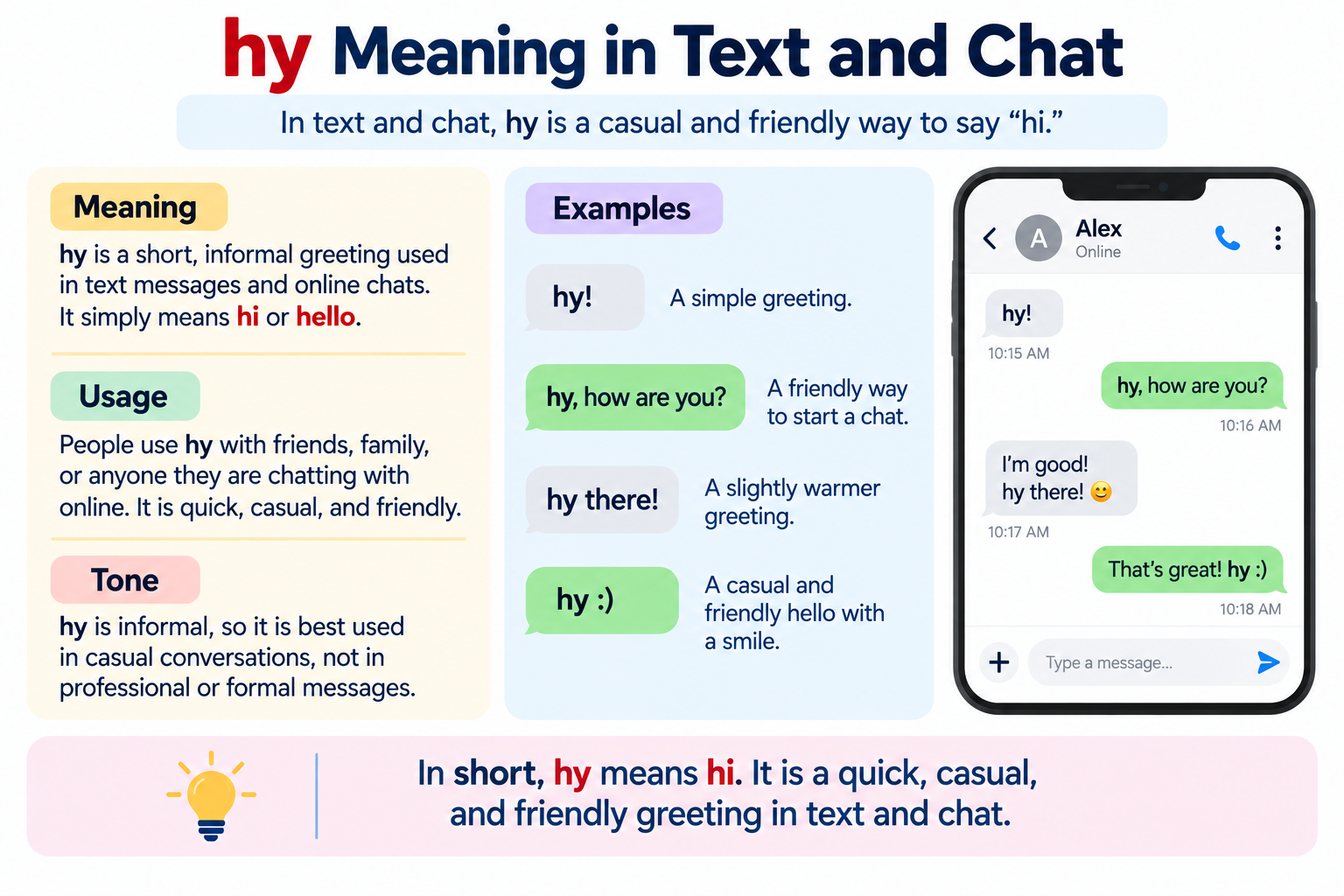
If you’ve received a text saying HY and wondered what it means you’re not alone. The search for hy meaning usually comes from a simple question: is the person saying hi or hey or are they expressing strong agreement? In casual texting HY can mean hi or hey when it starts a conversation. It can also mean hell yeah or hell yes when someone uses it as an enthusiastic response.
The confusion comes from the flexible nature of texting slang. Unlike standard English words many online abbreviations don’t have one fixed meaning. The same two letters can act as a casual greeting in one message and express an excited yes in another. The words around HY and the situation usually provide the clue you need.
This guide explains the common uses of HY in simple English. You’ll learn how to identify its intended meaning from context how people use it in texts social media and chats and how its tone can change. You’ll also see natural examples common misunderstandings related expressions and practical tips for using or interpreting this abbreviation.
A related grammar guide is Bougie or Boujee Meaning, Usage and Examples 2026.
Quick Definition
HY is an informal abbreviation used in texting and online conversations. It commonly means hi or hey when it starts a conversation. It can also mean hell yeah or hell yes when someone uses it to express strong agreement excitement or enthusiasm. The surrounding message usually tells you which meaning fits.
Quick Answer
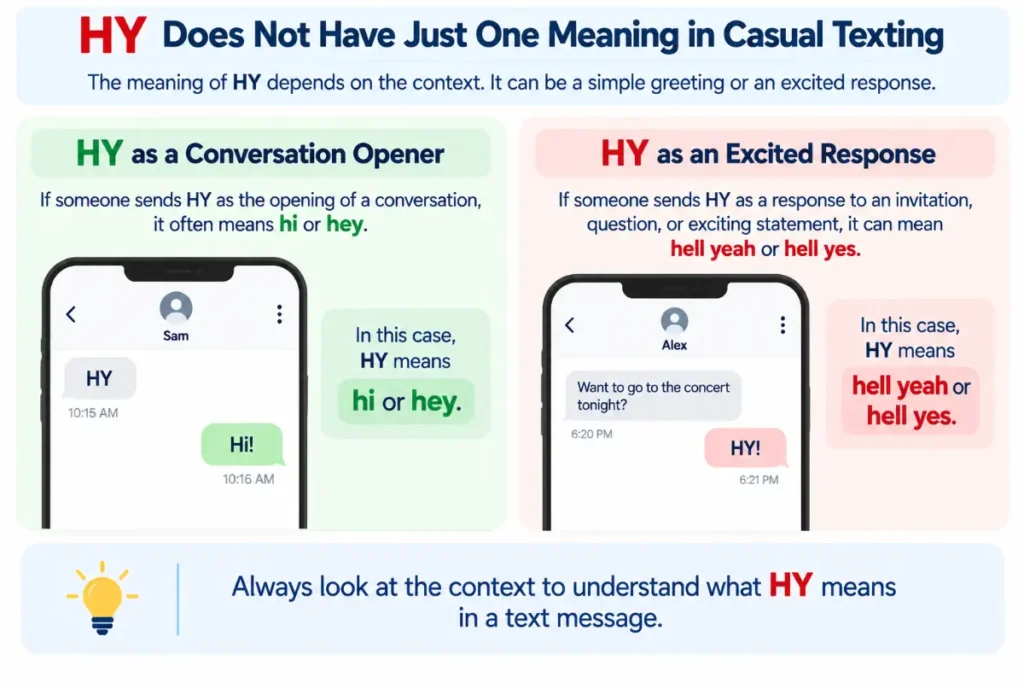
HY does not have just one meaning in casual texting. If someone sends HY as the opening of a conversation it often means hi or hey. If someone sends HY as a response to an invitation question or exciting statement it can mean hell yeah or hell yes.
For example if someone writes HY what’s up they’re probably saying hey what’s up. If a friend asks Are you coming with us and the answer is HY the intended meaning is likely an enthusiastic yes. Context is the deciding factor.
Comparison Table
| Form | Meaning | Part of Speech | Origin | Usage Frequency | Formality | Common Contexts | Example |
|---|---|---|---|---|---|---|---|
| HY as a greeting | Hi or hey | Informal abbreviation | Modern digital communication | Common in casual chats | Very informal | Texts DMs group chats social media | HY how are you |
| HY as an excited response | Hell yeah or hell yes | Informal abbreviation | Modern texting slang | Common in some casual conversations | Very informal | Friends reactions invitations gaming chats | HY I’m coming |
| HY as a context specific abbreviation | Another phrase or term | Abbreviation | Depends on the community | Less common | Depends on context | Work technical or specialized settings | Meaning depends on the subject |
Meaning And Definition
The Main Meaning In Casual Texting
The most useful way to understand HY is to look at where it appears in the conversation. When it appears at the beginning of a message it can function as a shortened greeting.
For example:
HY how are you?
HY what’s going on?
HY long time no talk.
In these examples the sender is almost certainly trying to start a casual conversation. The abbreviation keeps the message short and relaxed.
Several current explanations of texting slang identify hi or hey as common uses of HY. Some sources also identify hell yeah or hell yes as another common interpretation.
HY As An Enthusiastic Yes
The second major use appears in replies.
Imagine this conversation.
Are you coming to the party tonight?
HY.
Here HY can mean hell yeah or hell yes. It adds energy to the answer. Instead of giving a simple yes the sender is showing strong enthusiasm.
The same idea can appear in other situations.
Do you want to watch the game together?
HY.
That response sounds excited and confident.
The exact expansion can vary. Some people understand it as hell yeah while others read it as hell yes. In practical conversation the emotional message is similar. The person is strongly agreeing.
HY As A Greeting
When HY begins a conversation it usually has a much softer meaning.
For example:
HY Sarah. How have you been?
HY. What are you doing?
HY everyone.
Here the sender isn’t expressing strong excitement. They’re simply saying hello in a very informal way.
This use is especially easy to identify because greetings usually appear before a question or another conversational statement.
Less Common Interpretations
Short abbreviations can develop different meanings inside specific communities. A workplace team a gaming group a fan community or a technical field may give the same letters a specialized meaning.
That’s why you shouldn’t assume that every appearance of HY means the same thing. If the surrounding conversation is about business finance technology school or another specialized subject check the context before deciding what the abbreviation means.
Some online sources list additional interpretations. These are less useful for ordinary texting unless the conversation clearly supports them.
Key Differences Explained
- Greeting meaning. HY can be a quick way to write hi or hey. This usually appears at the beginning of a conversation.
- Excited response. HY can express hell yeah or hell yes. This usually appears as a response to a question invitation or exciting statement.
- Tone. The greeting use is casual and friendly. The excited response is stronger and more energetic.
- Grammar. HY is not a conventional English word. It functions as an abbreviation or piece of internet slang.
- Formality. HY belongs mainly in informal digital communication. It isn’t a good choice for formal business writing academic papers applications or professional correspondence.
- Pronunciation. There is no single standard pronunciation because HY is written shorthand. People normally say the full phrase represented by the abbreviation when speaking.
- Context. The words around HY provide the strongest clue. Position and conversational purpose matter more than the letters alone.
- Regional usage. The abbreviation can appear in different varieties of English because online communication crosses national borders. However individual users and communities may use it differently.
How To Tell Which Meaning Fits
The easiest method is to look at the sentence before and after HY.
If HY opens the conversation it probably works as a greeting.
If HY answers a yes or no question it may express strong agreement.
If HY follows exciting news it can signal enthusiasm.
If HY appears inside a technical discussion its meaning may depend on that field.
Consider these examples.
HY what’s up?
The abbreviation is functioning as a greeting.
Want to come over tonight? HY.
The abbreviation expresses an enthusiastic yes.
HY everyone. We need to talk about the schedule.
Again it is a greeting.
We got tickets for the concert. HY!
Here it expresses excitement.
This context test is simple but powerful. You don’t need to memorize every possible expansion.
Which Meaning Is Most Likely
There isn’t enough standardization in casual internet slang to assign one universal definition to HY. Current online usage guides disagree about which interpretation is most common. Some describe hi or hey as the main use while others emphasize hell yeah or hell yes.
That disagreement is itself useful information. It shows why context matters.
If someone sends only HY with no surrounding message you may not know exactly what they intended. If they write HY what are you doing the greeting interpretation becomes much clearer. If they answer Want to go with HY the enthusiastic response becomes more likely.
A good reader doesn’t force a single definition onto every conversation. Instead they use the surrounding words and the purpose of the message.
Sentence And Message Examples
Here are natural examples showing HY as a greeting.
- HY how are you doing?
- HY. I haven’t talked to you in ages.
- HY everyone. Are you ready?
- HY what are you up to tonight?
- HY. I just saw your message.
Now consider examples where HY expresses strong agreement.
- Do you want to go out for dinner? HY.
- Are you joining us for the game? HY.
- We’re getting tickets today. HY.
- Would you like to come with us? HY.
- Should we start now? HY.
The same abbreviation looks identical in all ten examples. Its meaning changes because its role in the conversation changes.
Common Mistakes And Misunderstandings
Assuming HY Always Means Hey
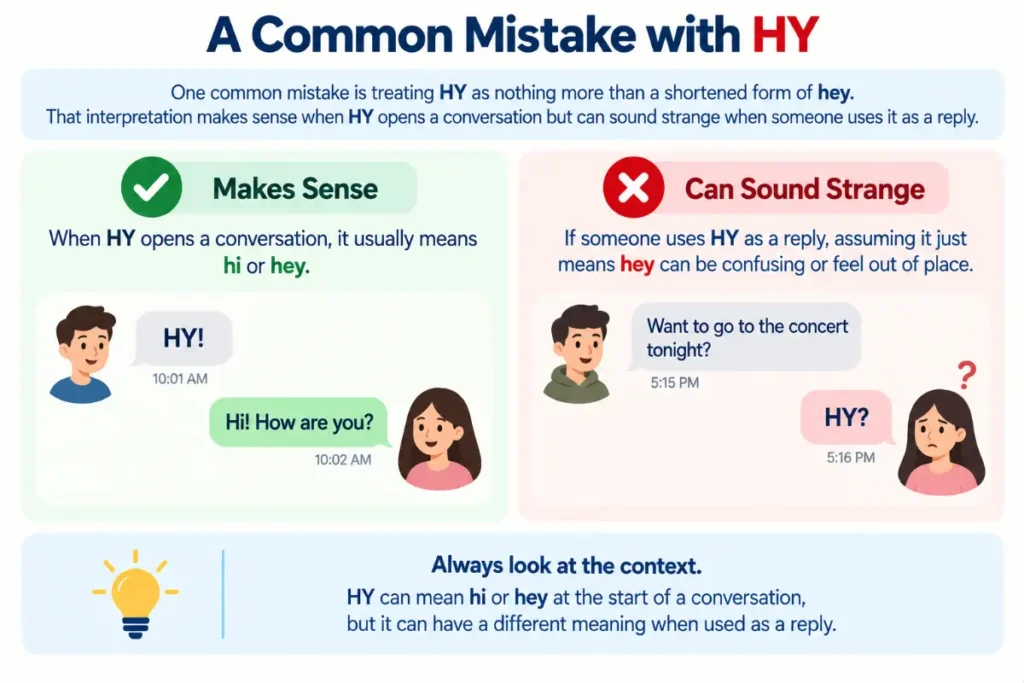
One common mistake is treating HY as nothing more than a shortened form of hey. That interpretation makes sense when HY opens a conversation but can sound strange when someone uses it as a reply.
For example:
Do you want pizza?
HY.
Reading that as hey doesn’t fit the conversation. The response is more likely an enthusiastic yes.
Assuming HY Always Means Hell Yeah
The opposite mistake happens too. Someone may see HY at the start of a conversation and interpret it as an enthusiastic response.
HY what’s up?
There is no earlier question here. The natural reading is a greeting.
Treating It As Formal English
HY is casual digital shorthand. Using it in a formal email can make the message look too relaxed.
Instead of:
HY Professor. I need help with my assignment.
Use:
Hello Professor. I need help with my assignment.
The second version is clearer and more appropriate.
Reading Tone From Two Letters Alone
A short message can be difficult to interpret because it contains very little information. An HY with an exclamation mark may feel more energetic than HY with no punctuation. An emoji can change the emotional tone too.
Still you shouldn’t guess too much from the abbreviation itself. Look at the whole conversation.
Assuming Every Online Community Uses It The Same Way
Internet slang is flexible. Different communities can assign different meanings to the same abbreviation. A gaming group may use a term differently from a workplace group or a group of close friends.
That’s why context remains the safest guide.
Pronunciation Guide
HY itself doesn’t have one fixed spoken pronunciation in ordinary English because it represents different phrases.
When HY means hi or hey you would normally say the full greeting aloud.
When it means hell yeah or hell yes you would normally say the full expression rather than pronounce the individual letters.
If someone reads the letters aloud they may say H Y using the names of the letters. However that is not the same as pronouncing the phrase represented by the abbreviation.
For practical communication the easiest approach is to think about the intended full phrase first. Then the pronunciation becomes obvious.
The pronunciation of the common greeting words is straightforward.
Hi sounds like high.
Hey rhymes closely with say and day.
The expression hell yeah has the main stress on hell and yeah.
The expression hell yes places strong emphasis on yes.
Etymology And Word Origin
HY does not have the kind of long dictionary etymology associated with an established English word. It is better understood as modern shorthand that developed within digital communication.
Texting encourages people to shorten expressions. Phones make typing quick messages easy but users still often want to communicate with as few characters as possible. Internet communities then create and spread their own abbreviations.
The exact origin of a particular abbreviation can be difficult to establish because slang usually develops through repeated informal use rather than through a single documented creator.
This also explains why different sources describe HY differently. Online shorthand doesn’t always have a central authority that fixes one meaning for every user. Current explanations consistently show that context can lead to meanings such as hi or hey and hell yeah or hell yes.
Regional Usage
American English
In the United States HY can appear in informal texting social media messages DMs gaming conversations and group chats. The meaning depends heavily on context. American users may understand it as a greeting or as an enthusiastic agreement.
It is best treated as casual slang rather than standard written English.
British English
British users can encounter the same abbreviation online. There isn’t a major British spelling difference because HY is an abbreviation rather than a conventional English word with separate national spelling rules.
The surrounding conversation still determines the intended meaning.
Australian English
Australian users may also encounter HY in online conversations. Since internet slang crosses borders quickly the abbreviation isn’t limited to one country.
As with American and British usage the safest approach is to read the full message rather than rely on the abbreviation alone.
Canadian English
Canadian users can encounter the same casual shorthand in texts and social media. There is no established Canadian spelling variant that changes the basic interpretation.
The meaning remains strongly dependent on context and the habits of the people communicating.
A related grammar guide is Busing or Bussing Grammar Rules and Usage Guide 2026.
Grammar And Part Of Speech
HY isn’t a normal part of speech in the same way that hello is a noun or verb or quickly is an adverb. It is better described as an informal abbreviation or texting expression.
Its grammatical role depends on the phrase it represents.
If it means hey it functions like a greeting.
If it means hell yeah it works as an enthusiastic response or exclamation.
That distinction matters because the abbreviation is standing in for different expressions.
Consider:
HY. How are you?
Here it replaces a greeting.
Now consider:
Are you coming?
HY!
Here it replaces a strong affirmative response.
Punctuation is also flexible in texting. People may write HY HY! or hy depending on personal style. Standard capitalization rules are often relaxed in casual messages.
That flexibility is common in digital communication. Still casual texting conventions shouldn’t automatically carry over into formal writing.
Is HY Formal Or Informal
HY is strongly informal.
It works best with friends classmates gaming partners online communities and people who already communicate casually.
It can also appear in social media comments or DMs where short messages are expected.
You should avoid it in formal settings such as job applications academic papers official letters professional reports and serious workplace communication unless the context specifically calls for informal language.
Compare these examples.
Casual
HY. Are you free tonight?
Professional
Hello. Are you available this evening?
Both messages can communicate the same basic purpose. The second one fits a professional setting much better.
Real Life Usage Examples
Daily Conversation
In everyday texting HY can open a conversation quickly.
HY. How was your day?
The sender is using it as a casual greeting.
HY. Are you home yet?
Again it functions as an informal hello before the actual question.
Email And Workplace Communication
You may occasionally see slang in casual workplace chats. A team that knows each other well may use relaxed language in an internal messaging channel.
HY team. Are we still meeting at three?
Even here a more conventional greeting may be better if the audience includes clients managers or people outside your close group.
For a professional email use hello hi or good morning instead.
Academic Writing
HY doesn’t belong in formal academic prose.
You wouldn’t normally write:
HY everyone. Today we will discuss the results.
A classroom presentation or casual student group chat may use it but an academic paper should use standard language.
News And Journalism
Professional news writing generally avoids unexplained texting slang unless the abbreviation itself is part of the story being discussed.
A journalist might mention HY while explaining online language but would not normally use it as a casual greeting inside standard news prose.
Literature And Storytelling
A modern writer can use HY in dialogue when the goal is to represent realistic texting behavior.
For example:
Her phone buzzed.
HY. You awake?
The abbreviation can help show that the character is communicating through a casual digital channel.
HY In Social Media
Social media is one of the places where short abbreviations spread quickly. People often use brief forms in comments DMs captions and group conversations because the environment favors speed and casual interaction.
If someone comments HY on a post the meaning may depend on the post itself.
Suppose someone announces:
I’m going to the concert tonight.
A reply of HY could express strong excitement or agreement.
If someone sends:
HY what’s up?
the meaning is clearly a greeting.
Different platforms don’t necessarily give HY one fixed definition. The user’s own communication style matters more than the app name.
Current online usage guides discuss HY across texting social media and chat environments while emphasizing the importance of context.
HY On Snapchat And Instagram
People often use short slang expressions on Snapchat and Instagram because conversations there tend to be quick and informal.
A message such as:
HY
may simply mean hey.
A reply such as:
You coming tonight?
HY!
can communicate an enthusiastic yes.
You shouldn’t assume that a platform automatically determines the meaning. The message around the abbreviation is more useful than the platform itself.
The same person may even use HY differently with different friends.
HY In Gaming Chats
Gaming communities often develop their own shorthand. Players may use short expressions because they are communicating while also playing.
A player might write:
HY let’s go.
That could be interpreted as an enthusiastic response depending on the conversation.
Gaming language can also be highly community specific. If HY appears in a specialized game community and the ordinary meanings don’t fit the context look at the surrounding messages before deciding what it means.
How To Reply To HY
Your response should match the meaning and tone.
If someone sends:
HY what’s up?
You can reply:
Hey. I’m good. How are you?
If someone says:
Want to come with us?
HY!
You can respond:
Awesome. See you there.
If you aren’t sure what the sender means you can simply ask.
What do you mean by HY?
There’s nothing awkward about asking. Two letter abbreviations can be ambiguous and a quick clarification is better than replying to the wrong meaning.
Related And Confused Terms
Hi
Hi is a standard informal greeting. It is clearer and more widely understood than HY.
Hey
Hey is another common greeting. It can sound friendly casual or attention grabbing depending on context.
Hello
Hello is more complete and neutral. It works in casual conversations and many professional settings.
Hell Yeah
Hell yeah is an informal expression of strong agreement excitement or enthusiasm. It is one possible expansion of HY in texting.
Hell Yes
Hell yes has a similar function. It expresses a strong affirmative response.
Yep
Yep is a casual way to say yes. It is less ambiguous than HY when you simply want to agree.
Absolutely
Absolutely expresses strong agreement but works much better in standard written communication.
Definitely
Definitely means with certainty or strong agreement. It is clearer than slang when the message needs to be understood by a wider audience.
These alternatives show why context matters. If you want a message that nobody can misunderstand use the complete phrase instead of a short abbreviation.
Why People Use Short Forms Like HY
Digital communication rewards speed. People often want to respond quickly while keeping the conversation relaxed.
Short forms can also create a sense of familiarity. Friends may understand an abbreviation instantly because they have seen each other use it many times.
There is another factor too. Online communities develop shared language. Once a short expression becomes familiar within a group people can communicate using fewer characters without losing much meaning.
The tradeoff is clarity. A short abbreviation saves time but gives the reader less information. That’s fine in a close conversation. It becomes risky when the audience is unfamiliar with the slang.
Common Context Clues
You can usually identify the intended meaning by checking five things.
- Position. If HY starts the message it is more likely to be a greeting.
- Previous message. If someone asked a question that expects yes or no HY may express strong agreement.
- Punctuation. HY! can feel more energetic than a plain HY.
- Following words. HY what’s up strongly suggests a greeting.
- Relationship. Friends often use slang more freely than coworkers or strangers.
These clues aren’t absolute rules. They are practical signals that help you interpret the message.
Expert Editor Insight
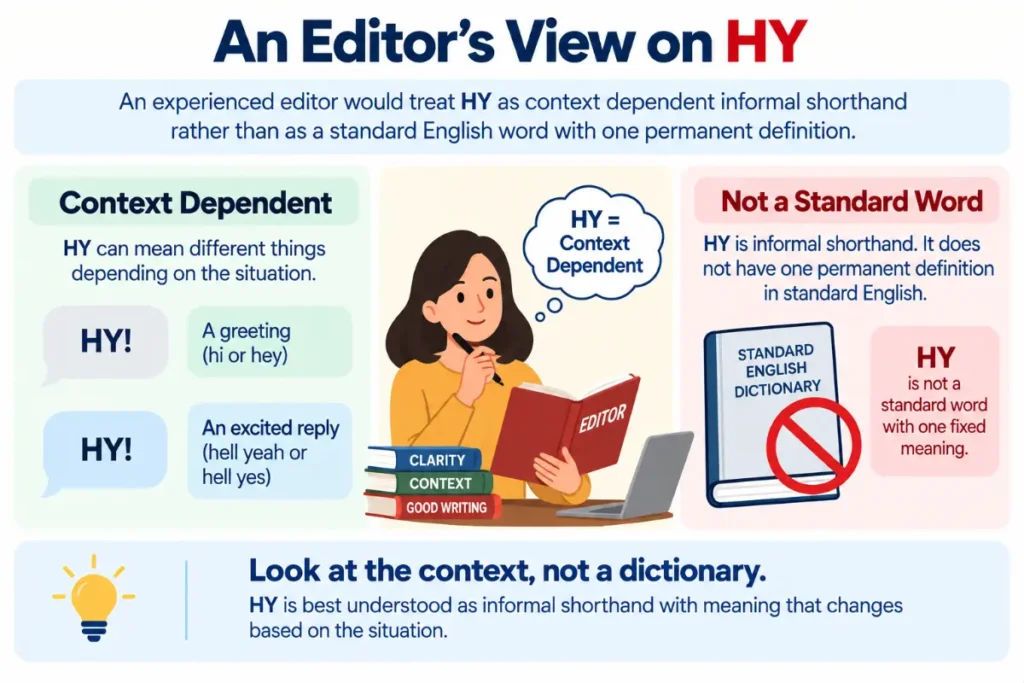
An experienced editor would treat HY as context dependent informal shorthand rather than as a standard English word with one permanent definition. The biggest mistake is reading the letters in isolation. Professional editing focuses on the complete sentence or conversation and asks what meaning actually fits. Spelling and grammar tools may not flag HY because software can recognize many abbreviations as valid text patterns. A useful editing habit is to replace the abbreviation with its likely full phrase and then check if the sentence still makes sense.
Still confused? Compare Please Disregard My Previous Email Meaning and Usage.
Conclusion
The main answer to hy meaning is that HY is informal texting shorthand with more than one common interpretation. It can mean hi or hey when used as a greeting. It can also mean hell yeah or hell yes when used as an enthusiastic response. Context determines which meaning makes sense.
The easiest way to understand the abbreviation is to look at its position and the message around it. An opening HY usually works as a greeting while a reply to an invitation or question can express strong agreement. This small distinction prevents most misunderstandings.
For casual chats HY can be quick and natural. For formal writing choose complete words such as hello yes absolutely or definitely. The best editing tip is simple: never judge a short abbreviation by the letters alone. Read the whole conversation and let the context tell you what the sender means.
FAQs
What does HY mean in a text message?
HY can mean different things in a text message. When it opens a conversation it commonly works as a short form of hi or hey. When it appears as a response to a question or invitation it can mean hell yeah or hell yes. The surrounding conversation is the best clue because texting slang does not have one universal meaning.
Is HY the same as hey?
HY can be used as a shortened casual form of hey. For example HY what’s up can naturally be read as hey what’s up. However HY can also express hell yeah or hell yes in another context. So it can represent hey but you shouldn’t assume that interpretation every time you see the abbreviation.
Can HY mean hell yeah?
Yes. HY can mean hell yeah or hell yes when someone uses it as an enthusiastic response. For example if a friend asks Are you coming with us and you reply HY the message can communicate a strong yes. Several current texting references identify this as one of the common informal interpretations.
Is HY a formal English word?
No. HY is best treated as informal digital shorthand rather than standard formal English vocabulary. It can work in texts DMs group chats gaming conversations and casual social media exchanges. For professional emails academic papers applications and official communication use a complete greeting or response instead. Standard words such as hi hello yes or absolutely are clearer.
How do you know which meaning of HY someone intends?
Look at the surrounding conversation. If HY starts a message it probably means hi or hey. If it answers a question it may mean hell yeah or hell yes. Also consider the sender’s usual writing style and the topic of the conversation. If the meaning remains unclear simply ask the sender what they meant.
Is HY rude?
HY isn’t automatically rude. In a casual conversation it can sound friendly relaxed or enthusiastic depending on the context. However some people may find unexplained abbreviations too informal or unclear. The setting matters. Using HY with a close friend is very different from using it in a formal email to a professor manager client or customer.
Can I use HY in a professional email?
You generally shouldn’t use HY in a professional email. The abbreviation is informal and can make the message sound overly casual. A clearer choice is hi hello good morning or another appropriate greeting. If your workplace has an extremely relaxed internal chat culture HY might appear there but that doesn’t make it suitable for formal correspondence.
Why does HY have different meanings?
HY has different meanings because internet slang develops through informal use rather than through one fixed rulebook. Different communities can shorten different phrases in the same way. Context then fills in the missing information. That is why HY can work as a greeting in one message and as an enthusiastic yes in another. The conversation around it provides the real clue.