
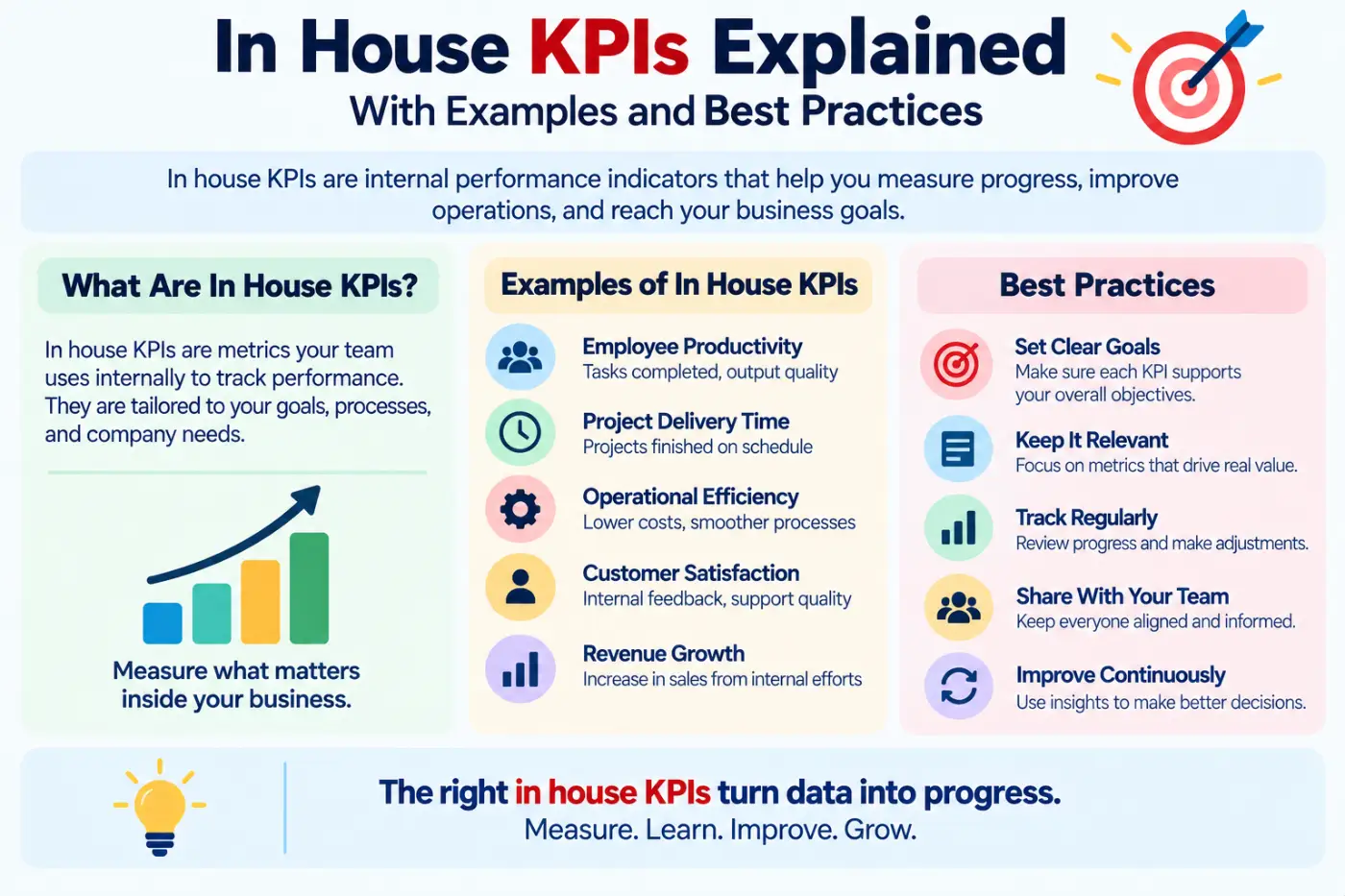
In house KPIs are internal performance measures that help a company understand how well its people, teams, systems, and processes are working. They give leaders a clear way to track progress without relying only on revenue or other high level business results. In simple terms, these metrics help you see what is happening inside the business.
The confusion often starts because companies use the word KPI for almost every important number. Revenue, customer growth, employee retention, response time, project completion, and operating costs can all become KPIs. However, an internal metric only becomes useful when it connects to a specific business goal and gives someone enough information to act.
A good KPI should answer a practical question. Are we improving? Where are we losing time or money? Is a team meeting its target? Is a process working as expected? This guide explains how internal performance metrics work, gives examples across major departments, and shows you how to choose measures that people can actually use.
Learn the difference in How To Spell Koozie in 2026.
Quick Definition
In house KPIs are measurable indicators used to track the performance of internal teams, employees, processes, and business operations. They help organizations measure progress toward specific goals and identify areas that need attention. Unlike simple activity numbers, a useful KPI connects measurement with a meaningful business outcome.
Quick Answer
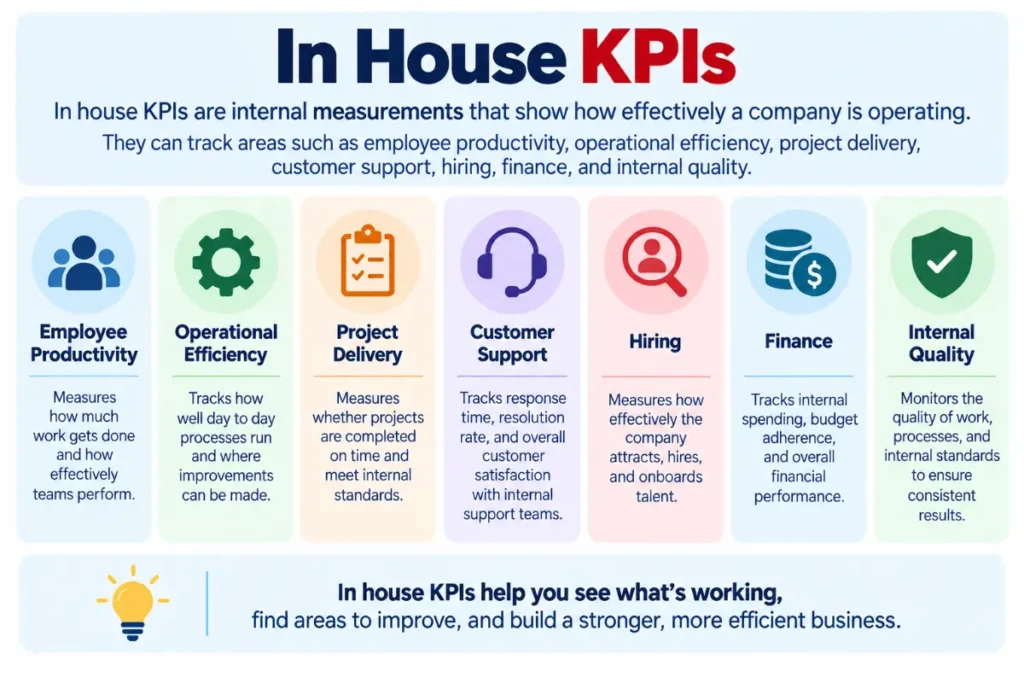
In house KPIs are internal measurements that show how effectively a company is operating. They can track areas such as employee productivity, operational efficiency, project delivery, customer support, hiring, finance, and internal quality.
For example, a customer support team might track first response time, resolution time, and customer satisfaction. A finance team might track invoice processing time and budget variance.
The key is relevance. A company shouldn’t track a number simply because it’s easy to measure. The metric should help someone understand performance and make a better decision.
What Internal KPIs Actually Measure
Internal KPIs focus on what happens inside an organization. They can measure people, workflows, resources, costs, quality, speed, and progress.
Consider a company that has strong sales but regularly misses delivery deadlines. Revenue alone won’t show the problem. Internal measures such as order processing time, on time delivery rate, production delays, and inventory accuracy can reveal what is happening behind the scenes.
This is why internal performance measurement matters. External results tell you what the business achieved. Internal measures can help explain how the business achieved it and where the process needs improvement.
A useful internal metric normally has five basic features.
- A clear purpose. The metric exists for a specific reason.
- A measurable value. The company can collect the data consistently.
- A defined target. People know what acceptable performance looks like.
- An owner. Someone is responsible for reviewing and acting on the result.
- A decision attached to it. The number should lead to a useful question or action.
Without these elements a dashboard can become a wall of numbers that nobody really uses.
Why Companies Use Internal Performance Metrics
A business can have talented people and strong products while still suffering from slow processes. Internal measurement helps leaders spot those problems before they become expensive.
For example an organization may notice that its sales team spends too much time preparing reports. The problem isn’t necessarily sales ability. The reporting process itself may be inefficient. An internal measure such as average reporting time could expose the issue.
These metrics can also create accountability. When a team knows its target and understands how performance is measured it becomes easier to discuss results objectively.
However measurement can create problems if leaders track too much. Ten useful metrics are usually more valuable than a dashboard containing fifty numbers that nobody reviews carefully.
The goal isn’t to measure everything. The goal is to measure the things that matter.
Types of Internal KPIs
Different departments need different measures because they perform different jobs. A finance team doesn’t need the same dashboard as a customer support team.
Employee Performance Metrics
Employee performance measures can help managers understand productivity, quality, attendance, goal completion, and development.
Useful examples include task completion rate, goal achievement rate, training completion, quality scores, and employee retention.
These measures need careful handling. A high number of completed tasks doesn’t always mean someone performed well. A person may complete many simple tasks while another person handles fewer but far more complex assignments.
Good performance measurement therefore combines quantity with quality and context.
Sales Team Metrics
Internal sales measures can show how efficiently a sales team handles opportunities.
Examples include lead response time, sales activity completion, opportunity progression, proposal turnaround time, and pipeline update accuracy.
These measures are different from final sales revenue. They focus on the internal activities that support the sales process.
For example if sales representatives receive new leads but take two days to respond the company may have a process problem. A response time metric can expose that delay.
Marketing Team Metrics
Marketing teams can use internal measures to track campaign execution, content production, project delivery, lead handling, and workflow efficiency.
Useful examples include campaign completion rate, content production time, approval time, email production accuracy, and lead handoff time.
Marketing shouldn’t judge every activity by volume. Ten rushed campaigns aren’t automatically better than three well executed campaigns. The metric should match the purpose of the work.
Finance Metrics
Finance departments often manage accuracy, speed, compliance, budgeting, and cash related processes.
Useful internal measures include invoice processing time, payment processing accuracy, budget variance, reconciliation completion rate, and expense report processing time.
For example a company might discover that invoice approvals regularly take several days. The problem could involve unclear approval rules rather than poor employee performance.
Operations Metrics
Operations teams often benefit from measures tied to efficiency and quality.
Examples include cycle time, order accuracy, production efficiency, inventory accuracy, equipment downtime, and on time completion.
Operations metrics can reveal bottlenecks that aren’t visible in top line financial results.
Human Resources Metrics
HR teams can measure the efficiency and quality of internal people processes.
Examples include time to fill a role, onboarding completion rate, training completion, employee retention, internal promotion rate, and HR request resolution time.
These measures can help HR understand how smoothly employees move through important company processes.
Customer Support Metrics
Customer support teams can use internal measures to monitor service speed and quality.
Common examples include first response time, average resolution time, ticket backlog, escalation rate, and quality assurance scores.
Customer satisfaction may also be included because internal service performance should connect with the customer experience.
How to Choose the Right Metrics
Choosing useful metrics starts with the business objective rather than the dashboard.
Suppose your company wants to reduce customer complaints. A vague goal such as improve support doesn’t give a team much direction. A clearer goal might be reduce average resolution time while maintaining service quality.
Now the team can identify measurements that connect to that objective.
A practical selection process looks like this.
- Define the business goal.
- Identify the process or team that influences that goal.
- Determine what can be measured reliably.
- Select the few measures that best represent progress.
- Set a realistic target.
- Assign ownership.
- Decide how often the metric should be reviewed.
- Define what action should happen if performance falls below the target.
This approach keeps measurement connected to work.
Leading and Lagging Indicators
One of the most useful distinctions in performance management is the difference between leading and lagging indicators.
A lagging indicator shows an outcome that has already happened. Revenue is a common example. So is employee turnover or the number of customer complaints received during a month.
A leading indicator provides an earlier signal about future performance. For example sales follow up time can influence future conversion. Training completion can influence employee readiness. Production downtime can affect future output.
Strong management systems often use both.
If you only watch final outcomes you may discover problems too late. Leading measures give you a chance to respond before the final result suffers.
KPI Versus Metric
The words metric and KPI often get used as if they mean exactly the same thing. They aren’t always the same.
A metric is any measurable value. A company might track the number of emails sent each day. That’s a metric.
A KPI is a metric that has been selected because it directly reflects progress toward an important objective.
For example a support team might track total tickets handled. It might also track resolution time because fast resolution is a defined service goal.
The second measure has a stronger connection to a business objective. That connection gives it KPI status.
The distinction matters because businesses often collect far more data than they need.
KPI Versus OKR
KPIs and OKRs serve related but different purposes.
A KPI normally measures ongoing performance. It can show how a process or function is performing over time.
An OKR framework usually combines an objective with measurable key results. The objective describes what the organization wants to achieve while the key results show progress toward that objective.
For example an operations team might have an objective to improve order fulfillment. Its key results could include reducing average processing time and increasing on time completion.
A KPI can support that work by continuously tracking the underlying process.
You don’t have to choose one system for everything. Many organizations use ongoing performance metrics alongside goal setting frameworks.
Comparison of Common Internal Measures
| Measurement Type | Main Purpose | Example | Best Used For | Common Risk |
|---|---|---|---|---|
| Productivity KPI | Measures work output | Tasks completed | Team operations | Ignoring quality |
| Quality KPI | Measures accuracy or standards | Error rate | Service and production | Focusing only on errors |
| Efficiency KPI | Measures resource use | Processing time | Operations | Encouraging rushed work |
| Cost KPI | Tracks spending | Cost per transaction | Finance and operations | Cutting useful resources |
| Employee KPI | Tracks workforce performance | Goal completion | People management | Oversimplifying performance |
| Process KPI | Tracks workflow health | Cycle time | Operations | Measuring the wrong stage |
| Service KPI | Measures support performance | Resolution time | Customer support | Ignoring customer experience |
| Project KPI | Tracks delivery | Milestones completed | Project management | Rewarding speed over outcomes |
Learn the difference in How to Spell Until Correctly and Use It 2026.
Setting Useful KPI Targets
A number without a target doesn’t tell you much.
Imagine that a team resolves support tickets in an average of eight hours. Is that good? You can’t answer without context.
Perhaps the company target is four hours. Perhaps the target is twelve hours. And Perhaps the ticket mix changed dramatically this month.
A target gives the measurement meaning.
Good targets should reflect business needs, available resources, historical performance, customer expectations, and realistic improvement opportunities.
Avoid choosing targets simply because they sound impressive.
A target that nobody can reach will eventually become background noise. People may stop taking it seriously.
Targets should also have a review period. A daily operational measure may need daily attention. A workforce retention measure may make more sense when reviewed monthly or quarterly.
How to Build a KPI Dashboard
A useful dashboard should make important information easy to understand.
Start with the most important measures. Put the metrics that require attention where people can see them quickly.
Next provide context. Show the current result alongside the target and previous period when useful.
For example:
Current result: 4.2 hours.
Target: 3 hours.
Previous period: 5.1 hours.
That small amount of context tells a much better story than 4.2 alone.
You can also use status indicators to highlight areas that need attention. Keep the design simple. A dashboard should help someone make a decision in seconds rather than forcing them to study a spreadsheet for twenty minutes.
Common Mistakes With Internal KPIs
Tracking Too Many Numbers
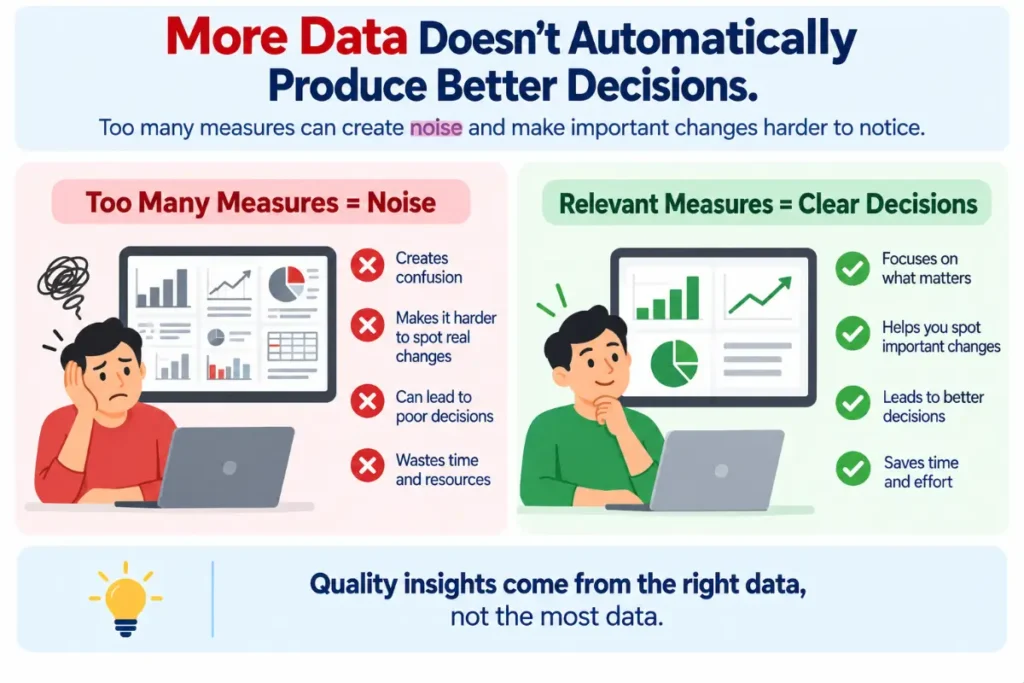
More data doesn’t automatically produce better decisions. Too many measures can create noise and make important changes harder to notice. Choose a focused group of measures for each team. Every number should earn its place.
Measuring Activity Instead of Results
A team may send hundreds of emails or complete hundreds of tasks without achieving its real objective.
Activity can matter but it shouldn’t automatically represent success.
Using Vanity Metrics
A vanity metric looks impressive but doesn’t help people make useful decisions.
For example a growing number of social media followers may sound positive. But if those followers don’t connect with the business goal the number may have limited value.
Changing Targets Too Often
Constantly moving the goal can make performance impossible to interpret.
Give teams enough time to understand a metric and improve the underlying process.
Ignoring Data Quality
A perfect dashboard built from unreliable data is still unreliable.
Check where the data comes from. Confirm that people calculate the metric consistently. Make sure everyone understands what the number includes and excludes.
Using One Metric to Judge People
This can create unhealthy behavior.
If employees know that speed is the only thing that matters they may rush work. If volume is the only target they may sacrifice quality.
A balanced measurement system reduces this risk.
How to Use KPIs Without Micromanaging
Good measurement should support people rather than turn every workday into a scorekeeping exercise.
Managers should use metrics to ask better questions.
If response time suddenly increases ask what changed. Maybe the team received an unusual volume of requests. Maybe a system stopped working.
The number identifies the signal. The conversation helps uncover the cause.
This is where management judgment matters. A KPI can tell you that something changed. It can’t always tell you why.
Avoid treating every variation as a failure. Business conditions change. Seasonal demand changes. Customer behavior changes. Staffing changes. Technology changes.
Look at the trend and the context before taking action.
Real Life Usage Examples
Daily Conversation
A manager might say that the team needs to improve its average response time before the next review.
A department leader might explain that the current numbers show a bottleneck in the approval process.
In casual workplace conversations people may not even use the term KPI. They may simply talk about response time completion rate quality or productivity.
Workplace Email
A manager could write:
Our internal performance measures show that invoice approvals are taking longer than expected. Please review the approval workflow and identify the main source of delay.
Another message might say:
The support team improved its resolution time this month while maintaining its quality target. Let’s review the process and identify the changes that produced the improvement.
Academic Writing
In business research an author might examine internal performance indicators to evaluate operational efficiency.
A study of workforce management might use employee retention training completion and hiring efficiency as measures of organizational performance.
News and Business Reporting
Business reports often discuss operational efficiency cost control workforce performance and productivity. Internal measures can provide context behind financial results.
For example a company may report stronger revenue while also dealing with longer fulfillment times. Looking at both external outcomes and internal measures provides a fuller picture.
Literature and Storytelling
Internal business measurement rarely appears as a major literary theme. Still workplace stories can naturally mention deadlines productivity targets customer complaints and performance reviews.
A fictional manager might notice that a department keeps missing deadlines and begin investigating the process behind those delays.
Related Terms You Should Know
Several terms appear alongside internal performance measurement. Understanding them makes business discussions much easier.
- Performance indicator. A measurable sign that helps show how a process or team is performing.
- Performance target. A specific result that a person or team aims to reach.
- Business objective. A broader result that an organization wants to achieve.
- Operational metric. A measurement focused on daily business processes.
- Productivity. The amount of useful output produced from available resources.
- Efficiency. How effectively a process uses time money people or other resources.
- Benchmark. A reference point used to compare performance.
- Performance dashboard. A visual system that brings important measurements together in one place.
These concepts work together. An objective gives direction. A KPI provides measurement. A target defines the desired result. A dashboard makes the information easier to monitor.
How Different Teams Can Build Their Own Measurement System
Each department should start with its own responsibilities.
A finance team shouldn’t copy the sales team’s dashboard. An HR team shouldn’t measure success using the same indicators as operations.
Instead ask three questions.
What does this team control?
What early signal shows that the process is working?
For example a hiring team controls parts of the recruitment process. It may track time to fill and candidate pipeline movement. An operations team controls workflow and production. It may track cycle time and error rates.
The strongest systems connect team level measures to broader company goals.
That creates a chain from daily work to business results.
How Often Should You Review Performance
The right review schedule depends on the speed of the process.
Some operational measures may need daily review. Others make more sense weekly. Workforce retention and strategic financial measures often need longer periods before meaningful patterns appear.
Avoid reviewing every metric at the same frequency.
A daily meeting about a metric that barely changes can waste time. A monthly review of a rapidly changing operational problem can leave the team reacting too late.
Match the review cycle to the pace of the business activity.
What Makes a KPI Actionable
An actionable KPI does more than describe the past. It helps someone decide what to do next.
Suppose a company sees that average order processing time increased from two hours to five hours.
That result creates a useful investigation.
Did order volume increase?
Did employees receive new instructions?
The metric doesn’t answer these questions by itself. It points the team toward them.
That is the real value of measurement. It turns a vague feeling that something is wrong into a specific problem that people can investigate.
Expert Editor Insight
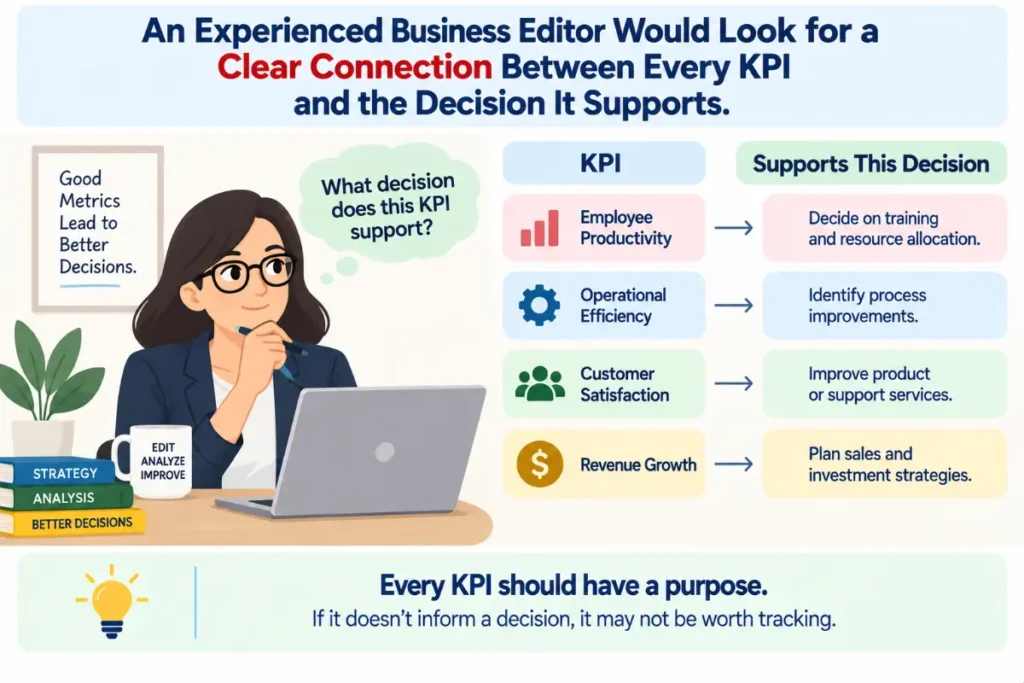
An experienced business editor would look for a clear connection between every KPI and the decision it supports. If a metric appears on a dashboard but nobody can explain what action should follow a change in the number then its value deserves another look. I also recommend defining each measure in plain language so two teams don’t calculate the same metric differently. Clear definitions prevent arguments later and make reports much easier to trust.
For another common grammar confusion, see jersies or jerseys Correct Spelling And Usage.
Conclusion
In house KPIs give companies a practical way to understand what is happening inside their teams and processes. They can reveal problems with productivity quality costs efficiency service and project delivery before those issues become much harder to fix. The strongest measures connect directly to a clear business objective.
The real value doesn’t come from collecting more numbers. It comes from choosing useful measurements and giving them context. Every important metric should have a clear definition a target an owner and a reason for being tracked. That approach keeps performance management focused and useful.
A simple editing tip can make your KPI system stronger. For every metric ask what decision this number will help us make. If you can’t answer that clearly the measure may not deserve a place on the dashboard. Good measurement should shine a light on the work rather than create more noise.
FAQs
What are in house KPIs?
In house KPIs are internal performance measures used to track how well a company’s teams processes and resources are performing. They can cover productivity quality costs efficiency employee performance customer support and project delivery. The best measures connect directly to business goals and give managers useful information for making decisions.
Why are internal KPIs important?
Internal KPIs help companies see what is happening behind their financial results. They can reveal slow processes quality problems rising costs staffing issues or workflow bottlenecks. This information gives managers a chance to address problems earlier. They also create clear performance expectations when teams understand what they need to achieve and how progress will be measured.
What are examples of internal KPIs?
Examples include employee retention rate task completion rate invoice processing time customer support response time error rate project completion rate budget variance and order accuracy. The right metric depends on the team’s responsibilities. A useful measure should connect to a specific goal rather than simply provide another number for a dashboard.
How many KPIs should a company track?
There isn’t one correct number for every company. A practical approach is to keep the set focused and manageable. Each department should track the measures that genuinely influence its goals. If a team has dozens of indicators but rarely reviews most of them the dashboard may contain too much noise. Fewer meaningful measures often create clearer decisions.
What is the difference between a KPI and a metric?
A metric is any measurable value. A KPI is a metric selected because it directly reflects progress toward an important objective. For example a company can measure the number of customer requests received. If reducing response time is a major service goal then average response time may become a KPI because it directly connects with that objective.
Should KPIs measure employees individually?
They can but companies should use care. Individual performance can involve many factors that one number cannot capture. A balanced system may combine output quality timeliness goal completion and relevant context. Managers should use metrics as evidence for a broader performance conversation rather than treating one measurement as a complete judgment of an employee.
What is a good KPI target?
A good target is specific measurable relevant and realistic. It should reflect the business goal and give the responsible team a clear standard to work toward. Historical results can provide useful context. Customer expectations and available resources also matter. Most importantly the target should encourage useful behavior rather than push employees to improve one number at the expense of quality.
How often should KPIs be reviewed?
Review frequency should match the speed of the process. Fast moving operational measures may need daily or weekly attention. Slower measures such as employee retention may need monthly or quarterly review. The goal is to review a metric often enough to respond to meaningful changes without wasting time on normal fluctuations.