
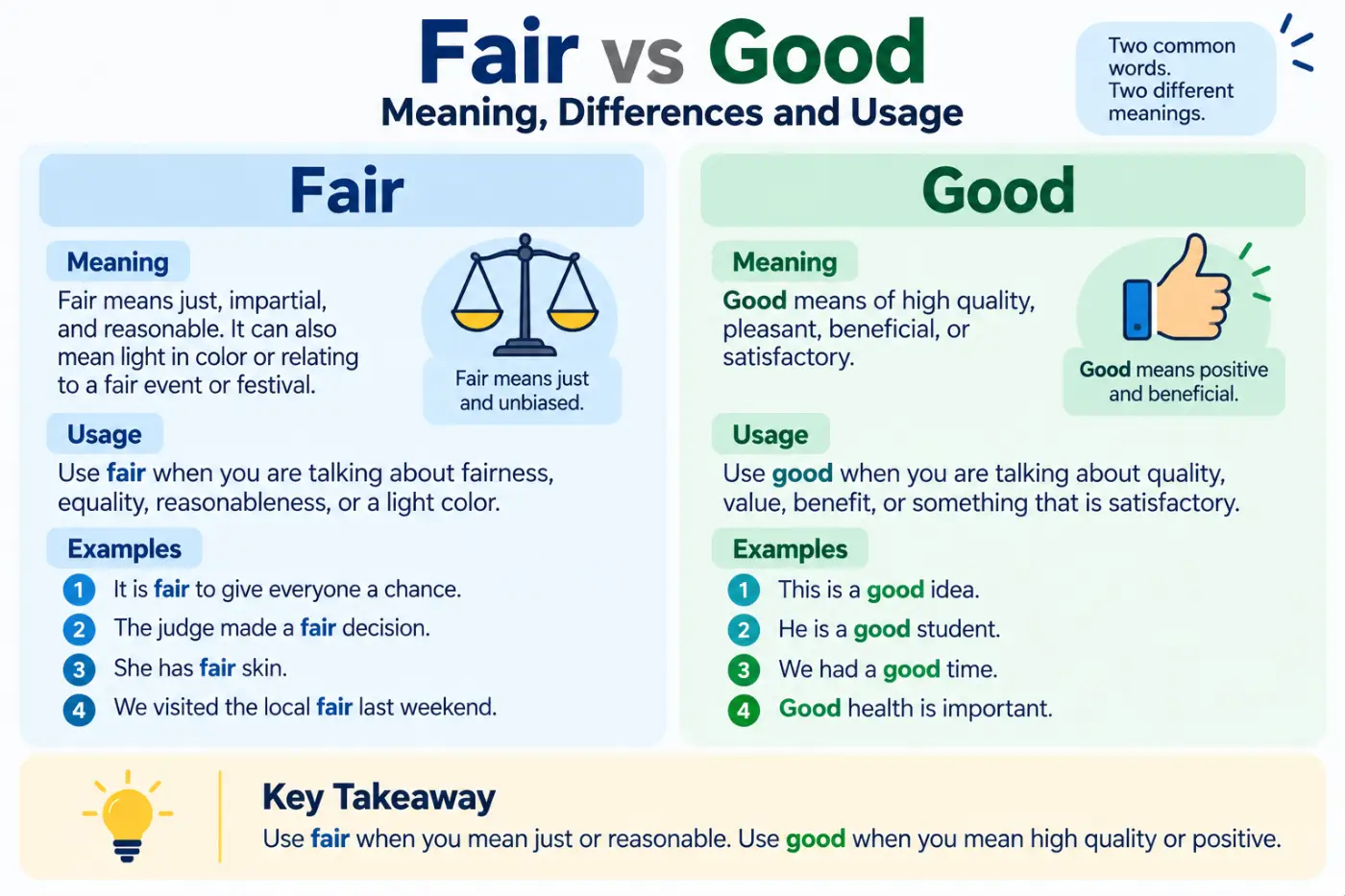
The difference between fair vs good comes down to what you want to describe. Fair often means reasonable, impartial, or acceptable, while good usually means positive, useful, enjoyable, or of satisfactory quality. The words can overlap in some situations, but they don’t mean the same thing.
For example, a teacher can give every student a fair chance without giving every student a good grade. A price can be fair because it matches the value of a product, while a good price might be lower than expected. In both cases, the words express different judgments.
This distinction matters in everyday conversations, school assignments, workplace reviews, customer feedback, and formal writing. Choosing the right word helps you explain your opinion without creating confusion. It also makes your writing more precise because you can separate what is acceptable from what is genuinely positive.
The easiest way to remember the difference is to think about fairness as a question of justice or reasonableness and goodness as a question of quality or value. Once you understand that basic idea, you’ll find it easier to use both words naturally.
Many readers also check Imply vs Infer The Difference Explained.
Quick Answer
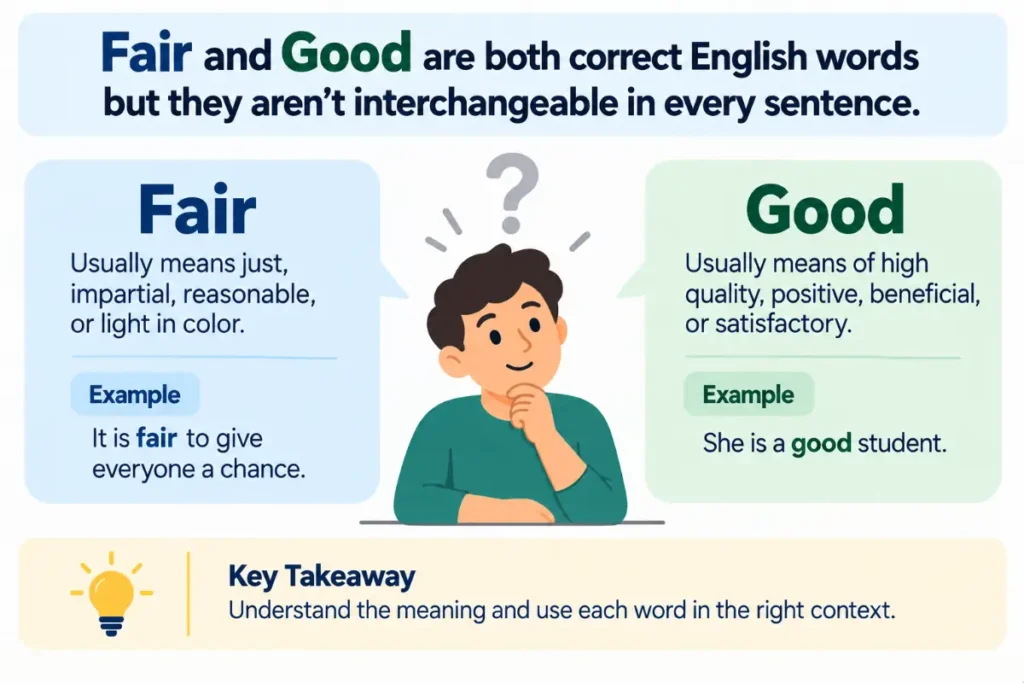
Fair means just, impartial, reasonable, or moderately acceptable. Good means positive, beneficial, suitable, or of satisfactory quality. A fair decision treats people reasonably, while a good decision produces a desirable result. The correct choice depends on the meaning you want to express.
Comparison Table
| Feature | Fair | Good |
|---|---|---|
| Main meaning | Just, impartial, reasonable, or acceptable | Positive, useful, satisfactory, or desirable |
| Part of speech | Adjective, noun, adverb in some expressions, and verb | Adjective, noun, and adverb in informal expressions |
| Typical context | Rules, treatment, prices, chances, judgments | Quality, performance, behavior, health, results |
| Common tone | Neutral or moderately positive | Generally positive |
| Formality | Standard in formal and informal English | Standard in formal and informal English |
| Opposite | Unfair or unjust | Bad or poor |
| Example | The teacher made a fair decision. | The teacher gave a good explanation. |
What Does Fair Mean?
Fair is an adjective that describes something just, reasonable, impartial, or acceptable. It often focuses on how people are treated, how decisions are made, or how closely something matches a reasonable standard.
A fair decision doesn’t necessarily make everyone happy. Instead, it follows reasonable principles and avoids favoritism. For example, a manager who assigns work according to each employee’s role and workload may be acting fairly, even if some employees receive more tasks than others.
The word also describes something that is acceptable but not outstanding. If you say a restaurant serves fair food, you may mean the food is reasonably satisfactory rather than excellent. However, this use is less common in everyday American English than phrases such as fairly good or fair enough.
Common Meanings of Fair
- Just or impartial. A fair judge considers the evidence rather than personal feelings.
- Reasonable or acceptable. A fair price reflects a reasonable amount for a product or service.
- Moderate or satisfactory. A student might receive a fair evaluation that indicates an acceptable but limited performance.
- Light in color. Fair can describe light skin, hair, or complexion, although the context determines the exact meaning.
- Clear or favorable. Fair weather generally means reasonably clear weather without significant rain or storms.
Fair can also function as a noun. A county fair is an event with rides, food, games, and exhibits. A job fair brings employers and job seekers together. In these expressions, the word names an event rather than describing quality or justice.
What Does Good Mean?
Good is an adjective that describes something positive, useful, suitable, enjoyable, or of satisfactory quality. It can refer to a person’s character, a product’s performance, a service, an idea, or the result of an action.
For example, a good student may work hard and participate in class. A good meal tastes enjoyable, while a good plan helps someone reach a goal. The meaning changes with the noun, but the general idea remains positive value or quality.
Good is broader than fair because it can describe many kinds of favorable qualities. However, something can be good without being fair. A company might offer a good salary to one employee while treating another employee unfairly.
Common Meanings of Good
- High or satisfactory quality. A good phone works well and meets the owner’s needs.
- Moral character. A good person tries to act honestly and treat others with care.
- Useful or beneficial. Regular exercise can be good for your health.
- Skill or ability. Someone can be good at mathematics, music, or public speaking.
- Positive results. A good decision can save time, reduce costs, or solve a problem.
Good also appears as a noun. In the sentence The charity works for the common good, it refers to the well being of the community. In the phrase goods and services, it refers to products that people buy or use.
Although good is usually an adjective in ordinary descriptions, it can also appear in informal phrases such as doing good. The grammar and meaning depend on the sentence.
The Key Differences Explained
The main difference is the standard you use to judge something. Fairness focuses on justice, balance, and reasonableness. Goodness focuses on positive qualities, usefulness, or satisfactory results.
Fairness and Quality
A fair result follows reasonable rules or expectations. A good result meets a goal or produces a positive outcome.
Imagine two students taking the same test. The teacher gives both students the same amount of time and grades their work using the same standards. That process is fair. If one student earns a high score, the student has also achieved a good result.
The two ideas can work together, but one doesn’t guarantee the other. A process can be fair even if the result is disappointing. Similarly, a result can be good for one person while being unfair to someone else.
Fairness and Moral Character
Fair describes how someone treats others in a particular situation. Good can describe a person’s broader character or behavior.
For example, a good friend may offer emotional support when you need it. A fair friend listens to both sides of an argument before deciding who is responsible. The same person can show both qualities, but each word highlights a different aspect of their behavior.
Acceptable and Excellent
Fair can suggest that something meets a basic or reasonable standard without being especially impressive. Good usually expresses a more clearly positive judgment.
Consider a customer reviewing a repair service. If the service was fair, the customer might mean the work and price were acceptable. If the service was good, the customer probably means the experience or results were satisfactory or better.
Context matters because fair can express strong approval in discussions of justice. A fair decision may be exactly the right decision, not merely an average one.
Price and Value
Fair and good often describe prices, but they emphasize different things.
A fair price is reasonable for the item or service. A good price is attractive to the buyer and may represent a bargain.
For example, a winter coat priced at $100 might have a fair price because it is well made and expected to last for years. If a store reduces the same coat to $60, a shopper might call that a good price.
The difference is the basis of the judgment. Fairness concerns reasonableness, while goodness often concerns value or benefit.
Which Word Should You Use?
Choose fair when you want to emphasize justice, impartial treatment, a reasonable price, or an acceptable standard. Choose good when you want to describe quality, ability, usefulness, character, or a positive result.
Use these simple questions to guide your choice.
- Are you describing how someone was treated? Use fair if the main concern is justice or impartiality.
- Are you describing the quality of something? Use good if it meets your needs or performs well.
- Are you evaluating a price? Use fair if it seems reasonable and good if it offers attractive value.
- Are you describing someone’s skill? Use good, as in She is good at math.
- Are you describing a result? Use good if the result is positive. Use fair if you mean the process or decision was reasonable.
For example, you might say, The coach was fair to every player, but the team did not have a good season. The first part describes equal and reasonable treatment. The second evaluates the team’s performance.
Neither word is inherently more correct than the other. The best choice depends on your intended meaning and the surrounding sentence.
Sentence Examples
These examples show how the two words work in everyday English and more formal situations.
Examples Using Fair
- The teacher gave every student a fair chance to answer the question.
- I think the mechanic charged a fair price for the repair.
- The manager listened to both employees before making a fair decision.
- We reached a fair agreement after discussing everyone’s concerns.
- The judge considered the evidence and delivered a fair ruling.
- That seems like a fair way to divide the household expenses.
- The hotel offered fair service for the price we paid.
- Both candidates deserve a fair opportunity to present their ideas.
- The company introduced fair rules for requesting time off.
- The forecast predicts fair weather for most of the weekend.
Examples Using Good
- She is good at solving difficult math problems.
- We had a good time at the family reunion.
- This laptop is a good choice for students on a budget.
- He gave a good explanation of the science experiment.
- The team made good progress on the project this week.
- Getting enough sleep is good for your health.
- My manager gave me good advice before the interview.
- The restaurant has a good reputation for fresh food.
- Her essay presents a good argument supported by clear evidence.
- The company made a good decision by improving its customer service.
Notice how the words suit different purposes. The fair examples often concern treatment, rules, or reasonable expectations. The good examples describe quality, benefit, ability, or positive experiences.
Common Mistakes and Confusing Expressions
Fair and good are both standard words, so the main problem isn’t spelling. The challenge is choosing the word that accurately expresses the intended meaning.
Using Fair When You Mean Good
Incorrect for the intended meaning: This is a fair movie, and I loved every minute of it.
Better: This is a good movie, and I loved every minute of it.
The first sentence isn’t grammatically wrong. However, fair can suggest a merely acceptable movie. If you want to express clear enthusiasm, good is more natural. You could also say excellent or fantastic for stronger praise.
Using Good When You Mean Fair
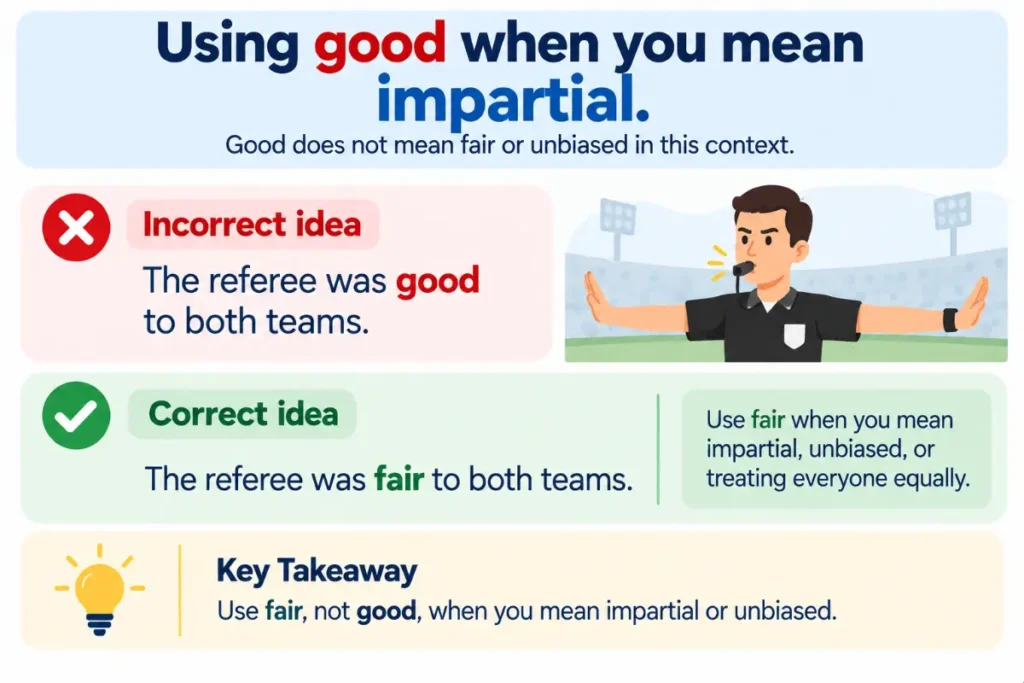
Less precise: The referee made a good decision because both teams received equal treatment.
Better: The referee made a fair decision because both teams received equal treatment.
Good is possible if the decision produced a positive result. Fair is more precise when you specifically mean that the referee treated both teams impartially.
Confusing Fair With Fairly Good
Fairly good is a common expression meaning reasonably good or good to a moderate degree. It doesn’t always communicate strong praise.
For example, My presentation was fairly good suggests that the presentation went reasonably well. My presentation was good gives a more direct positive assessment.
The word fairly can soften an adjective. In American English, the expression may indicate that something is satisfactory without being outstanding.
Treating Fair and Equal as Exact Synonyms
Fair and equal are related, but they aren’t interchangeable in every situation. Equal means the same in amount, number, value, or status. Fair means just or reasonable.
For example, giving every employee the same equipment may be equal treatment. Providing different equipment based on each employee’s job needs may be fairer. The appropriate choice depends on the circumstances.
Assuming Fair Always Means Average
Fair sometimes describes an average or moderate level of quality, especially in ratings and evaluations. However, it can also describe strong moral or legal correctness.
A fair judge is not an average judge. The phrase normally praises impartiality. Always look at the context before deciding what the word implies.
Pronunciation Guide
Both words have one syllable and are easy to pronounce once you recognize their vowel sounds.
Still confused? Compare Hanged vs Hung Which Word Is Correct.
Fair
IPA: /fɛr/ in common American transcription.
Sounds like the first part of fairy.
One syllable.
Good
IPA: /ɡʊd/.
Rhymes with could and should.
One syllable.
How to Pronounce Fair
Start with the /f/ sound made by placing your upper teeth lightly against your lower lip. Move into the vowel sound and finish with the American English /r/. Keep the word to one syllable.
How to Pronounce Good
Start with the voiced /ɡ/ sound at the back of your mouth. Use the short vowel /ʊ/ found in could, then finish with /d/. Avoid stretching the vowel into the sound found in food.
A common mistake is pronouncing good like the word gooed. Keep the vowel short and relaxed.
Etymology and Word Origin
The histories of these words help explain why their modern meanings differ.
The Origin of Fair
Fair developed from Old English fæger, a word associated with beauty, pleasantness, and attractiveness. Over time, the word gained additional meanings connected to favorable conditions, impartiality, and justice.
Today, fair can describe a beautiful appearance in some contexts, but its common modern uses include fair treatment, fair rules, fair prices, and fair weather. The word’s history reflects a broad shift from pleasantness toward ideas of acceptability and justice.
The Origin of Good
Good comes from Old English gōd. Its early meanings included goodness, virtue, and desirable qualities. It has remained a central English word for expressing positive value across many settings.
Modern English uses good for quality, health, morality, ability, usefulness, and favorable results. Its broad range of meanings explains why it appears in so many common expressions, from good work to good luck and good health.
The two words developed along different paths. Fair became strongly associated with impartiality and reasonable treatment, while good retained a wide general sense of positive value.
Regional Usage
The meanings of fair and good remain largely consistent across major English varieties. There is no major spelling difference between American and British English for these words. Differences mainly involve context, common expressions, and occasional differences in tone.
American English
In the United States, fair commonly describes impartial treatment, reasonable prices, and acceptable conditions. People use expressions such as fair enough, fair deal, fair chance, and fair game in everyday conversation.
Good is even broader in ordinary use. Americans commonly say good job, good idea, good health, good deal, and good at something. The phrase good deal can refer to a bargain, while fair deal often emphasizes reasonable or honest treatment.
British English
British English uses both words in much the same way. Fair can describe reasonable treatment, fair play, or fair weather. Good describes quality, character, usefulness, and positive results.
The phrase fair enough is also common in Britain. Depending on the conversation, it can express agreement, acceptance, or recognition that someone’s point is reasonable.
Australian English
Australian English follows the same basic distinction. Fair can describe reasonable treatment or acceptable conditions, while good commonly expresses approval, quality, or usefulness.
Local expressions may affect the tone of a sentence, but they don’t change the core meanings of these words.
Canadian English
Canadian English also uses fair and good according to the same general principles. Fair prices and fair treatment concern reasonableness and justice. Good service and good results concern quality and positive outcomes.
In all four varieties, context remains the best guide. You don’t need a different spelling or a separate grammar rule for each region.
Grammar Rules and Common Patterns
Both words function as adjectives in their most common uses. However, their sentence patterns differ depending on what you want to describe.
Using Fair Before a Noun
Fair often comes before nouns related to treatment, decisions, rules, prices, and opportunities.
Examples include:
- The company introduced fair hiring practices.
- We agreed on a fair price.
- Every applicant deserves a fair chance.
Fair can also appear after linking verbs such as is, seems, looks, and feels.
For example, The offer seems fair. Here, fair describes the offer rather than an action.
Using Good Before a Noun
Good commonly appears before nouns describing quality, experiences, choices, results, and personal qualities.
Examples include:
- She made a good choice.
- We received good service.
- He has a good attitude.
Good can also follow a linking verb. In The meal was good, the adjective describes the meal. In She is good at chess, it describes her skill.
Common Patterns With Fair
These expressions are useful in everyday writing.
- Fair to someone. The teacher was fair to every student.
- Fair for a purpose. The amount of time was fair for a short assignment.
- Fair enough. Your explanation sounds reasonable.
- Fair share. Everyone contributed their fair share of the work.
- Fair and square. They won fairly and honestly.
Common Patterns With Good
These patterns appear frequently in American English.
- Good at something. He is good at drawing.
- Good for someone or something. Walking is good for your health.
- Good with someone or something. She is good with children.
- Good to someone. My neighbors have always been good to me.
- Good for a purpose. This bag is good for carrying books.
Pay attention to the preposition. You are good at an activity, something can be good for your health, and a person can be good to another person.
Grammar and Punctuation
Fair and good don’t require special punctuation. They can appear in statements, questions, and comparisons using ordinary English grammar.
For example, Is this a fair price? and Is this a good price? are both grammatically correct. The first asks if the price is reasonable. The second asks if the price is attractive or satisfactory.
Comparative forms also differ in meaning. Fairer compares degrees of fairness, while better is the usual comparative form of good.
For example, This arrangement is fairer than the previous one compares justice or reasonableness. This arrangement is better than the previous one makes a broader positive comparison.
The superlative forms are fairest and best. You might say She received the fairest treatment or This is the best option available.
Real Life Usage Examples
The following situations show how these words work in different kinds of communication.
Daily Conversation
People use both words when discussing personal experiences and everyday decisions.
- Is that a fair price for a used bicycle?
- We had a good evening with our friends.
The first question concerns reasonable value. The second describes a positive experience.
Workplace Communication
In professional settings, fair often concerns policies and treatment, while good often evaluates performance and outcomes.
- The supervisor applied the same fair standards to every employee.
- Your team has made good progress on the quarterly report.
The first sentence emphasizes impartiality. The second praises the team’s progress.
Academic Writing
Students can use these words to make precise arguments about education, research, and social issues.
- A fair assessment should apply clear criteria to all students.
- The study provides good evidence for the proposed explanation.
The first sentence concerns the assessment process. The second evaluates the strength or usefulness of the evidence.
News and Journalism
Journalists may use fair when reporting on justice, policy, and access. Good often appears when describing results, outcomes, or public benefits.
- The new policy aims to ensure fair access to public services.
- Officials reported good progress on the housing project.
These sentences show the distinction between equitable access and positive progress.
Literature and Storytelling
Writers often use fair to develop themes of justice and responsibility. Good can describe a character’s nature, decisions, or actions.
- The king promised to give every village a fair hearing.
- Despite his mistakes, the farmer remained a good friend to his neighbors.
The first example highlights justice. The second focuses on character and loyalty.
Related Words and Expressions
Several English words overlap with fair or good. Understanding their differences helps you choose more precise language.
1. Just
Just means morally right or in line with fairness. It often appears in discussions of laws, decisions, and ethical behavior.
Example: The court reached a just decision after reviewing the evidence.
Fair and just are close in meaning, but just can carry a stronger moral or legal emphasis.
2. Equal
Equal means the same in amount, value, status, or opportunity. Fair means reasonable or impartial.
Example: Every student received equal time to complete the test.
Equal treatment can be fair, but fairness sometimes requires different support for people with different needs.
3. Reasonable
Reasonable describes something sensible, practical, or supported by sound judgment.
Example: The landlord asked for a reasonable deposit.
This word is often useful when discussing prices, expectations, requests, and decisions. It overlaps with fair when the main concern is what people can reasonably expect.
4. Excellent
Excellent means extremely good or of very high quality.
Example: She delivered an excellent presentation.
Good expresses general approval, while excellent communicates stronger praise. Use excellent when ordinary positive language doesn’t fully capture the quality.
5. Great
Great often expresses strong approval, enthusiasm, or admiration.
Example: We had a great time at the concert.
It is common in casual conversation. Good is more neutral, while great usually communicates a higher level of satisfaction.
6. Acceptable
Acceptable means suitable enough to meet a requirement or standard.
Example: The final draft was acceptable, but it needed more detail.
Fair can suggest an acceptable level of quality in some contexts. However, acceptable focuses more directly on meeting a basic requirement.
7. Better
Better is the usual comparative form of good. It describes something more desirable, useful, or satisfactory than another option.
Example: The second plan is better because it saves time.
Better can also compare fairness in a broader sense, but fairer is more precise when the specific issue is impartial treatment.
8. Unfair and Bad
Unfair and bad are common opposites, but they express different problems. Unfair means unjust or unreasonable. Bad means poor, harmful, unpleasant, or undesirable.
Example: It was unfair to blame one employee for the whole team’s mistake. The resulting report was bad because it contained serious errors.
A decision can be unfair even if it produces a useful result. A bad result can also follow a fair process.
Expert Editor Insight
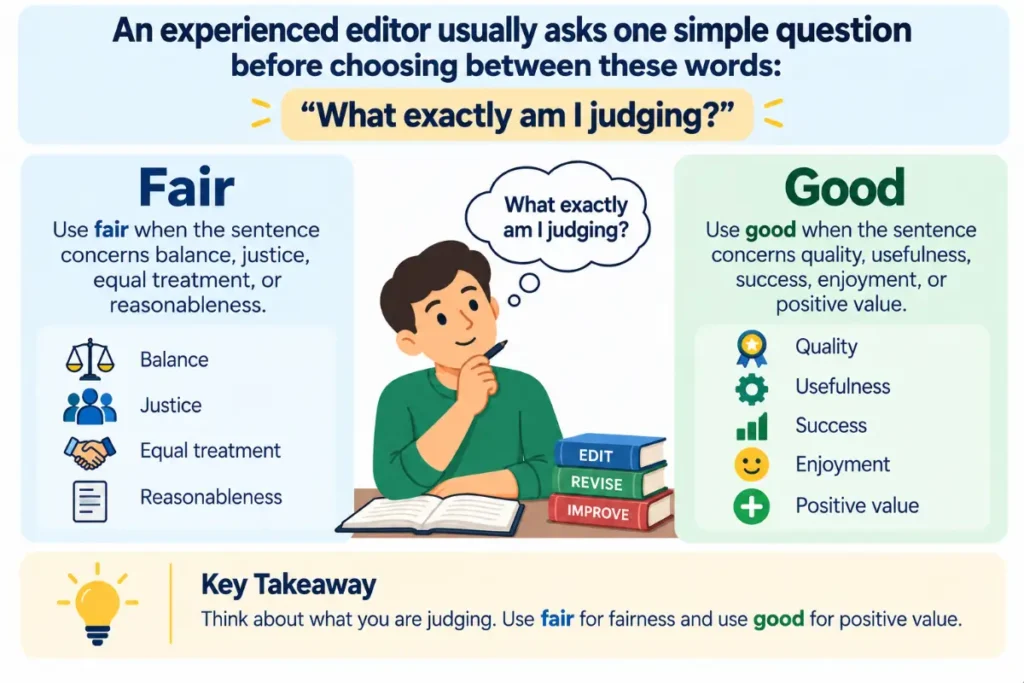
An experienced English editor looks at the meaning of the whole sentence rather than treating these words as interchangeable synonyms. If a writer describes a price, the editor checks if the sentence concerns reasonable value or a bargain. If the writer describes a decision, the editor checks if the point is impartiality or a positive outcome. Grammar tools may accept both words because both are spelled correctly, so a spelling checker alone won’t catch every meaning error. Read the sentence in context and ask what you want the reader to understand.
For another common grammar confusion, see Cancelation vs Cancellation Which Spelling Is Correct?.
Conclusion
The difference in fair vs good is simple once you focus on the meaning behind each word. Fair describes justice, impartial treatment, and reasonable expectations. Good describes positive qualities, usefulness, satisfactory performance, and desirable results. Both words are correct, but they serve different purposes.
A fair price is reasonable, while a good price may offer excellent value. A fair decision follows impartial standards, while a good decision produces a positive outcome. Remember this practical editing tip. Use fair when you judge how reasonable or just something is. Use good when you describe its quality or benefit. This small distinction will make your everyday speech and writing clearer.
FAQs
Is Fair Better Than Good?
Neither word is always better than the other. Fair is more precise when you mean impartial, just, or reasonable. Good is more suitable when you mean positive, useful, or satisfactory. The best word depends on the situation. For example, a fair decision may follow the right process, while a good decision may produce a useful result.
What Does Fair Mean in Everyday English?
In everyday English, fair usually means just, reasonable, or impartial. People use it to describe prices, rules, decisions, and the way others are treated. It can also mean moderately acceptable when discussing quality. The expression fair enough often shows that someone accepts a point as reasonable, even if they don’t fully agree.
What Does Good Mean in Everyday English?
Good usually describes something positive, useful, suitable, or satisfactory. You can use it for people, food, work, ideas, health, and experiences. For example, a good teacher explains lessons clearly, and a good plan helps you reach a goal. The exact meaning depends on the noun or situation being described.
Can Fair and Good Mean the Same Thing?
They can overlap in certain situations, but they aren’t exact synonyms. Both may describe an acceptable experience or a satisfactory result. However, fair often focuses on reasonableness or impartiality, while good emphasizes positive quality or value. Replacing one with the other can change the message, especially in discussions of prices, rules, and personal behavior.
Is Fairly Good a Positive Expression?
Yes. Fairly good generally means reasonably good or satisfactory to a moderate degree. It often communicates mild approval rather than strong enthusiasm. For example, The movie was fairly good suggests that you enjoyed it to some extent, but you may not consider it outstanding. Tone and context can make the expression sound more or less positive.
How Do You Use Fair and Good in a Sentence?
Use fair for justice, impartial treatment, and reasonable expectations. Use good for quality, ability, usefulness, and positive experiences. For example, The teacher was fair to everyone describes impartial treatment. The teacher gave a good lesson describes the quality of the lesson. Both adjectives can appear before nouns or after linking verbs.
What Is the Difference Between Fairer and Better?
Fairer is the comparative form of fair and usually compares justice, impartiality, or reasonableness. Better is the comparative form of good and compares quality, usefulness, or desirability. For example, This policy is fairer than the old one focuses on equal or reasonable treatment. This policy is better than the old one makes a broader positive judgment.
Can Something Be Fair but Not Good?
Yes. A decision can be fair because it follows consistent rules, yet produce a disappointing result. For example, a teacher might grade every student using the same standards, making the process fair, even if the class receives low scores. Similarly, a price can be fair for a product that still performs poorly. Fairness doesn’t guarantee quality.