
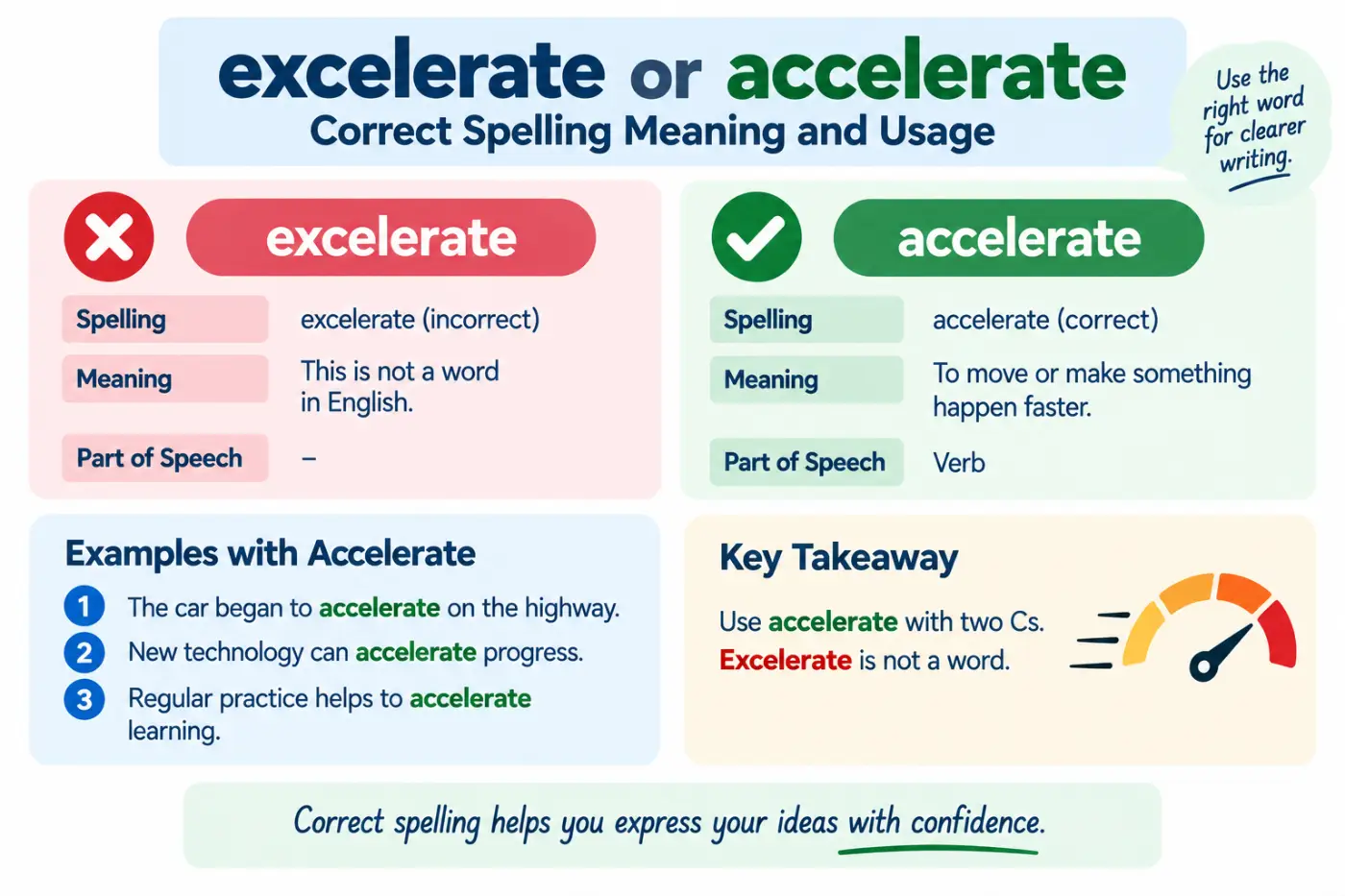
If you’re unsure about excelerate or accelerate, the correct spelling of the standard English verb is accelerate. It means to increase speed, make progress faster, or cause something to happen sooner. Excelerate is a common spelling mistake when someone intends to use this verb.
The confusion makes sense because both forms look and sound similar. The word accelerate begins with the letters acc while the mistaken form begins with exc. Both may seem plausible if you’re typing quickly or spelling the word from memory. However, only the standard spelling belongs in ordinary sentences about speeding up a car, growing a business, improving progress, or increasing the pace of an activity.
Understanding the difference helps you write more clearly at school, at work, and in everyday conversations. You’ll also learn how to pronounce the word, use it correctly in different sentence patterns, recognize common spelling mistakes, and choose suitable alternatives. Once you understand the word’s structure and meaning, remembering its spelling becomes much easier.
Still confused? Compare Council vs Counsel Which Word Should You Use.
Quick Answer
Accelerate is the correct standard English spelling. It means to increase speed or make a process happen faster. Excelerate is generally a misspelling when someone intends to express this meaning. Use accelerate in school assignments, business documents, emails, and formal writing.
Comparison Table
| Feature | Accelerate | Excelerate |
|---|---|---|
| Standard spelling | Correct | Incorrect for the intended verb |
| Meaning | To speed up or increase progress | No standard general English meaning as a variant of accelerate |
| Part of speech | Verb | Usually a spelling error in this context |
| Pronunciation | uhk SEL uh rayt | Often intended to sound like accelerate |
| Formality | Appropriate in formal and informal writing | Avoid as a substitute for accelerate |
| Common contexts | Cars, business, science, learning, technology | Typing mistakes and spelling confusion |
| Example | We need to accelerate the project. | We need to excelerate the project. |
The table describes ordinary English usage. A business, product, or organization could use Excelerate as a chosen name. That special use would not make it the standard spelling of the verb.
What Does Accelerate Mean
Accelerate means to increase speed, advance more quickly, or cause an activity or process to move forward faster. It can describe physical movement, such as a car gaining speed, or a change that happens over time, such as a business expanding more quickly.
The word is a verb. It tells readers that someone or something is speeding up or making progress at a faster rate.
For example, a driver accelerates when pressing the gas pedal makes a vehicle move faster. A company accelerates growth when it takes steps to expand its sales or reach new customers more quickly.
The Main Meanings of Accelerate
The verb has several closely related uses.
1. To increase physical speed. A vehicle accelerates when it moves faster than before. A cyclist can also accelerate while riding uphill or approaching the finish line.
2. To speed up progress. A student might accelerate learning by practicing daily. A team can accelerate a project by removing delays and organizing its work more effectively.
3. To make an event happen sooner. A new process may accelerate the delivery of a product. In this sense the word refers to reducing the time needed for an outcome.
4. To increase the rate of change. Scientists may describe a reaction or other process as accelerating when its rate increases. Economists may use the term to describe faster growth or a rising rate of inflation.
These meanings share one central idea. Something moves faster, develops sooner, or changes at a higher rate than it did before.
Is Excelerate a Real Word
In ordinary English, excelerate is not the standard spelling of the verb meaning to speed up. Most readers will understand it as a misspelling of accelerate, especially in a sentence about driving, progress, or growth.
However, spelling depends partly on context. Excelerate may appear as a proper name, brand, or organization name. A name can have its own spelling, but that does not make it an accepted replacement for the standard verb in general writing.
For example, write The company wants to accelerate production when you mean that production should become faster. Do not replace accelerate with excelerate simply because the alternative looks reasonable.
Key Differences Explained
The main difference is spelling. Accelerate is the accepted verb for increasing speed or progress, while excelerate is normally a spelling error in the same context. The two forms should not be treated as interchangeable.
Spelling
Accelerate starts with acc. This spelling is part of the established English word and should remain unchanged in standard writing.
A useful way to remember it is to connect the first letters with the word’s meaning. Accelerate begins with acc, just as acceleration and accelerator do. These related words share the same spelling pattern.
Meaning
Accelerate has a clear meaning. It describes speeding up movement, progress, or change. Excelerate does not serve as the standard general English verb with that meaning.
The difference matters because spelling errors can make otherwise clear writing look careless. A reader may understand the intended message, but a correct spelling makes the sentence more professional.
Grammar and Part of Speech
Accelerate functions as a verb. It can describe an action performed by a person or the change in speed of an object or process.
Consider these examples.
- The driver accelerated after the light turned green.
- The school plans to accelerate the training program.
- Economic growth accelerated during the final quarter.
In each sentence the word describes an action or change. Its form changes to fit the sentence, but the main spelling pattern stays the same.
Pronunciation
In standard American English, accelerate is commonly pronounced with four syllables. The main stress falls on the second syllable.
The similar sound of the first part can make the spelling harder to remember. However, pronunciation does not determine the correct spelling by itself. The written form remains accelerate.
Formality and Context
Accelerate works in casual speech and formal writing. You can use it in a conversation about driving, a school essay about learning, a report about economic growth, or a business plan about production.
Excelerate should not replace it in these contexts. If you encounter the alternative spelling in a company name or product name, preserve the name’s official spelling when referring to that specific entity.
Regional Usage
American, British, Canadian, and Australian English all use accelerate as the standard spelling of this verb. There is no common regional spelling rule that changes it to excelerate.
The main difference is not regional. It is the distinction between an established English word and a spelling mistake.
Which Form Is Correct
Accelerate is correct when you want to express the idea of increasing speed or making progress happen faster. Its spelling is established in standard English, and it appears in everyday language as well as technical and academic writing.
Excelerate is not the standard spelling for this meaning. It may result from typing quickly, remembering the sound rather than the spelling, or confusing the word with related forms that begin with exc.
A simple test is to check the word’s grammatical family. The standard forms are accelerate, accelerates, accelerated, accelerating, acceleration, and accelerator. They share the same initial spelling pattern.
For example, write The new system will accelerate the process rather than The new system will excelerate the process.
Ten Sentence Examples
The following examples show how the correct form fits different situations.
1. Everyday conversation. We need to accelerate if we want to reach the station on time.
2. Driving. The car began to accelerate as it entered the highway.
3. Text messages. Can we accelerate the plan and finish everything by Friday?
4. Workplace communication. Our team hopes to accelerate the approval process this month.
5. School. Daily reading can accelerate a child’s language development.
6. Academic writing. The researchers observed that higher temperatures accelerated the chemical reaction.
7. Business. The company introduced a new strategy to accelerate sales growth.
8. Technology. Better processors can accelerate certain computing tasks.
9. Formal writing. The committee recommended changes to accelerate the delivery of essential services.
10. Personal goals. Consistent practice helped her accelerate her progress in learning guitar.
Each example uses the verb in a natural way. The subject may be a person, an object, a process, or an event. The meaning stays connected to increased speed or faster progress.
Common Spelling Mistakes
Spelling errors often occur when a word sounds familiar but its written structure is less familiar. The following mistakes are useful to recognize when proofreading.
1. Excelerate Instead of Accelerate
Incorrect: The team wants to excelerate production.
Correct: The team wants to accelerate production.
The error comes from choosing the wrong first letters. Remember that the standard verb begins with acc.
2. Accellerate Instead of Accelerate
Incorrect: We need to accellerate the schedule.
Correct: We need to accelerate the schedule.
This error adds an extra letter l. The correct spelling has one l after the initial acce sequence and before the final erate portion. Checking the full word rather than relying on its sound can prevent this mistake.
3. Accelerater Instead of Accelerator
Incorrect: The accelerater controls the machine’s speed.
Correct: The accelerator controls the machine’s speed.
The noun for a device or control that increases speed is accelerator. The ending uses ator, not ater. The same word may refer to a person or factor that speeds up a process.
4. Acceleration Instead of Accelerate
Incorrect: We should acceleration the project.
Correct: We should accelerate the project.
This is a grammar error rather than a simple spelling error. Acceleration is a noun, while accelerate is a verb. After the modal verb should, use the base form of the verb.
5. Accelerated Instead of Accelerate
Incorrect: We will accelerated the process tomorrow.
Correct: We will accelerate the process tomorrow.
After will, use the base form of the verb. Accelerated is appropriate in other sentence patterns, such as The process accelerated yesterday or The team accelerated production last week.
These mistakes involve different problems. Some change the letters, while others confuse related words or verb forms. Identifying the type of error makes it easier to correct it consistently.
A related grammar guide is Coachs or Coaches Which Spelling Is Correct.
Pronunciation Guide
Accelerate is pronounced with four syllables in standard American English.
Pronunciation
1×PlayStop
accelerate
/əkˈsɛləˌreɪt/
Add to flashcards
Give feedback
IPA and Syllable Breakdown
The International Phonetic Alphabet representation is commonly given as /əkˈsɛləˌreɪt/. Dictionary transcriptions may vary slightly depending on the pronunciation system used.
The syllables can be understood as follows.
- The first syllable has a relaxed vowel sound, similar to the beginning of about.
- The second syllable sounds like sell and carries the main stress.
- The third syllable has a relaxed vowel sound.
- The final syllable rhymes with rate.
The easiest approach is to stress the second syllable and say the word smoothly. Avoid giving every syllable equal weight.
Common Pronunciation Mistakes
Some speakers may place the stress on the wrong syllable or pronounce each vowel too strongly. Others may rely on the sound to guess the spelling and accidentally write excelerate.
Remember that hearing the word correctly and spelling it correctly are separate skills. Practice the spoken form, but memorize the written form as well.
Etymology and Word Origin
Accelerate comes from Latin accelerare, meaning to hasten or make faster. The Latin word combines a prefix related to movement toward a result with a root associated with speed or swiftness.
The word entered English through historical language development and became established as a verb meaning to increase speed or hasten an action. Its related noun, acceleration, describes the process or rate of speeding up.
This origin helps explain the relationship among accelerate, acceleration, and accelerator. They belong to the same word family and retain a recognizable spelling pattern.
Excelerate does not follow the standard spelling of this established English word. The fact that an alternative form looks or sounds plausible does not give it the same status in ordinary usage.
Regional Usage
The standard spelling remains the same across major varieties of English. Regional differences do not explain the confusion between these two forms.
American English
Accelerate is the normal spelling in the United States. It appears in conversations about traffic, business growth, education, scientific research, and personal development.
For example, an American news report might say that a company accelerated hiring. A driving instructor might tell a learner to accelerate gradually when entering a highway.
British English
British English also uses accelerate. The meaning and spelling are the same as in American English.
Writers in the United Kingdom may use different vocabulary or punctuation conventions in other contexts, but this verb does not have a separate British spelling.
Australian English
Australian English follows the same standard spelling. Accelerate is suitable in professional reports, educational materials, everyday conversations, and technical documents.
Canadian English
Canadian English also uses accelerate. There is no established Canadian convention that replaces it with excelerate.
Across these varieties, the practical rule is straightforward. Use accelerate for the standard verb and preserve Excelerate only when it is the verified spelling of a specific name.
Grammar Rules and Word Forms
Accelerate is a regular verb. It follows the usual pattern for many English verbs, so you can change its form to show tense or grammatical function.
Base Form
Use accelerate after modal verbs such as can, could, may, might, should, and will.
Examples include We can accelerate the process and The changes will accelerate growth. The base form also appears after to when the infinitive form is needed, as in They hope to accelerate production.
Third Person Singular
Use accelerates with a singular subject in the simple present tense.
For example, The new engine accelerates quickly and This method accelerates learning. The ending changes to s, but the rest of the spelling remains the same.
Past Tense and Past Participle
Accelerated is the simple past form and the past participle.
- Simple past: The driver accelerated carefully.
- Present perfect: The company has accelerated its expansion.
- Passive voice: The process was accelerated by new equipment.
The correct spelling includes ed at the end. Do not add another letter to the main word.
Present Participle
Accelerating is used in continuous verb forms and can also function as a descriptive word.
Examples include The vehicle is accelerating and The team is accelerating its efforts. The final e is dropped before adding ing.
Using the Word With Objects
Accelerate can be transitive or intransitive. A transitive verb takes an object, while an intransitive verb does not require one.
- Transitive: The manager accelerated the hiring process.
- Intransitive: The vehicle accelerated smoothly.
Both patterns are correct. The sentence structure depends on what you want to describe.
Punctuation and Formal Usage
The verb does not require special punctuation. Use commas, periods, and other marks according to the sentence’s structure rather than the word itself.
Accelerate is suitable for both formal and informal writing. In casual conversation, people may prefer simpler expressions such as speed up or move faster. In technical writing, the word may offer greater precision.
Real Life Usage Examples
A word becomes easier to understand when you see how people use it in different settings. The following examples show the range of situations in which this verb works naturally.
Daily Conversation
People often use accelerate to describe movement or a change in pace.
- You should accelerate gently once the road is clear.
- We need to accelerate our preparations if we want to leave before noon.
In casual speech, speed up might sound more relaxed. However, accelerate remains correct and easy to understand.
Email and Workplace Communication
The word can help describe plans, deadlines, and improvements at work.
- We have reorganized the schedule to accelerate the review process.
- Please identify the main delays so we can accelerate delivery without reducing quality.
In professional communication, use the verb when the goal is to make progress faster. Avoid suggesting that speed should come at the expense of safety or accuracy.
Academic Writing
Academic writers use the word to describe measurable changes or faster development.
- The researchers found that sunlight accelerated the growth of the plants under the tested conditions.
- Additional practice may accelerate the development of reading skills.
In research writing, be precise about the process being accelerated. If evidence only shows an association, do not claim that one factor caused the change.
News and Journalism
News reports often use accelerate to describe changes in the economy, technology, public policy, or business activity.
- The company announced plans to accelerate construction of its new facility.
- Rising demand may accelerate the shift toward electric vehicles.
Journalists should explain what is speeding up and provide enough context for readers to understand the change. The word alone does not show how large or significant that change is.
Literature and Storytelling
In a story, the word can help build tension or show a change in pace.
- As the storm approached, the horses accelerated along the narrow road.
- The discovery accelerated events that had remained quiet for years.
The verb can make a sentence feel more immediate. Still, simpler wording may suit a scene better if the writer wants a relaxed or intimate tone.
Related and Confused Terms
Several words belong to the same family or express a similar idea. Understanding their differences can help you choose a more precise word.
1. Acceleration
Acceleration is a noun that describes the process or rate of increasing speed. In physics, it refers to the rate at which velocity changes over time.
Example: The vehicle’s acceleration increased after the engine was repaired.
2. Accelerator
An accelerator is a device or control used to increase speed or power. The word can also describe something that speeds up a process.
Example: The driver pressed the accelerator gently.
3. Accelerated
Accelerated is the past form of the verb. It can also describe a program or process designed to move faster than usual.
Example: She completed an accelerated training course.
4. Accelerating
Accelerating is the form used for an ongoing action. It can also describe a trend that is increasing in speed or rate.
Example: The accelerating demand created new supply problems.
5. Hasten
Hasten means to make something happen sooner or move more quickly. It often focuses on reducing delay rather than increasing physical speed.
Example: The new policy may hasten the approval process.
6. Expedite
Expedite means to make a process move faster or handle it more quickly. It is common in business, administration, and formal communication.
Example: Please expedite the shipment if possible.
7. Increase
Increase means to make something greater in size, number, amount, or degree. It does not always mean that something is happening faster.
Example: The company plans to increase its workforce.
8. Decelerate
Decelerate means to reduce speed. It is the opposite of accelerate in many situations involving movement or changes in speed.
Example: The driver began to decelerate near the intersection.
These words are related but not interchangeable in every sentence. Choose the one that matches the exact change you want to describe.
Expert Editor Insight
An experienced editor treats this as a spelling issue first and a context issue second. If a sentence describes faster movement or progress, accelerate is the expected form. A spelling checker may flag excelerate as an error, but automated tools do not always recognize proper names or brand names. Editors check the surrounding sentence before changing an unfamiliar form. My practical tip is to remember the related noun acceleration. Once you know that word’s spelling, you have a reliable clue for spelling the verb correctly. This simple habit can prevent repeat errors without slowing down your writing.
Still confused? Compare complement vs compliment Explained With Examples.
Conclusion
When choosing excelerate or accelerate, remember that accelerate is the standard spelling for the verb meaning to increase speed or make progress faster. Excelerate is generally a misspelling in this context, although it may appear as a proper name. The correct form works across American, British, Canadian, and Australian English.
It also follows familiar grammar patterns, giving you forms such as accelerates, accelerated, and accelerating. For an easy memory trick, connect the verb with acceleration and accelerator. These related words share the same opening letters. Check the spelling before publishing an email, assignment, or report, and your writing will remain clear and professional.
FAQs
Is Excelerate a Correct English Word?
Excelerate is not the standard spelling of the verb that means to speed up. In ordinary writing it is generally an error for accelerate. However, a company, product, or organization may use Excelerate as a proper name. Always consider the context before deciding how to handle an unfamiliar spelling.
What Does Accelerate Mean in Simple English?
Accelerate means to go faster or make something happen faster. A car accelerates when its speed increases. A student may accelerate learning through regular practice, and a business may accelerate growth by improving its services. The central idea is an increase in speed or the rate of progress.
Which Is Correct Between Excelerate and Accelerate?
Accelerate is correct for standard English sentences about speed, progress, or change. Excelerate is not an accepted alternative spelling for that meaning. For example, write The company plans to accelerate production. If the unusual form appears in an official business or product name, preserve the name’s verified spelling.
How Do You Pronounce Accelerate?
In standard American English, accelerate has four syllables, with the main stress on the second syllable. The beginning has a relaxed vowel sound, the stressed syllable rhymes with sell, and the final syllable rhymes with rate. Listening to a reliable dictionary recording can help you learn the sound and stress pattern.
Can Accelerate Be Used at the Beginning of a Sentence?
Yes. Accelerate can begin a sentence when the grammar supports it. For example, Accelerate the process by removing unnecessary steps is a command. You could also write Accelerate carefully when the road is clear as an instruction. The verb’s position does not change its spelling or basic meaning.
What Is a Synonym for Accelerate?
Common alternatives include speed up, hasten, expedite, quicken, and advance. Each has a slightly different use. Speed up works well in everyday conversation, while expedite often suits formal work communication. Hasten emphasizes making something happen sooner. Choose the alternative that best matches the action and the tone of your sentence.
Why Do People Misspell Accelerate?
People may confuse the first letters because the spoken word does not make its spelling immediately obvious. Typing quickly and remembering a word by sound can also lead to errors. Connecting accelerate with acceleration and accelerator helps reinforce the correct spelling. Reading the full sentence after typing it can catch mistakes before they reach the reader.
Is Accelerate Appropriate in Formal Writing?
Yes. Accelerate is a standard verb that works well in academic papers, business reports, technical documents, and professional emails. It can describe faster growth, movement, learning, or change. Use it when the idea of increasing speed or progress is accurate. For a more casual tone, speed up may sound more conversational.