

If you have ever paused while writing a cancellation email or filling out a form, you are not alone. The spelling difference between cancelation vs cancellation can be confusing because both forms look reasonable and both appear in English writing. The good news is that neither spelling is automatically wrong.
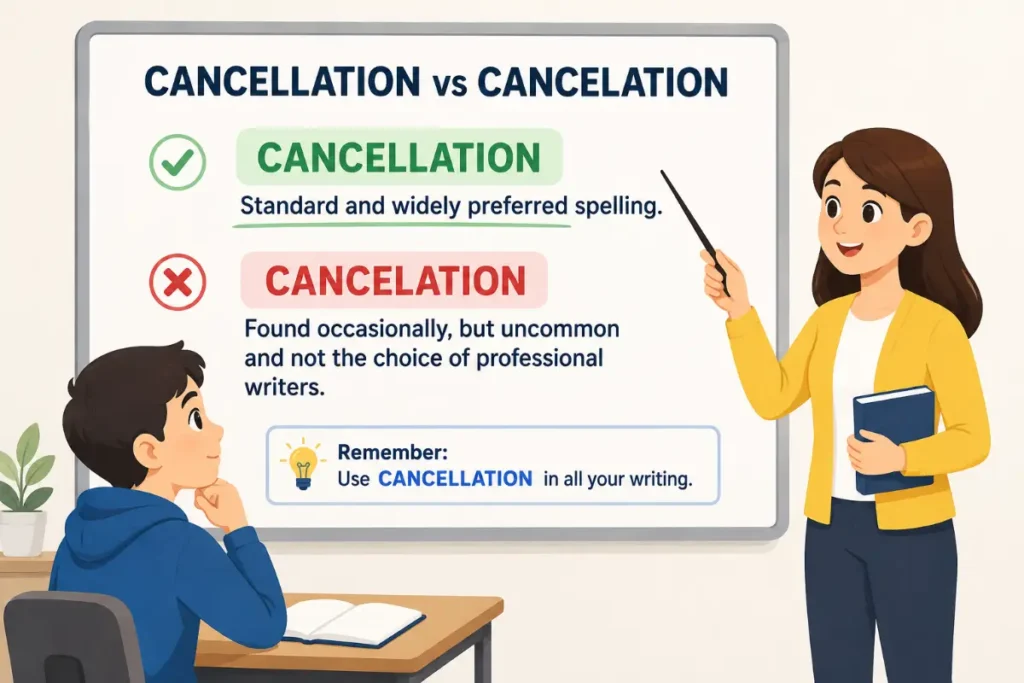
Cancellation is the standard choice for most American English writing. It is widely used in business emails, travel notices, appointment reminders, school announcements, and customer service messages. Cancelation is also a recognized spelling, but it appears less often and may look unusual to many American readers.
The difference comes from how English forms nouns from verbs. The verb is spelled cancel, with one L at the end. When you add a noun ending, the resulting spelling can vary. English does not always follow one simple rule for these changes, which explains why writers sometimes hesitate.
Understanding the difference will help you choose the right form for your audience, avoid unnecessary spelling corrections, and keep your writing consistent. You will also learn how to pronounce the word, use it in sentences, and distinguish it from related terms such as cancellation fee, canceling, and canceled.
Many readers also check Bring vs Take Which Word Should You Use.
Quick Answer
Both cancellation and cancelation are accepted English spellings of the noun meaning the act of canceling something. However, cancellation is the preferred form in American English and is the safer choice for professional, academic, and everyday writing. Cancelation is a legitimate variant, not simply a spelling mistake, but it is less common.
Comparison Table
| Feature | Cancellation | Cancelation |
|---|---|---|
| Spelling status | Standard and widely preferred | Accepted alternative |
| Meaning | The act of canceling something | The act of canceling something |
| Part of speech | Noun | Noun |
| American English | Preferred spelling | Less common variant |
| British English | Common standard form | Less common variant |
| Formality | Suitable for formal and informal writing | Understandable but less usual |
| Common contexts | Travel notices, business, appointments, contracts | Occasional publications and specialized usage |
| Pronunciation | /ˌkæn.səˈleɪ.ʃən/ | /ˌkæn.səˈleɪ.ʃən/ |
| Example | The cancellation of the meeting surprised everyone. | The cancelation of the meeting surprised everyone. |
The two forms carry the same meaning and generally have the same pronunciation. The main difference is spelling preference and frequency of use. If you are writing for an American audience, choose cancellation unless a particular organization or publication requires a different spelling.
Meaning and Definition
What Does Cancellation Mean?
Cancellation is a noun that describes the act of canceling something or the state of something being canceled. It can refer to an event that will not take place, an order that has been stopped, a reservation that has been withdrawn, or an agreement that has ended.
For example, if a company decides not to hold a scheduled meeting, the decision can be called a meeting cancellation. If a traveler decides not to take a booked flight, the action may be described as a flight cancellation.
The word also appears in legal, financial, and administrative settings. A contract may include rules for cancellation, an insurance policy may have a cancellation clause, and a service provider may charge a cancellation fee.
Common expressions include:
- Cancellation notice.
- Cancellation policy.
- Cancellation fee.
- Order cancellation.
- Flight cancellation.
- Appointment cancellation.
- Subscription cancellation.
- Event cancellation.
In each expression, the noun identifies an action, decision, or result involving something that will no longer continue as planned.
What Does Cancelation Mean?
Cancelation is an alternative spelling of the same noun. It refers to the same action and does not have a separate meaning simply because it contains one L instead of two.
For example, a writer might use cancelation in a sentence about a canceled event. The intended meaning remains clear to most English readers, even if the spelling looks unfamiliar.
However, accepted spelling and preferred spelling are not always the same thing. English contains words with multiple established spellings, and dictionaries may recognize forms that differ in how often people use them. In this case, cancellation is the more familiar choice for most American readers.
If you encounter cancelation in a published document, you should not automatically assume the writer has made a mistake. Check the intended variety of English and any relevant style requirements before correcting it.
Key Differences Explained
Spelling
The most visible difference is the number of L letters before the ending.
- Cancellation has two L letters in the middle of the word.
- Cancelation has one L letter in that position.
The base verb cancel ends in one L. When forming the noun, English usage has established both spellings. The double L version has become the usual choice in American English.
A useful way to remember the preferred form is to connect it with familiar expressions such as cancellation fee and cancellation policy. Seeing these phrases regularly makes the standard spelling easier to recall.
Meaning
There is no meaningful difference in definition between the two spellings. Both describe the act or result of canceling something.
Consider these sentences.
- The airline announced the cancellation of the flight.
- The airline announced the cancelation of the flight.
Both sentences communicate the same information. The first is the more familiar choice in standard American writing.
Grammar and Part of Speech
Both forms are nouns. They can act as the subject of a sentence, the object of a verb, or the object of a preposition.
For example, in the sentence The cancellation caused confusion, the noun is the subject. In We received a cancellation, it is the direct object. In The fee applies after cancellation, it follows a preposition.
Neither spelling changes the grammatical role of the word. The choice affects spelling preference rather than sentence structure.
Pronunciation
Both spellings are pronounced the same way in ordinary English. The difference is written rather than spoken, so a listener usually cannot tell which spelling a speaker intends.
The final part of the word sounds like the ending in education and information. The main stress falls on the syllable containing the long A sound.
Because pronunciation does not reveal the spelling, writers need to learn the conventional written form rather than rely on how the word sounds.
Formality and Context
Cancellation works well in formal documents, business messages, academic writing, and everyday conversation. It is the natural default for a US audience.
Cancelation may still appear in written material, but its lower frequency can make it look like a typo. That matters in professional writing because readers often expect familiar spelling in policies, invoices, contracts, and public notices.
For most purposes, choosing cancellation removes the uncertainty. You can then focus on the message itself instead of drawing attention to a less familiar spelling.
Regional Usage
The double L spelling is widely established in both American and British English. British English also uses other spelling patterns that differ from American English, but this particular noun does not follow the common pattern of changing an ending from American single L to British double L. Both varieties commonly use cancellation.
The single L variant is recognized, but it is less common in general writing. It is therefore not a reliable way to signal that a text follows a particular national variety of English.
Which Form Is Correct?
Cancellation is the best default spelling for modern American English. Cancelation is also a recognized variant, so describing it as universally incorrect would be misleading.
The reason cancellation is usually preferred is established usage. English spelling is shaped by convention, dictionary recognition, editorial standards, and the forms that readers see most often. A spelling can be legitimate without being the most common option.
For writers, the practical rule is straightforward.
- Use cancellation in everyday American English.
- Use cancellation in business documents, school assignments, reports, and formal correspondence.
- Follow a company’s or publication’s style guide if it specifies a particular spelling.
- Keep the spelling consistent throughout a document.
- Do not correct the less common form automatically in a quotation or historical document without considering the context.
This approach helps you write naturally while respecting the fact that English sometimes permits more than one spelling for the same word.
Sentence Examples
The following examples use the preferred spelling in a range of realistic situations.
- Everyday conversation. The cancellation of our dinner plans means we can stay home tonight.
- Text message. I received a cancellation notice, so I need to book another appointment.
- Workplace communication. Please inform the team about the cancellation of tomorrow’s meeting.
- Travel. The airline offered a refund after the cancellation of our flight.
- School. The principal announced the cancellation of classes because of severe weather.
- Academic writing. The study examined how event cancellation affected attendance rates.
- Formal writing. All requests for cancellation must be submitted before the stated deadline.
- Customer service. You can request a subscription cancellation through your account settings.
- Social plans. The sudden cancellation of the party disappointed several guests.
- Online communication. Check the cancellation policy before paying for the reservation.
These examples show that the noun can describe a decision, an administrative process, or the result of a change in plans. The surrounding words usually make the exact context clear.
Examples of the Less Common Spelling
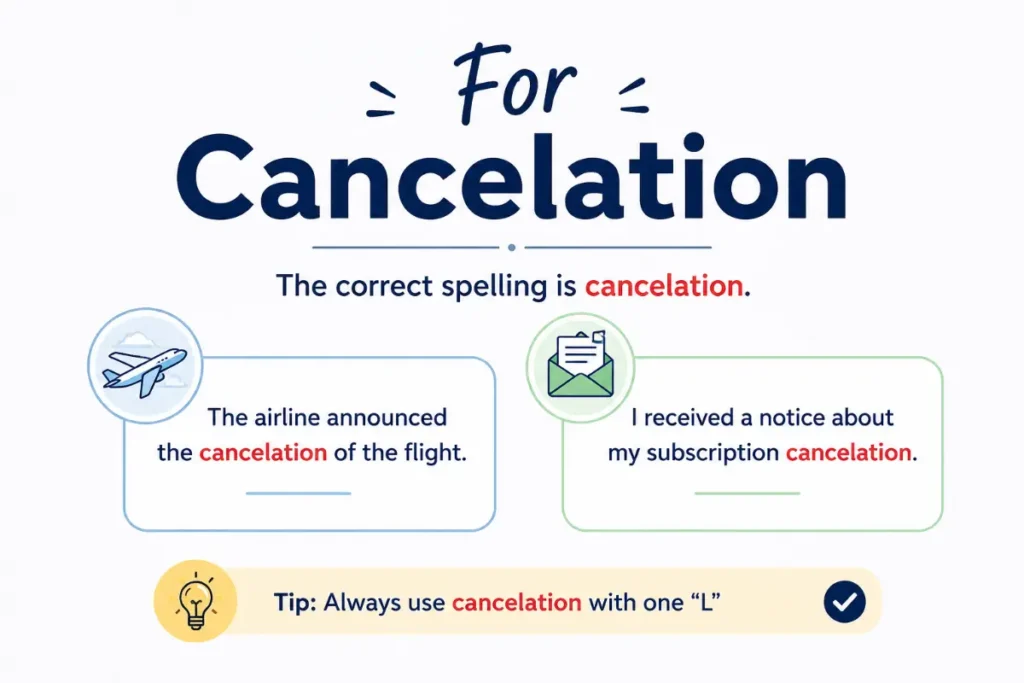
Cancelation can appear in sentences with the same meaning. These examples demonstrate its use as a variant rather than presenting it as the preferred spelling.
- The cancelation of the appointment left an opening in the schedule.
- We received an email about the cancelation of our reservation.
- The company explained its cancelation policy in the service agreement.
- A notice confirmed the cancelation of the scheduled event.
- The customer requested a cancelation of the order.
In ordinary American writing, changing these sentences to use cancellation would usually make them sound more familiar to readers.
Common Spelling Mistakes
Writers often confuse this noun with related forms because English spelling changes when words take different endings. Here are five mistakes worth watching for.
Using Cancelation in Formal American Writing
The single L spelling is recognized, but cancellation is the more familiar choice for American readers.
Incorrect for a standard house style. Our company received a cancelation request.
Preferred. Our company received a cancellation request.
The first sentence is understandable, but the second follows the usual American spelling preference.
Adding an Extra L to the Verb
The verb is spelled cancel, not cancell.
Incorrect. Please cancell my appointment.
Correct. Please cancel my appointment.
The noun’s double L spelling can lead writers to add an extra letter to the verb. Remember that the noun and verb have different established spellings.
Confusing Cancellation With Canceling
Cancellation is a noun, while canceling is the present participle or gerund form of the verb.
Incorrect. We are cancellation the reservation.
Correct. We are canceling the reservation.
Use the noun to name the action and the verb form to describe the action itself.
Mixing American and British Verb Forms
American English commonly uses canceling and canceled. British English commonly uses cancelling and cancelled. However, cancellation is standard in both varieties.
American English. The airline canceled the flight.
British English. The airline cancelled the flight.
The difference in these verb forms does not mean that the noun must be spelled differently. Writers should learn each form separately.
Misspelling the Ending
The noun ends in the letters A T I O N. Shortening or rearranging the ending can produce a spelling error.
Incorrect. Cancelationn.
Correct. Cancellation.
The easiest check is to look for the familiar ending and confirm the spelling in a trusted dictionary or writing tool if you are unsure.
Still confused? Compare Emigrate vs Immigrate and How to Use Each Word.
Pronunciation Guide
Both accepted spellings have the same standard pronunciation. The extra L in the more common written form does not create an additional sound.
IPA and Syllable Breakdown
- IPA. /ˌkæn.səˈleɪ.ʃən/.
- Syllables. can · cel · la · tion.
- Easy pronunciation. kan suh LAY shun.
- Main stress. The third syllable carries the strongest stress in the four syllable pronunciation.
The pronunciation guide is an approximation for American English. The unstressed vowels may sound slightly different depending on the speaker and accent.
Common Pronunciation Mistakes
One common mistake is putting too much stress on the first syllable. Another is pronouncing every vowel clearly and equally, which can make the word sound unnatural.
In ordinary American speech, the middle vowels are often reduced. The main emphasis falls on the LAY sound near the end. Listening to the word in a full sentence can help you hear the natural rhythm.
Remember that pronunciation alone cannot tell you which spelling a writer has chosen. Both forms sound alike, so spelling must be learned through reading and practice.
Etymology and Word Origin
The noun cancellation comes from the verb cancel, which entered English through French and ultimately traces back to the Latin word cancellare. That Latin verb meant to cross out or mark something with lines. It was related to cancelli, a word for a lattice or grating.
The original idea of crossing something out connects naturally with the modern meaning. When you cancel an appointment, order, or agreement, you remove it from the plan or arrangement. The action may involve a written record, but the meaning now extends far beyond marking text.
The spelling difference developed through English usage rather than through a difference in meaning. The form with two L letters became the established and more familiar noun spelling, while the single L form remained a recognized alternative.
This history also explains why the noun should not be treated as a simple copy of the verb. English often preserves spelling patterns that reflect convention and word history, even when a more regular pattern might seem possible.
Regional Usage
American English
Cancellation is the preferred spelling in the United States. You will commonly see it in airline notices, appointment reminders, business policies, school announcements, and subscription settings.
Cancelation is also recognized, but many American readers will find it less familiar. For general writing, choose cancellation unless your organization follows a specific alternative style.
American English also commonly spells the related past tense as canceled and the present participle as canceling. These forms use one L before their endings.
British English
Cancellation is also the usual spelling in British English. The noun does not follow the same spelling difference seen in some related verbs.
British writers generally use cancelled for the past tense and cancelling for the present participle. The noun remains cancellation in ordinary usage.
For example, a British newspaper might report the cancellation of a train service after the operator cancelled several scheduled departures. Both forms fit their respective grammatical roles.
Australian English
Australian English generally follows the same pattern as British English for the related verbs, using cancelled and cancelling. Cancellation remains the familiar noun spelling.
Writers should not assume that the single L form is preferred in Australia simply because some verb forms use different spelling conventions from American English. The noun is best written as cancellation for a broad Australian audience.
Canadian English
Canadian English uses a mixture of British and American spelling conventions, depending on the word. Cancellation is the usual choice, and it works naturally in Canadian business, academic, and everyday writing.
The safest approach across these English varieties is to use cancellation as the standard noun spelling. If you are following a formal publication guide, check its rules and apply them consistently.
Grammar Rules and Part of Speech
Understanding the grammar helps you choose the right form of the word in a sentence. Cancellation is a noun, so it names an action, event, decision, or result rather than directly describing someone performing an action.
Using the Noun in a Sentence
The noun can appear in several positions.
- Subject. The cancellation caused a delay.
- Direct object. We announced the cancellation.
- Object of a preposition. The refund depends on cancellation.
- Part of a noun phrase. The cancellation notice arrived this morning.
In each example, the noun identifies the action or event. The surrounding words explain who made the decision or what was canceled.
Common Grammatical Patterns
Cancellation often appears with the prepositions of, after, before, and without.
- Cancellation of the order. This identifies the thing being canceled.
- After cancellation. This refers to a point in time following the action.
- Before cancellation. This identifies a time limit or earlier stage.
- Without cancellation. This means something continues without being canceled.
The noun also combines naturally with words that describe policies, fees, notices, requests, and rights. These combinations are common in customer service and business writing.
Singular and Plural Forms
The singular form is cancellation. The plural is cancellations.
For example, The airline announced three cancellations because of bad weather. The plural refers to several separate events or decisions.
Writers sometimes use the plural when discussing a pattern across multiple appointments, flights, or orders. Use the singular when referring to one action or a general concept.
Choosing Between the Noun and the Verb
Use cancellation when naming the action. Use cancel when giving an instruction or describing what someone does.
Correct noun. The cancellation was unexpected.
Correct verb. They decided to cancel the event.
Correct participle. They are canceling the event.
These forms are related, but they are not interchangeable. A sentence can have the right spelling and still be grammatically incorrect if the writer chooses the wrong part of speech.
Punctuation and Formal Usage
The noun does not require special punctuation. It follows the same punctuation rules as other nouns and can appear in ordinary statements, questions, and lists.
For example, The cancellation fee is nonrefundable. The period belongs at the end of the sentence, not inside the word.
In formal writing, clarity matters more than choosing an elaborate expression. Cancellation is a familiar and precise word, so there is usually no need to replace it with a longer phrase.
Real Life Usage Examples
The word appears in many areas of daily life. These examples show how it fits naturally into different kinds of communication.
Daily Conversation
- I heard about the cancellation of the concert while I was driving home.
- The cancellation gave us enough time to visit our friends instead.
In casual conversation, the noun is useful when the canceled event matters more than the person who made the decision.
Email and Workplace Communication
- Subject line. Notice of Meeting Cancellation.
- Please confirm the cancellation of the order so our records remain accurate.
In workplace communication, the word helps make a change clear. It can also identify the subject of an email or the reason for a refund request.
Academic Writing
- The researchers recorded each cancellation and examined its effect on attendance.
- The report considered how frequent event cancellations affected student participation.
Academic writing often uses the noun because it refers to an event or process that can be studied, recorded, or compared.
News and Journalism
- The cancellation of several train services caused delays for commuters.
- Organizers announced the cancellation of the outdoor festival after heavy rain.
News reports often use this construction to describe an official decision. The noun keeps the focus on the event and its consequences.
Literature and Storytelling
- The cancellation of the journey left Mara with an unexpected afternoon at home.
- He read the cancellation notice twice before accepting that the trip was over.
In storytelling, the noun can communicate a change in plans without interrupting the flow of the narrative. The surrounding details provide the emotional meaning.
Related and Confused Terms
Several words share a connection with the noun, but each serves a different purpose. Learning these distinctions helps you choose precise language.
Cancel
Cancel is a verb meaning to stop something that was planned, arranged, or expected to happen.
Example. We decided to cancel the picnic because of the rain.
Use it when describing the action rather than naming the action as an event.
Canceled
Canceled is the standard American English past tense and past participle of cancel.
Example. The airline canceled our flight.
It describes an action that has already happened or a resulting state. British English commonly uses cancelled.
Canceling
Canceling is the present participle and gerund form used in American English.
Example. Canceling the reservation saved us money.
The word can describe an ongoing action or function as a noun in a sentence. British English commonly uses cancelling.
Cancellation Fee
A cancellation fee is a charge that a business may apply when a customer cancels a booking, service, or reservation.
Example. The hotel charged a cancellation fee for the late change.
The phrase is especially common in travel, hospitality, and service agreements. The fee and its conditions depend on the provider’s policy.
Cancellation Policy
A cancellation policy explains the rules that apply when someone cancels a booking, order, service, or agreement.
Example. Read the cancellation policy before confirming your appointment.
It may explain deadlines, refunds, penalties, and the steps needed to cancel. The exact terms vary by organization.
Refund
A refund is money returned to a customer after a purchase or payment. A cancellation may lead to a refund, but the two words do not mean the same thing.
Example. The company issued a refund after the cancellation.
A canceled order does not always result in a full refund. The agreement or policy determines what the customer receives.
Rescheduling
Rescheduling means moving an event or appointment to another time. Cancellation means stopping the original arrangement, though a canceled event may later be rescheduled.
Example. The clinic offered rescheduling instead of canceling the appointment entirely.
This distinction is useful when explaining changes to meetings, flights, classes, and appointments.
Termination
Termination refers to bringing something to an end. It often appears in contracts, employment, subscriptions, and legal agreements. Cancellation may refer to ending an arrangement, but the exact meaning depends on the agreement and context.
Example. The contract allows termination after written notice.
Use the term that matches the actual process. In legal or financial writing, the words may have specific meanings under the relevant agreement.
Expert Editor Insight
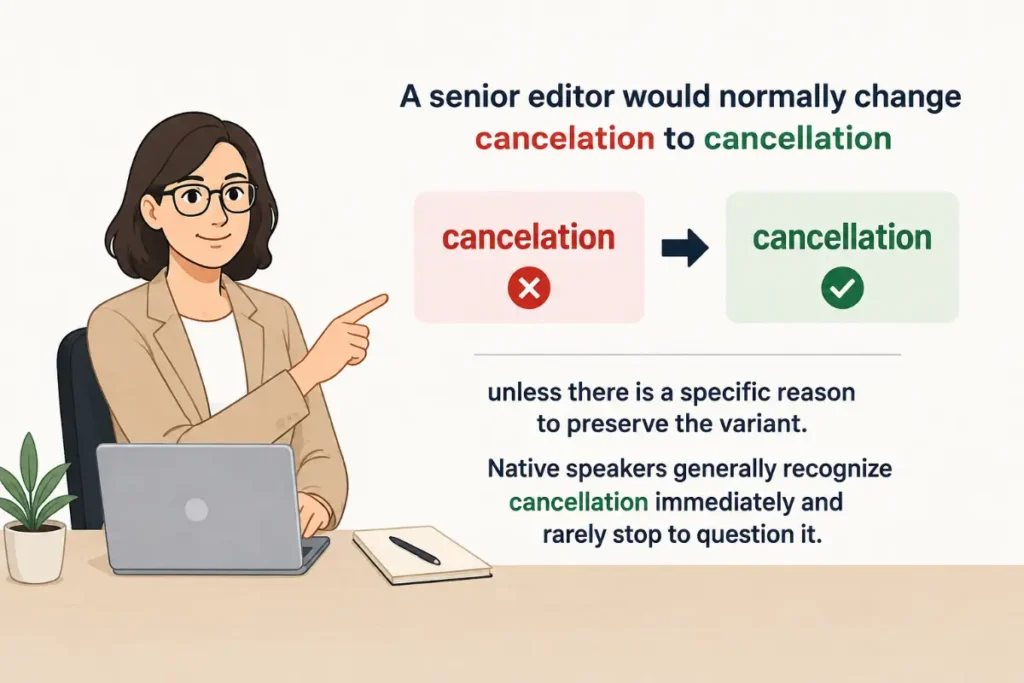
An experienced English editor would normally choose cancellation for an American audience because it is the familiar spelling and rarely distracts readers. The single L variant can trigger a spelling warning in some writing tools, although a warning alone does not prove that a recognized variant is wrong. Editors check the intended English variety, consult a reliable dictionary when needed, and follow the publication’s style guide. They also check related forms separately because cancel, canceled, canceling, and cancellation do not all follow the same visible spelling pattern. Consistency and context matter more than treating every less common form as an error.
You may also want to read Elicit vs Illicit Meaning and Usage Explained.
Conclusion
The choice between cancelation vs cancellation comes down to spelling preference rather than meaning. Both forms are recognized in English, but cancellation is the standard choice for most American readers. It works naturally in emails, school assignments, business documents, travel notices, and everyday conversation.
The single L form is a legitimate alternative, although it is less common and may look unfamiliar. To avoid confusion, remember the double L spelling when writing the noun. Also keep related forms separate in your mind. Cancel is the verb, canceled is the usual American past tense, and canceling describes an action in progress. Consistent spelling makes your writing clearer and more professional.
FAQs
Is Cancelation a Real Word?
Yes. Cancelation is a recognized spelling variant of cancellation. Both forms refer to the act of canceling something, and neither has a separate meaning based on the number of L letters. However, cancellation is more common and is the preferred form in standard American English. For everyday writing, business communication, and school assignments, cancellation is the safer choice.
What Does Cancellation Mean?
Cancellation means the act of canceling something or the state of something being canceled. It can refer to a canceled appointment, flight, order, event, or agreement. The word is a noun, so it names the action or result rather than directly describing someone performing it. For example, The cancellation of the meeting surprised the team.
Which Spelling Should I Use in American English?
Use cancellation in most American English writing. It is the familiar spelling in everyday communication, professional documents, schoolwork, and public notices. Cancelation is recognized but less common, so it may look unusual to some readers. If your workplace or publisher has a style guide, follow that guide. Otherwise, choosing cancellation keeps your writing clear and consistent.
How Do You Pronounce Cancellation?
Cancellation is commonly pronounced /ˌkæn.səˈleɪ.ʃən/ in American English. It has four syllables, with the main stress on the third syllable. An easy pronunciation guide is kan suh LAY shun. The alternative spelling has the same pronunciation. Since the two forms sound alike, you cannot determine the written spelling from speech alone.
Can Cancellation Start a Sentence?
Yes. Cancellation can begin a sentence when it serves as the subject or introduces the main topic. For example, Cancellation of the event disappointed many fans. Another example is Cancellation is available under the terms of the agreement. Starting a sentence with this noun is grammatically correct. Just make sure the rest of the sentence explains the action or situation clearly.
What Is a Synonym for Cancellation?
Useful alternatives include withdrawal, termination, revocation, annulment, and abandonment, but they are not exact replacements in every situation. Withdrawal often describes taking back an offer or request. Termination commonly refers to ending an agreement or relationship. Revocation means formally taking back a right or permission. Choose a synonym based on the specific action rather than replacing the word automatically.
Why Do People Confuse the Two Spellings?
People confuse the forms because both look logical and both are accepted. The verb cancel has one L, while the familiar noun cancellation has two. English spelling does not always follow a single predictable rule when words take endings. Repeated exposure to the standard form helps writers remember it. A dictionary or spell checker can also help confirm the preferred spelling.
Is Cancellation Appropriate for Formal Writing?
Yes. Cancellation is fully suitable for formal writing, including business emails, reports, academic work, contracts, policies, and official notices. It is clear and widely recognized, so it rarely needs a substitute. The single L variant may be understood, but it is less familiar to many American readers. Unless a style guide specifies another form, use cancellation in formal documents.