

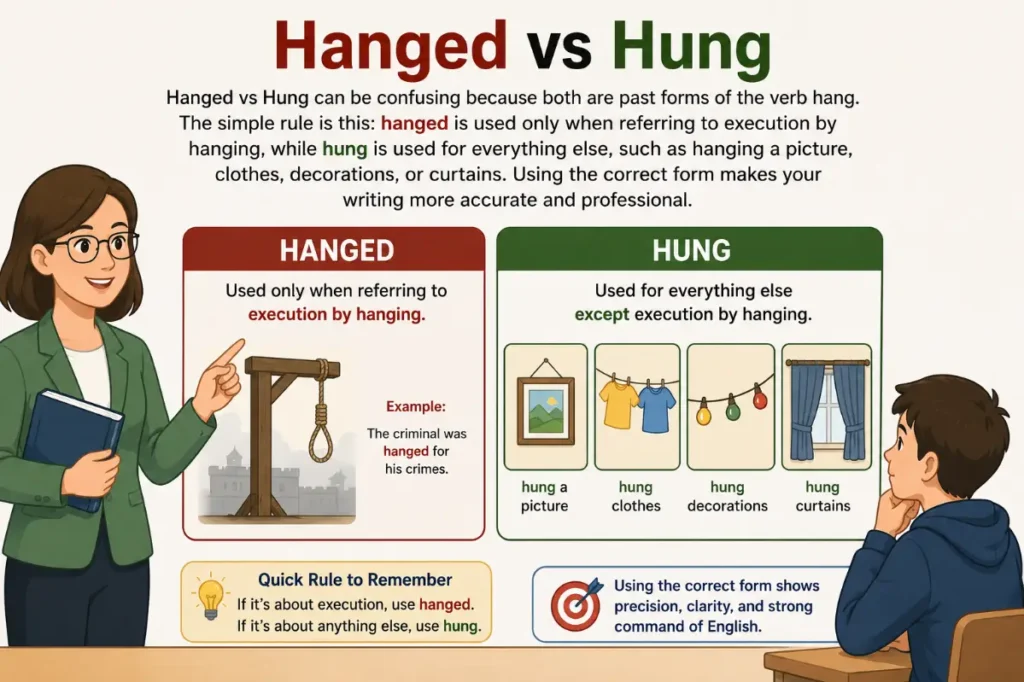
The difference between hanged vs hung can be confusing because both are correct forms of the verb “hang.” The key is the meaning of the sentence. Use “hanged” when describing a person who was put to death by hanging. Use “hung” for most other meanings, such as placing a picture on a wall, hanging a coat, or suspending an object.
For example, you might write, “The picture was hung above the sofa,” but “The prisoner was hanged.” These sentences use different past participles because English has kept two forms for different senses of the same verb. The distinction matters in news reports, history books, school assignments, fiction, and everyday conversation.
Once you learn the basic rule, the choice becomes much easier. You will also see how these words work in different tenses, why the distinction exists, how to pronounce them, and what to do when a sentence has a figurative meaning. The goal is simple: choose the form that matches the meaning and write with confidence.
Need another quick comparison? Read girlie or girly Which Spelling Should You Use.
Quick Answer
Use “hanged” when referring to execution by hanging. Use “hung” for other common meanings of “hang,” including putting up an object, suspending something, or allowing something to dangle. For example, “The portrait was hung in the hallway” is correct, while “The convicted man was hanged” is the traditional form for execution.
Comparison Table
| Word | Main Meaning | Grammar | Common Context | Example |
|---|---|---|---|---|
| Hanged | Put to death by hanging | Past tense or past participle | Historical accounts, legal reports, fiction | The spy was hanged for treason. |
| Hung | Placed, suspended, or left dangling | Past tense or past participle | Home, work, school, daily conversation | She hung her coat by the door. |
| Hanging | Suspending something or being suspended | Present participle or gerund | Ongoing actions and descriptions | He is hanging the curtains. |
| Hang | To suspend, attach, or execute by hanging | Base form | Present tense, commands, infinitives | Please hang the picture straight. |
Meaning and Definition
What Does Hanged Mean
“Hanged” is the past tense and past participle traditionally used when someone is put to death by hanging. The word appears most often in historical writing, legal discussions, news reports about past events, and stories involving capital punishment.
For example, “The prisoner was hanged after the trial” means that the prisoner was executed by hanging. The sentence describes a specific method of execution, not simply a person or object suspended from something.
The word can sound formal or old fashioned because execution by hanging is often discussed in historical settings. However, it remains a standard English word and is still useful when that precise meaning is intended.
What Does Hung Mean
“Hung” is the past tense and past participle used for most other meanings of “hang.” It describes placing or suspending something so that it is supported from above, attached to a surface, or allowed to dangle.
Consider these examples.
- Maya hung her jacket on the hook.
- We hung the family photographs in the living room.
- The wet towels hung outside in the sun.
- A heavy cloud hung over the valley.
- He hung his head after hearing the news.
The word also appears in figurative expressions. For example, “The decision hung in the balance” means the outcome remained uncertain. In “She hung on every word,” the phrase means she listened closely and with great interest.
In all these cases, “hung” is the usual choice because the sentence does not describe execution by hanging.
Is Hanged a Real Word
Yes. “Hanged” is a standard English word, not a spelling error. It is the established form used for the execution sense of the verb “hang.”
The confusion arises because English verbs often have irregular past forms. Some verbs use the same form for the past tense and past participle, while others have more than one accepted form. “Hang” is unusual because its two common past forms have developed different roles based on meaning.
Do not treat “hanged” as an incorrect version of “hung.” Both are correct, but the intended meaning determines which one belongs in the sentence.
Is Hung a Real Word
Yes. “Hung” is also a standard English word. It is the usual past tense and past participle of “hang” when the verb refers to suspending, placing, or allowing something to dangle.
For example, “They hung the banner across the entrance” describes an ordinary action. “The banner was hung before the guests arrived” uses the past participle in a passive construction.
In some informal expressions, “hung” can also have slang meanings. Those meanings depend on context and are separate from the basic grammar distinction discussed here.
Key Differences Explained
The easiest way to choose between the two forms is to focus on what the verb means in the sentence. The spelling alone does not tell you which form to use. Instead, the action or situation determines the choice.
1. The Meaning Is Different
“Hanged” usually refers to execution by hanging. “Hung” refers to ordinary suspension or placement, along with many figurative uses.
Compare these sentences.
- The criminal was hanged after the court delivered its sentence.
- The criminal’s portrait was hung in the courthouse.
The first sentence describes an execution. The second describes placing a picture on a wall. The same base verb appears in both sentences, but the meaning changes the form.
2. Both Forms Are Grammatically Correct
Neither word is always right or always wrong. Each has a recognized grammatical role. The mistake occurs when a writer uses one form in a context that normally calls for the other.
For instance, “She hung the curtains” is standard English. “The prisoner was hanged” is also standard English. In a formal account of an execution, using “hung” instead of “hanged” can sound unusual or imprecise.
3. The Forms Work in Different Tenses
Both words can appear as the simple past tense or the past participle. Their grammatical function depends on how the sentence is built.
The simple past describes a completed action.
- The caretaker hung the painting yesterday.
- The condemned man was hanged many years ago.
The past participle appears with helping verbs or in passive constructions.
- The painting has been hung near the entrance.
- The prisoner had been hanged before dawn.
Notice that “hanged” can also appear with helping verbs. It is not limited to sentences in the simple past.
4. Pronunciation Is Nearly Identical
In standard American English, both words are usually pronounced with the same vowel sound and ending. They sound like “hangd,” with one syllable.
This means you generally cannot hear the distinction in ordinary speech. You need to understand the context or see the spelling to know which form the speaker intends.
5. Formality and Context Matter
Both forms are appropriate in formal and informal English when used correctly. The distinction is not about writing style alone.
Use “hanged” in a history paper discussing an execution, a factual news report about a historical event, or a novel describing that method of death. Use “hung” when writing about decorations, clothing, objects, body posture, or expressions such as “hung in the balance.”
6. Regional Usage Does Not Usually Change the Rule
American, British, Canadian, and Australian English generally follow the same distinction. There may be differences in individual style choices or in how a writer phrases a sentence, but the basic contrast remains stable.
If you are writing for a US audience, use “hanged” for execution and “hung” for ordinary suspension. This is also a reliable guide for readers in other major English speaking regions.
Which Form Is Correct
Both forms are correct. The standard choice depends on the meaning of the verb “hang.”
Use “hanged” when the sentence refers to a person being executed by hanging. Use “hung” for the usual meanings of placing, suspending, or allowing something to dangle.
The distinction is a matter of established English usage, not a rule that one spelling is newer or more formal than the other. Major English dictionaries recognize both forms and distinguish their uses. When checking a dictionary, look at the verb entry and its past tense forms, then read the example sentences to see how meaning affects the choice.
A useful way to remember the rule is to connect “hanged” with a specific event: execution. For ordinary actions, “hung” is the form you will need most often.
Sentence Examples
Here are ten natural examples that show how the forms work in context.
- Everyday conversation: “I hung my keys beside the front door so I could find them easily.”
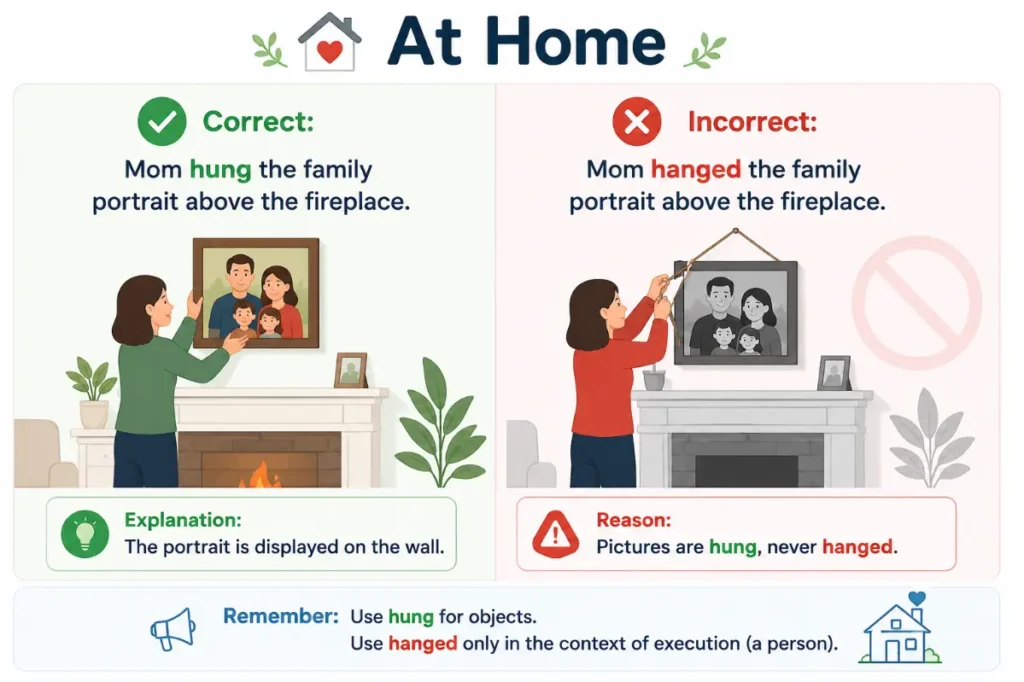
- At home: “We hung new curtains in the bedroom over the weekend.”
- At work: “The manager hung the updated schedule on the staff noticeboard.”
- At school: “Our teacher hung the students’ artwork along the classroom wall.”
- Formal writing: “The historical record states that the convicted man was hanged in the town square.”
- History class: “The prisoner was hanged after being found guilty of treason.”
- News reporting: “The museum displayed a document describing the person who was hanged during the conflict.”
- Social communication: “I hung the decorations early because everyone was coming over that evening.”
- Literature: “A pale moon hung above the quiet fields.”
- Figurative language: “The future of the project hung in the balance until the board reached a decision.”
These examples show why the meaning matters more than memorizing a single past tense form. Ordinary objects and figurative expressions usually take “hung.” A sentence about execution traditionally takes “hanged.”
Examples of the Wrong Form
Writers sometimes choose the wrong form because both words come from the same verb. The following examples show the usual correction in standard writing.
- Incorrect: The painting was hanged above the fireplace. Correct: The painting was hung above the fireplace.
- Incorrect: He hanged his coat on the hook. Correct: He hung his coat on the hook.
- Incorrect: The prisoner was hung for his crime. Correct in traditional usage: The prisoner was hanged for his crime.
- Incorrect: The curtains were hanged before the party. Correct: The curtains were hung before the party.
- Incorrect: The convicted man had been hung by the authorities. Preferred in standard historical writing: The convicted man had been hanged by the authorities.
The first, second, fourth, and fifth examples involve ordinary suspension or execution, respectively. The correction depends on the meaning. In the third and fifth examples, “hanged” is preferred because the sentence describes execution.
Common Mistakes and How to Avoid Them
Mistake 1 Using Hung for an Execution
Some writers use “hung” in every context because it is the form they hear most often. However, traditional standard English uses “hanged” for execution by hanging.
Incorrect: The prisoner was hung in the nineteenth century.
Preferred: The prisoner was hanged in the nineteenth century.
The solution is to identify the action before choosing the past form. If the sentence refers to execution, use “hanged.”
Mistake 2 Using Hanged for Everyday Suspension
The opposite mistake happens when people assume “hanged” is the proper past form in every situation.
Incorrect: She hanged the picture in the hallway.
Correct: She hung the picture in the hallway.
The sentence describes putting a picture on a wall, not executing a person. Use “hung” for this ordinary meaning.
Mistake 3 Assuming One Form Is Incorrect
Both words are legitimate. Marking “hanged” as a spelling mistake in every context would be inaccurate, just as replacing every instance of “hung” with “hanged” would be wrong.
The key is to distinguish meaning from spelling. A word can be correctly spelled but still be the wrong choice for a particular sentence.
Mistake 4 Confusing Past Tense and Past Participle
Some writers understand the basic distinction but struggle with longer verb phrases. Both forms can work with helping verbs, so do not assume that “hanged” belongs only after “was.”
Examples.
- The picture has been hung in the gallery.
- The prisoner had been hanged before the news reached the village.
The helping verb does not determine the form by itself. The meaning does.
Mistake 5 Changing the Form in Figurative Expressions
Figurative phrases can make the rule seem less obvious. In expressions such as “hung in the balance,” the verb does not describe a literal object being attached to a wall, but “hung” is still the normal form.
Examples include “hung over the city,” “hung on every word,” and “hung his head.” These expressions describe a situation, posture, or attitude rather than an execution.
Pronunciation Guide
The words “hanged” and “hung” are both one syllable, but their vowel sounds differ.
| Word | IPA | Easy Guide | Syllables |
|---|---|---|---|
| Hanged | /hæŋd/ | HANGD | One |
| Hung | /hʌŋ/ | HUNG, rhyming approximately with “sung” | One |
| Hang | /hæŋ/ | HANG | One |
In American English, “hanged” has the short vowel sound heard in “cat” and “hand.” Its ending sounds like a final d. “Hung” uses the vowel sound found in “cup” and “sun.”
The difference is not only in spelling. The two forms have different vowel sounds, which can help you recognize them in speech. Still, in a sentence, meaning remains the best guide to the correct written form.
Common Pronunciation Errors
- Pronouncing “hanged” as two syllables. In normal use, it is one syllable.
- Giving “hung” the same vowel sound as “hang.” The vowel in “hung” is different.
- Assuming the words sound exactly alike. They do not normally sound alike in standard American English, even though their spelling and grammatical relationship can be confusing.
Practice saying “The coat hung by the door” and “The man was hanged.” Listen for the vowel change and connect each form to its meaning.
You may also want to read Imply vs Infer The Difference Explained.
Etymology and Word Origin
The verb “hang” has a long history in English and is related to older Germanic forms. Over time, English developed irregular verb forms instead of following one simple pattern for every verb.
“Hung” became the common past form for ordinary meanings of the verb, such as suspending an object. “Hanged” remained associated with execution. This distinction has continued in modern English, although writers may occasionally encounter “hung” in older texts or in less careful use for the execution sense.
The history explains why the two forms exist, but you do not need to learn the full historical development to use them correctly. For modern writing, remember the meaning based distinction: execution takes “hanged,” while ordinary suspension takes “hung.”
Regional Usage
The distinction between the two forms is broadly consistent across major varieties of English. You do not need a different rule for American and British writing.
American English
In the United States, “hung” is the normal form for placing or suspending something. For example, “The workers hung the sign above the entrance” follows standard usage.
“Hanged” is the traditional form for execution by hanging. A history textbook might state, “The convicted man was hanged in 1790.” In modern American writing, this distinction is suitable for both formal and everyday contexts.
British English
British English generally follows the same pattern. Writers use “hung” for objects, clothing, pictures, and figurative expressions. They use “hanged” when referring to execution by hanging.
For example, “The portrait was hung in the hall” describes an object on display, while “The prisoner was hanged” describes an execution. The difference is one of meaning rather than a separate British spelling convention.
Australian English
Australian English also generally uses “hung” for ordinary suspension and “hanged” for execution. The same distinction works in newspapers, school assignments, historical writing, and everyday conversation.
Canadian English
Canadian English follows the same general convention. A Canadian writer can use “hung” for a picture placed on a wall and “hanged” for a person executed by hanging. There is no major regional spelling difference that changes this rule.
Grammar Rules and Part of Speech
Both words are forms of the verb “hang.” They are not separate verbs with unrelated meanings, although each form is linked to a different sense of the verb.
Simple Past Tense
Use the simple past to describe a completed action.
- We hung the banner yesterday.
- The authorities hanged the convicted man.
- She hung her bag on the chair.
- The prisoner was hanged after the trial.
The first three examples use the verb in different ways. The last example uses the passive voice, which places the person receiving the action at the center of the sentence.
Past Participles
A past participle often appears with a helping verb such as “has,” “have,” “had,” or “been.” Both forms can be used this way.
Examples.
- They have hung the decorations.
- The curtains had been hung before the guests arrived.
- The prisoner had been hanged before the public announcement.
- The historical account says that the man was hanged.
The helping verb does not change the basic distinction. Choose the form that matches the meaning of “hang.”
Active and Passive Voice
In the active voice, the subject performs the action.
Example: The caretaker hung the painting.
In the passive voice, the subject receives the action.
Example: The painting was hung by the caretaker.
The same structure applies to the execution sense.
Active: The authorities hanged the prisoner.
Passive: The prisoner was hanged by the authorities.
The passive voice is common in historical and news writing because the writer may want to focus on the person or event rather than the person responsible for the action.
Questions and Negative Sentences
The same rule applies in questions and negative statements.
- Who hung the photograph in the office.
- She did not hang the curtains herself.
- Was the prisoner hanged after the trial.
- The report does not say when the man was hanged.
In questions one and three, use a question mark in normal written English. The examples show that the choice of verb form still depends on meaning.
Figurative Expressions
English uses “hang” in many expressions that do not describe literal suspension. These expressions usually take “hung” in the past tense.
- The outcome hung in the balance.
- He hung on her every word.
- A sense of sadness hung over the room.
- She hung her head in embarrassment.
These expressions are common in conversation, journalism, and literature. They should not be changed to “hanged” simply because they describe an emotional or uncertain situation.
Real Life Usage Examples
Daily Conversation
In everyday speech, “hung” appears frequently because people often talk about clothes, decorations, pictures, and objects.
- “I hung your jacket in the closet.”
- “We hung the lights around the patio last night.”
Both sentences describe ordinary actions. Using “hanged” in these examples would sound incorrect to most readers.
Email and Workplace Communication
Workplace writing often involves instructions about signs, notices, displays, or documents.
- “The updated safety notice has been hung beside the main entrance.”
- “I hung the presentation board in the meeting room before the team arrived.”
The first example uses a passive construction, while the second uses an active one. Both describe the placement of an object.
Academic Writing
Academic writing may use both forms, especially in historical studies, literature, or discussions of legal punishment.
- “The historical record states that the convicted individual was hanged after the trial.”
- “The researchers hung the display charts in the classroom before the presentation.”
The first sentence refers to execution. The second describes a practical action. Academic writing benefits from choosing the form that accurately reflects the intended meaning.
News and Journalism
News reports must describe events clearly and accurately. The traditional distinction helps readers understand the event being reported.
- “The archival report records that the prisoner was hanged in the eighteenth century.”
- “Officials hung a new banner outside the public building.”
The first sentence reports an execution described in a historical source. The second reports the placement of a banner.
Literature and Storytelling
Writers use “hung” in descriptions of places, objects, emotions, and atmosphere. They use “hanged” when the story specifically refers to execution.
- “A thick mist hung over the village as the sun began to rise.”
- “The old tale tells of a traitor who was hanged at the castle gate.”
These choices help maintain clarity. They also allow a writer to create mood without confusing figurative descriptions with a literal act of execution.
Related and Confused Terms
Several words and expressions connect to this topic. Learning them can help you understand sentences that use “hang” in different ways.
1. Hang
“Hang” is the base form of the verb. It can mean to suspend an object, allow something to dangle, remain in a position, or execute a person by hanging.
Example: “Please hang your coat near the entrance.”
2. Hanging
“Hanging” can function as a present participle, a gerund, or an adjective. It describes an ongoing action or something suspended.
Example: “She is hanging the new curtains.”
The word also appears in phrases that refer to execution, so context remains essential.
3. Suspended
“Suspended” means held up or kept from falling, often by support from above. It is a useful alternative when describing an object or a person temporarily removed from a position or activity.
Example: “The lamp was suspended from the ceiling.”
It does not normally replace “hanged” in a sentence specifically describing execution.
4. Dangled
“Dangled” means hung loosely or moved while suspended. It often suggests that something is free to swing or move.
Example: “The keys dangled from her fingers.”
This word can be more descriptive than “hung,” especially when movement is part of the scene.
5. Placed
“Placed” means put something in a particular position. It can replace “hung” when the sentence focuses on location rather than the way an object is supported.
Example: “The framed photograph was placed above the desk.”
However, “placed” does not always carry the same meaning as “hung.” A picture placed on a shelf is not necessarily hanging.
6. Executed
“Executed” means put to death as a result of a legal or other imposed sentence, or carry out an action or plan. It is broader than “hanged” because execution can occur by methods other than hanging.
Example: “The prisoner was executed after the final ruling.”
Use “hanged” when the method of execution is specifically relevant.
7. Hoisted
“Hoisted” means lifted or raised, often with effort or by using equipment. It can describe flags, sails, equipment, or heavy objects.
Example: “The crew hoisted the flag at sunrise.”
It overlaps with some meanings of “hung,” but it emphasizes lifting rather than leaving something suspended.
8. Hung Up
“Hung up” is a phrasal verb with several meanings. It can mean placing something on a hook, ending a phone call, or becoming stuck on a concern.
Examples: “She hung up her coat” and “He hung up before I could answer.”
The phrase can also be figurative, as in “She is still hung up on the mistake.” These meanings differ from the execution sense.
Expert Editor Insight
An experienced editor checks the meaning before changing either form. If a sentence describes a picture, coat, curtain, or figurative situation, “hung” is usually the right choice. If it describes a person being put to death by hanging, “hanged” is the traditional form. Grammar tools may suggest a correction based on common patterns, but automated suggestions can miss the context. Read the entire sentence before accepting a change, especially in historical writing or fiction.
Key Takeaways
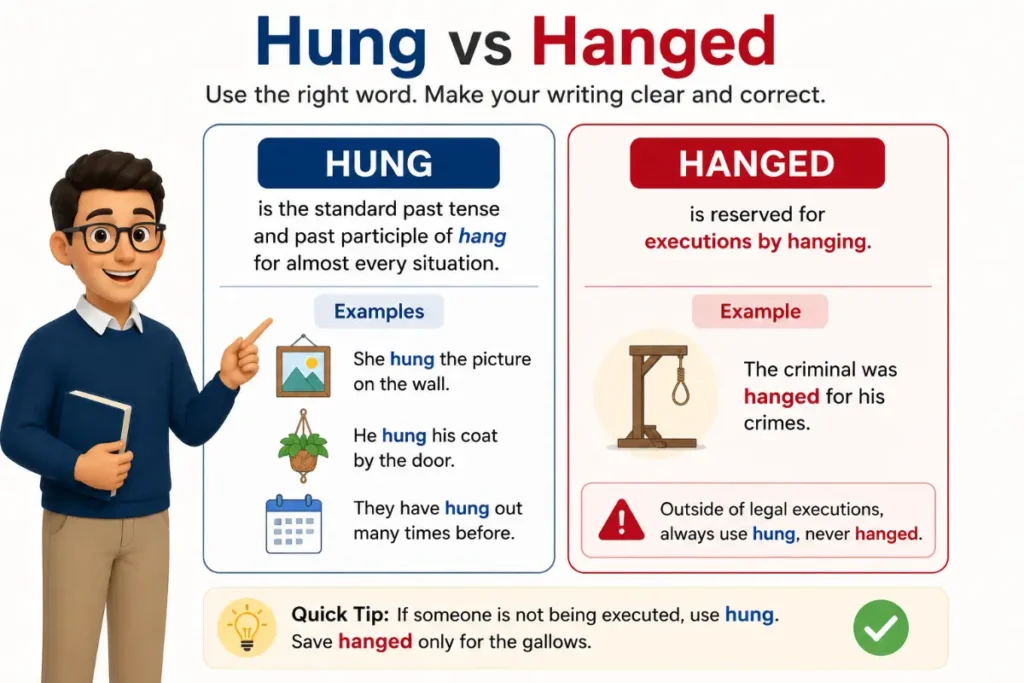
- Hung is the standard past tense and past participle of hang for almost every situation.
- Hanged is reserved for executions by hanging.
- American and British English follow the same distinction.
- Professional editors strongly recommend following the traditional rule.
For another common grammar confusion, see Adapter vs Adaptor Which Spelling Is Correct.
Conclusion
Hanged vs Hung comes down to the meaning of the verb, not a difference in spelling quality or formality. Use “hanged” when referring to a person executed by hanging, and use “hung” for ordinary suspension, placement, and common figurative expressions. Both forms are standard English, so the goal is to match the word to the action.
For a quick editing check, ask yourself what the sentence describes. If it refers to an execution, choose “hanged.” If it describes a picture, coat, curtain, or an expression such as “hung in the balance,” choose “hung.” This simple rule will help you write accurately and confidently.
FAQs
Is Hanged Grammatically Correct?
Yes, “hanged” is grammatically correct. It is the traditional past tense and past participle used when someone is executed by hanging. For ordinary suspension, such as placing a picture on a wall, “hung” is the usual form. The difference comes from meaning, so neither word should be treated as universally incorrect.
What Does Hung Mean?
“Hung” is the past tense and past participle of “hang” for most common meanings. It can describe placing an object somewhere, suspending something, or allowing something to dangle. It also appears in figurative expressions such as “hung in the balance.” For example, “They hung the sign outside the shop” uses the word correctly.
Which Is Correct Hanged or Hung?
Both forms are correct, but they are used differently. Use “hanged” when describing execution by hanging. Use “hung” for ordinary suspension, placement, and most figurative expressions. For example, “The prisoner was hanged” refers to an execution, while “The picture was hung” describes a picture placed on a wall.
How Do You Pronounce Hanged and Hung?
“Hanged” is usually pronounced /hæŋd/, with one syllable and the vowel sound found in “cat.” “Hung” is pronounced /hʌŋ/, also with one syllable, using the vowel sound found in “cup.” The pronunciation difference can help you distinguish the forms in speech, but context is still important for choosing the correct word in writing.
Can Hanged Start a Sentence?
Yes. A sentence can begin with “hanged” when the word is part of a suitable grammatical structure, such as a participial phrase or a question with the right word order. For example, “Hanged for treason, the prisoner became a figure in local history” is grammatically possible, though a more direct sentence may be clearer.
What Is a Synonym for Hung?
The best synonym depends on the meaning. “Suspended” works when something is supported from above, while “placed” may work when the focus is on location. “Dangled” suggests loose movement, and “hoisted” emphasizes lifting. These words are not interchangeable in every sentence, so choose one that preserves the original meaning.
Why Do People Confuse Hanged and Hung?
People confuse the forms because both come from the same verb and both can describe something being held in a suspended position. English also has many irregular verbs with past forms that do not follow one simple pattern. The clearest way to avoid mistakes is to remember the meaning based rule: execution takes “hanged,” while ordinary uses take “hung.”
Is Hanged Appropriate in Formal Writing?
Yes. “Hanged” is appropriate in formal writing when the sentence refers to execution by hanging. It can appear in historical accounts, academic essays, legal discussions, and factual reports. In those contexts, using the traditional form helps maintain precision. For ordinary actions, such as putting up a painting or suspending a sign, use “hung.”