

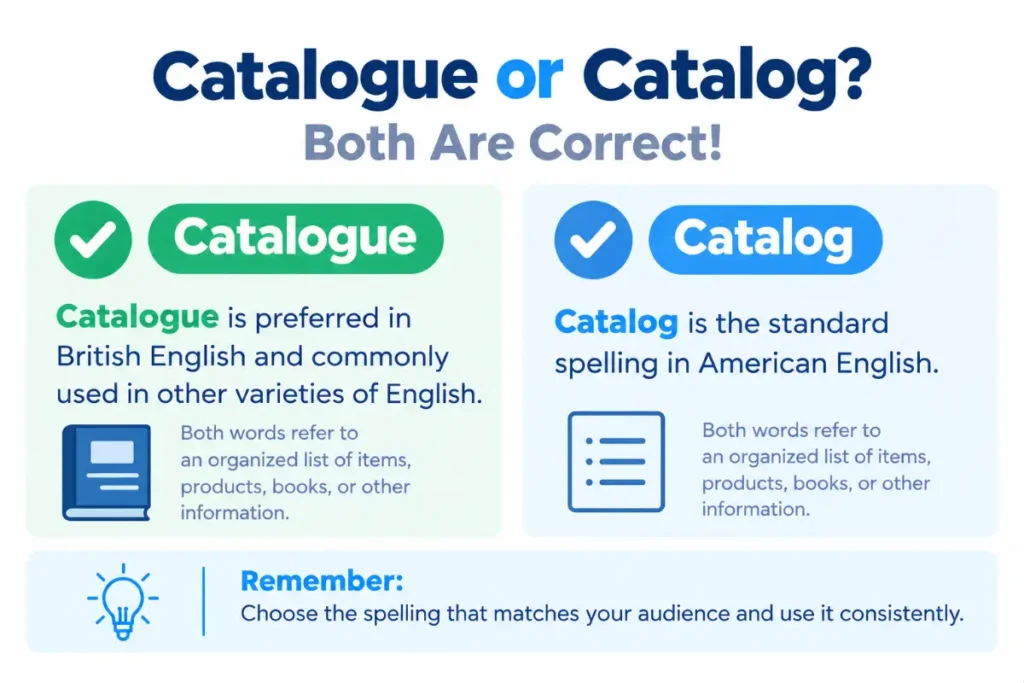
If you have ever wondered if catalogue or catalog is the correct spelling, the answer is simple. Both spellings are correct, but American English generally favors catalog, while British English usually favors catalogue. The difference comes down to regional spelling preferences rather than meaning or grammar.
Both forms describe an organized list of items, products, books, services, or other information. You might browse a store’s product catalog, search a library catalogue, or receive a mail order catalogue from a company. In each case, the word serves the same basic purpose.
The tricky part is knowing which version fits your audience. American readers will generally expect the shorter spelling, especially in business documents, product listings, and everyday writing. British readers are more accustomed to the version ending in ue. Both forms also work as verbs when describing the act of listing or organizing items.
Understanding this small spelling difference can help you write more clearly and avoid unnecessary corrections. Once you know the regional rule, choosing the right form becomes much easier.
You may also want to read Plural of quiz Is It Quizzes or Quizzez.
Short Answer
Both spellings are correct. Catalog is the preferred form in American English, while catalogue is more common in British English and several other varieties of English. Both words have the same meaning, pronunciation, and grammatical functions. Choose the spelling that matches your audience, and use it consistently throughout your writing.
Comparison Table
| Feature | Catalog | Catalogue |
|---|---|---|
| Spelling status | Correct | Correct |
| Main regional preference | American English | British English |
| Meaning | An organized list or to list items | An organized list or to list items |
| Part of speech | Noun and verb | Noun and verb |
| Pronunciation | Same in most standard accents | Same in most standard accents |
| Formality | Suitable for formal and informal writing | Suitable for formal and informal writing |
| Common contexts | US retail, libraries, databases, business | UK retail, libraries, publishing, business |
| Example | I ordered a product from the catalog. | I ordered a product from the catalogue. |
Neither spelling is inherently more professional or grammatically correct than the other. The appropriate choice depends mainly on regional convention and the style requirements of your document.
Meaning and Definition
What Does Catalog or Catalogue Mean?
A catalog or catalogue is an organized collection of information about items that people can browse, identify, compare, or select. It often includes descriptions, names, prices, photographs, reference numbers, or other details that help readers find what they need.
For example, a clothing company might publish a catalog featuring its latest products. A university might maintain a course catalog explaining its classes, degree programs, and academic requirements. A library may use a catalog to help readers locate books and other materials.
The word can also describe a digital collection. Online stores use product catalogs to display merchandise, while museums and archives organize collections through searchable records.
Meaning of Catalog as a Noun
As a noun, catalog refers to a structured list or collection of information. American English commonly uses this spelling in everyday writing and professional settings.
Examples include a library catalog, a product catalog, a course catalog, and a catalog of scientific discoveries. Each expression describes information arranged so that people can find specific items more easily.
A catalog does not have to be a printed book. It can exist as a website, a database, a spreadsheet, a digital file, or a searchable system.
Meaning of Catalogue as a Noun
Catalogue has the same meaning as catalog. The additional letters do not change its definition or grammatical role.
In British English, this spelling is standard in contexts such as retail, education, publishing, and library services. A school may publish a course catalogue, while a museum may maintain a catalogue of paintings.
The choice is regional rather than semantic. A British catalogue and an American catalog can contain exactly the same information.
Meaning as a Verb
Both spellings can also function as verbs. To catalog or catalogue something means to record, classify, or organize it in a systematic way.
For example, a librarian might catalog new books before placing them on the shelves. A museum worker might catalogue historical objects to preserve accurate records of the collection.
The verb can also describe arranging information about events or experiences. Someone might catalog the reasons for a decision or catalog the changes observed during a research project.
The past tense and past participle are normally cataloged and cataloging in American English. British English generally uses catalogued and cataloguing.
Key Differences Explained
The two spellings differ in appearance, but their meaning and use remain the same. The most useful distinctions involve regional preference, verb endings, and consistency.
Spelling Differences
The main difference is the ending.
- Catalog is the shorter spelling preferred in the United States.
- Catalogue is the traditional spelling preferred in the United Kingdom.
The extra letters in the British form do not represent an additional sound in normal pronunciation. They reflect a spelling convention that has remained common in British English.
Meaning and Grammar
Neither form has a special meaning that the other lacks. Both can describe a collection of items and the act of organizing those items into a list.
You can write catalog of products or catalogue of products. You can also say catalog the records or catalogue the records. The choice does not change the basic meaning of the sentence.
Pronunciation
In standard American and British English, the two forms are generally pronounced alike. The spelling difference does not require you to pronounce the final letters of catalogue separately.
Regional accents may affect the vowel sounds, but the difference between the written forms does not create a separate pronunciation rule.
Formality and Context
Both forms are appropriate for professional documents, academic writing, business communication, and casual conversation. One is not more formal simply because it contains more letters.
An American company would normally use catalog in its US marketing materials. A British publisher would generally use catalogue for the same type of publication.
Regional Usage
American English favors the shorter spelling, while British English retains the longer form. Australian and many other varieties influenced by British spelling often favor catalogue, although individual organizations may follow different style rules.
The best approach is to follow the spelling convention used by your readers or organization. Do not switch between the two forms without a clear reason.
Which Form Is Correct?
Both forms are correct English words. The decision depends on the variety of English you are writing in.
For American readers, use catalog. This spelling fits common US conventions and is appropriate for websites, school assignments, business reports, product descriptions, and library systems.
For British readers, catalogue is usually the safer choice. It aligns with standard British spelling and is familiar in educational, commercial, and publishing contexts.
There is no need to treat either form as a misspelling. The difference follows established regional spelling patterns, similar to the differences between color and colour or organize and organise.
A dictionary may list both forms while identifying one as more common in a particular region. That distinction matters because English spelling is not completely uniform across countries.
A practical rule: If you are writing for a US audience, choose catalog. If you are writing for a UK audience, choose catalogue. If your organization has a style guide, follow that guide first.
Sentence Examples
The following examples show how the word works in different settings. The American spelling is used in the first group.
- I found the chair I wanted in the furniture catalog.
- The library catalog helped me locate the book.
- Please send me your latest product catalog.
- The university publishes a catalog of available courses.
- Our team updated the catalog before launching the new website.
- You can browse the online catalog to compare prices.
- The museum catalog includes descriptions of every painting in the exhibition.
- Researchers catalog each sample before beginning the analysis.
- The company cataloged its old records to make them easier to find.
- I spent the afternoon cataloging photographs from my family collection.
The following examples use the British spelling in the same kinds of situations.
- The shop sent us a printed furniture catalogue.
- I searched the library catalogue for books on history.
- The university catalogue explains the requirements for each degree.
- The museum catalogued the collection of ancient coins.
- Customers can browse the online catalogue before placing an order.
These examples show that the spelling changes according to regional convention, not the meaning of the sentence.
Common Mistakes and Misspellings
Although both standard forms are correct, writers can still make errors when spelling the word or using it in a sentence.
1. Mixing Regional Spellings
Inconsistent: The company updated its catalog and printed a new catalogue for US customers.
Better: The company updated its catalog and printed a new catalog for US customers.
The original sentence is not grammatically incorrect, but it mixes regional forms without an apparent reason. A consistent spelling choice makes the writing look more polished.
2. Using the Wrong Verb Ending
American English generally uses cataloged and cataloging. British English generally uses catalogued and cataloguing.
For example, an American report would normally say, The staff cataloged the new books. A British report would generally say, The staff catalogued the new books.
The spelling of the main word affects its common verb forms.
3. Treating Catalogue as a Misspelling
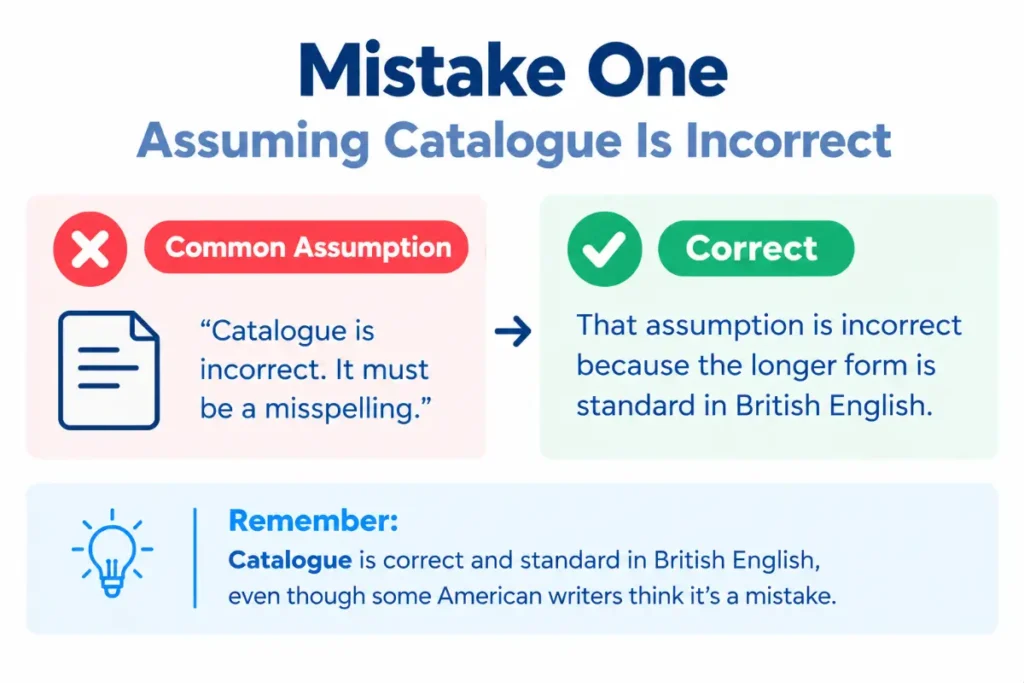
Some American writers assume the longer version is incorrect because it differs from the spelling they learned. That assumption is mistaken.
Catalogue is a legitimate English word. It is simply less common in standard American usage than catalog.
4. Treating Catalog as Informal
The shorter spelling is not slang or a casual abbreviation. It is the standard American form and works in formal documents, academic papers, and professional communication.
There is no need to replace it with the longer form to make a US document appear more serious.
5. Confusing a Catalog With a List
A catalog is often a list, but the two terms are not always interchangeable. A catalog usually organizes information about items in a way that supports browsing, identification, or retrieval.
A quick grocery list may simply record what someone needs to buy. A store catalog generally provides a structured collection of products and details about them.
The difference comes from the purpose and organization of the information, not just the name.
Pronunciation Guide
Both forms usually share the same pronunciation in standard American and British English. The spelling difference does not add a separate syllable.
American pronunciation
/ˈkæt.əl.ɔːɡ/
A common broad transcription.
British pronunciation
Many readers also check Puddy or Putty Which Spelling Is Correct in 2026.
/ˈkæt.əl.ɒɡ/
A common broad transcription.
The exact vowel sounds vary by accent, so these transcriptions represent common patterns rather than every speaker’s pronunciation.
Syllable Breakdown
The word has three syllables.
- Cat is the stressed first syllable.
- Uh represents the short, unstressed middle syllable.
- Log represents the final syllable, with a vowel sound that varies by accent.
The main stress falls on the first syllable. You do not need to pronounce the final letters of the British spelling as a separate syllable.
Common Pronunciation Mistakes
One common mistake is trying to pronounce the final letters in catalogue as an extra sound. In normal use, the ending does not add another syllable.
Another mistake is placing the strongest stress on the second or third syllable. The first syllable normally receives the main stress.
A simple way to remember the sound is to say the word naturally in a sentence, such as I checked the catalog this morning. Focus on the rhythm rather than trying to pronounce every written letter.
Etymology and Word Origin
The word has a long history that connects modern English with earlier European languages.
English adopted the word through French, which received it from Latin and ultimately from Greek. The Greek term katalogos referred to a list or an enumeration. Its parts are associated with the ideas of speaking or recounting and arranging items in an ordered way.
As the word entered English, it came to describe an organized list of names, objects, books, or other items. Printed catalogs became useful for libraries, merchants, publishers, and institutions that needed to present large collections in an accessible form.
The spelling catalogue reflects the influence of French and traditional European spelling conventions. The shorter catalog developed as an accepted English spelling and became the preferred form in the United States.
Both spellings have established histories. The shorter version is not simply a modern texting shortcut, and the longer version is not an error preserved by habit. They are recognized forms shaped by the development of English spelling.
Regional Usage
English spelling varies by region. The distinction between these two forms is a good example of how the same language can follow different written conventions.
American English
In the United States, catalog is the standard preferred spelling. You will commonly see it in retail websites, library systems, school documents, product listings, and business records.
American English also generally uses cataloged for the past tense and cataloging for the action of creating or updating a list.
For example, an American library might announce that it is cataloging new books. A US retailer might ask a designer to update its product catalog before a seasonal sale.
British English
In the United Kingdom, catalogue is the usual spelling. It appears in publishing, retail, education, libraries, and other formal settings.
British English generally uses catalogued and cataloguing for the related verb forms. These endings match broader British spelling patterns.
For example, a British museum might catalogue a new collection of historical objects. A university might publish a course catalogue for students.
Australian English
Australian English generally follows British spelling conventions, so catalogue is widely used. However, an individual business or software system may use the shorter form as part of its own naming or style conventions.
If you are writing for an Australian audience, catalogue is a sensible default unless the organization specifies otherwise.
Canadian English
Canadian English combines British and American spelling influences. Catalogue is a common and established form in Canada, although catalog also appears in some settings.
For Canadian writing, check the style guide used by your employer, publisher, school, or institution. Consistency matters more than trying to apply a single rule to every Canadian context.
Grammar Rules and Part of Speech
Both spellings can act as nouns and verbs. Their grammatical roles are the same, so you can apply the same sentence rules to either version.
Using the Word as a Noun
A noun names a person, place, thing, or idea. Here, the word names an organized collection of information.
You can use it with an article, an adjective, or a phrase that explains what the collection contains.
Examples include the following.
- The catalog is ready for publication.
- We received a new product catalog.
- The online catalog contains thousands of records.
The noun can also appear in a longer phrase, such as a catalog of rare books or a catalogue of historical documents.
Using the Word as a Verb
As a verb, the word describes the act of listing, recording, or organizing items.
For example, The librarian will catalog the books tomorrow uses the word as an action. The librarian is organizing the books so people can locate them.
The verb can take a direct object, which is the item or collection being organized. You can catalog records, photographs, products, documents, or research findings.
Verb Forms
The spelling of the related verb forms generally follows the same regional distinction.
| American English | British English |
|---|---|
| Catalog | Catalogue |
| Catalogs | Catalogues |
| Cataloged | Catalogued |
| Cataloging | Cataloguing |
These forms are regular in their basic grammatical function. The regional spelling pattern explains the extra letters in the British forms.
Singular and Plural Forms
As a noun, the word usually forms its plural by adding s.
- One catalog contains the new products.
- Three catalogs are available online.
In British English, the corresponding forms are catalogue and catalogues.
Capitalization and Punctuation
The word is normally lowercase unless it begins a sentence or forms part of an official name or title. A company might call a publication The Spring Catalog, for example, if that is its chosen title.
You do not need special punctuation simply because you use one spelling instead of the other. Normal sentence punctuation rules still apply.
Real Life Usage Examples
The word appears in everyday speech, professional writing, academic work, journalism, and storytelling. Its basic meaning stays the same, but the type of information it describes changes with the setting.
Daily Conversation
In casual conversation, people often use the word when talking about shopping, books, or finding information.
- I found a cheaper desk in the online catalog.
- Can you check the library catalog for that novel?
These sentences sound natural in American English. A British speaker could use the same sentences with the longer spelling.
Email and Workplace Communication
Businesses use catalogs to organize products, services, inventory, and records. The word is common in emails and internal documents.
- Please review the updated catalog before we send it to customers.
- Our team will catalog the new inventory this afternoon.
The first sentence uses the noun, while the second uses the verb. Both are suitable for professional communication.
Academic Writing
Schools and universities often use catalogs to explain courses, programs, and academic rules. Researchers may also catalog samples, observations, or historical records.
- The university catalog outlines the requirements for graduation.
- The research team cataloged each specimen before analyzing the results.
In formal writing, choose the spelling that matches the institution’s regional convention.
News and Journalism
Journalists may use the word when describing commercial publications, public records, or organized collections.
- The retailer released a new catalog featuring its holiday products.
- The archive catalog lists thousands of documents from the city’s early history.
The meaning should be clear from context. If a news organization follows a house style, its spelling preference should guide the final copy.
Literature and Storytelling
Writers may use the word literally or figuratively. It can describe an actual collection or a carefully arranged record of experiences.
- She opened the old catalog and searched for the painting her grandfather had admired.
- The diary became a catalog of the small changes that transformed the town.
The second example uses the noun in a figurative sense. The diary records events in an organized way, much like a list of observations.
Related and Confused Terms
Several words are connected to the idea of organizing and presenting information. They are not exact replacements in every sentence, so it helps to understand their differences.
1. List. A list is a series of names, items, or details. It may be simple and brief, while a catalog often includes organized records and additional information.
2. Inventory. An inventory records the items a person or organization owns or holds. Businesses often maintain an inventory for stock control, while a catalog helps people browse or identify items.
3. Directory. A directory organizes contact details or information about people, businesses, services, or locations. A catalog may describe products or resources instead.
4. Register. A register is an official or systematic record. It may document names, events, transactions, or property.
5. Index. An index helps readers locate information within a larger work or collection. A catalog usually describes the items in a collection rather than simply pointing to topics or page numbers.
6. Database. A database stores structured information that can be searched, updated, and managed. A digital catalog may use a database behind the scenes.
7. Archive. An archive preserves records or historical materials. A catalog can describe the contents of an archive and help people find specific documents.
8. Directory listing. A directory listing presents entries in an organized format. It may resemble a catalog, but its exact purpose depends on the information being listed.
These related terms help describe different ways to organize information. Choose the one that matches the function of the collection rather than replacing words simply to avoid repetition.
Expert Editor Insight
An experienced English editor would not mark either spelling as universally wrong. The first question is which audience the document serves. For US readers, catalog is usually the natural choice. For UK readers, catalogue is generally expected. Editors also check related forms such as cataloging and catalogued to keep regional spelling consistent. Automated spelling tools may flag a valid form if their language settings are configured for another region. Before accepting a correction, check the document’s intended audience and style guide. That small step prevents a correct word from being changed unnecessarily.
Key Takeaways
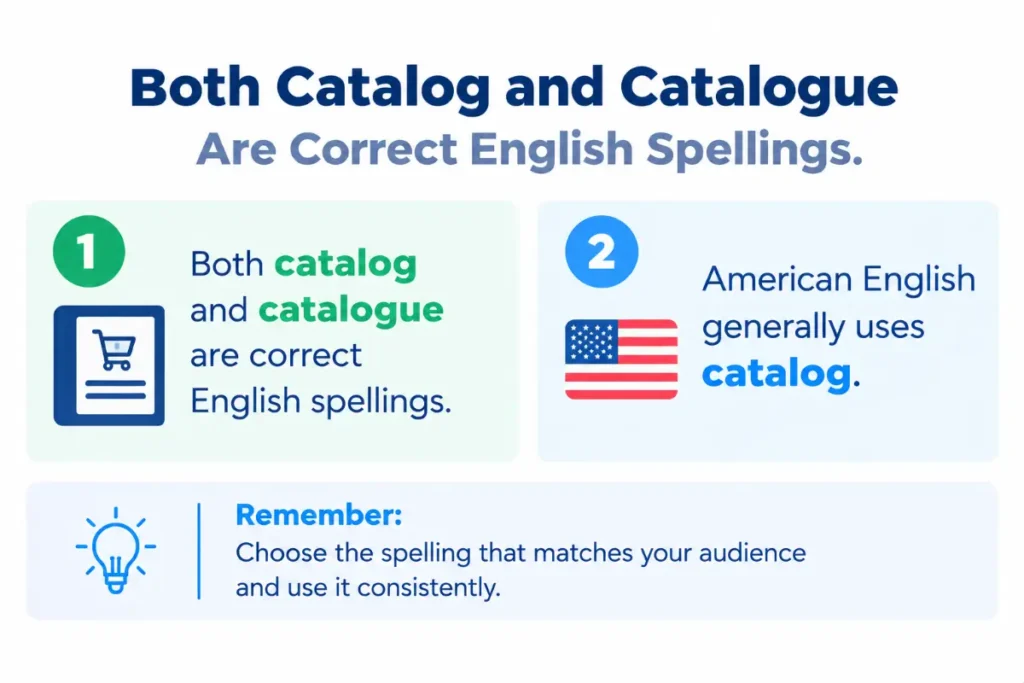
1. Both catalog and catalogue are correct English spellings.
2. American English generally uses catalog.
3. British English generally uses catalogue.
4. Both spellings have the same meaning and pronunciation.
5. Both forms can function as nouns and verbs.
6. American verb forms include cataloging and cataloged.
You may also want to read Natzi or Nazi Meaning, Usage, and Correct Form 2026.
Conclusion
The choice between catalogue or catalog depends mainly on your audience and regional spelling conventions. Both forms are correct, and both describe an organized collection of information or the act of arranging items systematically. In American English, catalog is the usual choice. In British English, catalogue is more common. The same regional distinction generally applies to related verb forms such as cataloging and cataloguing.
Remember this simple editing tip. Match your spelling to your readers, then use the same form throughout your document. Once you know this rule, choosing the right spelling becomes an easy part of clear and professional writing.
FAQs
Is catalogue or catalog the correct spelling in American English?
Catalog is the preferred spelling in American English. It is standard in US business documents, school assignments, retail websites, and library systems. The longer form catalogue is also a legitimate English word, but it is more closely associated with British spelling conventions. For American readers, choose the shorter form unless a specific style guide requires otherwise.
Is catalogue a real English word?
Yes. Catalogue is a standard English word used widely in British English and other varieties that follow British spelling conventions. It refers to an organized collection of information or the act of arranging items in a list. It is not a misspelling of the American form and can appear in formal documents, academic writing, and everyday communication.
What does catalog mean?
A catalog is an organized collection of information about products, books, services, records, or other items. It helps people find and identify what they need. For example, a store may publish a product catalog, while a university may provide a catalog of courses. The word can also function as a verb meaning to record or organize items systematically.
How do you pronounce catalog and catalogue?
Both forms generally have the same pronunciation. The word has three syllables, with the main stress on the first syllable. The exact vowel sounds can vary between American and British accents. The final letters in the longer spelling do not add another syllable, so you should pronounce the two forms naturally rather than sounding out every written letter.
Can catalog be used as a verb?
Yes. Catalog is both a noun and a verb in American English. As a verb, it means to record, classify, or organize items systematically. For example, a librarian may catalog new books, or a researcher may catalog observations. British English generally uses catalogue as the verb and catalogued for its past tense.
What is another word for catalog?
Useful alternatives include list, inventory, directory, register, and database. However, these terms have different meanings. A list may contain only a few items, while an inventory often tracks goods or property. A directory helps people find names or services, and a database stores structured information. Choose a substitute that fits the purpose of the collection.
Why do people confuse catalog and catalogue?
People confuse the two forms because English has different spelling conventions across regions. American English often favors shorter spellings, while British English retains certain traditional endings. Both forms are accepted, so the confusion usually comes from differences in regional expectations rather than a lack of grammatical knowledge. Checking the intended audience helps you make the right choice.
Is catalog appropriate for formal writing?
Yes. Catalog is entirely appropriate for formal American English. You can use it in academic papers, business reports, product documentation, and professional emails. The longer spelling is also suitable for formal writing in regions that prefer it. The key is to follow the relevant style guide and maintain consistent spelling throughout the document.