
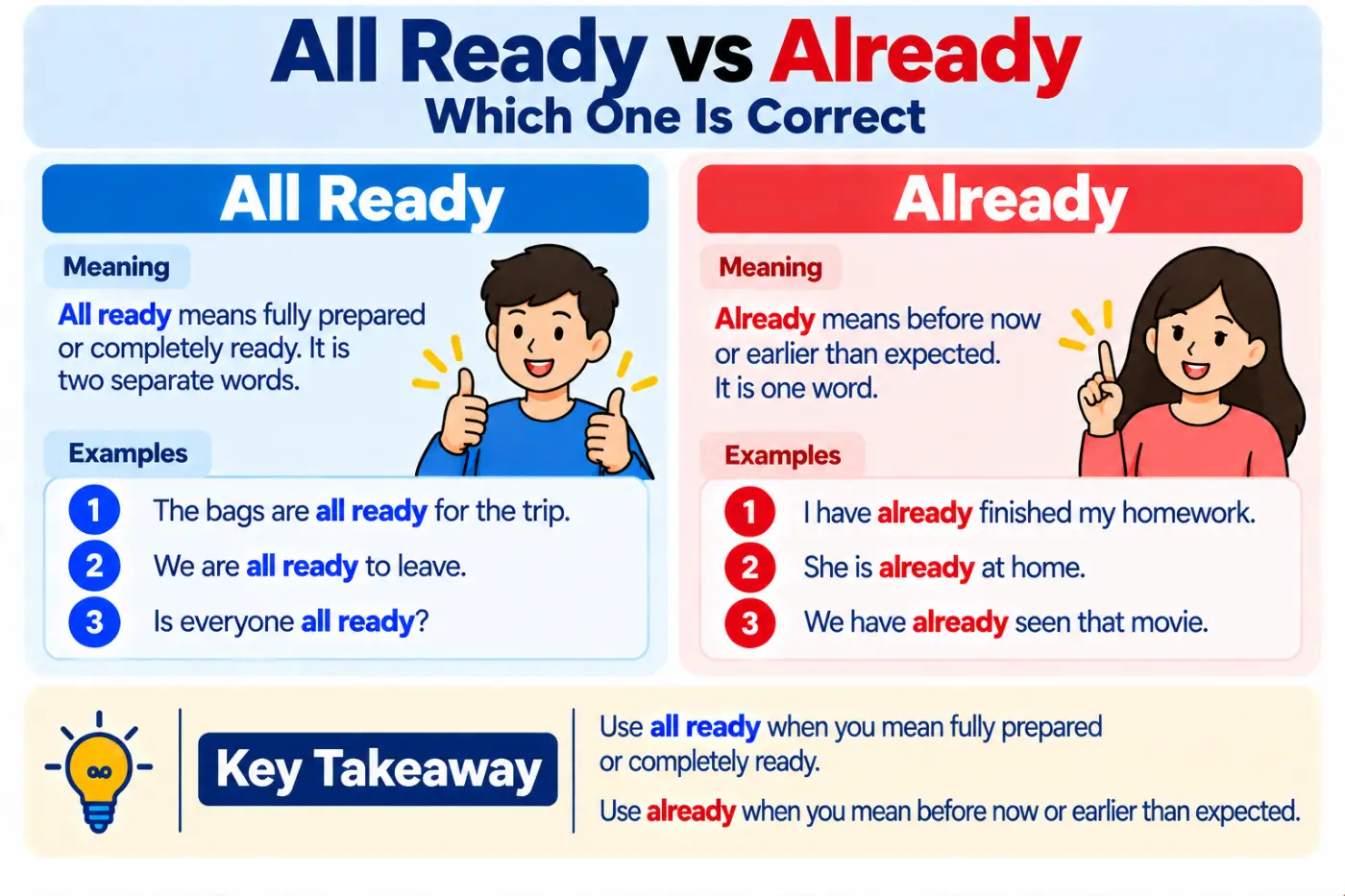
Have you ever paused while writing a message because you couldn’t decide between two words that sound almost the same? The difference between all ready vs already is simple once you understand what each expression means. All ready means everyone or everything is prepared. Already means something has happened before now or sooner than expected.
These expressions may sound alike in everyday American English, but they don’t serve the same purpose. Using the wrong one can change the meaning of your sentence. For example, saying that the team is all ready means the team is prepared to begin. Saying that the team has already started means the action has begun.
The good news is that you don’t need to memorize a long list of grammar rules. A simple meaning based test will help you choose the right form in emails, school assignments, text messages, and professional documents. You’ll also learn how to pronounce both expressions, avoid common mistakes, understand their origins, and use them naturally in American English.
Still confused? Compare convertor vs converter Which Form Is Correct.
Short Answer
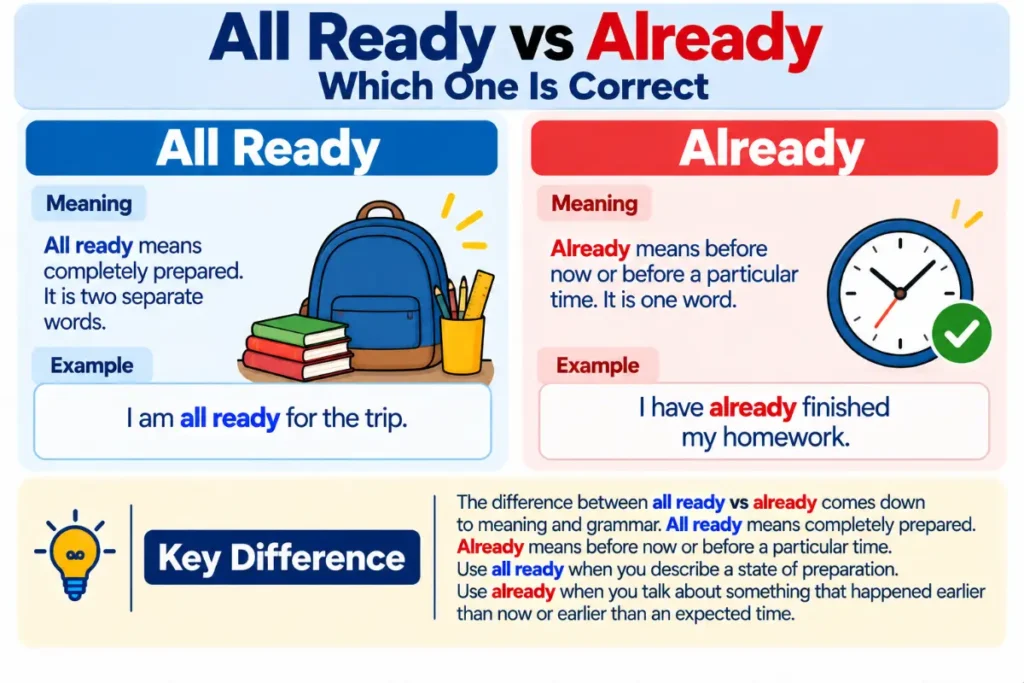
All ready means completely prepared or ready as a group. Already means by this time, before now, or sooner than expected. Both forms are correct English, but they have different meanings and grammatical functions. Use all ready for preparation and already for time.
Meaning and Definition
What Does All Ready Mean?
All ready is a two word expression that means everyone or everything is prepared. The word all refers to the whole group or the entire amount, while ready describes a state of preparation.
For example, if a family has packed its bags, checked the tickets, and gathered at the door, everyone may be all ready to leave. The expression focuses on the state of being prepared rather than the time an action happened.
You can use this phrase with people, objects, teams, plans, or tasks.
- The students are all ready for the exam.
- The meals are all ready for delivery.
- We are all ready to begin the meeting.
- The equipment is all ready for the demonstration.
In each example, the phrase tells you that the people or things are prepared.
What Does Already Mean?
Already is an adverb that refers to something that has happened before a particular time or earlier than expected. It often appears when the speaker wants to show that an action is complete or that something happened sooner than someone thought.
For example, if your friend asks you to submit a report and you finished it yesterday, you can say, I have already submitted the report. The word already tells your friend that the action is complete before the current moment or expected deadline.
Here are more examples.
- She has already left for work.
- We already know the answer.
- The movie has already started.
- He arrived earlier than expected and was already waiting outside.
The word doesn’t mean prepared. It tells the reader or listener when something happened or how soon it happened.
Comparison Table for Both Forms
| Feature | All Ready | Already |
|---|---|---|
| Spelling | Two separate words | One word |
| Meaning | Completely prepared | Before now or sooner than expected |
| Part of speech | Phrase containing a determiner and adjective | Adverb |
| Main purpose | Describes readiness | Describes time or completion |
| Common context | Travel, meetings, school, events | Completed tasks, past events, expectations |
| Formality | Standard in formal and informal English | Standard in formal and informal English |
| Example | We are all ready to leave. | We have already left. |
| Common mistake | Using it to mean something happened earlier | Using it to mean everyone is prepared |
The central difference is meaning. The two forms aren’t interchangeable simply because their sounds are similar.
Key Differences Explained
Spelling and Meaning
The first difference is easy to see. All ready contains a space, while already is a single word. That small spelling difference changes the meaning of the sentence.
Consider these examples.
- The children are all ready for school. This means the children are prepared.
- The children have already gone to school. This means they left before now.
Both sentences are grammatically correct, but they describe different situations. In the first sentence, the children are prepared to go. In the second, they have already completed the action of leaving.
Grammar and Part of Speech
Already functions as an adverb. It can modify a verb or help communicate that an event occurred before a particular time.
For example, in the sentence She has already finished her homework, the word already adds a time related meaning to the completed action.
All ready works as a phrase. The word ready is an adjective that describes a state of preparation, while all indicates the full group or amount.
For example, in the sentence We are all ready for dinner, the phrase describes the group’s readiness.
Pronunciation
In standard American English, both expressions are commonly pronounced the same way. Their shared pronunciation helps explain why people sometimes confuse them while writing.
However, identical pronunciation doesn’t make two expressions identical in meaning. English contains many words and phrases that sound alike but function differently. Context helps readers and listeners understand which meaning the speaker intends.
Formality and Context
Both forms are acceptable in professional and casual communication. Neither is automatically more formal than the other.
Use all ready when discussing preparation in a work email, school notice, or everyday conversation. Use already when reporting completed work, describing an earlier event, or explaining that something happened sooner than expected.
For example, The documents are all ready for review means the documents are prepared. The documents have already been reviewed means someone completed the review.
Which Form Is Correct?
Both forms are correct English. The right choice depends on the meaning you want to express.
Use all ready when you can replace the expression with completely prepared or everyone and everything is prepared. Use already when you can replace it with before now or sooner than expected.
Compare these sentences.
- We are all ready for the presentation. Everyone is prepared.
- We have already given the presentation. The event took place before now.
- The food is all ready. The food is prepared.
- The food has already been served. The serving happened earlier.
A reliable editing method is to check the intended meaning before checking the spelling. If your sentence describes preparation, choose the two word form. If it refers to time or an earlier action, choose the single word form.
Sentence Examples
Here are ten natural examples that show how the two forms work in everyday English.
- All the guests are ready for dinner, so we can say that they are all ready to eat.
- I have already sent the email to my manager.
- The students are all ready to take their final exam.
- We already booked the hotel for our vacation.
- The team is all ready for the championship game.
- She has already finished her science project.
- Are you all ready to leave for the airport?
- The store has already closed for the evening.
- The volunteers are all ready to help at the community event.
- I already know what you’re going to say.
Notice how the meaning changes with the context. The preparation phrase describes a condition, while the adverb places an action or situation in relation to time.
Common Mistakes and How to Fix Them
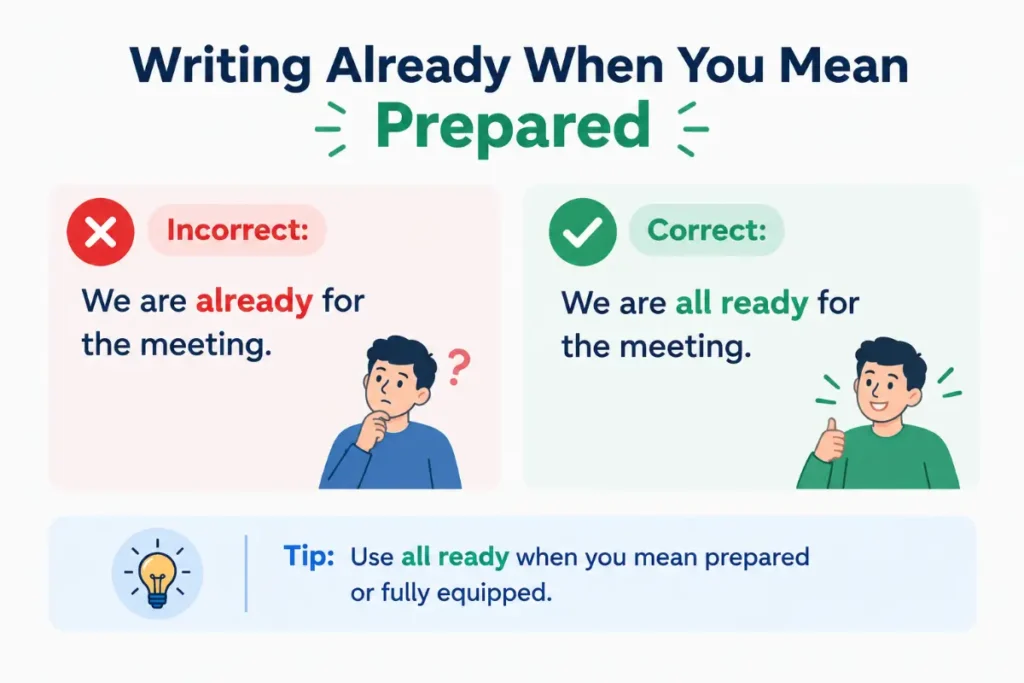
Using Already to Describe Preparation
Incorrect: We are already for the meeting.
Correct: We are all ready for the meeting.
The first sentence is missing the adjective ready. If you mean that everyone is prepared, use the two word phrase.
Using All Ready to Describe a Completed Action
Incorrect: I have all ready completed my assignment.
Correct: I have already completed my assignment.
The sentence refers to a completed action, not a state of preparation. The single word is the right choice.
Assuming the Two Forms Are Interchangeable
Incorrect: The train has all ready departed.
Correct: The train has already departed.
The train’s departure happened before the current moment. The sentence doesn’t describe a group or object being prepared.
Splitting the Single Word by Accident
Incorrect: She has allready called the office.
Correct: She has already called the office.
Allready is a common spelling error, but it isn’t the standard spelling of the adverb. Keep the letters together when you mean before now.
Choosing a Form Based Only on Sound
Incorrect: The guests have all ready arrived.
Correct: The guests have already arrived.
The correct sentence reports an earlier event. Although the two expressions sound alike, the meaning of the sentence determines the spelling.
A quick proofreading habit can prevent these mistakes. Read the sentence and ask yourself if it describes preparation or timing before you decide how to spell the expression.
Pronunciation Guide
How to Pronounce Both Forms
In standard American English, both forms are generally pronounced /ɔːl ˈrɛdi/ in a careful pronunciation. The vowel in all may vary slightly by speaker and regional accent. In ordinary conversation, the expressions often sound nearly identical.
The pronunciation guide is simple.
- All ready: all + ready.
- Already: al + ready, spoken as one word.
The two expressions share the same general sound pattern. Their spelling and meaning provide the key distinction.
Syllable Breakdown and Stress
Both forms usually have three spoken syllables when pronounced carefully: all, read, and y. The main stress falls on the first syllable of ready.
The word already may be spoken with a smooth connection between its parts. The phrase all ready may also flow together in rapid speech. Speakers don’t always pause between the two words, so listening alone may not reveal which form they mean.
Common Pronunciation Mistakes
A common mistake is to assume that already must sound different because it has one word in writing. In everyday American speech, the difference may not be clear.
Don’t force an unnatural pause into all ready just to make the phrase sound different. Instead, focus on the intended meaning and use the correct written form.
Many readers also check authorization or authorisation Correct Spelling And Usage.
Etymology and Word Origin
The history of these expressions helps explain why their meanings are related but distinct.
The Origin of Ready
Ready comes from Old English ræde, a word associated with being prepared or in a suitable condition. Its history connects with ideas of being prepared for action or being in a state to act.
The modern adjective retains that central meaning. A ready person can act, a ready room can receive guests, and a ready team can begin a match.
The Origin of Already
Already developed from the older English expression all ready. Over time, the expression became established as a single adverb with a time related meaning.
This development illustrates a common process in English. A phrase can become a single word as speakers use it repeatedly in a particular way. The modern adverb has its own established meaning and grammatical role, so writers shouldn’t treat it as merely a shortened spelling of the original phrase.
Why the Meanings Still Cause Confusion
The two forms share a historical connection and similar sounds. Both also contain the idea of something being in a particular state. However, modern usage separates their functions.
All ready focuses on preparedness. Already focuses on time, completion, or an event occurring earlier than expected. Remembering these separate meanings is more useful than trying to memorize the spelling alone.
Regional Usage
American English
Both expressions are standard in American English. Writers use all ready to describe preparation and already to refer to something that happened before now or sooner than expected.
For example, The crew is all ready for takeoff describes the crew’s preparation. The plane has already taken off describes a completed event.
British English
British English uses the same distinction. There is no major difference in spelling or meaning between standard British and American usage for these expressions.
A British writer might say The children are all ready for school or The children have already left. The grammar works in the same way as it does in American English.
Australian English
Australian English follows the same standard distinction. The two word phrase describes readiness, while the single word adverb refers to an earlier event or a situation that has occurred before the expected time.
Local pronunciation may vary, but the written forms retain their usual meanings.
Canadian English
Canadian English also uses both forms in the same way. Writers should select the expression that matches the sentence’s meaning rather than rely on regional spelling rules.
In short, this isn’t a case where American and British English use different spellings for the same word. The distinction is broadly shared across these English varieties.
Grammar Rules and Part of Speech
How to Use All Ready in a Sentence
All ready commonly appears after a linking verb such as is, are, was, or were. It can also appear in sentences that describe a group or set of things that has reached a state of preparation.
Examples include the following.
- We are all ready for the trip.
- The rooms were all ready before the guests arrived.
- The tools are all ready to use.
In these examples, ready acts as an adjective. The word all indicates that the statement applies to the entire group or amount.
The phrase can also appear in questions. For example, Are you all ready to start? asks if everyone is prepared.
How to Use Already in a Sentence
Already can appear in different parts of a sentence. Its position often depends on the verb structure and the emphasis the writer wants to create.
Examples include the following.
- I already know the answer.
- She has already left.
- They had already finished before we arrived.
- The meeting is already underway.
With many auxiliary verb combinations, already appears after the first auxiliary verb and before the main verb. In a simple present sentence, it often appears before the main verb.
English allows some flexibility in word order, so the best position can depend on the sentence. The key is to make the time related meaning clear.
Can Already Start a Sentence?
Yes. Already can start a sentence when the writer wants to emphasize that something has happened sooner than expected or that a situation exists before the reader might think.
For example, Already, the team had received three offers before the season began.
This structure is grammatical, although it may sound more emphatic than placing the adverb later in the sentence. In everyday writing, the sentence often reads more naturally without the opening adverb unless the writer wants that emphasis.
Can All Ready Start a Sentence?
Yes. The phrase can start a sentence when it forms part of a larger statement, question, or description.
For example, All ready for the trip, the family waited beside the car.
Here, the opening phrase describes the family’s state of preparation. This construction is more compressed than a full sentence such as The family was all ready for the trip.
Punctuation Rules
Neither form needs special punctuation because of its spelling. Add commas only when the sentence structure calls for them.
For example, Already, the staff had prepared the room places the adverb at the beginning and uses a comma after it for a natural pause. The staff had already prepared the room needs no comma around the adverb.
Similarly, All ready for the event, the guests gathered near the entrance uses a comma to separate an introductory phrase from the main clause.
Real Life Usage Examples
Daily Conversation
People use these expressions naturally when discussing plans, preparation, and events.
- Are we all ready to head out?
- I already ate, so I’ll just have a drink.
The first sentence asks about readiness. The second reports that an action happened before the present conversation.
Email and Workplace Communication
In professional communication, choosing the correct form helps keep instructions and updates clear.
- The presentation materials are all ready for tomorrow’s client meeting.
- I’ve already shared the updated file with the project team.
The first example confirms preparation. The second confirms that the file sharing has happened.
Academic Writing
Students and researchers can use both forms in appropriate contexts.
- All the required materials were ready before the laboratory session began.
- The researchers had already collected the initial data when the second phase started.
In the first example, the wording describes preparation. In the second, the adverb establishes the timing of an earlier action.
News and Journalism
News writing often uses the adverb to describe events that have happened before a specific point in a developing story.
- Officials had already issued a public statement before the press conference began.
- The emergency crews were all ready to respond when the storm reached the coast.
The first example focuses on timing. The second describes preparedness.
Literature and Storytelling
Writers use both forms to set a scene or move a story forward.
- The travelers were all ready when the first light appeared over the hills.
- By the time Mara reached the station, the last train had already departed.
The first sentence establishes a prepared group. The second uses an earlier event to create a sense of urgency.
Related and Confused Terms
Several expressions can help you understand the distinction more clearly.
1. Ready
Ready is an adjective that means prepared or in a suitable state to act.
Example: The room is ready for the guests.
Unlike the phrase all ready, this word alone doesn’t necessarily say that every person or item in a group is prepared.
2. All Set
All set is an informal expression that means fully prepared or ready to proceed.
Example: We’re all set for the meeting.
It often serves as a natural alternative to all ready, although the best choice depends on the sentence.
3. Prepared
Prepared means ready for an action or event, often because someone has made plans or taken steps in advance.
Example: The staff is prepared for the inspection.
This word can help you test the meaning of all ready. If prepared fits your intended sentence, the two word expression may be appropriate.
4. Previously
Previously is an adverb that means at an earlier time.
Example: The policy was previously used by the department.
It shares a time related function with already, but it doesn’t always carry the same sense of completion or unexpected timing.
5. Earlier
Earlier refers to a time before the present or before another event.
Example: We arrived earlier than planned.
It can replace already in some contexts, but not all. The sentence We already know the answer doesn’t always have the same emphasis as We knew the answer earlier.
6. Yet
Yet often refers to something expected that hasn’t happened up to a particular time. In questions and negative statements, it frequently appears near the end of the clause.
Example: Have you finished the report yet?
Already and yet can contrast in meaning. One often signals that something has happened, while the other may signal that it hasn’t happened so far.
7. Still
Still describes a condition or action that continues.
Example: She is still preparing the presentation.
Still and already have different time meanings. Someone who is still preparing hasn’t necessarily finished, while someone who has already finished has completed the action.
8. All Together
All together means everyone or everything is in one group or place.
Example: The family sat all together at the table.
This expression can be confused with altogether, which means completely or entirely in many contexts. Neither form means already. The words may look similar, but their meanings and grammatical roles differ.
Expert Editor Insight
An experienced editor checks meaning before correcting spelling. If a sentence describes people or things that are prepared, all ready is the natural choice. If it reports an event that happened before now or sooner than expected, already fits. Spelling tools may flag allready as an error, but they may not catch every incorrect use of all ready in a grammatically possible sentence. Read the full sentence and test its meaning. That extra check often catches errors that automated tools miss.
Key Takeaways
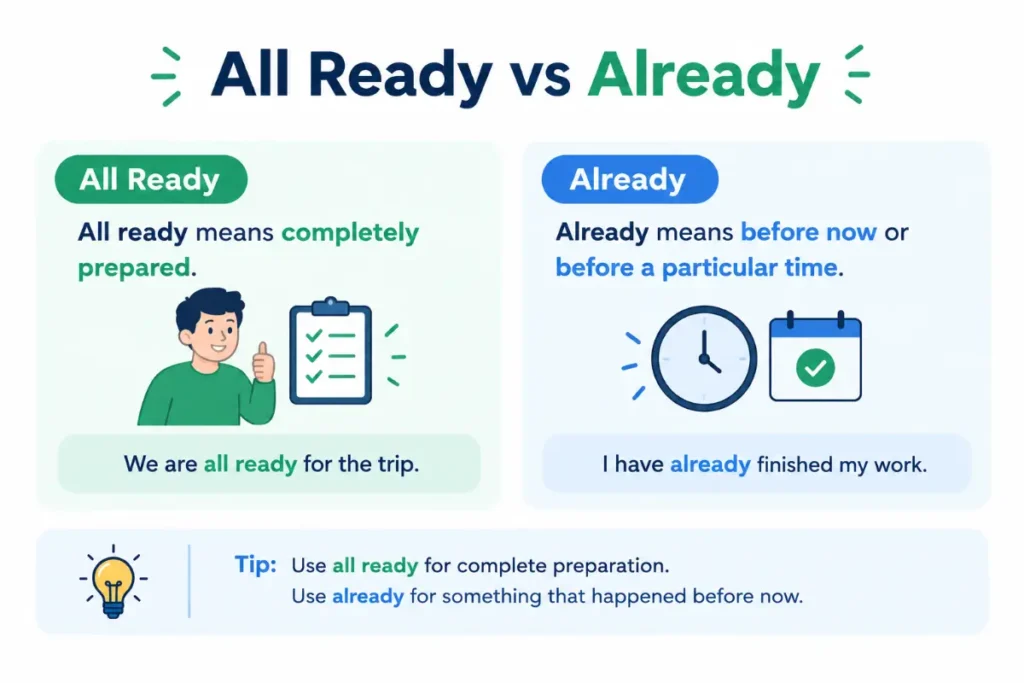
- All ready means completely prepared.
- Already means before now or before a particular time.
- All ready contains two separate words.
- Already is one word.
- All ready works as an adjective phrase.
- Already works as an adverb.
- Use the preparation test when you are unsure.
- Remove all and see if ready still makes sense.
- Use already when the sentence focuses on earlier timing.
- Use all ready when the sentence focuses on preparation.
- Both forms are standard in American and British English.
- The pronunciation can make the forms difficult to distinguish in conversation.
A related grammar guide is Developed vs Developped Which Spelling Is Correct?(2026).
Conclusion
The difference between all ready vs already comes down to preparation and time. All ready means everyone or everything is prepared, while already tells you that something happened before now or sooner than expected. Both forms are correct, and neither should replace the other without a change in meaning.
When editing, ask yourself one simple question: Am I describing readiness or reporting an earlier event? If you’re describing preparation, write two words. If you’re talking about timing, use one word. This small habit will help you avoid a common spelling mistake in everyday messages, workplace emails, school assignments, and formal writing.
FAQs
Is All Ready One Word or Two Words?
All ready is written as two words when it means completely prepared or when it refers to everyone or everything being ready. Already is written as one word when it means before now or sooner than expected. The distinction isn’t optional in standard writing because each form communicates a different meaning.
Is Already a Real Word?
Yes. Already is a standard English adverb used to describe something that has happened before now or earlier than expected. For example, I have already finished my work tells the reader that the task is complete. It is not a misspelling of the two word phrase, even though the forms share a historical connection.
What Does All Ready Mean in Simple English?
All ready means everyone or everything is prepared. You might say, We are all ready to leave, when everyone has gathered their belongings and can begin the trip. A useful way to remember the meaning is to replace the phrase with completely prepared. If the sentence still makes sense, the two word form is likely correct.
Can I Use Already in Formal Writing?
Yes. Already is appropriate in academic papers, professional emails, reports, journalism, and other formal writing. Use it when you need to show that something happened before a particular time or sooner than expected. For example, The committee had already approved the proposal before the final review began is a clear and standard sentence.
Can All Ready and Already Sound the Same?
Yes. In standard American English, the two expressions are commonly pronounced alike or very similarly. This makes the confusion understandable, especially in fast conversation. However, the written distinction remains important. Use the meaning of the sentence to choose the spelling instead of relying on sound alone.
Can Already Start a Sentence?
Yes. You can place already at the beginning of a sentence to emphasize that something happened sooner than expected or was true earlier than anticipated. For example, Already, the store had run out of supplies. This position can sound emphatic, so writers often place the word later in the sentence for a more neutral tone.
What Is a Synonym for Already?
Possible alternatives include previously, earlier, and by this time, depending on the context. These expressions aren’t exact substitutes in every sentence. For example, I have already eaten and I ate previously communicate related ideas, but the second sentence may sound less natural in everyday conversation. Choose a substitute that preserves the intended time relationship.
Why Do People Confuse All Ready and Already?
People confuse these forms because they sound alike and share a historical connection. Fast speech also makes the word boundary difficult to hear. The best solution is to focus on meaning. If you are describing preparation, use all ready. If you are describing an event that happened before now or sooner than expected, use already.