

Have you ever struggled to choose between imply vs infer while writing an email, answering a question, or explaining what someone meant? You’re not alone. These two words are often confused because both describe how people communicate and understand meaning. However, they refer to different sides of the same process.
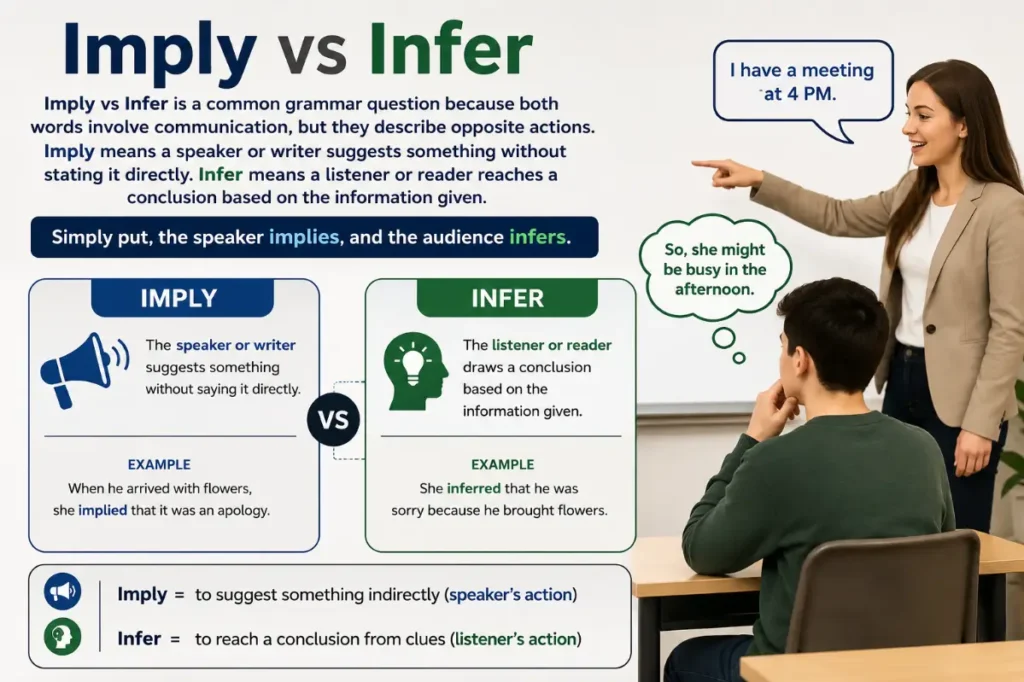
Imply vs infer comes down to one simple distinction. A speaker or writer implies something by suggesting it without stating it directly. A listener or reader infers something by drawing a conclusion from the words, actions, or evidence they notice.
For example, if your friend says, “It’s getting late,” they might imply that it’s time to leave. If you take that comment as a sign to head home, you infer that your friend wants to end the visit.
Once you understand who sends the message and who draws the conclusion, the difference becomes much easier to remember. You’ll also learn how to use both verbs in school assignments, workplace conversations, academic writing, and everyday situations without second guessing yourself.
You may also want to read Who vs Whom Explained With Simple Grammar Rules.
Short Answer
Imply means to suggest an idea without expressing it directly. Infer means to reach a conclusion from what someone says, does, or provides as evidence. Speakers and writers imply meanings, while listeners and readers infer those meanings. Both words are correct, but they serve different roles in communication.
Comparison Table
| Feature | Imply | Infer |
|---|---|---|
| Meaning | Suggest something indirectly. | Draw a conclusion from evidence. |
| Part of speech | Verb. | Verb. |
| Main role | Communicating an unstated meaning. | Understanding an unstated meaning. |
| Typical subject | A speaker, writer, statement, or action. | A listener, reader, observer, or investigator. |
| Common context | Conversation, emails, stories, and reports. | Reading, reasoning, research, and problem solving. |
| Example | Her reply implied that she was upset. | I inferred that she was upset from her reply. |
| Formality | Standard in casual and formal English. | Standard in casual and formal English. |
| Pronunciation | im PLY. | in FUR. |
What Does Imply Mean
To imply means to communicate an idea indirectly. A person may choose words that hint at a feeling, opinion, request, or intention without saying it outright. A statement can also imply something through its wording or context, even if the speaker doesn’t deliberately intend that result.
Imagine your coworker looks at a long list of unfinished tasks and says, “We have a lot to do before Friday.” The coworker states a fact, but the comment might also imply that everyone needs to work faster or share the workload.
The extra meaning comes from the situation rather than the literal words alone.
How Imply Works in a Sentence
The verb usually takes a person, statement, action, or piece of writing as its subject. It often appears in these patterns.
- Imply something. Her silence implied disappointment.
- Imply that something is true. The report implies that sales may decline.
- Imply something to someone. He didn’t mean to imply that you were careless.
The word doesn’t always signal a hidden message. Sometimes a statement indirectly suggests a clear conclusion, while in other cases its meaning remains open to interpretation.
For instance, saying “Some people arrived on time” may imply that others arrived late. However, that conclusion depends on context. The sentence doesn’t prove that anyone was late.
This distinction matters in professional writing because an implied message can sound stronger than the evidence supports.
What Does Infer Mean
To infer means to reach a conclusion based on clues, facts, observations, or information. You infer something when you use what you know to understand something that hasn’t been stated directly.
Suppose your friend walks into the room with a wet umbrella and water dripping from their jacket. You might infer that it has been raining outside. Your friend hasn’t told you about the weather, but the evidence helps you reach a reasonable conclusion.
Inference is a basic part of everyday thinking. You use it while reading a story, listening to a coworker, studying a report, or trying to understand someone’s mood.
How Infer Works in a Sentence
The verb commonly follows these patterns.
- Infer something from something. We inferred the cause from the available evidence.
- Infer that something is true. I inferred that the meeting had ended.
- Infer something about someone or something. The detective inferred the man’s intentions from his actions.
Notice the role of evidence. You don’t simply make a statement or send a message. You examine the available information and draw a conclusion.
That conclusion can be reasonable without being correct. If you see someone carrying an umbrella, you might infer that it will rain. However, the person could simply be carrying it after a storm or taking it somewhere for another reason.
Good reasoning means distinguishing a supported conclusion from a guess. The more reliable the evidence, the stronger your inference is likely to be.
Can You Infer Something From Silence
Yes. Silence can provide a clue, but it doesn’t automatically reveal what someone thinks.
For example, you ask a friend if they enjoyed a movie, and they pause before answering. You might infer that they didn’t like it. However, they may simply be choosing their words carefully or remembering a particular scene.
Your conclusion comes from the pause and the situation. It isn’t a confirmed fact about your friend’s opinion.
This is why careful writers often use phrases such as “I inferred that,” “the evidence suggests,” or “it appears that” when the available information doesn’t establish a conclusion beyond doubt.
The Key Differences Explained
The main difference involves the direction of communication. One word describes sending an indirect message. The other describes interpreting available information.
The Speaker and the Listener Have Different Roles
Think of communication as a game of catch. One person throws the ball, and another person catches it. The actions belong to the same exchange, but each person does something different.
Implying and inferring work in a similar way.
- A speaker implies an idea through words, tone, or actions.
- A listener infers an idea from those clues.
- The listener’s conclusion may match the speaker’s intention, or it may not.
Consider this example.
A manager says, “The report would be stronger with more recent data.”
The manager implies that the current report needs improvement. An employee infers that they should update the data before submitting the report.
The two actions are connected, but they aren’t interchangeable. The manager communicates an indirect message, while the employee interprets it.
Meaning and Purpose
Implying focuses on what a message suggests beyond its direct wording. Inferring focuses on what a person concludes from the available information.
For example, a teacher says, “Several students remembered to include their sources.” The teacher may imply that some students forgot to include theirs. A student may infer that the teacher expects better citation practices in future assignments.
The first action concerns the message. The second concerns the interpretation.
Grammar and Sentence Structure
Both words are verbs, so you can use them to describe actions in the present, past, or future.
| Verb form | Imply | Infer |
|---|---|---|
| Present | I imply. | I infer. |
| Third person | She implies. | She infers. |
| Past tense | She implied. | She inferred. |
| Present participle | Implying. | Inferring. |
| Past participle | Implied. | Inferred. |
The verbs follow different spelling patterns in their past forms. The final consonant changes in writing because of the way each verb forms its past tense and participles.
You might write, “His comments implied that he was worried,” or “I inferred from his comments that he was worried.”
Both sentences are grammatical. The first describes what the comments suggested. The second describes the conclusion the listener reached.
Intention and Evidence
Another useful distinction involves intention and evidence.
A person can imply something intentionally or unintentionally. A poorly worded statement might suggest an idea the writer never meant to communicate.
Inference, by contrast, describes a conclusion drawn by someone examining information. That conclusion may be strong, weak, or mistaken.
For example, a news headline might imply that a company acted dishonestly. A reader might infer that the company broke the law. Yet the headline alone may not provide enough evidence to support that conclusion.
The reader has moved from an indirect suggestion to a stronger claim. Recognizing that gap helps prevent misunderstandings and unfair judgments.
Which Word Should You Use
Choose the word based on the action you want to describe. If someone communicates an indirect meaning, use imply. If someone reaches a conclusion from clues or evidence, use infer.
A simple way to check your choice is to ask yourself two questions.
- Is someone suggesting something without saying it directly? Use imply.
- Is someone working out what something means from the information available? Use infer.
Consider a workplace example. Your supervisor says, “Some team members have been submitting reports late.” The statement may imply that deadlines need more attention. You infer that your own reporting habits could be under review.
The word you need depends on the action in your sentence, not on the subject matter. Both verbs can describe the same conversation from different points of view.
A Memory Trick That Works
Remember this simple rule.
Imply means to send a hint. Infer means to figure out the hint.
You can also connect the verbs to the people involved. The person communicating suggests a meaning. The person receiving the message interprets it.
This trick works in conversations, reading comprehension questions, workplace emails, and academic assignments. If you’re unsure, identify who is doing what before choosing the verb.
Does One Word Sound More Formal
Neither word is automatically more formal than the other. Both appear in everyday American English and in professional, academic, and legal writing.
The difference is meaning, not formality. You can imply something during a casual conversation, and you can infer something while analyzing scientific evidence.
In formal writing, accuracy matters because the wrong verb can reverse the meaning of a sentence. A researcher who says that the results imply a conclusion is describing what the findings suggest. A researcher who infers a conclusion is describing the reasoning used to reach it.
Ten Natural Sentence Examples
These examples show how the two verbs work in everyday situations. Pay attention to the person communicating the message and the person drawing the conclusion.
- Everyday conversation. When Jake said he had an early morning, he implied that he couldn’t stay out late.
- Text messages. Her short reply made me infer that she was busy.
- At work. The supervisor’s comments implied that the team needed to improve its communication.
- School assignments. From the character’s actions, students can infer that he feels guilty.
- Academic writing. The findings imply a possible link between sleep quality and concentration.
- Formal writing. The available records imply that the agreement was changed after the original meeting.
- Social situations. I inferred from her smile that she was happy to see us.
- Online communication. The post seemed to imply that the company was changing its policies.
- Reading comprehension. Readers infer a character’s feelings from dialogue and behavior.
- Family conversations. Dad’s comment about the empty refrigerator implied that someone needed to buy groceries.
Each sentence uses the verb that matches the action. The first person or thing suggests a meaning, or the observer reaches a conclusion from the available clues.
Common Mistakes and How to Avoid Them
Most errors happen because people treat these verbs as interchangeable. They are closely related, but they describe different actions.
Mistake One Using the Verbs Interchangeably
Incorrect: I implied from the evidence that the plan would fail.
Correct: I inferred from the evidence that the plan would fail.
The sentence describes a conclusion drawn from evidence. It doesn’t describe an indirect message sent by the speaker.
Mistake Two Reversing the Speaker and Listener
Incorrect: The reader implied that the author was criticizing the government.
Correct: The reader inferred that the author was criticizing the government.
The reader interprets the author’s words. The author may imply criticism through the writing, but the reader infers that meaning.
Mistake Three Assuming Every Hint Proves a Fact
Incorrect: Her silence implies that she is angry, so I know she is upset.
Better: Her silence led me to infer that she was angry, but I couldn’t be sure.
An indirect message or a personal conclusion doesn’t automatically establish the truth. Context and evidence matter.
Mistake Four Using the Wrong Verb Pattern
Incorrect: I inferred the message that she implied to me from her silence.
Better: I inferred from her silence that she was upset.
The first sentence is unnecessarily tangled. The second makes the reasoning clear and avoids repeating the same idea.
Both verbs can take a clause introduced by “that.” For example, “Her words implied that she needed help” and “I inferred that she needed help from her words” are correct.
Mistake Five Confusing Inference With Guessing
Incorrect: I inferred that the store was closed because I felt like it might be.
Better: I inferred that the store was closed because the lights were off and the doors were locked.
An inference should rest on some evidence. The evidence doesn’t have to prove the conclusion beyond doubt, but it should give you a reasonable basis for reaching it.
Pronunciation Guide
Both words have two syllables, and the main stress falls on the second syllable. Their first syllables sound similar, but the stressed vowels differ.
You may also want to read Borrow vs Barrow Explained With Examples.
Imply
IPA: /ɪmˈplaɪ/.
Sounds like im PLY.
Stress the second syllable.
Infer
IPA: /ɪnˈfɜr/.
Sounds like in FUR.
Stress the second syllable.
How to Pronounce Each Word
For imply, start with a short vowel sound, then say the final part like the word “ply.” Keep the stress on the second syllable.
For infer, begin with the short vowel sound in “in,” then say the second syllable like “fur” in American English. The final sound is an R sound.
A common mistake is to stress the first syllable in both words. In standard American English, the second syllable carries the main stress.
You don’t need to exaggerate the difference between the first syllables. Focus on the stressed vowel and the final consonant sounds. Clear stress helps listeners recognize the words in conversation.
Etymology and Word Origin
The historical roots of these verbs help explain their meanings. Both entered English through Latin, but their original senses developed along different paths.
Where Imply Comes From
Imply traces back to the Latin verb implicare, meaning to involve, entangle, or enfold. The idea of something being folded into or contained within another thing helps explain the modern sense of suggesting a meaning without expressing it openly.
Over time, the word developed its familiar use in English. Today, a statement can imply an idea that sits beneath its literal wording.
For example, “We could use another pair of hands” directly states a need for help. Depending on the situation, it may also imply a request for someone to volunteer.
Where Infer Comes From
Infer comes from the Latin verb inferre, meaning to bring in or carry into. Its later development in English gave it the sense of drawing a conclusion from facts or reasoning.
The modern verb describes a mental process. You take information you already have and use it to reach a conclusion that isn’t directly stated.
For example, a doctor may infer a likely cause from symptoms and test results. A reader may infer a character’s motivation from a scene in a novel.
Although their origins differ, both words now play important roles in how people send and interpret meaning.
Regional Usage in English
There is no major regional spelling distinction between these verbs in standard American, British, Canadian, or Australian English. Both forms are established English words, and both keep the same basic distinction across these varieties.
American English
In the United States, imply and infer are standard in everyday speech, education, journalism, and professional writing. American speakers use them to discuss indirect messages, evidence, reasoning, and interpretation.
For example, a manager might say that a comment implied a need for change. An analyst might infer a trend from sales figures.
British English
British English follows the same central distinction. Speakers and writers use imply for suggesting a meaning and infer for reaching a conclusion.
Spelling and pronunciation conventions can vary across English varieties, but these two verbs don’t have a special American versus British spelling difference.
Canadian English
Canadian English also uses both verbs with the same basic meanings. A student might infer an author’s message from a passage, while a report might imply that further review is needed.
The distinction remains the same in academic and professional contexts.
Australian English
Australian English follows the same usage pattern. A speaker can imply a request indirectly, and a listener can infer that request from the circumstances.
In all four varieties, context determines the appropriate verb. Regional spelling preferences don’t change the core rule.
Grammar Rules and Parts of Speech
Both words function as verbs. They describe actions involving communication and reasoning, and they fit into several common sentence patterns.
How to Use Imply Correctly
Use imply when a person, statement, action, or set of facts suggests a meaning.
- Subject plus imply plus object. His expression implied concern.
- Subject plus imply plus that clause. The email implies that the deadline has changed.
- Subject plus imply plus a noun phrase. Her response implied approval.
You can also use the past tense when describing an earlier message. For example, “His tone implied frustration during the call.”
The verb doesn’t require a hidden or secret meaning. A suggestion can be indirect without being difficult to understand. The key is that the message communicates more than its literal wording alone.
How to Use Infer Correctly
Use infer when someone reaches a conclusion from information or evidence.
- Subject plus infer plus object. We inferred the cause.
- Subject plus infer plus that clause. She inferred that the offer had expired.
- Subject plus infer plus conclusion plus from evidence. They inferred the answer from the available clues.
The phrase “infer from” is especially useful because it identifies the evidence behind the conclusion.
For example, “The investigators inferred from the records that the transaction occurred earlier than reported.” The records provide the basis for the investigators’ conclusion.
Tense and Agreement
Both verbs change form according to tense and subject.
In the present tense, write “She implies” and “He infers.” With plural subjects, write “They imply” and “They infer.”
For past actions, use “implied” and “inferred.” For ongoing actions, use “implying” and “inferring.”
Examples include “The letter implied a change in policy,” “The readers were inferring meaning from the passage,” and “The findings have implied a possible connection.”
The verbs don’t change according to formality. They change according to the grammar of the sentence.
Can You Start a Sentence With Either Word
Yes. Both verbs can begin a sentence when the sentence structure calls for them.
For example, “Implying that the project failed would be unfair without more evidence.” You could also write, “Infer the author’s message from the details in the final paragraph.”
The second example uses the base form as an instruction. Starting a sentence with either verb is grammatically acceptable.
Punctuation and Sentence Clarity
Neither verb requires special punctuation. Use commas, periods, and other marks according to the structure of the full sentence.
For example, “Her comment implied that the deadline had changed, but I inferred that the team still had another day.”
The comma separates two independent clauses joined by “but.” The choice of verbs comes from their meanings, not from punctuation rules.
When a sentence becomes confusing, name the person who communicates the message and the person who interprets it. That small change often makes the grammar easier to follow.
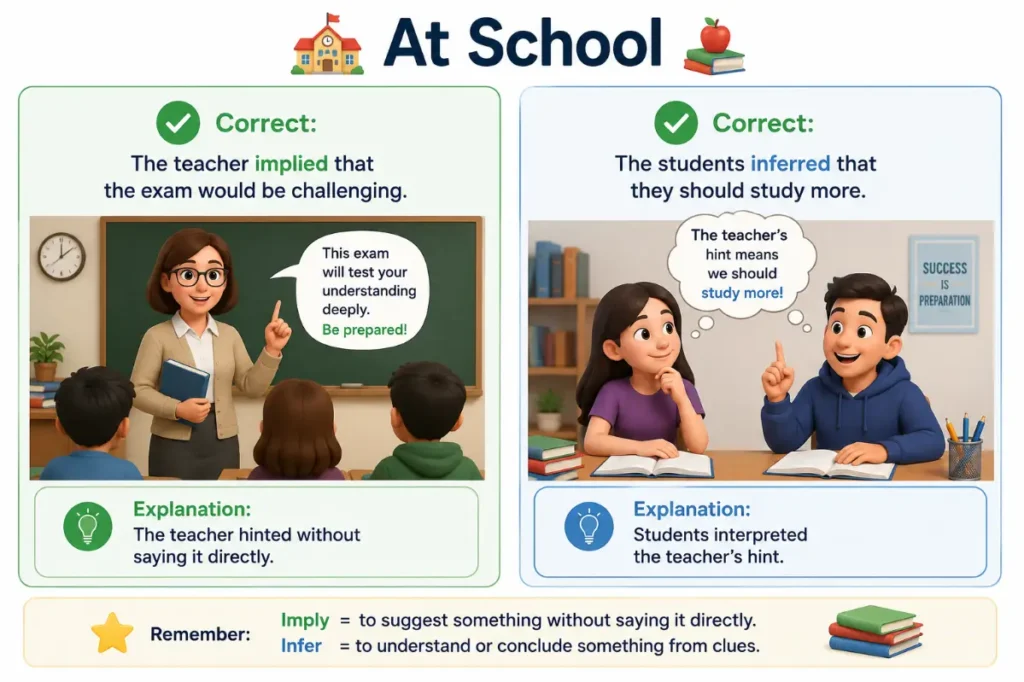
Real Life Usage Examples
The difference becomes easier to recognize when you see the words in different settings. The following examples show how they work in daily conversation, business communication, school, journalism, and storytelling.
Daily Conversation
Example One. “When Maria said she had already eaten, she implied that she didn’t need dinner.”
Maria communicates indirectly that she doesn’t want another meal. The listener interprets her statement in context.
Example Two. “I inferred from Ben’s yawn that he was tired.”
The speaker observes a physical clue and draws a conclusion. Ben’s yawn supports that conclusion, but it doesn’t prove the exact reason for his tiredness.
Email and Workplace Communication
Example One. “The client’s feedback implied that the presentation needed more detail.”
The feedback suggested a need for improvement without necessarily stating every required change.
Example Two. “From the revised schedule, we inferred that the launch had been delayed.”
The team used the new schedule to reach a conclusion about the launch date. The verb identifies the team’s reasoning process.
Academic Writing
Example One. “The author’s repeated references to isolation imply that the character feels disconnected from society.”
The writing suggests an idea through recurring details. The reader examines those details to understand the theme.
Example Two. “Researchers inferred a possible relationship from the observed pattern.”
The researchers drew a conclusion from the information they examined. The wording doesn’t claim that the pattern proves a cause and effect relationship.
News and Journalism
Example One. “The mayor’s remarks implied that further budget cuts were possible.”
The remarks suggested a possible future action without directly confirming a final decision.
Example Two. “Analysts inferred from the latest figures that consumer spending had slowed.”
The analysts interpreted numerical information and reached a conclusion. A careful report would distinguish that conclusion from a confirmed fact.
Literature and Storytelling
Example One. “The final scene implies that the main character has changed.”
The author uses the ending to suggest a change rather than explaining every detail directly.
Example Two. “Readers may infer that the missing letter contains a secret.”
Readers combine clues from the story to form an interpretation. Different readers may reach different conclusions because they notice different details.
These examples show that the distinction remains stable across different settings. The subject matter changes, but the difference between suggesting and concluding stays the same.
Related and Confused Terms
Several other words describe parts of communication, interpretation, and reasoning. Understanding them can help you choose more precise language.
1. Suggest. To suggest means to put forward an idea or point toward a possibility. It often works as a plain language alternative to imply. For example, “The results suggest a need for more testing.”
2. Indicate. To indicate means to point out or show something. A sign can indicate a road closure, while a report can indicate a change in performance. The evidence may be more direct than an implication.
3. Hint. A hint is a clue or indirect suggestion. A person might drop a hint about a birthday gift without naming it directly.
4. Conclude. To conclude means to reach a decision or judgment after considering information. It often describes a more settled result of reasoning, although the strength of the conclusion still depends on the evidence.
5. Deduce. To deduce means to reach a conclusion through logical reasoning from known facts or principles. Deduction often suggests a structured form of reasoning, while inference is a broader term.
6. Assume. To assume means to accept something as true without fully verifying it. An assumption may be reasonable, but it can also rest on little evidence. An inference generally refers to a conclusion drawn from available clues or information.
7. Interpret. To interpret means to explain or understand the meaning of information, behavior, language, or events. Interpretation can involve inference, but it may also include explaining a meaning that is stated directly.
8. Insinuate. To insinuate means to suggest something indirectly, often in a way that carries a negative or critical tone. Someone may insinuate that a coworker acted dishonestly without directly accusing them.
These words overlap, but they don’t always mean the same thing. Choose the term that describes the exact action instead of replacing one word with a near synonym simply to avoid repetition.
Expert Editor Insight
An experienced editor looks at the relationship between the subject and the message before changing either verb. If a sentence describes what a remark suggests, imply is usually the right choice. If it describes a person’s conclusion from evidence, infer fits better. Grammar tools may catch spelling errors or awkward sentence patterns, but they can’t always identify a reversed meaning. Read the sentence in context and ask who is communicating and who is interpreting. That simple check catches many errors that a spellchecker misses.
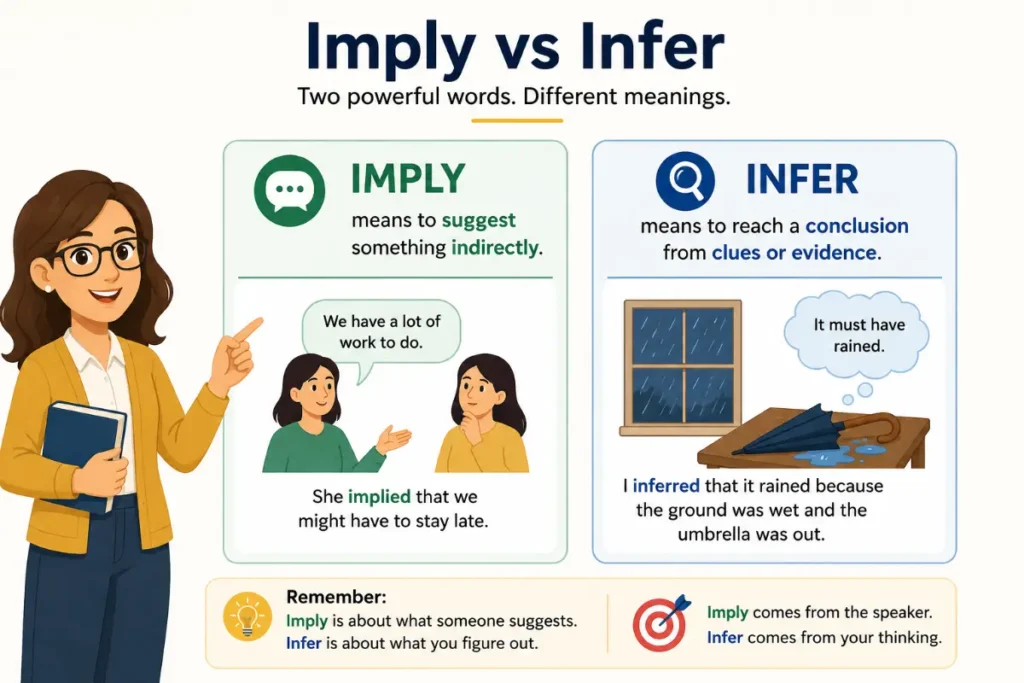
Key Takeaways
- Imply means to suggest something indirectly.
- Infer means to reach a conclusion from clues or evidence.
- The speaker, writer, or author implies.
- The listener, reader, or audience infers.
- The words describe opposite parts of the same communication process.
- They are never true synonyms.
- Remembering who performs the action helps you choose the correct word every time.
- Both words are appropriate in formal and informal English.
Many readers also check Farther vs Further Explained With Clear Examples.
Conclusion
The difference between imply vs infer becomes simple once you focus on the role each word plays. Imply describes suggesting a meaning indirectly, while infer describes drawing a conclusion from clues or evidence. Both verbs are correct in American English, and neither is more formal than the other. The key is to match the verb to the action in your sentence.
When you edit your writing, ask yourself one question. Is someone sending a message, or is someone figuring out what that message means? If you can answer that, you’ll usually choose the right word. Remember this simple rule. Speakers imply, and listeners infer.
FAQs
What Is the Main Difference Between Imply and Infer?
Imply means to suggest something indirectly, while infer means to reach a conclusion from clues or evidence. A speaker can imply that a meeting went badly through a comment about the team’s performance. A listener can infer that the speaker was unhappy with the result. The verbs describe different sides of communication.
Are Imply and Infer Both Correct English Words?
Yes. Both are standard English verbs, and neither is a misspelling of the other. The confusion comes from their related meanings, not from their spelling. Use imply for an indirect suggestion and infer for a conclusion based on information. Choosing the right one depends on the action described in your sentence.
Can a Person Imply and Infer Something at the Same Time?
Yes. One person can imply a message while another person infers its meaning during the same conversation. For example, a manager may imply that a report needs revision, and an employee may infer that they must update the figures. The actions connect, but each person performs a different role.
How Do You Pronounce Both Words?
Both verbs have two syllables, with the stress on the second syllable. Imply sounds like im PLY, while infer sounds like in FUR in American English. The stressed vowel helps distinguish them. Practicing the words in complete sentences can make their pronunciation and meaning easier to remember.
Can Imply or Infer Start a Sentence?
Yes. Both verbs can start a sentence when the grammar supports that structure. For example, “Implying that she lied would be unfair without evidence” uses the first verb in its participle form. “Infer the meaning from the surrounding sentences” uses the second as an instruction. Neither word has a special sentence position restriction.
What Is a Synonym for Imply?
Suggest is often a useful synonym for imply because both can describe communicating an idea indirectly. However, the words aren’t interchangeable in every context. A statement can suggest a possibility without deliberately implying it. Choose a synonym based on the intended meaning and the strength of the message.
What Is a Synonym for Infer?
Conclude is often a suitable alternative to infer when someone reaches a judgment from information. Deduce can also fit when the reasoning follows a logical process. Still, each term has a slightly different emphasis. Use infer when you want to highlight the process of drawing meaning from available clues.
Is This Difference Important in Formal Writing?
Yes. The distinction matters in essays, research reports, workplace documents, and news articles because it clarifies the relationship between evidence and interpretation. Saying that a report implies a result describes what the report suggests. Saying that researchers infer a result describes their reasoning. Accurate wording helps readers separate claims from conclusions.