

Have you ever paused while writing a sentence because you couldn’t decide between farther vs further? You’re not alone. Both words are correct, and their meanings overlap enough to make the choice confusing.
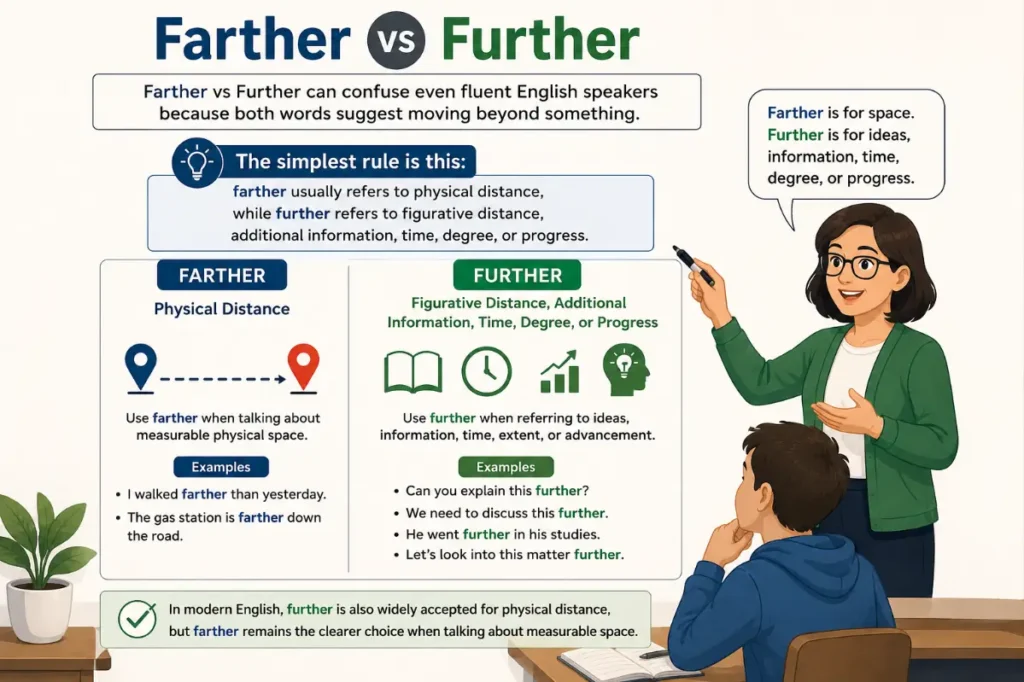
The simplest rule is to use farther for physical distance and further for additional progress, discussion, or degree. For example, you might say that one store is farther away than another, but you need further information before making a decision. However, modern English allows some overlap, so this rule isn’t absolute.
The good news is that you don’t need to memorize a long list of grammar rules. Once you understand how these words work, you can choose the right one in everyday conversation, emails, school assignments, and professional writing. You’ll also learn when both choices work, how American English handles the distinction, and which common mistakes to avoid.
Learn the difference in Bring vs Take Which Word Should You Use.
Short Answer
Use farther mainly for measurable physical distance. Use further mainly to mean additional, more advanced, or to advance something. Both words can express distance in modern English, so context matters more than a rigid rule. In formal writing, the physical distance distinction provides a useful guide.
Comparison Table
| Feature | Farther | Further |
|---|---|---|
| Main meaning | Greater physical distance | Additional amount or degree |
| Part of speech | Adjective or adverb | Adjective or adverb |
| Common use | Travel and measurable space | Progress and extra information |
| Example | We walked farther today. | We need further discussion. |
| Figurative use | Possible but less common | Very common |
| Formal writing | Correct and appropriate | Correct and appropriate |
| American English | Standard | Standard |
| British English | Standard | Standard |
| Pronunciation | FAR ther | FUR ther |
Meaning and Definition
What Does Farther Mean
Farther describes a greater physical distance between places, people, or objects. It often answers the question of how far someone traveled or how much space separates two points.
For example, if your office is three miles from home and your friend’s office is five miles away, your friend’s office is farther away. The distance can be measured in miles, feet, meters, or another unit.
You can also use the word when comparing travel or movement.
- We drove farther than we planned.
- The hiking trail extends farther into the woods.
- Move the chair farther from the window.
- My school is farther from the station than yours.
In each sentence, the word points to physical space or movement. You can picture the distance and often measure it.
Although this is the main use of farther, modern speakers sometimes use it for figurative distance too. That’s one reason the two words can overlap.
What Does Further Mean
Further often means additional, extra, greater, or more advanced. It works well when you discuss ideas, information, research, progress, or a process that needs another step.
Consider these examples.
- We need further information before approving the request.
- The team will discuss the issue further tomorrow.
- She wants to further her education.
- The company plans to make further improvements.
None of these sentences describes a physical distance. Instead, the word points to more information, continued discussion, personal development, or additional changes.
Further also works as an adjective and an adverb. As an adjective, it describes something additional, as in further details. As an adverb, it describes an action that continues or advances, as in investigate further.
The word can also describe physical distance. For instance, someone might say, The next town is further down the road. This usage is common in modern English and is not automatically incorrect.
Is Further a Verb
Yes. Further can function as a verb meaning to help something develop, advance, or make progress.
For example, a student might take an advanced course to further their knowledge. A nonprofit organization might launch a campaign to further its mission. In both cases, the verb describes an action that helps achieve a goal.
The verb is especially common in education, business, public service, and formal writing. It doesn’t mean to move a person or object across physical space. It means to advance an idea, goal, cause, or process.
Key Differences Explained
Physical Distance and Figurative Distance
The clearest difference concerns the kind of distance you mean. Farther usually describes space you can measure, while further usually describes an additional amount, degree, or step.
Compare these sentences.
- We walked farther along the beach.
- We need to discuss the budget further.
The first sentence describes movement through physical space. The second describes continuing a conversation.
However, English doesn’t always draw a sharp line between literal and figurative meanings. You may hear further down the road used for a physical location. You may also encounter farther from the truth when someone describes an idea that is inaccurate.
Both expressions can work. The main distinction is a helpful preference rather than an unbreakable law.
Grammar and Part of Speech
Both words can serve as adjectives or adverbs. Their role depends on how you use them in a sentence.
As adjectives, they describe nouns.
- We need further evidence.
- The farther route takes an extra ten minutes.
As adverbs, they describe verbs or actions.
- She ran farther than her brother.
- We researched the topic further.
The word further has an extra grammatical role because it can also act as a verb.
For example, The program aims to further scientific research. Here, the word describes what the program will do.
Formality and Context
Neither form is inherently more formal or more casual. Both appear in everyday speech, business communication, academic writing, and published work.
Still, the choice can affect precision. In a scientific report comparing measured distances, farther may communicate the intended meaning more clearly. In a report recommending additional investigation, further is usually the more natural choice.
A useful rule is to choose the word that matches the idea rather than the level of formality.
Pronunciation
Both words have two syllables, but their first vowel sounds differ.
- Farther sounds like FAR ther.
- Further sounds like FUR ther.
In American English, the first word usually has the vowel sound heard in car. The second has the vowel sound heard in bird for speakers who pronounce that word with the usual American r controlled vowel.
The second syllable is unstressed in both words. Their similar rhythm makes them easy to confuse in conversation, especially when people speak quickly.
Which Form Is Correct
Both words are correct. Neither is a misspelling or a nonstandard version of the other.
The right choice depends on what you want to say. Use farther when you want to emphasize greater physical distance. Use further when you mean additional information, more discussion, continued development, or greater progress.
For example, The airport is farther from my house than the train station makes a physical comparison. By contrast, I need further instructions before I begin asks for additional guidance.
You don’t need to correct every instance of further used for physical distance. That usage is well established. If an editor wants to maintain a consistent style, the editor can apply the traditional distinction throughout the document.
Ten Natural Example Sentences
These examples show how the two words work in everyday situations.
- Everyday conversation: We had to drive farther because the main road was closed.
- Family plans: The kids wanted to walk farther along the river before heading home.
- Text message: I’m a little farther away than I expected, so I’ll be there in twenty minutes.
- Workplace communication: Please send further details about the meeting before Friday.
- Business planning: The manager requested further review before signing the agreement.
- School: Students can read further about the subject in their course materials.
- Academic writing: Further research may help explain the difference between the two results.
- Formal writing: The committee will provide further guidance after reviewing the proposal.
- Social situations: We moved farther down the table to make room for everyone.
- Online communication: I found the answer in the comments after looking further into the discussion.
Notice that each word fits the purpose of its sentence. Physical movement often favors the first form, while extra information and continued investigation often favor the second.
Common Mistakes and How to Avoid Them
Using Further for Every Kind of Distance
Further can describe physical distance, but using it automatically in every sentence may blur a distinction that helps readers understand your meaning.
Incorrect for a style that follows the traditional distinction: We ran further than the other team.
Preferred: We ran farther than the other team.
The original sentence isn’t universally wrong. The revised version simply makes the physical comparison more precise.
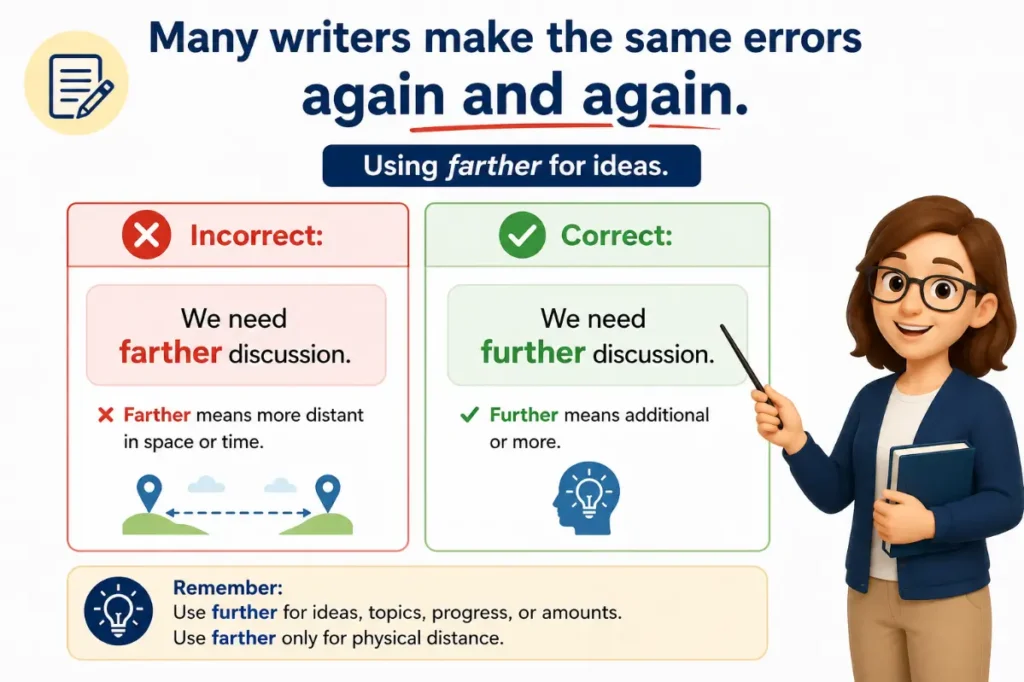
Using Farther to Mean Additional
Some writers use farther when they mean extra information or more discussion.
Less suitable: Please provide farther details about the project.
Better: Please provide further details about the project.
The word details signals that the writer wants additional information rather than greater physical distance.
Confusing Further With Far
Far describes distance, while farther usually compares distances. Further commonly describes an additional amount or continued progress.
- The store is far from my house.
- The store is farther away than the pharmacy.
- We need further information about its opening hours.
Each word has a distinct job in these examples.
Treating One Word as Incorrect
Some writers believe further should never describe physical distance. That rule is too strict for modern English.
For example, The cabin is further along the trail is a natural sentence. A writer may choose farther to follow a traditional style preference, but that doesn’t make the other version a universal spelling error.
Replacing the Words Without Checking the Meaning
Editing tools may suggest a replacement based on a sentence pattern rather than the writer’s full intention. Don’t accept every suggestion automatically.
Read the complete sentence and ask yourself what you mean. If you’re comparing physical locations, farther is a strong choice. If you’re asking for more details or progress, further usually fits better.
Pronunciation Guide
The two words sound similar, but their first vowel separates them.
| Word | IPA | Easy pronunciation | Syllables |
|---|---|---|---|
| Farther | /ˈfɑrðər/ | FAR ther | FAR ther |
| Further | /ˈfɝːðər/ | FUR ther | FUR ther |
These IPA forms represent common American English pronunciations. Exact vowel quality can vary by accent.
How to Pronounce Farther
Start with the vowel sound in car. Then pronounce the soft th sound found in this, followed by an unstressed ending. The stress falls on the first syllable.
How to Pronounce Further
Start with the vowel sound in bird for most American English speakers. Keep the tongue positioned for the American r controlled vowel, then finish with the same soft th sound and unstressed ending.
Common Pronunciation Errors
A common mistake is making the first vowel sound identical in both words. Another is stressing the second syllable. Practice saying the words slowly, then place each one in a sentence. Hearing the contrast helps you recognize the words in conversation.
Need another quick comparison? Read Cancelation vs Cancellation Which Spelling Is Correct?.
Etymology and Word Origin
The history of these words helps explain their close relationship. Both developed from older English forms connected with the idea of being far away or moving beyond a point.
The Origin of Farther
Farther developed from far, an old English word associated with distance. Over time, English formed comparative expressions to describe a greater distance. The modern form became a familiar way to compare how far people or things are from a place.
Its connection to physical distance remains clear in everyday sentences such as We traveled farther than expected.
The Origin of Further
Further comes from an older English form related to forth, which carried the sense of moving forward or onward. Over time, the word developed broader meanings connected with progress, additional steps, and advancement.
That history helps explain expressions such as further discussion, further education, and further investigation. These phrases suggest moving beyond the current stage rather than simply covering more ground.
Although their historical paths differ, the two words now share some meanings. Modern usage reflects centuries of change rather than a perfectly separated set of rules.
Regional Usage
American English
Both words are standard in the United States. Many American editors teach the traditional distinction because it gives writers a simple way to make their meaning clear.
Use farther for physical distance and further for additional information or progress. In ordinary speech, however, Americans also use further to describe physical distance.
For school assignments and professional documents, the traditional distinction is a reliable default. Follow any specific style guide required by your school, employer, or publication.
British English
British English also recognizes both forms. The traditional distinction is familiar, but further can describe physical distance too.
For example, a British speaker might say, The village is further along the road. That sentence is natural English. Choosing farther instead can emphasize the literal distance, but the alternative isn’t automatically incorrect.
Australian English
Australian English follows much the same general pattern. Both forms are standard, and the choice depends mainly on meaning and context rather than a separate spelling rule.
A writer can use farther for a longer physical journey and further for extra information or progress. Physical distance may also appear with further in natural usage.
Canadian English
Canadian English follows the same broad distinction. Both words are accepted, and there is no special Canadian spelling difference between them.
For a Canadian school paper or business report, the traditional rule offers a clear and practical guide. Consistency matters most when the distinction is relevant to the meaning.
Grammar Rules and Part of Speech
Understanding how each word functions in a sentence makes the choice easier. Both forms can describe nouns and actions, but their most common uses differ.
Using Farther as an Adjective
An adjective describes a noun. When farther acts as an adjective, it identifies something at a greater physical distance.
For example, We took the farther entrance because the main gate was crowded. The word describes the entrance in relation to another entrance.
You can also use it in comparisons.
- The farther building has a red roof.
- We chose the farther parking lot because it was cheaper.
Using Farther as an Adverb
An adverb describes an action or tells the reader more about a verb. In this role, farther often explains how far someone travels or how far an object moves.
For example, The runner went farther than anyone expected. The word describes the distance covered by the runner.
Other examples include Walk farther down the street and The ball rolled farther than I thought.
Using Further as an Adjective
As an adjective, further commonly means additional or extra. It often appears before nouns related to information, explanation, action, review, or investigation.
- We requested further details.
- The lawyer asked for further evidence.
- The school announced further changes to its schedule.
In these examples, the word tells the reader that more information, evidence, or changes are involved.
Using Further as an Adverb
As an adverb, further often means to a greater degree or to an additional stage.
Consider Let’s explore the problem further. The sentence means that the speaker wants to examine the issue more deeply.
Other natural examples include The discussion continued further into the evening and We need to investigate further before reaching a conclusion.
Using Further as a Verb
The verb further means to advance, promote, or help something develop.
For example, The scholarship will further her academic goals. It means the scholarship will help her make progress toward those goals.
You can use this verb with a range of nouns, including career, education, research, cause, and interests. This grammatical use is one of the clearest reasons the words aren’t interchangeable in every sentence.
Do These Words Need Special Punctuation
Neither word requires special punctuation. You can use them with commas or other marks when the sentence structure calls for them, but the words themselves don’t change punctuation rules.
For example, We walked farther, but we still didn’t reach the lake. The comma separates two independent clauses. It has nothing to do with the choice of comparative word.
Real Life Usage Examples
Daily Conversation
People use these words naturally when talking about travel, plans, and everyday decisions.
- Is the gas station farther down this road?
- I need further time to think about your offer.
The first asks about a location. The second asks for additional time.
Email and Workplace Communication
In professional messages, the distinction can make a request clearer.
- Please send further information about the proposed schedule.
- Our new office is farther from the airport than the old location.
The first requests more information. The second compares physical locations.
Academic Writing
Students and researchers often use further to describe continued study or additional evidence.
- Further analysis may reveal a pattern in the results.
- The second testing site lies farther from the main laboratory.
The first refers to additional analysis. The second refers to measurable distance.
News and Journalism
News writing uses both words to describe locations and developments.
- The storm moved farther inland during the night.
- Officials requested further information from local agencies.
These examples show how the same article might need both forms for different purposes.
Literature and Storytelling
Writers can use either word to describe physical movement or a character’s growing understanding.
- She wandered farther into the forest before the path disappeared.
- He read further into the letter and discovered a troubling detail.
The first describes physical movement. The second describes reading beyond an earlier point in a text.
Related Words and Expressions
Several related words can help you express distance, progress, and additional information more precisely.
Far
Far describes a large distance from a point. It doesn’t usually make the direct comparison that farther does.
Example: The hospital is far from our neighborhood.
Farthest
Farthest is the superlative form commonly used for the greatest physical distance among three or more points.
Example: That is the farthest I’ve ever driven in one day.
Furthest
Furthest is the superlative form often used for the greatest degree of progress or the most advanced point. It can also describe physical distance.
Example: Her latest proposal goes furthest toward solving the problem.
Further Information
This expression means extra information beyond what someone already has.
Example: Contact the office for further information.
Additional
Additional means extra or added. It’s a useful alternative when you want to avoid repeating further.
Example: We need additional staff for the evening shift.
Beyond
Beyond means on the far side of a point or outside a limit. It can describe physical space or an abstract idea.
Example: The village lies beyond the bridge.
More
More refers to a greater amount or number. It’s often the simplest alternative when you mean an additional quantity.
Example: We need more time to finish the assignment.
Advance
Advance means to move forward or make progress. It can work as a verb or a noun depending on the sentence.
Example: The training program helps employees advance their careers.
These terms overlap in meaning, but they don’t all fit the same grammatical patterns. Choose the expression that communicates your intended idea most directly.
Expert Editor Insight
An experienced editor looks at the meaning first rather than treating these words as a spelling test. If a sentence compares physical locations, farther usually offers the clearest choice. If it asks for additional evidence or continued work, further is the natural fit. Grammar checkers may suggest one form based on common patterns, but they can’t always understand the writer’s full intention. Read the sentence in context before accepting a correction. In most cases, a quick meaning check will solve the problem without a dictionary or a complicated grammar rule.
Key Takeaways
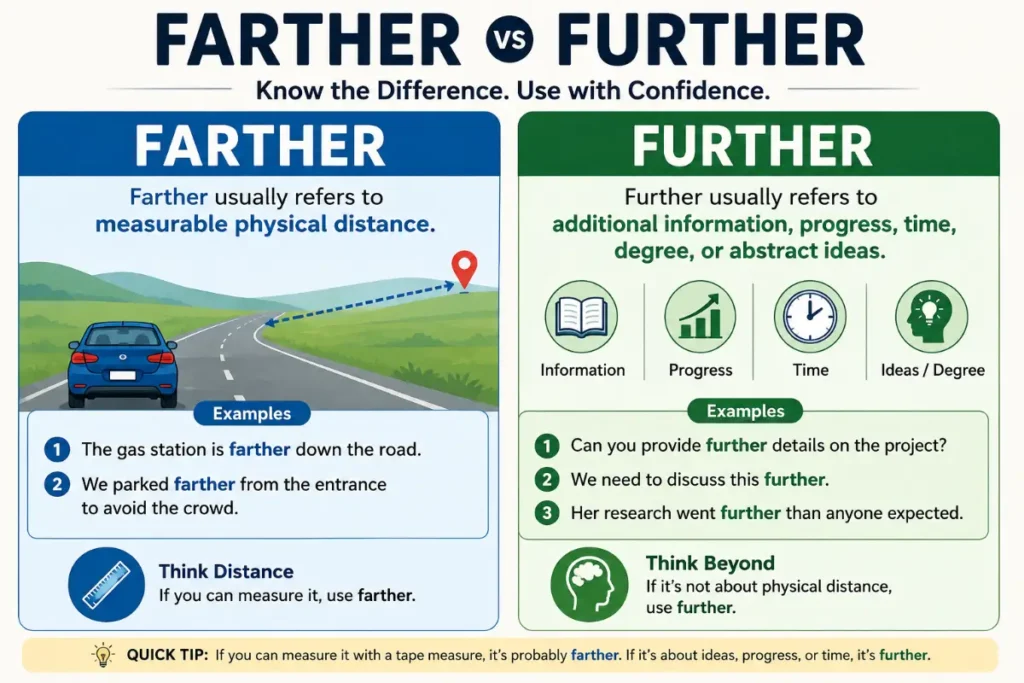
- Farther usually refers to measurable physical distance.
- Further usually refers to additional information, progress, time, degree, or abstract ideas.
- Further can also function as a verb meaning to promote or advance.
- Modern English accepts further for physical distance, but farther remains the clearer choice.
- Following the traditional distinction makes academic and professional writing more precise.
- Asking “Can I measure it?” is the easiest way to choose the correct word.
- Many fixed expressions, such as further information and until further notice, always use further.
You may also want to read Hanged vs Hung Which Word Is Correct.
Conclusion
The easiest way to remember the difference in farther vs further is to connect each word with its most common use. Choose farther when you describe a greater physical distance. Choose further when you mean additional information, continued discussion, or progress toward a goal. Both words are correct, and modern English allows some overlap in their meanings. You don’t need to treat every different choice as a grammar mistake.
Instead, focus on clarity and consistency. Here’s a simple editing tip. Replace further with additional in your sentence. If the meaning still works, further is likely a good choice. When describing a measurable distance, farther is often the clearest option.
FAQs
Is Further a Real Word for Physical Distance?
Yes. Further is an established English word that can describe physical distance. For example, The next exit is further down the highway is a natural sentence. Some traditional style guides prefer farther for measurable distance, but modern usage allows both. Choose farther when you want to make the physical meaning especially clear.
What Does Further Mean in Everyday English?
In everyday English, further usually means additional, more, or to a greater degree. You might ask for further details, discuss a problem further, or take steps to further your career. The word can also describe physical distance. Its exact meaning depends on the surrounding words and the purpose of the sentence.
Which Word Should I Use for Miles and Feet?
Use farther as your default when comparing measurable distances in miles, feet, yards, or other units. For example, The second store is farther from home. This choice follows the traditional distinction and makes your meaning clear. You may still encounter further in similar sentences because the two forms overlap in everyday English.
How Do You Pronounce These Two Words?
In American English, farther begins with the vowel sound in car, while further begins with the vowel sound in bird. Both words have two syllables, with stress on the first. The final syllables sound similar. Practicing each word in a complete sentence can help you hear and remember the difference.
Can Farther Start a Sentence?
Yes. You can begin a sentence with farther when the sentence structure supports it. For example, Farther down the road, we found a quiet place to stop. The word describes a location at a greater distance. Starting with it doesn’t create a grammar problem. Just make sure the opening phrase connects clearly to the rest of the sentence.
What Is a Good Synonym for Further?
The best synonym depends on the intended meaning. Use additional or extra when you mean more information or resources. Use more deeply when you describe continued investigation, and use advance when further functions as a verb. For example, We need additional evidence communicates the same basic idea as We need further evidence.
Why Do People Confuse Farther and Further?
People confuse these words because they share a similar sound, spelling pattern, and history. Their meanings also overlap in modern English. The traditional rule gives each word a preferred role, but everyday speech doesn’t always follow a strict division. Learning the difference between physical distance and additional progress makes the choice much easier.
Is This Distinction Necessary in Formal Writing?
The distinction is useful in formal writing because it helps readers understand the intended meaning. Use farther for measurable physical distance and further for additional information or progress. However, don’t mark every use of further for distance as wrong. Follow your organization’s style guide and keep your wording consistent throughout the document.