

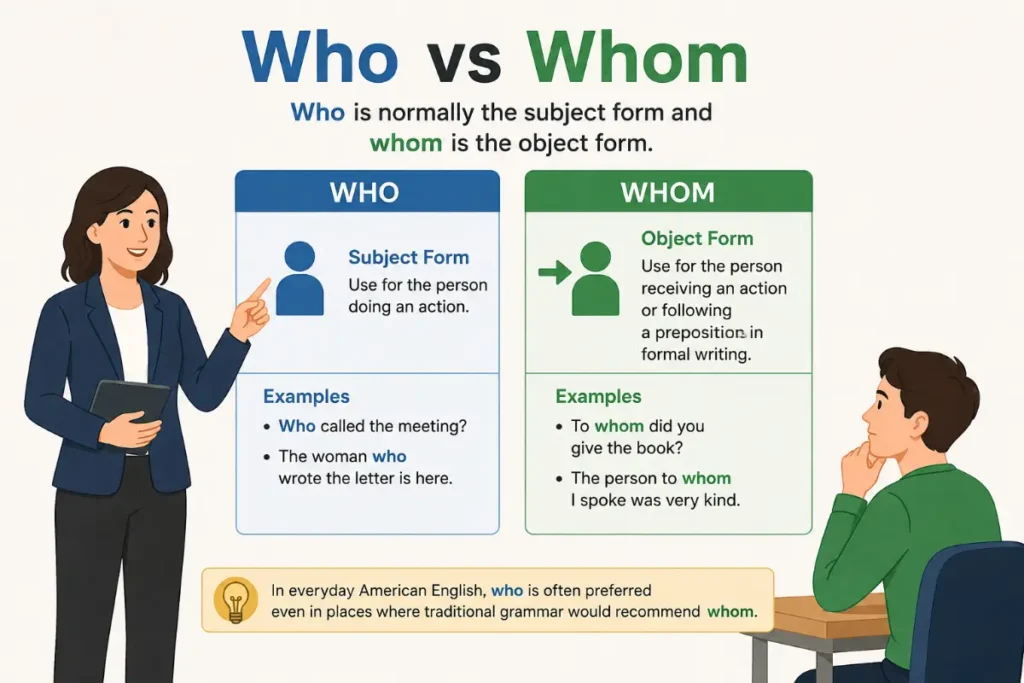
Who vs whom can confuse even experienced English speakers because both words refer to people, and they often appear in similar sentences. The difference comes down to one simple grammar rule. Who acts as a subject, while whom acts as an object. Once you understand that distinction, choosing the right word becomes much easier.
The easiest way to remember the rule is to try replacing the word with he or she or with him or her. If the first pair fits, choose who. If the second pair fits, choose whom. For example, you would ask Who called you? because the person made the call. You would ask Whom did you call? informal grammar because the person received the call.
However, everyday American English doesn’t always follow the most formal pattern. Many people use who instead of whom in ordinary conversation, even when traditional grammar recommends whom. This guide explains the basic rule, shows how it works in questions and longer sentences, and helps you decide which form fits casual conversations, academic writing, and professional communication.
A related grammar guide is loan vs lend The Difference Explained With Examples.
Short Answer
Who refers to the person doing an action. Whom refers to the person receiving an action or serving as the object of a verb or preposition. Use who when you can replace it with he or she, and use whom when you can replace it with him or her. In everyday American English, who is also common in informal speech where traditional grammar calls for whom.
Table of Contents
- What Who Means.
- What Whom Means.
- The Main Grammar Difference.
- The He or Him Test.
- How to Use Who in Sentences.
- How to Use Whom in Sentences.
- Who vs Whom in Questions.
- Who and Whom in Relative Clauses.
- Using Who and Whom After Prepositions.
- Formal and Informal American English.
- Common Mistakes to Avoid.
- Special Cases and Tricky Sentences.
- Memory Tips.
- Related Grammar Rules.
- Frequently Asked Questions.
- Key Takeaways.
- Conclusion.
What Who Means
Who is a pronoun used to ask about a person or identify the person performing an action. In traditional English grammar, it serves as a subject pronoun. The subject is the person or thing that performs an action or occupies the subject position in a sentence.
Consider this example.
Who opened the window?
The question asks which person performed the action of opening the window. The unknown person is the subject of the verb opened, so who is correct.
Here are more examples.
- Who called me this morning? The unknown person performed the action of calling.
- Who wants another cup of coffee? The unknown person is the subject of wants.
- Who broke the glass? The question asks which person performed the action of breaking.
- Who is waiting outside? The unknown person is the subject of is waiting.
- Who wrote this letter? The unknown person performed the action of writing.
In each sentence, who identifies the person responsible for the action or described by the verb.
Who can also appear in statements rather than questions. For example, The woman who lives next door is a doctor. In this sentence, who refers to the woman and acts as the subject of lives.
Another example is I know who prepared the meal. The sentence isn’t a direct question, but who is still the subject of prepared.
The important point is that who doesn’t appear only at the beginning of questions. It can also introduce a clause inside a statement. Its grammatical role determines its form, not its position in the sentence.
What Whom Means
Whom is a pronoun that refers to a person functioning as the object of a verb or preposition in traditional English grammar. An object receives an action or completes the meaning of a verb or preposition.
Consider this example.
Whom did you invite?
The person asking the question wants to know who received the invitation. The subject is you, and the verb is invite. The unknown person is the object of invite, so whom is the traditional formal choice.
Here are more examples.
- Whom did you meet at the conference? The unknown person is the object of meet.
- Whom should I contact about the problem? The unknown person is the object of contact.
- Whom did Sarah choose for the position? The person chosen is the object of choose.
- To whom did you send the package? The unknown person follows the preposition to.
- With whom are you traveling? The unknown person follows the preposition with.
Whom can sound formal or old fashioned in ordinary conversation, but it remains useful in formal writing and in sentences where a preposition directly precedes it.
For instance, To whom it may concern is a standard opening for certain formal letters. The pronoun follows the preposition to, so whom is appropriate.
Whom can also appear in statements. Consider I know whom the manager selected. The manager performed the action of selecting, and the unknown person was selected. Therefore, whom is the object of selected.
Keep in mind that whom doesn’t automatically belong in every sentence about a person who receives an action. Informal English often uses who in the same position. The formal grammatical distinction remains useful, especially when clarity and traditional correctness matter.
The Main Grammar Difference
The key difference between who and whom is grammatical function. Who is the subject form, while whom is the object form. Both refer to people, but they perform different jobs in a sentence.
Think about the relationship between a subject and an object. In the sentence Maria helped Daniel, Maria is the subject because she performed the action. Daniel is the direct object because he received the help.
If you ask about Maria, you say Who helped Daniel? If you ask about Daniel, the traditional formal question is Whom did Maria help?
The words refer to people in both questions, but the person being identified occupies a different grammatical role.
| Feature | Who | Whom |
|---|---|---|
| Grammatical role | Subject | Object |
| Main function | Identifies the person doing an action | Identifies the person receiving an action or following a preposition |
| Pronoun test | He or she | Him or her |
| Example | Who invited you? | Whom did you invite? |
| Formal writing | Standard | Standard |
| Everyday conversation | Very common | Less common in many contexts |
The difference becomes clearer when you compare pairs of sentences.
Who saw the teacher?
Who is the subject because that person performed the action of seeing.
Whom did the teacher see?
Whom is the formal object form because the teacher performed the action and the unknown person received it.
Now consider a sentence with a preposition.
Who is speaking?
Who is the subject of is speaking.
To whom are you speaking?
Whom is the object of the preposition to.
These examples show why meaning alone isn’t enough. Both words refer to people, so you need to examine how the person fits into the sentence.
A reliable writer doesn’t simply look at the nearest noun or verb. The writer identifies the clause, finds its subject and verb, and determines the role of the person being discussed.
The He or Him Test
The he or him test is one of the easiest ways to choose between who and whom. You don’t need to memorize complicated grammar terms or diagram every sentence. Just replace the person you’re asking about with a personal pronoun and see which form sounds grammatically correct.
Use this simple rule.
- If he or she fits, use who.
- If him or her fits, use whom in traditional grammar.
For example, consider the question Who called? You can answer He called or She called. The person performs the action, so who is correct.
Now consider the question Whom did you call? You can answer I called him or I called her. The person receives the action, so whom is the traditional formal choice.
How the Test Works in Real Sentences
Let’s look at several examples to see how the test works.
Example One
Question: Who invited you?
Test: He invited you.
Correct choice: Who.
Explanation: The unknown person performed the action of inviting. The person is the subject of invited, so who is correct.
Example Two
Question: Whom did you invite?
Test: You invited him.
Correct choice: Whom in formal grammar.
Explanation: You performed the action of inviting. The unknown person received the invitation, making that person the object of invited.
Example Three
Question: Who won the competition?
Test: She won the competition.
Correct choice: Who.
Explanation: The unknown person performed the action expressed by won. The subject form is needed.
Example Four
Question: Whom did the committee select?
Test: The committee selected her.
Correct choice: Whom in formal grammar.
Explanation: The committee performed the action of selecting, and the unknown person was selected. The unknown person is the object of selected.
Example Five
Question: To whom should I address this letter?
Test: I should address this letter to him.
Correct choice: Whom.
Explanation: The person follows the preposition to. The object form him confirms that whom is appropriate.
What If Both Pronouns Seem Possible?
Sometimes you may struggle to apply the test because the sentence contains several verbs or clauses. In that case, examine only the clause containing the pronoun.
For example, consider this sentence.
I know who called the office.
The main clause is I know. The other clause is who called the office. Inside that second clause, who is the subject of called. The fact that the whole clause acts as the object of know doesn’t change the role of who within its own clause.
Now compare it with this sentence.
I know whom the office contacted.
Inside the clause whom the office contacted, the office is the subject of contacted, and whom is its object. That makes whom the traditional formal choice.
This distinction is especially useful in long sentences. A pronoun can belong to a clause that functions as an object in the larger sentence while still acting as the subject of a verb inside that clause.
How to Use Who in Sentences
Use who when the person you’re identifying acts as the subject of a verb. This rule applies to direct questions, indirect questions, and relative clauses.
Who in Direct Questions
A direct question asks for information directly.
- Who ate the last cookie? The unknown person performed the action of eating.
- Who will lead the meeting? The unknown person will perform the action of leading.
- Who lives in that house? The unknown person is the subject of lives.
- Who has my notebook? The unknown person has possession of the notebook.
- Who can solve this problem? The unknown person is the subject of can solve.
Each sentence uses who because the person occupies the subject position.
Who in Indirect Questions
An indirect question expresses a question inside another sentence. It often follows verbs such as know, ask, wonder, remember, or tell me.
For example, consider this sentence.
I wonder who called yesterday.
The main sentence is I wonder. The embedded question is who called yesterday. Within that embedded question, who is the subject of called.
Here are more examples.
- Can you tell me who manages this store? Who is the subject of manages.
- Do you know who sent this package? Who is the subject of sent.
- She asked who wanted more coffee. Who is the subject of wanted.
- I can’t remember who recommended this book. Who is the subject of recommended.
- Please find out who left the door open. Who is the subject of left.
Notice that indirect questions don’t always use the word order of direct questions. You say Who called? but I wonder who called. You don’t normally say I wonder who did call unless you have a special reason to emphasize did.
The grammar of the embedded clause determines the pronoun, even when the sentence as a whole isn’t a question.
Who in Relative Clauses
A relative clause adds information about a person mentioned earlier in a sentence. Who commonly introduces these clauses when the person acts as the subject of the verb inside the clause.
Consider this example.
The student who answered the question received a prize.
The student answered the question, so who is the subject of answered.
More examples include the following.
- The doctor who treated my father was kind. Who is the subject of treated.
- I met a woman who works at the library. Who is the subject of works.
- The employee who submitted the report received praise. Who is the subject of submitted.
- We thanked the neighbor who helped us move. Who is the subject of helped.
- The author who wrote this novel lives in Chicago. Who is the subject of wrote.
In each sentence, who connects a person to an action or description.
You can also use who in a relative clause that follows an object in the main sentence. For example, I thanked the woman who opened the door. The woman is the object of thanked in the main clause, but who is the subject of opened in the relative clause.
This is a common source of confusion. The pronoun’s role in its own clause matters more than the role of the person in the main sentence.
How to Use Whom in Sentences
Use whom when the person functions as the object of a verb or preposition in traditional grammar. It often appears in formal questions, relative clauses, and expressions that use a preposition.
Whom as the Object of a Verb
A direct object receives the action of a verb. An indirect object identifies the person who receives something or benefits from an action. Whom can refer to either type of object when traditional grammar calls for the object form.
Consider these examples.
- Whom did the principal praise? The principal performed the action of praising, and whom identifies the person praised.
- Whom did you choose as your partner? You chose the person, so the person is the object of choose.
- Whom did the coach replace? The coach replaced the person identified by whom.
- Whom should we invite to dinner? The unknown person is the object of invite.
- Whom did the company hire? The company hired the person being identified.
These sentences sound formal to many American English speakers. In everyday conversation, people often use who in these positions. That informal choice doesn’t change the traditional grammatical explanation.
Whom as the Object of a Preposition
A preposition shows a relationship between a noun or pronoun and another part of a sentence. Common examples include to, for, with, from, by, about, and between.
When a person follows a preposition, traditional grammar generally calls for whom.
Examples include the following.
- To whom did you give the keys? Whom is the object of to.
- With whom did you attend the event? Whom is the object of with.
- For whom did you buy this gift? Whom is the object of for.
- From whom did you receive the message? Whom is the object of from.
- About whom were they talking? Whom is the object of about.
These constructions are common in formal correspondence, academic writing, official documents, and careful speech.
In casual conversation, speakers often place the preposition at the end of the question and use who instead.
For example, To whom did you speak? may become Who did you speak to? Both communicate the same basic idea, but the first sounds more formal.
Whom in Relative Clauses
Whom can introduce a relative clause when the person acts as the object inside that clause.
Consider this sentence.
The woman whom I met yesterday is a lawyer.
Inside the relative clause whom I met yesterday, the subject is I, the verb is met, and whom is the object of met.
Compare that sentence with this one.
The woman who met me yesterday is a lawyer.
Here, who performs the action of meeting. The woman is the subject of met, so who is correct.
The difference is clear when you rearrange the sentences into simple statements.
- I met her yesterday. Use whom in the formal relative clause because the person is the object.
- She met me yesterday. Use who because the person is the subject.
In informal American English, speakers often use who instead of whom in object relative clauses. You may hear The woman who I met yesterday is a lawyer. This construction is widespread in ordinary speech and informal writing.
Who vs Whom in Questions
Questions can make the distinction tricky because English often places an auxiliary verb before the subject. The position of a pronoun at the beginning of a question doesn’t tell you its grammatical role.
Compare these two questions.
Who invited Daniel?
The person being identified performed the action. Who is the subject of invited.
Whom did Daniel invite?
Daniel performed the action, and the person being identified received the invitation. Whom is the formal object form.
The second question uses did because English normally places the auxiliary verb before the subject in this type of question. The subject is Daniel, not whom.
Questions With Helping Verbs
Helping verbs include forms of be, have, do, and modal verbs such as can, should, and will. These verbs can change the structure of a question without changing the subject and object distinction.
- Who can finish the assignment? Who is the subject of can finish.
- Whom can we ask for advice? We is the subject, and whom is the object of ask.
- Who has taken my seat? Who is the subject of has taken.
- Whom have you invited? You is the subject, and whom is the object of have invited.
- Who will speak first? Who is the subject of will speak.
- Whom will the director appoint? The director is the subject, and whom is the object of appoint.
The helping verb doesn’t determine which pronoun you need. The role of the person does.
Questions With Linking Verbs
Linking verbs connect a subject to a description or identity. Forms of be are the most common linking verbs.
For example, Who is your teacher? is correct because who is the subject being identified.
Another example is Who was responsible for the mistake? Who is the subject of was, and responsible describes that subject.
Questions such as Who is she? also use who. The pronoun she appears after the linking verb, but the unknown person being identified is still the subject of the sentence in traditional grammar.
The subject complement she identifies the same person as the subject. It doesn’t make who an object.
This is one reason the he or him test works best when you understand the sentence rather than simply replacing the first pronoun without considering its structure.
A related grammar guide is function vs functionality Which Word Should You Use.
Who and Whom in Relative Clauses
Relative clauses provide extra information about a person. The choice between who and whom depends on the pronoun’s role inside the relative clause rather than its role in the main sentence.
Compare these examples.
The man who helped me is my uncle.
Who is correct because the man performed the action of helping.
The man whom I helped is my uncle.
Whom is the traditional formal choice because I performed the action, and the man received the help.
The main clause in both examples identifies the man as the subject of is. However, the relative clauses have different grammatical structures. In the first, the man is the subject of helped. In the second, the man is the object of helped.
When the Relative Pronoun Is the Subject
Use who when the person performs the action inside the relative clause.
- The teacher who explained the lesson was patient. Who is the subject of explained.
- I know a chef who makes excellent pasta. Who is the subject of makes.
- The player who scored the winning goal received an award. Who is the subject of scored.
- The family who lives upstairs is friendly. Who is the subject of lives.
- The person who called you left a message. Who is the subject of called.
When the Relative Pronoun Is the Object
Use whom in formal English when the person receives an action inside the relative clause.
- The teacher whom I thanked smiled. I thanked the teacher, so whom is the object of thanked.
- The chef whom we hired starts tomorrow. We hired the chef, so whom is the object of hired.
- The player whom the coach selected joined the team. The coach selected the player, so whom is the object of selected.
- The family whom we visited lives nearby. We visited the family, so whom is the object of visited.
- The person whom you called left a message. You called the person, so whom is the formal object form.
In informal American English, who often replaces whom in these examples. This usage is common enough that a sentence with who in an object position usually sounds natural in conversation.
Also, the relative pronoun can sometimes be omitted entirely when it serves as the object of a clause. For example, The person I called left a message is correct. The omitted pronoun would be the object of called.
However, you can’t omit the subject relative pronoun in the same way. The sentence The person called you left a message has a different meaning because called now appears without a subject inside that clause.
Using Who and Whom After Prepositions
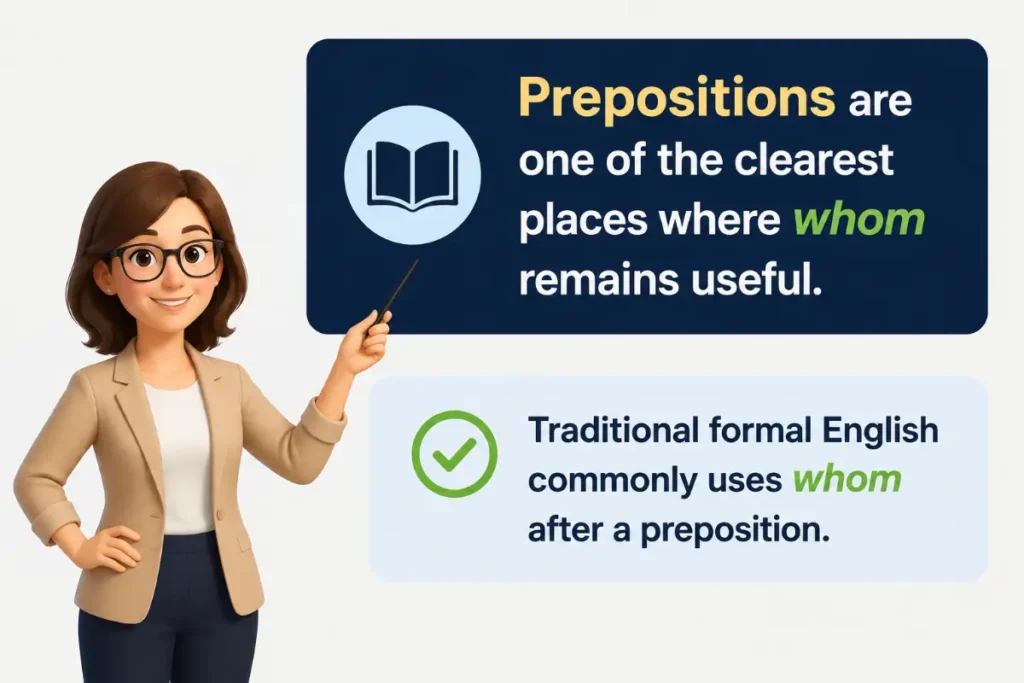
Prepositions are one of the clearest places to see the difference between the two pronouns. In traditional grammar, whom follows a preposition when it refers to a person.
Common prepositions include to, with, for, by, from, about, and between.
Formal Preposition Placement
In formal writing, the preposition often appears directly before whom.
- To whom should I send the application? Whom follows to.
- With whom did you discuss the proposal? Whom follows with.
- For whom was this package intended? Whom follows for.
- From whom did you get this information? Whom follows from.
- Between whom was the agreement made? Whom follows between.
These forms are grammatically standard. They often suit official letters, academic papers, business correspondence, and formal interviews.
Informal Preposition Placement
Everyday American English often places the preposition at the end of a question. In these sentences, who is widely used instead of whom.
- Who should I send the application to? This is a natural conversational alternative to the first formal example.
- Who did you discuss the proposal with? The preposition with appears at the end.
- Who was this package intended for? Who is common in ordinary speech.
- Who did you get this information from? This wording sounds natural in casual conversation.
- Who was the agreement made between? This construction is common in speech, though some editors prefer a more carefully structured sentence.
You don’t need to make every sentence sound formal to write correctly. Choose wording that fits your audience and purpose. In many cases, moving the preposition can make a sentence sound more natural without changing its meaning.
Still, formal writing often benefits from the traditional construction. For example, To whom it may concern remains a standard expression in letters and other official documents.
Formal and Informal American English
The traditional distinction between who and whom remains part of standard English grammar. However, everyday American English uses whom less often than older formal writing does.
Many speakers naturally say Who did you see? instead of Whom did you see? The first form is widely accepted in casual speech, and readers generally understand it without difficulty.
The choice often depends on tone, audience, and context.
| Context | Common choice | Example |
|---|---|---|
| Casual conversation | Who | Who did you meet? |
| Text messages | Who | Who are you going with? |
| Formal letters | Whom after a preposition | To whom it may concern. |
| Academic writing | Traditional object form when appropriate | Whom did the study include? |
| Business conversation | Often who | Who should I contact? |
| Formal interviews | Either, depending on tone | Whom did you interview? |
| Relative clauses | Who is common in informal English | The person who I met. |
When to Prefer Whom
Use whom when you want a formal tone or when the sentence places a preposition directly before the pronoun.
For example, To whom did you address the letter? is a conventional formal construction. It suits a professional document or a carefully prepared speech.
You can also use whom in formal writing when the object relationship is clear. For example, The committee interviewed the applicants, several of whom had extensive experience. The pronoun whom follows the preposition of and refers to the applicants.
When Who Is the Better Choice
Use who when the person is the subject. Also, who is often the most natural choice in casual American English when traditional grammar would use whom.
For example, Who did you speak to? sounds natural in everyday conversation. In a formal letter, To whom did you speak? may better match the expected tone.
The goal isn’t to force formal language into every situation. Good writing matches the reader and purpose. Traditional grammar helps you recognize the distinction, while an understanding of actual usage helps you make practical choices.
Common Mistakes to Avoid
Many errors happen because writers focus on sentence position or meaning instead of grammatical function. These mistakes become easier to avoid once you identify the subject, verb, and object.
Mistake One Using Whom as the Subject
Incorrect: Whom called you last night?
Correct: Who called you last night?
Explanation: The unknown person performed the action of calling. That makes the pronoun the subject, so who is correct.
Mistake Two Using Who as the Object in Formal Writing
Formal version: Whom did you invite to the party?
Common informal version: Who did you invite to the party?
Explanation: In the formal version, whom is the object of invite. The informal version uses who in a position where many speakers naturally prefer it. If you’re following traditional grammar strictly, choose whom.
Mistake Three Choosing the Pronoun Based on the Nearest Noun
Incorrect: The manager spoke to the employee who he had hired, in a context requiring strict formal grammar.
Preferred formal version: The manager spoke to the employee whom he had hired.
Explanation: The pronoun refers to the employee, who is the object of had hired. The subject of that verb phrase is he.
The closest noun isn’t always the subject of the relevant verb. Examine the clause containing the pronoun.
Mistake Four Using Whom After Every Verb
Incorrect: Whom is coming to dinner?
Correct: Who is coming to dinner?
Explanation: The person is the subject of is coming. The fact that the sentence includes a form of be doesn’t make whom appropriate.
Mistake Five Ignoring the Preposition
Less formal: Who are you waiting for?
Formal: For whom are you waiting?
Explanation: In the formal construction, whom is the object of for. In the conversational construction, who is widely used and sounds natural to most American speakers.
Mistake Six Confusing the Main Clause With the Relative Clause
Incorrect in traditional formal grammar: I thanked the woman whom helped me.
Correct: I thanked the woman who helped me.
Explanation: The woman performed the action of helping. Who is the subject of helped, even though the woman is the object of thanked in the main clause.
Mistake Seven Using Who in a Formal Prepositional Phrase
Less formal: Who did you send the letter to?
Formal: To whom did you send the letter?
Explanation: The formal version places whom directly after the preposition to. This structure is common in professional and official writing.
Special Cases and Tricky Sentences
Some sentences are harder to analyze because they contain linking verbs, embedded questions, or clauses that act as nouns. The same core rule still applies, but you need to examine the sentence structure carefully.
Who Is Calling and Whom Are You Calling
These questions look similar, but the pronouns perform different roles.
Who is calling? asks about the person performing the action. Who is the subject of is calling.
Whom are you calling? asks about the person receiving the action. You is the subject of are calling, and whom is the formal object form.
A useful way to compare them is to turn them into statements.
- He is calling. Use who in the question.
- You are calling him. Use whom in the formal question.
Who Do You Think Will Win
Consider this sentence.
Who do you think will win the race?
The sentence includes the main clause do you think and the embedded clause who will win the race. Inside the embedded clause, who is the subject of will win.
The correct form is who, even though the pronoun appears at the beginning of a longer question.
Now compare this example.
Whom do you think the judges will select?
The judges will select the person being identified. The person is the object of select, so whom is the formal choice.
These sentences show why it helps to identify the exact clause rather than relying on the position of the pronoun.
Who I Am and Whom I Am
Consider these examples.
I know who I am.
I know whom the committee selected.
The first sentence uses who because who is the complement that identifies the subject I in the embedded clause. The second uses whom because the committee selected the person being identified.
The grammatical structure determines the correct choice. A pronoun doesn’t become an object simply because it appears after another verb.
Who Versus Whom With Everyone and Someone
Words such as everyone, someone, and nobody can make a sentence feel complicated, but they don’t change the basic rule.
For example, Someone who knows the answer should speak up is correct because who is the subject of knows.
The sentence I need someone whom I can trust uses whom in traditional formal grammar because I can trust that person.
In ordinary conversation, many speakers would say I need someone who I can trust. This construction is common and easily understood.
Memory Tips
A simple memory trick can save you time when writing emails, essays, reports, and everyday messages.
Remember He and Him
The most reliable shortcut is to connect who with he and whom with him.
- Who matches he or she.
- Whom matches him or her.
Try this question: Who ate the sandwich? You can say He ate the sandwich. That confirms who.
Now try: Whom did you call? You can say I called him. That confirms whom in traditional grammar.
Remember Subject and Object
Think of the subject as the person doing something and the object as the person receiving the action.
In Anna helped Mark, Anna is the subject and Mark is the object. If you ask about Anna, use who. If you ask about Mark, use whom in formal grammar.
This method works especially well with action verbs such as help, invite, call, choose, hire, meet, and contact.
Remember Prepositions
When a formal sentence places a preposition directly before the pronoun, whom is usually the right choice.
For example, To whom did you give the keys? The word to signals an object relationship.
You can also remember common formal expressions such as to whom it may concern and with whom I worked. These phrases provide useful patterns you can reuse.
Use a Three Step Check
When you feel unsure, follow this quick process.
- Find the verb in the clause that contains the pronoun.
- Identify who performs the action and who receives it.
- Test the pronoun with he or him.
For example, in The applicant whom the company hired starts Monday, the company hired the applicant. The applicant receives the action, so whom is appropriate in traditional formal grammar.
In The applicant who starts Monday has experience, the applicant performs the action of starting. Who is correct.
Related Grammar and Usage Notes
Understanding who and whom also helps you recognize how other personal pronouns work in English. The same subject and object distinction appears in pairs such as I and me, he and him, she and her, and they and them.
Subject and Object Pronouns
| Subject pronoun | Object pronoun | Example |
|---|---|---|
| I | Me | I called her. She called me. |
| He | Him | He helped me. I helped him. |
| She | Her | She invited us. We invited her. |
| We | Us | We contacted them. They contacted us. |
| They | Them | They chose him. He chose them. |
| Who | Whom | Who called? Whom did you call? |
The pattern is consistent. Subject pronouns perform the subject role, while object pronouns serve as objects of verbs or prepositions.
Who and Whose
Both words are different words with different functions.
Who identifies a person. Whose asks about ownership or identifies the person something belongs to.
For example, Who owns this car? asks for the identity of the owner. Whose car is parked outside? asks which person owns the car.
Don’t confuse whom with whose. Whom is an object pronoun, while whose is a possessive form.
Who and Which
Who generally refers to people, while which often refers to things or animals. The choice depends on meaning and context.
For example, The woman who called is my neighbor uses who for a person. The book which I bought was expensive uses which for a thing.
For people, who is usually the natural choice when the pronoun serves as the subject of a relative clause. Whom may serve as the object in formal writing.
Who and That
That can introduce restrictive relative clauses referring to people or things in many varieties of English. Who is often preferred for people, particularly in polished writing.
For example, The student who won the prize was delighted is a natural sentence. The student that won the prize was delighted is also used in English.
When the relative pronoun acts as the object, writers may omit it. The student I congratulated was delighted is grammatically acceptable because the omitted pronoun would be the object of congratulated.
Pronunciation
Who and whom are pronounced similarly. Who usually sounds like /huː/, and whom usually sounds like /huːm/. The main audible difference is the final m in whom.
The words have different grammatical functions even though their pronunciation is closely related. Remembering the final sound may help you recognize the spelling, but the subject and object rule determines which word belongs in a sentence.
Key Takeaways
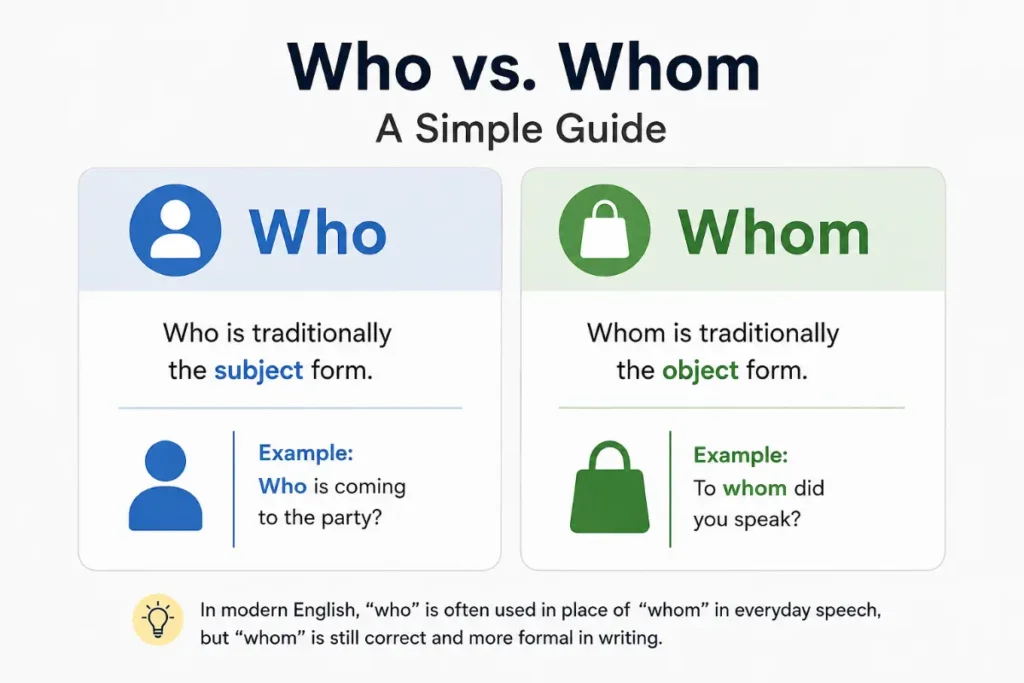
- Who is the subject form used for the person doing an action.
- Whom is the traditional object form used for the person receiving an action or following a preposition.
- The he or she test helps identify who, while the him or her test helps identify whom.
- The pronoun’s role inside its own clause determines the correct form.
- Who is widely used in informal American English where formal grammar recommends whom.
- Whom remains appropriate in formal writing and expressions such as To whom it may concern.
- A sentence can begin with either pronoun. The grammatical role matters more than its position.
- Who and whose have different meanings. Who identifies a person, while whose expresses possession.
A related grammar guide is Borrow vs Barrow Explained With Examples.
Conclusion
Who vs whom becomes much easier once you understand the difference between a subject and an object. Use who when the person performs an action, as in Who called you? Use whom in traditional formal grammar when the person receives an action, as in Whom did you call? The he or him test provides a quick way to check your choice.
In everyday American English, who often replaces whom in casual questions and relative clauses. That usage is common, natural, and widely understood. In formal writing, however, whom remains useful, especially after prepositions and in carefully structured sentences. Choose the form that fits the grammar and tone of your sentence.
The best approach is to identify the verb, find the person performing the action, and determine the role of the person being discussed. With a little practice, you’ll recognize the correct form without stopping to think about every rule.
Frequently Asked Questions
What Is the Difference Between Who and Whom?
Who is the subject form, and whom is the object form in traditional English grammar. Use who for the person doing an action and whom for the person receiving an action or following a preposition.
Is Who or Whom Correct in Everyday American English?
Who is more common in everyday American English. Speakers often use who in object positions where traditional grammar recommends whom. Whom remains useful in formal writing and expressions that place a preposition directly before the pronoun.
Is It Who Did You See or Whom Did You See?
Whom did you see is the traditional formal form because the person is the object of see. Who did you see is extremely common in conversation and informal writing.
Can a Sentence Start With Whom?
Yes. For example, Whom did the teacher choose? is grammatically correct in formal English. Whom is the object of choose, even though it appears at the beginning of the question.
Can I Use Who After a Preposition?
In informal English, yes. Who did you speak to? is natural in everyday conversation. In formal grammar, To whom did you speak? is the traditional construction.
Is Who I Met Grammatically Correct?
Yes, who I met is common in informal English. In traditional formal grammar, whom I met is preferred because the person is the object of met. You can also omit the relative pronoun and write the person I met.
Is Whom Outdated?
Whom isn’t outdated, but people use it less often in casual American English. It remains part of standard English and appears in formal writing, careful speech, and expressions such as To whom it may concern.
How Can I Remember Who vs Whom?
Use the he or him test. If he or she fits, choose who. If him or her fits, choose whom in traditional grammar. For example, He called me points to who called, while I called him points to whom I called.
Should I Use Whom in Academic Writing?
Use whom when it serves as an object and the sentence calls for the traditional formal form. However, don’t force it into a subject position. Academic writing should be grammatically accurate and clear rather than unnecessarily formal.
What Is the Correct Form in To Whom It May Concern?
To whom it may concern is correct. Whom follows the preposition to, so the object form is appropriate. This expression is commonly used in formal letters when the recipient’s name isn’t known.