

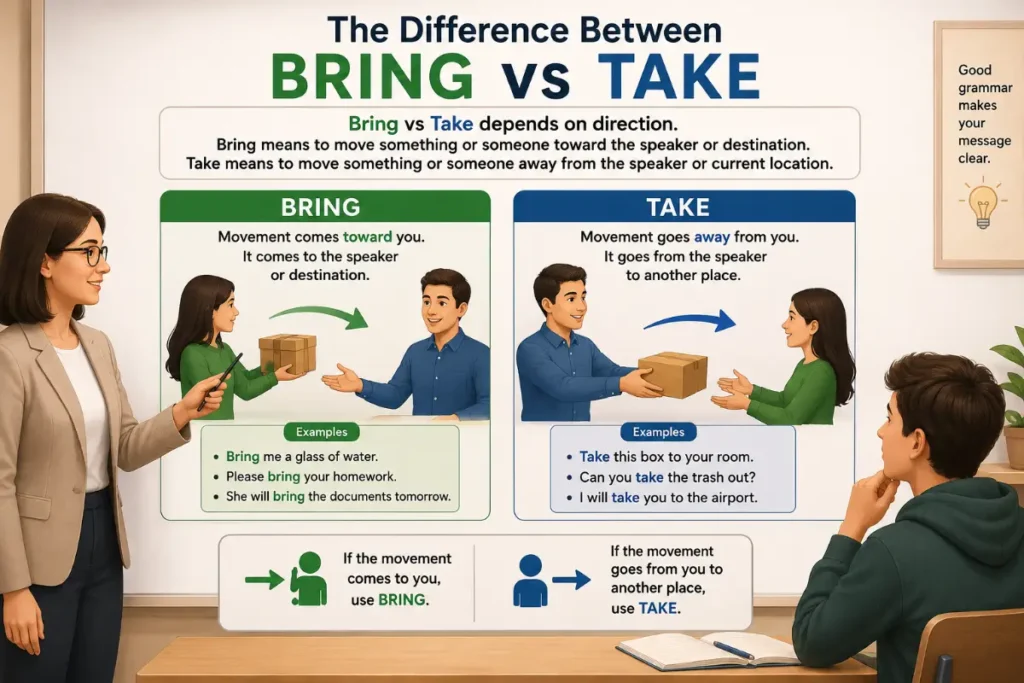
Bring vs Take can be confusing because both words describe moving a person or thing from one place to another. The difference is the direction of movement. You generally use bring when something moves toward the speaker, listener, or a place treated as the destination. You use take when something moves away from the speaker or the current location toward another place.
For example, you might tell a friend, “Bring your notebook to my house,” because your house is the destination. You might say, “Take your notebook to school,” because the notebook needs to go somewhere else. The same object can work with either verb, depending on the situation.
This distinction becomes easier once you picture the movement from the speaker’s point of view. However, real conversations can shift the point of view to the person receiving an item or to the place where people will meet. That is why you may hear both verbs in situations that seem similar. Learning the basic direction rule, along with a few common exceptions, will help you choose the right word naturally and confidently.
Need another quick comparison? Read desert vs dessert Explained With Simple Examples.
Quick Answer
Use bring when something moves toward the speaker, listener, or a destination treated as the center of attention. Use take when something moves away from the current location toward another place. For example, “Bring the report to my office” invites someone to deliver it to you, while “Take the report to the manager” directs someone to deliver it elsewhere.
Comparison Table
| Feature | Bring | Take |
|---|---|---|
| Main meaning | Move something toward a person or destination | Move something away from a person or location |
| Part of speech | Verb | Verb |
| Direction | Toward the reference point | Away from the reference point |
| Common context | Delivering something to the speaker or listener | Carrying or delivering something elsewhere |
| Example | Bring your jacket here. | Take your jacket upstairs. |
| Past tense | Brought | Took |
| Past participle | Brought | Taken |
| Formality | Standard in formal and informal English | Standard in formal and informal English |
| American English | Standard | Standard |
| British English | Standard | Standard |
Meaning and Definition
What Does Bring Mean
Bring means to carry, move, or cause someone or something to come toward a person, place, or situation that serves as the reference point.
The reference point is often where the speaker is, where the listener is, or where the people involved plan to meet. The verb can also describe less physical changes, such as bringing joy, bringing an issue to someone’s attention, or bringing a meeting to an end.
Examples include the following.
- Please bring your laptop to the meeting.
- Can you bring me a glass of water?
- The news brought relief to the family.
- Her question brought the problem to everyone’s attention.
In the first example, the laptop moves toward the meeting location. In the second, the water moves toward the speaker. In the third and fourth examples, the verb describes an effect rather than physical movement.
Bring is an irregular verb. Its main forms are bring, brings, bringing, brought, and brought. The past tense and past participle both use brought.
What Does Take Mean
Take means to carry, move, or cause someone or something to go from one place to another, often away from the speaker or the current location.
You commonly use it when giving instructions to deliver an item, accompany someone, or move something to a different place. The verb also appears in many expressions that do not describe physical movement.
Examples include the following.
- Take these documents to the front desk.
- I will take my brother to the airport.
- Please take your shoes off before entering.
- She took responsibility for the mistake.
In the first example, the documents move from the current location to the front desk. In the second, the speaker accompanies a family member to another place. The third and fourth examples show other common meanings of the verb.
Take is also irregular. Its main forms are take, takes, taking, took, and taken. Took is the simple past tense, while taken is the past participle.
Are Both Words Correct
Yes. Both are standard English verbs, and neither is inherently incorrect. The choice depends on the intended direction, the reference point, and the meaning of the sentence.
For instance, “Bring the food to the picnic” makes sense when the picnic is the destination under discussion. “Take the food to the picnic” can also be correct when the speaker views the food as leaving the current location. Context determines which perspective sounds most natural.
Key Differences Explained
Direction of Movement
The main distinction concerns the direction in which a person or object moves.
Use bring when the movement is toward the relevant person or place. Use take when the movement is away from the current point or toward a different destination.
Consider these examples.
- Bring the package into the room.
- Take the package out of the room.
The first instruction directs the package toward the room. The second directs it away from the room. This contrast makes direction a useful starting point when choosing between the verbs.
The Speaker and Listener Matter
The speaker’s location can help determine the correct verb, but it is not the only factor. The listener’s location and the destination being discussed also matter.
Imagine that you are at home and your friend is at work. You might say, “Bring your lunch home tonight,” because home is the destination you have in mind. If you tell your friend, “Take your lunch to work tomorrow,” the workplace is the destination.
Now imagine that you are talking to a person who is already at work. You could say, “Bring your lunch to the break room.” The break room is the destination of the conversation, even though you are not there.
The key is to identify the reference point rather than simply asking which person is speaking.
Movement Toward a Future Meeting Place
Sometimes the destination matters more than the speaker’s present location. This often happens when people discuss a party, appointment, class, or meeting.
For example, a host might say, “Bring a dessert to the party.” The party is the shared destination, so bring sounds natural. A person leaving a store might say, “I need to take this dessert to the party,” focusing on moving the item from the store to the event.
Both sentences can be correct. The difference comes from how the speaker frames the movement.
Physical Movement and Figurative Meaning
Both verbs can describe physical actions and abstract ideas.
Bring often appears in expressions such as bring happiness, bring attention to a problem, bring change, and bring an argument to an end. Take appears in expressions such as take responsibility, take action, take a break, and take control.
These expressions have established meanings. You cannot always select one verb by applying the physical direction rule alone.
For example, “The new policy brought change” describes an effect. It does not mean that someone physically carried change into a room. Likewise, “He took responsibility” describes accepting a duty, not moving an object.
Grammar and Verb Forms
Both words are irregular verbs, but their past forms differ.
| Verb form | Bring | Take |
|---|---|---|
| Base form | Bring | Take |
| Third person singular | Brings | Takes |
| Present participle | Bringing | Taking |
| Simple past | Brought | Took |
| Past participle | Brought | Taken |
Use the simple past for a completed action in the past. Use the past participle with helping verbs such as has, have, had, and be when the sentence structure calls for it.
Correct examples include “She brought her notes yesterday” and “She has brought her notes.” For the other verb, say “She took her notes yesterday” and “She has taken her notes.”
Avoid forms such as bringed, taked, and have took in standard English.
Formality and Context
Neither verb is more formal than the other. Both are suitable for emails, school assignments, workplace instructions, academic writing, and casual conversation.
The important issue is meaning. A professional email might say, “Please bring the signed form to your appointment.” Another might say, “Please take the signed form to the records department.” Each verb fits its intended direction.
In formal writing, clear context is especially useful when several people or locations appear in the same sentence. Naming the destination can prevent confusion.
Which Word Is Correct
Both words are correct, but they are not interchangeable in every sentence. Choose the verb that matches the direction or meaning you intend.
Use bring when you want something to come to a person or destination that serves as the focus. Use take when you want something to go from the current location to another place.
For example, if you are waiting at home, “Bring the groceries home” is a natural instruction to someone who is out shopping. If you are in the grocery store and planning to leave, “Take the groceries home” is also natural because you are describing the movement away from the store.
The difference is based on perspective, not on spelling, grammar quality, or level of formality. Standard dictionaries recognize both verbs, and their established definitions reflect different patterns of movement and use.
Ten Natural Sentence Examples
These examples show how the two verbs work in everyday and professional situations.
- Everyday conversation: Can you bring me a cup of coffee when you come upstairs.
- At home: Please take your shoes to your bedroom instead of leaving them by the door.
- Text message: Bring your charger tonight because mine is not working.
- Workplace: Please bring the updated report to our meeting at three.
- School: Remember to take your permission slip to the school office tomorrow.
- Academic setting: Students should bring their textbooks to class and take their completed assignments to the instructor’s desk.
- Social event: We are asking each guest to bring a dish to share at the picnic.
- Travel: I need to take my passport to the airport and keep it somewhere safe.
- Formal communication: Please bring the signed agreement to your appointment for review.
- Figurative meaning: Her calm response brought comfort to the team during a difficult week.
Notice that the choice depends on the situation. In some sentences, the destination is where the speaker or listener will be. In others, the speaker focuses on moving something away from the current place. The figurative example uses bring in the established sense of causing an emotional effect.
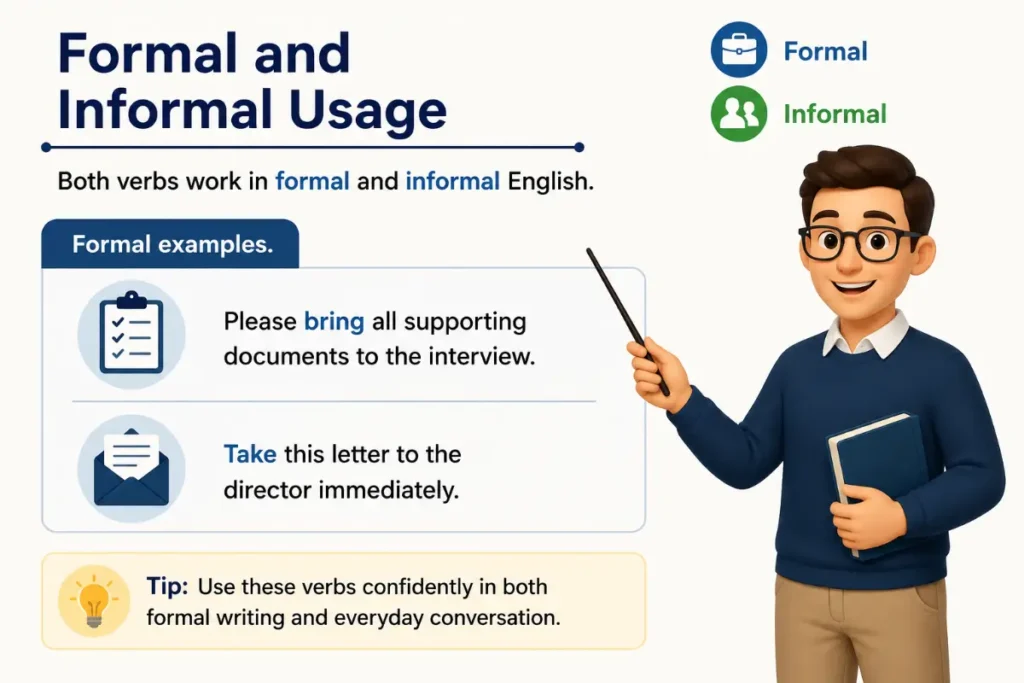
Formal and Informal Usage
Both verbs work in formal and informal English.
Formal examples.
Please bring all supporting documents to the interview.
Take this letter to the director immediately.
Informal examples.
Bring some pizza tonight.
Take your phone with you.
Common Mistakes and How to Avoid Them
Using the Verbs as Exact Synonyms
A common mistake is assuming that the two verbs mean exactly the same thing in every context. They overlap, but their direction and perspective can differ.
Incorrect for the intended meaning: “Take your notebook here to me.”
More natural: “Bring your notebook here to me.”
If the speaker is asking for an object to come to them, bring is usually the clearer choice. However, a different context could make take appropriate.
Choosing a Verb Only by the Speaker’s Location
Some learners assume that bring always means movement toward the speaker’s body and take always means movement away from the speaker’s body. That rule is too narrow because the listener and the planned destination can also act as reference points.
For example, a teacher can tell students, “Bring your projects to the exhibition.” The teacher may not be at the exhibition yet, but the event is the destination everyone has in mind.
To avoid this mistake, identify the place or person that serves as the focus of the movement.
Mixing Up Past Tense Forms
The verbs have irregular past forms, and learners sometimes apply the usual pattern of adding ed.
Incorrect: “Yesterday, I bringed the file to work.”
Correct: “Yesterday, I brought the file to work.”
Incorrect: “She taked the bus downtown.”
Correct: “She took the bus downtown.”
Remember that bring changes to brought, while take changes to took in the simple past.
Confusing Took and Taken
Took and taken are both forms of take, but they serve different grammatical roles.
Correct: “He took the keys this morning.”
Correct: “He has taken the keys.”
Incorrect: “He has took the keys.”
The helping verb has requires the past participle taken in this construction. You can remember the pattern by pairing took with a simple past statement and taken with has, have, or had.
Forgetting the Destination
A sentence can sound unclear if the reader cannot tell where an object is going. This problem is not always a grammar error, but it can make instructions less useful.
Less clear: “Take the papers.”
Clearer: “Take the papers to the front desk.”
Likewise, “Bring the forms” may be enough when everyone knows the meeting location. If the destination is unclear, name it directly.
For another common grammar confusion, see Inconsolable or Unconsolable Correct Spelling and Meaning.
Pronunciation Guide
Both verbs are short, familiar words in English. Their pronunciation is not the main source of confusion, but learning the sounds can help with speaking and listening.
| Word | IPA | Syllables | Simple guide |
|---|---|---|---|
| Bring | /brɪŋ/ | One | Bring, rhymes with sing |
| Take | /teɪk/ | One | Tayk, rhymes with make |
| Brought | /brɔːt/ in many US pronunciations | One | Brawt, with regional variation |
| Took | /tʊk/ | One | Tुक, similar to book |
| Taken | /ˈteɪkən/ | Two | TAY kuhn |
Bring starts with the consonant blend /br/. The final sound is /ŋ/, as in sing, rather than a separate hard g sound. Take contains the long a sound /eɪ/, followed by /k/.
In American English, the vowel in brought varies by accent. Some speakers pronounce it with a vowel close to the one in caught, while other speakers use a different vowel because of regional patterns. These variations do not change the spelling or meaning.
A useful practice method is to say each verb in a complete phrase: “Bring it here,” “Take it there,” “I brought it,” and “I took it.” Speaking the phrases aloud helps connect pronunciation with meaning and grammar.
Etymology and Word Origin
The two verbs have long histories in English and developed along different paths.
The History of Bring
Bring comes from Old English bringan, meaning to bring or carry. Related forms appeared in early Germanic languages, reflecting the word’s old roots. Over time, the verb developed into the modern form used for carrying, causing something to arrive, and producing an effect.
The past forms brought and brought also reflect historical sound changes rather than the regular pattern of adding ed. Modern speakers learn these forms as part of the verb’s irregular pattern.
The History of Take
Take entered English through Old Norse taka, meaning to take or grasp. The word became established in Middle English and gradually developed many meanings, including carrying something, accepting something, choosing an option, and performing an action.
Its forms took and taken preserve an irregular pattern. The wide range of meanings explains why take appears in expressions that do not involve carrying an object from one place to another.
The historical origins are different, but both verbs became basic parts of modern English. Their modern meanings depend on context and established usage, not simply on their original roots.
Regional Usage
The basic distinction is broadly consistent across major varieties of English. American, British, Australian, and Canadian speakers use both verbs, and the core difference in direction remains familiar.
American English
In the United States, bring commonly refers to moving something toward the speaker, listener, or shared destination. Take often refers to moving something away from the current location.
Examples include “Bring your lunch to work” and “Take these files to the front office.” The intended destination and conversational viewpoint guide the choice.
American English also uses both verbs in many fixed expressions, such as bring up a topic, bring about change, take a break, and take action.
British English
British English follows the same broad distinction. A speaker might say, “Bring your coat with you,” when addressing someone who is coming to the speaker’s location. “Take your coat upstairs” directs the person to move the coat to another place.
Some regional preferences and conversational habits may differ, but there is no major British spelling difference between these verbs. Both forms are standard.
Australian English
Australian English also uses both verbs in the same general way. Someone may ask a visitor to bring a plate of food to a gathering, while another person may tell a child to take a bag to school.
Local expressions and social customs can affect the surrounding sentence, but they do not create a different core rule for the two verbs.
Canadian English
Canadian English uses the same standard forms and follows the same basic directional distinction. The choice depends on the people, places, and events that frame the action.
Across these varieties, context can make either verb natural in a sentence about the same object. This is a difference in perspective rather than a regional spelling rule.
Grammar Rules and Part of Speech
Both words function mainly as verbs. They can take direct objects, appear with helping verbs, form commands, and occur in common verb phrases.
Using Them With Direct Objects
A direct object is the person or thing affected by the action. Both verbs often take a direct object.
Examples include “Bring the package” and “Take the package.” The package is the direct object in both sentences. The verb changes because the intended movement changes.
You can add a destination to make the instruction more specific: “Bring the package to reception” or “Take the package to reception.” The surrounding context tells the reader which direction the speaker has in mind.
Using Them in Commands
Commands often begin with the base form of the verb. The subject you is understood, even though it is not written.
- Bring your notebook to class.
- Take your notebook home.
- Bring the children inside.
- Take the children to the playground.
These are all grammatically correct. The right choice depends on the intended movement and destination.
Using Them in Different Tenses
The verbs can appear in present, past, and future constructions.
Present: “I bring my lunch to work every day.”
Past: “I brought my lunch yesterday.”
Future: “I will bring my lunch tomorrow.”
For take, the corresponding forms are “I take my lunch to work,” “I took my lunch yesterday,” and “I will take my lunch tomorrow.”
The future construction uses the base form after will. Do not write “will brought” or “will took.”
Using Them With Helping Verbs
Helping verbs change the grammatical structure of the sentence. After has, have, or had, use the past participle.
Correct: “They have brought the supplies.”
Correct: “They have taken the supplies.”
After will, can, should, or must, use the base form.
Correct: “You should bring your identification.”
Correct: “You must take the form to the office.”
These patterns are important in both casual and formal writing.
Common Phrases and Phrasal Verbs
Both verbs appear in phrasal verbs, which combine a verb with another word to create a particular meaning.
Bring up can mean to mention a topic or raise a child. Bring back can mean to return something or cause a memory to return. Take off can mean to remove something or for an aircraft to leave the ground. Take over can mean to assume control.
Because these expressions have established meanings, the direction rule does not always explain them. Learn the complete phrase in context rather than trying to interpret each word separately.
Real Life Usage Examples
Daily Conversation
In everyday speech, the verbs often appear in short requests and instructions. The speaker usually expects the listener to understand the destination from the situation.
- “Can you bring your umbrella when you come over?”
- “Please take these dishes to the kitchen.”
The first request focuses on the person arriving at the speaker’s place. The second directs the dishes to another room.
Email and Workplace Communication
Workplace messages often involve documents, equipment, and people moving between locations. A clear destination makes the instruction easier to follow.
- “Please bring the revised proposal to our afternoon meeting.”
- “Could you take the signed forms to the human resources department?”
The first message treats the meeting as the destination. The second directs the forms to a separate department.
Academic Writing
In school and academic settings, both verbs can describe materials and people moving to a location. They can also appear in abstract statements.
- “Students should bring their research notes to the seminar.”
- “The findings took the discussion in a new direction.”
The first example describes physical movement. The second uses take in a figurative expression to describe how the findings influenced the discussion.
News and Journalism
News writing often uses these verbs to describe people transporting items, attending events, or causing changes.
- “Volunteers brought food and blankets to families affected by the storm.”
- “The new evidence took the investigation in a different direction.”
The first sentence focuses on supplies reaching the families. The second uses take figuratively to describe a change in the investigation’s course.
Literature and Storytelling
Stories often use bring and take to show movement, emotional effects, and changes in a character’s situation.
- “She brought the old photograph into the room and placed it beside the window.”
- “He took one last look at the house before walking down the road.”
The first sentence moves an object toward the scene. The second follows a character moving away from a place. Writers can use the verbs to help readers picture the action and understand the viewpoint.
Related and Confused Terms
Several other verbs and expressions overlap with these words. The best choice depends on the action you want to describe.
Carry
Carry means to support and move something from one place to another. It focuses on the act of holding or transporting the item, not on a particular direction.
Example: “Please carry the box carefully.”
You can carry something toward a person or away from them. The verb does not by itself express the same directional viewpoint as bring and take.
Deliver
Deliver means to bring or transport something to a person or destination, often as part of a service or task.
Example: “The courier delivered the package this morning.”
Deliver is useful when the important point is that an item reaches its intended recipient. It often sounds more specific than simply saying bring or take.
Fetch
Fetch means to go somewhere, get something, and return with it or bring it to someone.
Example: “Could you fetch my glasses from the bedroom?”
The idea of returning or bringing the item back is often built into the meaning. This makes fetch useful when the action includes both getting an object and returning with it.
Get
Get has many meanings, including obtain, receive, fetch, and reach a place. In informal speech, people sometimes use get where a more specific verb could be clearer.
Example: “Can you get my bag from the car?”
The sentence suggests retrieving the bag, but it does not state the full movement as precisely as “Bring my bag in from the car.”
Carry Away
Carry away describes moving something away from its original place. It can also mean becoming overly excited or emotionally overwhelmed in expressions such as “get carried away.”
Example: “Please carry away the empty boxes.”
This phrase emphasizes removal from the current location rather than movement toward a speaker.
Send
Send means to arrange for a person or thing to go to a destination. It does not require the speaker to carry the item personally.
Example: “I will send the documents to your office.”
Send is often useful for emails, parcels, messages, and other things that travel without the speaker physically transporting them.
Return
Return means to go or bring something back to an earlier place, owner, or state.
Example: “Please return the library book by Friday.”
Return focuses on going back or restoring something. Depending on the sentence, bring or take may describe the movement, while return explains that the item is going back.
Transport
Transport means to move people or goods from one location to another. It often sounds more formal or technical than bring and take.
Example: “The company transports equipment between its warehouses.”
Transport is useful in logistics, shipping, and formal descriptions. It does not usually depend on the speaker’s viewpoint in the same way as the two main verbs.
Expert Editor Insight
An experienced editor looks first at the destination and the point of view in the sentence. If the writer asks someone to move an item toward a person or shared meeting place, bring is often the natural choice. If the writer directs an item away from the current location, take may fit better. Editors also check irregular forms such as brought, took, and taken. Grammar tools can identify tense errors, but they may not fully understand the intended direction without enough context. When a sentence sounds awkward, naming the destination often makes the meaning clearer.
Key Takeaways
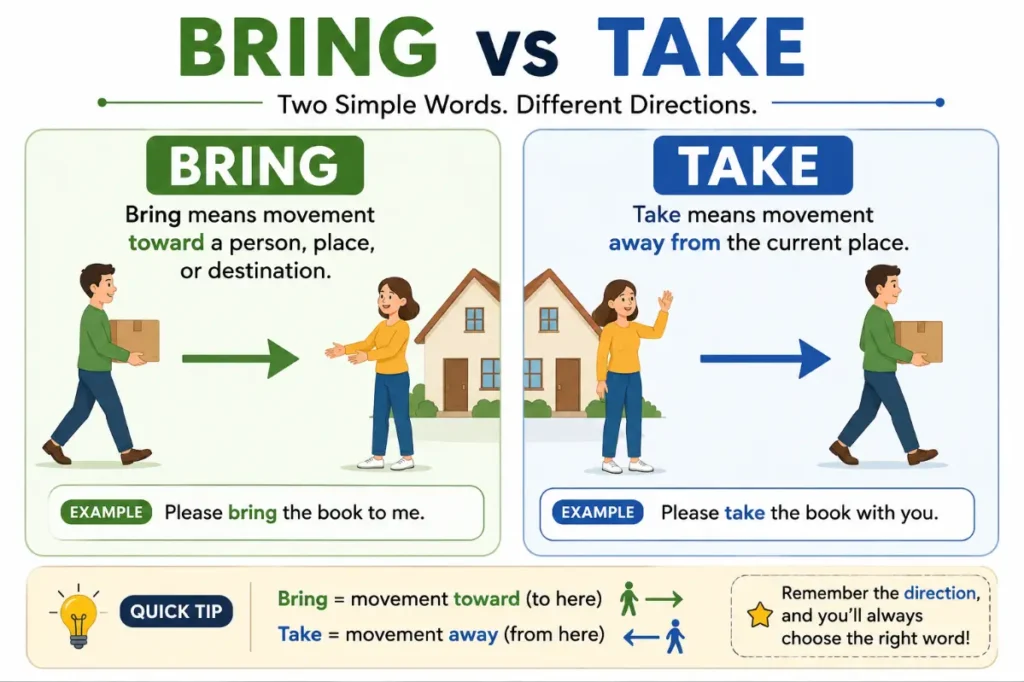
- Bring means movement toward a person, place, or destination.
- Take means movement away from the current place.
- The speaker’s perspective determines which verb is correct.
- Ask yourself, “Is it coming here or going there?” before choosing the verb.
- The same event may use both verbs when different people describe it from different locations.
- Both American and British English follow the same rule.
- Understanding direction is the key to mastering Bring vs Take.
- Regular practice with everyday examples makes the distinction feel natural.
You may also want to read Its vs It’s: Meaning and Correct Usage Explained.
Conclusion
Bring vs Take becomes easier once you focus on direction and point of view. Bring usually describes movement toward the speaker, listener, or destination being discussed, while take often describes movement away from the current place. Both verbs are correct, and both appear in everyday speech, professional writing, and figurative expressions.
Their irregular forms also matter: bring changes to brought, while take changes to took and taken. For a quick editing check, picture where the object starts and where it needs to go. Remember the simple cue “Bring it here, take it there,” then use the surrounding context to confirm your choice.
FAQs
What Is the Main Difference Between Bring and Take?
The main difference is the direction of movement. Bring usually describes movement toward the speaker, listener, or destination being discussed. Take usually describes movement away from the current location toward another place. Context can affect the choice, especially when people discuss a future meeting or a shared destination. Both verbs are correct standard English words.
Can Both Words Be Correct in the Same Situation?
Yes. Two speakers can describe the same action using different verbs because they focus on different reference points. Someone leaving a store might say they will take food to a party, while the host might ask them to bring food to the party. The destination is the same, but each speaker frames the movement differently.
Should I Say Bring It Here or Take It Here?
Bring it here is the usual choice when you want an object moved to your current location or to a place treated as the focus of the conversation. Take it here can sound less natural in that context, although special situations may allow it. If the destination is where you are waiting, bring is usually the clearest option.
Is Bring More Polite Than Take?
Neither verb is automatically more polite. The tone comes mainly from the wording, relationship, and situation. “Please bring the file to my office” and “Please take the file to the front desk” are both polite instructions. Adding please, using a friendly tone, or phrasing a request as a question can make either sentence sound more courteous.
What Are the Past Tense Forms of These Verbs?
The simple past of bring is brought, and the simple past of take is took. Their past participles are brought and taken. You can say “I brought the book yesterday” and “I have brought the book.” For take, say “I took the book yesterday” and “I have taken the book.” Avoid forms such as bringed and taked.
Can Bring and Take Be Used Figuratively?
Yes. Bring appears in expressions such as bring happiness, bring attention to an issue, and bring about change. Take appears in phrases such as take responsibility, take action, and take control. In these cases, the verbs express abstract meanings rather than simply describing physical movement. Learn common expressions as complete phrases because their meanings can differ from literal movement.
Do American and British English Use These Words Differently?
American and British English use both verbs with the same basic directional distinction. In both varieties, bring commonly points toward a person or destination, while take often points away from the current location. Small differences in conversational habits may occur, but there is no major regional spelling distinction between the two words.
What Is an Easy Way to Remember Which Verb to Use?
Picture the destination before choosing the verb. If the action moves something toward the person or place at the center of the conversation, bring is often appropriate. If the action moves something away from the current location, take is often appropriate. Try remembering the simple contrast “Bring it here, take it there.” Then check the wider context if the destination is shared or planned.