
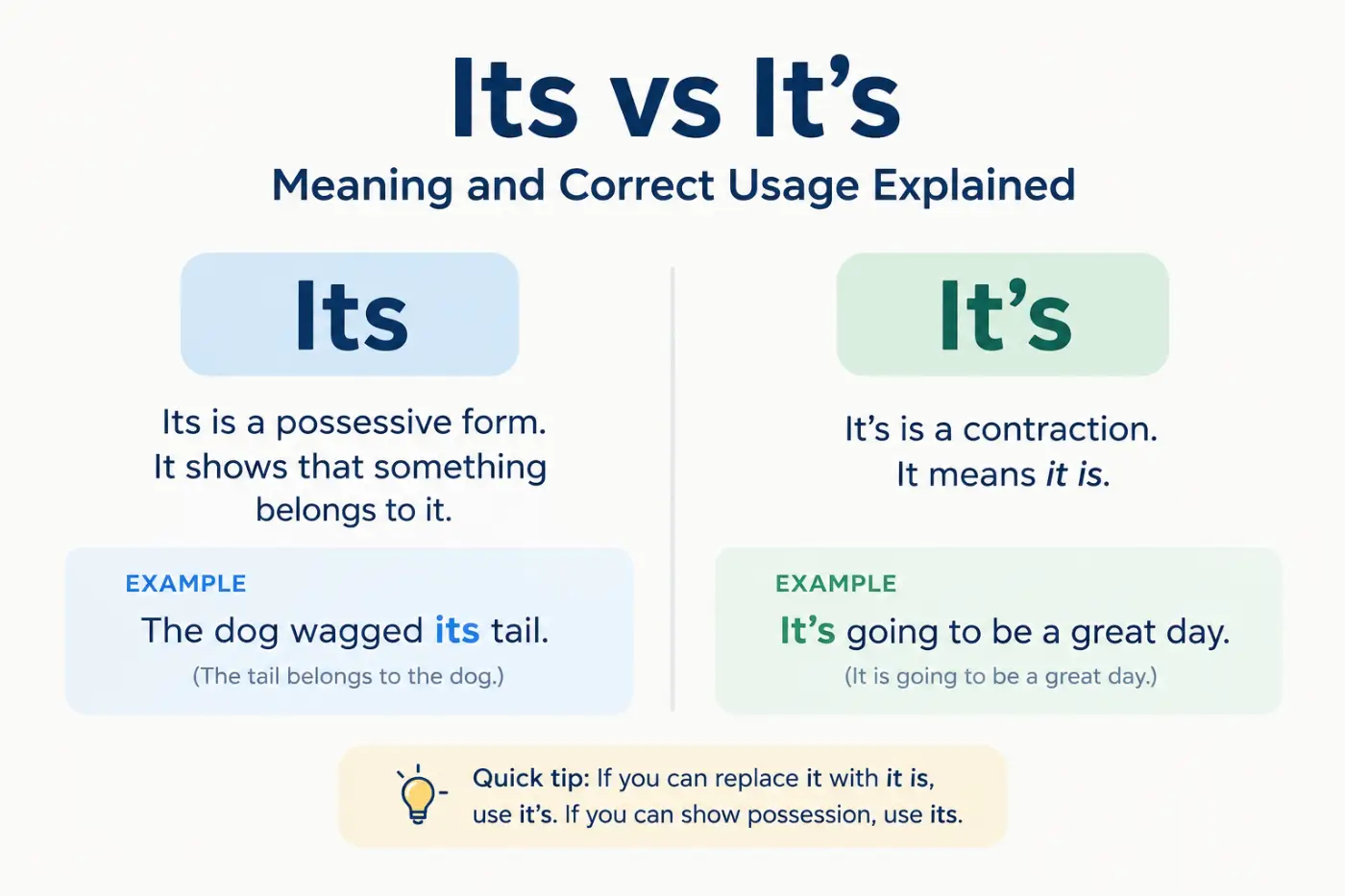
Its vs it’s is a common English grammar problem because the two forms look almost identical. The only visible difference is an apostrophe, yet that small mark changes the meaning and grammatical function of the word. The good news is that you can learn the rule in minutes and apply it to almost any sentence.
Use its when you mean that something belongs to or relates to something else. Use it’s when you mean it is or it has. For example, the cat cleaned its paws describes the cat’s paws, while it’s sleeping means it is sleeping. Both forms are correct English, but they serve different purposes.
The confusion often comes from a familiar spelling pattern. In English, apostrophes commonly show possession, as in Sarah’s book or the dog’s collar. However, possessive its follows a different pattern. Once you understand this exception and learn a simple replacement test, you’ll be able to spot the correct form in emails, school assignments, reports, social media posts, and everyday messages.

For another common grammar confusion, see Bring vs Take Which Word Should You Use.
Quick Answer
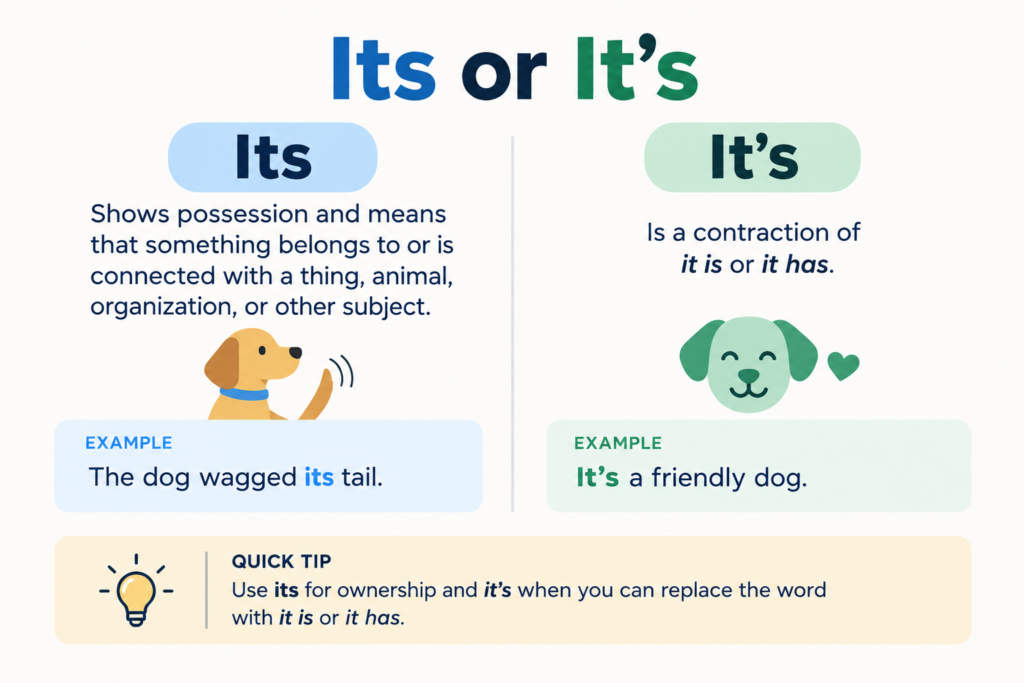
Its shows possession and means that something belongs to or is connected with a thing, animal, organization, or other subject. It’s is a contraction of it is or it has. For example, the dog wagged its tail, but it’s a friendly dog. Use its for ownership and it’s when you can replace the word with it is or it has.
What Its Means
Its is a possessive determiner. It shows that something belongs to, or is associated with, a thing, animal, organization, place, or other subject represented by it.
For example, in the sentence The bird spread its wings, the word its connects the wings to the bird. It answers the question whose wings? The bird’s wings.
Here are more examples.
- The company changed its policy.
- The tree lost its leaves.
- The phone has its own charger.
- The school updated its website.
- The restaurant is known for its fresh bread.
In each sentence, its connects a noun with the thing that owns it or is associated with it.
The word doesn’t mean that the subject must be an inanimate object. English also uses it for animals when their sex is unknown, irrelevant, or not being emphasized. For example, The puppy hurt its paw is grammatically correct.
Its can also refer to an abstract idea or a group treated as a single unit. In The plan has its advantages, the word connects the advantages with the plan.
Is Its a Possessive Pronoun
Strictly speaking, its is usually classified as a possessive determiner rather than a possessive pronoun in modern grammar. It normally appears before a noun, as in its color, its purpose, or its shape.
Compare it with mine, yours, hers, and ours. These possessive pronouns can stand alone in sentences such as The blue bag is hers. Its normally doesn’t work that way in standard modern English.
For example, you can write The company changed its policy. You wouldn’t normally write The policy is its to express the same idea. Instead, write The policy belongs to the company.
This distinction isn’t necessary for every everyday writing task, but it helps explain why its behaves differently from some other possessive forms.
What It’s Means
It’s is a contraction. A contraction combines two words and replaces one or more letters with an apostrophe.
This form has two standard meanings.
- It is.
- It has.
The intended meaning depends on the sentence.
When it’s means it is, the apostrophe replaces the missing letter in is.
Examples include the following.
- It’s cold outside.
- It’s a beautiful day.
- It’s difficult to explain.
- It’s my turn.
- It’s ready for delivery.
You can expand each example to it is without changing the basic meaning.
When it’s means it has, the apostrophe replaces the missing letters in has.
Examples include these sentences.
- It’s been a long week.
- It’s already started.
- It’s gotten much colder.
- It’s taken longer than expected.
- It’s been raining all morning.
In these examples, it’s has means it has. The contraction is natural in conversation and common in everyday writing.
How to Tell Which Meaning Applies
Look at the words that follow the contraction.
If the sentence works with it is, the first meaning is likely correct.
For example, It’s late becomes It is late.
If the sentence works with it has, the second meaning is likely correct.
For example, It’s been difficult becomes It has been difficult.
Pay attention to the grammar that follows. It has often introduces a past participle, such as been, started, finished, or changed. It is can introduce an adjective, a noun phrase, or a verb ending in ing.
These patterns are useful clues, although the replacement test is more reliable than trying to memorize every possible combination.
Comparison Table for Its and It’s
| Feature | Its | It’s |
|---|---|---|
| Meaning | Belonging to or associated with it | It is or it has |
| Grammatical role | Possessive determiner | Contraction |
| Apostrophe | No | Yes |
| Shows possession | Yes | No |
| Can expand to it is | No | Yes |
| Can expand to it has | No | Yes |
| Common example | The dog wagged its tail. | It’s getting dark. |
| Typical context | Ownership or association | Description or action |
| Formal writing | Standard | Standard when appropriate for the tone |
| Common mistake | Adding an apostrophe for possession | Using the contraction to show ownership |
Both forms are standard English. The right choice depends on the meaning you want to express.
The Main Grammar Difference
The central difference is grammatical rather than regional or stylistic. One form shows possession, and the other combines two words.
Use Its Before a Noun
Use its when you need to connect a noun with a subject.
Examples include its name, its color, its purpose, its location, and its effect.
Consider this sentence.
The machine stopped working because its motor overheated.
The word its tells readers that the motor belongs to or is part of the machine.
Now consider another example.
The book is famous for its detailed illustrations.
Its connects the illustrations with the book.
In both cases, the possessive determiner appears before a noun. This is one of the easiest ways to recognize it.
Use It’s When You Mean It Is
Use the contraction when the full sentence contains it is.
For example, It’s important to check your work means It is important to check your work.
It’s also getting late means It is also getting late.
It’s a useful tool means It is a useful tool.
The contraction makes the sentence shorter and often sounds more natural in ordinary conversation.
Use It’s When You Mean It Has
Use the contraction when the sentence contains it has.
For example, It’s changed since last year means It has changed since last year.
It’s been a difficult month means It has been a difficult month.
It’s reached the final stage means It has reached the final stage.
Don’t assume that every sentence followed by a past participle must use it’s. Check the complete grammatical structure and intended meaning before deciding.
Why the Apostrophe Is Confusing
English uses apostrophes in several ways. One common use is to show possession with nouns.
For example:
- Maria’s laptop.
- The teacher’s desk.
- The dog’s collar.
- The children’s books.
Because these forms use apostrophes, writers often assume that every possessive form needs one. However, possessive pronouns and determiners follow their own spelling patterns.
My, your, his, her, our, and their don’t need apostrophes to show possession. Its follows the same general pattern.
For example, you write its cover rather than it’s cover when you mean the cover belongs to something.
The apostrophe in it’s serves a different purpose. It marks the missing letters in a contraction.
This is why the rule may seem unusual at first. The apostrophe doesn’t always indicate ownership. In this pair, it signals that two words have been shortened into one.
Which Form Is Correct
Both forms are correct, but they aren’t interchangeable.
Use its for possession or association.
Correct: The bird built its nest.
The nest belongs to the bird.
Use it’s for it is.
Correct: It’s a beautiful nest.
The sentence means It is a beautiful nest.
Use it’s for it has.
Correct: It’s been a busy day.
The sentence means It has been a busy day.
Incorrect: The bird built it’s nest.
Correct: The bird built its nest.
The incorrect version expands to The bird built it is nest, which doesn’t make grammatical sense.
A helpful habit is to pause whenever you type it’s. Expand it to it is or it has. If the expanded sentence doesn’t work, you probably need its.
Ten Natural Sentence Examples
These examples show how the two forms work in real situations.
- The dog wagged its tail when I came home.
Its shows that the tail belongs to the dog.
- It’s going to rain this afternoon.
It’s means it is.
- The school changed its schedule for the holiday.
Its connects the schedule with the school.
- It’s been a busy week at work.
It’s means it has.
- The phone lost its connection during the call.
Its refers to the phone’s connection.
- It’s easier to understand the rule with examples.
It’s means it is.
- The restaurant is proud of its homemade desserts.
Its connects the desserts with the restaurant.
- It’s already time to leave for the airport.
It’s means it is.
- The company has improved its customer service.
Its refers to the customer service provided by the company.
- It’s taken longer than we expected to finish the project.
It’s means it has.
The examples cover animals, schools, workplaces, technology, and daily life. In each case, the meaning determines the spelling.
Common Mistakes and How to Fix Them
Mistake One: Using It’s to Show Ownership
Incorrect: The cat licked it’s paw.
Correct: The cat licked its paw.
The paw belongs to the cat. You can’t replace its with it is or it has, so the possessive form is necessary.
Mistake Two: Removing the Apostrophe From a Contraction
Incorrect: Its a lovely morning.
Correct: It’s a lovely morning.
The sentence means It is a lovely morning. Because two words are shortened, the apostrophe is required.
Mistake Three: Confusing Possession With Description
Incorrect: The company changed it’s name.
Correct: The company changed its name.
The name belongs to or identifies the company. The sentence doesn’t mean The company changed it is name.
Mistake Four: Misreading It’s Been
Incorrect: Its been three hours since we arrived.
Correct: It’s been three hours since we arrived.
Here the intended meaning is It has been three hours. The contraction needs an apostrophe.
Mistake Five: Trusting Automatic Corrections Without Checking Meaning
A spelling or grammar tool may flag a sentence for review, but the correct choice still depends on context. Some tools may miss the error because both forms are valid words.
For example, The company updated it’s website may look fine to a basic spellchecker. The sentence is still incorrect because the website belongs to or is associated with the company.
Read the sentence aloud and expand the contraction. If the expanded version sounds wrong or breaks the grammar, change the form.
For another common grammar confusion, see Borrow vs Barrow Explained With Examples.
Pronunciation Guide
The two forms are pronounced the same in standard American English.
Its is generally pronounced /ɪts/.
It’s is also pronounced /ɪts/.
Both are one syllable. The final sound is a combination of t and s, which can feel slightly clipped when spoken quickly.
Because their pronunciation is identical, listening alone usually won’t tell you which spelling a speaker intends. You need to rely on grammar and context.
For example, in speech, The dog wagged its tail and It’s a friendly dog contain the same spoken form at the point where the words appear. Their different grammatical functions determine the spelling.
This is a useful reminder that correct English spelling isn’t always something you can work out by sound. Sometimes you need to understand the sentence first.
Etymology and Word Origin
The difference between the two forms reflects a wider pattern in English grammar.
The word it is an old English pronoun with roots in Old English hit. Over time, its developed as the possessive form associated with it. Modern English uses this form without an apostrophe, following the pattern of other possessive determiners.
The contraction it’s developed from the combination of it and is or it and has. The apostrophe marks the omitted letters. This follows a common English convention used in contractions such as she’s, they’re, and we’ve.
The modern distinction is well established. Its functions as a possessive determiner, while it’s represents a shortened grammatical phrase.
You don’t need to memorize the historical details to use the forms correctly. The key point is that the apostrophe marks a contraction here, not possession.
Regional Usage in English
American English
Both forms are standard in American English. Writers use its to show possession and it’s as a contraction of it is or it has.
Contractions are common in everyday conversation, emails, informal articles, and many kinds of general writing. In very formal documents, writers may prefer the expanded form when it suits the tone, but it’s isn’t automatically incorrect in formal writing.
British English
British English follows the same spelling distinction. Its shows possession, and it’s represents it is or it has.
There is no meaningful British spelling alternative that changes this rule.
Australian English
Australian English also uses the same distinction. Both forms are standard, and the choice depends on grammar and meaning rather than regional preference.
Canadian English
Canadian English follows the same rule as American and British English. Use its for possession and it’s for the contraction.
The difference is not a matter of national spelling. It is a basic grammatical distinction shared across standard varieties of English.
Grammar Rules and Sentence Structure
Understanding where each form fits in a sentence makes the rule easier to apply.
Its Before a Noun
Its normally appears directly before a noun or before words that describe that noun.
Examples include:
- Its bright color attracts attention.
- Its unusual shape makes it easy to recognize.
- Its main purpose is to protect the device.
- Its recent success surprised the team.
In each sentence, its introduces a noun phrase. It doesn’t stand alone as a normal independent possessive pronoun.
It’s Before an Adjective or Noun Phrase
When it’s means it is, it can come before an adjective, a noun phrase, or a present participle.
Examples:
- It’s cold.
- It’s a good idea.
- It’s working.
- It’s surprisingly easy.
These structures work because the contraction can expand to it is.
It’s With a Past Participle
When it’s means it has, it often comes before a past participle.
Examples:
- It’s finished.
- It’s disappeared.
- It’s been repaired.
- It’s changed.
The surrounding sentence determines the meaning. For example, It’s finished can mean It is finished or It has finished, depending on the context and the intended sense.
Apostrophes and Possessive Forms
English possessive determiners include my, your, his, her, its, our, and their. These forms don’t need apostrophes.
By contrast, contractions use apostrophes to show omitted letters.
This distinction explains why you write the dog’s bowl but its bowl. The first uses a possessive noun. The second uses a possessive determiner.
Real Life Usage Examples
Daily Conversation
Example one: It’s getting dark, so let’s head home.
The contraction means it is.
Example two: The baby dropped its toy.
The possessive form connects the toy with the baby.
Workplace Communication
Example one: It’s important to send the report before noon.
The sentence means It is important.
Example two: The department updated its training plan.
The possessive form refers to the department’s plan.
Academic Writing
Example one: The study has several limitations, and its findings should be interpreted carefully.
Its refers to the study and connects the findings to it.
Example two: It’s difficult to draw a firm conclusion from a small sample.
It’s means it is. In formal academic writing, an expanded form may be chosen to suit the author’s style, but the contraction is grammatically valid.
News and Journalism
Example one: The city announced its new transportation plan.
Its refers to the city’s plan.
Example two: It’s unclear how long the repairs will take.
It’s means it is.
Literature and Storytelling
Example one: The old house creaked as the wind pushed against its windows.
Its connects the windows with the house.
Example two: It’s been years since anyone entered the abandoned building.
It’s means it has.
These examples show that the rule applies across different types of writing. The context changes, but the grammatical distinction stays the same.
Eight Related and Confused Terms
1. Your and You’re
Your shows possession, as in your book. You’re is a contraction of you are, as in you’re ready.
The same basic test works. Expand the contraction to check it.
2. Their and They’re
Their shows possession, as in their house. They’re means they are, as in they’re waiting outside.
Don’t choose the spelling based only on how the word sounds.
3. There and Their
There often refers to a place or introduces a statement, as in the keys are over there. Their shows possession.
These words sound alike in many accents but have different grammatical roles.
4. Whose and Who’s
Whose asks about ownership or identifies the person connected with something. Who’s is a contraction of who is or who has.
For example, Whose coat is this? asks about ownership. Who’s coming? means Who is coming?
5. They’re and It’s
They’re means they are. It’s means it is or it has.
Both contain apostrophes because both are contractions, but they refer to different grammatical subjects.
6. Its Own
Its own emphasizes that something belongs specifically to or is associated with a subject.
For example, The company has its own research team.
The word its remains a possessive determiner and does not need an apostrophe.
7. It Is
It is is the expanded form of one meaning of it’s.
For example, It’s ready means It is ready.
In formal writing, using the full form can sometimes create a more deliberate tone.
8. It Has
It has is the expanded form of the other meaning of it’s.
For example, It’s arrived means It has arrived.
Use this expansion to check the contraction when it appears before a past participle.

Expert Editor Insight
Experienced editors don’t judge these forms by appearance alone. They check what the sentence means and how the words function. A spellchecker may accept both forms because both are standard English, so a writer can still make a grammatical mistake even when every word is spelled correctly. The most reliable editing habit is to expand the contraction to it is or it has. If that replacement changes the meaning or makes the sentence ungrammatical, use the possessive form instead.
A Simple Memory Trick
Remember this short rule: no apostrophe for possession, apostrophe for contraction.
For example, the tree lost its leaves. The leaves belong to the tree, so use its.
Now look at the sentence It’s losing its leaves. The first form means it is. The second shows possession because the leaves belong to the tree.
A second trick is to test the contraction. Whenever you’re unsure, replace it’s with it is or it has. If the sentence still makes sense, the contraction may be correct. If the sentence means that something belongs to a subject, choose its.
You can practice this rule with everyday sentences until the distinction becomes automatic.
For another common grammar confusion, see Elicit vs Illicit Meaning and Usage Explained.
Conclusion
The difference between its vs it’s comes down to possession and contraction. Use its when something belongs to or is associated with a subject. Use it’s when you mean it is or it has. Both forms are correct English, but they cannot replace each other in a sentence without changing the meaning or breaking the grammar.
Keep one editing rule in mind. Expand it’s to it is or it has before you finish writing. If the sentence still makes sense, the contraction is appropriate. If you’re describing ownership, remove the apostrophe and use its. With a little practice, this small spelling difference becomes easy to spot and correct.
FAQs
Is its ever written with an apostrophe to show possession?
No. In standard modern English, its shows possession without an apostrophe. The form it’s is reserved for the contractions it is and it has. For example, the bird spread its wings is correct, while the bird spread it’s wings is incorrect because the contraction cannot express ownership in that sentence.
Is it’s a real word?
Yes. It’s is a standard English contraction of it is or it has. It appears in everyday conversation and many forms of writing. The problem isn’t that the form is wrong. The mistake occurs when writers use it to show possession instead of using its.
How can I tell which form belongs in a sentence?
Replace it’s with it is or it has. If the expanded sentence makes sense, the contraction is probably correct. If you mean that something belongs to or is associated with a subject, use its. For example, The dog wagged its tail shows possession, while It’s wagging its tail means It is wagging its tail.
Are its and it’s pronounced the same?
Yes. Both are usually pronounced /ɪts/ in standard American English. They have one syllable and sound alike in ordinary speech. Since pronunciation doesn’t reveal the spelling difference, you need to use grammar and context to choose the right form when writing.
Can it’s start a sentence?
Yes. You can begin a sentence with it’s when the contraction means it is or it has. For example, It’s time to leave means It is time to leave. It’s been a difficult week means It has been a difficult week. The choice depends on the sentence’s meaning and grammatical structure.
Is it’s acceptable in formal writing?
Yes. It’s is grammatically standard, but the best style depends on the document and audience. Contractions are common in general business writing and conversational articles. Some academic or legal documents may favor expanded forms for consistency or tone. The important rule is to use the contraction only when it means it is or it has.
Why do people confuse its and it’s?
People often learn that apostrophes show possession, as in the dog’s collar. They then apply that pattern to its, even though possessive determiners don’t use apostrophes. The similar appearance and identical pronunciation make the error more common. Remembering that the apostrophe marks a contraction helps prevent it.
What is an easy way to remember the difference?
Think of its as the ownership form and it’s as the shortened form. The cat licked its paw means the paw belongs to the cat. It’s hungry means it is hungry. When you are unsure, expand the contraction to it is or it has. That quick test catches most errors