
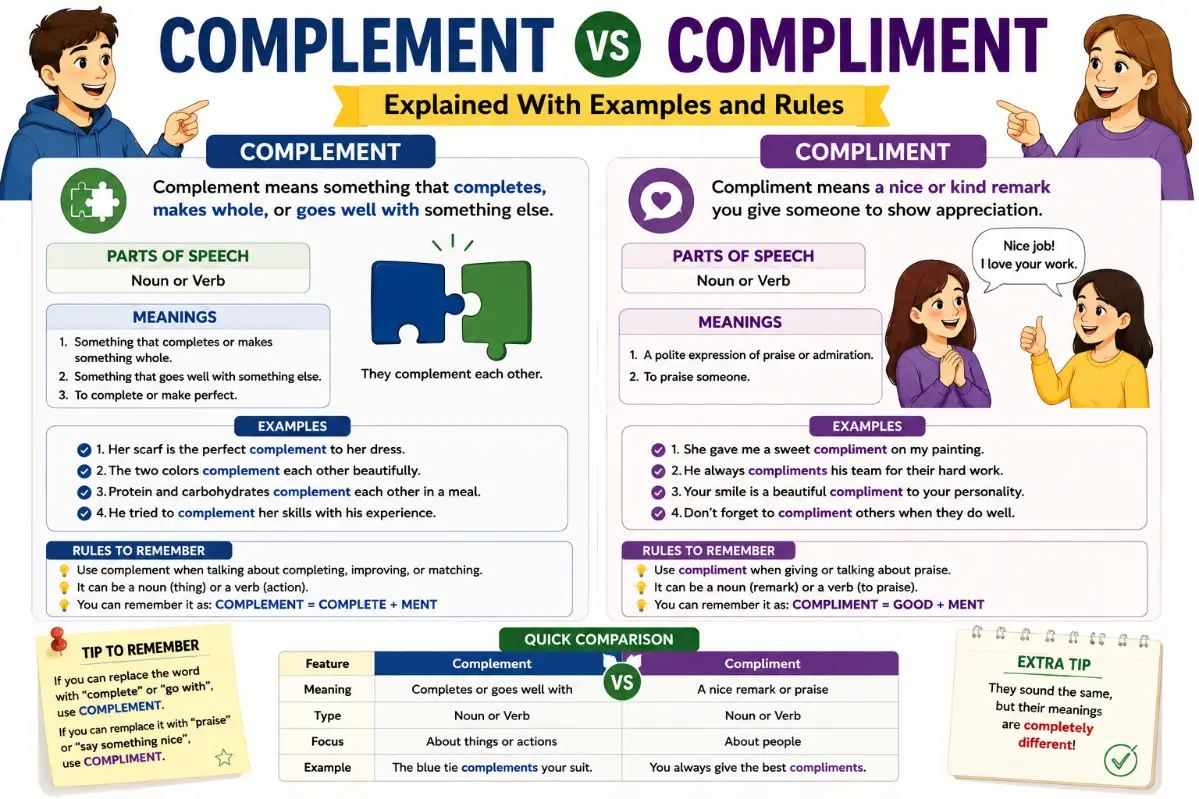
The difference between complement vs compliment can be easy to miss. Both words sound alike in American English, and their spellings differ by just one letter. However, they don’t mean the same thing. A compliment is a kind remark or expression of praise. A complement is something that completes, improves, or goes well with something else.
For example, telling your coworker that they gave a great presentation is a compliment. Saying that their clear slides complemented their presentation means the slides helped make the presentation better.
The good news is that you don’t need to memorize a long grammar rule to get these words right. Once you understand the main idea behind each word, the difference becomes much easier to remember. You’ll also learn how to use both terms in sentences, recognize common mistakes, understand their pronunciation, and choose the right form for emails, school assignments, business writing, and everyday conversation.
Learn the difference in Council vs Counsel Which Word Should You Use.
Short Answer
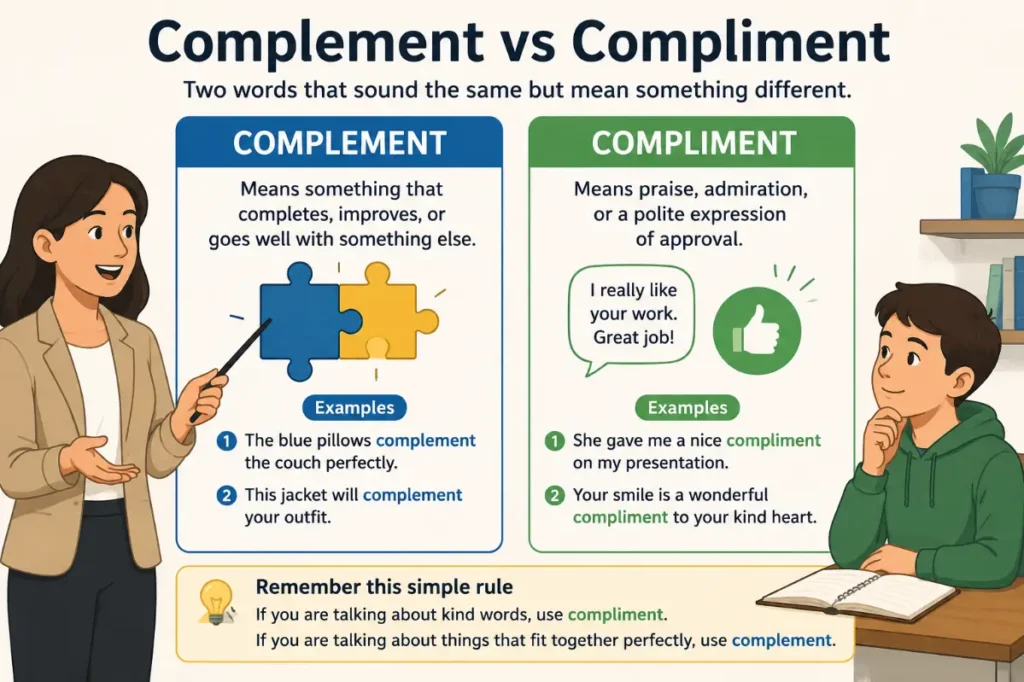
A compliment means an expression of praise or admiration. A complement means something that completes, enhances, or matches another thing. Both words are correct, and both sound alike in standard American English, so you must use their meanings and sentence context to choose the right spelling.
Meaning of Each Word
What Does Compliment Mean
A compliment is a kind or positive remark that expresses admiration, approval, or appreciation. You can compliment someone’s appearance, work, behavior, skills, or achievements. The word can also function as a verb that describes the act of praising someone.
For example, you might tell a friend that you love their new haircut. You could also compliment an employee on the way they handled a difficult customer. In both cases, you’re saying something positive about a person or their actions.
The word often appears in social situations, workplace conversations, customer feedback, and personal messages. It can help build trust, show appreciation, and make people feel recognized.
Consider these examples.
- Your teacher complimented you on your excellent essay.
- She gave me a nice compliment about my presentation.
- The manager complimented the team on its hard work.
In each example, the word relates to praise or positive feedback.
What Does Complement Mean
A complement is something that completes another thing, adds to it, or makes it better by fitting well with it. The word can be a noun or a verb.
As a noun, it describes something that works well with another thing. For example, a blue tie might complement a gray suit because the colors look good together. A helpful introduction might complement a detailed report by giving readers the background they need.
As a verb, complement means to enhance or complete something through a suitable addition. You might say that fresh herbs complement a pasta dish because they improve its flavor.
Consider these examples.
- The white curtains complement the dark furniture.
- Her research complements the findings of the earlier study.
- The sauce is a perfect complement to the grilled chicken.
These examples focus on how things fit together or improve one another rather than on praise.
Comparison Table
| Feature | Compliment | Complement |
|---|---|---|
| Main meaning | Praise or admiration | Something that completes or enhances another thing |
| Part of speech | Noun and verb | Noun and verb |
| Noun example | She gave me a compliment. | The sauce is a complement to the meal. |
| Verb example | I complimented his work. | The colors complement each other. |
| Main purpose | Expresses approval or appreciation | Shows a useful match or addition |
| Common contexts | Social life, work, school, feedback | Design, food, grammar, science, business |
| Pronunciation | /ˈkɑmpləmənt/ | /ˈkɑmpləmənt/ |
| Formality | Standard in casual and formal writing | Standard in casual and formal writing |
| American usage | Correct | Correct |
| British usage | Correct | Correct |
The key difference is meaning rather than spelling, grammar, or pronunciation. Both words can function as nouns and verbs, and both work in formal and informal English. The surrounding words and the idea you’re trying to express determine the correct choice.
The Key Differences Explained
Spelling
The two words differ by one letter. Compliment contains an i after the initial letters, while complement contains an e in that position.
That small difference creates a meaningful distinction. The word with the i relates to praise. The word with the e relates to completion, improvement, or a suitable match.
Because the words sound alike, listening alone won’t help you choose the spelling. You need to consider what the sentence means.
Meaning
A compliment communicates something positive about a person or their work. It often recognizes a quality, effort, achievement, or personal choice.
A complement describes something that adds value to another thing or fits well with it. It doesn’t have to involve praise or a person at all.
For example, saying that a colleague did an excellent job is praise. Saying that the colleague’s skills complement your own means the two sets of skills work well together.
Grammar
Both words can serve as nouns and verbs, which adds another layer of confusion.
As a noun, a compliment is something a person gives or receives. As a verb, compliment describes the act of praising someone.
A complement can be a thing that completes or enhances something else. As a verb, complement describes how one thing completes, supports, or improves another.
Compare these sentence pairs.
- The coach complimented the player on her effort.
- The player’s speed complemented the team’s defensive strategy.
The first sentence describes praise. The second describes how two elements work together.
Pronunciation
In standard American English, the two words are homophones. That means they have the same pronunciation but different meanings and spellings.
This is why even fluent English speakers sometimes choose the wrong form while typing. The words sound identical in ordinary speech, so spelling depends on understanding the message.
Formality
Neither word is more formal or more correct than the other. Both are standard English words used in everyday conversation, business communication, academic writing, and professional documents.
The right choice depends on meaning. Using the praise related word to describe a matching color scheme would be a mistake, just as using the completion related word to describe a kind remark would be incorrect.
Context and Regional Usage
American, British, Canadian, and Australian English use both words with the same basic distinction. There is no major regional spelling difference that changes the rule.
You may encounter different styles of pronunciation across English speaking regions, but the two words generally remain identical in sound within the same accent. The meaning of the sentence still provides the clearest guide.
Which Form Is Correct
Both forms are correct. Neither is a misspelling, and neither is simply an alternative spelling of the other.
Use compliment when you mean praise, admiration, or a positive remark. Use complement when you mean something that completes, enhances, or matches another thing.
An easy way to check your choice is to replace the word with a simpler expression.
- If you can replace it with praise or kind remark, use compliment.
- If you can replace it with completes, improves, or goes well with, use complement.
For example, consider the sentence, The chef received a compliment from the customer. The word praise fits naturally, so the spelling is clear.
Now consider, The lemon dressing complements the fish. The dressing enhances the dish, so the second spelling is correct.
This meaning based approach works better than relying on how the words look or sound.
Ten Natural Sentence Examples
The following examples show how to use both words naturally in everyday life, at work, in school, and in formal writing.
Examples Using Compliment
- Everyday conversation. Your new glasses look great on you.
- Text message. Thanks for the compliment about my presentation.
- Workplace communication. The supervisor complimented Maya on her attention to detail.
- School. My teacher gave me a compliment on my writing.
- Formal writing. The director complimented the staff for their dedication to the project.
Examples Using Complement
- Everyday conversation. Those shoes complement your outfit perfectly.
- Cooking. A little fresh basil complements the flavor of the tomato sauce.
- Academic writing. The new findings complement the results of the earlier experiment.
- Business communication. Her design skills complement his technical knowledge.
- News and journalism. The new community center will complement the public services already available in the neighborhood.
Notice how the meaning changes with the word. Praise is involved in the first five examples. The final five describe a good match, a useful addition, or an improvement.
Common Mistakes
These errors often happen because people rely on sound instead of meaning. The following examples show how to catch and correct them.
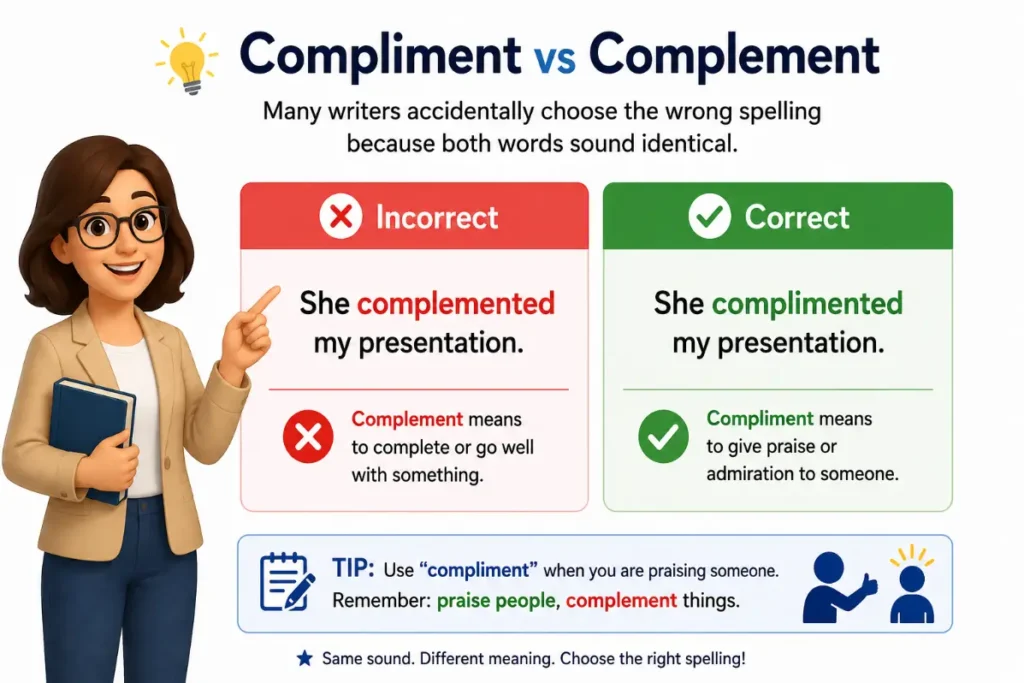
Using Compliment to Describe Matching Colors
Incorrect. The gold frame compliments the painting.
Correct. The gold frame complements the painting.
The sentence describes how the frame works with the painting. It doesn’t describe a spoken or written expression of praise.
Using Complement for a Kind Remark
Incorrect. She gave me a complement on my speech.
Correct. She gave me a compliment on my speech.
The person expressed approval of the speech, so the praise related word is the right choice.
Confusing the Noun and Verb Forms
Both words can function as nouns and verbs, so the sentence structure alone won’t always tell you which spelling to use.
Incorrect. He complement my work.
Correct. He complimented my work.
The corrected sentence uses the past tense of the verb meaning to praise.
Another correct example is, His experience complements my skills. Here, the verb describes how two things work well together.
Assuming One Word Is More Professional
Some writers avoid compliment in formal documents because they think it sounds casual. Others choose complement because it appears more technical.
Neither assumption is reliable. A formal performance review can include a compliment, and a casual conversation can describe how two things complement each other.
Choose the word that expresses the intended meaning. Formality doesn’t change the basic distinction.
Choosing the Spelling by Sound Alone
A voice typing tool may produce either word when you speak a sentence aloud. A spell checker may also accept both because both are correctly spelled words.
For example, a sentence about a colleague’s kindness needs compliment. A sentence about how that colleague’s abilities fit a team needs complement.
Read the sentence again and identify the relationship between the words. Are you describing praise or a useful match? That quick check usually resolves the confusion.
Pronunciation Guide
Both words are pronounced the same way in standard American English.
For another common grammar confusion, see Than vs Then: Learn the Difference and Use Each Correctly.
Compliment and Complement
American English pronunciation
Compliment
/ˈkɑmpləmənt/
Three syllables with stress on the first.
Complement
/ˈkɑmpləmənt/
Three syllables with stress on the first.
Syllable Breakdown
Both words have three syllables.
- Com.
- Pli.
- Ment.
The first syllable receives the strongest stress. The middle syllable sounds like a short, unstressed sound rather than a fully stressed vowel.
In American English, the first vowel often sounds like the vowel in cot, although the exact sound can vary by accent. The final syllable sounds like ment.
Common Pronunciation Mistakes
The main mistake is assuming that the different spellings must produce different sounds. In ordinary American speech, they don’t.
Some speakers may pronounce the vowels slightly differently because of their regional accent. However, you shouldn’t rely on pronunciation to distinguish the two words. Use the sentence’s meaning to determine the spelling.
Etymology and Word Origin
The histories of these words help explain their meanings. Both came into English through French and ultimately connect to Latin roots, but their histories developed along different paths.
The Origin of Compliment
Compliment entered English through French and is linked to Italian complimento. Its history connects to the Latin complere, meaning to fill up or complete, through later forms associated with expressions of courtesy and politeness.
Over time, the word developed its familiar modern meaning of a polite expression of praise or admiration. Today, it commonly describes a positive remark about someone’s appearance, work, ability, or behavior.
The historical connection to ideas of fulfillment and courtesy helps explain the word’s development, but modern writers should remember its current meaning rather than rely on its roots alone.
The Origin of Complement
Complement also traces back through French to Latin complere, meaning to fill up or complete.
Its modern meaning stays close to that idea. A complement fills a gap, adds something useful, or completes another thing in a particular setting. This meaning appears in ordinary language as well as technical fields such as mathematics, grammar, and science.
The shared Latin root helps explain why the words look and sound similar. Their modern meanings have developed into distinct uses, so their common ancestry doesn’t make them interchangeable.
Regional Usage
American English
Both words are standard in the United States. Americans use compliment for praise and complement for something that completes or enhances another thing.
In everyday conversation, you might hear, Your boss gave you a compliment. In a discussion about clothing or interior design, you might hear, Those colors complement each other.
American dictionaries recognize both spellings as separate words with different meanings.
British English
British English follows the same basic distinction. Compliment refers to praise, while complement describes completion, enhancement, or a good fit.
The words can appear in British business writing, education, conversation, and journalism without a change in their central meanings.
Australian English
Australian English also uses both forms in the same way. Writers choose the spelling according to the intended meaning rather than a special regional rule.
Canadian English
Canadian English follows the same distinction as American and British English. There is no meaningful national spelling difference between these two terms.
Across these English varieties, the central rule stays the same. Compliment expresses praise, and complement describes something that completes or enhances another thing.
Grammar Rules and Parts of Speech
Understanding how each word works in a sentence makes the distinction easier to apply. Both can function as nouns and verbs, but their grammatical patterns reflect their different meanings.
Compliment as a Noun
As a noun, compliment refers to an expression of praise or admiration. You can give a compliment, receive a compliment, or pay someone a compliment.
Common patterns include the following.
- Give someone a compliment. He gave his coworker a compliment about her presentation.
- Receive a compliment. I received a compliment from my teacher.
- Pay someone a compliment. She paid the chef a compliment after dinner.
The word can take an adjective that describes the kind of praise involved, such as a sincere compliment, a thoughtful compliment, or a generous compliment.
Compliment as a Verb
As a verb, compliment means to praise someone or something. It usually takes a direct object and may include a phrase explaining the reason for the praise.
For example, the manager complimented the employee on her patience. The teacher complimented the class for its effort.
The verb changes according to tense.
- Present. I compliment my teammates when they do good work.
- Past. I complimented my teammates after the game.
- Present participle. I am complimenting the team for its progress.
The past tense adds ed to the base form. The spelling of the root remains unchanged.
Complement as a Noun
As a noun, complement refers to something that completes or enhances another thing. It can describe an object, quality, person, ingredient, or element that fits well with something else.
Common patterns include the following.
- A complement to something. The short introduction is a useful complement to the report.
- A perfect complement. The fresh salad is a perfect complement to the main course.
- A natural complement. Her calm personality is a natural complement to his energetic style.
In technical English, the word has additional meanings. In grammar, a complement is a word or phrase that completes the meaning of another element in a sentence. For example, in She is a doctor, the phrase a doctor is a subject complement because it identifies the subject.
Complement as a Verb
As a verb, complement means to complete, enhance, or work well with something else.
It commonly takes a direct object.
- The curtains complement the furniture.
- The new course complements the existing training program.
- His practical experience complements her academic knowledge.
The verb also changes according to tense.
- Present. These colors complement each other.
- Past. The new program complemented our existing services.
- Present participle. The new program is complementing the work of the support team.
These patterns help distinguish the verb from its noun form, but the core meaning remains the same.
Grammar and Punctuation
Neither word requires special punctuation. Use ordinary sentence punctuation based on the structure of your writing.
You can also use both words in the same sentence when their meanings call for them.
For example, The designer received a compliment because her new color scheme complemented the room.
The first word describes praise. The second describes how the design improved the room. This sentence shows why the two spellings deserve careful attention.
Real Life Usage Examples
The best way to remember a word is to see how people use it in real situations. These examples show how the two terms fit into different types of writing.
Daily Conversation
In casual conversation, people often give compliments to show appreciation. They also use complement to describe things that go well together.
- My friend complimented me on the dinner I made.
- The spicy salsa complements the mild flavor of the tacos.
The first example describes a kind remark. The second describes how one flavor improves another.
Email and Workplace Communication
Workplace communication often involves praise, teamwork, and skills that support one another.
- I wanted to compliment you on the way you handled the client meeting.
- Your customer service experience complements the technical skills of the rest of the team.
The first sentence recognizes someone’s performance. The second explains how different strengths fit together.
Academic Writing
Academic writing uses both terms, although the second word can have a more specialized role in discussions of research and grammar.
- The professor complimented the student on the clarity of her argument.
- These results complement the evidence presented in the earlier study.
The second example is especially useful in research writing because it describes how separate findings contribute to a broader understanding.
News and Journalism
Journalists may use the first word when reporting praise and the second when describing how a new development adds to existing services or efforts.
- The mayor complimented local volunteers for their response to the storm.
- The new bus route will complement existing transportation services across the city.
Both examples use the words in a straightforward way. The context makes the meaning clear.
Literature and Storytelling
Writers can use compliments to develop relationships between characters. They can also use the other term to show how details, personalities, or events work together.
- She offered him a quiet compliment that made him smile.
- The peaceful setting complemented the character’s thoughtful mood.
The first sentence shows a character expressing admiration. The second describes how the setting supports the mood of the story.
Related and Confused Terms
Several English words describe praise, completion, similarity, or support. Understanding their differences can help you choose more precise language.
Praise
Praise means expressing approval or admiration. It is close in meaning to compliment, although praise can also describe broader recognition of someone’s actions or qualities.
Example. The coach praised the team for its determination.
Flattery
Flattery means praise that may be excessive, insincere, or intended to win favor. A compliment can be genuine, while flattery often suggests a hidden motive or exaggerated admiration.
Example. His constant flattery made the sales pitch feel less sincere.
Admiration
Admiration is a feeling of respect or approval for someone or something. A compliment is one way to express that feeling.
Example. She admired her mentor and often complimented his patience.
Appreciation
Appreciation means recognizing the value, effort, or importance of something. A compliment can express appreciation, but appreciation can also be shown through actions.
Example. The thank you note showed her appreciation for the extra help.
Enhance
Enhance means to improve or increase the quality, value, or appeal of something. It often describes what a complement does.
Example. Fresh flowers enhance the look of the dining room.
Complete
Complete means to finish something or make it whole. Complement can describe an element that helps achieve this result, although the two words don’t always mean the same thing.
Example. The final chapter completes the story.
Supplement
Supplement means to add something extra to improve or support what already exists. A supplement adds to something, while a complement often emphasizes a suitable fit or a contribution that makes the whole work better.
Example. The workbook supplements the lessons taught in class.
Counterpart
A counterpart is a person or thing that has a matching role or function in another place or system. Counterparts can work well together, but the word doesn’t automatically mean they improve or complete each other.
Example. The American manager spoke with her counterpart in London.
These related terms help explain the wider meaning of the two main words. However, they aren’t exact replacements in every sentence. Choose the expression that best matches the relationship you want to describe.
Expert Editor Insight
An experienced English editor looks at meaning before checking spelling. Since both forms are standard words and sound alike, a spell checker may accept either one even when the sentence calls for the other. Editors read the full sentence, identify the intended relationship, and check the word against that meaning. If the sentence describes praise, they choose compliment. If it describes how something completes or improves another thing, they choose complement. Reading the sentence aloud can help reveal awkward phrasing, but meaning remains the deciding factor.
Key Takeaways
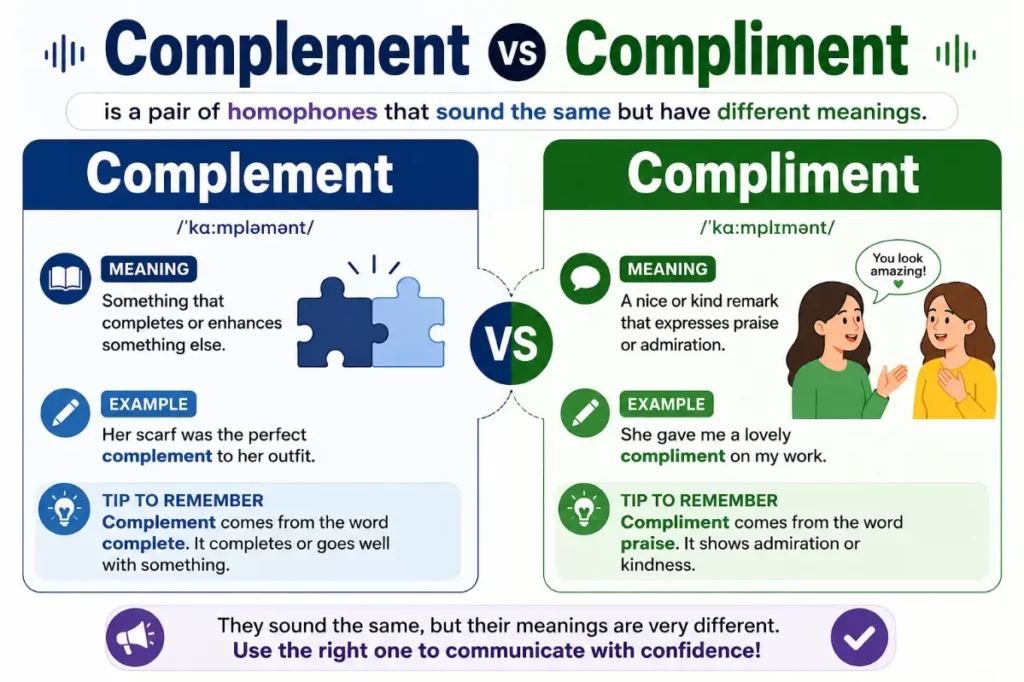
- Complement vs Compliment is a pair of homophones that sound the same but have different meanings.
- Complement means to complete, improve, balance, or match something.
- Compliment means praise, admiration, or kind words.
- Both words can function as nouns and verbs.
- Use complement for products, colors, food, skills, services, personalities, and anything that works well together.
- Use compliment when someone expresses appreciation, admiration, or respect.
- The easiest memory trick is that complement relates to complete, while compliment relates to I admire you.
- When in doubt, replace the word with match or complete for complement, and praise for compliment.
Learn the difference in Perspective or Prospective Which Word Is Correct.
Conclusion
The difference between compliment vs complement comes down to one simple idea. A compliment expresses praise, while a complement completes, enhances, or matches something else. Both words are correct, and both sound alike in standard American English, so you can’t rely on pronunciation alone.
When writing an email, finishing a school assignment, or editing a professional document, focus on the meaning of your sentence. If you’re talking about admiration, choose the spelling with an i. If you’re describing something that improves or completes another thing, choose the spelling with an e. Keep this simple memory trick in mind, and you’ll make the right choice with confidence.
FAQs
Is Compliment or Complement the Correct Spelling?
Both spellings are correct, but they have different meanings. Compliment refers to praise or a kind remark. Complement refers to something that completes, enhances, or works well with something else. Neither word is a misspelling of the other. Choose the form that matches your intended meaning rather than relying on its appearance or pronunciation.
What Does Compliment Mean?
A compliment is a positive remark that expresses admiration, approval, or appreciation. It can focus on a person’s appearance, behavior, skills, or achievements. The word also functions as a verb meaning to praise someone. For example, you might compliment a friend on a new haircut or compliment a coworker on a successful presentation.
What Does Complement Mean?
A complement is something that completes, improves, or fits well with another thing. The word can be a noun or a verb. For example, a side dish can complement a main course, and two coworkers with different strengths can complement each other. In grammar, a complement can also be a word or phrase that completes the meaning of another element.
How Do You Pronounce Both Words?
In standard American English, the two words sound alike. Both have three syllables and carry stress on the first syllable. Their pronunciation is represented by the IPA form /ˈkɑmpləmənt/. Because spoken English doesn’t usually distinguish them by sound, pay attention to the meaning of the sentence when deciding which spelling to write.
Can Compliment Start a Sentence?
Yes. You can begin a sentence with the noun or the verb. For example, Complimenting someone sincerely can brighten their day. You could also write, Compliment received with a smile, the student returned to her seat. The first example uses a verb form at the start, while the second uses a shortened introductory construction.
What Is a Synonym for Compliment?
Useful synonyms include praise, admiration, and commendation. The best choice depends on the context. Praise works in everyday conversation, while commendation often sounds more formal. Flattery can also involve praise, but it often suggests insincerity or an attempt to gain favor. These terms overlap in meaning, but they aren’t interchangeable in every sentence.
Why Do People Confuse These Two Words?
People confuse the spellings because the words sound alike and differ by only one letter. Both also function as nouns and verbs, which can make grammar an unreliable clue. In addition, spell checkers may accept both forms without recognizing the intended meaning. The easiest solution is to ask if the sentence describes praise or a useful match.
Is Compliment Appropriate in Formal Writing?
Yes. Compliment is standard in formal writing when the sentence describes praise or appreciation. You can use it in a performance review, a business email, a school report, or a professional letter. Complement is equally appropriate when describing how something completes or enhances another thing. Formality doesn’t determine the spelling. Meaning does.